
Monthly Archives: October 2007

Petroleum Market Mechanics

Krung Thep, Thailand. The center of mass of the petrochemical industry is slowly on the move.  Middle eastern petroleum states are in the process of building increased capacity in the Middle East (ME). A reported 2.3 million barrels per day (MMBpd) of ME petroleum refinery capacity is due to come on stream in 2011.  A total of 10 MMBpd increase in world capacity is expected by this time.

US refiners have limited their recent upgrades largely to desulfurization and sour grade processing rather than distillation capacity. A relatively minor 500,000 barrels per day of new US capacity over several sites will be available by 2009.

Approximately 3/4 of the total petroleum reserves are controlled by NOC‘s- National Oil Companies. This is a crucial distinction. Only 1/4 of the known reserves are controlled by international corporate entities (the Majors).  The major oil consuming states are increasingly dependent on foreign, nationalized petroleum suppliers.

NOC’s are used for more than just oil production and distribution. They are used as a cash reserve for patronage, political leverage, and even mischief.  These entities are intermeshed in the global market and provide varieties of risk that are hard for the marketplace to understand.

In particular, ethylene cracking capacity is expected to shift significantly towards the ME, providing advantages for regional production and distribution of polyolefins. Despite advantageous feedstock costs, overall manufacturing costs may not be as low as anticipated. The dramatically increasing cost of refinery construction and logistic issues unique to the location appear to provide a leveling effect on cost structure. It is thought that the EU will see the biggest effect of the ME buildup in capacity.

It is unclear how this refinery capacity uptick will effect liquid non-fuel commodity prices (i.e., chemical feedstocks).
A Week in Krung Thep

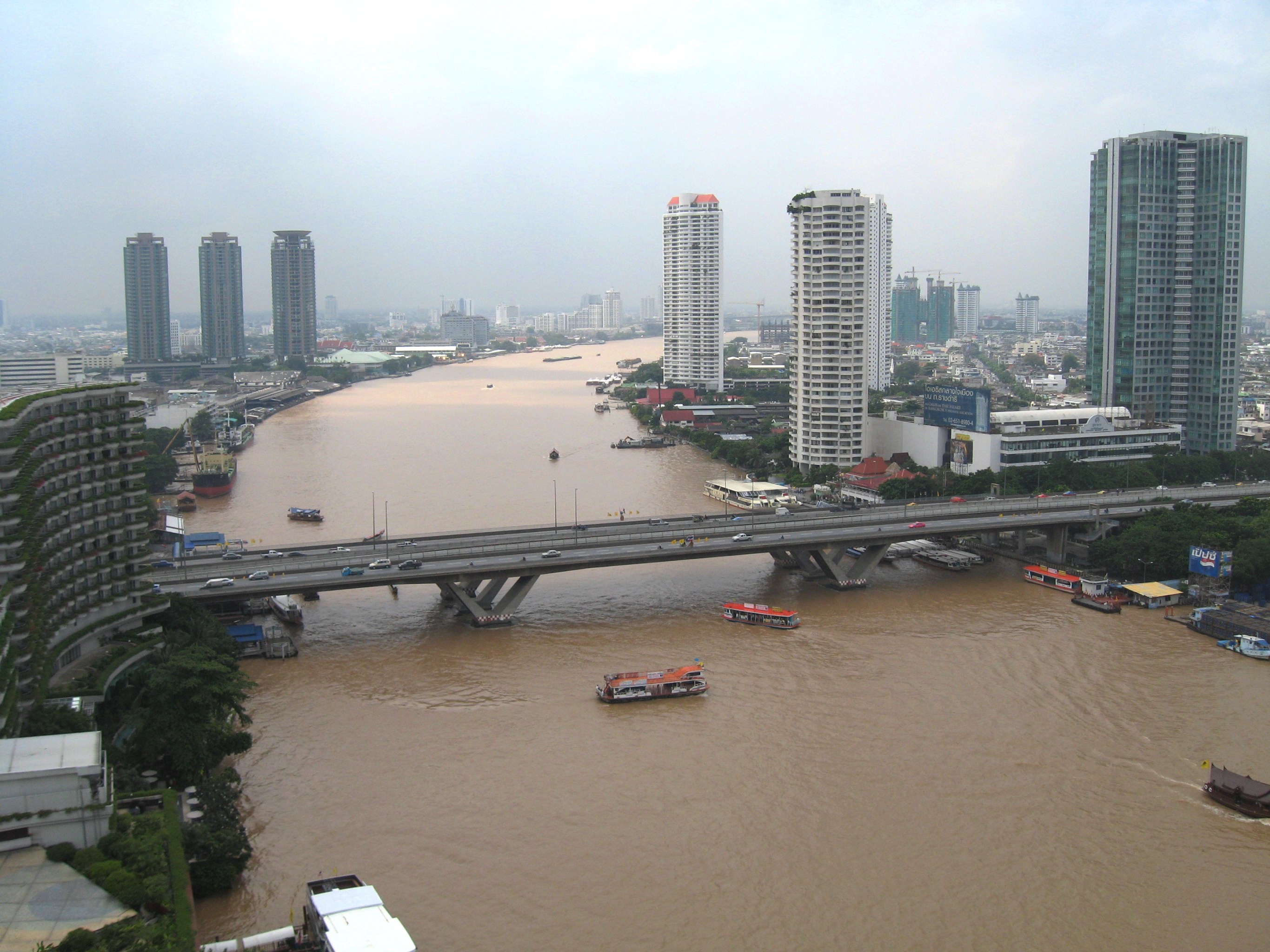
I startled to wakefulness by the sharp crack of nearby lightning. I had resolved to synch into the local time by remaining awake until evening, but failed shamefully. I stumbled to my feet and walked to the rain spattered window of my 21st floor room.  From this vantage I could study the cityscape of Krung Thep (Bangkok) and marvel at the activity on the muddy Chao Phraya river below. 

BKK

The television blares out that reassuring theme music of the BBC- the one with the swirling red pattern against the beeping time signal in the background. Despite all of my travel, it still boggles my mind how comfortable it is to go to distant places. You sit in an aluminum tube for a while, get out, and hop into a taxi.

The conference is in a 5-star luxury hotel, filled to the brim, it seems, with nattering western 60-somethings on holiday. Prosperous Europeans and North Americans out for a taste of exotic Siam. Nothing too strong mind you, just a taste.  The air-conditioned, hospital-clean hotel offers the one thing that you can’t get otherwise in Krung Thep- solitude.

A step into the streets of the city is, for this North American, a step into the heart of metropolitan Asia. It is monsoon season, so the air envelops you like a hot, wet sweater smelling of diesel and oily 2-stroke motor exhaust. Everyone is busy. Some are just moving from point A to B. Others are eyeing you from their narrow kiosks and calling out for your business.  Like the stationary bivalve that eats only when it can suck in some bystander, the kiosk proprietor has but 15 seconds to get catch your fancy before you leave the field of view. As a westerner, you resemble a big block of cheese and everyone wants a slice.

All of the motion, the incessant bartering and angling for prices is always a shock to Americans who are used to the economic firmament of price tags and the taboo of public bickering over prices.  Americans pride themselves on capitalism, but are reluctant to let it equilibrate to the microscopic level of one-on-one haggling with shopkeepers. Too untidy and confrontational. Americans would rather go to another store than attempt to haggle for a better price.  But this reluctance only serves to dilute the power of the consumer. This is a lesson we can take from Asia.

Far Side of the World

In chemistry, nothing is easy. Everything has failure modes. It’s possible to screw up when putting water in drums. My ham-fisted attempts at a new reaction pathway for a thorny, expensive process have thus far lead to naught. Nature has hidden some subtle requirements that are yet unknown to me. Application of known processes to new substrates may suffer failures that seem obvious afterwards, but are opaque going in.

I used to joke that if one in ten reactions lead to a good result I was doing well.  It’s not always that bad, but you can have stretches where the most reasonable transformations fail in one way or other. Unfortunate side products, poor yields, wrong selectivity, yada, yada, yada. Try doing the last experiment first, they say.

Th’ Gaussling is off to the far side of the world next week for a conference. A week in Bangkok will offer some needed punctuated disequilibrium.  The down side- 20 hours of confinement in an aluminum tube with wheezing strangers. I would prefer to be sedated and put in a box for transport than sit in an airline seat for that long.

Unplanned Comedy

So, I was standing on a ladder in the basement late this afternoon, draining the water line to the sprinkler system from a valve high inside the basement wall. The lawn care guy was outside with a high pressure air line connected to the sprinkle system waiting for my signal to blow down the line.

Suddenly there was a surge of high pressure water spraying into my face and down the wall of the basement. I started screaming “Stop! Stop the water!!”. Fumbling for the valve in the deluge of water I realized that the flow would only stop if I could screw the small brass cap back onto the valve. As I fumbled in the spray, the water flow tapered off giving way to air and finally stopped.

Drenched, I walked outside to find that the fellow felt bad, but was also laughing pretty hard. I started laughing too and we agreed that it was kinda funny. We got the job finished and went about our business.

October 10 Nobel Prize Announcement

Note added 10/10/07– Gerhard Ertl won the prize for his work relating to surface science.  Looks like there is no future for me in the prediction game. That’s why I’m not Th’ Oracle.

———————–

Any guesses as to who is going to win the Nobel Prize for Chemistry? I’m guessing Whitesides will be one of them. But, opinions are like noses- everyone has one. What do you think?

I mean, after all, he’s won everything else. Well, except for a slot on American Idol.

Publishing in Open Access Journals

In the course of searching chemical topics I keep running into the on-line publication Molecules, A Journal of Synthetic Organic Chemistry and Natural Product Chemistry.  This journal is part of MDPI, Molecular Diversity Preservation International, with an office in Basel, Switzerland.  MDPI is also dedicated to the “deposit and exchange of molecular and biomolecular samples”.

The idea behind this journal is to provide open access. The journal asserts that, with this approach, articles get substantially higher citation numbers. Open access is an alternative to paid subscriptions. In this model, the author pays the publication fee up front for peer reviewed editorial oversight and rapid publication.

This was covered by C&EN in the July 3 of 06 issue. It was stated in the article that Elsevier was planning to offer the same service for authors who wanted free access for a cool US$6,000 per article.  The Public Library of Science has a similar program, but with a more reasonable price structure.

What I find especially exciting about this publication mode is the MolBank service. Have you ever ended up with new compounds or data that was perhaps deserving of disclosure but not part of a body of work that would develop into paper?  Here is a blurb from the website-

Molbank (ISSN 1422-8599, CODEN: MOLBAI) publishes one-compound-per-paper short notes and communications on synthetic compounds and natural products. Solicited timely review articles will also be published. Molbank was published during 1997-2001 as MolBank section of Molecules (ISSN 1420-3049, CODEN: MOLEFW). Since 2002 it is published as a separate and independent journal. Molbank is a free online Open Access Journal. To be added to the subscriber’s mailing list, write your e-mail address into the “Publication Alert” box on the right side, and press the “Subscribe” button. Molbank is indexed and abstracted very rapidly by Chemical Abstracts.

Interestingly, this could be a possible venue for defensive disclosures in intellectual property. Hmmm … 

The question is, will paying-to-publish be cheaper than paying-to-subscribe? And, how will library administration have to change to accommodate this? 

But perhaps the bigger issue may be related to a certain snobismus that exists in regard to publishing. At some point, the rock stars of research (Whitesides, Trost, etc.) need to wave their hands over this mode of publishing and utter something like “verily, it is good” so the rest of the herd will thunder in that direction.

The writer of this blog has vented on this issue several times.  Putting public financed research results into free public access is the fair thing to do and should contribute to innovation and get new technologies into use at lower cost.  Turning over copyright of research papers to private third party groups only adds to the expense and complication to the use of this national treasure.

No doubt this will be vigorously opposed by the publishing establishment. The US$6000 fee charged by Elsevier is absurd and in reality is the beginning of the end of their publically financed milking of the R&D cash cow.

Halliburton and the Bush II Krewe

Anymore, criticizing the Bush administration is like having an unproductive cough- the stuff is so deep in there that you can’t hack up the obstructing mass. And so it is with the current president and appointees, who are insinuated into the deep recesses of power like a resistant strain of waxy mycobacterium. 

Serial government haters all, the Bush II krewe has privatized large chunks of gov’t service work and handed it on a no-bid platter to loyal backers like Halliburton who are largely registered in tax haven countries.

Unwilling to make the ultimate commitment to the USA (or wanting cover its tracks), Halliburton moved its headquarters to the United Arab Emirates. Presumably to take advantage of the tax-free business environment and the lack of a troublesome extradition treaty with the USA.  The status of Halliburton as a foreign contractor needs to be examined in public. 

Yes, this is old news, but Americans should not forget this outrage.  According to HalliburtonWatch, Cheney himself increased the number of foreign tax haven subsidiaries from 9 to 44 during his time there as CEO. 

There is nothing illegal about taking advantage of tax law.  But at some point a company has to decide what country they support and what side of history they want to be on. That which is possible is not necessarily manditory. When money is the only scorecard, ethics fly out the window. Stockholders bear as much responsibility for this craven behaviour as do the officers. [*crunching* noise as I step off the soapbox]

Halliburton became a successful company in part through it’s use of resources provided by the US taxpayer.  Halliburton used US government funded highways to get its goods and services moved around the US. Their security was provided by the Army, Navy, Air Force, and the Marines.  Halliburton staff and stockholders are protected from epidemic by the Centers for Disease Control. Sewage from Halliburton office buildings goes into local municipal  waste treatment plants. Physicians trained in publically subsidized medical institutions lance their boils and treat their childrens ear infections. The list of benefits from public infrastructure is substantial.

Now these greedy corporate ex-patriots want to shelter their earnings from tax liability. They don’t want to contribute to the upkeep of the very system that facilitated their ascent to wealth.

This entire thing is so dirty and so extensive, it will take a generation to understand it and legislate corrective action. The whole fetid, reeking mess is offensive.

Dawkins: Speaking the Ineffable

Warning!! The following text contains links and declarative statements that may cause chafing or philosophical infarct.

The Richard Dawkins BBC programs “The Root of All Evil, Part 1 and Part 2“, are quite worth the time to view. It will no doubt be uncomfortable for some. Dawkins is very much a promoter of reason and doesn’t restrain his blunt questions at all. 

What is interesting to witness is Dawkins’ genuine surprise when a few characters respond with an absolute and even threatening rebuff to his reasoning.  I think he truly expected to move these people to see his point of view by the force of reason.  In many ways, this program portrays a world very hostile to the analysis of belief.

The whole notion of belief as an inviolable, sacrosanct capsule of “vital essence” seems to be hardwired into our brains.  For many, the prospect of another person drilling into your personal theory of the universe (God or physics) is both profane and invasive.  Like most people, I am not keen on being “examined” like some analytical sample either. But in the end, a “theory of everything” that can’t survive scrutiny is not worth having.

Perhaps where Dawkins goes astray is at grasping the difference between being analytically correct and just being comfortable with an idea.  Few people have the overlap of both curiosity and the opportunity to cover some new ground in the scholarly examination of the Big Questions.  In fact, it seems that the methodical pursuit of novelty is not a universal trait in culture.  A great many people are perfectly happy to live and believe as the ancestors did. 

Dawkins is not shy about drilling into the bedrock of belief. I think between Dawkins, Harris, and Dennett, there is a growing realization that religion should be studied analytically as a natural phenomenon rather than exclusively as a subject of devotion. 

Communication Codewords

Within organizations there are always people who are very quick to demand better communication. When you hear them make this statement, you might understandably believe that they wanted more information out on the table for discussion. One could take this to mean that their intent was to come to a group concensus.  And, for some people this is the case.

But for others, the word “communication” is a kind of code word. It means something like this- “YOU need to disclose this information so I can make the call on what is going to happen”. It is about control, and in most organizations much of the day to day conflict that arises has to do with control over some kind of resource. It is the root cause of much bad behaviour by grownup persons who should know better. When you think about it, power is about the the ability to allocate resources.

Many people who bark about communication are vocal about receiving it, but are poor at reciprocating.  That is, they are an information black hole, or a kind of WOM-  Write Only Memory. Such folks are great at demanding information, but somehow can’t be as diligent about it themselves.

If you have a leadership role where these kind of conflicts are occuring, the best thing to do is to bring conflicting parties together and mediate or facilitate the communication between them.  If you are not in a leadershop role, the best thing to do is to be guilty of generosity with information.  Send information by email and save copies of the correspondence for CYA.

Enomagnetic Resonance

Nuclear Magnetic Resonance spectroscopists have finally crawled down off their crosses and condescended to the application of their technology to something really useful- the study of wine NMR spectra. If you believe the attached article, a restaurant in NJ has purchased an NMR spectrometer for the purpose of determining the quality of wine.  Evidently, the contents of a cork-sealed bottle can be examined by proton and 13C NMR.

Jeepers.  I wonder if it is hard to get boxed wines to spin inside the magnet? \;-)

One question. Does the rotating frame turn the opposite direction for Australian wines?