Category Archives: International Politics

Russian Economy & Military in Shambles Yet They Threaten Their NATO Neighbors

Estonia is in the news recently. The Baltic nation is preparing for a possible invasion by Putin’s Russia. The fact that Russia has taken more than 1.5 million casualties in its invasion of Ukraine with no sign of withdrawal or meaningful military improvement likely means that he is prepared to take more casualties.

In a speech, Putin stated that Russia has no interest in war with Europe. However, Putin warns of his concern about Russian speakers in Estonia, Latvia and Lithuania who he claims are oppressed. This transparent concern was used to justify the 2014 invasion of Ukraine. Hitler used it as well prior to his invasion of the Sudetenland. So Vlad, move the suffering Russian speakers back to Mother Russia. Easy peasy, right? God knows you’ve got plenty of real estate.

Despite Putin’s spiral diving military losses in Ukraine, Russia continues its hybrid hostilities in Eastern European, the Baltic and Scandinavian countries. Russian military tactics and its vast inventory of cold war surplus equipment has proven to be a paper tiger. It’s an open question as to the condition of his nuclear armaments that he rattles now and then. Nuclear weapons have a shelf life.

With all of the bullets and drones flying in Putin’s war, it’s a wonder that some projectile hasn’t found him. But then, evil men like Putin typically survive long enough to kill millions and trash their countries. It is a dark mark for humanity that the underlings of murderous dictators rarely summon the courage to assassinate these bastards.

Putin is upping the ante as he continues to menace the Baltic states and Poland. He is testing NATO to stress test their mutual defense pact. Will NATO really enter a shooting war with Russia if Estonia or Finland are invaded? Russia constantly probes the defenses of its neighbors with aircraft and and other underhanded incursions, just as they routinely did during the cold war. Russia is disadvantaged in the sense that it’s direct access to warm open ocean ports for commerce is hampered by geography. Sea access and ocean access are not equivalent.

There is zero indication that the Russian people will ever rise up to dethrone Putin. The Russian people have been cowed into passivity under threat of imprisonment in the gulags since before Stalin’s brutal rule. Even the faintest suggestion of a revolutionary movement in Russia is genuinely dangerous. Putin will fall over dead in office. [Note to self: remember to build a brutal state security organ like the KGB/FSB with remote concentration camps for forced labor of prisoners when I overthrow a country]

What will Putin’s successor be like? Would they step into the pre-fabricated mafia structure built by Putin? The problem is that Putin’s rule is a personality-based mafia organization which relies on his demand of a cut of the profits from his oligarchs, some say 50 %, against the assurance of prison or defenestration to leverage payments. Transfer to the next leader will be in contention. Russia is firmly built around bribery, kickbacks and favoritism. A conversion to a capitalistic democracy as fantasized in the west would take decades if ever.

Putin himself is only part of the problem of succession. Without a doubt, the Federal Security Service, or FSB, will require approval in any transfer of power. Russia’s military is a constant concern to the FSB. They will require a big part in any power transfer. The gamesmanship will be epic.

The Unseen Lever

1.1       Consider the stick.

Without a doubt, shortly after the first early human picked up a stick, the value of leveraging, nudging or hitting has been appreciated.ย  In the hands of a sentient being, most advantageously one with an opposable thumb, a stick or tree branch can be brought down on the skull of an animal or foe to provide food or protection. A sharp stick is just one jab away from being a spear. It can be used to poke and prod campfires and dig for roots or burrowing animals. Not all uses of a stick are in the realm of hunting or combat.

With the barest minimum of manipulation, the end of a stick can be wedged under a heavy object. With upward force on the other end of the stick, the object may be moved. By bringing the middle part of the stick down on a fulcrum, further downward motion may be used to raise the object.

A stick contains in its structure the means for which mechanical advantage of leverage may be taken. What is missing is only the motivation to do so.

1.2       Tools

The advance of human civilization is substantially the story of mankind’s ability to master the material world around them. The development of agriculture and the domestication of animals allowed for permanent settlements and away from the nomadic life.ย  The development of settlements led to the beginning of specialty occupations by people and food surplus. Food surplus allowed for time and resources for specialists to develop tools to increase labor efficiency.

Many tools have the elements of simple machines[1]. Simple machines are devices used singly or in combination to turn one kind of motion into another. For example, a screw converts rotational motion into translational motion. A wedge turns translational motion into diverging motion on an object as with the splitting of wood. A shovel uses the spade of the shovel as a wedge and the handle as a lever to raise soil from the ground. Likewise with an adze or hoe.

More important than motion conversion is the matter of mechanical advantage. Force can be amplified by the use of one or more machine elements.

In the world of bulk matter, material objects are subject to alteration by nature or by human engineering. Rock at the surface of the earth is prone to chemical weathering and mechanical attrition by the forces of nature.  In the hands of engineers, rock may be fractured, cut, or milled into desired shapes.  Some kinds of rock are easier to work than others. Limestone or sandstone, by virtue of their cementitious nature, is easier to hammer or chisel into desirable shapes than many harder igneous or metamorphic forms of rock.

Throughout recorded history and by observation of archeological evidence dated well before recorded history began, humans have been exploiting material objects around them. This advantage taken of materials has involved physical and chemical alteration.ย 

1.3       Energy

Living organisms have been external exploiting energy from the very beginning of life. The second-by-second machination of life requires that molecular mechanisms be in place to assemble or disassemble molecules. This is done by making and breaking chemical bonds. Forming a chemical bond- the arrangement of charges by which molecules are held together- commonly releases energy into the surroundings. This is called exothermicity. The opposite process, breaking a chemical bond, commonly absorbs energy from the surrounding environment. This is called endothermicity.

Mankind has been exploiting energy from the earliest times simply by eating food and using the derived energy to hunt, gather, farm, reproduce, and make fire. Food energy is capable of some very dramatic things. Before steam power, food energy used by animals or humans along with the clever use of elementary machines built the pyramids of Egypt and Meso-America. Food energy powered the construction of Stonehenge, the Great Wall of China, Rome and architecture all over the world.

Food energy had its limits, however. For humans, food energy could not light up the darkness of night, make steam, smelt iron or calcine clay into pottery.

Fire is an energy releasing phenomenon that has long been exploited by nature in the form of forest and prairie fires. Although initially highly destructive, fires are useful for the rapid recycling of life giving minerals back to the soil. The loss of prairie grass or forest canopy by fire provides opportunity for new and diverse species to invade and thrive.   

Fire in the hands of early human beings allowed them to stay warm and see in the dark of night. Fire allowed early humans to handle and direct a large magnitude of concentrated energy. But unlike the kinetic energy of a swinging hammer or a sharp axe, fire gave man thermal energy. Thermal or heat energy from fire was fundamentally different in its utility to mankind.

A knife or a hammer could cut or smash matter and a lever could move it. A sharp axe could fell a tree or an enemy. But fire, like the metabolism of food, could change the fundamental nature of materials. Fire gave mankind the ability to advance from altering the shape or size of a material to changing its composition. Foods could be made more palatable by cooking. Clay could be fired to yield stronger and more durable objects. Eventually, humans would discover that fire could be used to reduce metal ores to purified metal. From the hearths of industrious people came the bronze and iron ages.

On the darker side villages could be burnt to the ground and witches could be dispatched by burning at the stake. Bronze and iron would find use in armaments. With benefits come inevitable hazards.

1.4 Mechanization

One particular metric of mankindโ€™s progress over the millennia has been the mechanization of our use of tools. Tools of the past were made of stone, wood or metal and were operated by the input of muscle energy.ย  Tools are contrivances that enhance the userโ€™s ability to apply force to objects in order to do something useful.ย  A rock can be lifted to store potential energy and then be brought down on a prey animal for a kinetic kill or to expose the brain or bone marrow for rich nutrients. The bow or atlatl was used to accelerate flesh penetrating kinetic energy weapons in hunting or in battle. Some early weapons allowed for the storage of potential energy for release at the command of the user. The bow or catapult are examples of devices that allowed for the accumulation and short term storage of potential energy.

Over time, the screw, the lever & fulcrum, the pulley, numerous gearing mechanisms, the water wheel, the wagon wheel, springs, grinding wheels, and other devices were developed to store or aid in the application of force to a work piece or material. 

Until the invention of gunpowder, the application of energy was largely in the form of fire or through the agency of an axe, bow, hammer or spear.ย  Fire could be used to heat, melt, calcine, or cook materials in a reliable way. Fire was a phenomenon that could be used to apply intense thermal energy to objects. Fire was an early chemical tool.

The advance of technology is often the concentration or intensification of force. The spear or the arrow are tools that concentrate force by providing a cutting edge with a relatively small surface area.

1.5 AI

The invention of the transistor has evolved to into complex semiconductor devices converting computers from mere word processing engines to devices that can simulate human analysis and cognition. Presently, we are only part way through this step change. Just like the invention of the bow and arrow, the spear and gunpowder allows humans to apply lethal force at a distance, what will artificially intelligent (AI) machines allow us to do from a safe distance? Within 50 years or so of the discovery of compositions capable of deflagration i.e., what we now call gunpowder, it was weaponized for the purposes of war. We see the latest step change now with autonomous “smart” weapons like drones and robots in the Putin-Ukraine war. Can we resist the temptation to use AI not for more efficient inhumanity but for the betterment of mankind? I wish I could be more positive, but restraint seems unlikely.


[1] Simple machines have been listed as the lever, wheel and axel, pulley, inclined plane, wedge, and the screw.
Putin’s Client State Belarus Preparing for ‘Defensive War’

Putin has been preparing Belarus for war with Ukraine for at least several years. According to one source, Belarus is being prepared as a staging ground and military hub for Russia. Along the Belarus border with Ukraine, roads and artillery positions are being built.

Belarus is thought to have as many as 50 to 60 thousand troops, though none are combat hardened. The Belarusian military is participating in extensive joint nuclear warfare exercises with Russian forces, testing the readiness of strategic deterrents and tactical nuclear systems.

Belarusian president Lukashenko claims not to want war but warns it is prepared to defend its sovereignty. Whether or not Belarusian troops actively engage Ukrainian forces in combat or simply provide help to Russian forces by way of assistance along the border with war materiel is unclear.

As a client state of Russia, the question of Belarusian sovereignty seems a bit shallow given its heavy reliance on Russia for armaments and political support of the Lukashenko regime. Lukashenko finds himself between NATO and Putin- not a happy place. What Putin forces Belarus to do remains to be seen.

The Suwaล‚ki corridor connects the Russian Kaliningrad Oblast on the Baltic to Belarus along the Polish-Lithuanian border. If fighting begins in earnest along the Belarus-Ukraine border, the inherent westward advance of hostilities will threaten Poland and Lithuania as well as call into question Russia’s intentions in regard to its access to Kaliningrad.

It’s worth remembering that Russia’s nuclear doctrine has long held that it does not recognize a firebreak between conventional and nuclear war as does the West. This is baked-in uncertainty for NATO in it’s approach to Russian response to the conduct of war.

One thing is certain, Putin intends on diluting Ukraine’s force posture along it’s eastern and southern fronts by ramping up hostilities from the Belarusian border. Reportedly, Russian electronic warfare sites have been placed on civilian residential buildings in the hope of using civilians as human shields.

Billions of bullets flying through the air in Putin’s dirty little “special military operation” but not a single one has found him. Isn’t that the way it always goes?

Uncle Joe is Watching From Beyond the Grave

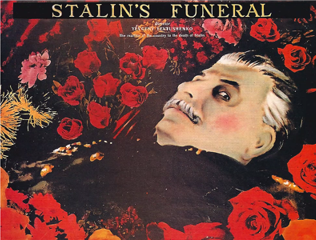
I ran into this image today from the online class I’m taking. I suspect Uncle Joe may have been reincarnated and his shadow darkens the Kremlin floors even today.

Question: How do you transition from a Stalinist dictatorship to something less terrible and maybe even faintly democratic? It’s still an open question.

Source: Movie poster of Stalin’s Funeral by Yevgeni Yevtushenko. I’d have been tempted to poke the body with a stick to make sure he was dead.

Nikita Krushchev led de-Stalinization after Stalin died but was soon replaced by Leonid Brezhnev. It is said that not much of interest happened during the Brezhnev years other than keeping up with the cold war.

Big changes finally began with Mikhail Gorbachev and his glasnost and perestroika, but the USSR imploded before he was finished. The Kremlin couldn’t make the centralized economy work as desired, so they shut off the lights and went home. Boris Yeltsin was the first popularly elected and reelected President of Russia from 1991 to 1999 but his tenure was checkered with successes and failures. His hand picked successor was Vladimir Putin who was later elected President. The merits of that choice is apparent in the news today.

An even better question: how does a country whose skids were greased with bribery, had zero history of democratic anything or a market economy and little if any market-related institutions make the transition? Yeah, it’s a hard problem. The Soviet security apparatus didn’t fully collapse and survives to this day, frightening as ever.

There was an old joke- the KGB headquarters in Moscow went up 7 floors and down all the way to Siberia. The gulags were substantially emptied of millions of laborers after Krushchev’s elevation, but many of the camps were retained.

Eastern European History

In an effort to understand just what the hell is the deal with Russia, I enrolled in a university extension school spring semester course to study Eastern European history as it relates to capitalism and communism. It concerns the interwar period between WWI and WWII and why Eastern Europe adopted Soviet-style communism. Being from central USA, I’m familiar with much of the two world wars but only to the extent focused on histories written from the western allies’ viewpoint. This is the normal condition for most Americans.

Western European history, arbitrarily dating back to the Romans, is highly complex in the sense that the entire western Eurasian land mass has been repeatedly settled, conquered, and partitioned into empires, kingdoms, and duchies. The inevitable intermingling of cultures, languages, trade, and military might has combined to paint the map of today. Coastal nations had the advantage of access to fisheries and trade across long distances. On the downside, however, coasts were subject to easy invasion and wars of conquest.

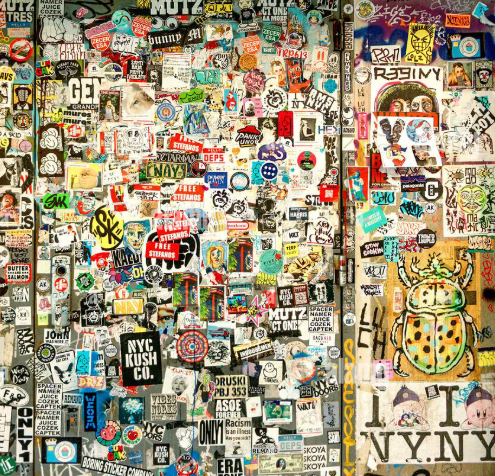
This wall is covered and overprinted with diverse messages. So too is the Eurasian landmass overprinted with fragmented, missing and overlapping cultural and political domains over the last several millennia.

Much of Eastern Europe retains a strong Slavic ethnic identity. Along with the Roman Catholic Church, the Eastern Orthodox Church still holds a strong position in many regions, including Russia. Putin even has the cooperation of the Eastern Orthodox Church in his effort to promote his agenda and propaganda at all levels in Russia.

In addition to Slavic and other ethnic identities, Eastern Europe and Russia have been isolated from much of the world by distance, economics, and the high level of modernism that Western Europe embraced. Tsar Peter the Great was aware of the more advanced nature of Western Europe and spent time there in order to gather ideas for modernizing Russia, particularly in the area of naval ships.

The landlocked or nearly landlocked nations of Eastern Europe lacked ice-free, warm water ports, not just limiting trade and shipbuilding but also economic exchange with more distant parts of the world. The Netherlands, Belgium, France, Germany, England, Rome, Portugal, and Spain in particular, established distant colonies and trade, generating wealth and power. With wealth, a kingdom acquires military strength and the ability to project power and conquest in resource-rich territories within just months or weeks of sailing time.

Conquest and the material wealth it brought was critical not only for an empire or monarchy to maintain or expand its holdings but also for self-defense from marauding armies looking for their own conquest. The various kingdoms, duchies, and empires were not entirely independent entities. The custom of the royal families to intermarry across empires and kingdoms assured continuity of the ruling families and wealth in the royal houses. This familial connection led to many alliances and specific choices in dividing up land.

The question of “what’s the deal with Russia” is about how it came to be that Russia is remote and standoffish to the point of being endlessly hostile and paranoid about the West. To American eyes like mine, the attitude Russia has about the West is peculiar and originates from … what? Even if Russia did not suffer overland invasions by Napoleon and Hitler, would they be any less paranoid? They would have less historical invasion baggage to drag along in some ways, but would other tragedies have befallen them? Impossible to say. It is fair to say that the Bolsheviks were keen on global-scale revolution and widespread implementation of Soviet socialism. They were not without imperialistic enthusiasm themselves.

President Putin continues to press the rhetorical but incendive argument about how the West is desirous of their resources. It is pitched as a clear and present danger to Russia. The West, he intimates, is crawling with greedy and perverted imperialists who want nothing more than to steal Mother Russia’s oil & gas, minerals, uranium, and timber. Any leader in any country could get mileage from this argument, and Vladdy-buck is pumping this handle with gusto.

The main thesis of my history class is that had Hitler not invaded the Soviet Union, the spread of Soviet conquest to its western frontier would not have happened. I’ll write more as this topic unfolds in class.

Dear World …

As an American I want to express my dismay and humiliation at the malignant behavior of the maniac that many, but not a majority of, US voters elected as our president … twice. The words idiot or narcissist fail to capture the magnitude of Trump’s deviant personality. I’m at a loss for a strong enough description of this American bad guy.

It’s bad enough that the USA has to put up with him, he is now taking his diseased fantasy show on the road. The attack on Venezuela and apprehension of the Venezuelan president has rattled cages around the world. Worse yet, he said that America will “run Venezuela for a while.” The noises emanating from his cake hole also suggest that Venezuelan crude oil is on his mind as well. After all, Venezuela has the largest oil reserves in the world. Does he think that American oil company giants will immediately “drill baby drill” and be forever grateful to him?

Does the Trump administration fantasize about placing a democratic republic in place after Maduro? Just like we did in Afghanistan, Iraq, Libya or Viet Nam?

The US snatch & grab of Maduro from his home in Caracas was technically well-executed but strategically very dangerous and diplomatically naive. One can imagine Chinese military planners moving up the date of their invasion of Taiwan now that international norms have ratcheted down a few clicks.

Pro-Trump media in the US are portraying this Venezuelan expedition as a phenomenal success and cause for patriotic chest thumping. There isn’t anyone stating in public that Maduro is a misunderstood saint. He is was a bad actor and should have been toppled years ago. Few are shedding tears.

The drug running crimes of Venezuela’s cartels include cocaine, but not fentanyl according to knowledgeable people. Worse yet, many are saying that the Venezuelan “drug boat” interdictions conducted by the US Navy were primarily of deliveries to Europe. Not that that is acceptable but victories for the America drug war they are not.

The big problem is the unilateral obliteration of another nation’s sovereignty and disregard for rules-based conduct of the USA. Has the Trump administration thoughtfully considered what unanticipated consequences may hatch out of this offense against international norms and the United Nations?

One of the more intriguing ideas is that the next “expedition” might be Cuba which is closely tied to Venezuela. Venezuela supplies oil to Cuba and they provide health care professionals in return. Being a client state of the Soviet Union in the 1960s, Cuba has been a strategic thorn in the side of the USA since the early Fidel Castro days and a locus of embarrassment in foreign US policy. The US Secretary of State and former Florida senator Marco Rubio is of Cuban descent and is known to harbor ill will towards the Cuban government. But, as always, predicting the future is iffy.

Along with the restructuring of global political power is the momentum to remove the US dollar by the BRICS states from the dollar’s dominance in international finance. American global financial dominance and “political stability” is connected to foreign investment in the dollar which sustains American debt and deficit spending.

There is speculation floating around that Putin wants Russia to be the hegemon of the former Soviet states along with Europe. He believes it to be Russia’s destiny, and he will be the emperor who brings it in. Some reckon that he’ll be fine with the USA dominating the western hemisphere. America and Russia with their own spheres of influence.

The very idea that an American president would collude or at least fly in formation with Putin to divide up the world into an American western hemisphere empire and a Russian/European empire as some are suggesting is beyond my comprehension. Trump’s earlier speculation regarding the annexation of Canada and Greenland into the United States seemed odd in isolation, however in the bigger picture of the USA as hegemon of the Americas puts a bit of context to it.

How US strikes in Nigeria will play out in the near term is a mystery. Given that the reason for the strike was that Nigerian Christians were under attack, where will American Christian Nationalists, whom I will assume were behind the strike, drive this conflict next?

Okay, so this is somewhere between wild-assed speculation and Political Science 202. The game of political rugby is in motion and God help us all.

Good Lord, It’s The Greenland Thing Again.

The Fearless Overlord of the American Oligarchy, DJT, has resurfaced the Greenland question again. Louisiana’s Republican governor Jeff Landry has been anointed by Trump to a volunteer position as Special Envoy to Greenland. This move was promptly condemned by both the EU President and Denmark, unsurprisingly.

Resembling the many tragic leaders in history, Trump keeps nattering on about the need to annex Greenland for national security. The claim of national security is a kind of universal excuse that is solemnly expressed but rarely explained. We understand that an explanation might reveal the poker hand we are playing- We get it. But like a when a hammer looks around and sees only nails, what does a property developer see when he pans his orange face across a large, underdeveloped island? Bingo!!

We shouldn’t forget that Trump has been in the business of selling his name as a brand for a long time. He knows the value of an attractive brand and is not the least bit shy about plastering his family name as far and wide as possible. Look at the recently renamed “Trump Kennedy” Center in DC where he is the CEO. His coterie of sycophants are constantly trying to outdo each other with ever increasing levels of ass-kissing. Whatever shame there might have been in self-promotion is long gone.

The thing is that when a businessman who was in the business of promoting his brand begins to label government property with that brand, isn’t that a conflict of interest? His escape must be that others are slapping the brand on buildings, not him. There isn’t a single milligram of shame in him that would request that such naming happen only after he passes.

An interesting thing is that while the Trump administration is officially contemptuous of global climate change, a particular result of climate change must come about. In order to extract mineral wealth from below the ice –whatever that might be– global warming will be needed to melt the Greenland ice cap to expose that mineral wealth.

However, the motivation goes far beyond minerals. Access to the Arctic Ocean and whatever crude oil that may be pumped out from below the ocean floor is up for grabs. A US shoreline on the Arctic Ocean supports arctic military access as well as access to the new Northwest Passage that is opening up to commerce.

A surprise to precisely no one, annexing Greenland is about a new phase of American hegemony and extending the reach of military power. Perhaps Greenland is the new Manifest Destiny in the eyes of the rancid White House clique running American government just now.

I previously mentioned American hegemony. The USA has been a leading world power since the conclusion of WWII. There are presently two other powers who desire this status and are happy to help the USA to topple over as hegemon. The post WWII track record of the American hegemon is spotty at best and since the election of Trump, has begun an abrupt nosedive.

Trump’s slogan “America First” is catchy and patriotic-sounding and appeals to us as citizens of an isolated country bounded by two expansive oceans. Unlike a great many other countries, the USA has a temperate climate, warm deepwater ports, and abundant fertile farmland, minerals and lumber. Importantly, the USA had a capitalistic economic establishment favoring industrialization as a mostly democratic republic. In combination, all of this allowed the USA to rapidly tool-up after Pearl Harbor and back its fighting forces with massive quantities of war materiel and enter WWII cocked and loaded for bear. Fascism was defeated in Europe and the Pacific, and we even helped our defeated enemies get back on their feet.

In my lifetime, I’ve heard many fellow citizens try to explain our victories in WWII as the result of some unique attribute of American clean living and superior moral fiber. Never mentioned are the countries who also had clean living and high moral fiber but were unable to summon the resources to assemble a powerful war machine. American successes in WWII greatly relied on abundant natural resources, an existing industrial base and oceans that prevented tanks and troops from marching across our borders.

Today, the tell-tale voices of fascism are surfacing around the USA. People who had previously voted republican and strutted around claiming to be patriotic citizens are now saying that maybe democracy doesn’t work and an authoritarian government is needed. Let Trump be Trump!

WWII veterans and their offspring have come, passed away or retired by now in 2025. They brought a kind of optimism and energy to the growth of the USA. Technological modernism was the answer to all the ills of society. What was needed was an electrified, push button life of convenience.

If you look deep enough into virtually any peacetime period of American history, you’ll find reports of conflict, malfeasance, criminality and a myriad of dirty political dealings for the time. This represents the true baseline, ground state of America. This is bumpy ground but normal. My point is that before we indulge in self-flagellation and unrealistic expectations of our society, we should have a good think about what “normal” is actually comprised of. The inability to deal with exponential growth, uncertainty and a bit of disorder only cripples us.

Where does Russia go next?

[Edited and Rewritten post.]

Many Western observers often imagine a future in which, after Putinโ€™s departure, Russia evolves into a more open and cooperative nation. Wouldnโ€™t it be appealing if Russia joined the global community of states that embrace free trade and safe tourism? This vision reflects our own ideals, making it easy to assume that Russia might share themโ€”but history suggests the reality may be far more complex.

A review of Russian history from Tsar Nicholas II to the present reveals a persistent pattern of authoritarian governance. Although Tsar Alexander II abolished serfdom in 1861 and introduced several liberal reforms, these changes faced strong resistance. Many reforms were ultimately reversed, as they diminished the power of the nobility, provoking significant opposition despite their positive perception in the West.

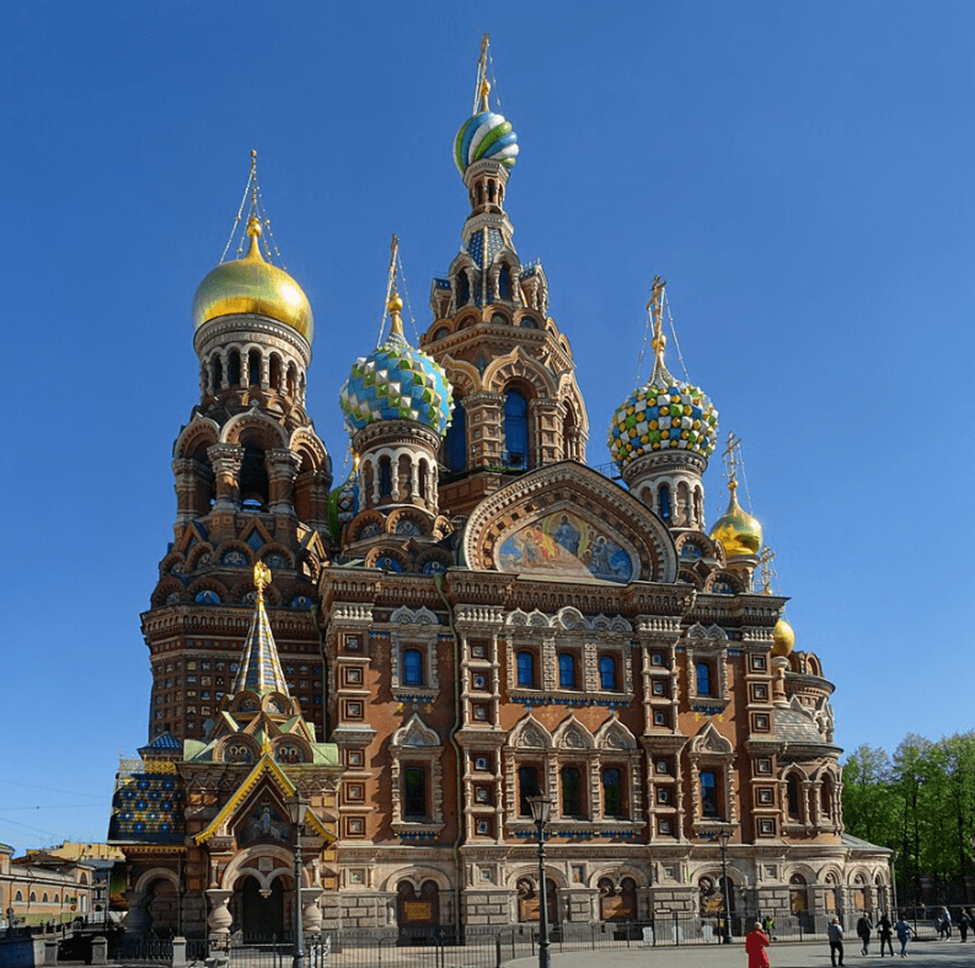
On March 31, 1881, Tsar Alexander II was assassinated in St Petersburg, Russia. His habit was to ride his carriage to a military roll call that day of the week. The route was along the Catherine Canal. An assassin threw a bomb under the horses and it exploded as the carriage rolled over it. The emperor’s carriage was bullet proof, a gift from Napolean III. Alexander exited the damaged carriage uninjured and paused to survey the scene. As he was doing this, a second assassin tossed another bomb at his feet which exploded, later killing him and killing and injuring many others in the vicinity. Afterwards a beautiful cathedral was built on this site called the Cathedral of the Savior on Blood.

Cathedral of the Savior on Blood. Included here only because it is a beautiful image. Image from Wikipedia.

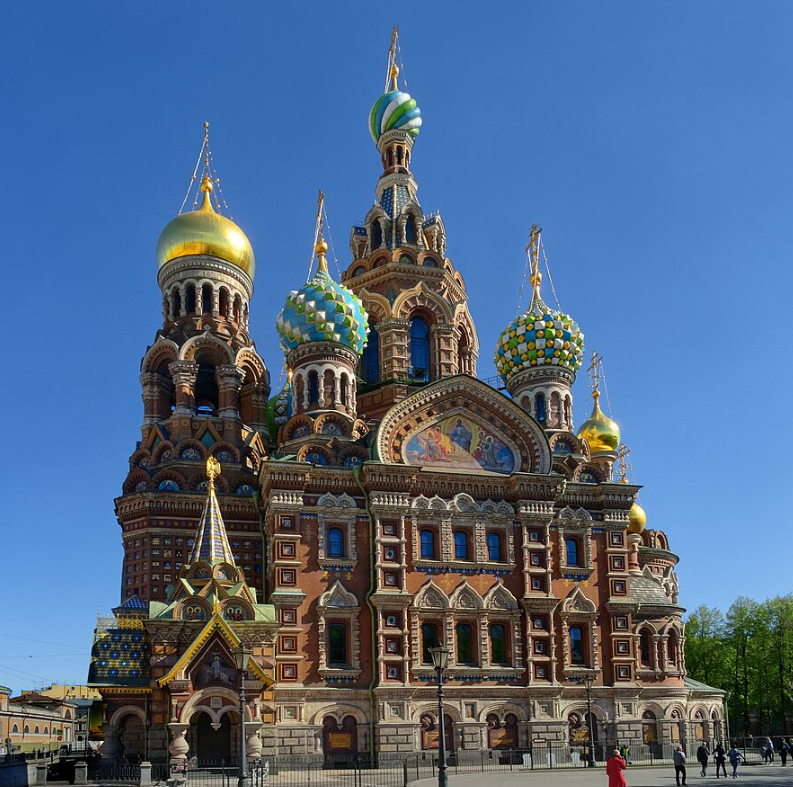
Cathedral of the Savior on Blood. Included here only because it is a beautiful image. Image from Wikipedia. I was awestruck when I visited.

If you end up in Saint Petersburg, which I whole heartedly recommend, this cathedral is well worth a visit. It’s newer and, in my opinion, perhaps even more beautiful than the famous Saint Basil’s Cathedral in Moscow along Red Square,

Following Tsar Nicholas IIโ€™s abdication in 1917, a provisional government briefly assumed power before being overthrown by the Bolsheviks during the October Revolution. The ensuing civil war ended with Bolshevik victory, elevating leaders such as Lenin, Trotsky, and Molotov. In November 1917, the Russian Socialist Federative Soviet Republic (RSFSR), the Russian Soviet State declared itself a sovereign state.

The revolution triggered widespread unrest, with numerous factions pursuing divergent objectives. The Bolsheviks relied on the Red Army, while the White Army comprised former imperial officers and Ukrainian anarchists opposed Bolshevik control as well. Additionally, thirteen foreign powersโ€”including Austria-Hungary, Germany, and the Ottoman Empireโ€”intervened against the Bolsheviks.

In 1922, the Russian Socialist Federative Soviet Republic ratified a constitution and formally established the Union of Soviet Socialist Republics (USSR), written in Cyrillic as CCCP.

Amid the turmoil of the Bolshevik Revolution, Russia ceded territories previously seized by Germany during World War I. The collapse of the Russian Empire sparked a protracted struggle among various ethnic groups and factions to reclaim land and assert authority. By 1923, the Russian Civil War had concluded.

Let me say that although the western block vigorously opposed the Soviet communism later in the Cold War, the break from monarchy by popular uprising to form the Federative Soviet Republic and later the Union of Soviet Socialist Republics was a remarkable achievement for that part of the world. To transition from a monarchy with serfdom to the USSR in ~60 years was a world-class achievement. The sad part was the rise of Stalinism and cementing in state authoritarianism as well as revolutionary expansion to global communism. Global socialism was an early goal of the Bolshevik leadership. Socialism was interpreted as a precursor to true communism.

So, why can’t they be like us? Because their history and cultural development never included exposure to free markets, private ownership, foreign travel and individual freedoms we in the west are accustomed to today. No Magna Carta setting limits on the power of the monarch and no parliament sharing power with the monarch. Russia did not participate in global travel as western European nations did which led to colonization and the extraction of wealth from their colonies producing gold, silver, spices, salt peter, slaves, etc. The wealth accumulation and theft of colonial resources set the pace for producing vibrant and wealthy countries in Europe, but not in many of the colonies. The American colonies are a famous exception.

Summary-

This summary only scratches the surface of the October Revolution and the subsequent civil war. For further detail, readers are encouraged to consult additional sources. The period was marked by extreme complexity and violence, resulting in an estimated 7โ€“12 million deaths.

Given this history of conflict, authoritarianism, and systemic repression, it is unsurprising that Russia continues to exhibit traits of a closed and deeply security-conscious state,

The Latest Crusades

You’ve probably heard that #47 has asked the Pentagon to be ready for action. According to an article in The Hill, President #47 has labeled Nigeria as a “Country of Particular Concern”, or CPC. This designation stems from news that Islamic terrorists are allegedly attacking Nigerian Christians. A group of approximately 30 American Christian religious leaders and a few politicians like Ted Cruz and Rep. Riley Moore (R-W.Va.) as well as the entertainers Nicki Minaj and Bill Maher have made a convincing enough case for the President to make the CPC declaration.

If you read H.R. 2431 (2018), you’ll find:

Title IV: Presidential Actions – Subtitle I: Targeted Responses to Violations of Religious Freedom Abroadย – Directs the President, for each foreign country in which the government engages in or tolerates violations of religious freedom (including particularly severe violations), to oppose such violations by taking certain actions and promoting the right to freedom of religion in that country. [emphasis mine]

(Sec. 405) Specifies among the actions the President may take: (1) public condemnation; (2) delay or cancellation of scientific and cultural exchanges; (3) withdrawal, limitation, or suspension of U.S. development assistance and U.S. security assistance; (4) instruction of U.S. executive directors of international financial institutions to vote against loans primarily benefiting the foreign government responsible for such violations; (5) restrictions on the issuance of licenses to export any goods or technology to such foreign government; (6) prohibition against the making, guaranteeing, or insuring of loans, or extension of credit by certain U.S. financial institutions to the violating government; and (7) prohibition of U.S. Government procurement of goods or services from such government. Provides for: (1) commensurate actions in substitution for any of the above presidential actions; and (2) binding agreements with foreign governments obliging them to cease, or take substantial steps to address and phase out, the acts, policies, or practices constituting violations of religious freedom.

(Sec. 407) Authorizes the President to waive the requirements of this Act if certain conditions are met.

My reading of Title IV of H.R. 2431 is that the President is compelled to take certain actions against Nigeria. While taking no action does not seem to be specifically barred, I didn’t see it listed as an option.

The potential threat by the President is in sending an expeditionary military force to Nigeria to stop the violence on Christians. According to Wikipedia, the population (2023) of Nigeria is estimated atย 236,747,130 people. Unless the terrorists are wearing military uniforms, how will our troops find them and what’s to prevent a guerrilla war with the terrorists gradually taking bites out of our soldiers as they did in Viet Nam, Iraq and Afghanistan? Guerilla warfare has time and again proven successful against superior military forces.

America does not need another distant land war … this time in west-central Africa with guerilla fighters in the jungle. Peace through superior firepower only works if you can find the targets. Perhaps we should call in favors from Israeli special forces?

Finally, conflict between religions is a conflict between ideas. When both sides believe that they have authority based on the supernatural, short of religious conversion or death how do you decisively win such a war? A war of attrition, perhaps?

As a military conflict progresses, what is to prevent escalation on the part of US forces. Or is this just to be the work of a few military advisors? Remember, that is how the US stumbled into the Viet Nam war.

Progressive Voices From America

Colorado, 8/12/25. I find myself in the murky world of the Anti-Trump movement. Millions of voices cry out in opposition of this American President, yet he remains in office supported by the current House and Senate Republican majorities and the election cycle. America is stuck with this condition at least until the 2026 election. At that time the majority leadership of both houses could fall to the Democrats. or not.

The current plague of house and senate MAGA elected officials is with us at least until 2026. The present deconstruction of the US federal government was planned out by the American political group Heritage Foundation and published for all to see in the form of “Project 2025“. Musk’s DOGE may have been connected, but I do not know.

Some people trace the current political catastrophe to President Reagan in the 1980s. This is when he endorsed the trickle-down supply side Laffer Curve to press forward the view that returning tax dollars to the wealthy would in return result in greater general prosperity for all. Wealth would “trickle down” from the wealthy and onto the millions of pointy heads who believed it.

The world should know that a large liberal progressive population still exists in America and is getting stronger. The problem is that the liberal Democratic Party in America has failed to surface any charismatic leadership beyond a few individuals. There are no liberal rallies to attend in my part of the US. Democratic politicians seem to have their heads down trying to plow through endless political outrage.

America’s current president, #47, is a huge embarrassment for most Americans. I can say that we apologize to the western nations for letting this buffoon loose on the world. For America to fall apart because a greedy and precocious real estate developer is building an authoritarian state is just too much to comprehend.

I began to notice cracks in the political foundation around 1976. I stopped at a booth on the July 4th fair fairgrounds and listened to the people there. They were the John Birch Society and were supporting anti-communism, right wing populism and libertarianism. They were unrepentant in their focused anti-establishment views on how to carry out American civilization. What they described resembled anarchism but with close ties to conservative protestant evangelicalism. Never a churchy person or a fan of communism, I stood and listened for a while just to hear their screwy arguments. I found it unworkably utopian and their conspiracy arguments for their ideology too much of a stretch. Their interlocking diatribes match with what I see today.

To my European friends, there is hope for the USA yet in the coming few years. I have to believe that our culture is still strong enough to survive this orange monstrosity in the White House. We cannot allow this guy to convert a long term liberal democracy into an illiberal democracy.