Category Archives: Drugs

Lululemon Under Attack Over Forever Chemicals

Texas State Attorney General Ken Paxton has opened an investigation over whether or not Lululemon has misled the public over their claims of the safety and health of its products. Specifically, this is in regard to the alleged presence of so-called forever chemicals and microplastics. According to USA Today, Paxton said “I will not allow any corporation to sell harmful materials to consumers at a premium price under the guise of wellness and sustainability.” Lululemon sells upscale activewear under the claims of health & wellbeing as well as sustainability. Naturally, Lululemon denies the allegations of harmful substances in its activewear.

Lululemon has a website that presents its restricted chemicals list, RSL. Presumably this might remind vendors to avoid any of the many chemicals on the RSL. Just as importantly it serves as a public document to render intractable any legal liability for the presence any of the chemicals that a vendor may try to pass off in their work.

What is a perfluorocarbon?

But first, what does ‘perfluorinated’ mean? The word is a verbal shortcut that makes these substances easier to talk about. The word breaks into 2 parts- ‘per’ and ‘fluorinated’. With chemical substances, ‘per’ indicates that the molecule in question has fluorine atoms attached to every part that would otherwise have hydrogen atoms. Take butane for example. The chemical formula is C4H10. It is a simple hydrocarbon substance consisting of only two chemical elements, 10 hydrogen atoms and 4 carbon atoms. It is the fuel in your butane lighter.

Perfluorinated butane in this simple example would have the formula C4F10. Every hydrogen from the butane – C4H10– is replaced with fluorine. Fluorine is a gas much like chlorine but is a much more reactive chemical. It attacks most substances except fluorinated materials like Teflon(TM). Carbon-based substances containing fluorine are also called fluorocarbons. This class of substances finds considerable use in refrigerants and fire extinguishing foams.

Fluorine- The savage beast

Fluorine is commonly supplied as 20 % mixture of F2 in nitrogen, helium or argon. Organic and inorganic substances are known to vigorously ignite on contact with fluorine gas. Interestingly, no reports of lethal effects have been reported by inhalation of the dilute gas. This might be due in part to the extra care chemists use when handling it. Like chlorine and bromine, dilute fluorine can cause severe irritation of the nose and eyes.

Many drug molecules on the market contain one or several fluorine atoms connected to the structure. A fluorine atom is very similar in size to a hydrogen atom so it’s contribution to drug activity is not based on steric bulk. Fluorine groups a drug molecule can bring increased lipophilicity and increased resistance to metabolic degradation. The presence of fluorine atoms can help the drug molecule to better pass through the blood/brain barrier or raise the compatibility and binding strength with hydrophobic features on the target molecule.

It turns out that the features that suppress metabolic degradation in the body also suppress biodegradation of excreted fluorinated drugs in water treatment plants and in the environment. This leads to soil and water accumulation and potentially bioaccumulation in the food chain.

===============

National Research Council (US) Committee on Acute Exposure Guideline Levels. Acute Exposure Guideline Levels for Selected Airborne Chemicals: Volume 8. Washington (DC): National Academies Press (US); 2010. 5, Fluorine Acute Exposure Guideline Levels. Available from: https://www.ncbi.nlm.nih.gov/books/NBK220011/

Fentanyl Now a WMD

US President Donald J, Trump has declared that the illicit synthetic opioid Fentanyl has been declared a weapon of mass destruction, WMD. Fentanyl precursors have been added to the Convention against Illicit Traffic in Narcotic Drugs and Psychotropic Substances of 1988. This WMD status is from casting about for justifications to be at war with Venezuela or other countries.

When you are in control of the world’s most powerful military, there must be tremendous temptation to use it to clobber someone. When you’re a hammer, everything looks like a nail.

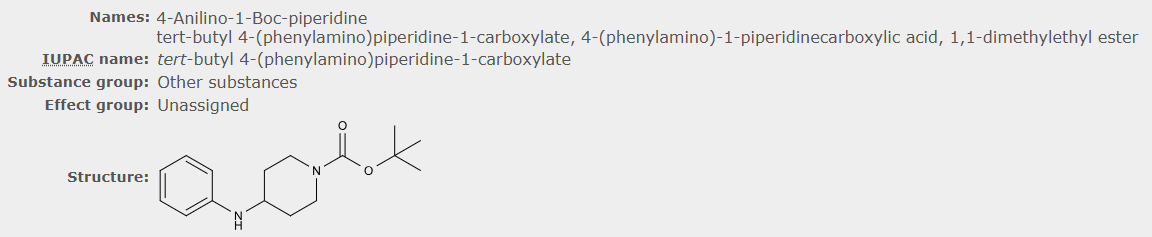
Intermediates added to the Convention against Illicit Traffic in Narcotic Drugs and Psychotropic Substances of 1988:
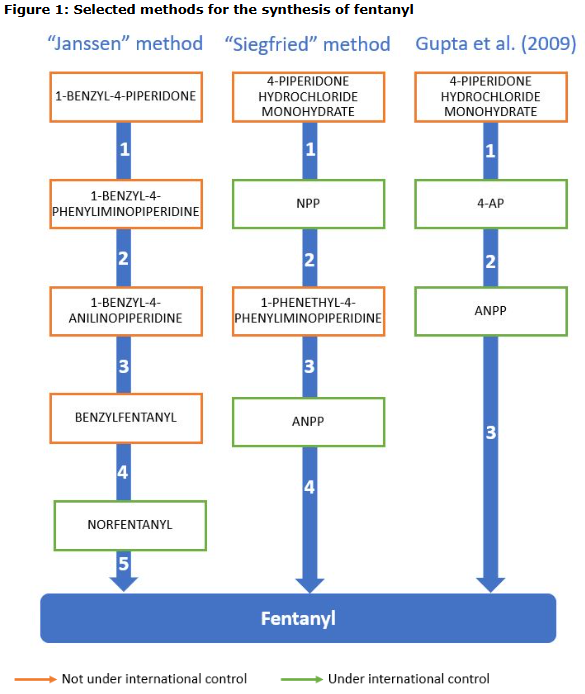
VIENNA, Austria – April 2022: At its 65th regular session from 14 to 18 March 2022, the Commission on Narcotic Drugs added three precursors that can be used for the manufacture of fentanyl and its analogues to Table I of the Convention against Illicit Traffic in Narcotic Drugs and Psychotropic Substances of 1988. Source: News: April 2022 – UNODC: Three precursors of the most common synthesis routes used in illicit fentanyl manufacture now under international control

From UNDOC

The WMD designation is clearly about legally mobilizing the military to interdict transport of fentanyl into the USA. The choice of fentanyl as a drug to manufacture by the cartels comes down to the extremely high potency and the relative ease of manufacture. The high potency, 2 milligrams for a lethal dose, means that it can be highly diluted with another drug and add to the overall potency. The high potency also means that a great many doses can be transported in small containers that may be easier to disguise and transport.

The obvious downside to fentanyl distribution is for the user. How careful are the people who spike intermediate quantities of substances, e.g., heroin or coke, so as not to provide a toxic product when repackaged for individual doses? Fentanyl should be redesignated as a highly potent toxic substance outside of the health care industry. As a drug distributor you probably don’t want your customers falling over dead from your product. That’s bad for repeat business. Regardless, user safety is unlikely to be a major concern to the distribution chain.

Sodium borohydride (NaBH4) can be used in the synthesis of fentanyl, so it is on the DEA Special Surveillance List. Sodium borohydride is a very useful and relatively safe hydride reducing agent that I and hundreds of thousands of others have used over the years in chemical synthesis. Sorry to see possible restrictions on its use.

The problem with this “designation of fentanyl and precursors” is that making a designer drug not cited in some list based the structure of fentanyl is that potent analogs can be dreamt up and produced if the right raw materials are available. Any organic or medicinal chemist should be able to come up with a list of candidates. Using existing drugs as a rough guide, producing obscure analogs is a skill set used by pharma companies frequently: Methyl, ethyl, butyl, futile … as the saying goes.

Wouldn’t it be nice to make some headway on the demand side too?

Fentanyl anecdote-

A few months ago I had surgery that involved my being anesthetized with fentanyl. I’ve been dosed with fentanyl several times and can report that it works well. What I didn’t note until the last instance was that it caused my face to itch badly for about 1 hour after surgery. Turns out this is a normal side effect and is not harmful. I had to wonder if addicts whose heroin was spiked with fentanyl had to suffer from both opioid-caused constipation and an itchy face. They have my sympathies there.