Category Archives: Essay

Freedom vs Predation

Americans, especially those of a particular political bent, love to exclaim that we love and cherish freedom. In America, the word ‘freedom’ is frequently used to amp up political rhetoric and to make people’s chests swell with pride with the aim of making us more receptive to a message. Particularly when playing Lee Greenwood’s song God bless the USA. This will not be the (n + 1)th valentine to freedom. Instead, my purpose is to reexamine a basic idea, i.e., certain pragmatics of freedom.

In America we thrive on a lumpy blend of civil liberties, freedoms and capitalistic ideals. Leading capitalists are both adored and despised, but not universally. Among many, being a millionaire or billionaire is tantamount to sainthood because if they are so rich, they must be doing something right. Luck is never part of the equation. In much of the USA, capitalism is raised to the level of a sacred obligation. Its principles are taken on hearsay or faith, and its boundaries are constantly pressing the limits of the law and ethics. In this way, capitalism is like a gas- it expands to fill the available space. Acquiring everything you can get away with is seen more as the act of a lone ranger. People have always admired a Robin Hood or a Jesse James character. Being one step ahead of the law is viewed as a righteous sport.

There is no doubt that capitalism has raised the level comfort, safety and wealth in America and elsewhere. One of the oft-cited merits of capitalism is that it seeks to raise the efficiency in the use of capital. From a distance that sounds like a dandy goal. Examples of the efficient use of capital are all around us and in ways that we may not recognize. Reducing the cost of doing business while retaining or increasing margins is a prime example of boosting the efficiency of capital. This benefits consumers if prices lower or remain level against inflation. But what about those who may have lost their jobs or their operating margins as the result of someone else’s boost in efficiency?

When the cost of doing business increases due to, say, tariffs, those afflicted are forced to raise their prices to pass along the costs. This is inflationary and most people understand this. But what about businesses not affected as much by tariffs? When they look around and see inflation raising prices by 6 %, aren’t they tempted to raise their prices as well? I would be. If customers are acclimated to inflation generally, they won’t mind if I raise my prices too, will they?

A misconception many people make is that if the cost of some raw material or labor drops, then the retailer will automatically pass that savings along to me. Ah, nope. They’ll bank the increase in margins. Why give away the boost in margins? This is just human nature.

The losses resulting from an increase in another’s raise in efficiency is part of progress. What about the buggy whip makers who went out of business after invention of then automobile? Who cried for them? A Pollyanna might say that they had a chance to expand their horizons into the automobile game.

After word processing became widespread and normal, it coincided with the extinction of the office secretary and typist pools. This helped to make Microsoft very wealthy at the expense of career secretarial staff. Today, most do their own secretarial work. Those who were once secretaries are now called administrative staff. Those of us who use word processors now spend our days on repetitive type setting chores.

Main Point

There comes a point where capitalism discolors into a shade of predatory behavior. The 1941 WC Fields movie Never Give a Sucker an Even Break expresses a sentiment held by many seeking easy money. It says that if I can take your money, you deserve it for being so clueless. In American history there are a great many incidents where a confidence man (conman) persuades an easy mark to part with his or her money. This kind of activity is always simmering somewhere. It involves a proposed cash transaction for something a doe-eyed sucker is anxious to exploit. Usually, the conman receives the cash and disappears leaving the sucker poorer and embarrassed. This extreme example is predatory behavior dressed up as a business transaction.

But capitalistic predators aren’t necessarily lone wolves tracking suckers. Many times, they operate from a store front as a legitimate business. Enron is a glaring example of a capitalistic enterprise that used the energy bull market of the 1990’s, creative accounting tricks and highly complex financial statements to mislead regulators and investors away from their felonious activities. So much money was being made that most were transfixed by their apparent success.

Obviously, business isn’t automatically fraudulent. But within the complex world of finance and accounting there exists a spider web of opportunities to lose your money. Predators may work in the shadows of crimes of omission rather than commission. The big investment people measure their strength and gain status through the contracts they land and the services they bill for. It is all very bewildering to outsiders.

So, what about the commercial onset of artificial intelligence, AI? It promises new vistas and opportunities by those who offer its services. Okay, but how and to whom? AI is already showing its worth in problem solving in many areas. Will AI understand context or counterpoints? Will AI eventually prosecute to the letter or to the spirit of the law? Will AI ever give a person a second chance based on past performance or extenuating circumstances in an HR situation?

Everyone has at some time has benefited from slack in the system, value judgements or another’s faith in your ability to improve. Will AI be used mainly to mete out discipline or strictness on the job? What happens when you are fired by an AI “staff member”? An AI staff member will be able to execute all manner of unpleasant duties in nearly every context. When will we have the right to be judged by a human being?

Is the “Vast Empty Space” of the Atom an Empty Idea?

I’ve come around on this business of the atom being almost entirely empty space. This is an established bit of folklore in intro chemistry and physics. It dates back to experiments by Hans Geiger and Ernest Marsden under Ernest Rutherford, showing how alpha particles could sail through thin gold foil and infrequently, an alpha particle would impact something hard and scatter. The striking thing about the experimental results was just how infrequent the scattering was. The conclusion eventually drawn was that the atoms in the gold were mostly empty space.

But what if that space wasn’t quite empty? What if that space was a beehive of electrons at maybe half light-speed and mutually repelled by one another yet attracted to the nucleus. Each electron is a single point negative charge. The nucleus has a diameter 100,000 times smaller with equal but opposite charge. The strong positive nuclear charge field holds the electrons tightly but only to the to the point where electron-electron repulsion is balanced in atoms with more than two electrons.

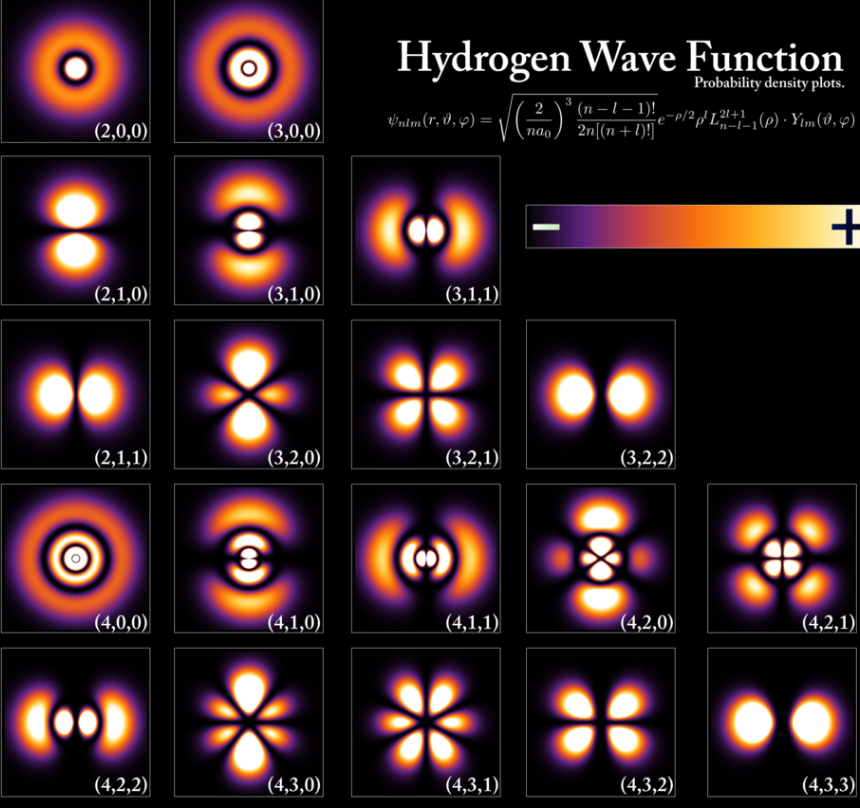
The electron is a point charge manifestation of the electromagnetic force, but with mass and angular momentum. It is a perturbation in the electric field. It doesn’t fly like a ball, it exists in the manner of a wave of chance. It has none of what humans think of as material substance, rather it is purely a quantum mechanical manifestation. It is shaped by 3-dimensional standing waves of probability density surrounding the nucleus. This probability density is defined by a spherical harmonic wave series. We chemists know this harmonic series as s, p, d and f “orbitals”. Electron probability density extends from the nucleus to the outer orbitals of the atom with s, p, d, and f orbitals occupying space defined by their unique wave equations.

Source: Wikipedia. The atomic orbital series for the hydrogen atom. The blue fringed shapes represent the space available in each atomic orbital. The orbitals have no reality as “objects” themselves. Instead, they define regions of space that an electron can inhabit. The hydrogen atom is used because there are no complications with electron-electron repulsion. The orbital structure of the hydrogen atom can be defined precisely as an equation. Atoms from lithium and up cannot.

As a reminder, the shape of an orbital itself defines a region of space where an electron of a certain energy is most likely to be found. It is not necessary to be able to calculate the position of the electron moment to moment to understand its properties. Heisenberg’s Uncertainty Principle does not allow for high precision determination of both position and momentum simultaneously, so this is where the universe tells us that ‘ya can’t have everything’. However, energy levels and transitions between them can be measured precisely. Exact position of an electron is not necessary. Besides, the 3-body problem shows up very early in the periodic table and spoils the fun anyway.

The edges of orbitals are not sharp but rather feather off into space and are pragmatically defined by a reasonable certainty as encircling an overall 95 % probability density.

What about the ’empty space’ view of the atom? As previously surmised, the filled concentrically overlapping occupied orbitals of an atom define a region of electron probability density that is not ever empty except for the hydrogen cation, H+.

Recall that the mass of the electron is small, about (1/1800)th that of the proton mass. This says that the space between outer edge of the atom and the nucleus is occupied by the electrons which are in constant motion constrained only by the individual 3-dimensional orbitals.

Perhaps better way to describe the space between electron and nucleus is to simply mention the dimensions of the atom and its nucleus in meters as an example.

And for the Rutherford gold foil experiment, the diffuse electron density around the nucleus would pose little resistance to an alpha particle with its larger momentum passing through, giving the illusion of empty space.

A gold foil of larger thickness will easily block all alpha particles. Alpha’s are stopped by losing their energy to ion formation when passing through matter.

US Constitutional Trip-Hazard

It appears that the US has had a particular “trip hazard” within it all along. Not an error of commission so much as an error of omission. We have been so busy heaping praise and devotion to our Constitution that the cold eyes of criticism have not held sway. To be sure, here criticism also means “analysis and judgment of the merits and faults of a literary or artistic work“. For crying out loud, even Einstein’s theory of relativity, which has been endlessly validated, is still subject to criticism yet it is physics and based on mathematics.

Can it be true that the Founders were able to construct a constitution so tight, internally consistent and prescient that the future could never evolve in a way that calls for revision. Seriously, could they have believed this?

The view from 30,000 ft shows that there are circumstances wherein safety rails meant to restrain a runaway President have failed. To date the US President is still subject to many restraints except for a part requiring Congress provide effective a counterweight to the executive. The current circumstance is where the Congress chooses not to summon self-control enough to exert its constitutional responsibility to declare war or not. To declare war is to draft and execute a policy directing the US to summon resources and direct military engagement with another state. This was done properly and for the last time by FDR in 1942 against axis-aligned Bulgaria, Hungary, and Romania (Google).

Perhaps the Constitution does not disallow a wide-eyed march into chaos and ruin by majority rule. In other words, within the constraints of this founding document, there are pathways to self-destruction. It is conceivable that the founders hadn’t considered a self-immolation led by a madman in the future. Could they have anticipated that 1 or 2 of the 3 branches of government would choose not to execute its responsibility to provide effective checks and balances? After all, why would rational citizens allow the nation they love to celebrate fall into collapse?

Actually, the Republican majority party in Congress probably doesn’t believe that there is a failure of checks and balances on their part. Why would they challenge the president, their national party leader and lord of the MAGA movement? The Trump network is large and powerful and getting ‘primaried’ is a likely outcome for sheep who stray from the flock.

Somewhere there is a coterie of planners who, having drafted Project 2025 now underway, are busy plotting the transition to illiberal democracy. Who are these big-money usurpers, and how do we turn the rock over and expose them to the light of day?

The Tyrannical Gov’t is Here. Where is the NRA?

For decades a population of Americans citizens have been extremely vocal about the 2nd Amendment to the US Constitution and their right to bear arms. A major element to their argument is to have protection from a tyrannical government. Legislation carrying even the faintest whiff of what they spit out as “gun control” is defeated. But, that is an issue for another day.

Well, what if that tyrannical government is now materializing? Will they even recognize it? So far it doesn’t look like it. This population is heavily invested in Trump so could that possibly blind them to the situation? Or did they just shrug and sign up to work for ICE in large numbers?

Trump and his cronies are constantly presuming authority over many areas of government that were statutorily or constitutionally understood to be outside the grasp of the executive. These people are constantly flooding the zone with acts of overreach backed by a republican SCOTUS and congress and enjoy a corrupt DoJ, DHS and, increasingly, a politicized DoD.

What does the term “liberal democracy” really mean? From Wikipedia-

Anyone who made it through 9th grade civics should have a background sufficient to realize that liberal democratic America is in existential danger. Not by violent overthrow but by a slow, painless slouch to illiberal democracy. A slouch because not enough voters will engage with money, votes or the gumption to step out and take a public stand against what is happening. A majority still have utilities, access to health care and safe neighborhoods and roads. So far the changes are rather abstract and distant for most citizens and it is easy to conclude that nothing personally serious is happening.

The US Constitution appears inadequate to provide a clear and muscular remedy against an abusive and malevolent single party control of all three houses of government. The Dems have had such control in the past, but did not seek to form an oligarchy or some dictatorial power grab. Were they just too dumb and timid to even try or is there something else? Maybe they know better.

In this country the Republicans have most of the lawyers, guns and money. But we woke liberals also have the 2nd Amendment at our disposal as well.

“Unspeakable Depravities”

The reliable American MAGA/GOP fear machine shifted into overdrive on the Bad Bunny halftime show during the recent Super Bowl. Against the blinding glare of Trump’s never-ending stream of foul blather stands the latest upsurge of Christian puritanical indignation and accusations of unspeakable depravities freely broadcast over the public airwaves. A group of “conservative warriers” have been orchestrating a war dance from the corridors of Congress out into the MAGA world. Their legislative blunderbuss tactics and shrill accusations and are aimed at Bad Bunny, NBC, and the NFL.

The NFL and NBC stand accused by red state dullards of broadcasting “openly glorified sodomy and countless other unspeakable depravities.” The MAGA populist movement is a jealous and cantankerous mob, intolerant of competing populist stirrings including pop music stars. Roger Goodell, National Football League (NFL) commissioner, enthusiastically backed the selection of Bad Bunny according to Time. This was not a trick foisted on the NFL.

Opposition began after the announcement of the half-time entertainment lineup in 2025. Much of the backlash focused on Bad Bunny’s Puerto Rican identity and his status as a Spanish speaker, with Fox News and political commentators framing the choice as anti-American. 

The truly unwholesome aspect here is the extent to which American politics promotes and elects such Christian nationalist puritans to high office. Though politicians play to their home districts, their nationalist puritanical claims are broadcast widely, banking authority and credibility into their castle keep. Their words are cheap and easy to speak, but practically impossible to correct or refute. With Bible in one hand and the other reaching skyward in supplication, the sobbing preacher-man reads a verse and proclaims fealty to the invisible almighty and the President. It is at once moving and ridiculous. They know precisely what they are doing.

The Christian nationalist cult is intent on moving the US into a position where the rule of law is based on Biblical law, whatever that may be. Whatever it is, it will certainly place preachers into high-ranking, high-power positions of influence. If you listen to the TV preachers, they call for ‘Gods people’ to save America. All that matters is accelerating the return of the Savior to earth to trigger the end of times and banishment of the unworthy to a lake of molten sulfur.

I wonder if Biblical law would continue with parking tickets or tax law? If you wanted to change the easement on your property, would that be New or Old Testament, and would pastor Bob approve it?

What a strange way to run the universe.

Eastern European History

In an effort to understand just what the hell is the deal with Russia, I enrolled in a university extension school spring semester course to study Eastern European history as it relates to capitalism and communism. It concerns the interwar period between WWI and WWII and why Eastern Europe adopted Soviet-style communism. Being from central USA, I’m familiar with much of the two world wars but only to the extent focused on histories written from the western allies’ viewpoint. This is the normal condition for most Americans.

Western European history, arbitrarily dating back to the Romans, is highly complex in the sense that the entire western Eurasian land mass has been repeatedly settled, conquered, and partitioned into empires, kingdoms, and duchies. The inevitable intermingling of cultures, languages, trade, and military might has combined to paint the map of today. Coastal nations had the advantage of access to fisheries and trade across long distances. On the downside, however, coasts were subject to easy invasion and wars of conquest.

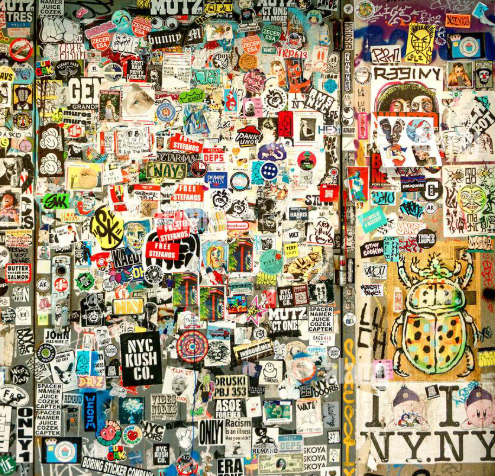
This wall is covered and overprinted with diverse messages. So too is the Eurasian landmass overprinted with fragmented, missing and overlapping cultural and political domains over the last several millennia.

Much of Eastern Europe retains a strong Slavic ethnic identity. Along with the Roman Catholic Church, the Eastern Orthodox Church still holds a strong position in many regions, including Russia. Putin even has the cooperation of the Eastern Orthodox Church in his effort to promote his agenda and propaganda at all levels in Russia.

In addition to Slavic and other ethnic identities, Eastern Europe and Russia have been isolated from much of the world by distance, economics, and the high level of modernism that Western Europe embraced. Tsar Peter the Great was aware of the more advanced nature of Western Europe and spent time there in order to gather ideas for modernizing Russia, particularly in the area of naval ships.

The landlocked or nearly landlocked nations of Eastern Europe lacked ice-free, warm water ports, not just limiting trade and shipbuilding but also economic exchange with more distant parts of the world. The Netherlands, Belgium, France, Germany, England, Rome, Portugal, and Spain in particular, established distant colonies and trade, generating wealth and power. With wealth, a kingdom acquires military strength and the ability to project power and conquest in resource-rich territories within just months or weeks of sailing time.

Conquest and the material wealth it brought was critical not only for an empire or monarchy to maintain or expand its holdings but also for self-defense from marauding armies looking for their own conquest. The various kingdoms, duchies, and empires were not entirely independent entities. The custom of the royal families to intermarry across empires and kingdoms assured continuity of the ruling families and wealth in the royal houses. This familial connection led to many alliances and specific choices in dividing up land.

The question of “what’s the deal with Russia” is about how it came to be that Russia is remote and standoffish to the point of being endlessly hostile and paranoid about the West. To American eyes like mine, the attitude Russia has about the West is peculiar and originates from … what? Even if Russia did not suffer overland invasions by Napoleon and Hitler, would they be any less paranoid? They would have less historical invasion baggage to drag along in some ways, but would other tragedies have befallen them? Impossible to say. It is fair to say that the Bolsheviks were keen on global-scale revolution and widespread implementation of Soviet socialism. They were not without imperialistic enthusiasm themselves.

President Putin continues to press the rhetorical but incendive argument about how the West is desirous of their resources. It is pitched as a clear and present danger to Russia. The West, he intimates, is crawling with greedy and perverted imperialists who want nothing more than to steal Mother Russia’s oil & gas, minerals, uranium, and timber. Any leader in any country could get mileage from this argument, and Vladdy-buck is pumping this handle with gusto.

The main thesis of my history class is that had Hitler not invaded the Soviet Union, the spread of Soviet conquest to its western frontier would not have happened. I’ll write more as this topic unfolds in class.

Crossing the OS Rubicon- From MS Windows 11 Across to Linux Ubuntu

After viewing an alarming report on YouTube concerning the shady situation with Microsoft’s business strategy in general and Microsoft Windows 11 in particular, I’ve decided to cross the Rubicon to Linux Ubuntu. It’s not just about what I’ve learned about Microsoft’s intrusion into my personal computer’s files. My latest update of MS Outlook ab.so.lute.ly stinks. My relearning and expectations of Windows 11 Outlook is contaminated by my prior familiarity with the previous rev. The blurred familiarity of the new version is twisted with years of habit and expectations. I’ve had enough.

I’ve been using Microsoft products since the Jurassic age of home computing, ca 1986. I refer to both “IBM” machines of that age and Apple’s McIntosh. As a result, both my entire professional and personal computer lives are deeply invested in Microsoft products, MS Word especially. I’ve heard that transfer compatibility going from Word documents to whatever Linux app is problematic, except for pdf files.

My plan is to experiment with an inexpensive laptop from Amazon with Linux Ubuntu already installed. The goal is to make a parallel assessment of Ubuntu with my personal and consulting work on MS Windows.

Remember the scene from Saving Private Ryan where a German soldier is killing an American soldier by struggling to push his bayonet into his chest on the upper floor of a building? While the German soldier is pushing the blade closer and closer, all the while he is attempting to quell the American’s panic with soft words, shushing and a pleading for him to stop resisting. It’s very disturbing and reminds me of the banality of evil.

Many companies, including Microsoft, are constructing business models that remind me of this disturbing scene. They are encouraging customers to switch from Windows 10 to Windows 11 by aging out Windows 10 updates. In doing so, Windows has become a subscription service rather than your personal property in the privacy of your hard drive. Instead of buying MS windows once, you are now paying for a subscription and allowing MS to examine your files. What do they do with what they may find? Overall, they want to turn your proclivities and interests into cash through selective advertising and sales of marketing data to third parties.

They are trying to force users to use their cloud storage where they will have access to all of our data. Worse yet, their AI “helper” encourages users to ask for help that reveals what the user is thinking. That help can be in the form of rewriting your text or actually producing content for the user. The AI system resides in one of their data centers and who knows what kind of analysis and business planning that results in.

This approach is really about shooting fish in a barrel and is increasingly appearing on social media with advertisers pushing subscriptions rather than outright purchases. Amazon does it as well with certain food stuffs. I understand the business motivation to exchange a single larger sale for monthly payments of smaller dollar amounts over time. This works best when charges are hidden in your credit card statements disguised as lengthy character strings rather than intelligible names. Also, that particular human frailty of losing track of what you are paying for by credit card is a real issue for people. Do we actually think that the C-Suite knobs who oversee their sales operations haven’t thought of this? They know exactly what they are doing.

Ostensibly, the “genius” of the free market is to maximize the efficient use of capital. Obviously, history bears (or bares?) out that there is much evidence for this assertion. The downside of this is that decisions contrary to your personal choice are made by others who decide what efficiencies that you will pay for while they retain their margins.

Do you want to produce a product that results in a few single-item sales of a dollar each or a product that produces a larger number of nickels over time? Obviously, it depends on the product.

Like hundreds of millions of others, I have helped to keep Microsoft afloat and remain a great investment for their stockholders. We’ve done our part. But now it is time to say “so long and thanks for all of the fish.”

Season’s Greetings 2025

To all the readers of Lamentations on Chemistry, Happy Holidays, Merry Christmas, С Рождеством, 圣诞快乐, عيد ميلاد مجيد, Feliz Navidad, חג מולד שמח, Wesołych Świąt, Krismasi Njema, (کریسمس مبارک),  मेरी क्रिसमस, Happy Hanukkah, Gleðileg Jól, Maligayang Pasko, Vrolijk Kerstfeest, and 메리 크리스마스, Wadda Din Mubarak, Happy Kwanzaa, Feliz Natal, Happy New Year, Peace, Love and (fill in the blank).

Be of good cheer! Beneath all of the chaos, turmoil and ill will rests a beautiful world of natural wonder and fascination. Stop occasionally and take in the views of our gorgeous planet, ponder our amazing human consciousness and let your good will wrap around the web of life.

Be cool! Peace and Love!

Th’ Gaussling

Who on God’s Green Earth Wants to Invade Russia?

Putin has said on numerous occasions that the West wants what Russia has. Seriously? You mean permafrost? -61 oF winters. A border with China? A multiethnic and antagonistic population? A shortage of warm, deepwater ports? A long history of brutal authoritarianism?? Its gleaming history with nuclear energy and vast stretches of land contaminated with radioactive soil. Yes, we in the West stare longingly at Russia for this from time to time … NOT!

Oh yes, Pootie-Poot (nickname by George W. Bush) must mean natural resources like petroleum, platinum group metals, gold, titanium, uranium, diamonds, etc. These are valuable natural resources but at what cost for a conquering power. Too high by half would be the conclusion by rational people. Recall the problems Hitler had with Operation Barbarossa. Or the disaster Napolean fell upon with his ill-conceived invasion of Russia. Like any modern state, Russia has much in the way of weapons to bear upon its enemies. But what Russia has in great abundance are brutal winters and a muddy spring season to immobilize invaders.

Like any authoritarian worth his salt, Putin continues to make the case for tightening personal liberty in exchange for layers of “state security”. Citizens have been conditioned to avoid politics in exchange for politics avoiding citizens. It seems to work.

Like nearly everywhere else, Russia is populated by good and decent folks. I’ve been there and have experienced generous hospitality from ordinary citizens in their cramped apartments. How we could be mortal enemies is beyond me.

The people we now call Russians are descended from tough people who survived conquest and occupation by many hostile invaders over the many centuries. Somehow, they even chased out the Mongols and later overcame the mechanized invasion of Nazis. As the Red Army chased the Nazis westward in WWII, they burned down their own villages and even executed Russian citizens who failed to fight and die. My Russian language professor was a Ukrainian kid whose family evacuated Ukraine for Europe in WWII to flee the advancing Red Army.

The title of this post asks, “Who on God’s Green Earth Wants to Invade Russia?” I’d offer that to try would be at best to invite a nuclear exchange, terrible hardships and losses for any invasion force. It would be a supremely bad decision. And even if an invader prevails, what have they gained? A population dedicated to guerrilla warfare and civil disobedience. Sounds like a nightmare.

The consequences of invasion and occupation of any large region would produce guerrilla warfare and civil disobedience by the surviving conquered population.

The West could benefit by making it known out loud to the Russian people and the Kremlin that we understand that an invasion or occupation of Russia by a foreign power would be a suicidal calamity for any invader. The usual rancid Kremlin propaganda must be countered with words of strength, peace and prosperity for all people. We invite Russia to be a member in the community of peaceful states who participate in open commerce and tourism.

I’ve Been Scraped!

Last week, this blog saw an unusual spike in traffic—roughly 350 visits higher than normal. Each visit appeared to be for a single post, with no clear theme among them. My best guess? An AI platform was scraping my content for something specific.

Suddenly, I feel a renewed sense of accountability for what I’ve written. What if—gasp—a sentence was inaccurate, or a sarcastic remark too obscure for most readers? The responsibility could be enormous! Think of the children!

The content choices lie somewhere between the bookends of accurate and complete fabrication. I’d rather be accused of being boring than being found in an untruth.

How does this mesh with my anonymity? Well, a handful of people know my identity and their respect is important to me. Eventually I will reveal my identity and suddenly the truth and accuracy (and spelling) of my 1700 posts will be forever connected to my real name. Skin in the game.

Disclosure-

Very occasionally I will write some fictional content, and it should be apparent as fiction from both the content itself, and the key words attached to the post. The example would be my posts on the fictional Poltroon University in Guapo, Arizona. I do enjoy the occasional jab at the culture of higher education and the institution of science.

However, as a scientist in matters of physical reality, I am dedicated and eager to describe content as truthfully, accurately and mellifluously as possible. When I’m on one of my political jags, I’ll admit to some amount of enhanced emphasis where others have tread more carefully with the source material.

The reason I write and blog is to help me think ideas through. Somehow the act of scribbling down sentences followed by multiple passes in editing is helpful. At any given time I have 20 to 30 unfinished posts languishing in draft space. The open-air aspect of blogging is to assure that I have done my best lest public humiliation, scorn and derision should come my way. Not just in the present, but more so in the future. Writing is thinking. To put it bluntly, there is a fear of publishing something I would regret forever. Absolutely the worst thing I could do as a blogger and as a scientist would be to post indefensible or phony science. Posts with linked references are direct connections to what I view as credible content on the internet. The reader only has to click a link to verify a factual statement thing I made.