Monthly Archives: June 2008

Flying Barn Door

There is an old saying in aviation that “with enough horsepower, you can make a barn door fly”.  A friend recently gave me a copy of Principles of Flying, McGraw-Hill Book Company, 1943, published under the authority of the Bureau of Aeronautics, US Navy. I couldn’t resist posting this graphic from p. 88.  [I hope this comes under fair use doctrine of Title 17 Section 107.]
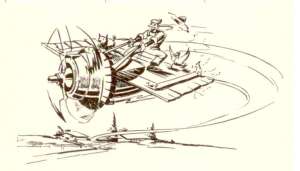
Cartoon of a barn door taking flight.

The older aviation training manuals were often written in an avuncular voice that would appeal to farm boys. This Navy manual on flying takes the reader through the basics of Naval aircraft construction as well as aerodynamics. Floatplane construction and controls are particularly well illustrated.

My first airplane ride occured when I was 6. We went to a pancake flight breakfast in an airport hangar in Boone, Iowa. There, somebody was giving airplane rides for a penny-a-pound. This was a bargain price even then. I recall that the event was connected with the Flying Farmers.

My father had a pilots license and as did my cousin up the road. Cousin Verlyn had a Cessna 170 tail dragger that he flew from a pasture on his farm. One day on the rollout after landing he rolled into a pool of standing water, flipping it over and bending the main spar. It never flew again.

Though my mother worked on her license, somehow she didn’t take the flight test. This was in the early 60’s and manned space flight was all over the news. Americans were going places and to see my father riding with a friend in his Stearman doing aerobatics over our cornfield could only mean to a small boy that somehow, we could be a part of the big adventure.
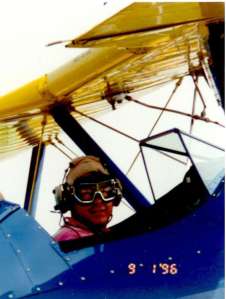
My first and only ride in a Stearman during the Stearman fly-in in Galesburg, IL.
1950’s Chemistry

I recently spent some time listening to an acquaintance talk about his days as a student at MIT and as a grad student at Harvard in the early 1950’s.  He had Geoff Wilkinson for inorganic chemistry at MIT as an undergrad and later did his PhD with Wilkinson at Harvard.  Curiously, Wilkinson did radiochemistry in the Manhattan Project prior to joining academia. His radiochemistry experience compelled him to work fast and in test tubes, according to my friend.

My friend’s lab mate in Wilkinson’s group was Al Cotton. They started grad school together ca 1952 or so. This was shortly after the sandwich structure of ferrocene was proposed by Wilkinson’s fellow Harvard prof R. B. Woodward. Woodwards basis for this structure was on symmetry and a single IR stretch absorption. Spectroscopically, the original sigma bonding model didn’t fit the data.  Just prior to this, Wilkinson had begun work on a variety of organometallic Cp compounds. As the story goes, when Woodward expressed interest in making more Cp compounds, Wilkinson went to his office and “had words” with Woodward. Afterwards, Woodward moved on to other things.

My friend laughingly recalls the time he was chewed out by his P-Chem prof, the great George Kistiakowski and earlier, by Arthur Cope at MIT. He recalls being summoned to Cope’s office. Cope was wearing pink slacks which contrasted with his red hair. He was displeased about the impertinent back channel invitation my friend pitched to Linus Pauling to speak to the chemistry club. (I haven’t verified the color of Cope’s hair)

My friend recalls having E. J. Corey as a lab assistant while in an undergraduate lab at MIT. He joked that he saw Corey once at the beginning of the term and once at the end. My PhD advisor, Al Meyers, did his post doc with Corey some years later. Small world.


Preparation of Iodonium Tetrafluoroborates

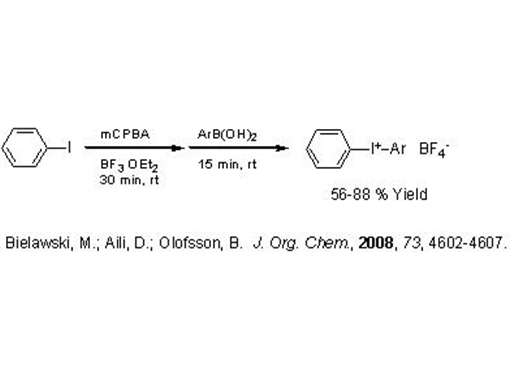
An interesting bit of chemistry was published by Berit Olofsson at Stockholm University in a recent JOC. The Olofsson lab has previously produced a method for the one-pot preparation of diaryliodonium triflates. This latest work provides diaryliodonium tetrafluoroborates (JOC, 2008, 73, 4602-4607). 

The preparation of I(III) compounds usually starts with an Ar-I compound undergoing oxidation followed by an electrophilic addition/substitution to another arene. Regioselectivity is obtained by choosing a donor with a leaving group such as a boronic acid, stannane, or silane.

What is clever about this process is the fact that a BF4 salt is directly produced. Two equivalents of boron trifluoride etherate are used in the reaction which evidently results in some kind of disproportionation producing the BF4 counter-anion. 

It is known that the reactivity of iodonium compounds is somewhat sensitive to the coordinating ability of the counter-anion, so BF4 is less undesirable than other choices (like chloride). Solubility is greatly influenced by the choice of counter-anion as well. This is particularly true in photo-initiator applications where the choice of carrier fluid may be limited.

A statue celebrating the bronze enema bulb

According to the Novosti News Agency, the Zheleznovodsk spa center recently unveiled a statue celebrating its emphasis in hydraulics.

Photo Credit- AP

“As gastroenterology is the main treatment area at the Zheleznovodsk spa center, it was decided to create such a unique monument, which is both funny and vital,” said Alexander Kharchenko, the director of the center.

“There is no kitsch or obscenity, it is a successful work of art,” Alexander Kharchenko told The Associated Press. “An enema is almost a symbol of our region.”

Lordy. I thought some town in Tejas owned the rights to that symbol!

In case you’re sketchy about the location, it’s just off the M-29 north of Pyatigorsk. Looks like there is an airport in nearby Mineral’nye Vody. It’d be a good reason to burn up those Aeroflot frequent flyer miles.

The juxtaposition of children, balloons, and shapely nurses in a celebration of the enema bulb seems most peculiar and is a major source of conflict for my brain at many levels.

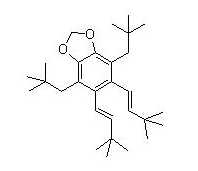
Amphibidiene

I finally cracked the secret of getting ChemDraw structures into a post without having to buy anything. It’s not perfect, but it is a start.

Paste a structure into Microsoft Paint which is found in Accessories in the Start Menu. Save as a jpeg. Then, re-open in Microsoft Photo Editor, crop, and save again. Finally, import to wordpress as a jpeg. Whew!

Be nice. I’m a little slow sometimes.

Meat and Cheese Explosives

So, I’m blundering through the literature on a snipe hunt when I run into this ICI patent- US 5,456,729. In the description, they teach a method of preparing an explosive composition using “lactic casein”. Having been in the dairy business long ago, and specifically having worked in a cottage cheese plant, I recognized this component as … cheese. Well, mostly. Example 5 discloses a composition comprising 25 % ammonium nitrate and 3 % lactic casein.

Unless you have lactose intolerance, cheese is not ordinarily an explosive. In the patent, the lactic casein is one of many examples of a foam stabilizer. Other stabilizers include animal and fish proteins as well as collagens. A collection of other chemical additives rounds off the list.

If they had specified gluten, they could have claimed the use of a pastrami and cheese on rye sandwich as stabilizer feedstock for their explosive composition.

Farewell George Carlin

June 22, 2008, Santa Monica, California. Comedian and satirist George Carlin died sunday evening after checking into a Santa Monica hospital complaining of chest pains. He was 71.

Carlin was a brilliant social satirist and comic. He had the ability to look at ordinary things from a different angle and see the obvious obsurdity in things most of us accept as simple background noise. This is one of the key attributes of a successful satirist and comedian.

I think it’s the duty of the comedian to find out where the line is drawn and cross it deliberately. 

The very existence of flamethrowers proves that some time, somewhere, someone said to themselves, “You know, I want to set those people over there on fire, but I’m just not close enough to get the job done.”

I went to a bookstore and asked the saleswoman, “Where’s the self-help section?” She said if she told me, it would defeat the purpose.

There’s no present. There’s only the immediate future and the recent past.

Not only do I not know what’s going on, I wouldn’t know what to do about it if I did.

-George Carlin

Carlin was a serial quipster who pushed the boundaries of social norms. His Seven Dirty Words ended up as the center of a 1978 Supreme Court ruling that affirmed the right of the state to bar “indecent” of speech on the public airwaves.

While it is common for contemporary comedians to exploit “indecent” speech for shock value today, few seem to have the facility with language that Carlin had. He was able to reduce to a few short humorous sentences the dark uncertainties that many of us have with common subjects.  Carlin’s observations on taboo subjects put him well ahead of his time.

Structural diversity of organic chemistry

The recent issue of Journal of Organic Chemistry, (JOC, 2008, 73(12)) has a few articles that are particularly interesting.

The article by Lipkus, et al., entitled Structural Diversity of Organic Chemistry. A Scaffold Analysis of the CAS Registry, JOC, 2008,73, 4443-4451, is a particularly ambitious bit of work that only CAS could do. This article describes a scaffold survey of more than 24 million organic compounds in the CAS Registry.

The data set was limited to carbon-based structures containing the heteroatoms H, B, Si, N, P, As, O, S, Se, Te, and the halogens.  Moreover, the work was further limited to framework structures containing rings or linked rings. Acyclic compounds were not included owing to the inapplicability of the framework definition in the search algorithm. Multicomponent substances and polymers are ignored as well.

Lipkus and coworkers found that half of the graph frameworks analyzed are described by only 143 framework shapes.  The remaining half are described by 836,565 graphs.

One of the key conclusions is quoted here-

“It is not surprising that some frameworks occur much more frequently than others. However, the extreme unevenness in the way frameworks are distributed among organic compounds is somewhat surprising. This is particularly true at the graph level, where it is found that only 143 framework shapes can describe half of the compounds. The fact that both graph and hetero frameworks have very topheavy distributions tells us that the exploration of organic chemistry space has tended to concentrate on relatively small numbers of structural motifs.”

Lipkus concludes that cost minimization is one of the drivers of this “… shaping the known universe of organic chemistry.” He comes to this conclusion due to the presence of a power law which describes this distribution. The power law he refers to is a linear log-log relationship that is indicative of what they refer to as the “rich-get-richer process”.

If I understand this correctly, a relatively small number of easily made or commercially available early precursors are comprised of ring graphs that, by virtue of modification, propagate into more complex analogs that retain the original graph. This has the effect of multiplying the frequency of a given graph.

The cost minimization aspect comes from the benefits of familiar chemistry and the commercial availability of a fairly limited set of ring graphs. Adding more rings will usually mean adding more molecular weight and adding problematic synthesis and separation issues.

The authors conclude that the lopsided distribution of organic compounds toward only 143 graphs comprises a bottleneck in drug discovery. They further suggest that more exploration in other areas of chemistry space may be worthwhile.

My dinner with a meteorite

Last night I found myself sitting at a restaurant with astronomers for the occasion of viewing a meteorite. Customarily, a few observatory folk have dinner with the speaker and then we go to the observatory for a public star night. While waiting for our entrees we passed the object carefully amongst ourselves, cherishing a few moments of close contact with this rare object.

Astronomers seem to be prone to public displays of humility. I would estimate that the humility quotient was near 0.8 (8 out of 10 Sagans- the Sagan is the international unit of humility). It is generally agreed that the Buddha achieved a Sagan quotient of unity. Okay, I’m kidding.

The curious 936 gram achondrite is from the recent Berthoud, Colorado, fall.  Meteor enthusiasts refer to the arrival of a meteorite as a “fall”.  This is one of only 5 witnessed falls in Colorado. A section of the meteor has been cut off and has been the subject of investigation at the University of Arizona.

Based on the composition of the object (olivine, plagioclase, ilmenite, chromite) and based on the reflectance spectra of various asteroids, the Berthoud meteorite is thought to be a fragment of the asteroid Vesta. Imagery of Vesta suggests that a portion of this object may have been shattered by an impact in the past.

The family whose property the stone landed on are somewhat bewildered by the event. They have been the subject of much unwanted attention, so the object is kept secure at an unknown location. In October of 2004, in the early afternoon several family members were standing outside their home when they heard a whistling sound and thump. Following the direction of the sound, they found the impact site less than 100 feet from where they were standing and in a spot where one member had just walked through. Only a small part of the object protruded upward through the disturbed topsoil.

Reportedly, it was cool to the touch immediately after arrival. This is counter-intuitive given the fiery appearance of most meteors. However, the object was quite cold prior to entry into the atmosphere and the rapid transit through the air didn’t allow for heat saturation. And, ablation carries away much of the friction energy.

The low iron object has a dark fusion crust over a grey, mottled composition. Other than the crust, it is not that unusual in its appearance.