
The Cresson Mine in Cripple Creek contains a good deal of fluorite. I was able to casually collect a few samples just lying in the road bed. In the photo below, the rock on the top has the most pronounced blue/purple color indicating CaF2 (fluorite). These specimens are not collectors pieces and are entirely unremarkable other than as indications of fluorite.
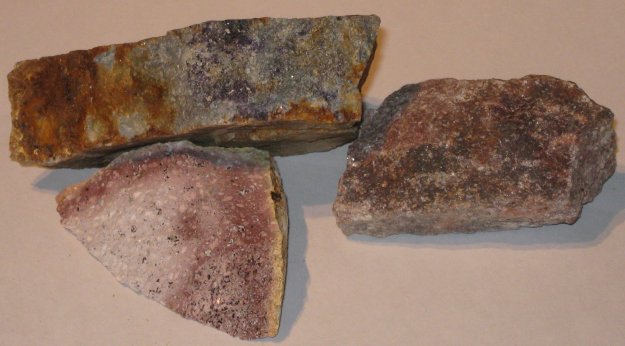
Cripple Creek Fluorite Indications (Cresson Mine). Copyright 2009 Gaussling.
The mine business model requires heap leaching as a means of extracting the gold value out of the ore. Given that the ore is peculiar in that it contains gold in the form of gold telluride which cannot be leached out by cyanide, approximately 40 % of the gold remains in the host rock. The cost per toz of gold produced must be kept as low as possible and the way you do that is economy of scale.
The heap sits atop multiple layers of clay barriers and the 14,500 gal per minute of extract that flows out of the heap 24/7 is passed through coconut husk charcoal to trap the gold cyanide and the raffinate is recharged to the desired 100 ppm titer of aq NaCN and pumped back onto the pile. pH adjustment is a constant chore. The crushed rock is mixed with calcuim oxide prior to being dumped on the heap to maintain a high pH.
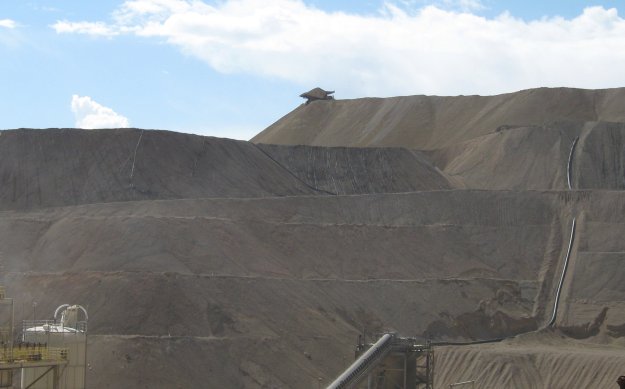
Building the Heap. Cripple Creek Cresson Mine. Copyright 2009 Gaussling.
 Lamentations on Chemistry
Questions, questions questions…
1) How small is the ore ground?
2) Is the ore shook, vibrated or otherwise agitated during the leaching? (I can imagine that the flow through the pile would be wildly non-uniform and would miss some areas completely.)
3) Given the time-dependent value of gold, do the extraction operations change quickly depending on the market? (i.e., certain operations can be done at $1000/oz. that would not be done at $500/oz. How quickly can the operation adapt, or do they?)
Hi John,
1) Rocks are crushed to 3/4 of an inch for the heap.
2) The heap is the size of a mountain. The aq extractant is trickled from fixed locations. It isn’t clear that they understand the flow patterns in the heap.
3) The cost of extraction to the first pour of gold is ca $530/toz. The business end of it was something the geologists didn’t want to discuss.
The operation is given a permit to operate a heap leach field for a certain period. After that they have to go into a reclamation mode. So, the clock is ticking. They are trying to extract as many oz of gold as possible.
I take it that they grow the coconut husks on site?
No. It comes from the volcanic island where they have a secret underground lab and launch facility.