
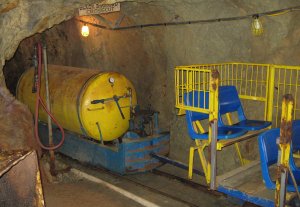
Underground Air Locomotive
In Part 1 of my post on the Mollie Kathleen Mine in Cripple Creek, Colorado, I described the ride down to the 1000 ft level. Having been in mines considerably less developed, I was impressed with the quality of the skip lift equipment and the general state of the mine workings above and below ground. The mine make heavy use of pneumatic equipment to minimize ignition sources. The air locomotive above features a pressure tank which energizes an air motor to drive the contraption. It works quite well.
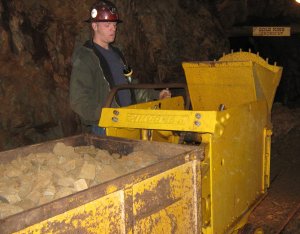
Mechanized Mucking with Pneumatic Equipment
Once at the bottom of the shaft, the mine appears to be little more than a hallway with steel tracks on the floor. In fact, it is a series of hallways, or drifts, and shafts. The goldbearing formation that the Mollie Kathleen mine has penetrated is a volcanic formation called a diatreme and it is composed of highly disturbed rock from ancient volcanic activity. The district contains gold in varying abundances. Certain features of the formation are more enriched than others.
In general, one does underground hardrock mining to exploit a network of veins enriched in value, in this case, gold. By definition, an ore is a body of rock or mineral that contains commercially exploitable value such as gold.
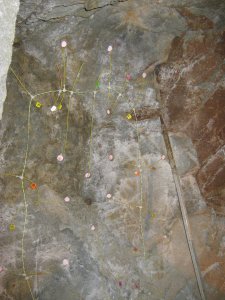
Blasting pattern prior to a shot
Solid rock is fragmented with explosives and loaded into ore carts. The rubble accumulated from blasting activity is called “muck”. Muckers were very important workers in a mine and the mines productivity hinged on their ability to load the ore carts as fast as possible. Until carbide lamps arrived, miners toiled in very low light levels in candle or kerosene lamplight.
With the advent of better technology came more effective and safer blasting agents, fuse cord capable of adjusting the timing of a blast sequence, and more efficient ejection of fragmented rock. Near the center of the photo above is a pattern of holes filled with blasting agent. Well, except for one hole in the center of the pattern. This empty hole is placed specifically to provide for space for expansion relief. A shot is timed to trigger the charges around the empty hole first, followed by concentric detonation of the blast pattern. Finally, a set of charges low in the pattern lift the muck out of the hole and onto the floor.
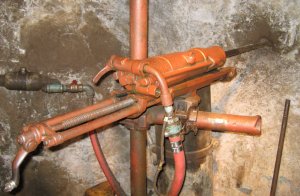
Pneumatic hammer for pounding a drilling steel into the rock wall.
According to the tour guide, the Mollie Kathleen mine is fairly rich in gold but lacks access to a milling facility. Without milling and refinement, there is no point in pulling the ore out of the ground. So, until a scheme for beneficiation of the ore comes along, the gold will have to sit in the formation and make money for its owners as a tourist attraction.
As is common in mine tours, the staff is well versed in the history and mechanics of getting ore out of the formation. What seems to be glossed over or wholly ignored is the process of getting purified gold out of the ore. Being a chemist, I was naturally interested in the isolation process. The refining process I was able to “extract” from the mine tour operators was a simple but inefficient method.
Gold ore was pulverized and heated to high temperature in a way that resembles calcination. Diffuse wisps and pieces of elemental gold in the ore would melt and agglomerate so as to produce larger pieces of gold. The roasted ore could then be exposed to a mechanical/slurry agitation process that would dislodge the now larger pieces of gold and classify them by density much like the gold panning process.
The roasting process apparently oxidized the tellurium in the ore, resulting in a purification. The question is, did the roasting process just oxidize the free tellurium or did it free the gold from the gold telluride (Calaverite)?
Another process can be used to extract gold from the ore. It grossly resembles the mercury amalgamation method. Metallic lead is combined with gold ore and heated to some high temperature in a special container. A lead-gold alloy is formed which can be poured away from the gangue. The molten alloy is then exposed to air oxidation, forming litharge (PbO) and metallic gold which phase separate and can be separated mechanically. Assayers use a process called fire assay or cuppelation to extract refined gold for an assay.
Chlorine extraction was used to oxidize metallic gold to the soluble NaAuCl4 salt which could reduced by contact with carbon or by electrolysis. Chlorine water was used prior to the cyanide extraction methodology now in common practice.
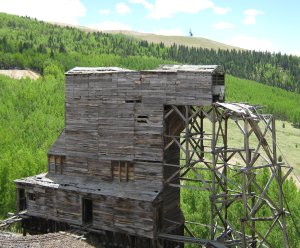
Old Headworks by the Mollie Kathleen Mine
 Lamentations on Chemistry
Very interesting locomotive. Its not unusual and the technology is quite old in fact. Back when I worked my way through college I happened to get a job with Michigan Technological University’s Archives. As you may know MTU started out as a mining and technologies school. The upper penisula of Michigan is rich in Iron, and Copper and some Gold speculation. Silver is also know to have been found with some of the copper deposits. The Keweenaw penisula is by far one of the richest sources copper which comes out of the ground as nearly 98% pure metalic Cu.
At any rate – I had the opportunity to catalog the Victoria Mining company (Located near Ontonogon Michigan) documents almost 30 years ago, and became facinated with the correspondence between the mining company and an engineering company located in Marquette Michigan. Victoria if I remember correctly operated from the 1860-1920’s. The documents I think where from the late 1860’s, and described the purchase and design of a compressed air locomotive for use underground. The Victoria Mine had a cheap source of energy, as they where near a lake (Victoria) from which they could derive via hydropower compressed air. The original 5+ mile long wooden sluice still carries water from the dam under considerable pressure. Its a wonder to behold. The old wooden dam was replaced by a steel dam then later a concrete one. The Steel damn is an Engineering Historic site and still stands behind the newer concrete one.
Thanks for the very interesting comment. You have a good memory. I figured that the air locomotive technology was fairly old, but didn’t anticipate that it could be that old.
I was offered a teaching job at NMU in Marquette maybe a dozen years ago. I decided that the climate wasn’t for me. It is pretty country, though. Lake Superior is not a happy lake.
I knew about the iron, but the Cu is news to me. I’ll have to look into that.
What in the name of kobold is in the muck wagon? Do they have a huge pile of those big clear cubes that scratch glass and can be heated to 1000 C in air wthout glowing?
The ore cart was full of actual muck. Just rock fragments from blasting. One of those carts averages about one troy ounce of gold- they say. I suspect they are right when averaged over the formation.
No problem. I am glad you found out something of interest about the Keweenaw. I am a bit of a history of technology buff, and a former Medicinal Chemist now Cheminformatics/Knowledge management professional. My wife and I are both originally from the UP of Michigan, and as she is a Geotechnical Engineer (dirt), has an interest in geology and minerology. If jobs would have been available we never would have left the area.
Until the early 1950’s most of the nations copper came from mines in the area I beleive. Unfortunately the big Arizona open pit mines containing copper salt ores became more economical vs the UP underground mines containing metalic copper. Local governments are opposed to useing modern technics to leach the copper out with sulfuric acid. Last mine closed about 15 years ago I think because the local citizens wouldn’t let them bring in tank cars of sufuric acid.
At any rate – If you ever make your way over to the Houghtonarea or MTU campus. You must vist the Mineral Museum. Its collection rivals that of the Smithsonian. They also display more of the collection than any other such facility in the US maybe even the world. They have the largest collection of natural halfbreeds (pure metalic copper/silver nuggets) known to exist. Very educational.