
Th’ Gaussling took a drive through some local mining territory today. I made my way up Left Hand Canyon through Ward and then on to Nederland, Colorado, careful to dodge the high altitude bicyclists. Either they are unaffected by the low O2 partial pressure, or oxygen starvation has dulled their senses. I do not have the metabolism for it.
While there is a fair amount of mining history in Nederland, it is most recently famous for having a dead guy in a box of dry ice stored in a Tough Shed. Not to be missed is the annual Frozen Dead Guy Days with its charming coffin races. I’m sure there are a few tarpaper homesteads still around. It’s our own little bit of Appalachia.
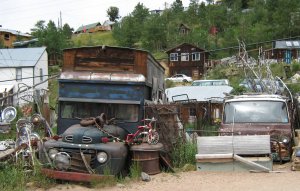
RV Heaven in Ward, Colorado
Western Boulder County was once a bustling mining district producing mostly silver with some gold and tungsten. Mines were serviced by smelter and milling operations and were located near available streams. While a great many mines remain, nearly all trace of the mills has been long lost. What tourists and casual observers of mining history may not appreciate is the critical function of the mill. Without crushing and extraction, the mines would have no way to pull the pay out of paydirt.
On a side note, southern Boulder County- between Boulder and Golden- had one of the most significant early uranium mines – the Schwartzwalder Mine. A geologist who studied the operation told me that the Schwartzwalder mine has been shut down by the owner, Cotter Corp., and is flooded.
Southwest of Ward is the town of Nederland. The town has a modest mining museum with some unique pieces of equipment on display indoors and two steam shovels on static display ouside. It’s worth a stop.
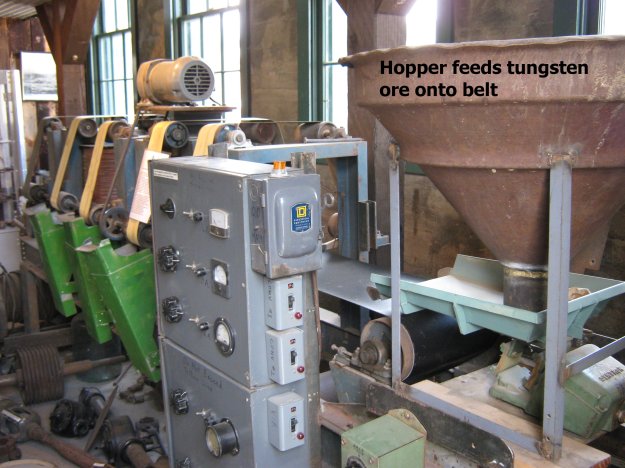
Magnetic Separator for Tungston Ore, Nederland Mining Museum
Of particular interest is a curious looking machine in the back of the museum. The photo above shows this machine- it is a magnetic separator designed to remove magnetic iron gangue from milled ore and was built by a local miner. The machine was donated by Joe and Joann Chavez. It is believed that Joe built the device in the early to mid 1940’s.
The machine moves milled ore on a main belt underneath the pole faces of 5 successive electromagnets. Around the upper magnets is a sweeping belt that is situated between the magnet pole face and the underlying ore. As the main belt delivers a constant stream of ore to the magnets, the sweeping belt constantly moves accumulated magnetic material away from the magnet and into chutes that discharge the unwanted material to a separate mass stream. The purpose of the lower magnet is a little unclear.
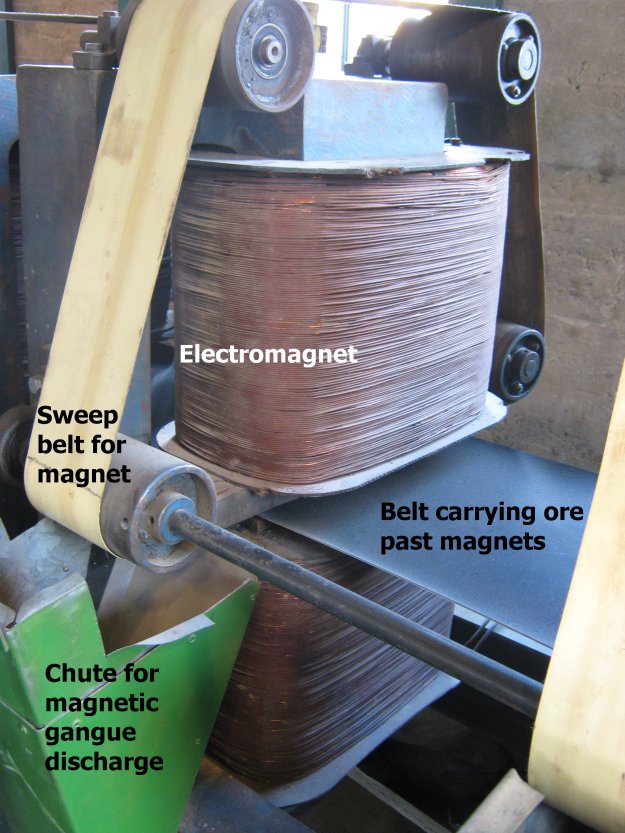
Magnetic Separator Detail
Separating iron minerals from other minerals can be difficult. Iron is more or less ubiquitous in many formations. In any serial refining process it is important to remove unwanted material as early in the stream as possible. The less mass that has to be taken through later-stage energy and chemical intensive processes, the better the economics. Magnetic separation, if it is applicable, is fairly simple. But if considerable comminution is required beforehand, then the energy costs begin to add up.
Three empirical laws describe the cost of comminution or size reduction. Basically, energy consumption (and cost) follows some power law with the surface area generated. If one can cheaply concentrate medium sized grains of solids before further milling has to occur, a cost savings might be had as inferred from Rittinger’s, Bond’s, or Kick’s Laws.
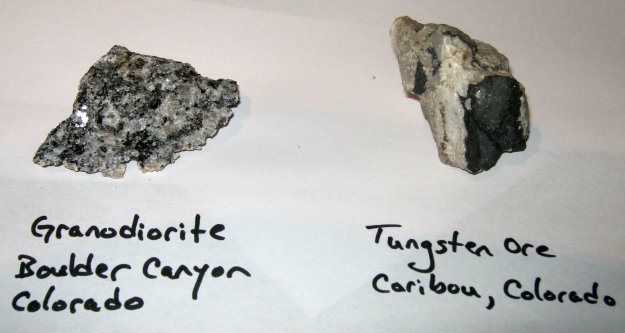
Samples of Granodiorite and Tungsten Ore
Along much of the route from Nederland to Boulder the predominant rock seen in the canyon is granodiorite. This mineral is similar to granite but is more mafic in nature, meaning that it contains less potassium feldspar and more plagioclase which is richer in Na and Ca. According to Wikipedia the Rosetta Stone is carved from granodiorite. A softer stone would have been easier to carve- I would have picked sandstone if I were the chisler.
The Rosetta Stone sits at the British Museum in London and is surprisingly large- it’s as big as a section of residential sidewalk.
 Lamentations on Chemistry
Magnets. Sounds very green. I wonder what type of metal ore is the most environmentally friendly type to mine (aside from the blast pits and tunnels. Gold, with its cyanide/mercury isolation is pretty brutal).
Seems greenish, sort of I suppose. One source says that comminution consumes 5 % of the worlds energy. The magnetic separator above will require a fair amount of crushing to achieve a particle size that would allow clearance between belt and magnet.
The museum had no information on how effective this gadget was. It doesn’t seem to be worn out from use, which may say a lot about it. or the mine ran out of funds.
The magnet’s effectiveness depends upon its field gradient as well as its strength. If the bottom pole were wedged or prickled, sharp ends toward the belt, it would work better. (Pot the surface to make it smooth – more likely slightly rippled to minimize friction- against the belt). Kaolin slurry is cleansed of trace colored transition metal muck by running it though a tube loosely packed with steel wool and surrounded by a supercon solenoid.
MT Magnetic Equipment Co.,Ltd is specialized in producing iron separators, magnetic separators, vibrating feeders, vibrating screens, crushers, tailing recovery equipment, conveyor belt scales, adjustable magnetic reunion equipment, magnetic filters, belt conveyors and etc
Our products are widely used in metallurgy, electric power, mining, building materials, cement, brick, refractory, coal, chemical, food, paper, glass, ceramics and other industries,
our products have been exported to Italy, Germany, South Korea, Vietnam, the Philippines, Indonesia, Pakistan, India and other countries.
For any requirements, contact us now.
Frozen Dead Guy Days is in Nederland, not Ward.
That’s what I thought, but I’ve seen links that say otherwise. Thanks for the correction.
Wow; it a nice blog; well you can also get more related info with visit a link given below:-
http://www.magnetic-equipments.com – offering a wide range of vibrating equipment, suspension magnet, overband magnetic separator, magnetic grill, plate magnet, magnetic drum separator , magnetic pulley magnetic sweeper etc.
Are there latest usable versions of this machine that could be used for tin and colombite processing?
Magnetic separation is an established field and there are companies that make this equipment.
http://www.mastermagnets.com/content/view/29/9999/lang,en/
As far as use for Sn and Nb ore processing, you’ll need to have some testing done or consult the literature for specifics. I’m not up to speed on these ores.
I do not know the origin of the mag separator in the photo. Next time I’m there (next summer) I’ll take a look for a name plate.
it is a nice blog.you can also get more products visit a link:http://www.linuxmagnetics.com