Monthly Archives: August 2009

Significant New Molybdenum-Rhenium Find Announced

A significant new ore deposit of molybdenum and rhenium has been announced by Ivanhoe Australia. The Merlin Mo-Re deposit is located in western Queensland, Australia, south of Cloncurry. The deposit is said to be worth $6 billion Australian. The core sample shown on a download contains 2.25 % Mo and 29 g/t of Re, according to the company.  The principal ore is Molybdenite, or molybdenum sulfide.

Ivanhoe claims the advantages of the ore stem from the high grade and shallow depth. High grade ore requires a smaller refining facility. Ivanhoe says that its rhenium is not a byproduct.

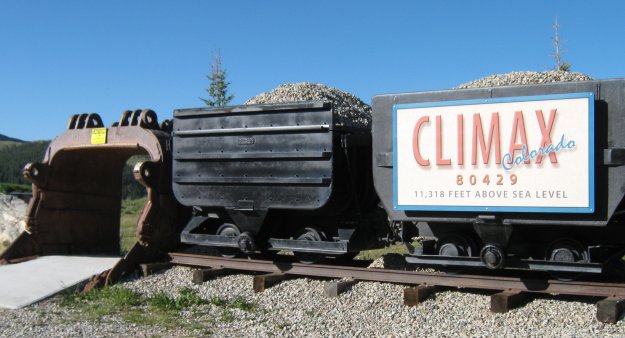
Climax Molybdenum, a Freeport-McMoRan company, is also a producer of rhenium products. Climax Molybdenum operates the Climax mine on Freemont Pass near Leadville, Colorado, and the Henderson Mine near Empire, Colorado.

The geochemical association of Mo and Re is apparently not limited to a unique location. Molybdenum deposits at Ivanhoe, Climax, and Copaquire all have associated rhenium.  Rhenium products such as rhenium pellets and ammonium perrhenate are supplied by Climax Molybdenum in addition to a variety of metallic moly and moly chemicals.

International PBX operates the Copaquire Mo-Re-Cu porphyry project in northern Chile.  The company estimates that 47,000 to 60,000 lbs of indicated rhenium reside in their part of the district. According to PBX announcement, the indicated moly is between 203 and 253 million lbs and indicated copper lies between 364 and 563 millions lbs. The company is quick to point out that 25 % of the deposit is above ground in a mountain.

As of 2005 the three leading producers of rhenium were Chile, Kazakhstan, and the USA, with the USA having the largest known reserves. How the Australian find will alter this distribution is unclear at this time. The estimated rhenium trade in 2005 was $32 million.

Rest Stop on Freemont Pass at Entrance to Climax Mine

Rest Stop on Freemont Pass at Entrance to the Climax Mine


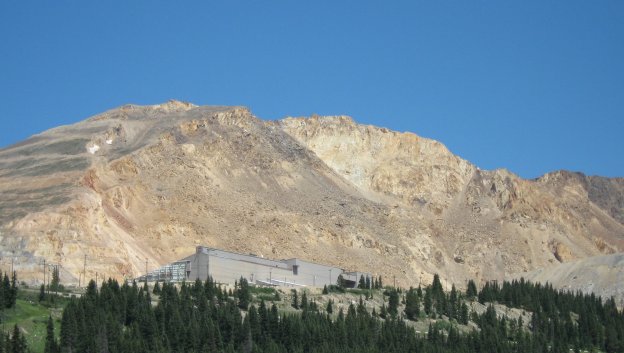
View of Climax Mine (Copyright 2009 All rights reserved)

View of Climax Mine (Copyright 2009 All rights reserved)

The above photo of the Climax mine shows a processing building with what remains of Bartlett Mountain behind it. In fact there is a considerable lode of moly remaining in the mine.

Health Care and the Bell Curve

In watching the political turmoil associated with health care, I’m reminded of how populations fall into bell-shaped curves. Some attribute sorted into some kind of frequency is represented as a distribution having a small population of outliers on either side of a larger population representing the mean.  There are normal distributions and distorted distributions. As you might imagine, the details and nuances require a good bit of coursework to comprehend.

So from between our bare feet on the Lazyboy recliner we can passively view on high definition television the spectacle of a kind of replay of The Empire Strikes Back. We can watch as a small cadre of elite influence workers (lobbyists) practice the art of propaganda upon a group of lazy thinkers. Dick Armey is still with us, but now he is stirring up the muck behind the curtains.

Some have cynically observed that what we are witnessing is one group of dumbshits rattling another group of dumbshits. A more polite description might be that it is a matter of the sly and conniving having their way with the analytically challenged. 

People who are vehemently against big government somehow find it acceptable to be shills for big business in this battle.  All in the name of marketplace economics. But the fact is that the medical industry “marketplace” is deeply distorted and is itself far from being a system that can respond to consumer demand. The supply and demand balance is not sensitive to the needs of the patient- supply and demand is a battle fought between insurance carriers (the economic consumer) and medical organizations (the supplier).  

Consumers of medical services have few real choices- be sick or plug into a complex, gold plated system. In order for the medical system to be a functioning marketplace, there must be lower octane choices for the consumer.

That part of the affluence bell curve that cannot pay for modern, high tech, and expensive health services really must have access to a form of care that they can afford. The health care “debate” should focus on new forms of affordable medical services rather than simply new mechanisms of payment for a system that is economically distorted and inaccesible to significant numbers of people.

Medical school needs to be cheaper so that more universities can train more doctors to feed into the market. This is a supply & demand question that we seem to be unable to even define. The professional and business elitism of medicine must be toned down a bit. It is not sustainable.

The Gangues of Leadville

The mining history of Leadville, Colorado, is well documented and the details are left to the reader to pry out of the internet. As a process chemist, my interest in mining is more directed to the geochemistry and milling of the ore. How did they get the pay out of the paydirt?

How does it come about that we can get our hands on particular elements like molybdenum, gold, silver, uranium, tungsten, vanadium, etc? How do the elements manage to concentrate into ore bodies that are worth the effort and expense to refine?

When you take the various mine tours around the country, the spiel offered by the guide is usually geared toward the lowest common denominator- our fascination with fabulous wealth. The miners were certainly taken with the possibility of wealth. Gold and silver mines are an easy sell because everybody has greed and everybody yearns to pluck a fat nugget of gold from a pan of gravel.  Other types of mines are a tougher sell entertainment-wise and require a bit more explanation of the relevance of the obscure element that is being extracted.

Mining is an activity with good and bad effects. To sustain modern civilization, if you can’t grow what you need, you have to mine it. Mining is inherently extractive in nature and requires that large volumes of earth be disturbed. Open pit mining requires that overburden be removed and the mineral value be moved to a processing site. Material sidestreams are generated and must be dealt with. 

Underground mines also generate large volumes of material that must be piled somewhere. To ensure responsibility for reclamation costs mining companies are required to put up a surety bond to cover the costs of future reclamation under 43 CFR section 3809.

The inevitable trade-off that a society must make is one of environmental insult for material goods. The balance point is always hard to find, and in fact is usually a moving target on account of politics, employment, and environmentalism.

Mining can have substantial effects on the landscape, the watershed, real estate, and the future tax base. Land that is not available for habitation or sustainable commercial use is fundamentally limited in potential value. An area covered with mine tailings, mine shafts, the occasional blasting cap, and acidic runoff is an area that requires cash infusion on a long timescale.

But if we enjoy the benefits of lead batteries in our cars, or silver jewelry, tungsten elements in our light bulbs, zinc plated wire fences, or the ten thousand other metal products in our lives, we must come to grips with the consequences for having such material goods. At some stretch point, everybody becomes a Luddite. Question: How much technological triumphalism can we take? Answer: Whatever the market says we can take.  

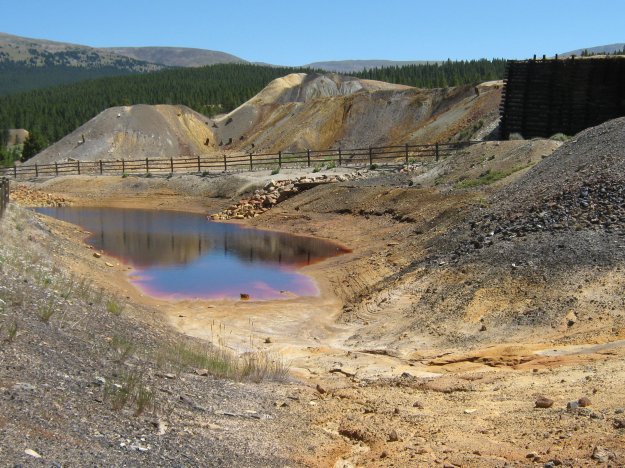
Runoff Collection Pond from Mine Tailings in Leadville Mining District.

Runoff Collection Pond from Mine Tailings in Leadville Mining District.

Our society has benefitted greatly from metallurgy. The compulsion to recover metals from the ground is one of the great economic forces in civilization. No amount of highminded pontification will stop it. Metals enable industry and war which are forever entangled in politics and greed. The goal is to be smart about how we mine elements from the ground so that maximum value of the surrounding land may be enjoyed. The enthusiasms of the time come and go. But metals are forever.

Mine Waste, Leadville Mining District August 2009

Mine Waste, Leadville Mining District August 2009

Plum-bummin’ in Leadville

After an insane week in the lab a road trip to the cool meadows of the nearby mountain range was just what the doctor called for. It was the last weekend before the family- one teacher and one kid-  return to school. Summer break 2009 is history.

We piled in the car and pointed it uphill towards Leadville, Colorado. The planetary atmosphere thinly blankets this insanely high mountain city. It was just what I needed to clear my scrambled mind. Nothing like blinding sunshine and mild oxygen starvation to reset a brain in chronic spasm from sensory overload.

Leadville sits at 10,152 feet above sea level.  If you doubt the effect on your stamina, just take a short sprint in any direction. Or just plod up the stairs of your hotel. Lordy.  All of those business dinners- all that lovely Cabernet and creme brulee- and years of driving a desk have caught up with me.

Leadville is located in the Colorado mineral belt and began to populate with fortune seakers about the time of the Colorado gold rush in 1859. Some placer gold was found in the streams, particularly in what was then called California Gulch, but for the most part Leadville became a silver camp.

In 1874, two investors with metallurgical training, Alvinius B. Woods and William H. Stevens arrived in Leadville and analyzed the muds found in the local sluicing operations. According to A Companion to the American West, edited by William Francis Deverell, (2004, Blackwell Publishing, ISBN 0-631-21357-0, p. 319)  Woods and Stevens found the heavy black mud so problematic for gold sluicing was in fact composed of lead carbonate with high levels of silver.  Woods and Stevens invested $50,000, quietly buying as many claims as they could and began hydraulic mining operations immediately.

By 1890 there were nearly 90 mines in operation employing 6000 miners. At its peak there were 14 smelter operations supporting the mines. Leadville was a genuine boom town with the expected mix of characters.

A mine is a hole in the ground with a liar standing at the top.

All mining towns have characters who go on to dominate local legends and stories. Among the well-known-for-being-famous rags to riches to rags players in Leadville are Horace and Agusta Tabor, along with Horace’s mistress and 2nd wife, Elizabeth “Baby Doe”.

To make a long story short, Horace was a struggling shop keeper who invested in a mine east of Leadville. Though it was salted by the previous owner to entice buyers, Tabor dug 25 ft further down the shaft and struck a rich and extensive vein of silver ore.  The operation was called the Matchless Mine, after Tabor’s favorite brand of chewing tobacco.

According to the tour operators, Tabor operated the Matchless Mine 24/7 for 13 years, pulling an average of $2000/day of silver out of it. At its peak, the mine is said to have employed 100 people. Miners were paid the common rate of $3.00 per day to climb 365 ft to the bottom of the shaft for 12 hour shifts.
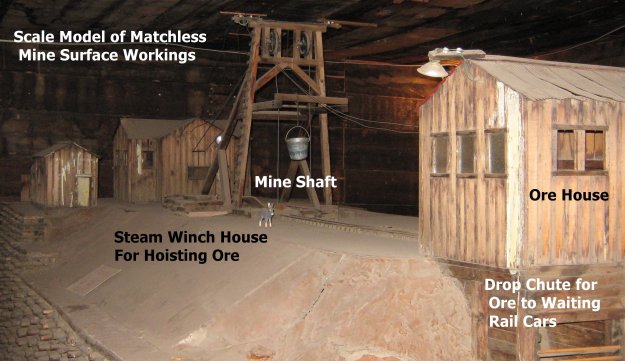
Matchless Mine Surface Workings
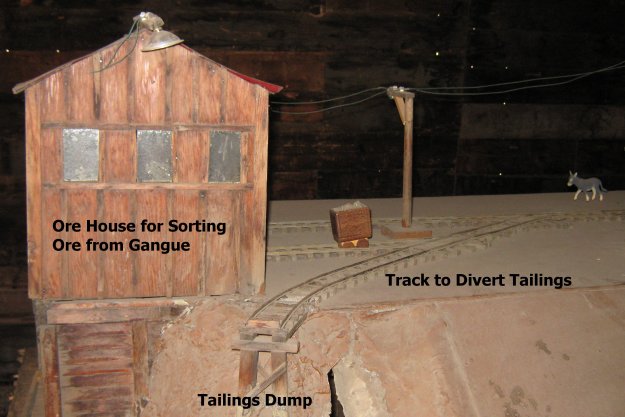
Matchless Mine Surface Workings

Gangue Dump Detail

Tailings Dump Detail

The underground workings of the mine followed the vein structure and focused on sending concentrated ore to the surface. Buckets carrying approximately one ton of ore per load (my estimate) were tipped into ore carts and rolled into the ore house for hand sorting. The most highly concentrated and valuable ore was dumped down a chute for loading into a rail car and the gangue (or tailings) was dumped into the gulch.

An assay building (not shown) was on site to provide a continuous assay and accounting of silver sent to the smelter in Pueblo, Colorado. Unlike many other mine operators, Tabor owned a rail operation and had a spur at the mine for pickup and delivery of ore. Many mine operators had to employ mule-skinners to cart wagon loads of ore to a rail siding for transport to the nearest smelter.

In 1893 the repeal of the Sherman Silver Purchase Act and the collapse of the railroad industry bubble were part of a panic that lead to a crash in silver prices. Tabor lost everything and, as a respected public figure, was appointed postmaster of Denver for a short time. Eventually Tabor died at age 69 in 1899. Ex-wife Agusta had invested her divorce settlement wisely in Denver and lived comfortably. Widow Baby Doe Tabor was found frozen stiff in her shack at the Matchless Mine in 1935.
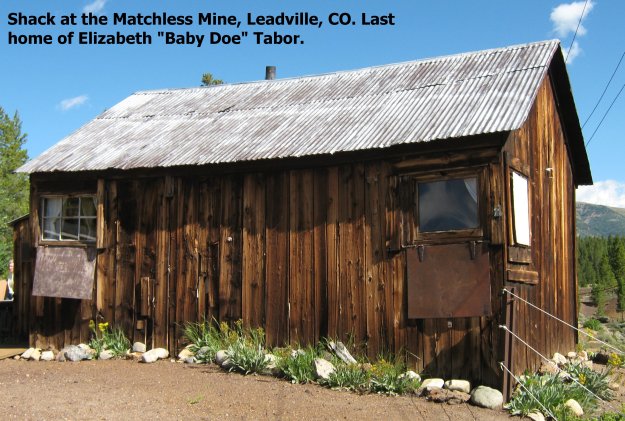
Matchless Mine Shack

Matchless Mine Shack

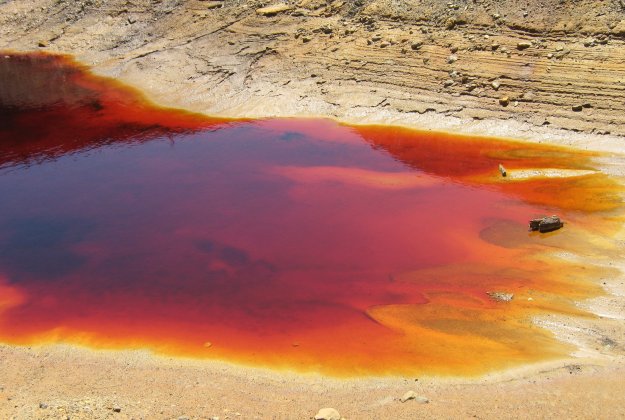
All of the digging from the boom time of Leadville has left an enduring legacy for those who live in the watershed. Much of the mining activity occurred uphill, east of the city and as a result, that area is pock marked with many large colorful tailings heaps. While the colors are interesting to ponder and sample, the ground and surface waters are greatly affected by aqueous extraction of metals from these piles.

If you stand next to one of these heaps, you can’t help but notice the smell of sulfur. The ore and tailings are enriched in sulfides and once exposed to air and water, oxidation occurs to make corrosive runoff. This is a kind of heap leaching phenomenon that will eventually exhaust itself, but only at the cost of water quality.
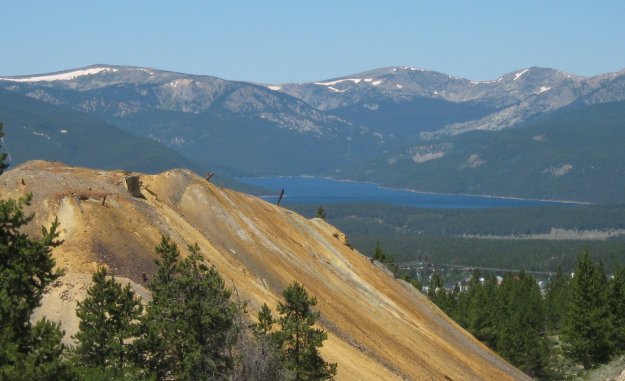
Boomtown Legacy

Boomtown Legacy (Copyright 2009 All rights reserved)

Flocking Algorithms

A company called Atair Aerospace offers an autonomous parachute system comprised of self-guided chutes that, according to the site, are able to avoid one another in multiple drop scenarios. Thus the need for “flocking algorithms”. The company claims a ~57 m accuracy in some of its parachute dropping systems.  The company also makes an Inertial Measuring Unit that combines input from GPS, inertial, and barometric sensors, all in a package the size of a Buffalo wing.

Interesting quote from the Daily Kos

> For all of our bad-assity—all our guns and nukes and soldiers and cops and black helicopters and warrantless surveillance and militias and tough talk and the fact that our private citizenry is armed to the teeth with every type of firepower imaginable, we sure scare easily. Half the stuff over which we tremble is a figment of our own overactive imaginations. But one thing is as real as it is backwards: we fear our government, but our government does not fear us.

> Our media is so afraid to offend anyone that they go out of their way to give both sides of an issue equal weight, even if one of those sides is either factually incorrect or batshit crazy…thus slowing down our progress as a country even more.

Ah, yeah. Pretty much.

S.O.L.

I’ve been too busy inserting Mg into R-X bonds to pay attention to the www. The DSC is on the fritz and the ethernet is playing games with my TGA.  I need to run an FTNMR and a GCMS of my cpd ASAP. Luckily the HPLC is still spewing out results. I treated my headache with NSAID’s but my ADD is flaring up. The Jeep is in the shop, DOA, and I’m PO’d.  I need to gin up a procedure for the ARC and RC-1 tests. And, worst of all, I’m out of concentrated givashit. SSDD.

So there.