
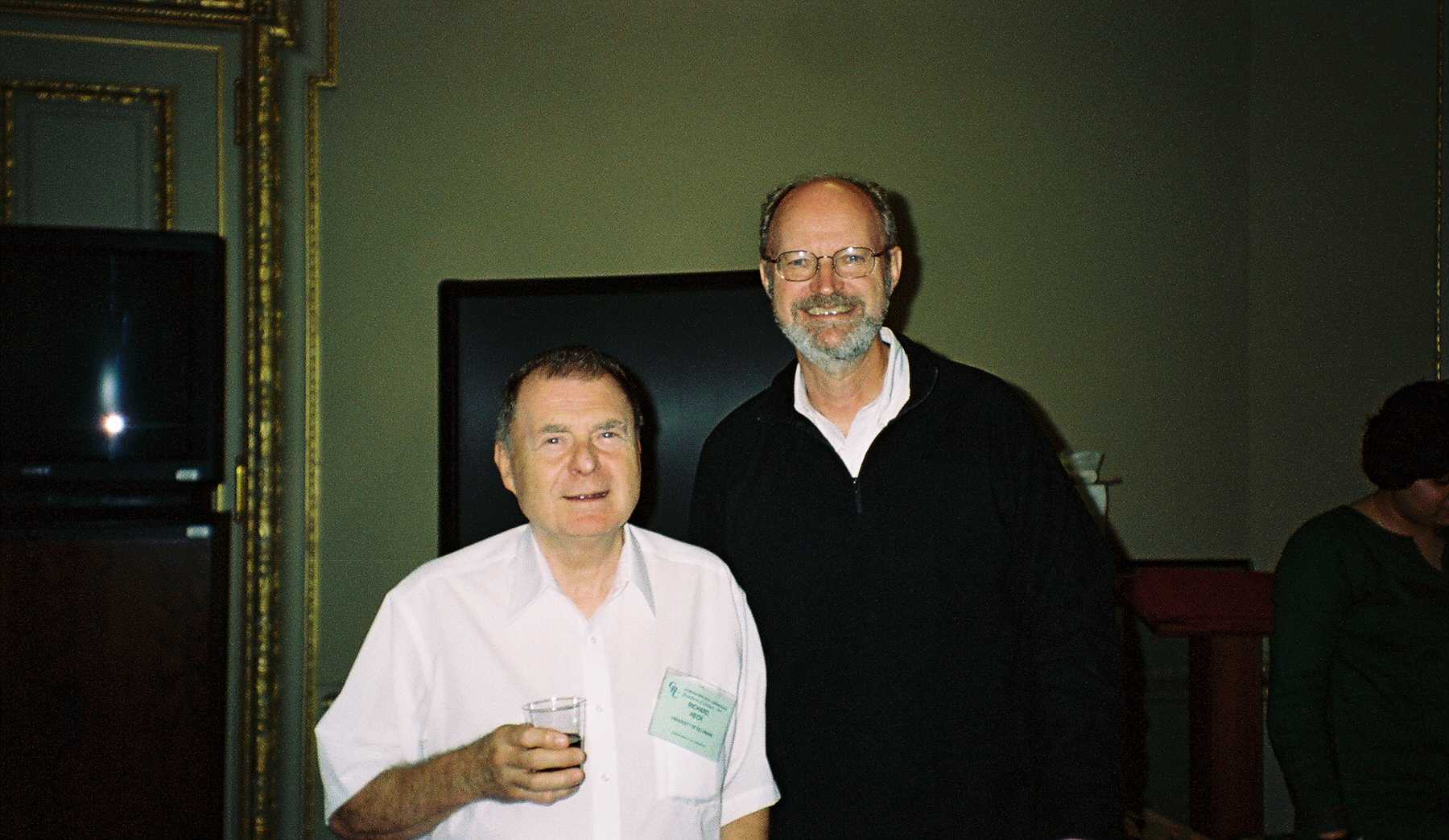
Richard Heck and Bob Grubbs, Gordon Conference, Salve Regina, 2005
Here is a picture I took of Richard Heck in the spring of 2005 posing with Bob Grubbs before his trip to Sweden. This was taken at the Organometallic Chemistry section of the Gordon Conference at Salve Regina in 2005. It is a great place to spend a few days giving or listening to chemistry talks, though the dorm accommodations are a bit spartan.
I think the 2010 Nobel Prize in Chemistry for Heck, Suzuki, and Negishi was well deserved. The coupling reactions they uncovered are a great alternative to some otherwise awkward transformations and have enabled much development around the world.
Here is my question- Is -B(OH)2 a meta or an ortho-para director for electrophilic aromatic substitution? At least in principle. In practice it is difficult to determine due to competing deborylation.
This was taken on one of my very last rolls of Kodacolor film.
 Lamentations on Chemistry
thanks for posting this Gauss! You have shown great restraint in your pithy comments.
I’m trying to be nice.
I’m not the best at electronics, but it’s my understanding that boron is not so electronegative. Therefore, it’s more likely to be an ortho/para director.
I’d compare its electronegativity to H, which is usually right in the middle of those activating/deactivating charts for EAS substituents.
It’s been ten years or so, but I remember doing a problem where the o vs. m vs. p reactivity of boron-subtituted aromatic rings can be tuned by adding Lewis bases that complex with the boron atom. I can’t remember how substantial the effect was, though.
One expects boron to be a meta-director from its propensity to pi-quaternize into an anion, Ar=[B(-OCH2CH2O-)](-) via ring electron withdrawal in addition to being a sigma-electron withdrawing substituent (hard Lewis acid). The same mechanism renders nominally sigma-electron withdrawing, meta-directing halogens into ortho,para-directing pi-electron donating substituents, Ar=X(+).
Call them inductive and conjugative couplings in LCAO theory. No doubt MO theory has elegant obfuscative jargon that works better in dilute phase vacuum than condensed phase in Pyrex. Make your choice: produce or publish.
.
I don’t know. I’ve done some UV/Vis spectroscopy with phenylboronic acid cyclotrimer looking for signs of delocalization of O lp’s onto boron. There is very little extinction beyond that of the benzene rings. A friend (Bill) did some Gaussian calculations for me looking for UV transitions and only found transitions consistant with sigma electrons. So, including the low electronegativity of B, it is hard to believe that the Boronic ester functional group is much of a pi acceptor. Aromaticity in the B-O ring system of the trimer would appear to be quite weak just from the low UV absorption.
Bummer. (NO2)+ (BF4)- in sulfolane sits a bottle. Add it to some NaBPh4 solution, triphenyl boron solution, phenylboronic acid anhydride solution. That’s a hefty kick in the pants for aromatic substituton.
Real fun would be Hydride Sponge [1,8-bis(dimethylborono)napthalene] with -C(CN)3 or Meldrum’s acid anion. Would a symmetric pentacoordinate carbon result? If so… TCNQ, Proton Sponge, Hydride Sponge 1:1:1. Two pentacoordinate carbons as the zwitterion?