I found this cartoon over at High Power Rocketry.

[There was no citation for the art work.]

I wish to make a few remarks on current news items of interest.
Country singer Randy Travis was found in a ditch in north Texas allegedly drunk, naked, and belligerent following an apparent one car accident. Crimony! It’s that awful Nashville music that he sings. If I sang that twangy, mornful, depressing stuff all the time, I guess I’d be sloppy drunk in a ditch too. He should dry out and switch to show tunes or something a bit more cheerful.
It seems that while the televisions and internets of the world are busily dulling enchanting us into the delusion that our ever accelerating consumption of resources and expansion into wild spaces are having no effect on the “natural world”, the global ecosystems are actually in trouble. I emphasize natural world only because so many of us are preoccupied with the on-line world. In fact, many are worried about a “state change” in the global ecosystems.
In Approaching a state-shift in Earth’s biosphere, a paper just published in Nature, the authors, whose expertise spans a multitude of disciplines, suggest our planet’s ecosystems are careening towards an imminent, irreversible collapse.
Earth’s accelerating loss of biodiversity, its climate’s increasingly extreme fluctuations, its ecosystems’ growing connectedness and its radically changing total energy budget are precursors to reaching a planetary state threshold or tipping point. [ The Automatic Earth, August 6, 2012. ]
I know, I know. Sounds like Chicken Little. But we should pay more attention to our small planet. The atmosphere is thinner than most people think, the fisheries are stressed, desertification is happening in Africa, and human population pressures are mounting in many locations. We can’t keep the extractive industries going forever. We need to find an economic model or culture that allows us to do with less mass. Reduced consumption per capita. Look, it’ll happen anyway as key resources dwindle.
We should be aggressively recycling lithium, gallium, tellurium, indium, and the rare earth elements in particular. These are key elements in our much beloved electronic devices. There are other materials to watch, including hydrocarbons in general. A society with infrastructure causing one to hop in the SUV and drive 5 miles from their isolated subdivision to buy cigarettes and beer is a society that is on a rendezvous with destiny.
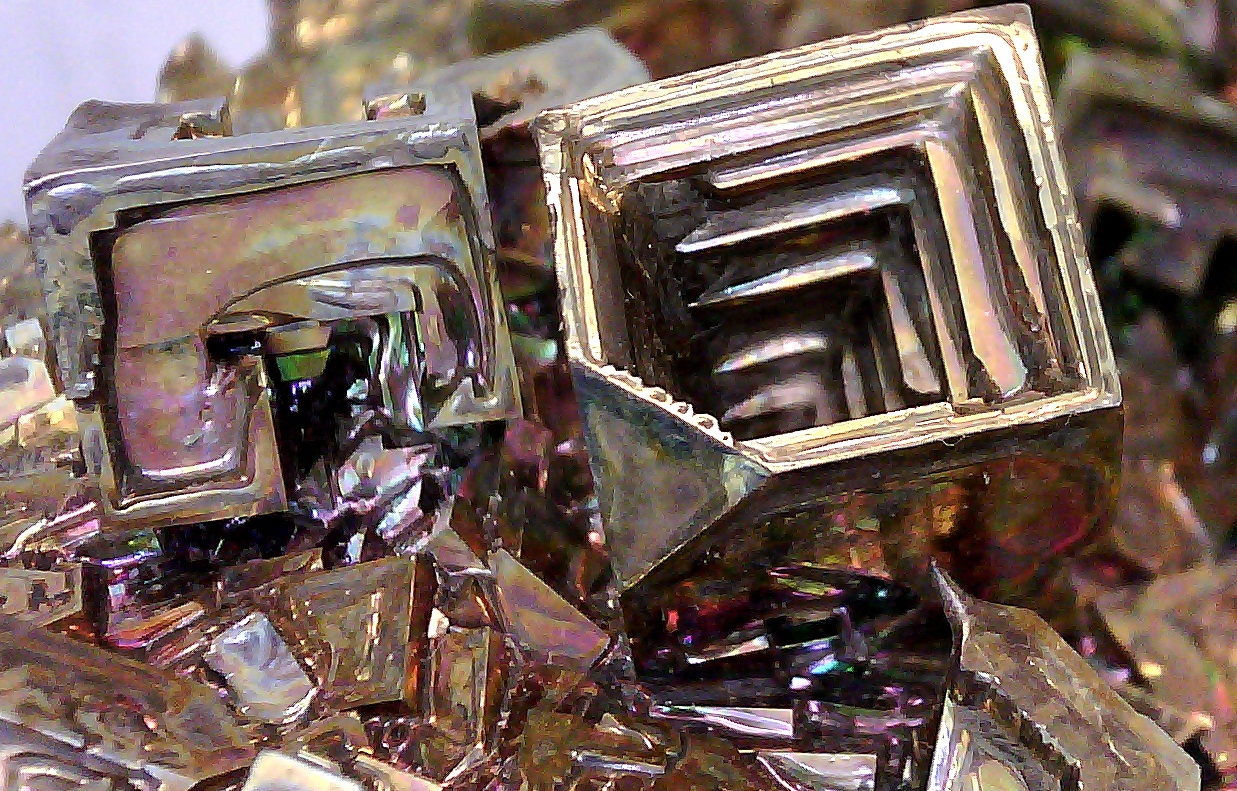
Bismuth crystals on my desk
Nothing too unusual here. Just some bismuth crystals sitting on my desk. A metallurgist friend died recently and his family passed along some of his samples to me. Virg was a great guy. He knew how to conduct himself with decorum like a civilized human being. I don’t confer this praise on everyone.
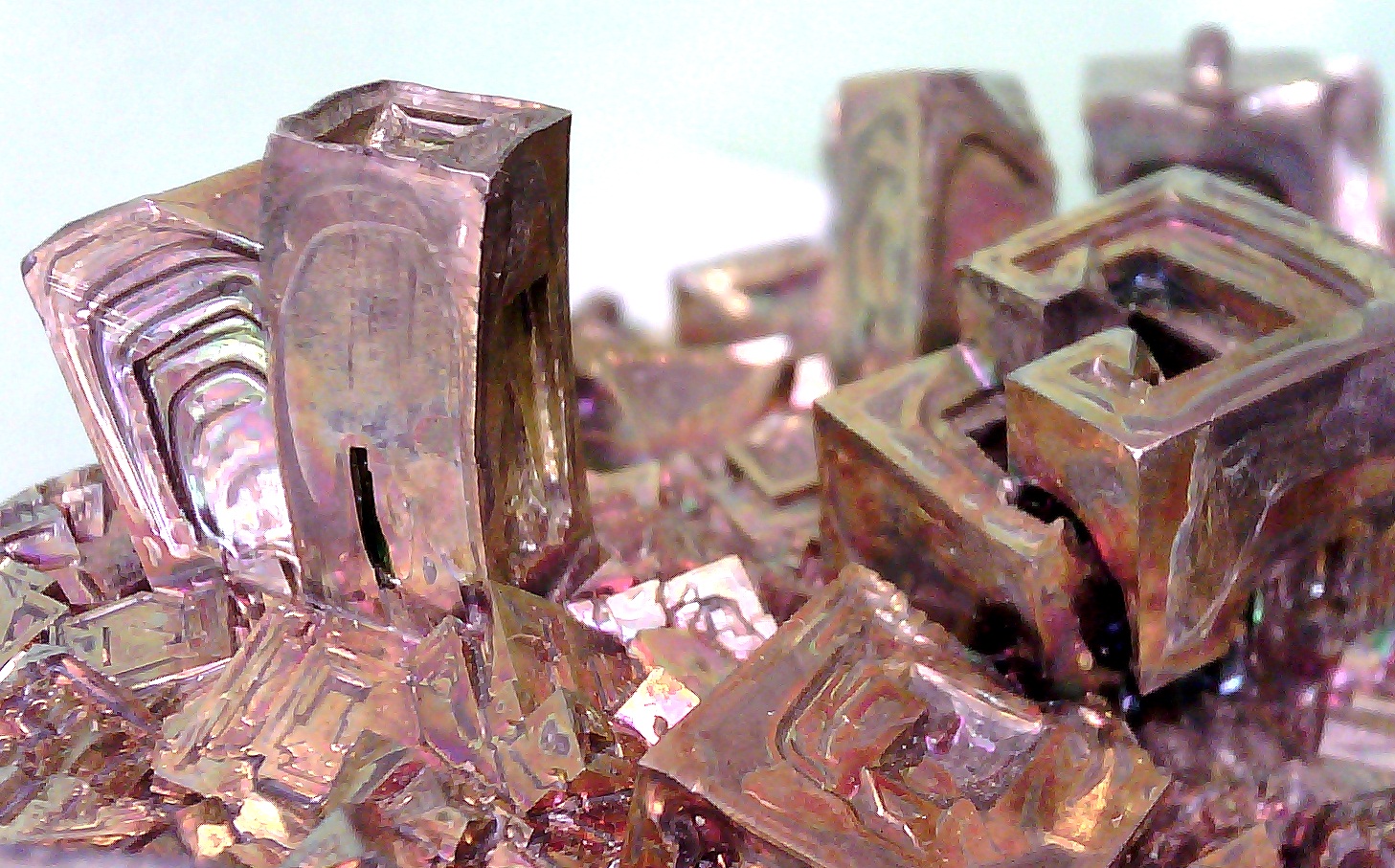
Bismuth City
I think many people find some kind of solace in the orderliness of crystals. Nature has seemingly betrayed the prevalent trend of disorderliness to produce a latticework of pristine stuff in appealing shapes. Crystals appeal to our innate desire for symmetry and rectilinearity. We subconsciously associate symmetry with goodness and calm. Properly stacked goods in your basement suggest orderliness. Shoes lined up in the closet or socks neatly arranged in the drawer provide a reassurance that something in life is at least predictable.
Crystallinity infers a repetitive array of subunits asssembled under the austere constraints of efficient stacking. It represents subunits held in confinement and subject to limits on motion.
Crystallinity is in a sense sterile and lacking in diversity. Living things are not crystalline for the most part. Crystallinity is static and devoid of the many necessary degrees of freedom needed for life. Living things often have superficial symmetries, though on closer inspection something inevitably cracks the symmetry. Humans have a bilateral symmetry across a line taken from the head to between the feet, as do butterflies and hippos. Internally, though, the symmetry is less than obvious. Our genetic polymers of DNA have a gross secondary helical symmetry as do some peptides, but even that yields to partial symmetry when the monomeric units are accounted for. Sure, there are instances of crystallinity in living things. But living things require a fluid internal environment to allow molecules to collide and react.
If you take crystallinity as an allegory of perfection in the sense of a way of being- that is, orderliness and freedom from defects- then you might conclude that a perfect being would be constrained by symmetry or the attributes of perfection. It would seem that the attribution of perfection in a being might pose the possibility of limitation.
Instead of getting wrapped around the axel philosophically, perhaps we should gladly rejoice in the lack of perfection in ourselves and the ultimate absurdity of perfection in the fanciful dieties whom we imagine control the vibration of every molecule in the fleas that ride on the tailfeathers of every sparrow.
Photo of Curiosity during descent phase, taken from orbit. This shot is amazing all by itself.

Curiosity in descent phase. Photo taken by NASA’s Mars Reconnaissance Orbiter. Credit: NASA/JPL-Caltech/Univ. of Arizona.
Curiosity is powered by a Pu-238 oxide thermoelectric generator. The Multi-Mission Radiosiotope Thermoelectric Generator, MMRTG, has an output of 2000 watts thermal and 100-120 watts electric. The MMRTG unit sits in the aft end of the rover enclosed by a finned heat exchanger.
 Lamentations on Chemistry