
Monthly Archives: April 2013

Ice stalks. A winter oddity.

Yesterday I placed clay sorbent granules on my steep, north facing driveway to add some friction so the car and visitors can negotiate the grade in the snow and ice. The clay granules are used for absorbing oil and are similar to cat litter. I used the granules because I did not have sand.
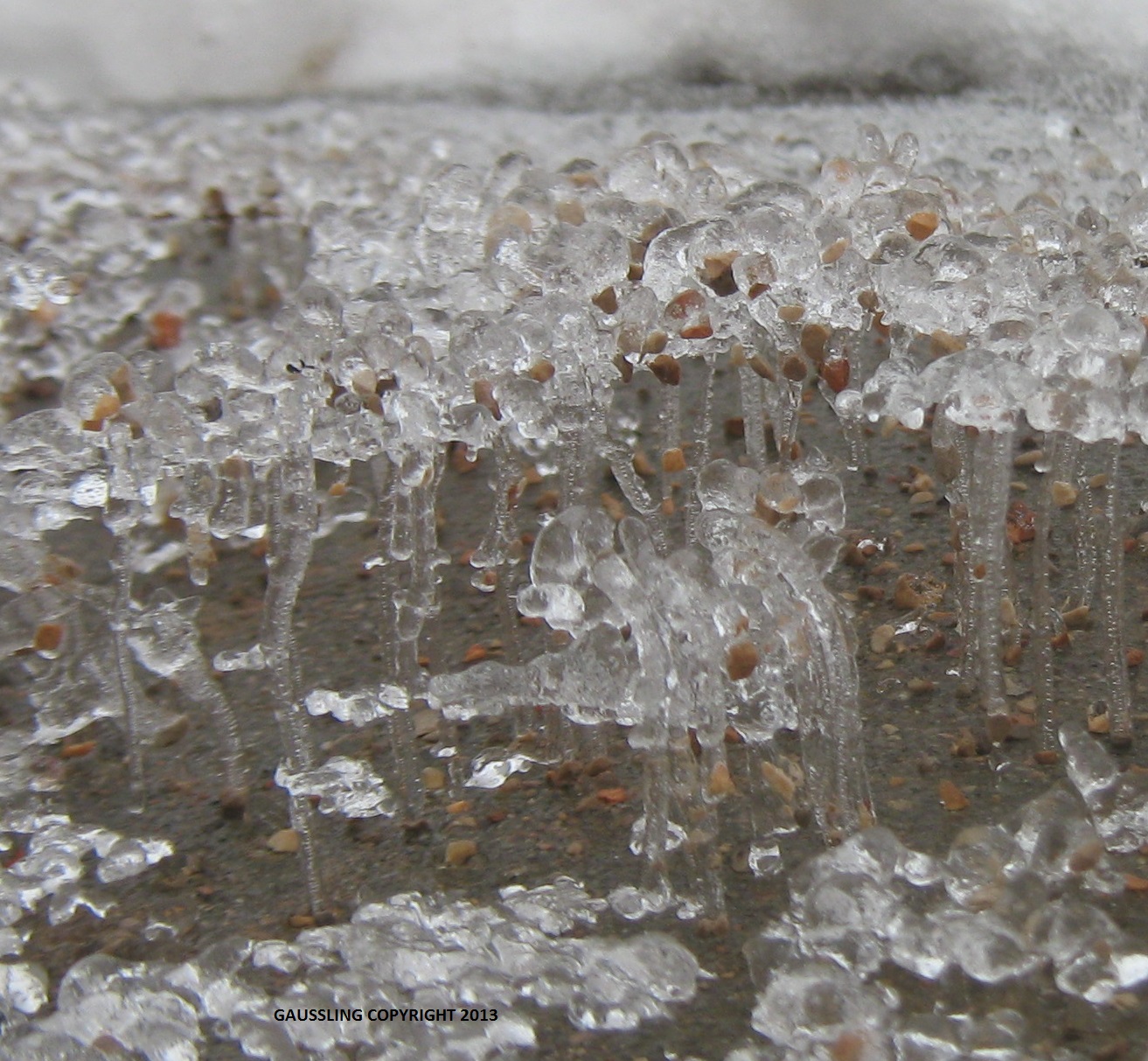
Curious ice formation. Copyright 2013 Th' Gaussling.

Ice stalk formation. Note that many of the clay granules have been lifted by the slender stalks of ice. Copyright 2013 Th’ Gaussling.

The granules were deposited on freshly shoveled concrete with just a thin layer of clear slush. I would estimate that, overnight, the temperature ranged between 25-32 F. In the morning, the 1-5 cm stalks of ice were observed only where the granules were deposited.

The slender stalks were capped with flat, irregular plates of ice.  Many of the stalks had lifted granules off the ground. Most appear to have arisen from the granules. Obviously, the process forming the stalks lifted some of the granules and ice vertically. Curved ice stalks appear to have extruded gradually from the granule and, under the influence of gradually shifting cover of snow or other ices, have extended produced a curved shaft of ice.

The granules are manufactured with absorbency in mind.  In this circumstance, I will hypothesize that capillary action pulling liquid water from the concrete surface is delivered to the upper surface of the granule where it freezes at the air/water interface by evaporative cooling. Why it doesn’t just stop is puzzling. Perhaps the action of freezing at the granule upper surface reduces the vapor pressure of water enough to induce a small pressure drop through the pores of the clay that draws liquid phase to the surface where is freezes continuously. The heat of fusion at the surface may be sufficient to prevent freezing of the water within the pores of the granule in the subfreezing range of the air and shutting the process down.
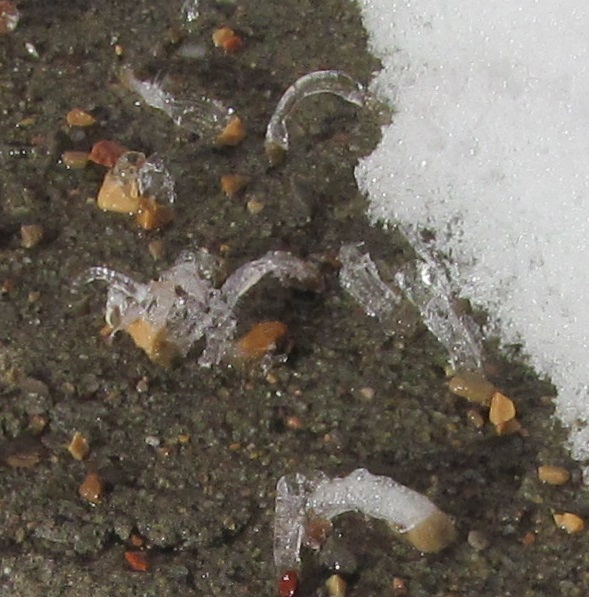
Ice Stalks 2

This is a very curious type of ice formation, one that I have observed on two separate occasions. This is another odd thing water can do.

Priestley Medal 2013

Congratulations to Professor Peter J. Stang on winning the 2013 Priestley Medal. The C&EN bio at this link reveals quite an interesting career.

Oh, by the way.  Am I the only one to notice some faint resemblance between the Medal winner and Ambassador Sarek from Star Trek? Face it. Being a JACS editor is about the same status as an ambassador.

Well, it depends …

Getting technical people to offer insight and advice can range from simple to vexing. Following a recent purchase of an unusual type of spectrometer we found ourselves in need of advice regarding consumables and sample preparation. Going into this installation I believed, naively, that our set up to operate the new instrument would be eased by patient advice from the seller.  I was mistaken.

I could whine on about deficiencies in this or that, but instead I’ll get to my point. Consider the following exchange-

Q:  What sort of electrode should we use to run this mineral sample?

A:  Well, that depends.

Q:  It depends upon what?

A:  Well, it depends on the type of matrix you have and the concentration of the desired metals.

Q:  How do we decide on what kind of electrode to use?

A:  We do not have experience with that element or that matrix. And there are many kinds of graphite widgets, many for specific uses. The widget company did not return your email because they are small and would prefer to talk to their customers.

Q:  So, how do we get started?

A:  You’ll have to prepare bracketing calibration standards that match your matrix as closely as possible.

Q:  What can you tell us about buying or the preparation of calibration standards? Are there any special materials we can use as diluents or any preferred methods?

A:  There are no manufacturers of these solid calibration standards anymore. We bought out the inventory of the last one.

Q:  So we can compound our own standards at concentrations close to the spec of the inventory you hoarded bought out?

A:  Well, yes, I suppose. It depends on your capabilities ….

And on it went.  Eventually we extracted the information we needed and are moving forward.

Here is my point. Everything “depends”.  A little louder.  EVERYTHING DEPENDS. For crying out loud!  This is one of the fundamental theorems of life. We technical people have to get past this barrier when a questioner asks for help.

A few sentences of advice-

On the assumption that everything depends, offer a hint to the questioner in the form of a range of possibilities. Open with insightful examples or a recitation of common practices. Do not sit there, Sphinx-like, while the questioner sputters and struggles with finding the best questions. Offer some guidance by way of general performance boundaries.

The technical service folks we spoke with were very much in the quandary of Buridan’s Ass. In this fable, a donkey was in between two identically appealing piles of hay. In the end he starved to death because there was no good reason to pick one over the other.

In the case of the tech service folks, one pile of hay was to offer zero advice and make no errors. The other pile of hay was to offer frank advice and satisfy the customer. Having been in this position, I know that offering advice has it’s appeal, but it may be fraught with liability. Telling people how to run their equipment can have negative consequences- thus the reluctance to speak. But sellers are there to service their customers. They should use words and pictures to help their customers get started.