
I found myself up north in Casper, Wyoming, with friends for the 8/21/17 solar eclipse. We were modestly equipped for the spectacle. A member of our small group brought a Celestron 8″ Cassegrain telescope with solar filter and clock drive. We set up in an uncrowded neighborhood and began the wait.
Knowing that Casper would be crowded I had arrived 2 days early to explore some of the local geology. Jeez- I guess that makes me a geotourist. This activity gives a person a mission to complete. Pick some locations to visit and go do it within your time constraints. There is a beginning, a middle, and an end. Success consists of finding the location of interest, getting samples and photographs of unique rocks, stata and general landforms.
I’ve had good luck with the Roadside Geology series of books by Mountain Press Publishing. In the case of the eclipse trip, I secured a copy of the Roadside Geology of Wyoming ahead of time at a local Barnes and Noble. These books are quite well written and illustrated, especially important if you’re not packing a degree in geology.
The unique value of the Roadside Geology books is that the content is divided into state regions then subdivided into stretches of highway that you can drive along. Commonly along the highway can be seen many large-scale features described in the book. Even better, photographs and diagrams of road cuts are frequently highlighted. In hilly or mountainous regions there are many road cuts that allow you to view underground features.
Lately I’ve taken to wearing a yellow reflective vest along the roadside while taking a close look at the exposed formation. People don’t expect to see some yay-hoo walking along the road with a hammer and a notebook as they careen around the curves on a mountain road. Best not to surprise drivers.
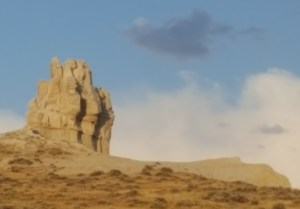
Teapot Rock north of Casper, Wyoming.
There is a bit of interesting US history attached to the geology of the Casper area. The Teapot Dome scandal erupted during President Warren G. Harding’s administration in 1922. Harding’s Secretary of the Interior, Albert Bacon Fall, was caught taking bribes in exchange for awarding oil rights to a subsidiary of the Sinclair Oil Company. The oil field was within the Navy Petroleum Reserve north of Casper.
“Teapot” Dome takes its name from Teapot Rock– a formation that, at the time, had a feature that resembled a spout. This feature is no longer there. “Dome” comes from an anticline fold in the oil bearing strata below. It is part of the larger Salt Creek Oil Field.
The seeing in Casper was good right up to the back third of the eclipse. The Celestron was rigged to throw an image onto a white screen. A chain of sunspots were visible early in the eclipse. As I was equipped with only my Samsung 6 for photography, I did not manage to get great pictures, nor was it really my intent. Sometimes you have to put the camera down and look. Just before totality we saw Baily’s Beads and the diamond ring. The autofocus of the Samsung was unable to produce a sharp image of the beads on the projection owing to the low light level.

Close-up of sunspots early in the eclipse.
When totality arrives you can look at it directly with the naked eye. It’s best to view it without the distraction of equipment. During totality it became noticeably cooler. The eclipsed sun had a wispy corona around it, reaching into space. Around the horizon back on the ground was a beautiful 360 degree sunset. People in the neighborhood were cheering. What a thing to see.
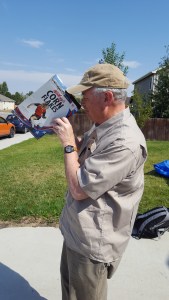
Pinhole projection using aluminum foil and a cereal box.
Here you can see some knucklehead trying to get a view through a pinhole projector cleverly disguised as a box of corn flakes. He commented that the image was only slightly better than nothing. In fact, the image projecting through a colander onto the pavement was superior (below).

Multiple images of eclipse as projected through a colander.
 Lamentations on Chemistry
Wonderful essay. We here in western NC had a band of totality passing within 50 miles of our house. The problem was scattered clouds so we spent the afternoon (pre 2;35p Eastern) chasing the patches of blue sky. We got lucky south of Brevard NC and had about 1 minute of complete obscuration of the sun. You’re right. Totality is different. Close enough is not good enough.
Now we’re looking forward to the next one in 2024.
Hi Phil,
It was indeed an amazing thing. So was the traffic. Drive time to Casper was 3.5 hrs. Drive time out of Wyoming immediately after the eclipse was 10.5 hrs. One estimate of the out of state crowd was 500,000. And we couldn’t get out fast enough. Imagine one of the great basins of Wyoming. Not a sign of people as far as you can see in any direction. Then imagine a thin band of southbound traffic threading through the endless scrub brush, bumper to bumper. Break lights flickering off as a wave of slackness propagates backward and the complementary wave of break lights switch on going forward, jealously scooping up the space between cars. As far as the eye can see.
But I’d do it again.
Your description of the traffic is pure poetry. I think you missed your calling. I can’t imagine that the state population doubled for that day. I’m sure the infrastructure was overwhelmed.