
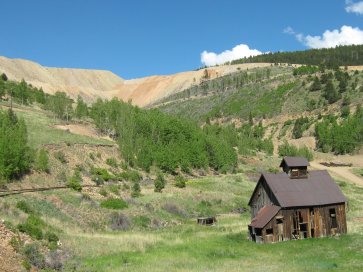
A Blacksmith shop is all that remains of Anaconda, Colorado.
The discovery of gold in the early 1890’s west of Pikes Peak at Cripple Creek was the last major gold rush in Colorado. This discovery coincided with the repeal of the Sherman Silver Act which compelled the government to guarantee a price for silver. The repeal of the Sherman Silver Act led to an immediate collapse in silver prices and the crash of virtually all silver mining operations. As a result, miners in the area made their way to Cripple Creek for newly discovered gold.
Today many of the valleys around Cripple Creek and Victor are largely regrown and quiet. Little indication remains of the towns and mills that once covered the area. Many mining towns were consumed by fire and a few were rebuilt. Once town left to extinction is Anaconda.
In the winter of 1904 a fire consumed the mining town of Anaconda. Today, all that remains is the shell of a blacksmith shop. This abandoned building sits at the end of the line on the Cripple Creek and Victor Narrow Gauge Railroad (CC&V). Near Anaconda were a number of significant mines- the Mary McKinney, the Doctor Jack Pot, the Chickenhawk, the Anaconda mine and others.
Nearby is the Mollie Kathleen mine which is open for tours. This tour involves piling into a small-man lift and dropping 1000 ft into the mine. This puts you below the level of Cripple Creek, located in the valley below. If you are very lucky, the big open pit gold mine on the other side of the mountain will do some bench blasting while you are down there. It’s very exciting. The mountain between the big CC&V mine and the Mollie Kathleen is riddled with shafts and drifts.
The Cripple Creek & Victor Gold Mine east of Cripple Creek is a large open pit gold mining operation run by Newmont Mining Corporation. The gold in the mine is highly disseminated in microscopic form and is recovered by cyanide heap extraction. The CC&V deposit is the remnant of an extinct volcano that is highly brecciated. Hydrothermal water has extracted and transported gold throughout the throat of the volcano and into the surrounding rock. However, much of the gold (ca 30 %) is tied up as gold telluride, AuTe2, also known as calaverite. The gold in calaverite cannot be extracted with cyanide and must be left behind. The tellurium can be removed by roasting and burning off the oxide, but this is highly polluting. This gold formation is where the famous Cresson Vug was located. It was a cavity in the formation that yielded 60,000 troy ounces of gold.
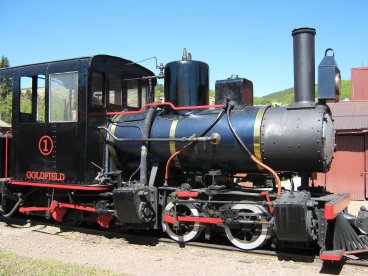
CC&V Steam Engine
The CC&V railroad is a modest tourist attraction located on the outskirts of Cripple Creek. The line has several operating steam locomotives that take passengers on a 45 minute trip into the countryside. Our engineer estimated the horsepower of the engine above to be ca 20 hp. Narrow gauge rail was popular in mountainous areas as opposed to standard gauge owing to the ability to negotiate a tighter turn radius.
 Lamentations on Chemistry