Reuters has reported that 4 of the 5 largest oil companies have reported a combined total of almost $50 billion in net income for the third quarter of 2022. Chevron reported a quarterly profit of $11.2 billion, its second highest ever, even against declining production over a year ago.
Exxon reported nearly $20 billion in net income while Shell earned $9 billion in 3Q2022. France’s TotalEnergies reported a record $10 billion in profits for the quarter.
This stark picture is one of record gas & oil company profits versus citizens struggling against the headwinds of rampant global inflation. One could counter that there is no such thing as too much profit. After all, companies always strive to maximize their profit margins to the greatest extent possible and that this is ‘normal’ behavior with a favorable outcome. Companies take risks and get rewarded with extraordinary cash flows now and then.
The reality is that sellers will always charge as much as the market will bear. This is ECON 101. But buyers control the release of cash from their pockets, most of the time. Petroleum distillates are an essential ingredient of life for most of us. If you cannot walk or bicycle to work, then some motorized vehicle must take you there. Zoning practices in the US make walking to work in a commercial or industrial zone problematic in most locations.
Politicians can hurl accusations of price gouging and maybe they will have some effect. A better approach is the reduction in consumption by consumers. It’s not always comfortable but it does work. We do have a handle to pull in this situation, but who wants to go first?
Today we hear about lithium batteries ad nauseum. Everyone is anxious to achieve a bright battery-powered electric future for happy motoring. Mineral exploration has revealed a few new sources of lithium and mines are increasing production. Battery factories are ramping up and R&D keeps turning out tweaks in battery technology. Many are betting on or prophesying the eventual phase-out of hydrocarbon fueled motor vehicles.
Lithium is quite scarce and is the 25th most abundant element on earth with about the same crustal abundance as chlorine although this may vary with the source. For the most part, lithium is fairly widely dispersed in the earth’s crust but it is subject to concentration by hydrothermal transport, forming evaporite deposits or briny ground water. Lithium is also a component of the mineral spodumene which can be found in pegmatites within some host formation. An uncommonly rich site was at the Foote Company Mine in the Kings Mountain Mining District of North Carolina. This operation produced lithium carbonate, Li2CO3. This is a common finished product because it can be removed from a solution of lithium chloride by treatment with sodium carbonate to precipitate the poorly soluble lithium carbonate.
This light metal has many chemical uses apart from batteries. For instance, organolithium reagents are a vital part of the chemical industry clocking in at about $1 billion per year in sales. Organolithium reagents are an indispensable part of organic synthesis. Switching to a reagent with a different metal usually does not work well, giving poor results or the wrong reactivity.
Today we’re seeing organolithium prices rise dramatically with little expectation that it will ever come back and no clue of how it plays out in the future. If a few select lithium reagents, e.g., LiAlH4 or n-butyllithium, go off the market, it will be a bad day for the organic synthetic industry as well as for chemical R&D in general. It is an unexpected consequence of the switch to reduced carbon EVs.
Vlad Putin has been ominously reminding us that he will not rule out the use of nuclear weapons if the Russian state is under existential threat, whatever that means. Maybe now is a good time to review just a few basics of nuclear weapons and what they do.
There are a large number of internet sites that go into great detail about the dark art and history of nuclear weapons. No need to duplicate that here. I’ll just give my take on a few points.
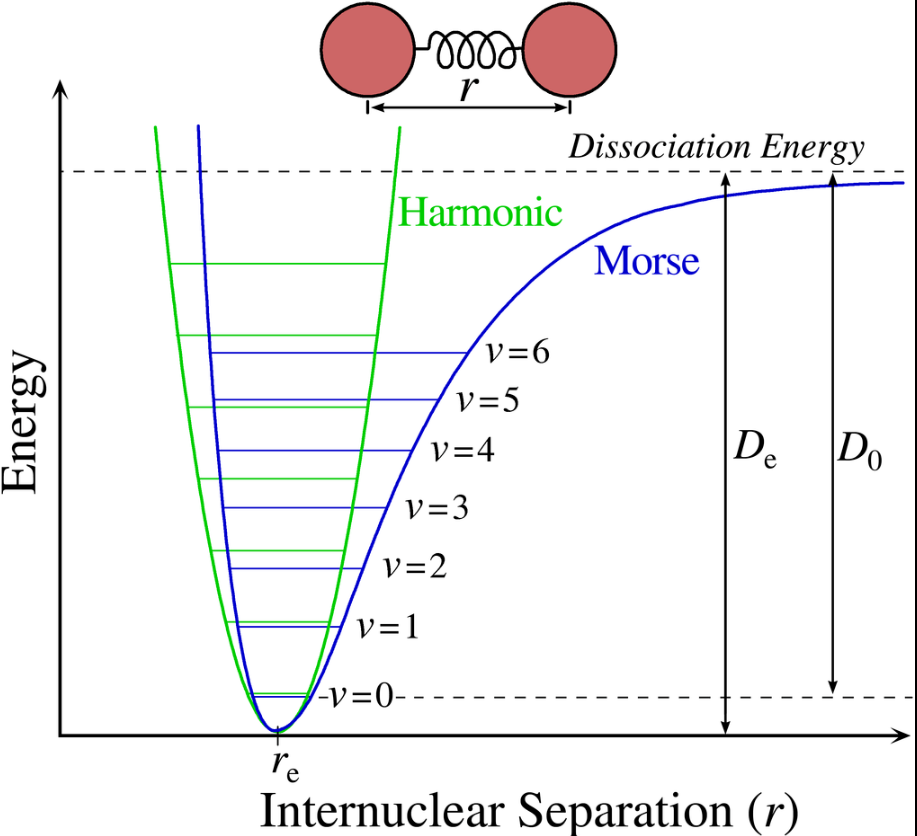
Remember the Morse curve from freshman chemistry? It describes the potential energy versus distance of two atoms at the scale of chemical bonds. The left side of the blue curve shows how steeply the repulsive energy potential rises (exponentially) with diminishing internuclear distance. By contrast, the attractive potential on the right of the blue curve flattens out with increasing interatomic distances. Keep this in mind.
When a fissile uranium-235 nucleus absorbs a neutron, the nucleus momentarily becomes unstable uranium-236. A stable nucleus has repulsive Coulomb forces between nucleons that are balanced at close proximity by the attractive strong nuclear force. The liquid drop model is useful for visualizing a nucleus as it fissions. On absorption of a neutron the uranium nucleus will distort to an elongated dumbbell shape leading to an imbalance of attractive and repulsive forces between nucleons. This can take the nucleus past the distance where the strong nuclear force attraction can hold it together. The strong nuclear force holding together nuclear particles (nucleons) falls off much faster with distance than does the Coulombic repulsion of protons. At the instant the nucleus separates into adjacent fragments, the two highly positively charged nuclei find themselves in very close proximity and are now only subject to net repulsive force. From the left side of the Morse Curve we can see that the repulsive force is exceedingly high in this moment. The highly repulsive potential energy is converted to kinetic energy at the moment the nucleus splits. The nuclear fragments fly apart at high velocity along with neutrons and dump thermal energy into the surrounding bulk material. But the kinetic energy of the fragments is not the only source of energy output.
Nuclear fission fragments are released in a highly excited state. Apart from their kinetic energy, nuclei have different energy levels with differing stabilities. A nucleus can undergo energy transitions from one state to another. These higher energy levels are called nuclear isomers and their stability can be expressed in terms of half-life. As fission fragments are formed they shed energy in the form of alpha, beta, gamma, and neutron emissions. Neutrinos are left out of this discussion for simplicity. As nuclei decay, they get closer to a stable ground state. Unstable nuclear fission products will decay in their characteristic ways, contributing to the overall energy release.
One challenge to weapons designers is to cause as many nuclei as possible to fission before the weapon undergoes “hydrodynamic disassembly” over the first 1 microsecond or less. After ignition the rapidly expanding plasma of the bomb core increases in volume and the probability of neutron collisions with nuclei diminishes rapidly. When a uranium or plutonium nucleus fissions, 2 or 3 neutrons are emitted which go on to strike other nuclei and induce fission in them. The cascading generations result in an avalanche of fissions. One of the ways to ensure that enough generations of fissions occur with enough neutrons flying about inside the supercritical assembly is to surround the core with neutron reflecting material. Ways of doing this can be found elsewhere.
One more thing about the strong nuclear force. This quote is from the Wikipedia entry for the strong interaction–
“The residual strong force is thus a minor residuum of the strong force that binds quarks together into protons and neutrons. This same force is much weaker between neutrons and protons, because it is mostly neutralized within them, in the same way that electromagnetic forces between neutral atoms (van der Waals forces) are much weaker than the electromagnetic forces that hold electrons in association with the nucleus, forming the atoms.“
A nuclear weapon produces a near instantaneous point source of energy release. These bombs can be detonated at or below ground or water level, or they can be set off in the atmosphere or space. The choice of where to do it depends on the intended effects. Subsurface bursts consume much of the explosive energy in moving soil or water which provides some radiation shielding to the surrounding area. Furthermore, bursts in contact with soil or water, especially when the fireball contacts the soil, tend to produce more fallout than air bursts. Air bursts deliver EMP, radiation and blast effects to a wider area, where “radiation” refers to neutrons, gamma and longer wavelengths of electromagnetic radiation. Thermal and blast effects produce considerable prompt destruction in the area surrounding the blast. As an approximate point source of energy, the intensity of the radiant energy falls off as some inverse square law. On an encouraging note, this means that radiation exposure falls off rapidly with distance. Distance is your friend.
There are numerous variations on the nuclear weapons theme. In the early cold war days, so called A-Bombs and H-Bombs were in the news. H-Bombs are also referred to as “hydrogen bombs or thermonuclear weapons.” An A-bomb, A for Atomic, was a basic implosion-type fission explosive and it was the typically the least powerful of the two. The H-Bomb was a nuclear fusion explosive that was triggered by a fission “primary.” That is, a fission trigger would be used to generate x-rays that would be “focused” onto fusion fuel, the “secondary,” which would initiate a runaway nuclear fusion explosion. The explosive yield of these bombs is much higher and can deliver a devastating blast to a larger area. Over time, the efficiency and compactness of these bombs has been greatly optimized.
The fusion explosive element was lithium-6 deuteride. The lithium atom would absorb a neutron, become unstable and decay into a helium-4 nucleus and a tritium (helium-3) nucleus. On a side note, in grad school I attended a seminar by Dieter Seebach from ETH, Zurich, who was talking about mechanistic work they’d done with lithium enolate complexes. He mentioned in passing that at that time, the mid-80’s, they had to be careful with stoichiometry because the commercial lithium that was available was often depleted of lithium-6 which was accumulated by the government for diversion to weapons. It was an unexpected brush with the cold war.
The main deleterious effect of radiation on human tissue lies in the formation of ions and radical pairs along the path of the penetrating radiation. The molecules of life are dissociated into ion pairs or radicals which may or may not collapse back to the original molecules. Given the amount of energy transferred into molecular dissociation along with random diffusion, the molecular destruction cannot be reversed. Heavy radiation particles like alpha particles produce a great many ions per centimeter of tissue penetrated. Penetrating, energetic photons like gamma rays produce relatively few.
There are 6 forms of hazardous radiation commonly considered- alpha, beta, gamma, x-ray, ultraviolet and neutrons. Of these 6, alpha, beta, gamma and neutrons are of nuclear origin. X-ray and ultraviolet are “electronic” in origin, that is they arise from electron transitions outside of the nucleus. The matter of the origin of x-rays is often confused in the literature with some authors implying that x-rays are from the nucleus. I prefer to define x-rays as resulting from electron transitions at the atomic level.
Of the 4 nuclear radiation types mentioned above, alpha, beta, and neutrons are particles. Gamma rays are photons. The atomic nucleus is comprised of so-called nucleons which are protons and neutrons. Nucleons are composite particles comprised of quarks and can bind by the strong nuclear force. Alpha particles are helium-4 nuclei and neutrons are neutral particles with approximately the same mass as a proton or about 1 atomic mass unit. Neutrons are not stable outside of the nucleus and have a half-life of about 15 minutes. Free neutrons will undergo radioactive decay into a proton, an electron, and an electron antineutrino.
Like gamma rays, neutrons are neutral in charge and have great penetrating ability. However, neutrons are effectively scattered by collisions with the hydrogen atoms of biomolecules and water. As a result neutrons can be very destructive to living tissue. As a side note, paraffin wax and water are effective shielding materials for neutrons due to the high concentration of hydrogen atoms. The collisions with hydrogen atoms in living tissues is a means of dumping neutron kinetic energy into the bulk matter, resulting in dissociation of biomolecules.
The so-called “neutron bomb” was an explosive that was designed to produce an abundance of neutrons at the expense of explosive yield. During the early Reagan years in the US there was much public handwringing about these bombs and their ability to kill people but leave buildings standing. People seemed indignant that somehow this reduced the value of human life below that of material things in the grand calculation of destruction.
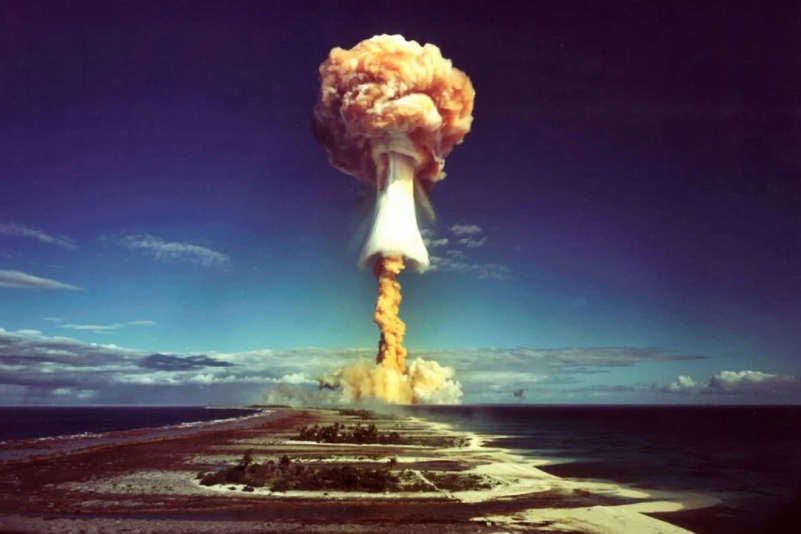
The characteristic mushroom shape rising to the sky after a nuclear air burst is just the result of a rapid release of energy and bomb debris in the air, but close enough to the ground to suck up soil. The “cap” of the mushroom results from the convectively rising point-source expansion of incandescent, debris-filled air from the point of energy release. The “stem” of the mushroom is a column of air that has rushed in to replace the rapidly rising fireball, picking up soil as it does so. There is nothing intrinsically nuclear about a mushroom cloud. Chemical explosives can do this as well.
Initially the fireball produces a strong pulse of thermal radiation. As this fireball develops, there is a momentary drop in radiant thermal energy due to the increasing opacity of the fireball. With further expansion the opacity of the fireball decreases and the thermal output increases. The shock wave and out-rush of air is obviously destructive, but the radiant thermal effects are not to be underestimated.
Another major effect of a nuclear blast is nuclear fallout. A nuclear blast unavoidably produces radioactive substances from the fission process and from neutron activation. A low altitude air burst is particularly troublesome because ground debris is sucked up into the air and contaminated with radionuclides. This material does what all suspended solids do, namely it is carried by the wind and falls back to earth gradually, contaminating a wide swath of ground. The finest particles remain suspended and are transported long distances, eventually falling out with rain or snow.
Finally, there are psychological effects associated with “the bomb.” It inevitably produces dread fear in people. This fear buttresses the idea of Mutually Assured Destruction or MAD.
Now that we are in a nuclear state of mind, let’s turn to what Putin intends to do with his nuclear arsenal. The Russians are not suicidal. Putin is neither crazy nor stupid. Russians have long understood where a nuclear confrontation with the West can go. They know escalation of nuclear war to full-scale would lead to mutual destruction of Russia and the West. The Russians know that the West has a policy of no first use with nuclear weapons and that we are extremely reluctant to use them. For the West, there is a firebreak between conventional and nuclear weapons. For the Russians, it is more of a continuum. They know that sabre rattling with their nuclear arsenal creates a good deal of anxiety in the rest of the world and Putin has been pushing this threat envelope to new levels and will keep doing so. Once a KGB guy, always a KGB guy. Putin obviously understands the pragmatics of coercion and the influential value of torture.
What nobody knows for sure is what happens when a Russian nuclear war shot is released. What does the West do? Respond in kind quickly or play the long game and see what happens next. How much planning has gone into nuclear conflict between two states outside of NATO? When would NATO step in? NATO is presently taking the side of Ukraine in terms of supplying money and arms but is studiously avoiding direct conflict with Russia. On the positive side, at least right now we aren’t bogged down with an endless middle east whack-a-mole exercise.
The best use of nuclear arms has always been and remains the threat of their use. Russia has been using this threat aggressively, even going so far as to blame Ukraine for planning a false flag operation with a “dirty bomb.”
Putin wants to see the alliance of the US and Europe disintegrate. He wants to see the American hegemony in place since WW II collapse. He wants to see the dominance of US culture, military reach, the influential dollar and prevalence of the default English language peel away. He wants to see Novorossiya rise from the ashes of the fallen USSR. But his vision requires the conquest of territory and cultural domination. The armed extinction project for Ukraine in process now will be followed by rebuilding the captured land with Russian infrastructure, political leaders and culture.
Russia, in its constant state of paranoia, wrings its hands about the “threat” of NATO at its border. The cruel irony is that it is hard to imagine that the West would find the conquest Russia possible or even desirable. The US-lead coalition was unable to get the medieval opium poppy kingdom of Afganistan under control with conventional weapons. How is it possible that we could even consider a preemptive invasion of Russia? Russia’s historical paranoia seems entirely self-serving for its authoritarian leaders.
One way to tear apart western alliances is to help them along with the demise of liberal democracy. Quietly support the internal cultural rot of individual nations by encouraging radical nationalism, white supremacy and political disharmony. It is happening all around us and especially here in the US. As badly as I’d love to entirely blame #45, I have to admit that he has only prodded a sleeping dragon. The MAGA and QAnon crowds were already out there. #45 has rallied them and validated their seething anger and indignation.
Today we have many people of great influence like Tucker Carlson, Alex Jones, Sean Hannity, nationalistic religious broadcasters, a stable of fringe political figures, and a mass of MAGA foot soldiers winning down-ticket elections moving their nationalistic and religious conservative agenda forward. Post-war baby boomers are being replaced with crowds and leaders who reject America’s present liberal democratic culture and leadership role in the world. There is growing open admiration for strongman authoritarian leadership. America’s experiment with fascism has already begun. Surprisingly, many Americans have expressed support for Putin.
Putin’s vicious attack on Ukraine, the rise of Trumpism with American fascism and a viral pandemic have overlapped within a narrow window of time- any one of which is a big problem by itself. It seems doubtful that MAGA right-wing crowds will have a change of heart in their vision for America. They will live out their lives within the same closed ideological space they are in presently. A political depolarization of America seems unlikely in the near term.
In this depressing global political climate it is more important than ever for the US to maintain its role as a thriving democratic culture and defender of those seeking democracy. Our leadership role in NATO must not waver against Russian aggression and expansionism. Russian expansionism will not end with Ukraine.
What will Putin do if he sees his internal political power structure collapsing? Will he ramp up the war to distract his opponents and rally the country? The present situation in Russia seems to suggest that rallying the population is more difficult than he anticipated.
It is hard to believe that Putin and his inner circle will change their ways in their lifetimes. They’ve painted themselves into a corner with their aggression and, like a trapped animal, will fight to the death. The cruel and murderous Joseph Stalin died in power. There is no reason to believe that Putin will be any different.
Russia sent a letter to the United Nations accusing Ukraine of preparing to use a ‘dirty bomb’ in their battle with Russia. Western countries have claimed that this is nothing but a transparent attempt by Russia to provide a pretext for their own use of a dirty bomb or some other offensive action.
This issue resembles the matter of Weapons of Mass Destruction (WMD) that the Bush administration in the US contrived as a pretext for taking down Saddam Hussein. A great many innocent people died and we damaged our moral authority in the world by that and other wars. It was an obvious lie to a great many Americans and allies yet the Bush administration went forward with the invasion. No WMDs were found.
According to Wikipedia, a dirty bomb is a conventional explosive packed with radioactive material that, on detonation, disperses the dangerous material in the target area. Such a thing could be made portable or assembled on site. It is not to be confused with a nuclear bomb. A dirty bomb blast would be a radiological calamity wherever it is set off as well as downwind of the explosion. Being non-nuclear, dispersion by a conventional explosive would be extremely limited in range in terms of blast effects, but intensely radioactive. As with any sudden generation of dust and smoke, there would be a plume of radioactive material (RAM) extending downwind from the release. Water soluble radioactive materials would pollute the watershed and possibly groundwater. Contaminated soil would exclude the area from farming for many decades if not longer. Great harm would befall the biosphere.
Construction of a dirty bomb could be quite problematic for its builders. Assuming the builders of the bomb are not suicidal, collecting RAM, assembling and delivering the bomb could be tricky. On one end of the scale, spent nuclear fuel could be used as the source of RAM. Assembly could be as simple as packing explosives around a container of RAM. To prevent serious exposure to the workers, there would have to be some kind of shielding present during the handling of the RAM. On the lower end, a small RAM source from a medical device could be used. Whatever the case, the containment must be fragile enough to rupture in the explosion but dense enough to provide some level of shielding for the handlers.
The harmful effects of a dirty bomb would be both radiological and psychological. On the psychological end, it is sure to cause dread fear in the general population and sway public sentiment toward one side or the other. Importantly, its use would be releasing the nuclear weapons genie from its bottle. It would lower the threshold and allow war planners everywhere to reconsider their own use of nuclear strategy and tactics because a precedent has been set. Once the genie is out, there is no putting it back, or so the saying goes.
In all of the war gaming and planning NATO has done over the decades, I wonder how much attention has been given to responding to nuclear conflict between non-NATO states? What should the NATO countries do if other actors engage in nuclear conflict? As always, it depends on the circumstances.
==========================
I have chosen to avoid using the term “explosive device” because I feel it has a certain sanitizing effect. A thing that is meant to cause death and destruction by the explosive release of energy is just a f*cking bomb with all of the meaning and negative connotation associated with the word. Even grudging admiration for someone’s cleverness should not be awarded for putting together a “device.”
“The AEC is my shepherd: I shall not live. (AEC- the Atomic Energy Commission) It maketh me to lie down in radiant pastures; it leadeth me beside deathly waters. It destroyeth my bones; it leadeth me in the path of frightfulness for its name’s sake. Yet, though I walk through the valley of the shadow of death, I will hear no evil; for thou art with me; thy bomb and thy SAC, they comfort me. Thou preparest a fable before me in the presence of mine enemies; thou anointest thy words with oil; my cup runneth over. Surely, strontium and fallout shall follow me all the days of my life; and I will dwell in the house of the AEC–but hardly forever.”
An interesting bundle of factoids arrived in my daily newsletter from the American Petroleum Institute, API. The cost of shipping LNG is disclosed. I’ll just cut and paste it for convenience. The source is Freightwaves.
From API- “Liquefied natural gas charter rates were estimated to average $313,000 per day for the most efficient LNG carriers and $276,700 per day for tri-fuel, diesel engine carriers as of Monday, according to Clarkson’s Securities, some analysts predict rates could climb as high as $500,000 per day or even $1 million in the fourth quarter amid tight ship availability on the spot market. “According to brokers, owners can now achieve three-way economics, which means they are compensated not just for a regular round voyage but also for positioning voyages,” said Clarksons Securities analyst Frode Morkedal.”
Ok, I like big boats and I cannot lie. When you look into the shipping vessels themselves you can find a wondrous horde of information on LNG carrier details, such as tri-fuel, diesel engine (TFDE) powered ships. These are ship propulsion systems that drive the propellers with electric motors that in turn are energized by generators driven by engines that can burn diesel oil or LNG.
There are many advantages to the TDFE propulsion systems. Due to the low boiling point of LNG (-161.5 C), loss of LNG to evaporation is unavoidable. Fortunately, the boil-off vapor from the LNG tanks can be piped down to the engine room and used for propulsion. This LNG boil-off can be used to generate steam or can be used directly by powering two-stroke engines. The newer TFDE system, or the DFDE (Di-Fuel Diesel Electric) engines require less space than conventional diesel engines with all of their ancillary features. This leaves more room for payload.
The Bright Hub Engineering site says that a typical TFDE electric generator system produces 8 to 12 megawatts of power from each of its 4 generators at 6600 to 11000 volts at 60 Hz. The electric propulsion motors are coupled together with a reduction gear to turn the props.
As alluded to above there are duel fuel 2-stroke marine engines in use. The duel fuel engines combine Heavy Fuel Oil (HFO), also called bunker fuel, or Marine Diesel Oil (MDO) with LNG in the Diesel cycle with a load range of 10 to 100 %. The mixture of HDO or MDO with LNG is injected directly as opposed to being premixed with air. Because the autoignition temperature of LNG is high, a small amount of pilot oil is injected as well to ensure ignition. The actual mixture used can be adjusted to best match the price and availability of the fuel oil.
The di- and tri-fuel systems have the advantage of producing considerably less pollution that conventional bunker fuels. This is especially important in port where emission controls can be very strict.
The term ‘bioorthogonal’ seems a little odd at first but the definition of orthogonal is- Adjective, intersecting or lying at right angles. This could stem from the idea of an atomic or molecular orbital whose axis is perpendicular to another resulting in bonding and anti-bonding orbital overlap. That is, they are electronically unconnected with each other. The analogy is with the fact that click reactions don’t interfere with biochemical reactions in the system. It’s a good choice of terms.
Sharpless achieved the vaunted adjective status prior to his earlier 2001 Nobel Prize in Chemistry for work on catalyzed chiral oxidations, i.e., the Sharpless Oxidation. To be an adjective in a named reaction in chemistry is the highest honor for a synthesis chemist.

 Lamentations on Chemistry
