
Note: Not residing in Russia, I cannot grasp the full extent of the events and mood unfolding there. All that remains is to perch on a power pole across the polar cap and try to discern fact from fiction.
>>> Let’s ask a very basic question about today’s Russia. Why can’t Russia Putin play nice? <<<
Like most, I have anxiously watched Putin’s invasion of Ukraine. The prevailing Russian narrative is trying to say that the sovereign nation known as Ukraine has historically been a part of Russia or some earlier Russian empire, a view promoted by Putin. Following the Bolshevik Revolution, Lenin directed the Bolsheviks to seize the territory now recognized as Ukraine. The goal was to claim territory for the Soviet Union, but also territory that was extremely fertile. Stalin ordered that Ukrainian industry and agriculture were to be collectivized. An independent Ukrainian government was briefly established but just as quickly collapsed. After several years of intense Ukrainian resistance and significant suffering, Lenin conceded and established Soviet Ukraine, enabling its incorporation into the Soviet Union as a constituent republic.
In the current action, with the support of an extensive security apparatus, Vladimir Putin has resolved that what is now Ukraine will be assimilated into a growing Russian empire. The process will methodically transform its Ukrainian identity through Russification, transforming it into southwestern Russia. Ukraine is expected to become an agricultural hub and potentially a strategic forward base for further military operations into Poland the Baltic states, and likely Moldova.
Why does Putin desire Ukraine when there is considerable open land to the east and north? Well, it’s the geography. The land beyond to the north and east of Moscow consists of vast stretches of challenging subarctic taiga and arctic permafrost, much of which is now thawing, making it unsuitable for roads, urban development, agriculture, and industry. In contrast, Ukraine boasts rich, productive farmland with significant annual grain exports. Additionally, along its southern coast, including Crimea, Ukraine possesses the only warm water ports available in the region, other than possibly the Neva River to the north which are vital for commerce and the military.
Historically, western European colonization was driven by the prospect of trade opportunity including raw materials, cheap labor as well as power projection. Like all countries, Russia would like room for its prosperity to grow. It is desirable that agricultural and industrial capacity also rise. However, Russia has learned the hard way the value of having a buffer zone between Moscow and Western Europe. The relative ease with which both Napolean and Hitler crossed the Eastern European territory enroute to Moscow, Leningrad and other cities through greater Russia did not go unnoticed by Stalin. By absorbing the Eastern European territories after WWII, Stalin built a picket fence protecting the Soviet state.
As the Nazi’s Operation Barbarossa was failing and Stalin’s Red Army began pushing the Germans into a westward retreat, the Soviets took advantage of the opportunity to install Soviet political structure in captured Nazi territory like the Baltic states, Eastern Europe and the eastern half of Germany. While Stalin did not share Hitler’s enthusiasm for exterminating Jews, he did act to eliminate preexisting local political structures which included substantial Jewish presence. This meant executions and large-scale banishment of politically unreliable people to the Russian gulag system. Poland was hit particularly hard by both Hitler and Stalin because it was directly between Russia and Germany and had a large Jewish population.
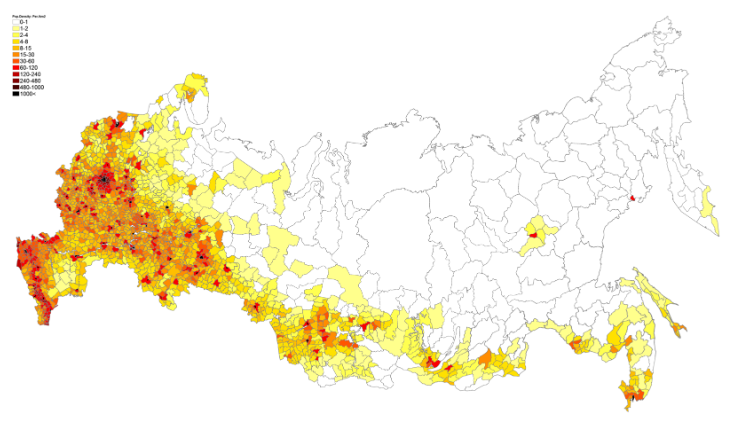
The above map shows the population density of Russia. A substantial fraction of Russians live in the southern and western regions of the country. If you assume that people are living there because it is at least somewhat livable, then the map shows the extent of land poorly suited for habitation.
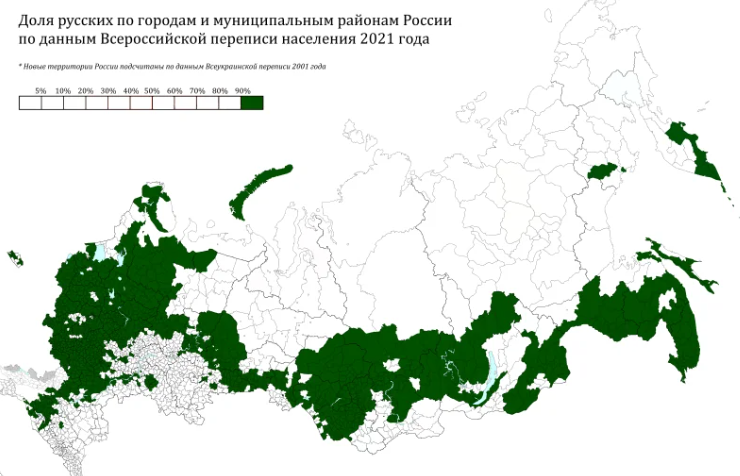
Russia has a great deal of acreage but the livable turf is much smaller.
Putin views the world partially from the old cold war perspective. It’s Russia against the aggressive, corrupt and immoral west, but without the fever dream of a Soviet-style socialist world. Putin’s state-controlled media endlessly repeats that the west wants what the Russians have and stokes the fires of fear. For the Soviets, “aggressive, corrupt and immoral” included resistance to Soviet influence.
In my many years of trying to be as informed as possible in many areas in a free and open society, not once have I heard anyone suggest “Gosh, I wish the USA could occupy Russia (or the USSR) as an American territory and take all of their stuff.” Imagine the scope of the folly in stupidity of such an attempt. It is mindbogglingly absurd to believe that one could or would want to do such a thing. Russia is for the Russians. Maybe one day they will hit upon a way to craft a free and open society.
The Soviets were ardent promoters of global socialism. Although not overtly socialist, Putin appears more focused on preserving Russian culture and dominance from across a substantial territorial buffer with the West. He asserts his aim to shield Russia from Western cultural influences and what he perceives as a “belligerent” military stance.
The “belligerent military stance” of the West amounts to NATO responding to Soviet adventurism and their habit of hybrid warfare. They would say the same thing from their perspective, but which side was the more authoritarian?
Historically, Russia has endured invasions by King Charles XII of Sweden, Napoleon, and later Hitler. The history of the Kievan Rus from 830 to 1241 is jammed with bloody feuds, wars and invasions. From the Principality of Moscow in 1281 to the end of the Tsardom in 1917, and even beyond into the era of the Soviet Union and into Putin’s time, near continuous conflict has plagued the Russian people. Fortunately, Russia’s northern geography and harsh winters have often played to its advantage, compelling invaders into prolonged conflicts and misery with eventual withdrawal. But not always.
Most nations would like to have global hegemony. Putin is fond of saying that Russia has suffered greatly from American and Western hegemony since WWII and hopes to put an end to it. He has reestablished a Soviet-like security state apparatus with strict media control when he assumed power after the 8 years of Yeltsin’s chaos following the collapse of the Soviet Union. He is trying to resume for present day Russia the former Soviet Union’s international status but largely without the manpower and resources of the former adjacent Soviet states.
Like his Soviet predecessors, Putin both envies and worries about overreach of western hegemony and is moving to unseat the West. For that matter, so is China. This is only natural. I believe they resent western influence generally. The English language as the global lingua franca and the US dollar as the standard international currency are seen as an annoying affront to their own cultures, sovereignty and political significance. Again, this is only natural. And so is the temptation to use power projection or coercive propaganda to achieve their own hegemony. Casualties would be considered the West’s fault for being in the way.
Both Russia and China have long been critical of the West for internal propaganda purposes but to be fair there has been some valid criticism as well. In truth, the US has done some bone-headed things that we should not be proud of and that hardly serve to highlight our presumed “special” nature. But in fairness, most all cultures can look back at regrettable conduct in their history. Neither Chairman Mao’s China or Stalin’s USSR have sparkling clean histories either. Often the benefit of hindsight doesn’t come into focus until far down the timeline.
The Soviet Union in the person of Joseph Stalin, had brutalized Ukraine previously in an attempt to halt its independence. The Holodomor, meaning death by starvation, of 1932-33 is estimated by scholars to have killed 3.5 to 5 million people. This period of time is marked by forced collectivization of agriculture and industry in the USSR and Ukraine. Collectivization meant taking control of farmland owned by the peasants (especially the Kulaks), many times banishing them to the gulags never to be seen again. Already by 1931, Moscow had taken 42 % of the Ukrainian grain harvest, forcing some locations even to turn over seed for the following harvest. By early 1932 some districts in Ukraine were already experiencing famine. The governing committees in Ukraine in 1932 believed that the 6 million tons of grain demanded by Moscow was unachievable, yet they ratified the plan anyway.
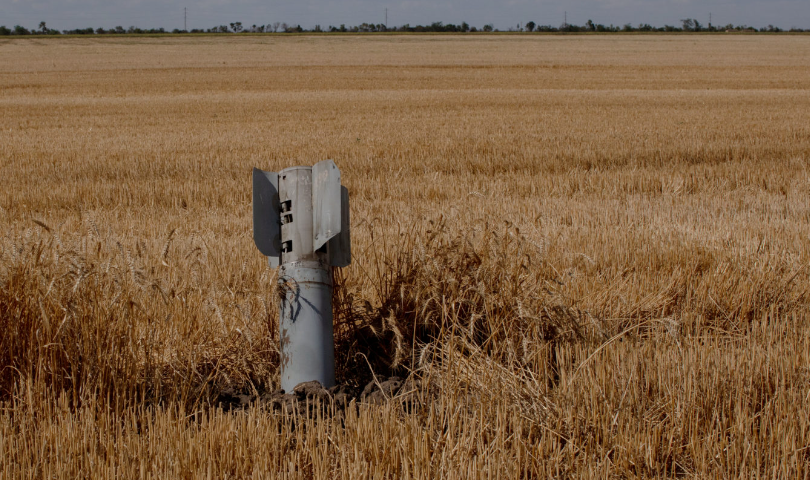
The current brutal murder and devastation of Ukrainian citizens and their infrastructure and agriculture will take a generation or more to repair even if Russia prevails. Russia has done great damage to the Ukrainian environment in addition to the many casualties. Much of the country is cratered, littered with destroyed vehicles and war debris, denuded of vegetation, and rendered deadly by the landmines.
The great equalizer among the leading nations is Mutual Assured Destruction, or MAD, by virtue of the threat of the use of nuclear weapons for mutual annihilation. Sometimes just called “the bomb”, it was indeed invented by an international cast of scientists and engineers using American uranium and Plutonium and first used in successive releases by the US on Japan near the end of WWII in the Pacific theater. This will darken a stretch of American history indefinitely. Some continue to argue that the bombing was not necessary because Japan was soon to surrender, but it happened, and nothing can change that. However, to our credit, the US has never used it since and has actively sought with other nations to suppress the proliferation of nuclear weapons and remove the hair triggers for their use. That said, the US remains a no-first-use country but will participate in the principle of Mutual Assured Destruction as needed.
A Nuclear Sidebar
Very soon after the discovery of nuclear fission in December, 1938, in Nazi Germany by German-born chemists Hahn and Strassmann, and Austrian-born physicists Meitner and Frisch, the theoretical potential of using the vast energy output of nuclear fission for a bomb was quickly realized. On May 4, 1939, Frédéric Joliot-Curie, H. Von Halban and L. Kowarski in Paris filed for three patents using a fission chain reaction. Two involved power generation and the third was for an atomic bomb, patent No. 445686. Fission was experimentally discovered in Dec. 1938, theoretically explained in January 1939, and a patent for the atomic bomb was filed on May 4, 1939.
The point of this atomic interlude is to highlight the short time interval between the discovery of nuclear fission, conceiving the idea of the atomic bomb and filing for a patent by scientists. On August 2, 1939, a letter written by Leo Szilard and signed by Albert Einstein was sent to President Franklin D. Roosevelt warning that Germany may be developing an atomic bomb. This led to the Manhattan Project and America’s entry into nuclear weaponry.
During and after the Manhattan Project, Stalin’s spies detected and infiltrated the American bomb project and presumably used important stolen information for their own nuclear program. This was an important shortcut benefitting the Soviets greatly. The first Soviet atomic bomb burst so soon after the war shocked the world.
Humans have a gift for the invention and use of weapons. I’m sure it has always been that way for humans. The inclination for war and conquest is also an ancient instinct. It is hard to see how aggression will ever change. In view of this distressing thought, how are we to proceed?
Looking forward
In the short term we in the west must continue to discourage Putin’s expansionist push. A win for Ukraine will set a precedent that might even unseat Putin. It is up to the many good people in Russia to be rid of him. However, Russian citizens will have to struggle against the vast authoritarian political machine in place just like the Poles, East Germans and the other Soviet states had to do in the late 1980’s. The intimidation and resources of the Putin authoritarian state are a huge obstacle.
My guess is that in general, doing the “right thing” in a culture of normalized authoritarianism, bribery and corruption is more difficult to accomplish than doing the “right thing” in a free and open culture where doing the right thing is occasionally practiced and always admired.
To a westerner like me, Russian withdrawal from Ukraine seems like the optimal solution to Russia’s present economic and military race to the bottom. Even in winning, Russia will inherit a devastated region that will require vast resources and a decade to repair, as well as a population of angry and vengeful citizens looking to kill a Russian or two. Then there are all of the land mines to contend with. There is amputation or death by landmines in the future for many unsuspecting people regardless of who wins.
A cessation of hostilities led by Putin is likely to end his career. Thus far, Putin’s invasion has led to over 500,000 Russian casualties, of which there have been over 80,000 Russian fatalities. In a way, this pales in comparison to Stalin’s murderous handiwork, but the comparison is really more like “terrible versus really, really terrible.”
Whether or not Putin is a reanimated Soviet leader or “just” another Tsar isn’t a question to dwell on. He is a creature of his time who happens to be a former Soviet KGB officer but has rejected Marxist/Leninism and rules by a roughly mafia-style kleptocracy behind closed doors in the Moscow Kremlin. For Russian citizens, the rule of thumb is if you stay out of political business, the government will stay out of your business.
 Lamentations on Chemistry