
Here we are 25 years into the 21st century already. One might have supposed that by four hundred years beyond the start of the Enlightenment, someone might have devised a coffee pot that does not dribble. Some pots approach this asymptote, however, but not ours. For myself the bigger problem shows up when I pour water into the reservoir of the coffee maker.
After considerable experimentation I have observed that dribbling will happen when the flow rate is either too slow or too fast. The problem for the coffee pot user is that while a dribble-free flow is occurring, the liquid level and flow rate drop and the water begins to dribble again. The angle of the pot can be raised to increase the water flow rate, but it is very easy overcompensate and slip onto the dribbling flow regime once more. So, filling the coffee maker can turn into a series of back and forth corrections trying to keep the water flow in the “sweet spot.”
As the flow rate rises the liquid flow begins to crawl up along the sides where there is no spout, thus adding to the dribbling. Too slow (lacking momentum) and capillarity pulls the stream around the curve of the spout causing it to run down the sides of the pot.
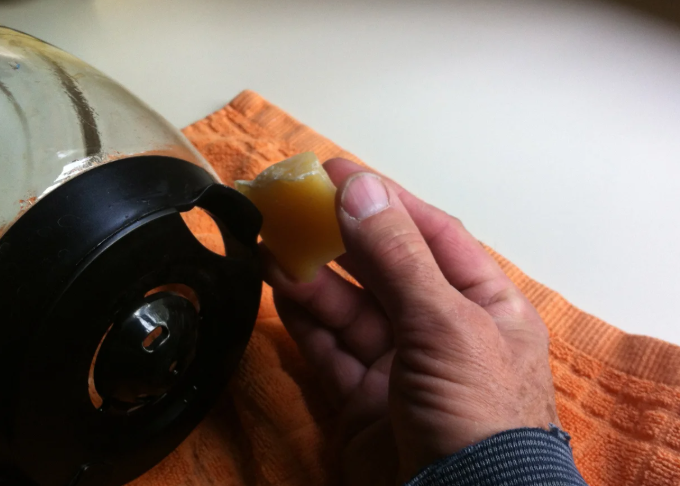
A cure for this can be found on the Instructables website. The author of this article found 2 possible causes- a mold seam in the plastic spout and capillary action of water. The author reports that after carefully filing down the ridge of the plastic molding seam and coating the spout with a light layer of beeswax, the problem has disappeared.
Every time I make coffee at work, I check my pockets only to find that I left my beeswax at home. I have a hoard of beeswax for use in the event of the apocalypse. After all of the “goody-two-shoes” have been raptured, those of us ground-pounding leftovers on earth will need candle wax.
It turns out that this pouring issue has been fixed at the commercial level for some time. I have seen plastic lips around the opening of syrup bottles that are actually dribble-free. In the laboratory I found plastic rings that fit on the opening of numerous chemical jugs. Off-hand I have seen this on 4 L jugs of concentrated nitric, sulfuric, chlorosulfonic and triflic acids. Dribbles of these acids are especially problematic. The purpose was obvious on inspection- make the spout hydrophobic to suppress capillary action attracting the liquid to follow the surface. Evidently, I failed to remember this trick.
The spout on our Cuisinart coffee maker is plastic, as is the spout in the Instructables article, so you’d think that in itself would prevent the dribbling due to its hydrophobicity. But apparently it is appreciably wetted by water. The dielectric constant of the beeswax then must be lower than the plastic, making the beeswax surface energy lower, thus the attractive forces lower.
Ok. I’m done with this.
 Lamentations on Chemistry