
Ok, so there is this Harvard professor named Avi Loeb who attracts media attention with his suggestions that a new comet or asteroid may be an alien spaceship, especially if we’re sure that it is from outside our solar system. Any given new object arriving from “way out there” has the possibility of being made and operated by extraterrestrials. Yes, it is a remote possibility, but still non-zero.
What gets my attention is how his pronouncements of possible alien spaceships are leapt upon by media who publish and promote with breathless and fanciful headlines. Ok, media are in a 24 hour or less news cycle and feel the need obligation to publish a story with breathtaking headlines. Or at least the writer of the story intends it will attract the reader’s engagement,
Is the professor just looney or is there method to his madness? Perhaps his personal threshold for signal to noise ratios is set just a bit too low. I just don’t know.
With this, however, the ET credibility gap is bridged by the fact that a professor at Harvard University is making the statement. This affords instant credibility because, as we all know, God himself spends Thursday afternoons at Harvard and what is more sanctified than a tenured Harvard faculty member? In fairness, it must be said that God spends Thursday mornings across town at MIT, though half-assed claims of ETs are a bit rarer from there.
As Carl Sagan or someone else once said, incredible claims require incredible evidence. In this example, where was the incredible evidence? Extremely distant, small and faint objects detectable only in the visible part of the spectrum with very sensitive equipment tend to reveal only faint evidence. Even if some kind of signal can be discriminated, would aliens want to broadcast their appearance to the whole flippin’ solar system straight away?
For myself, if there were aliens strapped inside this object, the more interesting problem is how did they manage to cross interstellar space in a way consistent with sufficient fuel for their propulsion system and critical supplies?
My faint mockery of the Harvard professor is now complete. Time to move on.
Perhaps aliens have picked up our radio transmissions, remembering that TV transmission is also a kind of radio transmission. Amplitude modulated transmissions, AM, would be easiest to investigate since it is only a narrow carrier frequency that is modulated by wave amplitude.
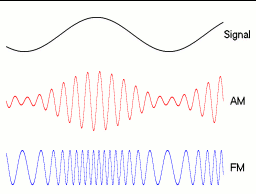
Black and white television used AM for video and FM for sound. AM is the easiest to understand, but the FM signals are quite different. Frequency modulation, FM, takes a fixed carrier frequency and combines it with signal that is near the carrier frequency, but the frequency is modulated in a way that the sum of the carrier and sound frequencies combine in such a way that the combined carrier and sound signals produce peaks and valleys resulting from combining two signals of somewhat different frequencies. The peaks of the carrier frequency end up adding or subtracting with the other signal.
AM receiving equipment has difficulty discriminating between signal by variable amplitude noise. Lightning or other sources of radio frequency energy easily interfere with the clarity of the signal. If you have listened to an AM radio station in stormy weather, you know how interfering lightning can be.
FM, on the other hand, is from the addition of a set carrier frequency plus a variable frequency sound signal. Electrical mechanisms that produce RF noise generally do not produce an FM signal, thus the quiet sound of FM reception.

This is a superficial explanation of television. Television images of the Lucy show, or the Three Stooges received by aliens has been speculated on to our great amusement, but we should understand that a transmitted TV signal is generated taking into account of specifically how it will be read. On a monochrome TV receiver screen, the picture is produced by interlacing two half vertical images alternating every 60th of a second so a whole image is received by our retinas every 30th of a second exploiting our persistence of vision to prevent flickering images. Below 30 frames per second, the images begin to flicker. Aiding in this is the fact that the phosphors in the picture tube glow momentarily after the beam has passed. In order to produce images from a radio frequency signal, this method would first have to be recognized then a receiver built by the aliens to “decode” the signal. Also, the aliens would have to recognize that the analog information is visual in nature and presented as an interlaced raster scan on some kind of display. Misinterpretation of our signals as hostile in nature would be avoided, hopefully.
Ok, movie projection just for fun
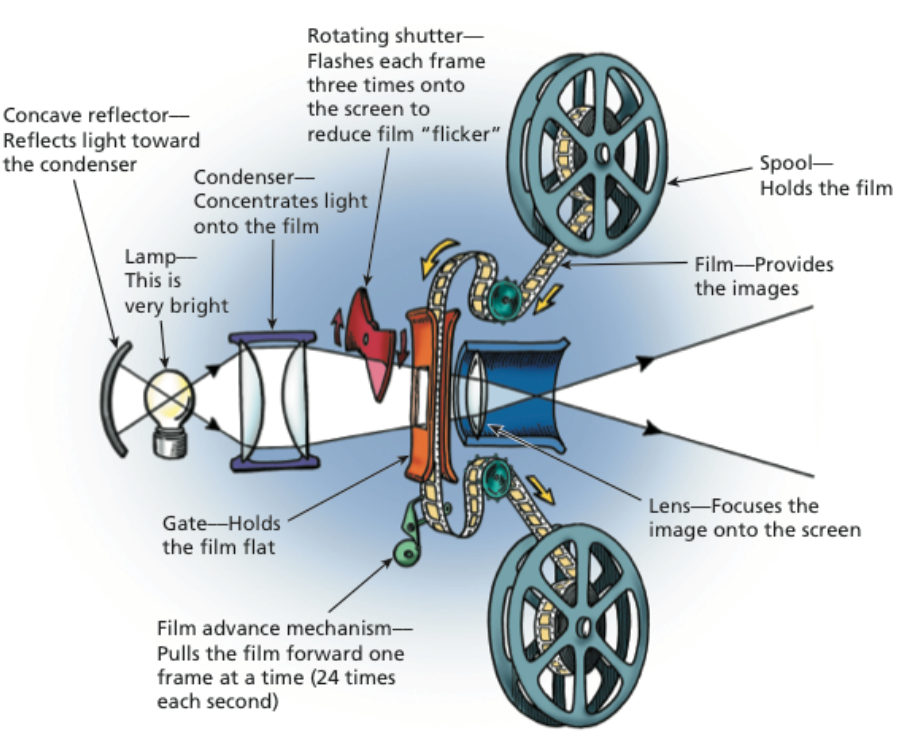
The passage of movie film through a movie projector is at 24 frames per second but flickering is avoided by projecting each frame twice to give a frame rate of 48. The classic sound of a movie projector results from the advancing of each frame past the shutter, stopping the film momentarily while the shutter rotates in the light beam and shines light through the frame twice. Slack is built into the continuous flow of film through the projector using loops of film above and below the aperture and shutter to allow continuous movement of the film but also stopping for 1/24th of a second so that a steady image is projected twice per frame. The source of the flickering sound is in large part from the upper and lower loops jumping up and down every 1/24th of a second.
If only we’d ship reels of movie film to the aliens, they could better understand us. For starters, I’d suggest a recent Godzilla movie.
 Lamentations on Chemistry