Gaussling is a senior scientist in the chemical business. He occasionally breaks glassware, spreads confusion and has been known to generate new forms of hazardous waste. Gaussling also digs aerospace, geology, and community theatre.
Copied from a source whose name may be off-putting to MAGA Americans. The words of the UAE businessman should stand apart from sanctimonious misperceptions burrowed under the skin of MAGA supporters.
=================
“One of the UAE’s top businessmen, Khalaf Ahmad Al Habtoor, just lashed out at Trump over the Iran War.
His Excellency President Donald Trump,
A direct question: Who gave you the authority to drag our region into a war with #Iran? And on what basis did you make this dangerous decision?
Did you calculate the collateral damage before pulling the trigger? And did you consider that the first to suffer from this escalation will be the countries of the region itself!
The peoples of this region have the right to ask as well: Was this your decision alone? Or did it come as a result of pressures from #Netanyahu and his government?
You have placed the countries of the #GulfCooperationCouncil and the Arab countries at the heart of a danger they did not choose. Thank God, we are strong and capable of defending ourselves, and we have armies and defenses that protect our homelands, but the question remains: Who gave you permission to turn our region into a battlefield?
For before the ink has dried on the #BoardOfPeace initiative that you announced in the name of peace and stability, we find ourselves facing a military escalation that endangers the entire region. So where did those initiatives go? And what is the fate of the commitments made in the name of peace?
Most of the funding proposed in those initiatives came from the countries of the region themselves, and from Arab Gulf countries that contributed billions of dollars on the basis of supporting stability and development. And these countries have the right to ask today: Where did this money go? And are we funding peace initiatives or funding a war that exposes us to danger?
More dangerous than that, your decision does not threaten only the peoples of the region, but also reaches the American people whom you promised peace and prosperity. And here they are today, finding themselves in a war funded from their money and taxes, with costs ranging, according to the Institute for Policy Studies (IPS), between 40-65 billion dollars for direct military operations, and could reach 210 billion dollars including economic impacts and indirect losses if it lasts four to five weeks, not to mention the sacrifice of Americans themselves in a war in which they have neither camel nor she-camel.
You have even broken your promises not to get involved in wars and to focus only on America and put it at the top of your priorities, as you ordered foreign military interventions during your second term that included seven countries: Somalia, Iraq, Yemen, Nigeria, Syria, Iran, and Venezuela, in addition to naval operations in the Caribbean and the eastern Pacific Ocean. You directed more than 658 foreign airstrikes in your first year in office, which equals the total strikes in Biden’s entire term, for which you directed your arrows of criticism for involving the United States in foreign wars.
Your Excellency the President, these numbers have severely reflected on your approval ratings among Americans, which have declined since your inauguration for the second term, by about 9% in just 400 days.
These numbers say something clear: Even within #TheUnitedStates, there is growing concern about being dragged into a new war, and about exposing the lives of Americans, their economy, and their future to unnecessary risks.
True leadership is not measured by war decisions, but by wisdom, respect for others, and pushing toward achieving peace. And if these initiatives were launched in the name of peace, then we have the right today to demand full transparency and clear accountability.”
I ran into this image today from the online class I’m taking. I suspect Uncle Joe may have been reincarnated and his shadow darkens the Kremlin floors even today.
Question: How do you transition from a Stalinist dictatorship to something less terrible and maybe even faintly democratic? It’s still an open question.
Source: Movie poster of Stalin’s Funeral by Yevgeni Yevtushenko. I’d have been tempted to poke the body with a stick to make sure he was dead.
Nikita Krushchev led de-Stalinization after Stalin died but was soon replaced by Leonid Brezhnev. It is said that not much of interest happened during the Brezhnev years other than keeping up with the cold war.
Big changes finally began with Mikhail Gorbachev and his glasnost and perestroika, but the USSR imploded before he was finished. The Kremlin couldn’t make the centralized economy work as desired, so they shut off the lights and went home. Boris Yeltsin was the first popularly elected and reelected President of Russia from 1991 to 1999 but his tenure was checkered with successes and failures. His hand picked successor was Vladimir Putin who was later elected President. The merits of that choice is apparent in the news today.
An even better question: how does a country whose skids were greased with bribery, had zero history of democratic anything or a market economy and little if any market-related institutions make the transition? Yeah, it’s a hard problem. The Soviet security apparatus didn’t fully collapse and survives to this day, frightening as ever.
There was an old joke- the KGB headquarters in Moscow went up 7 floors and down all the way to Siberia. The gulags were substantially emptied of millions of laborers after Krushchev’s elevation, but many of the camps were retained.
I’m happy to speak highly of a retired petroleum geologist who produces excellent geology video content for YouTube. His name is Myron Cook, and he lives in Wyoming; he loves the geology of Earth. He is a very prolific videographer and is known as the “Bob Ross” of geology for the genteel narration of his field trips in Colorado, Wyoming, and Utah. His manner of speaking and folksy explanations are suitable for the general public, but he manages to avoid patronizing oversimplification of geology. What is nice is that all of the formations he explains can be visited.
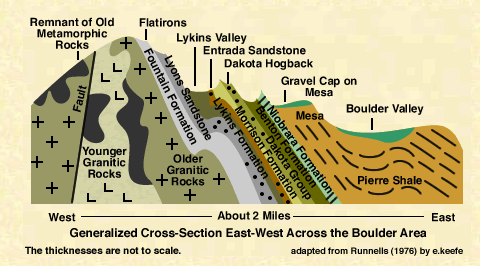
Source: Cross sectional sketch of the stratographic geology the basement rock protruding upward through the layers of sediment pushed upwards by the Laramide Orogeny. This represents the formations adjacent to Boulder, CO. Excerpted from “Boulder, A Sight to Behold: Guidebook” (1976) by Donald D. Runnells, modified by Sheila Murphy
His videos are well-produced 20-40 minute intro-level geology seminars, combining his aerial photography, whiteboard talks, and field trip adventures into geologically interesting terrains on the Colorado Plateau and up into Yellowstone and the Bighorn Mountains in Wyoming. He is particularly adept at explaining sedimentology, an area in which I previously held little interest, but for no good reason. That has since changed.
If you live along the Colorado Front Range like I do, you’ll recognize the Boulder Flatirons, Red Rocks Amphitheater, and the Garden of the Gods in Colorado Springs. These steeply dipping conglomerate formations sit at the juncture of the Great Plains and the eastern foothills of the Rocky Mountains. They are part of the Fountain Formation, which extends steeply downward and toward the east. The formation is named for the Fountain River, where the layer was identified.
Source: Wikipedia. Fountain Formation exposure at Roxborough State Park near Denver.
Myron Cook has an excellent YouTube introduction to the Fountain Formation of Colorado. The rocks of the Fountain Formation are thought to be 290 to 340 million years old.
Mr. Cook began a video by asking the question “Is the Fountain Formation composed of sediment from the Rocky Mountains?” Well, sort of, but first consider how the adjacent sediment layers are situated. Next to the Front Range, numerous layers of sedimentary rocks lie pancaked together and aligned substantially vertical. The rule of thumb in sedimentary geology is that the oldest sediments are at the bottom and they accumulate going upwards. There are scattered apparent exceptions, but they are few and do not negate the rule.
The Fountain Formation is an alluvial fan formation of coarse red feldspar-rich granitic arkose. All of the exposed sandstone and conglomerate layers lying a few miles eastward from the Fountain Formation are likewise tilted upwards. These sedimentary exposures are not limited to the Front Range but also appear on the western slope of Colorado.
Vocabulary Update
How is ‘alluvial’ different from ‘fluvial’?
Fluvial (The Process): Relates to the erosion, transport, and deposition by active river channels. Examples include river channels, canyons, and waterfalls.
Alluvial (The Deposit): Refers to the material laid down by water, often outside the main channel during floods. Examples include alluvial fans, floodplains, and sandbars.
Usage: “Fluvial” describes the system or environment, whereas “alluvial” describes the sediment type or landform.
Source: Google (search terms: ‘alluvial versus fluvial’)
There is nothing strange about arkosic alluvial fans, except that in this case, it dips so steeply that much of it sits directly in contact with the granitic/metamorphic basement rock which is at a depth of about 10,000-11,000 ft of sediment below eastern Denver. If the alluvial fans were recent, they wouldn’t rest on the basement rock. Instead, they sit roughly two miles below many sedimentary layers. In general, the lower the sediment layer, the older the formation. Exceptions exist, and for very interesting reasons. The Fountain Formation is very old.
Another plug
If you have not visited Utah, you’re really missing out on a vast landscape of stunningly beautiful red sandstone formations. Even if geology does not do it for you, the sheer beauty of the many red river canyons, cliffs, arches and oddly eroded features should rouse the coldest of souls. Let your spouse drive so you can take in the view, just don’t say that.
Back to it
The present Rocky Mountains are thought to have begun in a third mountain building episode roughly 55 to 80 million years ago (MYA) called the Laramide Orogeny. These earlier mountain ranges are called the ‘Ancestral’ Rocky Mountains. This orogeny was the result of tectonic activity lifting mountains in New Mexico, Colorado. into Wyoming and Utah. Going north along the Rockies are other named orogenies.
The occurrence of mountain building of the Rocky Mountains far from a coastal subduction zone is rather odd. One of the more popular explanations is that subduction of the Farallon plate is unusually shallow, creating compression and uplifting far inland from the coastal subduction zone. When you push a rug or tablecloth, you’ll note that the rug or cloth will cause ripples in the direction of motion. This is similar to mountain building. It could also cause repetitive mountain building. This NASA link describes the subduction of the Farallon plate.
The Fountain Formation is much older than the present Rockies. This formation is believed to have come from the erosion of the Ancestral Rocky Mountains. But which one? One source makes reference to two prior ancestral ranges. The earliest is referred to as the Precambrian mountains and not much is known about it. It predates the Western Interior Seaway.
A second iteration of the Rocky Mountains from the next Laramide orogeny rose ca 300 MYA in the Late Pennsylvanian and Early Permian geologic periods. It was eventually eroded flat and carried away as sediment by wind and water. Sediments, i.e., sand & mud, are layered in ways that are consistent with alluvial fan formation.
Finally, 55 to 80 MYA the current iteration of Rocky Mountains arose from the Laramide Orogeny. In numerous places in or near the Rockies fossilized clams and oysters can be found at the surface. This further supports the past presence of the Interior Western Seaway.
I just remembered that I’m not writing a book. Ciao!!
For decades a population of Americans citizens have been extremely vocal about the 2nd Amendment to the US Constitution and their right to bear arms. A major element to their argument is to have protection from a tyrannical government. Legislation carrying even the faintest whiff of what they spit out as “gun control” is defeated. But, that is an issue for another day.
In District of Columbia v. Heller, the Supreme Court held that the Second Amendment codifies a natural right to keep and bear arms for self-defense. That right to self-defense extends to both private and public threats, including self-defense against agents of a tyrannical government. Source: Google.
Well, what if that tyrannical government is now materializing? Will they even recognize it? So far it doesn’t look like it. This population is heavily invested in Trump so could that possibly blind them to the situation? Or did they just shrug and sign up to work for ICE in large numbers?
Trump and his cronies are constantly presuming authority over many areas of government that were statutorily or constitutionally understood to be outside the grasp of the executive. These people are constantly flooding the zone with acts of overreach backed by a republican SCOTUS and congress and enjoy a corrupt DoJ, DHS and, increasingly, a politicized DoD.
What does the term “liberal democracy” really mean? From Wikipedia-
Anyone who made it through 9th grade civics should have a background sufficient to realize that liberal democratic America is in existential danger. Not by violent overthrow but by a slow, painless slouch to illiberal democracy. A slouch because not enough voters will engage with money, votes or the gumption to step out and take a public stand against what is happening. A majority still have utilities, access to health care and safe neighborhoods and roads. So far the changes are rather abstract and distant for most citizens and it is easy to conclude that nothing personally serious is happening.
The US Constitution appears inadequate to provide a clear and muscular remedy against an abusive and malevolent single party control of all three houses of government. The Dems have had such control in the past, but did not seek to form an oligarchy or some dictatorial power grab. Were they just too dumb and timid to even try or is there something else? Maybe they know better.
In this country the Republicans have most of the lawyers, guns and money. But we woke liberals also have the 2nd Amendment at our disposal as well.
The reliable American MAGA/GOP fear machine shifted into overdrive on the Bad Bunny halftime show during the recent Super Bowl. Against the blinding glare of Trump’s never-ending stream of foul blather stands the latest upsurge of Christian puritanical indignation and accusations of unspeakable depravities freely broadcast over the public airwaves. A group of “conservative warriers” have been orchestrating a war dance from the corridors of Congress out into the MAGA world. Their legislative blunderbuss tactics and shrill accusations and are aimed at Bad Bunny, NBC, and the NFL.
The NFL and NBC stand accused by red state dullards of broadcasting “openly glorified sodomy and countless other unspeakable depravities.” The MAGA populist movement is a jealous and cantankerous mob, intolerant of competing populist stirrings including pop music stars. Roger Goodell, National Football League (NFL) commissioner, enthusiastically backed the selection of Bad Bunny according to Time. This was not a trick foisted on the NFL.
Opposition began after the announcement of the half-time entertainment lineup in 2025. Much of the backlash focused on Bad Bunny’s Puerto Rican identity and his status as a Spanish speaker, with Fox News and political commentators framing the choice as anti-American.
The truly unwholesome aspect here is the extent to which American politics promotes and elects such Christian nationalist puritans to high office. Though politicians play to their home districts, their nationalist puritanical claims are broadcast widely, banking authority and credibility into their castle keep. Their words are cheap and easy to speak, but practically impossible to correct or refute. With Bible in one hand and the other reaching skyward in supplication, the sobbing preacher-man reads a verse and proclaims fealty to the invisible almighty and the President. It is at once moving and ridiculous. They know precisely what they are doing.
The Christian nationalist cult is intent on moving the US into a position where the rule of law is based on Biblical law, whatever that may be. Whatever it is, it will certainly place preachers into high-ranking, high-power positions of influence. If you listen to the TV preachers, they call for ‘Gods people’ to save America. All that matters is accelerating the return of the Savior to earth to trigger the end of times and banishment of the unworthy to a lake of molten sulfur.
I wonder if Biblical law would continue with parking tickets or tax law? If you wanted to change the easement on your property, would that be New or Old Testament, and would pastor Bob approve it?
In an effort to understand just what the hell is the deal with Russia, I enrolled in a university extension school spring semester course to study Eastern European history as it relates to capitalism and communism. It concerns the interwar period between WWI and WWII and why Eastern Europe adopted Soviet-style communism. Being from central USA, I’m familiar with much of the two world wars but only to the extent focused on histories written from the western allies’ viewpoint. This is the normal condition for most Americans.
Western European history, arbitrarily dating back to the Romans, is highly complex in the sense that the entire western Eurasian land mass has been repeatedly settled, conquered, and partitioned into empires, kingdoms, and duchies. The inevitable intermingling of cultures, languages, trade, and military might has combined to paint the map of today. Coastal nations had the advantage of access to fisheries and trade across long distances. On the downside, however, coasts were subject to easy invasion and wars of conquest.
This wall is covered and overprinted with diverse messages. So too is the Eurasian landmass overprinted with fragmented, missing and overlapping cultural and political domains over the last several millennia.
Much of Eastern Europe retains a strong Slavic ethnic identity. Along with the Roman Catholic Church, the Eastern Orthodox Church still holds a strong position in many regions, including Russia. Putin even has the cooperation of the Eastern Orthodox Church in his effort to promote his agenda and propaganda at all levels in Russia.
In addition to Slavic and other ethnic identities, Eastern Europe and Russia have been isolated from much of the world by distance, economics, and the high level of modernism that Western Europe embraced. Tsar Peter the Great was aware of the more advanced nature of Western Europe and spent time there in order to gather ideas for modernizing Russia, particularly in the area of naval ships.
The landlocked or nearly landlocked nations of Eastern Europe lacked ice-free, warm water ports, not just limiting trade and shipbuilding but also economic exchange with more distant parts of the world. The Netherlands, Belgium, France, Germany, England, Rome, Portugal, and Spain in particular, established distant colonies and trade, generating wealth and power. With wealth, a kingdom acquires military strength and the ability to project power and conquest in resource-rich territories within just months or weeks of sailing time.
Conquest and the material wealth it brought was critical not only for an empire or monarchy to maintain or expand its holdings but also for self-defense from marauding armies looking for their own conquest. The various kingdoms, duchies, and empires were not entirely independent entities. The custom of the royal families to intermarry across empires and kingdoms assured continuity of the ruling families and wealth in the royal houses. This familial connection led to many alliances and specific choices in dividing up land.
The question of “what’s the deal with Russia” is about how it came to be that Russia is remote and standoffish to the point of being endlessly hostile and paranoid about the West. To American eyes like mine, the attitude Russia has about the West is peculiar and originates from … what? Even if Russia did not suffer overland invasions by Napoleon and Hitler, would they be any less paranoid? They would have less historical invasion baggage to drag along in some ways, but would other tragedies have befallen them? Impossible to say. It is fair to say that the Bolsheviks were keen on global-scale revolution and widespread implementation of Soviet socialism. They were not without imperialistic enthusiasm themselves.
President Putin continues to press the rhetorical but incendive argument about how the West is desirous of their resources. It is pitched as a clear and present danger to Russia. The West, he intimates, is crawling with greedy and perverted imperialists who want nothing more than to steal Mother Russia’s oil & gas, minerals, uranium, and timber. Any leader in any country could get mileage from this argument, and Vladdy-buck is pumping this handle with gusto.
The main thesis of my history class is that had Hitler not invaded the Soviet Union, the spread of Soviet conquest to its western frontier would not have happened. I’ll write more as this topic unfolds in class.
In my industrial career as a PhD organic/organometallic chemist I was kept busy for about 10 years with in-house Reaction Calorimetry (RC), Accelerating Rate Calorimetry (ARC), Differential Scanning Calorimetry (DSC) as well as Thermogravimetric Analysis (TGA) for validating thermal process safety. To institutionalize this I was asked to start a process safety department and began standardizing experimental protocols and a database for the results. I was able to scour the internet for thermochemical papers, looking for mentions of energetic properties. As always, much can be learned by just looking around.
Thermal process safety refers to safe operation of chemical manufacturing in regard to the generation of heat in a reaction mass and the hazards arising therein. The hazards from uncontrolled self-heating include acceleration of reaction kinetics producing accelerating heat and pressure evolution. If the reaction enthalpy and subsequent temperature rise theoretically exceeds the boiling point of the solvent despite the cooling jacket and the chilled condenser, then self-heating can lead to a boil up and uncontrolled ejection of the reaction mass. With insufficient cooling, the temperature will rise to the solvent bp and boil off the solvent first, carrying much heat away as heat of evaporation. Once most of the solvent has boiled away and if the reaction mass continues to self-heat, the temperature will continue to rise and peak at some undesired level as the reactants are consumed. Further heating of the now hot, highly concentrated reaction mass, potentially leading to successive reactions that may or may not be exothermic.
When a liquid phase reaction mass self-heats faster than heat can be removed, the reactor pressure will begin to rise. As pressure builds, the boiling point of the reaction mass begins to rise, slowing down the boil-off. A sudden drop in pressure, as with the burst of a rupture disk, will cause a superheated solution to promptly boil throughout the reaction mass. This means that flash vaporization can lead to bubble formation throughout the volume of the reaction mass producing a foam. The severity will depend on the pressure drop and the bp of the solvent. If the headspace is sufficiently small, the foam can expand rapidly and begin to exit through the vent pipe. A properly engineered vent pipe has been sized to vent gas/vapor at specified conditions. Since a foam is part liquid and part gas/vapor, it lacks the overall compressibility of a gas/vapor so the resulting foam flow may be lower than calculated for a gas/vapor, slowing the rate of depressurization.
The distinction between gas and a vapor is that a vapor may be condensable as with most solvent vapors, but evolved gases like hydrogen, methane or carbon dioxide will combine with a non-condensable blanket gas like nitrogen and resist condensation in the by the chiller. The point is that if one is relying on a chilled condenser to knock down non-condensable gases as a pressure management control, then a rude shock is headed your way, especially if the rupture disk bursting pressure is higher than need be.
Flow into vent pipes that exit outdoors may discharge hot reaction mass onto the roof or wherever the vent terminates. If the vent terminates into a knockdown drum or other catch vessel, the hot reaction mass contacts whatever may be in those vessels.
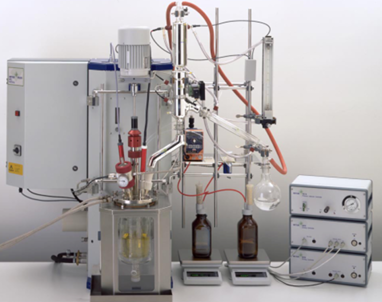
Image: Mettler Toledo. The Mettler-Toledo RC1 rigged for dual feed and distillation or reflux. The two brown bottles (lower right) sit on balances and feed from two reagent bottles into the reactor (lower left). The feed of liquid reactants is pre-programmed and is controlled quite accurately. Reagents are fed into an agitating reaction mass (yellow) while the temperature and enthalpy (H or h) are monitored on the fly. The instrument monitors the jacket and reactor temperatures and with the help of heat capacities, Cp, can display the enthalpy of the reaction as it proceeds.
Fortunately, the thermal profile leading up to the above scenario can be modeled in properly conducted RC1 experiments. But exactly what can be done beforehand?
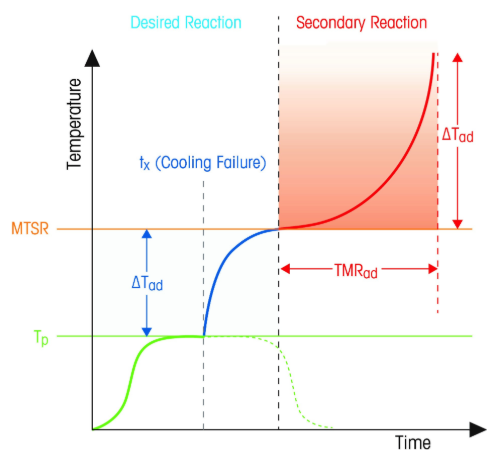
First, let’s realize that the total self-heating temperature rise can be measured. We add that ΔT (temperature rise) to the proposed reaction temperature Tr and get a maximum temperature of the synthetic reaction, MTSR. Once we have this, if the MTSR is greater than the bp of the solvent(s), then we know that an uncontained runaway is possible. What to do then?
R&D needs to justify the problematic low boiling solvent with the reaction temperature to be applied.
R&D needs to provide input on lowering the design reaction temperature.
Is a lower Tr for a longer reaction time feasible?
How sensitive is the reaction to a higher bp solvent substitution?
If the chosen solvent conveniently forces side or waste products to precipitate and be removed by filtration, then we have the conundrum of safety vs efficient processability.
The magnitude of the hazard in the minds of everyone involved may be quite different and will require a documented decision process. Engineering input here is invaluable.
Thermal runaway profile. Source. The linked article is well written.
Tp Process Temperature
ΔTad Adiabatic Temperature rise
MTSR Maximum Temperature of the Synthetic Reaction
TMRad Adiabatic Time to Maximum Rate
Tx Time of Cooling Loss
What if the design solvent is truly required for a feasible and economic process? This needs to be discussed first with chemists and engineers in the room and a decision rendered. If chemist input says no solvent change is desirable or economic, the engineers need to speak up as to whether there is an engineering work around. If a ready engineering work around is not feasible and the product is still important, then the chemists need to be challenged to find procedure that denies the equipment a runaway condition.
If we’re lucky, a partial batch reaction method can be used wherein the reactor is charged with solvent and most of the reactant compounds are in the vessel at the beginning of the run. The final reactant is slowly fed into the reactor and the reaction temperature is controlled by the feed rate. Reaction calorimetry can be used to arrive at a plausible maximum feed rate that is fast but not too fast. A reaction calorimeter is basically a chemical reaction detector and can be used to look for an approximate reaction onset temperature. Remember that onset temperature is not a physical or chemical property. It depends on the detection equipment and the rate of heating.
Like everything else, success can depend on first asking the right questions. On the graphic computer display of the RC1, you can determine the response to an aliquot of reagent addition. Does the heat production, q, rise promptly with addition or does it lag? If there is a lag or a latency, it means that over-charging by operators at scale can happen if they are looking for a prompt “heat kick” on addition of the feed.
The RC1 can also show the length of time to react away the feed or what the total reaction time may be If the reaction has a natural response lag, then a defined charge mass is called for. A response lag may also be due to the presence of water which must first be quenched under the reaction conditions. The most insidious situation is when the feed reactant accumulates in the reactor over the course of the reaction. This is very difficult to judge by the operators. The feed may accumulate until the reaction suddenly begins and accelerates out of control. This is not uncommon.
Finally, a proper “batch reaction” is one in which all of the reactants are loaded into the reactor all at once, the temperature is adjusted and the reaction begins. It is critical that before a new batch reaction is allowed, the chemists must show that this will not result in a runaway condition. This is where reaction calorimetry shines. The safety of a batch reaction is reproduced in the RC1and the progress is monitored. The RC1 can also be used to explore various reaction conditions to see if runaway potential can be easily blundered into. How narrow are the safe operating parameters? Many plant incidents happen at shift changes where the continuity of watchfulness may diverge for a time, even with automation.
TMRad Adiabatic Time to Maximum Rate
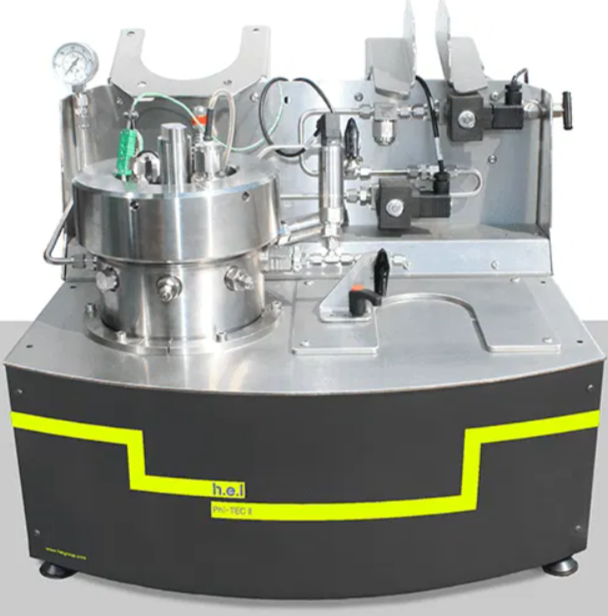
A very informative piece of data to have is the TMR- Time to Maximum Rate. This can be obtained by an Accelerated Rate Calorimeter or ARC. The instrument consists of a furnace into which is placed a sample “can” which can be made of metal or glass. The furnace raises the sample temperature gradually using a heat-wait-search (HWS) method searching for an onset temperature.
Once an onset temperature is found, the HWS is automatically halted and the furnace keeps adjusting its temperature to match the rising internal sample temperature. If the internal sample temperature and the exterior furnace temperature are the same, then the sample is under adiabatic conditions and no heat flows in or out of the sample can. The sample temperature is driven by self heating only.
Knowing the sample mass and the best guess at Cp, constant pressure heat capacity, the reaction enthalpy can be determined. From the data, the Time to Maximum Rate (TMR) can be calculated to give an equation. It is the time that a substance that is self-reacting takes to reach the maximum rate of heat output as a function of sample temperature. The instrument also records sample pressure. If the sample pressure does not return to ambient pressure at room temperature, this would mean that a non-condensable gas was evolved.
Image of the Phi-Tec II ARC system. from H.E.L. company. My ARC experience is with this model.
A typical ARC experiment took me from 6 to 24 hours to complete the HWS routine.
What TMR data allows one to do is to find a reaction temperature the reaches maximum rate in 24 hours or more. You plug in a temperature and you get a TMR. The temperature needed to produce a TMR of 24 hours is considered by many in industry to be the uppermost safe processing temperature. It helps to answer what the maximum safe temperature in which a solid can be dried before decomposition begins.
To outsource safety testing or not
First and foremost, a commercial safety test lab understands and uses procedures that are agreed upon and standardized. Also, if down the road there comes a related event, your response to criticism will be to refer to the test lab experts, not some ham fisted employee monkeying around in the lab doing improvised experiments. Certain safety matters should be referred to the commercial lab experts for valid results and for CYA. This applies especially to energetic materials like nitroaromatics or nitrate esters.
Chemical manufacturing is conducted at many scales from laboratory gram scale products for R&D, multi-kilogram kilo-lab batch processing to the colossal commodity scale continuous manufacturing of petrochemicals, agrichemicals, polymers, flavors & fragrances, and pharmaceuticals. Nearly all of these commodity chemicals and polymers are well known and have safety issues related only to flammability, exposure and dose.
Outsourcing tests that can be done inhouse is a missed opportunity to accumulate more skills which is company treasure. I’m speaking of calorimetry. Calorimeters can be brought on-site and meshed in with research and development. Just learning how to interpret thermograms alone brings workers new insights into their chemistry.
What is best for your company? In-house safety testing or outsourced safety testing? Like nearly everything else in life, the answer depends on the situation. If you need to survey for explosive hazards for the first time, there are several competent commercial labs available that will use standard protocols. My experience is that they employ just engineers or a mix of chemists and engineers. They conduct standard testing protocols wherein a series of samples are exposed step-wise to a series of ever increasing stimuli intensity to find the boundary conditions of sensitivity to various stimuli, like heat, friction, impact, dust explosion parameters, burn tests, static charge lifetimes and minimum ignition energy (MIE) with electrostatic discharge.
Explosibility testing
Sensitivity to explosive behavior is tested in numerous ways to flesh out the sensitivity profile. Testing is performed in stages where the least intense stimuli are tried first to screen for highly sensitive substances. The results of any single test run are graded as ‘Go/No Go’ or ‘positive/negative’. The terms ‘Go’ or ‘Negative’ mean that an explosive property was observed.
Part of explosives testing is finding out what kinds of stimuli lead to initiation of an explosion. The Bureau of Mines (BOM) drop weight test looks for the maximum safe impact energy. There is a friction test, an electrostatic discharge test, and many others. If the sample does not give a Go result at the maximum machine impact or friction, then it is regarded as safe under those precise conditions. In the BOM test, the higher the number (in drop distance of a 5 or 10 kg weight), the more stable it is to impact.
You get the testing data. Now what?
Now how do you take numerical test data and convert it to safer operations? This is where engineers can be most useful. Imagine a substance that has a 34 inch BOM drop weight result with a 10 kg anvil. Will any process equipment mash down on the substance inadvertently? Put this ball in the court of engineers and let them chew on it. This data moves workers closer to confidence in safety.
Outsourcing safety testing and explosive screening can lead to a conundrum. Outsourcing anything means that certain expertise may not be internalized for your company’s use, the user or manufacturer. Commercial labs will absolutely not comment on how the material can be safely used, whether or not it is too dangerous or nominally safe under your use conditions. Safe use is not an endorsement they will make, they will only stand behind their results from standard testing protocols. I’d do the same.
Before safety testing you were alone. Now, with safety data, you are still alone but with numbers. Engineers and plant operators are invaluable in locating equipment that delivers impacts or friction. They can also help to identify non-grounded equipment that may generate or accumulate electrostatic charge. Always get the plant people involved.
It didn’t take long to realize that if we sent samples out to commercial labs for calorimetry testing, the samples were subjected to unfamiliar standard test methodology. Early on it was fascinating to see what kind of experimental setups were used and what the results looked like. Being a synthesis chemist I was unfamiliar with calorimetry. My earlier exposure to calorimetry was limited to what appeared in molecular dynamics and mechanics modeling. Acquiring actual data on reaction enthalpies and onset conditions myself awakened a fascination that carried me far into reaction calorimetry and thermochemistry.
What was not clear at the outset of receiving external calorimetric, electrostatic and explosive test data was what to do with it. Using external hazard data to inform operational procedure was new to everyone. Yes, we could learn from an ARC experiment what temperature the onset to a runaway condition begins, but how to use the measurements in practice wasn’t always obvious.
Incidents have three phases- initiation, propagation and termination. You have to ask this: if an incident initiates, what is the preferred propagation direction to termination? Yes, this can be controlled somewhat but only in advance. For instance, if an explosion happens, what is the least terrible direction for the blast to go? These matters should be considered in the design phase of construction of a chemical facility. If they weren’t, then decisions must be made despite the lack of preplanning.
As an example, a commercial explosives company I’m aware of built their manufacturing facility out in the European countryside. Explosive materials were prepared, stored and handled in small buildings distributed over a large area with distance, berms and trees separating them. If an explosion happened, the blast wave would be isolated from other assets and attenuated by distance, berms and forest. Here, the propagation phase was suppressed by distance and topography.
Another explosion highlights the folly of not segregating manufacturing operations. A plant manufacturing a hydroxylamine called HOBT suffered a catastrophic incident where a reactor blew apart explosively during a process previously performed many times. The reactor was housed in a structure that had expanded over time by adding manufacturing space by piecemeal addition as needed. This resulted in a building that was a rabbits warren of rooms and hallways even including admin space. The explosion did not just happen without warning. The reactor began to overheat from accumulating heat of reaction and became unresponsive to cooling efforts by the operator. As the operator turned to go get help, the reactor exploded sending parts up and out of the building, with the agitator landing on the roof of an adjacent business and onto railroad tracks. Heat transfer oil ran out of the building and flowing into the nearby river. The operator was blown through a sheet rock wall but survived. The shock wave propagated into adjacent spaces and down hallways, blowing out windows, internal and external doors including overhead doors.
The sad thing is that another plant suffered a devastating explosion 20 years earlier making the same hydroxylamine product. Perhaps lessons were learned at this plant, but those lessons didn’t to the other plant.
The lesson is clear. In chemical manufacture the R&D folks must be sure that all chemical properties are well understood and such knowledge is a part of accessible in-house expertise. If there is no R&D, meaning that a large scale procedure is simply written up and performed without the scrutiny of cold expert eyes evaluating it, then you are stepping onto a high wire without a net. Both plants making the hydroxylamine had experienced chemists on site and performed the procedure without incident many, many times. Even then, incidents happened but how many incidents were averted by expert judgement? We’ll never know.
Experience
Let’s talk about experience. Career chemists are like everyone else- they may have accumulated years of experience. Some of the learning’s a person has accumulated are captured in writing and available to staff. Other learning’s reside in a person’s head only and are perhaps regarded as ‘obvious’. Or the serious hazards are actually disclosed on the Safety Data Sheet which was filed away without scrutiny. Knowledge of explosibility of a particular substance could be too narrow by virtue of time and obscurity to serve as walking around knowledge by many chemists. Some of us are accustomed to spotting explosive functional groups (explosophores) on a molecule but many are not.
For some individuals, their 18 years of experience is better described as 6 years repeated twice, or worse. Years of experience should always imply years of continuous improvement.
The main reason that process safety was a separate department was to prevent production and R&D from having vested interest in how test measurement results were interpreted and used or ignored. If calorimetric data suggests that a particular process reaction can run away or if a reaction should be initiated and run at a lower temperature, managers personally responsible for productivity may object owing to increased plant time or lower processing yields. This is especially problematic if prior experience has never shown a hint of a hazard, yet. Or, incidents in the past were not taken seriously or properly understood. The phrase “we’ve always done it this way” can be a very difficult barrier to overcome. And even if overcome, can revert back to the old practices over time.
This forces management to deal with safety margins and acceptable risk. They should automatically understand that zero risk is not possible. However, they may look back over the production history and not realize that they spent too much time near the edge of disaster.
Unknown risks
Imagine wearing a blindfold while standing 2 meters from the rim of the Grand Canyon. Someone turns you around a few times to scramble your senses. Now, even while not knowing the location of the rim, it is possible to walk around blindfolded and not go over the edge. You could do this for a short or a long time period and not fall in. Slowly you begin to doubt the hazard is real since you have not gone over the edge. Soon the risk is forgotten in the frenzy to reduce costs. Then one day you fall into the canyon and on the way down you muse about your own folly.
I hope that peoples of the world understand that America’s president, Mr. Trump, is mightily disliked in the US and his opposition is only growing. His behavior at Davos in particular was humiliating for a growing majority of my countrymen. On behalf of the millions of Trump opponents, please understand that this won’t last forever and that we regret that our friends and allies have been exposed to this blithering idiot.
The Republican party has surrounded him in exchange for political protection and votes, but lately Republican congresspeople have been jumping off the MAGA barge like rats in a fire. While he crosses over every red line and is excused by his party, the rest of the country is obeying the laws and norms of our national heritage. While he wreaks havoc on everything he touches, he tries to rule by decree. This is dictator behavior.
Alienating America’s friends and NATO allies while threatening annexation of sovereign nations can only be the work of a greedy and deeply ignorant man. On top of that he fancies that certain dictators in the world are his friends. His voters were primarily interested in a candidate who would “kick ass and take names”. They wanted someone who could eliminate what they called the “deep state”. Trump has a persistent group of about 1/3 of the conservative voters who support him through thick and thin, but they don’t sound very educated.
Now the hidden brainwaves working in the Trump White House have dreamed up the idea of the “Board of Peace“. Accepted are the countries of UAE, Bahrain, Albania, Armenia, Azerbaijan, Belarus, Hungary, Kazakhstan, Morocco and Vietnam have already signed up. Rootin’ tootin’ Putin too.
It is plain to see that the American Constitution is inadequate for this and other circumstances. What if he is removed by the 25th Amendment but refuses to acknowledge it? His executive branch controls the major law enforcement agencies. If they refuse to remove Trump from office, who will do it? Foremost is needed a mechanism for the physical removal of a president from the White House and confiscation of the nuclear codes that follow him. Such authority and mechanism should be defined in the US Constitution. The current US Supreme Court’s conservative majority has adopted a legal theory called “originalism” at least since Justice Scalia’s time.
This philosophy seeks to limit interpretation of the Constitution to the language and meanings as well as the original intent of the 18th century document. In other words, it is frozen in time. Nobody believes that another amendment to the constitution will be supported by the required number of states. America needs a living document relating to 21st century American life.
Trump has an Edifice Complex. Apologies to Sigmond Freud.
Vice President JD “Gilligan” Vance is next in the line of succession and his inclinations as the next president are unclear. Ok, so we get rid of Trump only to have Gilligan take his place. Will he mindlessly continue the efforts of Trump”? Stay tuned.
I’ve joined the migration away from Windows 11 specifically and Microsoft (MS) generally. The last few posts on this site were written from a Linux Ubuntu system. Whereas my Windows 11 machine became incompatible with the WordPress editor used to write this blog, my switch to Linux has gotten around this. It is unlikely that the issue was not a Windows 11 problem per se so much as a setting being changed somehow. I was unable to find such a setting.
In short, MS has gotten increasingly greedy not just in cash flow but also in their built-in machinations for automatic scraping of data from users. Its insistence on cloud storage and AI features seems to be based on a business model intent on monetizing every facet of a user’s activity. Superficially, monetization of features the customers value is just normal business strategy. What MS has been doing over time might be called creeping featurism. Product improvement is a competitive act by a manufacturer but also justifies price increases when a revised product is released, if the market allows it.
Alas. Microsoft’s cash cow is dying. Without planned obsolescence, whatever will Microsoft do? Poor miserable buggers.
MS has forced users to deal with Co-Pilot and to upgrade their older computers due to equipment upgrades required by Windows 11. In the past MS users have complied with the requirements of Windows (n+1) for the most part. But the jump to Windows 11 is different.
World wide, there is backlash to MS Windows 11 and data security is no small part of it. South Korea has banned it outright for government use. China, Brazil, the EU, and even Japan are backing off of Windows 11. US corporations are reevaluating going forward with Windows.
My main beef with Windows 11 is that decades of my muscle memory accumulated using Windows OS and MS Office apps has been disrupted. Familiar features, especially in Outlook, continue to trip me up because the menus have been changed to where my keyboard habits refined over many years now work differently.
Windows now requires annual payments for continued use and access to records and documents.
I wish I could reciprocate with a similar inconvenience to MS.
I want to call out Canada’s prime minister Carney for his well crafted speech at the 2026 Davos World Economic Forum. Maybe Canada should annex the USA rather than the other way around.
It is painful, embarrassing and sickening to watch the Trump administration methodically driving our great country off the road and into the weeds of blatant unilateralism. Listening to the despicable White House aid Stephen Miller speaking about the need for the USA to exercise its strength by threatening the world with the Trump administration’s aims at conquest is deeply distressing.
The Trump problem in the USA stems from his ring of back room schemers and, most importantly, the voters who put him in power … twice. Many of us were surprised at the magnitude of MAGA discontent and anger at the status quo. The various polls I’ve seen show that of the fraction of voters responding, about 30 % support Trump consistently. The remaining Trump voters seem to think that he is tolerable and, by default, a less terrible choice than the Democratic candidate.
Not being a political scientist, sociologist, economist or anthropologist I must restrain myself from anything more than superficial commentary. That said, what strikes me is the gap between voter confidence and their grasp of the consequences of having Trump in high office. It appears that many voters possess a wildly insufficient education in civics and history. Instead, that knowledge void is packed with bullshit. Before the internet and instant access to news and opinion, the movement of news was through narrower channels that spread poorly. Controversies were more sluggish and mob mentalities perhaps slower to spread. Today there is a hair trigger on personal political opinion for a great many.
Today any individual with half-baked opinions can potentially incite unrest even at a great distance with fake news and recently with AI produced images. And energized with Christian nationalist ideology, people can cite supernatural powers to justify their insane political views. Political ideology justified by supernatural forces is impossible to reason with.
The people who have been complaining about the poor quality of American education were right all along. A third of the US population is unable to discern why Trump is a disaster for America and the huge hit our democracy is facing. This is largely an education problem and those adults so afflicted can be expected to carry their ignorance and poor judgement to their graves.The critical mass (of idiots) for this disaster is smaller than many of us thought. I am unable to fathom how this might be changed for the better.




 Lamentations on Chemistry