Gaussling is a senior scientist in the chemical business. He occasionally breaks glassware, spreads confusion and has been known to generate new forms of hazardous waste. Gaussling also digs aerospace, geology, and community theatre.
Colorado, 8/12/25. I find myself in the murky world of the Anti-Trump movement. Millions of voices cry out in opposition of this American President, yet he remains in office supported by the current House and Senate Republican majorities and the election cycle. America is stuck with this condition at least until the 2026 election. At that time the majority leadership of both houses could fall to the Democrats. or not.
The current plague of house and senate MAGA elected officials is with us at least until 2026. The present deconstruction of the US federal government was planned out by the American political group Heritage Foundation and published for all to see in the form of “Project 2025“. Musk’s DOGE may have been connected, but I do not know.
Some people trace the current political catastrophe to President Reagan in the 1980s. This is when he endorsed the trickle-down supply side Laffer Curve to press forward the view that returning tax dollars to the wealthy would in return result in greater general prosperity for all. Wealth would “trickle down” from the wealthy and onto the millions of pointy heads who believed it.
The world should know that a large liberal progressive population still exists in America and is getting stronger. The problem is that the liberal Democratic Party in America has failed to surface any charismatic leadership beyond a few individuals. There are no liberal rallies to attend in my part of the US. Democratic politicians seem to have their heads down trying to plow through endless political outrage.
America’s current president, #47, is a huge embarrassment for most Americans. I can say that we apologize to the western nations for letting this buffoon loose on the world. For America to fall apart because a greedy and precocious real estate developer is building an authoritarian state is just too much to comprehend.
I began to notice cracks in the political foundation around 1976. I stopped at a booth on the July 4th fair fairgrounds and listened to the people there. They were the John Birch Society and were supporting anti-communism, right wing populism and libertarianism. They were unrepentant in their focused anti-establishment views on how to carry out American civilization. What they described resembled anarchism but with close ties to conservative protestant evangelicalism. Never a churchy person or a fan of communism, I stood and listened for a while just to hear their screwy arguments. I found it unworkably utopian and their conspiracy arguments for their ideology too much of a stretch. Their interlocking diatribes match with what I see today.
To my European friends, there is hope for the USA yet in the coming few years. I have to believe that our culture is still strong enough to survive this orange monstrosity in the White House. We cannot allow this guy to convert a long term liberal democracy into an illiberal democracy.
The state of Nevada is quickly becoming the leading source of lithium in the USA and beyond. In the state there will soon be three major types of lithium ore beneficiation- Brine evaporation, hard rock extraction and lithium clay extraction. Nevada already has in excess of 180,000 active mining claims amounting to 49 % of the total BLM national inventory. In addition to this, Nevada has “198 authorized mining plans of operations, and 282 active exploration notices.” Nevada has a long history of fruitful gold and silver mining.
Nevada had earlier won the gold deposit lottery with the Carlin Trend occupying much of the northwestern section of the state. The Carlin Trend has become an archetype in gold mining. These deposits are often described as Carlin-type “invisible gold” ore deposits. Such a deposit is characterized as sediment hosted and disseminated [Editor: disseminated seems like a bummer]. Gold in such deposits are typically invisible and often only detected by lab analysis. According to Wikipedia, most of the gold mines in the Great Basin of the western US are of the Carlin-type.
But, enough about gold and on to lithium
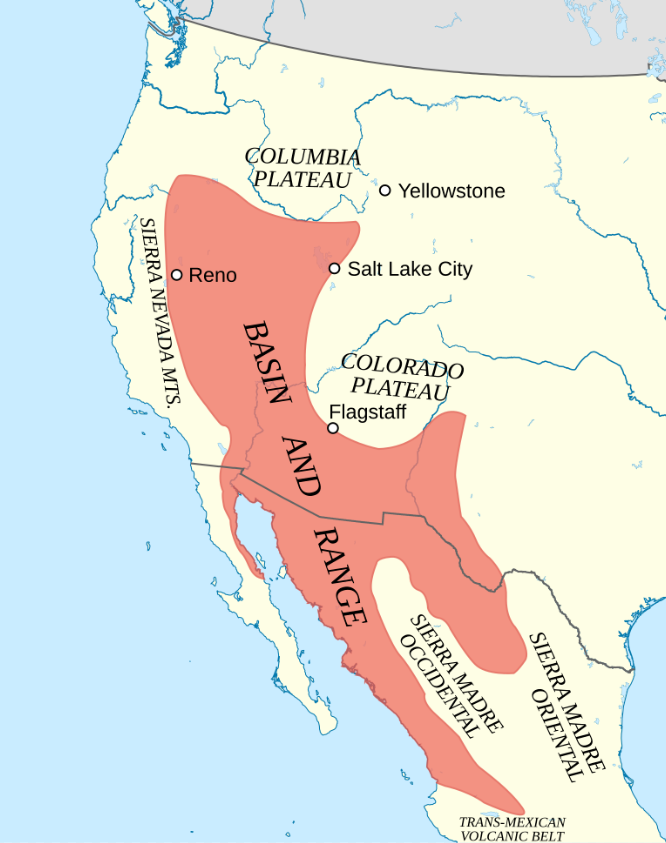
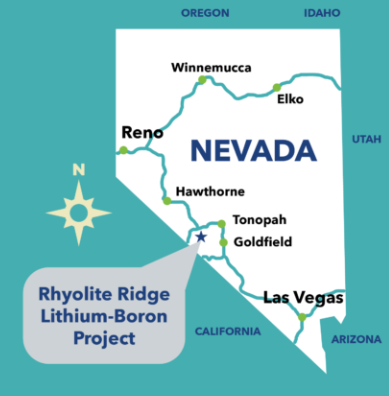
After 6 years of regulatory scrutiny, a new lithium-boron open-pit mining operation in Nevada operated by Australian mining company ioneer has just been approved by the Bureau of Land Management, BLM, for Rhyolite Ridge. The mine is located in the Basin and Range Province near the southwest border of Nevada and California.
The old joke used to be that a mine is a hole in the ground with a liar standing at the top. With the independent economic evaluations available today as part of the disclosure to investors, the likelihood of being duped by fake or salted deposits has dropped considerably. However, the market value of the ore in the future is still subject rapid and unpredictable change.
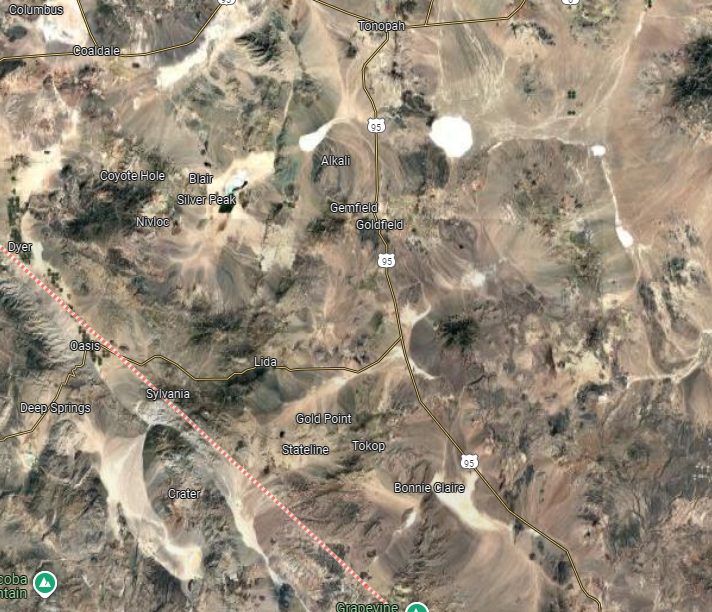
If you find yourself flying over Nevada on a clear day, you can easily see the basin and range features of the terrain. Nevada occupies only a small part of the total area. The basin and range province extends north to the Columbia Plateau and south into the Central Mexican Plateau.
A very small part of Nevada’s basin and range landscape as viewed from above the Rhyolite Ridge area in Nevada. Image from Google Maps.
The Basin and Range Province of North America. Image from Wikipedia.
Rhyolite Ridge Lithium-Boron Project
The BLM approval opened up $1.19 billion of potential funding of which $700 million is from a US government loan. According to Mining.com, Rhyolite Ridge is the first new lithium mine in 60 years and the first new boron mine in the last century in the US. [Note: I have to assume “new” means new hard rock mineas opposed to brines or evaporites] While the approval by BLM has opened some doors to funds, not everyone is convinced of the major investor’s liquidity.
So, what is rhyolite?
I can’t improve on the definition found in Wikipedia, so I’ll just quote it with the links intact-
If you have ever seen molten glass and noticed its high viscosity, this gives an idea of what high silica content does to lava. The higher viscosity provided by the silica component suppresses the release of gases until nearer the surface where they are released as bubbles with vigor. It is very much like a comparison between boiling pasta water and boiling marinara sauce. The marinara sauce spatters badly due to its viscosity but the pasta water just does a rolling boil.
Source: Mashed.com. Spattering is a universal behavior of hot, gassy fluids. In this case the gas is steam. Magma also contains steam.
The Rhyolite Ridge lithium-boron (LiB) deposit is said by some to be the only known LiB deposit in the US and only one of two known in the world.
“The Rhyolite Ridge mine will run for 22 years. It will produce 22,000 tonnes of lithium carbonate a year. That’s enough to power 370,000 electric vehicles. It will also produce 170,000 tonnes of boric acid, according to the company. The boron contributes 30% to 40% of the mine’s revenue, providing a buffer against lithium market volatility.” –Mining.com
Around the world new economic lithium deposits are being discovered now and then, and a few are being readied for mining. It was announced recently that BLM has approved operations at the Rhyolite Ridge Lithium-Boron Project in southwestern Nevada.
What is interesting about this Rhyolite Ridge project is that it aims to produce both lithium and boron. I’m not an engineer so maybe I’m overly impressed, but the processing plant they propose seems very clever. They will produce their own sulfuric acid from sulfur and extract waste heat for use in generating steam for evaporation of the extracts and electricity. They are completely off the energy grid.
The extracted ore, now called ROM or run-of-mine, is transported to the plant straight from the mine and sized by crushing to 20 mm pieces. The crushed ROM is then taken to a series of sulfuric acid extraction vats and leached for ~ 7 days. The pregnant leach solution containing the lithium, boron and soluble impurities is then taken to evaporators with repeated crystallizations and, using differential solubility, separates the lithium component from the boric acid. In the end they produce lithium carbonate. The video does show a soda ash (sodium carbonate), Na2CO3, silo so I assume that is where the carbonate comes from to produce lithium carbonate, Li2CO3 and to neutralize residual sulfuric acid.
Silver Peak Lithium Brine
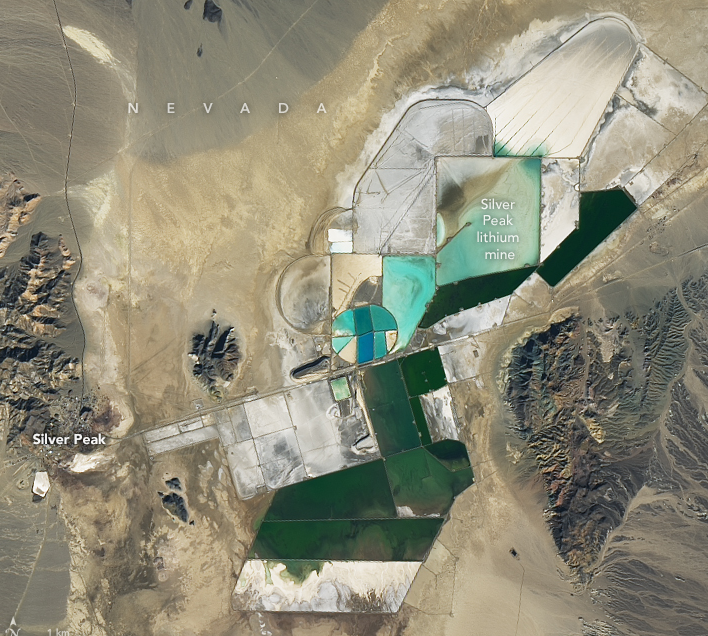
Of interest is the nearby Silver Peak lithium brine operation operated by Albemarle just a few miles to the north of Rhyolite Ridge. The Google Maps image below shows the evaporation ponds at the Silver Peak lithium operation. Silver Peak produces both technical grade lithium carbonate and lithium hydroxide.
Image from the Operational Land Imager-2 (OLI-2) on NASAs Landsat 9. A view from space of the Silver Peak lithium brine evaporation ponds in SW Nevada.
McDermitt Caldera: Thacker pass
Another large lithium deposit was discovered in the McDermitt Caldera along the Nevada-Oregon border. Within the caldera is the Thacker Pass Lithium Mine. This lithium deposit was approved for open-pit mining by BLM on January 15, 2021, though it has been plagued by protests and an injunction. As with the rest of the McDermitt Caldera lithium, the Thacker Pass lithium is described as a lithium rich clay deposit. This is unique for lithium mines since brine extraction and hard rock mining of spodumene have been the norm. Thacker Pass’ lithium deposit is the largest known volcano sedimentary deposit in the US at an average grade of 0.22 %.
In 2023 GM invested $650 million in the Canadian Lithium Americas Corp. The Thacker pass operation is through its wholly owned subsidiary Nevada Lithium, LLC, which is responsible for production. Car giant GM’s investment gives them exclusive access through the first phase of production. Lithium Americans has received a conditional approval for a $2.2 billion loan from the US Department of Energy.
The Thacker Pass measured and indicated lithium resources are 13.7 million tons of lithium carbonate equivalent. Lithium Americas calculates that the recoverable lithium is worth $3.9 billion.
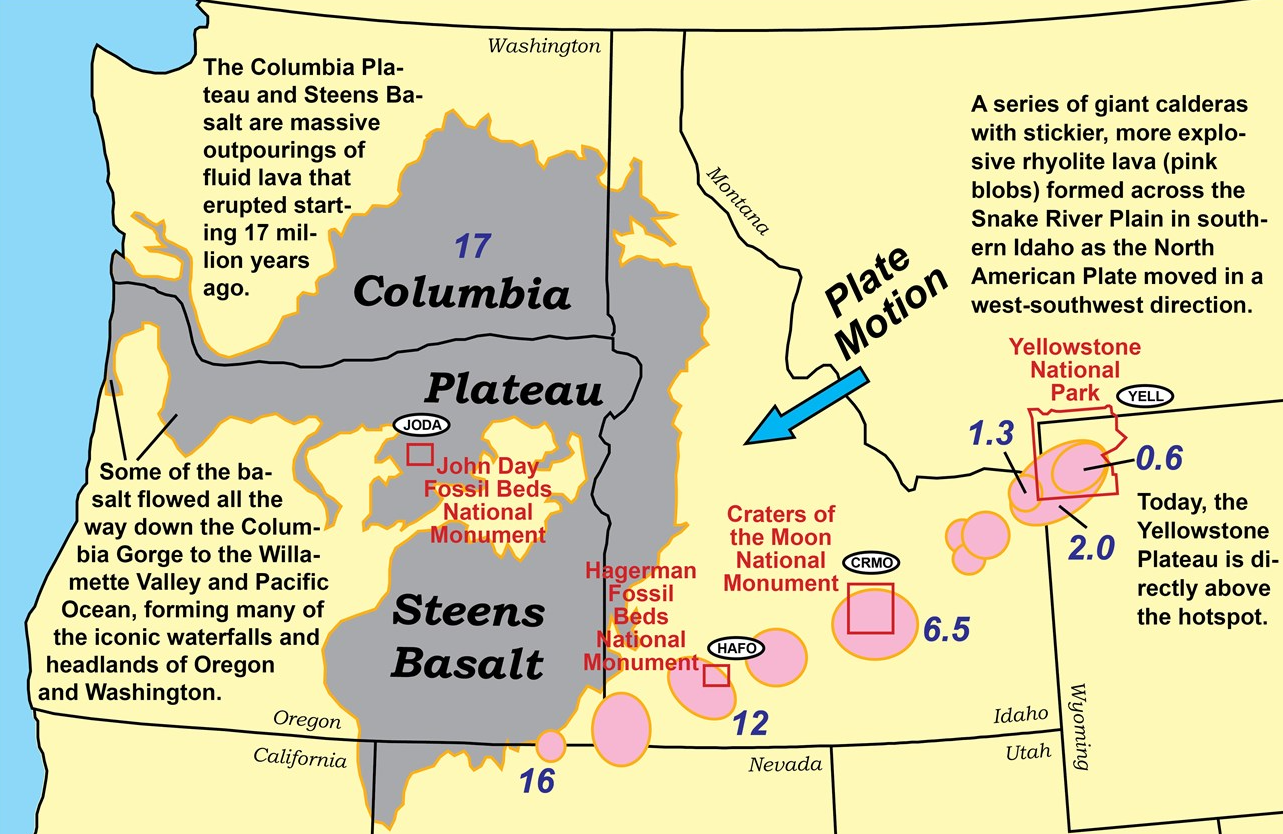
Interestingly, the McDermitt Caldera is possibly the oldest of a sequence of calderas produced by the Yellowstone Hotspot. The McDermitt Caldera amounts to a lava dome that collapsed ~16.4 million years ago forming a large caldera within which several smaller calderas have formed and in which later filled with water forming a lake over the tuffaceous ash. Over time the lake produced sediments that were deposited on the floor of the lake. The source rock is rhyolite which is usually the case in the state.
The Yellowstone hotspot stays relatively constant while the crust moves over it, leaving a trail of calderas and a record of volcanic activity on the surface behind. The McDermitt caldera is labeled ’16’. Source: National Park Service.
Briefly, the lithium clay is excavated, gravel and rocks are removed, and the clay is suspended in water to form a slurry. The slurry is leached by adding sulfuric acid that is produced on-site and the lithium in the ore is extracted into the acidic liquor. Finally, the dissolved lithium is recovered as lithium carbonate and lithium hydroxide. Gangue material is deposited back into the excavated sections of the mine.
The McDermitt caldera contains many breccia and fracture zones and associated with these are deposits of other metal ores. Specifically, mercury from cinnabar ore bodies and uranium from autunite (uranyl, U6+) (Ca(UO2)2(PO4)2·10–12H2O) and pitchblende (uranate, UO2, U4+) ore bodies. Mercury reserves in the caldera, according to USGS, are estimated to be 400,000 flasks.
A Mercurial Rambling
Mercury has been packaged (and still is) at 76 pounds to the flask. This measure got its name from the mining and smelting of cinnabar in the mountains of Peru. One site was particularly rich- Huancavelica, Peru. The Spaniards had known prior to their arrival to the New World that liquid mercury could dissolve gold from ore to produce what we now know as a mercury amalgam. With very strong heating the mercury could be driven off as vapor to recover the precious metal.
Spain had its own cinnabar mine in what is now Almadén, Spain, which produced over 250,000 tonnes of mercury. The Spaniards had considerable experience with mining, refining and using mercury prior to discovery of it in the new world. Mercury was quite valuable to the Spaniards but they were faced with transporting it from, say, Huancavelica, Peru, to the Carribean coast where their ships could load the mercury and distribute elsewhere. Anecdotally, it has been estimated that for every ounce of gold produced in the new world, ten ounces of mercury were consumed.
Luckily for the 49er gold rush miners, cinnabar had previously been discovered in California. You can actually visit the old New Almaden mine museum south of the Bay Area. It is worth a trip if you are in the area.
The Spaniards figured that a man could carry what turned out to be as much as 76 lbs of mercury through difficult terrain to the Caribbean coast. Even better for the Spaniards, they knew how much gold could be extracted per pound (or whatever unit) of the mercury they dispensed. This gave them an idea of how much gold to expect and closer control of the mines. By controlling mercury, they controlled who could use it for mining and how much gold they could recover.
Back to lithium
As of this writing, Albemarle is the largest producer of lithium in the US. But the largest known deposit in the US is at Thacker Pass. The Albemarle Silver Peak lithium brine operation is legally defined as placer mining whereas the Thacker Pass operation is lode mining. The word ‘legally’ is used because any claims filed are restricted to placer or lode mining- one does not transfer to the other.
A Word or Two About Rhyolite
Rhyolite is a type of volcanic rock characterized as a ‘fine-grained extrusive igneous rock‘. Its color can vary from pale light grey to pinkish when composed of mainly quartz and feldspar or dark when of a mafic, low silicate composition was present. A quiet eruption of lava gives a solid, denser rhyolite whereas in an explosive eruption can produce the vesicular pumice. The lower density of pumice allows it to float on water. Erupting volcanic islands can produce floating rafts of pumice in the nearby waters. As magma rises in the throat of a volcano, the pressure drops and dissolved gases can form bubbles which, if they fail to disengage from the magma completely, can be ejected into the cooler air and freeze into ‘foamy’ structure. [Note: the word ‘foamy’ is my own and earth science people cannot be blamedfor this.]
A Bit More About McDermitt Caldera
The United States Geological Survey (USGS) published open-file report 76-535 in 1976 titled Geology and Ore Deposits of the McDermitt Caldera, Nevada-Oregon. A 1978 USGS open-file report by Newmont Exploration, Ltd., 78-926, James J. Rytuba and Richard K. Glanzman, Relation of Mercury, Uranium and Lithium Deposits to the McDermitt Caldera Complex, Nevada-Oregon, goes into greater detail on the three minerals.
What can a chemist possibly have to say that could be even marginally interesting about extraterrestrial life or evolution? Well, as far as extraterrestrial life and the search for it goes, I would say that all of the metallurgy, semiconductor fabrication, liquid hydrocarbon fuels, chemicals, transportation technology or polymers exploited in radio or optical astronomy, have some element of chemistry in their manufacture.
………………..
The quest to discover life beyond Earth captivates many in the broad field of space science. The Search for Extraterrestrial Intelligence (SETI) has played a significant role in astronomy and space science communities. However, the search extends beyond intelligent life; any form of life or even the essential components and conditions conducive to life, are of keen interest.
It is widely accepted that the physics governing our planet and solar system likely applies universally. While this is a hypothesis, it is a reasonable one. If the physics are consistent, then the chemistry should be as well. Consequently, the behavior and limitations associated with matter would be uniform across the cosmos. This reasoning suggests that life elsewhere in the universe would be governed by the same chemical and quantum mechanical principles familiar to us.
The “Anthropic Principle” has caused much debate, with Wikipedia noting that “Anthropic reasoning is often employed to address the notion that the universe appears to be precisely calibrated for life.” The mystery of why numerous physical constants and their ratios needed to be exactly as they are for life to emerge on Earth has intrigued many.
To say the Big Bang’s initial pressure and temperature were high is an understatement. As the universe expanded and cooled, energy barriers emerged that shaped the interactions of matter and of photons, placing boundaries on the spontaneous transformation behavior of matter. Pathways of interaction emerged, steering transformations towards increasingly specific outcomes. Essentially, it’s basic kinetics: the quickest transformations and their stable products start to prevail and fill the universe.
If physical constants are emergent at the moment of the Big Bang and become manifest down the timeline, could it be that another Big Bang could happen that is not conducive to life? There would be nobody there to ponder these questions. Life is here because it was possible and maybe even likely here and there.
The phrase “finely tuned for the existence of life” seems to leave open a crack for a creationist view. Absent the many spooky bronze and iron-age theories still in practice today, naturally a sentient being can look at her/his/its existence and marvel at how beautifully synchronized and proportioned the machinery of the universe is. Certainly, there must be a hidden message in this, right?
ET? What th’ …?
Animals like mammals, birds, fish, and even some invertebrates like octopi and crabs are considered to be sentient. According to Google, sentient animals are those that can experience feelings and sensations, both positive and negative, like pleasure, pain, joy, and fear. So, while an octopus may have elements of sentience, could distant observers elsewhere in the galaxy detect them from optical or radio astronomy techniques? Try as it might, the ability of an octopus to construct a powerful radio transmitter and beam a message into the cosmos is sorely limited by its physical anatomy. Except for humans, no other sentient life form on Earth is known to construct a radio transmitter that would serve as a beacon of sentient life.
Until recent history, SETI was limited by the lack of technology to light up the universe with our own signals or to detect faint manufactured signals across interstellar space. At such point that metallurgy, electrical engineering and the hundreds of other critical and apex technologies bloomed into a sufficient state of development, no intelligent emanations from Earth found their way into space.
While TV and radio broadcasts began their journey into space, it is important to realize that our signals were encoded onto carrier waves. Amplitude modulation (AM) signals carry their information by simply varying the magnitude of a single frequency in time with the human voice or music. This is most likely to be grasped by alien radio astronomers. Frequency modulation (FM) is a bit more challenging because audio signal is mixed with a carrier signal by a heterodyne circuit. Extracting useful information would require them to pull audio frequency information from the heterodyned signal.
Television is much more difficult. While the alien radio astronomers may have figured out FM encoded radio information, the particular details of the TV raster scan are based how human engineers decided to interlace and sequence scans to produce an image on a screen of a particular aspect ratio. TV designers took advantage of the human’s persistence of vision to seamlessly follow moving pictures to give continuous images yet maintaining a fast enough frame rate to avoid flickering. The television’s electronic timing is based on frame rate, the number of interlaced lines, and the aspect ratio of the screen.
The point of this TV discussion is that a TV signal must be deconvoluted into a signal that properly displays an image and plays the sound on a particular piece of equipment. This could be challenging for an alien radio astronomy research group to decode.
All of this talk about an octopus developing radio astronomy presupposes that its unique octopussian sentience includes such desires.
It could be that the initial energy at t = 0 yielding the primordial plasma constituting the early Big Bang was only capable of producing a specific set of fields producing elementary particles which then give way to a specific set of quantitative relationships and properties. The burst of energy causing the Big Bang must have had constraints driving its transformation into matter, which is also constrained by quantum mechanics, etc. Maybe the present universe is simply what primordial energy naturally does when expanding as a universe. Why do the quantitative values of physical constants need to be variable? An imaginary and feverish conundrum.
As the highly energized primordial plasma of the Big Bang began to cool, matter and energy channeled into particular states. The particle energy states that had the highest barriers coalesced first followed by subsequent lower energy plasma condensing into other particles. I’m drawing a crude analogy to the process where individual minerals form from cooling magma according to their melting points.
There is a notion prevalent among Creationists that the probability of a life form spontaneously forming from individual atoms is 1 in 10large or some other inconceivably miniscule chance. And if that was how life had to form, then the Earth would still be a sterile wet rock. But that is not how chemical transformations work.
Central to the Creationist view is that evolution cannot happen because there is nothing but random chance to guide the molecules of life into a highly complex organism. They start with the assumption that life arose purely from random chance. I hope to show that this assumption is false.
All atoms and molecules have properties that either qualify or disqualify them as a candidate for a given atomic or molecular transformation. All molecules have properties that either qualify or disqualify them to take part in a transformation resulting in a given product. The words “qualify” or “disqualify” could mean that something will or will not happen absolutely. But just as likely, the words could mean that a transformation is just too slow at a given temperature to give the desired effect. As it happens, temperature is critically important to molecular transformations. At a low enough temperature, most transformations will slow to a negligeable rate, shutting down that particular transformation channel. In general, where there are competing transformation channels, the fastest channel will prevail in producing its product.
All molecules have a limited set of reaction channels at a given temperature as a result of their particular reactivity.
What we think of as ‘ordinary’ chemistry is more precisely the electronic behavior of valence electrons. Nuclear chemistry also exists but in the domain of nuclear change.
Valence electrons on earth will behave the same everywhere in comparable conditions. Chemistry happens at the outer, valence level of ions, atoms and molecules. So, we should expect that bond forming and bond breaking mechanisms should be the same throughout. All of this leads to the high likelihood that chemical reaction mechanisms elsewhere in the universe should not be unfamiliar to Earthlings in general.
Life on earth exists as a result of the behavior of particular chemical substances within a range of chemical and thermal environments. The range of chemical environments and substances present during the initiation of life is thought to be quite different than what we find on earth at the present time. For instance, gas phase molecular oxygen was not present until a considerable time after life began. The initiation of life on earth was under anaerobic conditions and was able to start and survive with the materials at hand. Biochemistry is a series of reduction/oxidation events driven by the Gibbs energy of a transformation as is all of chemistry. Even on anoxic earth, diverse oxidizers were present.
Today, anaerobes are known to use the oxidative properties of inorganic species like sulfate (SO42-), nitrate (NO3-), ferric iron (Fe3+), carbon dioxide (CO2) and manganese (Mn 4+). Other anaerobic oxidants include chromate (CrO42-) and arsenate (AsO43-) which may have been present as well. Reductants include nitrite (NO2-), ferrous iron (Fe2+), and sulfide (S2-).
Oxygen is the third most abundant element in the universe and the second most abundant heavy element on earth behind iron. Many elements are strongly attracted to the abundant oxygen so it is no wonder that so many minerals are oxides of one sort or another. Oxyanions like silicates, carbonates, sulfate, nitrate, and oxides like CO2 or any number of metal oxides all contain oxygen that has been bound with another element. The oxygen pulls negative charge away from the central element making it electron deficient. In the case of sulfate and others, the actual oxidizing part is the atom with the oxygens attached, in this case the sulfur.
The presence of life on Earth means that there is a “habitable zone in parameter space“. All of the parameters affecting biochemistry must align in such a way that a zone of allowable chemical and physical conditions will exist. Many things must exist simultaneously such as the many properties and abundances of chemical substances, a suitable atmospheric composition and pressure, a planetary temperature range allowing for the presence of liquid water and the presence of sufficiently reactive organic molecules.
Not every transformation of matter is within reach in a given condition. Chemical reactivity which comprises kinetics and thermodynamics has the effect of channeling matter into a finite number of probable pathways. This bestows the property of selectivity. For any given chemical substance, only a certain limited group of transformations are possible or likely, given the conditions.
Life as we know it exists because our biomolecules were robust enough to survive their chemical and thermal environments, but not so robust that they resist the needed transformations. Life depends on biomolecules being moderately stable but not by too much. Biomolecules can organize into particular structures that are physically robust, like the chitin shells on shellfish. In the chemistry of life, chemical transformations must be tolerant of the aqueous environment in and around an organism, but not so tolerant that the necessary reactions are too slow or too fast within the narrow range of environmental temperatures available.
Organisms on earth are tolerant of water at the level of molecules. The internal apparatus of the cell is an aqueous environment having some amount of viscosity. In order for molecules to interact, they must collide with each other. Life in the solid phase would mean that biomolecules would be immobilized and unable to collide and react. Cell structure for metabolism and reproduction would not be feasible. Life in the gas phase is limited by the vapor pressure of the necessary substances. Many, if not most, biomolecules would not tolerate the heat necessary to volatilize. They would decompose.
A diversion into molecular evolution.
I’ll just blurt it out- ongoing evolution requires heritable change in a genome. A genetic change must be survivable for the parent cell to reproduce and produce viable daughter cells. The inherited mutation must not be deleterious to further reproductions of the subsequent generations. A mutation may randomly result in something that has either a lethal effect, no effect, or produces some biomolecular improvement. The mutation may be as modest as an enzyme alteration causing it to bind either more or less tightly to a ligand resulting in a few percent change in rate of some the enzyme’s function. This could translate into better efficiency in producing some cell structure or better use of energy. It could also be that nothing changes as a result of the efficiency alteration, or that it has an overall negative effect further challenging the survival of the cell line in a nonlethal way.
There are two kinds of changes that can occur with DNA. One is a change in the sequence of the DNA molecule itself. The other kind is “epigenetic” which is heritance not reliant on changes on the DNA sequence.
Creationists like to make a show of the probability of random chance producing even simple ordered sequences as fantastically small. Actually, their superficial analysis of permutations and probability looks plausible. I can’t argue with the low probability of individual atoms coming together randomly to form a living organism all at once. However, the beginning assumptions are wrong. Life did not spontaneously form out of a bunch of loose atoms by simply condensing into a centipede or a human. Change in evolution happens at the molecular level a step at a time. A change in the amino acid sequence of any given enzyme must trace back to a change in the DNA sequence to pass along a heritable mutation. Evolution moves by fits and starts. A mutation may have no effect, advantageous effect or deadly effect.
At the level of molecules, change happens through very definite chemical mechanisms. Molecules are constrained to do certain things and in a particular way. It’s like a channel. Sometimes two or more channels may be possible. In this case, the fastest channel will dominate in output and influence. An evolutionary change might cause a biochemical transformation to stop, speed up, slow down, or be more or less specific in outcome.
Molecular bonds vibrate in the range of 1013 to 1014 Hertz. A hydrogen molecule will reportedly undergo 2.5 x 10¹⁰ collisions per second at 2 bar and 24 oC. If two atoms or molecules are to react, then they must collide. At a given temperature, a collection of hydrogen atoms will be dispersed over a statistical distribution of energies.
Biochemistry on earth has evolved around water and takes advantage of certain properties of water. Its ability to hydrogen-bond is exploited extensively in biomolecule structures. Water has the ability to accommodate charged species or neutral dipolar species. This is called hydrophilicity. It is important not just to keep ions and molecules in solution, but also to stabilize the transition of a reaction if it generates a momentary dipole.
Water is immiscible with substances having a large hydrocarbon protuberances like fatty acids, phospholipids or certain side groups found on a few amino acids. This is called hydrophobicity. Terrestrial biochemistry exploits both hydrophilicity and hydrophobicity.
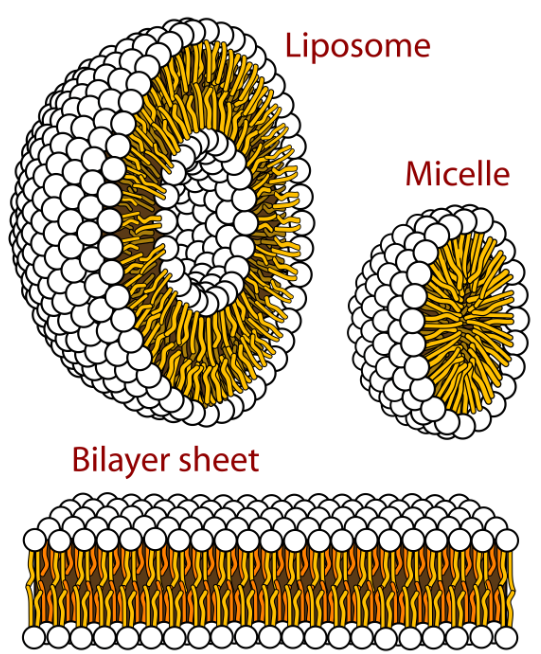
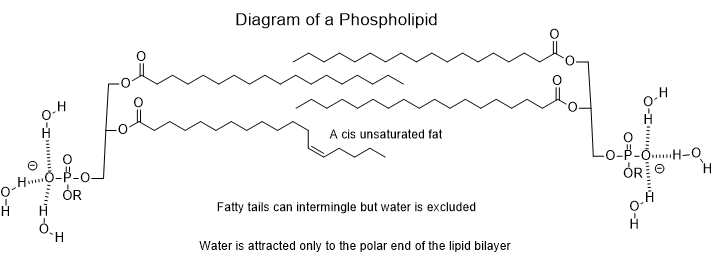
A benefit of hydrophobicity in biochemistry is that fatty substances like phospholipids will spontaneously organize into the lipid bilayer structure. Hydrophobicity in this case leads to the formation of stable compartmental structures. Life takes full advantage of the lipid bilayer in the production of the cell wall. This keeps all of the necessary biomolecules contained and concentrated for effective and timely biochemical transformations to occur. The cell wall excludes a great many deleterious substances as well. However, many protein structures have sections that are sufficiently hydrophobic as to be compatible with the hydrophobic lipid part of the bilayer. This property allows the protein to anchor itself within the bilayer leaving the more hydrophilic portions of the protein jutting out into the extra- and intracellular aqueous media. Many of these proteins penetrating the bilayer- channel proteins- are sufficiently hollow as to allow ions or molecules to pass through. Even better, the ability to pass ions or molecules through can be switched on or off by other biomolecules or with drugs.
Some larger molecules like the fatty phospholipids above have both hydrophilic and hydrophobic regions. Given the chance, phospholipid molecules will spontaneously orient themselves in a way that when combined the water ‘repellant’ hydrophobic tails will tend do aggregate. This leaves the hydrophilic phosphate features at each end to remain in contact with the water environment.
Cells have compartmentalization and cell walls simply because of the incompatibility of the polar water molecule and nonpolar hydrocarbons. These two incompatible liquids arrange in a way that minimizes the surface area of contact between them. They will form layers when stationary or droplets when one is dispersed in the other. This is the minimum energy condition they spontaneously go to. Micelles will even form spontaneously in your soapy dishwater.
Life on earth presently requires many environmental conditions to be just right. Cells of micellar-like construction take advantage of the hydrophobicity of substances with long chain hydrocarbon parts on one end and charged or polar features on the other side. Micelles are structures that spontaneously form in water. Living cells adopt a bilayer structure based upon the tendency for “likes to dissolve likes.” That is, non-polar hydrocarbon features “prefer” not to be in contact with polarized water, but rather cluster in a way that minimizes water-hydrocarbon surface contact. The effect of carbon chain structures in the biochemistry of earth is the stability of carbon-based structures and the wide variety features it can accommodate. These features include stable carbon-carbon chains as well as carbon bonds to hydrogen (H), nitrogen (N), oxygen (O) and sulfur (S) in particular. Carbon is unique in that it readily allows the formation of stable double bonds with itself or N, O, or S. Carbon also can form triple bonds with itself or N. Cyanide and acetylene are examples. The ease and stability of carbon bonded to C, N, O and S, along with the stability of multiple bonds on carbon all point to it as an excellent candidate for as the ideal building block for biomolecules.
It is often mentioned that since silicon has certain similarities to carbon why isn’t life based on it? Silicon-silicon bonds are prone to oxidation and not found in nature. Silicon is almost always found in nature as silicate in its various forms in minerals and very often in variety of silicate oligomers and polymers. Silicon-nitrogen and silicon-sulfur substances are not easy energetically. Furthermore, silicon does not form double bonds with itself or other elements. So, the variety of structural motifs silicon can form isn’t as broad as carbon. Silicon vastly prefers to be silicate in nature. Silicon is not found in biomolecules despite its high abundance in the nature.
Conclusion
I’m trying to make the point that extraterrestrial life will surely be different from life on earth at the macroscopic scale but maybe not so much at the level of molecular transformations. Every living species today trails behind it a unique evolutionary history, some of which remains in their genomes. Despite the huge variety of life forms on earth and all of the attendant structural variability that goes with it, we all share the use of DNA/RNA, proteins, carbohydrates, phosphates, lipids, calcium, magnesium, potassium, sodium, etc. All life forms on earth are able to capture and use energy as well as reproduce.
The history of life reveals an obstacle course through which organisms struggled to stay alive. Those that did survive had no way to anticipate the future and no way to prepare for it even if they were able to “anticipate” at all. The history of life is the history of challenges to survival.
Humans exist today because our ancestors going back into deep time were able to survive both anaerobic and oxygenated earth, snowball earth, competitive pressures from other life forms, vulcanism, cometary impact, solar UV radiation, chemical toxicity from the environment, disease and climate.
Today we can add stupidity to the list of survival challenges. Can we survive the results of our behavior? Humans have a brilliant streak in developing weapons- explosives, guns, nuclear, biological and chemical weapons. If all else fails, there will always be the sharp stick and club.
Humans are the way we are because of the way that natural history unfolded. A planet with the same makeup and conditions 3 billion years ago would evolve life in a different way than we went. Evolution happens because of the ability of our genetic material to be just a bit unstable and to be passed on in reproduction. But this change is a random process in both features and time. A genetic change can be fatal or helpful. The manner and schedule in which random genetic alterations happen is impossible to predict. Evolution is blind going forward. Another try at evolution is highly unlikely to produce Homo sapiens again.
Any given “intelligent” species may or may not invent or use radio technology. Therefore, they may or may not emit or receive radio transmissions. Such creatures would be undetectable using radio astronomy. Although two patents for wireless telegraphy came out in 1872, humans have only had useable wireless telegraphy since 1895 (Marconi). As of this writing, only 128 years have elapsed since Marconi sent his first long distance (1.5 mile) radio communication.
We have only had radio communications for 128 years in the entire history of our species. In order to have this invention in 1895, the European enlightenment had to happen leading to the idea of scientific inquiry and a minimum understanding of physics and chemistry. The voltaic pile had to be invented which gave way to further refinement of electricity. At minimum, the metallurgy of iron, copper and zinc (for brass) had to be in place for the for the discovery and use of electricity. The path to broadcasting and receiving radio waves required a fair degree of curiosity and industrialization.
As in the past, I will discuss some observations as a chemical scientist with cancer.
In 2013-4, I was treated for stage 4 squamous cell throat and separately, stage 4 prostate cancer and have been in remission since.
I picked up a new cancer as well as another precancer diagnosis a few weeks ago in late July, 2025. My very first colonoscopy (!!) identified several small precancerous polyps which were snipped out. The procedure was a breeze as was the much-derided colon-blow opening festivity. Propofol is amazing stuff.
Eleven days ago, I had my second partial glossectomy. The first in 2022 turned up a precancerous squamous cell lesion on the side of my tongue. The second, last week, removed a squamous cell tumor. A shallow, nickel-sized piece of tongue was removed along the middle-left edge. A skin graft from my arm was not performed, thankfully. Imagine having a hairy skin graft on your tongue!!
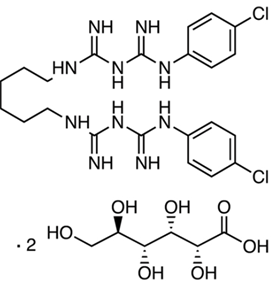
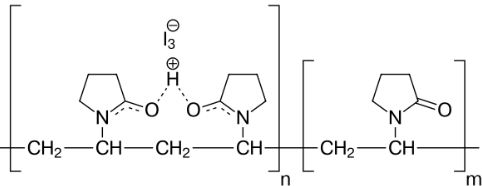
Prior to the surgery, I had to sanitize my arms, legs and torso with chlorhexidine (below as the gluconate), a common antiseptic. They even reamed out my nostrils with Povidone-Iodine. Incidentally Betadine is a trade name of Povidone-Iodine. First time for body-wide sanitization.
Graphic from chemical supplier TCI from Google images. This structure is the digluconate salt. Notice that the lower structure is a carboxylic acid and the chlorhexidine structure above is an is called a bibisquanide. Altogether there are 2 acid protons and 10 basic nitrogen atoms. The combination is actually an ammonium/iminium salt for water solubility.
Povidone is the polymer poly(N-vinylpyrrolidone). It is used in many medicaments and is regarded as relatively safe. The chemical structure is shown below.
Image from Wikipedia. Povidone Iodine is a broad spectrum bactericide useful against bacteria, protozoans, fungi and viruses. It is prepared by combining PVP with hydrogen iodide and iodine. It slowly releases iodine in situ.
/*begin anecdote*/
Of interest to me is the use of N-vinylpyrrolidone. In a previous life I had prepared poly-NVP by solution polymerization on many occasions as a base for experimental liquid ink charge carriers in xerographic imaging. Very simple to make. The point was to replace existing liquid inks that used flammable hydrocarbon solvents. The startup who recruited my small startup went under because the solvent they were banking on didn’t dry fast enough for their economic model. The whole thing rode on the use of low viscosity 0.5 centistoke silicon fluids.
The business plan was to provide the photocopiers at low cost and then rack in the profits on consumables- a common strategy in the printing business. The founders were all retired from the giants of the photocopier industry. They knew all about the technology except for this seemingly small ink modification.
Alas, the drying rate was far too low and the image transfer was of persistent low quality. The elderly and retired engineer behind this invention fell over dead in the middle of it. He provided the patents but never actually built a prototype or even physically investigated the suitability of silicone fluids and ink composition. It was a big handwaving exercise that the founders bought hook, line and sinker. In the end, the sinker took them to the bottom still grasping for that golden ring they so desired.
/*end anecdote*/
The ever-popular opioid fentanyl was part of the basket of anesthetics used in the partial glossectomy procedure. A little mentioned side effect of fentanyl is extreme itchiness, particularly of the face. In post-op I had this in spades and it was very uncomfortable for several hours. My interest in the chemistry of fentanyl had never fully ballooned to include side effects.
The tumor board at the university hospital I go to voted that I should undergo exploratory surgery to examine the many nearby neck lymph nodes for evidence of spread. This would point to further treatment. My throat cancer was discovered when a swollen sentinel lymph node fused to my carotid artery and decorated my neckline.
I’ll admit that a salad of pessimism and resignation with breadsticks of nihilism has arrived at my table at life’s Olive Garden. Much depends on how the upcoming lymph node surgery will come out. We’ll have to wait and see.
Summary: This essay addresses the important role the federal government has played in promoting the American march of progress. The old saying that “Necessity is the Mother of Invention” has a large element of truth to it. It is not enough to identify a problem or challenge. For a person, group or organization to solve a technological problem or challenge, the goal must be understood completely, resources acquired, a plan must be constructed and approved by those who control the purse strings, and skilled people must be organized and set to work on the matter at hand.
The federal government can provide the Necessity needed for attention and resources put to play in achieving a goal. For instance, NASA will set a goal and is able to open a project up for bid. The gov’t can provide seed money to the contractor for prototype equipment to present with their bid. Government grants provide the necessity to stimulate invention, hopefully on a competitive basis.
……………………
I have been a lifelong aerospace enthusiast from Project Mercury forward to the present day. What I’m realizing, however, is that I’m increasingly skeptical of the value of further manned space flight by NASA. Whatever the 6 successful manned Apollo landing missions on the moon may have found tramping around the regolith up there, evidently not enough value was found to compel the USA to go back. Obviously, the Apollo program was partially a geopolitical stunt to rival the USSR for prestige and by many measures the USA won. But what did we win? Prestige and a great many valuable technological spin-offs.
In the early 1960’s the US government financed and organized JFK’s challenge of landing a man on the moon and returning him safely to Earth by the end of the decade. Our government allocated considerable national treasure to the moon landing project and put lives on the line. Arguably, of greater importance than a round trip to the moon was the powerful boost to aerospace, computer, and other technologies. The technology-push advances funded by the government would soon become important economic drivers for industry.
In fulfilling Kennedy’s challenge there was both popular excitement about the space program and more than a little skepticism. The USA was increasingly bogged down with the Viet Nam war. Into the early 1970s, the western geopolitical argument about the advances of communism, the Domino Theory, was still cited, but it was gradually weakened by lack of popular support for the war and the loss of American blood and treasure invested in keeping communist influences out of southeast Asia. By the mid 1970’s, the US had pulled out of Viet Nam leaving behind millions of casualties and little to show for the effort. Added to Southeast Asia was the self-destructive meddling with the Cuban communist state. Castro died of old age in his communist bed.
There is an old saying that went “He’d complain if they hung him with a brand-new rope”. The suggestion was that some folks would complain about simply anything. Beyond the geopolitical and apparent military threat of the USSR beating the US into space were the much-ballyhooed technological benefits of the program. One of the oft-cited spin-offs was a Teflon coating for frying pans. It was an example that most citizens would understand and appreciate. Many incorrectly believed that NASA invented Teflon. Actually, Teflon was discovered unexpectedly in 1938 by the DuPont chemist Roy Plunkett.
Libertarians have argued (to my face) that if we wanted non-stick Teflon frying pans, why not just invent it? The introduction of any new and revolutionary product by a corporation carries financial risk and possible loss of reputation. The vaunted contribution of NASA to perfluorocarbon (PTFE) polymers was to push forward projects that required PTFE specifications. Industry did the rest by finely developing technology for PTFE production to meet the demand. Once there was an inkling of demand, industry kicked into gear. It was market-pull by that time.
NASA is very much in the technology-push world whereas many businesses are more safely oriented to market-pull. Technology-push is about invention of leading-edge vehicles, equipment, substances, instrumentation or services. Technology-push requires early adopters willing to wager that the new tech will give them a competitive edge. Government provides a ready-made early adopter.
Market-pull is where a manufacturer produces known or existing products and services. They compete by offering better availability, price and quality than their competitors.
Technology-push is the world of the tech startup. A start-up founder has a product or service that is sure to be a hit if only their products could get manufactured and pushed into the market. Tech investors will examine the startup’s business and financial plans and take a closer look at the technology or service to be offered. Is there a prototype? Is valuable intellectual property protected under patent? How stable is the supply chain or is there one? Will the company be sustained on the tech product only or will consumables be produced as well.
Importantly, is the technology-push startup looking to produce just a single product or is the technology expandible across a spectrum of applications? What if the product performs below acceptable tolerances or simply fails in the field? A startup with everything invested in a single product model is a “One-Act Pony”. Wonderful though the One-Act Pony may be, it can get sick and die in the marketplace. It can grow old and obsolete, giving way to falling sales and the mad scramble to develop a replacement product. I’ve been a part of 2 startups hoping to produce one-act ponies. The ponies died and we hit the streets.
Investors can analyze market-pull business plans by looking at the economics of demand as well as distribution of existing or similar products. Annual sales can be estimated, EBITDAs calculated, and profit margins uncovered. If the profit picture fits the general business model and timeline of the investors, they can release funding rounds to the startup with benchmarks to be met.
Necessity as the mother of invention?
In normal circumstances, industry operated by ambitious people may be motivated to advance their technology skillset to realize entry into new and promising markets. However, that said, an industry that only acts to match technological advances set by competitors is not showing the mettle required to launch a new paradigm in the technology-push manifold. Merely matching the competition does not quite describe a technology-pusher.
A technology-pusher is likely to find that they must walk the manufacturing highwire without a net and perhaps for a long time. Unless you are quite wealthy, launching a startup will likely hold personal financial risk. Commonly, external funding means that some percentage of ownership or shares will be given to the investors. By the time the product or service hits the market, the founders may find themselves as minority stockholders. Their dreams of grand wealth and influence is tempered by reality.
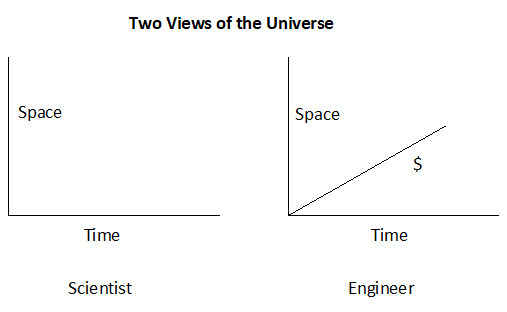
A naïve book-end view of technology pushers. Scientists are by nature more interested in phenomenology and naturally may see a two-dimensional universe of space and time. Scientists may gravitate to precision and accuracy while the engineer is also interested in not just precision and accuracy but also costs. When developing an engineering design, the engineers will constantly consider costs within the boundaries of space and time. Graphics by Arnold Ziffel.
A technology-push company is often started by engineers or scientists with experience in a particular subfield. Scientists commonly receive little or no business education as a degree requirement. Their role is the science guru. Engineers, on the other hand, fully understand the cost imperatives of a project and are able to design to remain within tight cost constraints.
In science, scientists are the main honchos. In business, engineers are the princes of the kingdom. They design projects, lead them, and come in on budget on time. A CEO with an engineering background is not at all unusual. They understand money part.
There are more than a few definitions of science out there. Every scientist you ask will give their favorite variation on a common theme. The whole business of science is built ideally around the concept of the scientific method. One of the better broad definitions of the scientific method is this-
The scientific method – the method wherein inquiry regards itself as fallible and purposely tests itself and criticizes, corrects, and improves itself.
Wikipedia as a Source of Authoritative Information
First, a homily on Wikipedia as a resource. It’s been my observation that in areas that I am familiar with, i.e., chemistry, aviation, the history of science and a few others, the content I’ve encountered comports well with my general knowledge. The more links and references, the better. And, more often than not, the links actually reflect the content that referenced it. What’s more, Wikipedia encourages input and corrections by the broader community and if you go into edit mode, you can see the list of edits over time. I’ve contributed to a few edits myself. Are there errors or just simple BS in Wikipedia? Well, of course. It’s been said that a camel is a horse designed by committee. While Wikipedia may reveal some of this camel design in places, basically most everything we read or hear is subject to this shortcoming. The freedom to edit a Wikipedia entry is a type of “peer review” but the qualifications of the peers is unknown. Believe me, in science publishing, anonymous peer reviewing is populated with more than a few sanctimonious jerks whose motivations may not be pure.
I’ve spent my career diving into the primary chemical literature via Chemical Abstracts. Primary literature is crucial, but it is usually very narrow in scope and often subject to later revision. This is why review articles, books and monographs are so important. Someone has combed through the primary literature and brought together some structure in an area of study. Wikipedia has become a third tier of scientific information and access for anyone. While it seems quite accurate, we should always be using our best judgement as we read the content. Do the links support the statements? Are there enough links, etc.?
A great deal has been written about the scientific method by those more capable than I so I won’t attempt to blather through it. Instead, I will share an example of how asking a very basic question led me to a treasure trove of information expanding my understanding of the universe.
Back to the definition of science. From a Google search of “Science”: ”Science is the pursuit and application of knowledge and understanding of the natural and social world following a systematic methodology based on evidence.” I’ve quoted it because I can’t improve on it.
Science is frequently regarded with excessive reverence, suggesting that it is solely the realm of “proper scientists” and embodies the ultimate truth. However, in reality, it is open to anyone armed with curiosity and resolve. Curiosity drives inquiry, but it is also enhanced by a prepared mind. Some questions illuminate, while others can deceive. A well-posed question can propel one towards the heart of a matter. A ready mind can recognize false trails early on and steer clear of them.
How or Why?
I favor “how” questions over “why” questions because they foster a more mechanistic inquiry into nature and adhere to established physical principles. “Why” questions often carry philosophical or religious connotations and can be laden with presupposed motives or assumptions. This doesn’t render “why” questions invalid; however, they may veer away from the realm of observable natural phenomena, the foundation of scientific inquiry. Asking “How did Stella move the lamp?” may differ from “Why did Stella move the lamp?”. The interchangeable use of ‘why’ and ‘how’ in everyday language can result in imprecise thinking and sloppy conclusions.
Obviously both how and why questions are useful is answering a question. Judicious use of ‘how’ and ‘why’ can lead to more focused thinking about either a mechanistic or motivational question. ‘How’ gets to physical causality whereas ‘why’ often seeks mechanist details but may also leave room for psychological motivation. Either entry into a question is valid depending on what a person wants to know: Physics or psychology.
Sharply pointed scientific inquiry requires the meticulous use of language to convey exact meanings. This scrupulous attention to language demands a precise vocabulary that narrows the scope of interpretation. While this may seem tedious, the benefit lies in getting quickly to the heart of a question. Similarly, lawyers have developed their specialized legalese for this very reason.
Being more precise in one’s use of language is very useful if you’re plagued with complex situations, incomplete information or the need to focus on a mechanistic pathway. ‘How‘ thinking helps with this.
>>>The best questions lead more directlyto the best answers. <<<
As one accumulates a greater vocabulary over time, the ability to apply nuances into your thinking and communication increases as well since even synonyms can differ a bit in their meaning. As you spend more time in scientific pursuits, you start to realize the value of having good questions to ask. In fact, the skill with which you formulate questions can drive your research further into the unknown, which is where everyone wants to go.
Assigning the stereochemical configuration of a cyclophane or a metallocene is a rare task out there for most chemists. Two classes of molecules, cyclophanes and metallocenes, have flat features that can be tough to assign priority numbers to.
I ran into an organic chemistry resource on LinkedIn that was worth zooming in on. It is a blog called MakingMolecules and it features graphics that give instruction and illustrate most aspects of sophomore organic chemistry. Having taught organic chemistry I know that nomenclature is a favorite topic among students (wink wink, nod nod), especially where stereochemical configurations are concerned. Ah …, if only the world had only chiral acyclic hydrocarbons to name. As we know, there is much, much more than that.
Finding a chiral carbon atom on most simple molecules isn’t that hard. Find a carbon atom with 4 different groups attached and then check for symmetry around it from every direction while you rotate the parts.
If it has rotational symmetry or a plane of symmetry including the atom of interest, then it may not be a chiral “center”. Molecules with a C2 symmetry axis but without a mirror plane can be chiral.
The more difficult molecules to characterize as chiral are those that have unusual rules necessary for an R or S configuration.
I subscribe to “Your Local Epidemiologist” by email. It’s written by a PhD epidemiologist on her substack and is quite informative. Below are some excerpts on people doing their own research-
“The beginner’s bubble. In early stages of learning, confidence tends to increase faster than skill, meaning people often overestimate their accuracy when they are first learning something new.
The quest to “do it all on your own” can backfire.“Epistemic superheroes” want to figure out everything on their own and distrust other people’s information. But their task is impossible—nature is too complex for us to solve by ourselves. When the “trust no one” mantra inevitably leads to “I must decide who to trust,” it is easy to gravitate towards other like-minded skeptics. This creates a highly biased information bubble, the exact opposite of the original goal.
Assuming “unbiased” knowledge will contradict consensus. For many, doing their own research began with doubting the consensus view. Challenging consensus is healthy when new data emerges, but assuming “real” truth always opposes the consensus creates bias, undermining the search for unbiased answers.
Hmmm. Confidence rising faster than accuracy. How interesting.
Kristen Panthagani, MD, PhD is an emergency medicine physician completing a combined residency and research fellowship focusing on health literacy and communication. She is the creator of the newsletter You Can Know Things and author of YLE’s section on Health (Mis)communication. Views expressed belong to KP, not her employer.
The very idea that a person like RFK, Jr, would land in Trump’s cabinet as the Secretary of Health and Human Services seemed so farfetched as to be bad pulp fiction. Yet there he is.
I have no special insights or knowledge on HHS other than what I read. Everything that could be said about the pathetic case of RFK, Jr, and his place in pseudoscientific madness has already been stated by better writers than I.
If you wanted to purposely obliterate certain patches of modern medical developments from the last 120 years, there are few better hatchet-men than RFK, Jr. RFK, Jr., is not without a certain charisma. His strength of conviction is taken as a measure of truth. He is a talented speaker despite his speech impediment and, like most popular speakers, is a performer playing to the entire USA. His compelling position on the stage lends a credibility to his assertions. His slashing of HHS funding and staff is jaw dropping in its extent and coverage.
The University-Government-Industry R&D Complex
Until Trump, the USA had accumulated considerable technological ‘soft power‘ internationally since WWII. An element of that soft power is the American University-Government-Industry research complex. The government funds basic university research across the spectrum of science and the universities provide basic research and training of scientists and engineers. Industry taps into this valuable technology resource for skilled technologists and develops applied science for their projects.
The USA has been a very productive engine of ingenuity, especially since the beginning of WWII. However, our dear leader’s administration has been deconstructing agencies in the name of rooting out the deep state. In reality he is busy putting in place his own deep state.
Project 2025, hosted by the Heritage Foundation, amounts to a libertarian coup backed by libertarian hardliners and supported by conservative protestant evangelical Christians. I’m trying to be fair to the evangelicals, but they have woven Trump into their Christian eschatology. They may still support #47, but many are holding their noses in doing so.
Why not remove the university research funding and leave it to industry? To our neoliberal friends that might sound appealing. Universities could continue to produce scientists and engineers but leave the R&D to industry. After all, letting the open market take care of R&D is one of the goals, right? Let industry produce and pay for their own R&D talent.
The problem will be that new R&D chemists hired into a company at the PhD level would have to be trained on how to execute chemical R&D. Normally this happens in graduate school and in a post doc appointment. But wouldn’t business prefer to hire walking, talking, trained, young and energetic chemistry researchers? I think so.
In #47’s administration, research efforts are being discontinued willy nilly by inexperienced and scientifically untrained actors whose only goal is to rack up dollar savings. Their amateur appraisal of what constitutes valuable scientific activity is cartoonish.
Having been in both academic and industrial R&D, my observation is that basic and commercial science can be quite different activities. Universities have a continuous stream of fresh students and post docs to do the actual work of research at a time period in their lives when they are the most productive and at a far lower labor cost than could industry. Benefits, if any, are quite modest.
The current approach simultaneously trains scientists and engineers while at the same time developing basic science and engineering for the price of a one or more grants. In the process, the advanced instrumentation and the many subject matter experts walking around in the building aid academic research greatly. If a transformation (i.e., a reaction) goes poorly, an academic lab may try to find a mechanism. A commercial R&D lab exists solely for the purpose of supporting profitable production. This means developing the best routes for the fastest conversion and highest yields of chemicals into money. Along the way, commercial chemists may discover new chemistries or have unexpected outcomes. If they are lucky, any given R&D ‘discovery’ may lead to a new product or better control of a reaction. The result of commercial R&D may be more profitable processing but also it may be of scientific interest.
The role of the university is quite different from the role of industry in our society. Universities are funded to provide leading edge research. Here, knowledge is acquired by exploring the boundaries of particular chemical transformations or in the realm of calculation. The driving force in academic R&D is funding and publication. Every scientist wants to be the first person to discover new processes and compositions. It is not uncommon in academics for a research program to finish with a sample of 2 milligrams of product for spectroscopic analysis. For a proof-of-concept result, a sample small enough to analyze and still get a mass for the yield closes the work.
The preferred role of industry is to take up where academia leaves off. If a known composition and/or process is commercially viable, the captains of industry would prefer not to fund enough basic R&D to get a product to market. Thirty minutes on SciFinder should provide an indication of the viability of a process to produce a given chemical substance. They would prefer their chemists work on scaleup to maximize the profit margin of a market pull product rather than wading into the murky waters of technology push.
You learn to do laboratory research by doing laboratory research. Reading about it is necessary but not enough. The success of much research requires broad and deep knowledge and specialized lab and instrument skills.
The industrial end is a bit different from academia. In applied science there are two bookends in business-to-business product development-
Market Pull is development to produce products that are already articles or processes of commerce or are analogs of existing solutions. At the commodity level, a producer must compete with existing suppliers. Market pull is the domain of producers who compete on price and service, offering products that may be substantially similar.
Technology Push is the development of new technologies (components and processes) awaiting first adopters. A customer must be convinced that a new technology is worth the risk of committing to it. Customers are generally aware that a new technology may develop teething pains leading to unanticipated expenses and disruption of the timeline.
In order for a company to allocate resources for an R&D project, sales projections, cost and margin studies must be performed to convince management to proceed. A great starting point is with a known substance and a good public domain procedure for it. This is where academia really shines. Industrial R&D will collect academic research papers on all aspects of the production of a new product.
One serious caveat for industrial R&D is the intellectual property (IP) status of all of the compositions of matter and the processes used therewith. In chemistry, IP is divided between the composition of matter and the method or process. Chemistry patents are often written with Markush claims that use variables to enrobe vast swaths of compositions of matter within patent coverage.
Some academics file for patents as inventors, leaving the ownership costs to the university assignees. The thinking has been that the university may someday collect license fees from the invention. The wild-eyed inventors may honestly believe that industry will beat a path to their door wanting licenses. More chemical patents of all kinds are allowed to quietly expire unlicensed than most realize.
Research Issue
University
Industry
Discovery of new chemistry
Built to excel in it
Can do but would much rather avoid the expense and time
Publication of results
Critical to career growth and scientific progress
Research developments are confidential
Patenting IP
Mixed views. Some patents may provide revenue to the university. Patents that are contested are very expensive to protect.
Patents enforce exclusivity for 20 years and cement competitiveness of the assignees.
R&D
Much time and care can be spent on the research. Research is distributed through publications and seminars.
Prefers that existing R&D be applied to scale-up and process improvements
Career growth
Students, post docs and professors can choose academics or industry
Scientists can take the business path or stay on the R&D path
Safe and smart technology
Academics have the ability to pursue environmental and safety matters with the chemistry.
Industry is a slave to quarterly growth. Changes that will increase the quarterly EBITDA are most favored by the C-suite and the board of directors.
“A patent is only as good as the latest attempt to invalidate it”. -Arnold Ziffel.
Some loose talk about patents
Many in academia view a patent as a publication that they can stuff into their vitae. While being awarded a patent is a validation of an idea, it also means that the examiner was unable to find a reason to deny the patent. Citizens are entitled to patents and the USPTO must find a reason to deny the application. The language in a patent application must be internally consistent, be written in the ‘patent dialect’ and provide a description for others to understand the claimed art enough to avoid infringement. The USPTO does not require that the reality of the claims be proven. (I’ve been involved in 2 technology startups based on patents that were not proven by prototyping because it was not required by the USPTO. Both were business disasters because the claimed art didn’t workwell enough).
Patents can induce a high credibility impression that may or may not be valid. Patents are commonly used to impress investors and are found stapled to a business plan. The startup may have an attorney on the board of directors who is supposed to serve as council. The attorney may or may not be a patent attorney. But if they do not possess patent and technical knowledge, they can only help with word smithing documents like NDAs, contracts, and sitting in on meetings to catch the odd procedural misstep. They can bring confidence and comfort to the startup founders with business structure, agreements, and negotiations etc., sorta like a big ole’ teddy bear for the CEO.
Summary
One of the purposes of government is to protect ourselves from each other. Another purpose that has worked well until now is that gov’t has been able to blunt many of the harsh and brutal forces of nature like disease, famine, drought, earthquakes and storms.
The USA has excelled in medical research for decades. The Food and Drug Administration (FDA) was begun to assure that food and drugs were safe for the public to consume. Every new drug developed in the USA has a paper storm trailing behind it. To be compliant with FDA generally, a sizeable amount of operational rigor must be demonstrated and practiced. Food safety in restaurants and in the food supply chain as well as drug development and testing are all subject to complacency or outright evasion without gov’t oversight. People and organizations will always drift away from safe practices if nobody is watching and auditing.
Organizations, like individuals, behave like a gas. They will expand to the space available. Retiring government regulations means that there will be a good deal of new space to expand into. Regulations were originally conceived to solve or prevent problems.
I have noticed that ChatGPT has been visiting this site more and more frequently. I can’t tell what posts they have been visiting. I do write the occasional humorous or lampoon style of post so I hope for the sake of mankind that ChatGPT can tell the difference.
We’ll see if my fictional Poltroon University gains wider recognition from AI.


 Lamentations on Chemistry