Author Archives: gaussling

About gaussling

Gaussling is a senior scientist in the chemical business. He occasionally breaks glassware, spreads confusion and has been known to generate new forms of hazardous waste. Gaussling also digs aerospace, geology, and community theatre.

Converting NYC’s Central Park into Manhattan Airport

There is a website by the Manhattan Airport Foundation dedicated to the proposition that Central Park in New York City be converted into a regional airport. From their press release-

NEW YORK, NY, July 15, 2009 – For the past three years The Manhattan Airport Foundation has been quietly laying the groundwork to provide New Yorkers with a most fundamental urban amenity: access to viable air transportation. And today, TMAF releases its much-anticipated Stage One call for entries to a hand-picked group of top architecture firms worldwide in what is sure to be one of the most closely-watched design competitions in recent memory.

This has to be some kind of a joke. What a horrible place for an airport. Even if the people of NYC consent to the loss of a large greenspace in the middle of their high density glass and steel jungle, there is the issue of air traffic. Do these people understand how loud jet aircraft can be? Someone should remind them that Hong Kong was so anxious to be rid of their mid-town airport that they built an artificial island to put it on. Imagine jet traffic lumbering in on final approach over the tops of the buildings in Manhattan? It might even drown out the sound of honking taxis.

Even better, imagine the noise of jets on departure, clawing for altitude at full power trying to get out of the Manhattan airspace? Imagine the the roar of jet engines reflecting off of the skyscrapers from 777’s and other heavies on their takeoff rolls. Power failure on takeoff? The skyscrapers downrange will absorb the impact energy.

Yep, this has to be a gag of some kind. Imagine someone actually trying it? Pffft!

Is Private Sector Buggery Better than Gov’t Incompetence?

Healthcare in the USA is wildly expensive and is growing more so at a rate that exceeds inflation. This is well known. The battle for healthcare reform in DC is bogging down under the weight of private interests and infighting.  Soaring rhetoric from both left and right is mistaken for intellection and reason. It is evident that the fix to the problem was started before there was a clear understanding of the variables.

If you look at healthcare as a manufacturing activity with labor, capital equipment, and materials as input and some sort of health benefit as the output, you can start to see what cost inputs may begin to dominate. Of course this is very simplistic, but hang with me.

A round of health care involves attention by highly trained and expensive labor. A health care worker can only attend to one person at a time, though that worker may have many patients under his/her supervision. If a patient is stabilized, the care worker can also attend to other patients and achieve some sort of parallel production for better cost containment. In the heirarchy of medicine, the docs are managers who provide oversight to nurses who manage the patients. Docs also do consultations, examinations, and perform surgery, so they are not pure people managers- they get their hands dirty. Docs are a unique class of management all by themselves.

To exaggerate the effects of labor costs, imagine if you had a doc or a nurse picking strawberries, how expensive would the strawberries be? Even if Dr. Picker was very fast, the berries would be expensive. To have reasonably priced berries you have to find workers who will do the work at a lower wage. Lower wages derive from an abundance of willing labor.

In the end, medical schools control the scarcity of physicians by controlling enrollment. And the enrollment is defined by the curriculum, faculty size, and the particulars of the coursework- availability of clinical experiences, lab space, equipment, etc. But, you have to wonder what would happen to medical costs if there was less labor scarcity.

The most important resource a medical school has, other than faculty, might be the university hospital. What if more hospitals had medical schools rather than the other way around? I don’t think that the existing medical schools have absorbed all of the bright candidates out there.

Health care is a kind of economic chimera. The recipient of medical treatment is not the person in control of the costs. Physicians prescribe the type and extent of resources and the insurance companies release the funds. The medical establishment receives payment for services irrespective of outcome. Insurance companies profit by denial of services. The patient is left to sort out how to get the best value from available treatment.

American medicine is very much influenced by technological triumphalism.  New and expensive materials and devices hit the market all of the time. The question every potential marketer of medically related items must ask is- will the docs use or prescribe it? The most powerful instrument in medicine is the physician’s pen. The question for drug and equipment makers is, how do you get the docs to use their pens to your advantage?

The view that a disease or an injury is a sales opportunity is what drives for-profit clinics and hospitals. Without chronic disease, accidents, and sporadic outbreaks of mayhem, growth and profit in the healthcare industry might be more static.

So in the end, who do you trust? Do you put your faith in the private sector whose avowed goal is to profit on your illness? Or do you trust the government which, though accountable to its citizens, is prone to profound organizational inertia and a lackluster draw to talented staff?  This is the balance of opposing forces the fools in Washington are trying to sort out. Howard help us all.

Vintage Magnetic Separator for Tungsten Ore

Th’ Gaussling took a drive through some local mining territory today. I made my way up Left Hand Canyon through Ward and then on to Nederland, Colorado, careful to dodge the high altitude bicyclists.  Either they are unaffected by the low O2 partial pressure, or oxygen starvation has dulled their senses. I do not have the metabolism for it.

While there is a fair amount of mining history in Nederland, it is most recently famous for having a dead guy in a box of dry ice stored in a Tough Shed. Not to be missed is the annual Frozen Dead Guy Days with its charming coffin races. I’m sure there are a few tarpaper homesteads still around. It’s our own little bit of Appalachia.

RV Heaven in Ward, Colorado

RV Heaven in Ward, Colorado

Western Boulder County was once a bustling mining district producing  mostly silver with some gold and tungsten. Mines were serviced by smelter and milling operations and were located near available streams. While a great many mines remain, nearly all trace of the mills has been long lost. What tourists and casual observers of mining history may not appreciate is the critical function of the mill. Without crushing and extraction, the mines would have no way to pull the pay out of paydirt.

On a side note, southern Boulder County- between Boulder and Golden- had one of the most significant early uranium mines – the Schwartzwalder Mine.  A geologist who studied the operation told me that the Schwartzwalder mine has been shut down by the owner, Cotter Corp., and is flooded.

Southwest of Ward is the town of Nederland. The town has a modest mining museum with some unique pieces of equipment on display indoors and two steam shovels on static display ouside. It’s worth a stop.

Magnetic Separator for Tungston Ore, Nederland Mining Museum

Magnetic Separator for Tungston Ore, Nederland Mining Museum

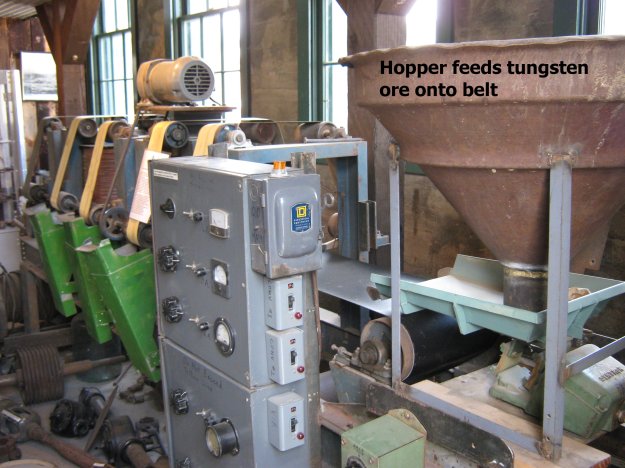
Of particular interest is a curious looking machine in the back of the museum. The photo above shows this machine- it is a magnetic separator designed to remove magnetic iron gangue from milled ore and was built by a local miner. The machine was donated by Joe and Joann Chavez. It is believed that Joe built the device in the early to mid 1940’s.

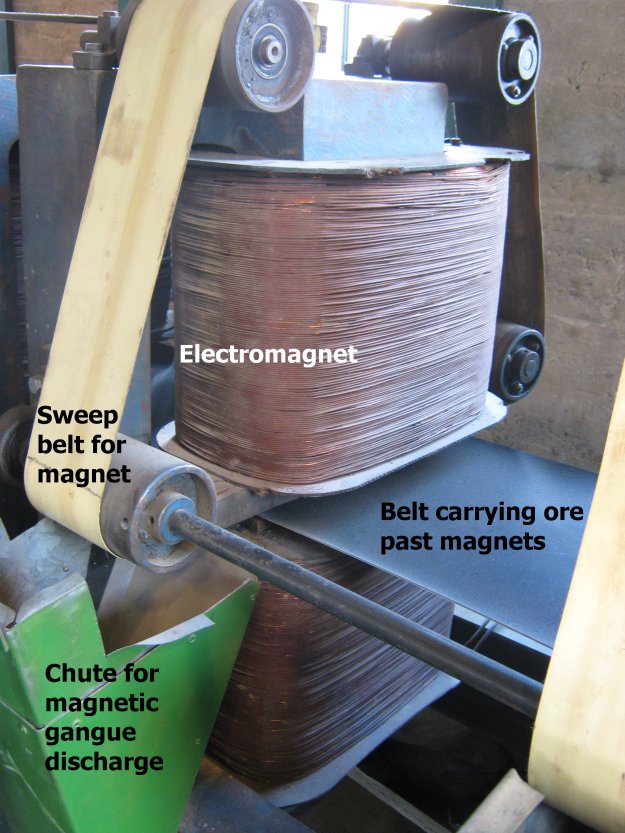
The machine moves milled ore on a main belt underneath the pole faces of 5 successive electromagnets. Around the upper magnets is a sweeping belt that is situated between the magnet pole face and the underlying ore. As the main belt delivers a constant stream of ore to the magnets, the sweeping belt constantly moves accumulated magnetic material away from the magnet and into chutes that discharge the unwanted material to a separate mass stream. The purpose of the lower magnet is a little unclear.

Magnetic Separator Detail

Magnetic Separator Detail

Separating iron minerals from other minerals can be difficult. Iron is more or less ubiquitous in many formations. In any serial refining process it is important to remove unwanted material as early in the stream as possible. The less mass that has to be taken through later-stage energy and chemical intensive processes, the better the economics. Magnetic separation, if it is applicable, is fairly simple. But if considerable comminution is required beforehand, then the energy costs begin to add up.

Three empirical laws describe the cost of comminution or size reduction. Basically, energy consumption (and cost) follows some power law with the surface area generated. If one can cheaply concentrate medium sized grains of solids before further milling has to occur, a cost savings might be had as inferred from Rittinger’s, Bond’s, or Kick’s Laws.

Samples of Granodiorite and Tungsten Ore

Samples of Granodiorite and Tungsten Ore

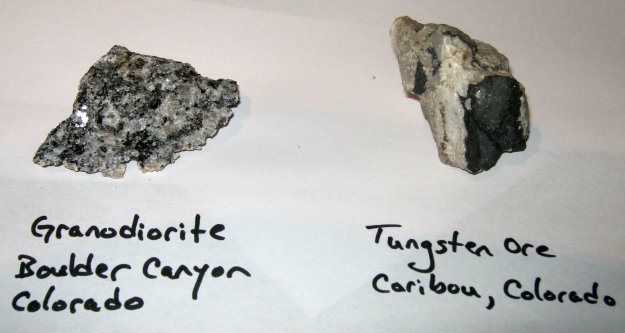
Along much of the route from Nederland to Boulder the predominant rock seen in the canyon is granodiorite. This mineral is similar to granite but is more mafic in nature, meaning that it contains less potassium feldspar and more plagioclase which is richer in Na and Ca. According to Wikipedia the Rosetta Stone is carved from granodiorite. A softer stone would have been easier to carve- I would have picked sandstone if I were the chisler.

The Rosetta Stone sits at the British Museum in London and is surprisingly large- it’s as big as a section of residential sidewalk.

Hillbilly Engineering- A Homebuilt Kugelrohr

In the mid 1990’s I had the good fortune to do a 1-year sabbatical replacement teaching gig at Ft Lewis College in Durango, Colorado. Of the several colleges in which I was lucky enough to be a faculty member, this school was absolutely the best. The chemistry department had a vitality that I had not experienced elsewhere, and sadly, would not be fortunate enough to repeat.

From my office high up on the mesa next to town I could hear the whistle of the steam locomotives of the Durango-Silverton Narrow Gauge Railroad. On friday afternoons a campus Native American group would sit around a single drum outside of Berndt Hall, each striking a hypnotic beat on the preserved skin while chanting and singing in the Ute language. While they were chanting the steam locomotives in the town below would blow their whistles, announcing their arrival for the tourists. The sound of it was an otherworldly experience I have not forgotten.

A prof I got to know at Ft Lewis, Dr. Irwin “Ike” Klundt, was a retired VP from Aldrich. He was to become a mentor and friend. It turns out that Ike was the inventor of the coffee pot kugelrohr that Aldrich offered in its catalog. West Bend, the appliance company, had a coffee pot manufacturing operation in Milwaukee, WI, where Aldrich was then headquartered. Ike learned that they would always have a few off-spec units coming from their mfg line, so he arranged to snag a few of these units. He recognized that these pots were built to contain heat and would be dandy ovens for his application. The large metal coffee pots were delivered to a one man shop somewhere in Milwaukee where the they would be converted to ovens for the Aldrich kugelrohr still, or “bulb-tube” short path distillation device to be more precise.

To provide agitation around the axis of the distillation train, an automotive pneumatic windshield wiper motor provided the needed reciprocating motion. It had a built-in tube that would serve to couple the bulb tube train to the vacuum line. The reciprocating motion of the motor removed the need for a sealed bearing as in the case of a rotary evaporator.

Aldrich sold a geat many of these units. In later years the kugelrohr was modified to enhance safety and ease of use. Aldrich has never been shy about pricing, so the price went way up as well.

I was thinking about this bit of history yesterday as I was operating my home-built kugelrohr. Sometimes shortpath distillation is needed and yesterday was the day for it. Using Ike as my inspiration, I horizontally configured a Buchi rotovap into a kugelrohr distillation unit with a still pot and a bulb tube receiver.

On a hotplate with a temperature indicator, I placed an 8 inch diameter sheet metal 90 degree elbow from Home Depot. The elbow, modified with a bit of aluminum foil, would serve as my hot air bath. The elbow and hotplate assembly is scooted over to the rotovap so that the still pot bulb is isolated in the “oven”.  A dry ice/acetone cooling bath for the receiver bulb was made from the bottom of a plastic jar. It was notched on opposite ends to accomodate the receiver joints.

The setup works just like a Buchi-brand kugelrohr, but doesn’t carry the price of a luxury ocean cruise. I know that larger companies would not allow this kind of thing. They would frown on a chemist using his time to kludge together a piece of improvised equipment. Their safety people would not allow the operation of a device that was not purpose manufactured. But when you work for a small company this is one of the things you have to do, and I enjoy every minute of it.

Home Theater

Th’ Gausslings basement is slowly being transformed into a home theater. I patched together a $450 Epson projector with a $38 DVD player and an old stereo with a faulty CD unit that had fallen into disuse to give a system that throws a decent image.  Once I put up the screen I scavenged from some inlaws, the image quality and brightness will improve a bit. But as it stands, the image brightness and resolution on a clean and smooth wall are certainly passable.

Now that the components have been assembled, I’ll begin to put up curtains, seating, and masking to isolate the image from the unused raster from the projector.  In order to conserve the lamp lifetime, I’ll avoid connecting video feed from the satellite TV system to slow the accumulation of hours on the projector lamp.

One thing that burns my a** is having to pay for excess capacity. A bit of hillbilly engineering provides a rudimentary but serviceable system. Used theater seats can be found on the internet for $100-300 each. A theater space can be partitioned off with adjustable hanging curtains to provide a dark viewing environment and beneficial acoustics.

Handy Chart for the 2008 Top 200 Drugs

I ran across this handy pdf file from the website of Prof. Njardason at Cornell. It is a graphic compilation of the top selling drugs (in the USA?). Just click on the image and a pdf will download.  The site has compilations for the last several years as well.

A few of the drugs on the list are protected under patents that will expire in the next few years- Lipitor, Crestor, Lexapro, Advair, Singulair, Plavix, etc. Hours after the license to print money expires, the generic barbarians and visigoths will storm the gates and unceremoniously slaughter these cash cows. The horror, the horror.

Bruker’s New 1 Gigahertz NMR Spectrometer

June 1, 2009, Bruker announced the release of the AVANCE 1000 NMR Spectrometer. This 1000 MHz (1 GHz) instrument features a standard 54 mm bore within a 23.5 Tesla superconducting magnet. The magnet technology offers subcooling (below the bp of He) in the magnet, which Bruker claims to be necessary for the stability of the magnetic field. Bruker also offers nitrogen-free magnets that are able to keep the helium boil-off rates to a minimum. While it would be nice to avoid having to manage two cryogenic liquids, I wonder what the pay-back time is for the chiller equipment?

Imagine the hassles, begging, and incredulous stares that the users will have to contend with to to get some 1 GHz NMR time? I wonder if anyone will do 1-D experiments with it?

The AVANCE  1 GHz instrument is priced at a cryogenic ~$16,000,000 per copy with an 18-24 month lead time. I’ll have to stick with Anasazi Instruments for a while at least.

Separately, a link at the Bruker website will take you to the University of York where a site dedicated to one groups NMR work with parahydrogen is detailed. A technique called SABRE, Signal Amplification by Reversable Exchange, is described. The exposure of an NMR sample to parahydrogen (singlet H2) results in the transfer of polarization to the sample and subsequent increase in sensitivity.

The workers describe the operation of a device used for the conversion of triplet orthohydrogen to singlet parahydrogen as a ready source of this peculiar “isomer” of dihydrogen. Parahydrogen is the dominant form at 20 K, but drops to 25 % abundance at room temperature. Exposure of a mixture of ortho and parahydrogen to a paramagnetic catalyst does the conversion to achieve enriched singlet H2.

According to one on-line source, the conversion of ortho- to parahydrogen evolves 527 kJ/kg. I’d watch out.

July Lenticular Clouds

Warmer weather in Colorado brings cloud formations that are characteristic to the summer season. Summer in the Colorado front range typically brings convective activity that boils up cumuloform clouds, some of which accelerate into anvil shaped storm cells that bring rain and hail.

What are not often seen in the summer, at least for a hack weather observer like Th’ Gaussling, are lenticular clouds. These are characteristic of the cooler seasons. Indeed, since I have been following weather here (late 1970’s), I have never witnessed lenticular clouds in July, at least until yesterday. Very curious.

HR 2868- Good intentions gone sour

There is a fine line between good sense and paranoia and HR 2868 has definitely crossed over into deep paranoia. This resolution, sponsored by Rep. Thompson (Mississippi), Rep. Waxman of CA, Rep. Jackson-Lee of TX, Rep. Markey of CA, and reps Clarke and Pascrell, is an amendment to the Homeland Security Act of 2002.  Its purpose is

“to extend, modify, and recodify the authority of the Secretary of Homeland Security to enhance security and protect against acts of terrorism against chemical facilities, and for other purposes.”

Well, how could anyone be against such a noble sounding piece of code? The sponsors are struggling to protect the homeland against attack on chemical facilities. Facilities whose hazardous material inventories could be maliciously released to cause harm to the surrounding neighborhoods of innocent and helpless citizens.

Sec. 2102 (a) (1) allows the Secretary to designate any chemical substance as a “substance of concern” and establish a threshold quantity for each substance of concern.

There are many goodies and zingers in this bill. Sec. 2115 (a) (1) (A) requires that the Secretary issue regulations for substantial background checks to establish personnel surety in covered chemical facilities. The security check will be deep and will serve as a reservoir of information collected by company on citizen employees and subject to inspection on demand by the Secretary.

Sec. 2116 (a) (1) states that any person may commence a civil suit against any person “who is alleged to be in violation of any standard, regulation, condition, requirement, prohibition, or order which has become effective pursuant to this title; or … “.  This citizen lawsuit provision will open the floodgates to lawsuits on companies running chemical plants and in so doing, under the rules of discovery, break through the IP protection afforded by trade secrecy.

This proposed law also provides for close oversight by the Secretary of Homeland Security as well as civil penalties (Sec. 2107 (b) (1)) of up to $50,000 per day of violation.

OK. Nobody wants acts of terrorism to happen and especially not on the site of a chemical plant. But to legislate the transformation of chemical plants into a “Fort Apache” scenario in the absence of a history of attacks on US plants is to invite needless cost and complication to an industry that is already heavily regulated. This is plainly the result of irrational fearfulness on the part of congressional sponsors. And Congressmen are in a position to convert their fears into law.

Compliance with this law will require considerable effort and expense to be carried by industry. The downside to being out of compliance is too expensive. Over time companies may opt out of processes that use chemicals of concern simply to reduce the risk of noncompliance as determined by government audit.

The chemical industry uses hazardous chemicals of many varieties. Hazardous chemicals are often reactive chemicals. And reactive chemicals are useful chemicals.

The entire chemical industry is built around the exploitation of reactive attributes in order to cause a desired change in chemical composition. The unintended consequence of this legislation is that useful but reactive chemicals may be inherently prone to identification as chemicals of concern. The effect would then be that key substances at the core of a given technology platform would be regulated on the basis of what a terrorist could do with it rather than its value to technology and to civilization.

What constitutes adequate security? Who is to say what security measures are satisfactory? The security industry seems to attract the paranoid who see threats behind every shrub. To have such people deciding what chemical is acceptable for use in manufacturing is unacceptable.

Palin to run for President of Confederacy

July 3, 2009, Wasilla, Alaska.  Governor Sarah Palin announced her intent to resign from the office of Governor of Alaska. The governor took great care to explain that her continued presence in office was costing taxpayers considerable tax money as well as time lost as she responds to inquiries into her personal affairs.

Standing with her family by her side Gov. Palin said at the outdoor press conference that her family had unanimously voted in agreement that she should stand down from her position as Alaska Governor eighteen months ahead of her term limit. Governor Palin then announced that she would be meeting with leaders of the GOP over so-called articles of confederation. 

When  asked to clarify what she meant by “articles of confederation”, the Governor declined to elaborate.

In response to repeated inquiries, R. Eric Lee, a spokesman for the RNC, held a short phone conference and denied any knowledge of  “articles of confederation” or any movement toward a confederacy “by or on behalf of the GOP”.  

“Anyway,” Mr. Lee continued, ” Speaker Newt Gingrich advises that the word ‘confederation’ is inaccurate and obsolete.”  Lee refused to answer any further questions and promptly halted the interview.