Gaussling is a senior scientist in the chemical business. He occasionally breaks glassware, spreads confusion and has been known to generate new forms of hazardous waste. Gaussling also digs aerospace, geology, and community theatre.
I heard a sarcastic moniker for Texas yesterday for the first time. It was “Howdy Arabia”. It was used by one of my favorite comedians, Trae Crowder, and refers to ultra-conservative xenophobic southern American culture. Crowder is from Tennessee and calls himself a progressive hillbilly or a liberal redneck. But Howdy Arabia has been around for a while as a Google search will show. The phrase “Y’all Qaeda” also bubbles up.
Why all of this intemperate 8th grade slander on an entire state? The abortion fiasco led by Texas Attorney General Ken Paxton happening in Texas presently is so foul and unnecessary that I can barely listen to it without becoming angry. Medical reality doesn’t seem to have a place in Paxton’s absolutist, linear brain. He is putting on a performance to display his Republican bona fides. His are the Bible belt constituents who elected him. In this sense, he is a duly elected official giving his voters what they want no matter the cost. It isn’t just Paxton- it is the entire GOP party apparatus at work.
Paxton is an aggressive, doctrinaire male exerting control over a woman’s body from a distance. He won’t be present as she suffers through this ordeal. He could have accepted the local court’s decision and allowed the woman to go forward with the procedure. Instead, he appealed to the Texas Supreme Court and ruled against the lower court’s decision. Further, he sent letters to local health care providers threatening severe legal consequences if they were to aid in the woman’s abortion. This is Republican Texas.
It came out that the state of Alabama is preparing to execute a prisoner by nitrogen hypoxia. Oklahoma and Mississippi are the only other states that have authorized this method of execution. The prisoner, Kenneth Eugene Smith, had previously selected nitrogen hypoxia as a secondary means of execution. This decision was backed by the US Supreme Court. The first attempt to execute Smith by lethal injection failed because of the inability of workers to find a vein after 4 hours trying.
Smith’s attorneys have made the argument that this new form of execution claim that Smith is a “test subject for this novel and experimental method.” According to the Death Penalty Information Center, some have claimed that “those who support the use of nitrogen hypoxia can only theorize that the method will be painless and quick, but opponents have likened it to human experimentation.”
Criticism of the nitrogen hypoxia method have raised safety concerns for witnesses. It’s been argued that nitrogen escaping from the condemned man’s mask could threaten the health of those nearby, particularly the preacher standing close for spiritual comfort.
Critics say that the state of Alabama has not adequately prepared for the execution and the safety of witnesses and workers nearby.
“They could start to hyperventilate because their body would detect that they’re in a low oxygen environment,” said Dr. Joel Zivot, an anesthesiologist and associate professor at Emory University School of Medicine. “And that severe hyperventilation can lead to a stroke.” The doctor expressed concern that the method is full of unknowns and seemed quite skeptical of the method.
Seems to me that on basic principles alone, this method should work just fine. It would’ve been nice to read that the state had a written procedure that specified the type of mask and the nitrogen flow rate. As for the safety of others, minimally there should be an O2 concentration meter present, which is the case. The air exchange rate in the room can be measured and increased, assuming this is possible in an Alabama prison. Best of all, supplied air hoods or masks are widely available. This would only require an air compressor in fresh air.
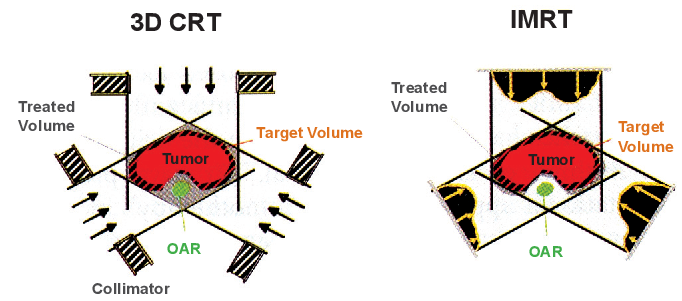
It has been right at 10 1/2 years since I was treated for squamous cell throat cancer. This virally induced cancer is quite treatable with a high success rate. The treatment was simultaneous radiation and cisplatin. The x-radiation dose was 68 Gray in daily 2 Gray doses with 6 cisplatin infusions. The radiotherapy machine was an Intensity Modulated Radiation Therapy (IMRT). The source rotates around the stationary patient varying the beam size and intensity as it goes. The idea is to put the energy into the tumor and spare healthy tissue to the greatest extent possible. The neck is a very crowded place with many kinds of tissues you don’t want to zap too much.
Illustration showing variable intensity beam shaping from the IMRT on the right. Source: Semantic Scholar.
It took about 1 week for the radiation effects to show up. It began with a sore throat which quickly led to a stomach feeding tube. They snake a pointy-ended tube down your throat and poke it out of your belly. I had it in for about 6 weeks. I jammed my liquid food in with a 60 mL syringe.
Besides the considerable discomfort from the radiation, long term side effects were not terrible. My thyroid took a big hit as did my salivary glands and taste buds. Ten years of dry mouth has led to the loss of some teeth. And, there was difficulty in swallowing initially. This problem unexpectedly returned during my recent bout of pneumonia.
The cisplatin was given in 6 doses. The nursing staff in the infusion suite don considerable PPE while handling chemotherapeutic drugs due to the toxicity hazard. I had no noticeable symptoms from this treatment. But while in the infusion suite, I could hear numerous female patients who were groaning in misery and vomiting from their meds. It was heart wrenching.
Nine years ago I wrapped up radiation for my stage 4 prostate cancer. Though the dose was lower at 38 Gray, there were no real negative effects as with the throat radiation. This was followed by 2 years of chemical castration with Lupron. It is also called hormone ablation. Lupron interferes with the production of testosterone. It does not, however prevent the adrenal glands from producing it, but this is a minor source. The first effective treatment for prostate cancer was surgical castration done to halt testosterone production. This hormone accelerates the growth and spread of the cancer. These guys who take testosterone for body building have no idea about the other thing the hormone can do. Just my opinion.
Hormone ablation eventually becomes ineffective because over time the prostate cancer cells respond by increasing the number of androgen receptor proteins on the cell walls. After hormone ablation fails, more severe treatments are put into use.
My outlook is this- The throat cancer is unlikely to return, but the prostate cancer will eventually take me out. I’ve had plenty of time to ponder death since the cancer diagnoses. I’d much prefer to have a quick, fatal heart attack than a slow, wasting death from cancer. I jokingly mentioned this to my cardiologist. He replied that the heart attack might not kill me. Buzzkill.
As of this date, the Texas Supreme Court has blocked a lower court decision by Travis County District Judge Maya Guerra Gamble that a Texas woman may obtain an abortion. Within hours the Texas Attorney General Ken Paxton sent letters to 3 area hospitals saying the temporary order would “not insulate hospitals, doctors, or anyone else, from civil and criminal liability for violating Texas’ abortion laws.”
The woman is currently in another state where her condition does allow for a legal abortion.
Apart from the usual hairball of arguments about abortion itself, I’m flabbergasted at the apparent absence of medical input relating to this law. Why isn’t there a medical board of OB/GYN specialists who have some authority in this? Were obstetrics medical school faculty consulted in the drafting of this law? Was the religious conservative pressure so great that OB/GYN best practices were just disregarded? Looks like an absolutist approach was taken and exceptions could be finely scrutinized with a bias towards “no.”
Is there a religious conservative in Texas who knows what an ectopic pregnancy is or any other dangerous medical condition? Pregnancy is a hazardous business and much can and does go wrong taking the life of one or both the infant and mother. Apparently in Texas, dying in childbirth is acceptable because it is God’s will and the rest of us have to respect the wishes of Republican believers.
Perhaps the Texas AG, Mr. Paxton, has the habit of denying/prosecuting abortions across the board and letting the matter go to the Supreme Court for a decision. This keeps him free of criticism from the anti-abortion mega-church preachers in Texas.
The whole thing stinks of ignorance and religious disregard for medical reality. The Texas state motto should be- “Frequently wrong, but never in doubt.”
The political party of Indian Prime Minister Narendra Modi is the Bharatiya Janata Party (BJP). This party won the 2014 general elections by a landslide, and again in 2019. Since then the BJP has reportedly aligned with the RSS, Rashtriya Swayamsevak Sangh, a paramilitary right-wing group. Modi has been accused of leading the country into what has been called a “Hindu religious autocracy.” The process of implementing a Hindu Nationalist agenda has been given the colorful name “saffronization.” No small part of it is the de-westernization of India.
Indian history and politics is very rich but unfamiliar to most westerners so I can’t go into detail other than to say that there is a strong Hindu Nationalism movement there. A level of rejection of Eurocentric values is to be expected given the history of British rule in the 20th century. India is a nuclear, space-faring nation today with much to be optimistic about.
Recently, Darwin’s theory of evolution has been removed from textbooks in 9th and 10th grade biology. The fear is that most students do not take biology later in their school years and therefore will have no understanding of this important aspect of biology. The decision to drop evolution from the 9th and 10th grade biology textbooks was a “content rationalization” made by a government organization called National Council of Educational Research and Training (NCERT). NCERT claims that they dropped discussion of evolution during the COVID-19 pandemic in order to streamline online classes. India currently has 256 million primary and secondary students.
This has resulted in an uproar by Indian academics, including artists, writers, historians and scientists. The notion held by most scientists and mathematicians around the world is that physical and biological science is secular, i.e. it should not contain cultural, historical or racial structural elements imposing subjectivity in modeling the physical world.
The reader should know that I would much prefer to write about sciency topics like chemistry or mining geochemistry. But I have become aware of a political tsunami that could arrive at our shores in 2025. It is a planned sequence of actions aiming to convert our American civilization, its economy and politics so drastically as to be unrecognizable by the standards of today. It is breathtaking in its sweep and amounts to nothing less than a sociopolitical revolution. I refer to “Project 2025” organized by the Heritage Foundation. Short of a mainland invasion of North America, I am hard pressed to think of something that will so drastically alter the course of American civilization. Republicans are seeking to emplace a permanent conservative state. My view is this- screw ’em.
At present, the US is the global hegemon and has been one since WWII. Many nations resent this, especially China and Russia, and seek to become the major hegemonies themselves. They strongly desire to knock the US off the sandpile and take up residence for themselves. Trump’s America First policy would allow Russia and China to step up as US foreign influence is purposely relaxed. As the unity of the US/EU and NATO collapses, Russia’s influence in Eastern Europe will rise as they move forward to the reestablishment of a Soviet-scale state. China’s dominance along the South China Sea, Southeast Asia, Taiwan, Philippines, Indonesia, Malasia and Australia will grow, as they intend it to.
The expansion of Chinese and Russian influence will come as a result of the loss of global US influence. As technology and the quality of life expands across the world, US hegemony will necessarily diminish somewhat. What we can and should hold onto is our standing as an influential and thriving democracy.
To my many friends, colleagues and readers, all I can say is that now is not the time to shrink back into your shells and wait out the 2024 political season in the US. If your visual acuity takes you past your nose you will see that Project 2025 will strongly alter the function of the federal government. This is a step towards a dictatorial architecture that will directly affect our lives and our standing in the world.
Hyperbole? Visit the link and think it through for yourself.
Project 2025 is nothing less than a coherent plan to deconstruct the administrative function of the federal government, especially under the executive branch. The many designers of this project believe in the so-called “deep state” which, they say, is firmly nested in the ponderous federal bureaucracy. As a story it has the necessary elements of a conspiracy novel. There are protagonists, antagonists, narrators and enough historical detail to make their storyline convincing. In my view, the deep state exists in the form of dark money and the subsequent influence over politicians, mostly the recipients of big conservative money.
The US media will be of little help here and will relegate themselves to documenting the downfall for the infotainment of everyone around the world. Decades hence, dissertations and documentaries will be produced attempting to explain the collapse to authoritarianism to puzzled citizens.
But Project 2025 is more than just a rejiggering of the administrative apparatus of the federal government. Significantly, it aims to intensify the many powers of the federal bureaucracy directly into the hands of the president by aligning the federal workforce job security to be politically accountable to the president.
It represents a transition from a primary emphasis on expertise to that of political reliability for one’s career-sake. The plan will go into effect the first day of the next Republican president’s administration, be it Trump or otherwise. This is what the plan states in clear English.
In our federal government, laws are passed and placed into the Unites States Code, USC. This content is then translated into the Code of Federal Regulations, CFR, for promulgation. The CFR is a structure of regulations based on the USC for practical application and enforcement.
It is easy and quite lazy to claim that the US federal government is completely broken. It seems to be hypersensitive in some areas and intractably slow elsewhere. Nonetheless, much of it functions like it should behind the curtains. Do we really want a government that is incontestably and quickly responsive to the whims of a president? Or should there be checks and balances built into the system? Handing over more power to a morally bankrupt person like Trump is grossly irresponsible, stupid and may not be reversable. Other than a foreign invasion, this could not be more serious.
Due to a recent hospital stay with pneumonia, I found myself staggeringly bored. To stave off some of this I began to look into an antibiotic I was given that I had never heard of- Levofloxacin. The structure of this antibiotic was different from antibiotics I was previously familiar with. Natural I suppose, considering that I’ve been immersed in organo-transition metal chemistry for most of my industrial career. Metal-carbon bonds are quite useful in some sectors but not as drugs.
Levofloxacin is a good place to go deep diving into some of the murkier depths of chemical nomenclature. The complicated-looking chemical naming system exists to unambiguously represent the composition and shape of molecules. Certain features and properties of a molecule confer important attributes that need categorizing, thus requiring descriptive names rather than just a number. Every different chemical substance is, well, different and their chemical names must reveal a unique identity. Two or more substances with the same name leads to nothing but trouble.
Chemical substances can be grouped into categories to associate them with related aspects. We have noble gases, transition metals, hydrocarbons, pnictogens, polymers, acids, and bases etc. But the categories allow for variation when particular attributes are under discussion.
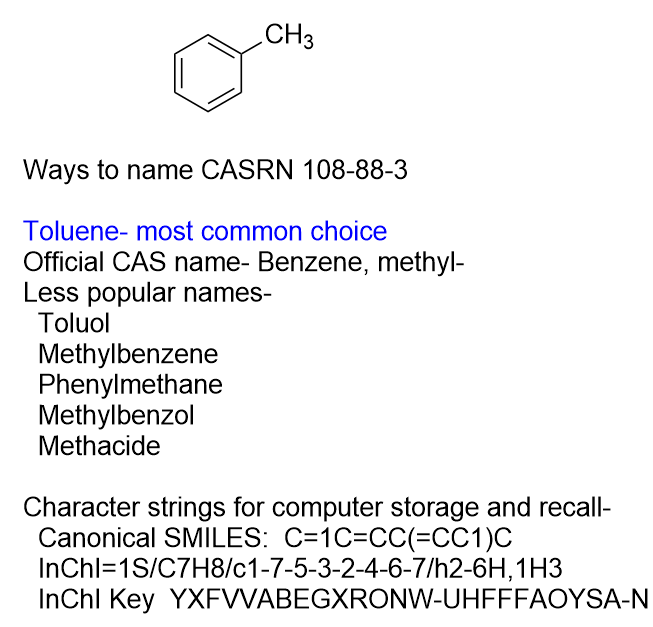
The names of chemical substances can be very off-putting to non-chemists and often does lead them to abandon their search for information. A few have even suggested that if you cannot pronounce the name it must be bad. Even worse than the polysyllabic and numbered character strings are the various synonyms. Consider simple toluene which is actually not so bad-
Directly from Chemical Abstract’s SciFinder.
In chemical nomenclature there is just a bit of flexibility in how numbers, syllables and name fragments can be assembled as the toluene example above shows, if you don’t read the rules too closely. The plethora of names come from historical trade names or long-time industrial use or may just predate systematic nomenclature now in use. There is also the German Beilstein and Gmelin organic and inorganic nomenclature as well, but these seem to be outdated.
As always, a proper chemical name describes the composition and 3-dimensional connectivity of the chemical structure of a molecule. These names are commonly listed in one of the two dominant styles of chemical nomenclature in the world- International Union of Pure and Applied Chemists (IUPAC) and Chemical Abstracts Service (CAS). IUPAC tends to be taught in undergraduate chemistry because it always has been and is maybe a trifle easier.
The CAS databases contain more than 200 million organic and inorganic chemical substances and about 70 million protein and nucleic acid sequences. There are two search platforms available in CAS- SciFinder and STN. STN is much more cryptic and harder to learn than SciFinder. Some say there are weaknesses in patent searching in SciFinder alone. For IP work I use SciFinder, Google Patents and the USPTO in combination. All three offer different kinds of searching capability.
Levofloxacin is a biocidal antibiotic effective against both gram-positive and gram-negative bacteria. It is an inhibitor of both DNA gyrase and topoisomerase IV enzymes which are involved in shaping the geometry of bacterial plasmids, or rings of bacterial DNA. Plasmids have to fit inside the bacterial cell wall and those that are not made compact enough are too long to allow successful formation of daughter cells in reproduction resulting in cell death. Other kinds of antibiotics are bacteriostatic and often work better in one or the other of Gram-Negative or Gram-Positive bacteria. Gram stains are effective with certain types of bacterial cell walls and not with others. The ability of a dye to stain a colony of bacteria a particular way is used to help identify bacteria.
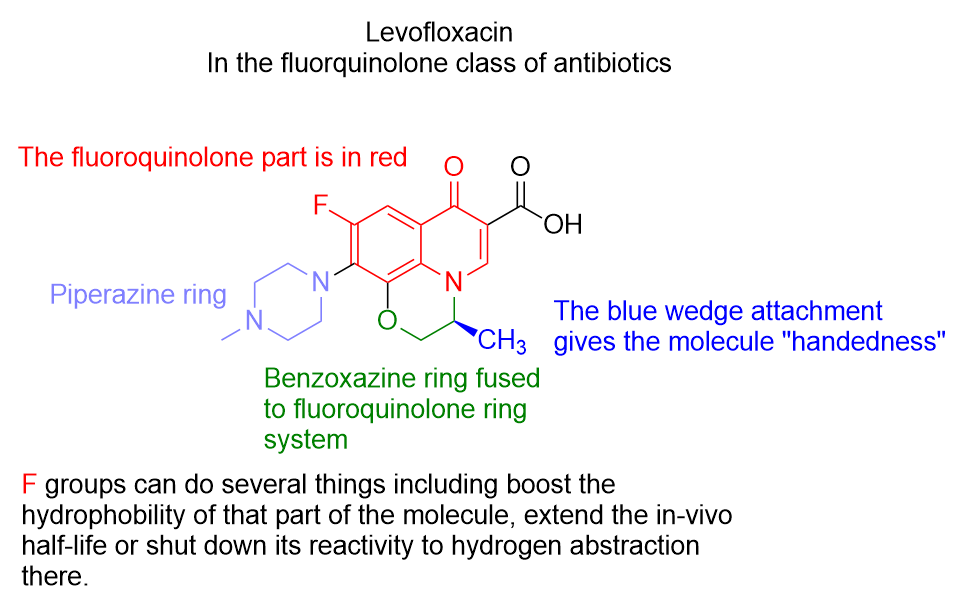
Consider the name of Levofloxacin from IUPAC: (-)-(S)-9-fluoro-2,3-dihydro-3-methyl-10-(4-methyl-1-piperazinyl)-7-oxo-7H-pyrido[1,2,3-de]-1,4-benzoxazine-6-carboxylic acid hemihydrate. The name is a string of characters with numbers indicating attachment points. The core of the structure is a 1,4-benzoxazine ring system which is festooned with a carboxylic acid and a few other groups. The core structure was identified and numbered previously by someone according to rules. The IUPAC name also specifies that it is a hemihydrate, meaning that there is one molecule of water associated with every two (hemi) molecules of Levofloxacin. For some reason the CAS name does not include the hemihydrate in the name, probably because it was not mentioned in the composition when registered with CAS. How it is in the IUPAC name is not known to me.
More pain. The IUPAC name above indicates “(-)-(S)-“. Molecules with “handedness” are said to be chiral and are not superimposable with their mirror images, similar to a right-hand being shape-incompatible with a left glove. These molecules can be prepared as individuals of single handedness or all of the way to a 50:50 mixture of left and right-handed. A 50:50 mixture of left and right-handed is called a “racemate” (RASS eh mate). Each handedness version is a type of isomer called an “enantiomer“. A substance consisting of a pure enantiomer is said to be “enantiomerically pure.”
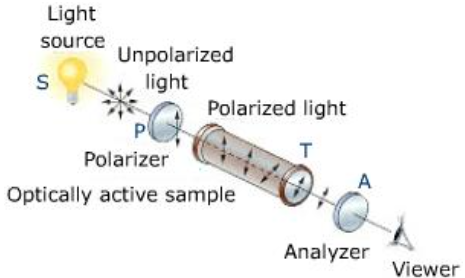
Isolated enantiomers have the ability to rotate plane polarized light as measured by a polarimeter. Plane polarized light is a light beam where the electric field vectors of the electromagnetic radiation are all vibrating in a single plane. Obviously the magnetic vectors are polarized as well, but it is the electric field that is usually mentioned. The angle of the oscillating ray’s electric fields along the axis can be tilted one way or the other depending on the interaction with matter. Reflected light and skyglow are polarized as well. Molecules with handedness rotate the vibrational plane and by an angle dependent on the light frequency and the amount of chiral mass traveled through. Light that is rotated counterclockwise, or levorotary, has a (-) sign and signified with an “l” and light that is rotated clockwise is dextrorotary and has a (+) sign and signified with a “d.” If a molecule rotates plane polarized light, the substance is said to be “optically active.” The amount of rotation is dependent on the light frequency, frequently the sodium D line (actually a close doublet) which is often used as the standard source for this. Mercury lines, e.g., 354 nm, can be used if the D line results in a low measured rotation. Substances that do not rotate plane polarized light are often designated “dl” as an abbreviation for racemic.
D-Glucose, or dextrose, solutions rotate plane polarized light in the clockwise, dextrorotary direction, thus the “D” in the name.
Commercial L-lactic acid derived from fermentation is “L” for levorotary. This enantiomerically enriched lactic acid is used to make the lactide monomer for poly(lactic acid), PLA. Only the lactide dimer from L-lactic acid gives the desired PLA isomer. The racemic form of lactic acid is not useful for PLA due to undesirable physical properties in the polymer.
A ratio can be taken from an experimental sample that may range from 50:50 racemate to 100 % of a single enantiomer to give the optical purity of the chiral material, representing the proportion of pure enantiomer. Often the measure % ee, or percent enantiomeric excess is used to describe enantiomeric purity. A 95:5 mixture of enantiomers would have a 90 % excess enantiomeric of one enantiomer. Chemical synthesis of 99 % ee can be quite difficult.
A racemate does not have a net rotation of plane polarized light. The (-) sign represents the “levo” part of the levofloxacin, referring to counterclockwise rotation of plane polarized light. Prior to the appearance of reliable analytical methods for the determination of enantiomeric purity, polarimetry and optical rotation were the method of choice. Today, Gas Chromatography (GC) and High Performance Liquid Chromatography (HPLC) columns and chiral shift reagents for 1H-NMR that can provide baseline separation of enantiomers.
The (S) character in the name indicates the handedness of a molecule as determined by standard selection rules defined by an organization for assigning absolute configuration. “S” stands for the Latin word “sinister” meaning left-handed. There is no simple calculation to go between absolute configuration and sign. The (-) sign can indicate which particular enantiomer is under consideration with an easy measurement if it has been previously correlated. (-)-(R) and (+)-(S) enantiomers can and do occur. The “(S)” defines only the precise configuration of atoms about an asymmetrically situated atom in a molecule based on a few simple rules. The mirror image of (-)-(S)- would be (+)-(R)-, “R” for rectus meaning right-handed in Latin.
The first task in assigning a name to a molecule is to determine the “core” structure. This is the basis of the name. Your molecule will be a variety of “the core structure.” This is not so easy because IUPAC or CAS will have already done this and your choice may or may not match. Referring to the CAS name below, you can see that some structural fragments end in “-yl,” “-ic” or “-o”. These signal that the fragments are not the core structure, they are attachments. The core structure onto which everything else is attached is the “1,4-benzoxazine”. It is a standalone chemical name which may be modified. This is a very obscure fact that most won’t know, but the “-ine” suffix indicates that the core structure is an amine, full stop. Other nitrogen indicators like azo, aza, amino, ammonium, nitro, azido, etc, suggest a nitrogen group attachment to something else.
Does it help to have a college degree in chemistry to know this stuff? Sorry but yes. In the set of all worldly knowledge, this is pretty obscure.
The CAS name for levofloxacin is 7H-Pyrido[1,2,3-de]-1,4-benzoxazine-6-carboxylic acid, 9-fluoro-2,3-dihydro-3-methyl-10-(4-methyl-1-piperazinyl)-7-oxo-, (3S)-. The core structure seems to be the 1,4-benzoxazine. CAS has a ring-system handbook that defines and numbers all of the known ring systems. The significance of CAS is that they assign and maintains the official CAS registry number, CASRN, which is depended upon world-wide for the exact composition and connectivity and geometry of substances. There is a very extensive rule book that rigidly defines a chemical name with rooms of CAS experts sitting in a building in Columbus, OH, to assign these names. For levofloxacin the CASRN is 100986-85-4. Today, CASRNs are usually directly searchable on Google. The final digit “4” is a check digit for error entry detection.
General comments about chemical features on Levofloxacin.
Yet more pain. The more formal official CAS name, however, does not indicate the direction of rotation of plane polarized light. I suppose this is considered experimental data not needed in the name. The CAS nomenclature only shows “(3S)-” in the name, indicating the absolute “S” configuration at position 3 of the molecule. The business of handedness or shape in 3-space of a molecule is called “stereochemistry” and arises in several ways. The rules for assigning the absolute configurations of R or S enantiomers may depend on the features of the molecule.
This business of molecular handedness is mostly an issue for biochemistry and pharmaceuticals. A great many- most?- biomolecules have handedness themselves and are therefore subject to interactions with other biomolecules or drugs that depend on the precise shapes for their interactions. This is very important for the interaction between molecules like an enzyme and substrate or ligand.
In the absence of other chiral molecules, two enantiomers will have the same chemical properties when individually pure. However, a racemate consists of a pair of enantiomers. The interactions between R and R or S and S enantiomers, will be different than the interactions between a racemic mixture of R and S or S and R enantiomers. If there is more than one chiral feature in a molecule- say two- then the molecule could be R, R or R, S, or S, S, or S, R. This gives two pairs of enantiomers, each called a “diastereomer.” For instance, one substance with R, S and another with R,R will be substances chemically and physically different called diastereomers. The presence of a diastereomer in an enantiomeric drug product would likely be deemed a contaminant and removed.
A druggable disease-state is one that can be positively influenced by a drug molecule. This commonly involves the drug molecule docking with an enzyme to activate it or deactivate it. These enzymes are very large diastereomers having many chiral atoms giving them complex shapes that can result if the formation of a pocket in the protein structure called the “active site.” This active site has very particular shape and charge features provided by the chiral amino acid chain of the protein. An active site will have a shape that is compatible with the close fitting of a drug or other molecule similar to a hand in a glove. Many of these active sites bind the shape and charge of one enantiomer of a drug molecule more effectively than the other for a better fit. The drug, or substrate, may just sit there and block the action of an enzyme, shutting it down or activate it continuously. Other active sites may bind a drug and change the shape of the enzyme causing the enzyme to speed up or slow down for a throttling or accelerating effect elsewhere on the enzyme. This is called the allosteric effect.
So, you may be asking- big deal, what does it matter? In the world of pharmaceuticals, many drug substances can exist as single enantiomers, racemates or diastereomers. Racemates may be easiest to manufacture, but very often one of the enantiomers is more biologically active than the other. In fact, one enantiomer may be disastrously harmful. The classic example is Thalidomide. The S form caused birth defects and the R form did not. Pure R enantiomer was safe from teratogenicity but a racemic mixture of R and S was not.
Conclusion. A superficial look at a chemical name opens up insights into the chemical nature of a substance. What makes each chemical substance unique is their distribution of charge in 3-dimensions. The distribution is affected by the types of the atoms present, geometric features of the 3-dimensional shape and the ability of the system to allow charge to accumulate in particular places of the molecule. These attributes mentioned also set up the type and vigor of reactivity the molecule will display.
US Senator, retired college football coach and conservative brainwave from Alabama Thomas Tuberville (R-AL) has dropped his blockade of US military promotions. He held up this ordinary staffing operation in order to protest the use of military funds for reimbursement of travel expenses to obtain abortions by military personnel.
This was a 4th down Hail Mary pass effort by a Bible Belt Republican Senator to move the needle on his conservative bona fides for conservative single-issue voters. Other similes may apply here, like the value of surprise plays.
It’s much like if y = mx +b, then Q must = 7k. Could be true depending on undisclosed information about the variables, but sometimes things are just as they appear- f**king stupid. This was a wrench-in-the-gears tactic designed to rattle his colleagues into submission. Nobody really wants to inhibit military readiness.
The idiot Tuberville was playing games with US military top-level staff and readiness but lost the game. This was a major league display of US political disfunction put on by a former college football coach who, as a group, are otherwise deified. More attention must be paid to resumes and credentials. Like other countries, in America, idiots elect idiots to office. After all, it was widely believed that a rich real estate developer with a long history of bankruptcies, fraud, law-suit harassment and sexual aggression was deemed inherently qualified to be US President based on his business experience. This particular idiocy has not fully played out yet.
As I approach retirement in a year or so, I’m overcome with intrusive thoughts as I inventory my accomplishments and failures. Questions like “what have I done with my life?” or “why the hell did I do that?” are dangling in my consciousness more than usual. It’s normal sentient-being stuff I suppose. I never had the impression that farm animals agonized over such things. One lucky benefit of being a bovine.
I find myself disappointed over not having chosen a career path that might have led to a more impactful life. The closest I got was as a chemistry prof helping students get through organic chemistry. It was very satisfying and I managed to meet many wonderful students and faculty. Chemical science has provided a comfortable and intellectually stimulating lifestyle. One negative I suppose is that a chemist isn’t much good without an institution from which to practice chemistry within. Outside of an organization with no lab and no free access to Chemical Abstracts, how is a person to remain connected to chemistry? I guess you just don’t. Some say that a I could be an adjunct prof somewhere. But that is just being a hired hand in a school too cheap to pay much. I wouldn’t be surprised if they picked up adjuncts at Home Depot early in the morning for day labor. The poor sods would load up in the back of an old Ford pickup and trundle off with their sack lunches.
One of my faults as a person is a deficiency in recreation and doing vacations. The fact is that I’m perfectly happy at home reading or watching YouTube videos on geology, writing this silly blog, war reporting on Ukraine or following Itchy Boots. The problem is that guys who don’t stay active during retirement tend to die soon thereafter. I’m not ready to croak just yet so I decided to stay on for another year.
My memory begins in the early 1960’s. One of my earliest memories is watching the funeral of JFK on black and white television. Up until age 14 most of my time was spent on a hog, corn and soybean farm in Iowa. I grew up very aware of the US space program on television and was captivated by it. My father was a private pilot/farmer so airplanes were in our lives. I recall him in his friend Daryl’s Stearman buzzing our farm. They would drop a roll of toilet paper producing a long streamer of paper sailing to the ground and then fly back to the airport. We would go to flight breakfasts at the local airport where we would feast on pancakes, sausage and scrambled eggs inside someone’s hanger. Afterwards they gave kids airplane rides for a penny a pound.
Source: Corn picker mounted on a tractor. Public Domain.
My family still used machines like the corn picker above when I was a kid. For a kid interested in space, these machines made fantastic spaceships of the imagination when sitting in the machine shed. Why didn’t I try to be an astronaut? I did, sort of. I got a pilots license then entered Air Force ROTC in college in 1980. Between nearsightedness and a superabundance of qualified candidates with perfect vision from the Air Force Academy down in the Springs, the odds looked poor. My civilian pilots license was sneered at and valued as less than nothing, but I could train to be the GIB- Guy In Back, handling weapons systems and electronic countermeasures. While blowing things up could be exciting, what do you do when you get out? Naah.
Instead they tried to funnel most of us off into some missile squadron up at F.E. Warren AFB in Cheyenne, WY. It is an honorable slot for many good Americans, just not me. I lived an hour from there and had no interest in southeastern Wyoming or the Dakotas. There would be long stretches underground with someone authorized to shoot you if they doubt your sanity. The whole point of missileer training was to get the launch orders confirmed and the bird launched before the silo got cratered when Soviet MIRVs came sailing in from over the north pole. You can drive by missile silos in northeastern Colorado. Just don’t linger at the fence or a USAF vehicle with armed military police will pull up with considerable urgency and ask just exactly WTF you are doing.
A civilian commercial airline flying career in the 1970’s was complicated by the number of retired Viet Nam pilots who dominated the flying slots at the airlines, or so I was told. They had turbine engine time in complex, very fast aircraft and I had time with a 100 hp Lycoming horizontally opposed 4-cylinder engine poking holes in the sky at 95 knots. I was overly concerned about this I think.
Anyway, organic chemistry captured my fancy and I went for it. This was a constructive career whereas blowing things up was destructive. I chose the former.
The difficulties black citizens encounter with law enforcement are numerous and many have been severe. More than a few end up dead from a police encounter. Everybody has seen this in the news. I am not a legal scholar and have no official experience in law enforcement. I know only what I have observed.
What I have observed on video are episodes of escalating tension followed by a step change to violence over the course of an individual’s encounter with the police. A traffic stop results in a request for the driver’s documents. Sometimes the driver is reluctant to hand them over for some particular reason. The driver could have trouble with authority figures generally or is angered by the tone with which he is being spoken to. The driver could be frightened and given to poor judgement. Or, the driver could be wanted for some warrant or crime and is unwilling to be apprehended.
The driver could be perfectly innocent of crimes and just speeding a bit or could be carrying contraband in the vehicle. The officer is likely to be unsure of who they have stopped or may have found a vehicle they have been looking for. Officers need to be extremely careful in all interactions with the public.
What seems to happen in many of these violent encounters with police is that the officer repeatedly tries to get information from the citizen and something snaps. Either the officer loses patience or the citizen gets combative or both. Whatever the case, the officer at some point feels threatened and wants to restrain the citizen according to procedure. The citizen, not comprehending why this is happening and fearing the worst, resists following the directions of the officer. The officer notices the resistance and ratchets up the intensity. This is where things can go south.
At some point the officer may call in for other officers to help with the situation. Whether alone or with several officers present, an officer will repeatedly demand instant obedience. If there is not prompt obedience, the officer may escalate and draw and point a stun gun or service pistol at the citizen. If the citizen is agitated and out of control or threatens the officer, they might be subject to a stun or worse.
If the officer attempts to forcibly remove the citizen from the car, a struggle may ensue. In videos broadcast to the public, the officer remains with the citizen struggling for control, shouting instructions at the citizen. By this time the citizen is likely in a state of panic or anger and is irrational. The citizen could lash out violently or attempt to escape. Prompt and absolute yielding to force and shouting isn’t necessarily natural to the citizen.
It seems to be in the nature of police training that once a non-compliant citizen has been encountered, the police will not stop until they apprehend them. This approach can escalate to physical harm or the death of the suspect or the officer. Also evident, the method police use is what I can only refer to as a “shock and awe” approach. It is meant to confuse and overwhelm the suspect with police power and authority. The problem is that it doesn’t always work. As the suspect continues to struggle the officer(s) may begin to fear for injury or death. Or, the officer(s) may become unable to contain their rage. Whatever the case, a service pistol may be drawn and discharged. Pardon my ignorance, but it has never appeared to me that the police shoot to wound or disable- only to kill.
It appears that the requirement perceived by the officer is that once they have a suspect in hand they may apply whatever it takes, even as much as shooting, if they are unable to control the suspect in a reasonable time.
We have to ask, is an apprehension technique that relies on arresting officers to overwhelm and outwrestle the citizen the only technique available? Officers do not start with this shock and awe. They ask for license, registration and proof of insurance first. During that time the citizen has time to think about how he or she will react to the situation.
What happens in other countries?
Plainly, a law enforcement agency will not interact in a way that would let the citizen escape if things became difficult. In principle, the law must always prevail lest it be known that all you have to do is struggle and you can get away. This seems reasonable, except that the officer may end up the judge, jury and executioner. Should a suspect die from a kill shot delivered by the arresting officer if the officer is just out of patience? Or if the suspect is physically too powerful? Is it ever OK for the officer to relent and let the citizen escape into the wind?
How can we educate people to avoid escalating an encounter with a police officer before the point where the officer pulls their gun? Either the citizen or the officer or both can suffer from hot headedness. But in the exchange between you and the police officer, the law will always get the upper hand eventually.
The police have a responsibility to use good judgement and the training to execute their duties. But I’d say that when citizens are stopped by the police, they must realize that they are in a situation where things could go irreversibly for them if they make some poor choices. That means knowing when to stop arguing and yield to the officer(s). If the officer has engaged you in a traffic situation, they have already called in your plates for warrants and other information. If a polite exchange of information has not convinced the officer to let you be on your way, then further haggling is likely to go badly for you. At this point, you’ve already lost the game and should relent.
The reason behind this essay is to explore the idea of shock and awe as an apprehension method. How often does it work? What do criminologists say about it?
Obviously, asking citizens to behave better is not an easy strategy. But physical actions by the police that confuse and frighten the citizen puts them on alert and may trigger a violent reply. Does any agency or other organization try to have a discussion with the public about this?
It’s not all about heavy handed officers out there. Citizens must learn that there are poor choices that will ruin or end their lives and that there may well be a time for submission. Due process still exists.


 Lamentations on Chemistry