

Author Archives: gaussling

About gaussling

Gaussling is a senior scientist in the chemical business. He occasionally breaks glassware, spreads confusion and has been known to generate new forms of hazardous waste. Gaussling also digs aerospace, geology, and community theatre.

Thoughts on crystals, symmetry, and perfection

Bismuth crystals on my desk

Nothing too unusual here. Just some bismuth crystals sitting on my desk. A metallurgist friend died recently and his family passed along some of his samples to me. Virg was a great guy. He knew how to conduct himself with decorum like a civilized human being. I don’t confer this praise on everyone.
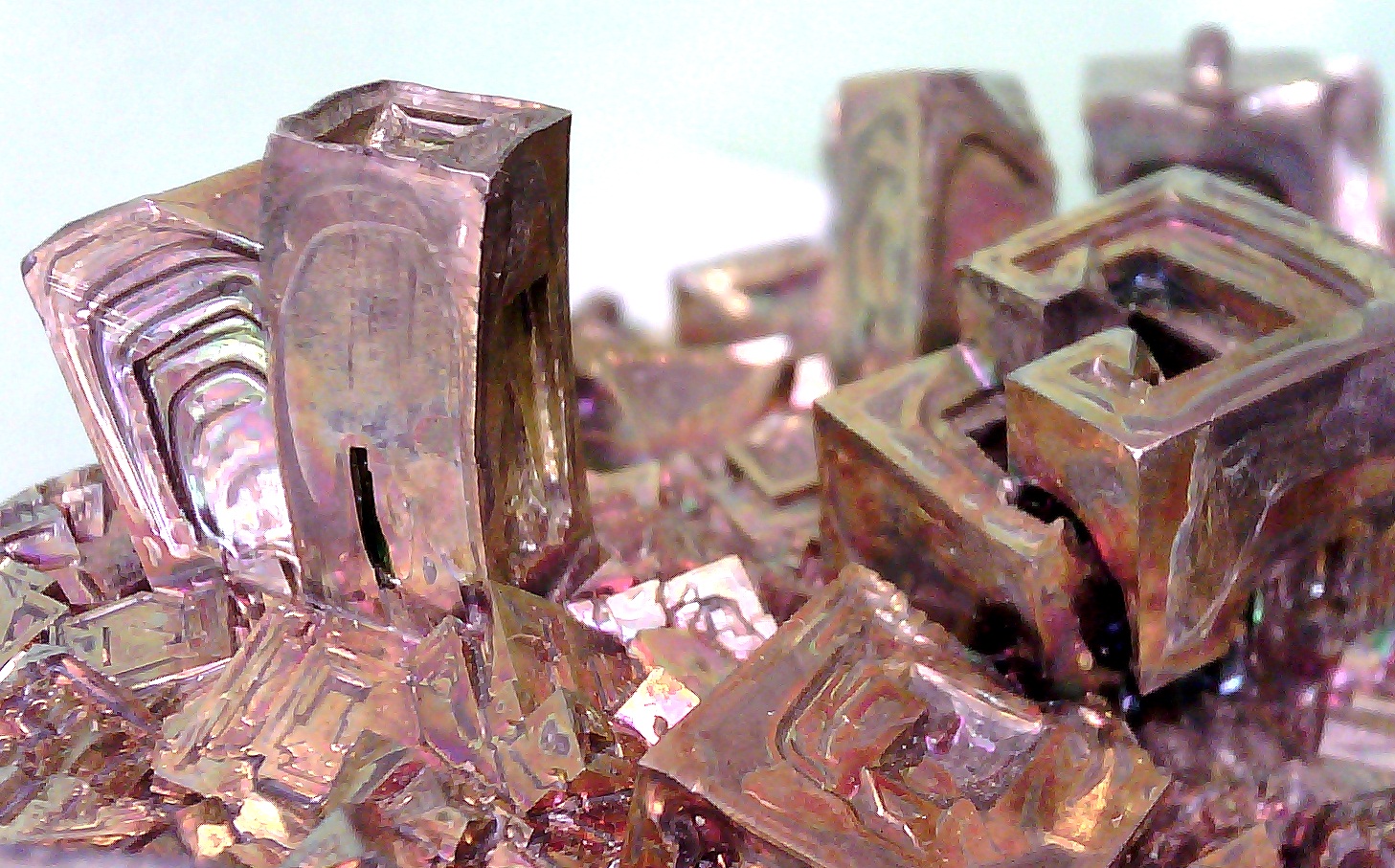
Bismuth City

I think many people find some kind of solace in the orderliness of crystals. Nature has seemingly betrayed the prevalent trend of disorderliness to produce a latticework of pristine stuff in appealing shapes. Crystals appeal to our innate desire for symmetry and rectilinearity. We subconsciously associate symmetry with goodness and calm. Properly stacked goods in your basement suggest orderliness. Shoes lined up in the closet or socks neatly arranged in the drawer provide a reassurance that something in life is at least predictable.

Crystallinity infers a repetitive array of subunits asssembled under the austere constraints of efficient stacking. It represents subunits held in confinement and subject to limits on motion.

Crystallinity is in a sense sterile and lacking in diversity. Living things are not crystalline for the most part. Crystallinity is static and devoid of the many necessary degrees of freedom needed for life.  Living things often have superficial symmetries, though on closer inspection something inevitably cracks the symmetry. Humans have a bilateral symmetry across a line taken from the head to between the feet, as do butterflies and hippos. Internally, though, the symmetry is less than obvious.  Our genetic polymers of DNA have a gross secondary helical symmetry as do some peptides, but even that yields to partial symmetry when the monomeric units are accounted for.  Sure, there are instances of crystallinity in living things. But living things require a fluid internal environment to allow molecules to collide and react.

If you take crystallinity as an allegory of perfection in the sense of a way of being- that is, orderliness and freedom from defects- then you might conclude that a perfect being would be constrained by symmetry or the attributes of perfection.  It would seem that the attribution of perfection in a being might pose the possibility of limitation.

Instead of getting wrapped around the axel philosophically, perhaps we should gladly rejoice in the lack of perfection in ourselves and the ultimate absurdity of perfection in the fanciful dieties whom we imagine control the vibration of every molecule in the fleas that ride on the tailfeathers of every sparrow.

Curiosity on Mars

Photo of Curiosity during descent phase, taken from orbit. This shot is amazing all by itself.

Curiosity in descent phase. Photo taken by NASA’s Mars Reconnaissance Orbiter. Credit: NASA/JPL-Caltech/Univ. of Arizona.

Curiosity is powered by a Pu-238 oxide thermoelectric generator. The Multi-Mission Radiosiotope Thermoelectric Generator, MMRTG, has an output of 2000 watts thermal and 100-120 watts electric. The MMRTG unit sits in the aft end of the rover enclosed by a finned heat exchanger.

Thoughts on Academia

The blog post by Terran Lane of the University of New Mexico provides a good example of the frustrations in academics today. Much of this is well plowed soil. I link to it because I think he is spot on about more than a few things.

The availability of external funding for the last 30 years has equipped American colleges and universities with a great deal of equipment and facilities. The availability of funding for grad students and post-docs has energized a vast educational complex that has come to depend on external grant money to maintain built up infrastructure. Naturally when an institution expands in good times, it finds itself top heavy in overhead when the good times end.

Ambitious people step forward when presented with the opportunity to grow programs and institutions when times are cash rich.  But when the cash influx begins to taper off, these same people find themselves in the position of having to decomission or dismantle parts of the very organization they helped to build.  It is hard for people in any circumstance to feel like they are moving forward when they have to make do with less.

One response to restricted university resources is to increase competition for teaching positions and tenure. Candidates with the best potential for winning grants are highly prized in any candidate search. The result of this is that professors today are burdened by administrative expectations in the hunt for resources in order to maintain close to what they already have.

Friends at PUI institutions are also feeling the heat, possibly due in part to the rise in undergraduate research programs that took off in the 1980’s.  Undergraduate research in chemistry, at least, has grown into an expectation rather than a plus. This brought the buzz saw of the grant machine into the grassy quads of many quiet institutions.

Certainly no untenured prof is going to throttle down their scholarly activity for the greater good of science funding.  Faculty will continue to struggle with this as long as grants are a major metric in rank and tenure.

Which brings me to my final point. Scientific knowledge as national treasure.  I am sifting through Chemical Abstracts Service data bases searching for something nearly every day. This resource of ours, scholarly and pragmatic knowledge, is one of the crown jewels of human civilization. It is the collective contribution of people and institutions going into the distant past and across the curved surface of our world.  We should cherish it for what it is- an archive of achievement, a repository of knowledge for application to future challenges, and a representation of the best of what we are capable of.

The notion that academia is the apex of the life intellectual has never been entirely true. You do not have to be in industry for very long before it becomes quite clear that there are a great many smart and creative people outside of academia. People who become professors are people who are in love with the very idea of the university and of higher education. We must find a way to allow research active faculty to throttle down the grant cycle just a bit so they may throw their energies into serving their institutions in the traditional manner. By service to  their students, to scholarship, and to the advance of civilization.

That said, it seems embarrassingly obvious to say that our academic institutions are a critical part of our civilization past, present, and future. But today our institutions are in peril of substantial decay if left to antagonistic legislators and fulminating demagogues bent on terminating programs in the name of social reconstruction.

We know how to operate our university/research complex. Absent some of the mania in the horse race for grants, perhaps we can offer a bit more student contact with professors. A BA/BS degree must be understood to mean that a graduate has absorbed knowledge, sharpened reasoning ability, accrued some judgement, and has developed a professional demeanor that can only come from the personal interaction between people. We should expect from our institutions that a professor is a professor, not a shift supervisor.

On the Merry Path of Calorimetry

I enjoy working with our RC1 reaction calorimeter. As we get more experience with thermal profiles of reactions, the utility of this instrument is made more evident. The Mettler-Toledo RC1 can be used to follow the heat evolution of a reaction for safety purposes, and/or it can be used to narrow in on optimum feed rates of reactants.

What is next on the agenda is to determine the heat transfer coefficient(s) and wetted heat transfer surface areas in selected reactors in order to gauge the upper heat load boundary that can be managed safely. There are many variables to contend with.  Inevitably, one has to pick a finite range of operating parameters to evaluate. Agitation rate, fill level, and heat transfer medium are variables to take into account.

So, down the merry path we go, learning more and more about applied thermodynamics and chemical engineering. I can dig it.

In my experience with people in different organizations in the context of training and expertise, I have come to notice that employees can be partitioned into two camps. There are those who wait to be trained and there are those who will not wait to for it.  As a rule, scientists and engineers are driven by curiosity and not a small portion of competitive spirit. This group will engage in self-study to acquire the necessary skills to push back the limits of their abilities.

An instrument like the RC1 requires that the user be familiar with the intimate details of the chemical transformation.  It is possible to alter the experiment profile on the fly, and that is not the work of a pure analyst following SOP’s. A chemist experienced in experimental synthesis with a broad background in material phenomena and descriptive chemistry is one who can steer the instrument and tease out key subtleties.

I recently had a reaction mixture in the RC1 that formed a slush at low temperature. At this temperature the heat flow trace was extremely irregular.  The reaction mass showed little visible sign of mixing.  Addition of reactant was followed by large magnitude, short coupled, exothermic swings. Apparently the heat of reaction was being released on a relatively small top portion of the reaction mass and eventually swirling towards the heat sensor strip with little dilution, giving exaggerated heat flow indications. With a Tr increase of 20 ºC and a higher mixing frequency, the mass began to thin a bit giving a vortex. The wild heat excursions disappeared.

What I take from this experience is that control problems might arise as a result of poor mixing leading to temperature or feed control inputs that are exaggerated as a result of being out of phase with the state of the reaction mass. An economic consequence might arise in the form of overly conservative metering of reactant, adding extra plant hours to the cost.

The concentration effects due to poor mixing can lead to localized enthalpic overheating and potential disturbances in the composition profile.  A reaction mixture with high viscosity or density in a solvent with low tensile strength (i.e., diethyl ether) can lead to cavitation and further exacerbation of mixing problems.

A poorly mixing slurry of reactive components in a low boiling solvent is a bad combination. Especially when the reactor is filled to afford low headspace. A temperature excursion can exceed the boiling point and cause the thick mixture to develop into a foam which can expand into the headspace or beyond.  This is the realm of heterogeneous flow and your emergency venting system may not be designed for such flows.  This is one of the many reasons that some operations define an operating temperature policy relating to the reaction temperature and the boiling point of the reaction solvent.

It is worth pointing out that process intensification is likely to lead to higher power densities (W/kg) in the reaction mass as well as solubility problems that can cause poor mixing and heat transfer. The RC1 can help the process chemist flesh out the merits of process intensification.

Aurora Shooting

At some point we Americans are going to have to address the peculiar gun fetish that marks the national character.  Between the NRA and the entertainment industry, we have way too much fascination with firearms and destruction for our own good.  When citizens aren’t being entertained by gunplay on TV and the movies, more than a few citizens are out shooting at other citizens or the police, invading foreign countries with guns, cheering bloodlust at National Rifle Association rallies, giving heartfelt testimonials to our devotion to the 2nd amendment, watching reality television programming about gunsmiths and their frothy zeal for firepower, daring people to wrench our guns from our cold dead hands, equipping our municipal law enforcement with militaristic firepower, selling armaments all over the world, and training our young soldiers to be ever more effective in the killing arts.  Obviously soldiers have to kill effectively, but do we put enough energy into avoiding battle with smarter foreign policy and thus making fewer veterans?

All of the bravado about our national ability to kill with pinpoint accuracy from anywhere a drone can fly has the effect of normalizing or sanitizing the act of killing. Firearms and conflict are big business and presently politicians who stand up to these interests are unelectable.  Is this really a desirable consequence of the market- to allow gun violence to thrive as a side effect of the arms industry and laissez faire legitimized by the 2nd amendment?  Perhaps the US constitution is inadequate to provide for the conduct of civilized society with it’s 18th century publication date.  Why do constitutional guarantees like due process only apply to citizens?  How is it “OK” to have a Gitmo?  Who is this great nation that has extraordinary rendition?

Gun control really comes down to urge control. These pitiful, fearful people who have armed themselves to the teeth in their basements aren’t going to lose their guns anytime soon. Hell no. There isn’t an ounce of political courage in the entire continent to cause that to happen. Instead, we are likely to tighten the civil arms race as the rigor mortis of paranoia stiffens our imaginations against new ways to conduct civilized society.

We need to consider that gun bravado of all sorts is substantially a form of violence bravado and is a disfigurement. Mature peace loving adults should reject gun and other violence as entertainment and as a normal fact of life. More to the point, we should challenge Obama and Romney to identify exactly how they will act to turn gun violence around in this country.  Greater law enforcement is not the answer, nor is the imposition of more severe punishment.  We have to find a way for people to make money waging peace. Right now, there is too much profit in armanment and conflict.

We cannot allow the Aurora shooting to become normalized by a quiet passing into the murky depths of history. We, all of us, should push back against this disfigurement on our civilization. One mass killing is one too many. I’ll be volunteering with campaign work monday to put better elected officials in office. What will you be doing to turn this around?

Why does Russia seem to support the Syrian government?

Why does Russia vote the way it does in the Security Council of the United Nations in relation to Syria?  Could it be that they are anxious to protect their only Mediterranean naval base located in Tartus? I’m sure this fact plus a great many skeletons in the closet from past activities based in Syria or in support of Syria over the decades contributes to their position.  The total collapse of Syrian society would likely have an adverse effect on their naval operations in Tartus as well as the loss of a significant diplomatic investment accumulated over time. Of course they are reticent to back the overthrow of the al-Assad regime.

China is nothing if not consistent. They seem to vote against all measures critical of existing governments, irrespective of the atrocities in play. This is pure self interest and I’m guessing it is to telegraph the notion to an internal audience that rebellion is never acceptable. Pretty obvious, I suppose.

Why not encourage Iran and other states to develop thorium-based nuclear power?

It is a crying shame that we (the rest of the world) did not think to encourage Iran and other states to develop thorium-based nuclear power many years ago. The thorium fuel cycle provides nuclear-powered steam generation, but is largely absent the use of fissile isotopes in the cycle which may be used for nuclear proliferation.  Thorium-232 is more abundant that uranium-(235 + 238) isotopes and does not require isotopic separation as uranium does.

The great exploration boom in progress with rare earth elements would facilitate thorium supply. Thorium and uranium are commonly found in rare earth ores and, to the dismay of extractive metallurgists since the Manhattan Project, these elements tend follow along in rare earth extraction process. The isolation of thorium was developed long ago.  Point is, since so many rare earth element extraction process streams are either in operation or are pending, now is the time to accumulate thorium.

At present however, thorium is a troublesome and undesired radioactive metal whose isolation and disposal can be quite problematic. The best process schemes partition thorium away from the value stream as early in the process as possible and channel it into the raffinate stream for treatment and disposal in the evaporation pond.

The specific activity of natural thorium is 2.2 x 10^-7 curies per gram (an alpha emitter). The specific activity of natural uranium is 7.1 x 10^-7 curies per gram.  Alpha emitters pose special hazards in their handling. Dusts are a serious problem and workers must be protected especially from inhalation or ingestion. While alpha’s are not difficult to shield from, their low penetration through ordinary materials or even air makes them a bit more challenging to detect and quantitate relative to beta’s and gamma’s. In spite of the mild radioactivity of thorium, managing the occupational health of workers is known technology in practice in the nuclear industry.

Regrettably, most of the world’s nuclear power infrastructure is geared to uranium and plutonium streams. Thorium, the red-headed stepchild of the actinides, is thoughtlessly discharged to the evaporation ponds or to the rad waste repository- wherever that is- to accumulate fruitlessly. If we’re digging the stuff up anyway, why not put it to use? It is a shame and a waste to squander it.

Corporate person Pratt & Whitney provides attack helicopter technology to China

Lets give a big Bronx cheer for Pratt & Whitney, a subsidiary of United Technologies (UTC), for illegally providing turbine engine technology to China.  And, while we’re at it, lets give a toot for Hamilton Standard for providing the control software.

According to a recent article in The Atlantic, the Canadian division of Pratt & Whitney provided engines for the production of the Chinese Z10 attack helicopter. It is worth the read.

The Chinese helicopter that benefited from Pratt’s engines and related computer software, now in production, comes outfitted with 30 mm cannons, anti-tank guided missiles, air-to-air missiles and unguided rockets. “This case is a clear example of how the illegal export of sensitive technology reduces the advantages our military currently possesses,” Immigration and Customs Enforcement Director John Morton said in a statement released on June 28.  The Atlantic, July 6, 2012.

According to the Federal Contractor Misconduct Database of the top 100 offending corporations, UTC ranked number seven.

OK. I’ll state the obvious. This is a very eggregious crime.  If an individual did this, the outcome for such a person might be considerably more punitive. But an amoral corporate being like UTS and it’s wayward subsidiary Pratt & Whitney, the consequences are more abstract. A $75 million hit to the bank account for aiding a nation who’s military influence in the eastern Pacific rim is increasingly in conflict with US interests.  Not a trivial consequence, but nonetheless a consequence that does not match the transfer of sensitive technology to a country with values antithetical to US policy.

CERN to make announcement Wednesday, July 4, 1012

According to the CERN website, a webcast on LHC experiments is planned for, Wednesday, July 4, 2012. Apparently a new particle has been detected. Could it be the big chalupa? The Higgs boson?

CERN has previously announced resonance data at the expected energy but cautioned that the correlation by the requisite number of sigma’s was not in hand. In the US, a similar announcement was issued the other day from Tevatron data in Illinois. Same problem- not enough sigma’s. Hmmm. I wonder what CERN is going to say tomorrow wink wink nod nod?

On a side note, according to Quantum Diaries, researchers at CERN run Monte Carlo collision simulations for comparison purposes to the actual data stream. If events occur that are not anticipated by the simulations, then there is cause to examine the particular events. Interesting approach to sorting the data.

USPTO to open new regional offices

Attention inventors!  I just received this from a friend who is a patent examiner. The USPTO is expanding to 4 new locations around the country.

================================

USPTO to Open Four Regional Patent Offices The Commerce Department and USPTO announced plans today to open regional USPTO offices in or around Dallas, Denver, and Silicon Valley, in addition to the already-announced first satellite office to open July 13 in Detroit. The four offices will function as hubs of innovation and creativity, helping protect and foster American innovation in the global marketplace. They will also help the agency attract talented IP experts throughout the country who will work closely with entrepreneurs to process patent applications, reduce the backlog of unexamined patents, and speed up the overall process, allowing businesses to move their innovation to market more quickly and to create new jobs.

Selection of the four sites was based upon a comprehensive analysis of criteria including geographical diversity, regional economic impact, ability to recruit and retain employees, and the ability to engage the intellectual property community. The Leahy-Smith America Invents Act of 2011 (AIA), signed into law by President Obama in September, requires the USPTO to establish regional satellite locations as part of a larger effort to modernize the U.S. patent system over the next three years.

Since the passage of the AIA, the USPTO and the Department of Commerce have been committed to an open, robust, and fair site selection process based on extensive public input. In addition to reviewing more than 600 public comments in response to a public Federal Register Notice, USPTO officials met with hundreds of state and local officials, congressional delegations, and policy leaders. The selection team developed a model to evaluate more than 50 Metropolitan Statistical Areas based on the previously stated criteria to assess operational cost and feasibility, ability to improve patent quality, and ability to employ U.S. veterans.

The USPTO will develop concepts of operations and best practices for the three newly-announced locations based on lessons learned from the Elijah J. McCoy Detroit Office over the coming months and years. While the Detroit office will employ approximately 120 individuals in its first year of operations, including patent examiners and administrative law judges, the USPTO is working to develop specific hiring plans for the other sites.

The agency will also seek to identify and maximize the unique regional strengths of all four offices to further reduce the backlog of patent applications and appeals.

“By expanding our operation outside of the Washington metropolitan area for the first time in our agency’s 200-plus year history, we are taking unprecedented steps to recruit a diverse range of talented technical experts, creating new opportunities across the American workforce,” said USPTO Director David Kappos. “These efforts, in conjunction with our ongoing implementation of the America Invents Act, are improving the effectiveness of our IP system, and breathing new life into the innovation ecosystem.”