Category Archives: Angst

Market Pull and Technology Push

The chemical business is, after all, a business.  You have to make something that somebody wants. Brilliant ideas are a dime a dozen. Getting a new product to market is harder than you might expect, even if you have a purchase order in hand. The transition from bench to 1000 gallon reactor is often full of unanticipated problems.  The process of forcing a new product or technology on a market that didn’t exactly ask for might be called “Technology Push”.  The process of responding directly to a clear market demand is called “Market Pull”.

Market pull is a force that business types, especially the MBA’s, feel best about.  It is easy to justify the allocation of resources to launch into a product development cycle that addresses a clear and quantifiable demand.  Duh. It’s a no-brainer. That is, if there are no bottlenecks to get through. The merits of market pull are only valid if the proposed technology has been shown to work to specifications. Beware of the inventor who cannot produce a prototype to back his/her patent.

Technology push is a circumstance wherein a company has a product or technology that might stimulate demand if it were marketed properly.  Now, an economist might say that there is no such thing as stimulating demand. They’ll patiently explain that this only stimulates an underlying demand that may not have been articulated. Whatever formalism you prefer, it is possible to dazzle potential customers with a new capability.  Clever people can dream up applications that the original inventors could have never anticipated. Look at Symyx with their fantastic technology package for high throughput experimentation.

It is a bit easier to write a business plan based on market pull because the job of forecasting revenue flows should be based on measurable market conditions. Again, the assumption is that the proposed response to the market pull is a technology that works.

A business plan based on technology push has to incorporate estimates of acceptance of change. You see, technology push is the realm of the paradigm shift.  Predicting outcomes from the early side of the timeline is very tricky.  Customers for paradigm shift technologies may be scarce.  Not all companies are interested in being an early adopter or a buyer of first generation technology. 

Market pull is the domain of orthodoxy, of the rightous and proper company president who is also a CPA and who worked his way up the ladder from the accounts receivable department. Technology push is the domain of the engineers and scientists.  These are the dreamers who know in their hearts that if you build it, they will come.

Successful technology companies are somehow able to give a voice to the technology people in the allocation of resources.  Very often, these companies are managed by chemical engineers. While ChemE’s may not be trained in advanced synthesis R&D, they are involved in the scale up and economics of new processes.  Chemists live in a 2-dimensional world of space and time.  Chemical engineers live in the 3-dimensional world of space, time, and money.  Their knowledge of economics is what causes them to rise to the top of the corporate ladder more frequently than chemists.

It seems to me that companies that thrive today are those who do both market pull and technology push. Market pull is the cash cow.  Technology push is the seed corn for next years crop.
In Praise of Reverse Polish Notation

I have been a devotee of calculator RPN notation since the mid 70’s. My first HP calculator was an HP 25C. For those who aren’t sure what it means, RPN stands for “Reverse Polish Notation”. For an eternity, in electronic industry years anyway, Hewlett Packard offered a variety of advanced calculators that used the RPN data entry format. Over the last 10 years or so, this blessed notation has been going the way of the Dodo.  Gradual extinction. 

As they explain it on the HP Museum of Calculators web site, RPN was named after a Polish mathematician named Jan Lukasiewicz who developed a logic in the 1920’s that allowed for the removal of parentheses in calculations.   Years later, computer scientists were able to apply the unique juxatposition of operators to the operands in first in last out (FILO) recursive stack manipulations. 

HP maintains that the term RPN is a type of homage to Lukasiewisz, and it may very well be. But, why isn’t it just “Polish Notation”? Here is my guess.  Up through the early 1970’s, the Archie Bunker years, Polish jokes were quite popular. In those days it wasn’t unusual for oddly configured devices to be referred to disparagingly with the adjective “Polish” and an especially strange contrivance might be further described as “reverse Polish”. My guess is that the word “Reverse” in RPN was from this vein of English usage.

I write to lament the decline of this intuitive and useful mode of computation. My guess is that onslaught of Japanese calculators (Sharp, etc) into the US market from the 1970’s onward with their algebraic entry format was an easier sell to the mathphobic masses.  Death by faint marketing.

College bookstores still offer a few versions of the RPN calculator and OfficeMax does offer the HP12 business calculators. But sadly, there does not appear to be any kind of revival anytime soon. There may be pockets of users out there, but we seem to be getting fewer in number.  It’s fun to watch people borrow your RPN calculator only to find that there is no “=” key. They quickly hand it back, grumbling as they look for another.

Post post graduate

Making the transition from grad school to industry is a big deal.  Most people dive into the embracing bosom of a large company. A few choose the riskier startups. 

Large organizations have something called infrastructure.  This is truly a fabulous concept. The hireling lands on an organizational sleep number mattress where all of the necessary bureaucratic mechanisms are in place. Job descriptions are etched in the finest Italian marble and loving administrative assistants sing their sweet, tender songs of service to you like the Sirens on the rocks of Scylla. Your company credit card arrives in the mail one day and you sit there imagining the possibilities.

And lo! For the first few years life is grand. You become accustomed to the benefits package and the commute. Your responsibilities become clear. You forge alliances and carefully note the treacherous characters. Your spouse finds work and you sign a mortgage. Your lunchtime conversations are discussions of local school districts and churches and mill levees. Older relatives will begin to die of old age and you’ll be attending funerals.

Then the economy stalls or your companies blockbuster drug is found to have unexpected mortalities. Management announces that there is a hiring freeze and restraints are placed on spending.  Then one friday morning it is announced that there will be downsizing.  They’ll say that they hope to accomplish it with early retirements and attrition.  A few months pass and then they’ll announce a restructuring or continued downsizing. You find yourself looking at the ads in C&EN with increased interest.

But it could just as easily go the other way. Your team could produce a new class of compounds that turn the business on its head.  You could find yourself on a horse giving you the ride of your life. Your group could find itself keeping teams of patent lawyers busy writing Markush claims covering thousands of molecular permutations.

On this ride, you could be involved in scaleup with engineers asking questions about space yields, calorimetry, side products, and all manner of process improvements.

There is a great deal of luck involved in any successful project. I know people who have participated in or lead actual paradigm shifts in chemical technology. I can’t mention their names. Believe me, they are very talented people. But they are talented participants in a field of talented people.  Their personal successful outcome also had a large dollop of luck in the making. They were at the right company in the right time interval.

At conferences they’ll strut around like roosters, and that is OK. They genuinely deserve their time in the spotlight. But they know, like you do, that you’re only as good as your last accomplishment.  In the end, few of us have much control of anything.  Whether you reach the highest achievement or you plod on in anonymity, your fate is largely woven into the web of commerce.

Dealey Plaza

I had the bad judgement to visit the Texas Book Depository in Dallas a day after Christmas last year. What an incredible downer. Anyway, after paying the fee to go into what is now a museum, we made our way to the famous corner on the sixth floor by the window, behind stacks of boxes, and had a look down range to see the line of fire enjoyed by Oswald.  After a lifetime of watching programs on the JFK shooting and listening to endless drivel about it, there it was. It was evident to me that the distance from the window to the presidential limo, while not so short, isn’t really so long either. I would believe that a circle the size of a torso at that range could contain 90 % 0f the shots fired at the center of the circle. Randomness is a funny thing.  Oswald might have just been lucky that day. 

Sick Pups at News Corp.

There are some pretty sick kids working over at News Corp.  They’re the ones behind the O.J. Simpson freakshow that will air on Fox over the thanksgiving holiday, Nov. 26 & 27.  There is supposedly a book as well. 

I refuse to waste many more heartbeats thinking about it so I’ll be  brief.  At some point, a genius at Rupert Murdoch’s shop decided it would be a good idea to get OJ Simpson to, in lieu of a confession, fabricate some morbid story describing how he would have (hypothetically) committed the infamous double homicide. 

There is almost nothing new to say about OJ Simpson so we’ll leave that alone.  The really twisted part is that somebody at Fox committed resources to put together this “show” to air over the holiday.  OJ’s sickness speaks for itself. And so does the pathological state that exists in the “newsroom” at Fox.  Some cynical producer imagined that among their viewers there is enough prurient, gawking, morbid interest in this that the market share in viewers would bring a handsome profit to them.

Fox will make some lame-ass statement that the pubic demands this crap and that they are just giving us what they want.  Fox and News Corp have just shown us who they really are and what they think of us. 

In which I was found to be decidedly odd

I’m used to being an oddball.  Well, perhaps I should rephrase that.  I’m accustomed to marching to a different drummer. I can actually hear the cosmic ratta-tat-tat snare drum beat over the cacophany of familiar voices in my head.  All of the history and justifications for this assertion will have to wait for another time.  Just assume for now that I am odd.

I love books and when an opportunity to write one came I took the bait.  A smooth editor plied her magic ways in recruiting me and I  agreed to consider the process.  Oh, this wasn’t to be some work of haute literature.  No, no, tsk. This was to be a chemistry book.  One of those “Advances in _____ Chemistry” type volumes.  It is with a respected publisher that the reader would recognize instantly.  I would serve as editor and write a few chapters.  My head was spinning with the thought of occupying library shelves along with the many familiar names of our science.  Heady thoughts. But to do this, I would need access to the literature.

So, at the recent ACS meeting in San Francisco, I happened by the CAS pavilion where I made an innocent query.  A question that would eventually bring down the whole house of cards.  You see, CAS- Chemicals Abstracts Service- is a type of business. They are in the business of abstracting every single chemically-related publication in the known universe.  Periodicals, patents, poster abstracts, toilet graffitti, symposium series, etc.  To do this requires an army of fastidious people with typing skills.  These people expect compensation commensurate with their skills, and so it costs real money to provide this service. 

So, the universe of customers for the services of CAS is broken into two domains- penurious Academia and fabulous Industry.  Academia, it turns out, pays approximately nothing. Industry pays through the nasal passages.  Now (camera zooms in on me) I’m standing there on the padded carpet in business casual attire with my badge screaming out my affiliation (INDUSTRY!!!).   A representative of CAS dutifully approaches me and politely asks “may I help you”?  By now I’m in full schmooze configuration and I explain my need to purchase SciFinder services for a book project. I explain that this project is my own and my employer has no obligation to fund it.

It was as though I had spoken in some archaic Portuguese dialect.  The CAS person listened to me respectfully and with patience. I can expect no more. I could tell that this story I put forth was considered unconventional or … odd.  But it was quickly determined that I was in the industrial bin and hitherto subjected to the full broadband blast of industrial charges.  I was DOA.

Point of clarification. If you have been on booth duty at a trade show, you know that the first thing you do with a contact is to qualify them.  If they have no potential for decent sales, you politely eject this spent round and load another cartridge.

The representative was done with me. In desparation, I pointed out the grim economics of writing a book.  I would make about $4500 over 5 years and the literature search could easily cost that much at industry prices.  But the door was shut. I was industrial and that was that (crickets in background).

So there I was. Standing there, rudder disabled by an errant torpedo.  Dreams slipping under the cold greasy waves of the north sea.  I needed the economics of academic SciFinder prices and it wasn’t to be.  Crap-a-matic.

The question I have is this.  How does a non-academic write a book summarizing the literature? I guess I have to forget SciFinder and camp out at the nearest unversity library. Interesting problem.

Pissin’ and a moanin’

On occasion I am overcome with episodes of extreme clarity. It can happen anywhere- driving to work or standing in the 104 degree Fahrenheit shower water.  One such episode has recently come and gone. The realization was that for as much as I dearly love my chosen field of chemistry for the employment and multitude of Aha! moments it has given me, I am faced with the stark reality: Some of the most profound and pernicious a**h***s I have ever known have been fellow chemists. Shocking, isn’t it?

For the love of God, man, can it be true? Is this too dark of a subject to blog about? Can we talk about this? Maybe it is a dirty little professional secret that should be kept under wraps.  Maybe I am some sort of chaotic attractor that funnels these people into my local space?  Seems unlikely.  It’s probably just a proximity effect.  If I took up grocery bagging, the same realization would probably happen. 

How did people deal with a**h***s like this 40,000 years ago? If the troublesome Neanderthal who lived a few klicks up Olduvai Creek got out of control, we’d settle it the caveman way. With a club or that newfangled imported Folsom point. Today we are expected to use our words.  Well, here are some words- Damn and blast!

Some lab jerks are petulant turds who, if it weren’t for a wealthy grandmother, might be managing a Denny’s on the interstate. Others are true alpha males- tall, articulate, athletic, and sycophantic. These characters are especially loathesome.  It has been my experience that many sycophants have no immunity to the enchantments of other sycophants. Some cluster and form cells. Others collect clients or something like courtiers– grinning, pasty-faced trolls who lock onto the teat.  It is most distasteful.

(*End of Scorn Routine*)

Organic Qualitative Analysis. RIP.

One of the chemistry classes I took as an undergrad continues to assist me in my synthetic endeavors mid-career.  The class was organic qual.  It was designed to take the student through the determination of an unknown organic compound , or mixture, with the aid of qualitative tests and derivitization to figure out the compound. We did small visual tests to guage acidity, basicity, water solubility, etc. We did sodium fusions to look for halides, 2,4-DNP hydrazones for carbonyls, picrates of amines, and flame tests to make a guess at saturation. We were given just so many grams of unknown and we had to perform several tests to support a claim of identity. It was an excellent experience because an organic prof taught the actual lab section.  We had access to the lab during the week to work on the unknowns. 

We used derivitization to determine some of the more difficult unknowns. CRC Press had a book of physical properties of a large range of known compounds that were derivatized, so you’d compare mp’s, color, bp, solubility, etc., to make a case for identity.

I would be interested to hear if this is still in the curriculum out there. I fear that it has passed along into history in the face of the hyphenated cryptozoology of todays analytical instruments.  That’s a pity.  Organic qual gave me the chance to handle chemicals, perform reactions, deal with ambiguity,  and do tests that might be hard to work into the rest of the curriculum.   Part of being a good organic chemist is racking up lots of time in the lab doing stuff, polishing up the physical intuition and mechanical skills.

I am embarrassed to admit that at one time I embraced the idea that the organic microlab experience was good pedagogy.  I now see it as more of a phenomenon meant to stretch department budgets. The idea of giving students barely enough reagents to make 100 mg of something is pretty dubious.  If the student goofs and spills something or makes a mismeasure, they might end up with 25 mg of product. The isolation of this amount of mass is problematic for fresh learners.  I miss the days when the organic lab kit had 25, 50, 100, and 250 mL flasks in it (19/22 ST joints, of course). 

The argument goes something like this: Our conversion to microlab equipment is justified because of the cost saving gained by going to a lower scale. We buy fewer grams of expensive reagents and we lower waste generation for the department. Well, this is a bunch of self-serving crap. I can just see the department chair’s pointed head nodding in agreement as some tenured Poindexter drones on about minimizing the negative impact on the environment.  

For Christ’s sake, we’re talking about chemistry, not church camp.  Minimally, chem majors should not be cheated by limiting them to the microscale experiments.

If you want to save the environment, stop driving your SUV down to 7-11 to get cigarettes.  Or, don’t bring home so much cheap plastic crap from Big Box Mart.

Colleges should be giving their chemistry majors more synthesis experience, not less.  In industry it can be a real problem finding fresh BS/BA graduates that have lab experience beyond sophomore organic lab.  Schools that promote lab-based synthesis research for undergrads (as opposed to computation) are doing their students a bigger favor than they may realize. 

A mote in the eye of Schrodingers Cat

I have made some adjustments to the blogroll. It turns out that physicists, to a greater extent than chemists, have taken up the craft of blogging.  Why chemists seem less inclined to blog remains unclear.  This tendency is seen on the shelves of book stores as well.  Whereas, bookstore science shelves are clogged with treatises on Quantum _____ (fill in the blank), works on chemistry are often limited to chemical dictionaries or Schaums Outlines.  Here in Colorado, where the per capita college education is reasonably high, in certain counties at least, urban bookstores may have chemistry titles that go ever so slightly beyond the study guides and dictionaries. 

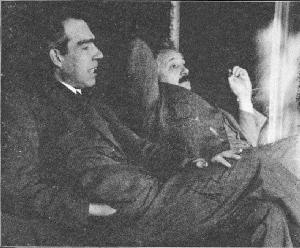
It seems to me that many of the popular quantum mechanics books on the market are peddling to people looking for a mystical experience.  Fred Alan Wolf and a few others have made a career of feeding this need.  I recall the quote by Niels Bohr-

‘There is only an abstract quantum physical description. It is wrong to think that the task of physics is to find out how nature is. Physics concerns what we can say about nature.“. 

 Bohr and Einstein

But I’ve ventured out on a limb. I am but a lowly synthetic organic chemist, a plebian scribbler in the scientific pecking order, who has not used a Hamiltonian operator or a Kroniker delta since grad school. My fragmented knowledge of quantum mechanical formalism is but a mote in the eye of Schrodingers cat.

Note: I’ve deleted The Volokh Conspiracy from the blogroll. They have developed an unfortunate neocon twitch that I find distasteful.