One of my favorite YouTube characters is Philomena Cunk, otherwise known as Diane Morgan. She is a British humorist who deadpan parodies those fine British television programs where a host narrates the script and talks about history while visiting the actual locations of that history. Most programs are about well-established British history. The difference is that she is so uninformed that she can’t even ask good questions or come to reasonable answers. But this doesn’t stop her from asking questions to experts based on deeply faulty assumptions which she openly expresses. Philomena is able to ask these questions with a straight face and directly to a subject matter expert. A few are even hosts of their own programs. When the expert provides an answer to what they think Philomena is really asking, she usually expresses disbelief and moves on to the next question.
Case in point- In an interview with a well-known physicist and host of his own TV program, she asserted that we do not know how an airplane works and asked how that could be. The physicist looked puzzled, but as all with interviewees, he kept a straight face and tried to gently answer the question that should’ve been asked. The look of puzzlement on their faces is priceless.
The physicist’s initial reply was to answer with the comment that “we have equations …”. Realizing that using equations to brush off the question was not enough so he tried to do what he should have done in the first place- use the English language to describe qualitatively how a wing generates lift.
This struck me as emblematic of physicists. Go straight to equations to answer the question to the public. Physicists can be shameless reductionists. At least in my experience. Such a reference to the equations, even though rigorously correct, is a poor answer given to the non-physics world. The public and especially Philomena need a few succinct sentences with ordinary vocabulary, but without patronizing them.
Source: Facebook. Original image source unknown.
My suspicion is that nearly everything can be described at least qualitatively with the English language. This is my conclusion after having done public outreach for a few decades. To non-specialists, explaining equations can easily go sideways in the conversation. Equations are succinct expressions of relationships between quantities. If more detail is requested, then going to the whiteboard and easing into a fuller quantitative explanation with math and illustrations should be done.
Speaking for myself only, Philomena’s interviews cause me to immediately pop into cringe mode. Sometimes my cringing is so bad I become painfully embarrassed for the guest and I have to move on to a different channel. This is a general response for me when I see people innocently exposed to embarrassment. Searching for a polite answer while retaining a shred of dignity is difficult for many people.
Vocabulary gained while watching British crime shows. I will only show the meaning from the context in which they were heard.
Putrescible, noun or adjective: liable to decay; subject to putrefaction, “putrescible domestic waste”
Summat, pronoun: a British dialect form of the word ‘something.’
Kip, noun: sleep, a nap: ‘I might have a little kip’
Egg sucking, phrase: used as an expression of anger or scorn, ‘go suck an egg if you don’t like it’
Gaffer, noun: a person in charge of others; a boss.
Scarpered, intransitive verb, to flee or run away.
Minging, adjective: very bad or unpleasant.
Parkour, noun: the activity or sport of moving rapidly through an area.
Gutted, adjective: Very disappointed or upset.
Bloke, noun: a man, guy or dude.
Knackered, adjective: Worn out or tired.
Bollocks, : nonsense or rubbish.
Ta, : Thank you.
To leg it, phrase: To run away.
Daft, : A bit stupid.
Gob, noun: Mouth.
Cuppa, noun: Shorted version of ‘cup of tea.’
To Crack on, : To get started or to finish something.
Innit, : Short for ‘isn’t it?’
I like and would adopt most of these here in the US if others knew what they meant. My favorites are the words in orange.
Editorial
Let me say a few things about British television in general. We subscribe to both BritBox and Acorn TV found on Prime streaming service. First, in American TV entertainment, most of the actors tend to be very pretty and young- even the men. It’s a bit too saccharine. British TV has young and pretty people too, but with a large dose of people who ordinarily wouldn’t fit that description. Perhaps the talent pool there is small. My point is that the Brits use older folks to a larger extent than in the US. Another noticeable difference is the use of gun play in the cop shows. British TV uses far less shooting or even just the pointing of guns in their screen plays. There is some, granted, but far less than in the US. I like that. The Brits have a tradition of parlor murder mysteries where the killer is identified by deduction. On Brit TV, conflicts or apprehensions of suspects is frequently handled without excessive violence.
Another refreshing aspect of BritBox and Acorn TV is the availability of continental European programming. I’ve never been bothered by reading subtitles, so the authenticity of language and the drama is unfettered. Truthfully, the use of subtitles for English, Scottish and Irish programming is necessary when accents are too thick to understand, which is not infrequent.
One thing I have noticed is the adoption of American English vocabulary abroad. It is a bit sobering to see the extent of influence abroad by the US movie and television industry.
[Note: I changed the name of this post to something more suitable.]
Back in 1976 and a year out of high school I got a part time job at a single screen movie theater as a projectionist. The first movie I ran by myself was a Roman Polanski movie called The Tenant. It was the third in a trilogy of Polanski horror movies after Repulsionand Rosemary’s Baby. Both films had won critical acclaim. I can only assume this is why the owner of the local theater chain company booked it.
Over the stretch of 6 days we sold 7 tickets, of which 5 walked out during the show. One night we ran the movie for no one. The owner was watching this unfold and by the 7th day, we had a new movie to show. Low ticket sales also meant low concession sales. Minimal staff meant a manager to supervise and work ticket sales, a concessionaire, and a projectionist. On the bright side for the janitor, there was little to clean up.
Spoiler warning. The Tenant wasn’t a happy movie. There is a scene where the main character begins to take on the symptoms of madness that the previous tenant had. Eventually he throws himself out of his apartment window and survives like the previous tenant did. But, not one to easily give up he drags his broken body up the stairs to try again. The second attempt doesn’t work either. But that isn’t the end of it. You’ll have to see it.
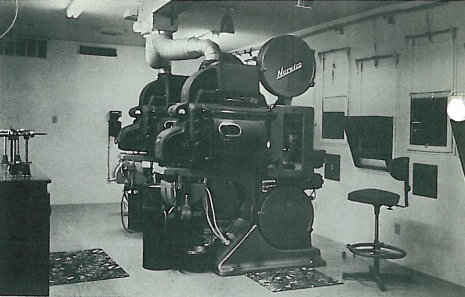
My first theater had two of what were at the time relatively new 35 mm Norelco projectors. At this time theaters commonly used two 35 mm projectors sitting side by side in the darkened upstairs projection booth. Movies were shipped in one or more metal shipping containers in roughly 5 to 7 20-minute reels. Since the Norelco projector used 1-hour reels, three shipping reels were spliced head to tail and wound onto the larger reel. Usually there was only one changeover. We spliced in short preview clips on the first reel. This gave folks time to hear the movie begin and rush to their seats after getting concessions. When customers weren’t bitching about the price of popcorn, they would complain about the previews. We ignored them. That decision was way over our heads.
Older model Norelco projectors in a typical projection booth. Source: Norelco.
Two projectors were used to avoid interruptions between reels. Near the very end of a reel, a black spot would appear twice in the upper right-hand corner of the image. The first time was the signal to be sure the lamp was lit and to get the motor rolling on the other projector. Shortly after this was the second appearance of the black spot. This time it was the signal for the changeover. This was the cue to drop the dowser on the first projector and block the light while simultaneously opening the dowser on the other letting light through the next reel. At the same time the sound was shut off from the first projector and activated on the second projector. The result was smooth continuity of image and sound between reels.
At this point, the take-up reel was rewound and put away, ready for the next run. Leaving unrewound reels for the next guy was a major faux pas. Wash, rinse and repeat.
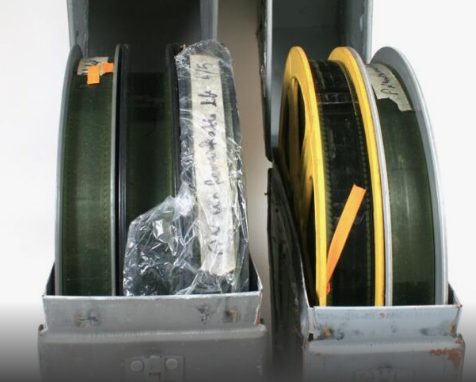
35 mm movies shipping reels. Source: ebay.
Most movies arrived on 5 to 7 reels in 2 or 3 shipping cans. The more common brand of projectors, Simplex 35’s, were designed to run the shipping-reel sized reels on the upper feed side directly. We’d use our own better-quality reels for use. The Simplex projectors came with carbon-arc lamphouses that required some attention when they were lit up.
A Simplex projector. It looks old because it is old.
Above is a common example of the Simplex 35 mm movie projector. It is comprised of a lamphouse, the upper feed reel, the intermittent movement and film gate, the spinning shutter, the optical sound pickup is below and slightly behind the image in time. The take-up reel is at the bottom. Between the shutter and the light is the dowser. There was one for manual use and later, one for automatic use. The purpose of these black pieces of thin metal was simply to block the light from getting to the gate where the film passed through. One reason is to avoid projecting an undesired image or white light onto the screen. It’s unprofessional and bad showmanship. The other reason is to prevent light getting to the film if the motor gives out and the film stops in the gate. Lamphouses generate considerable heat and a stationary piece of film will begin to melt within a second or two. Naturally, this fiasco will show up on the screen for God and everyone to see.
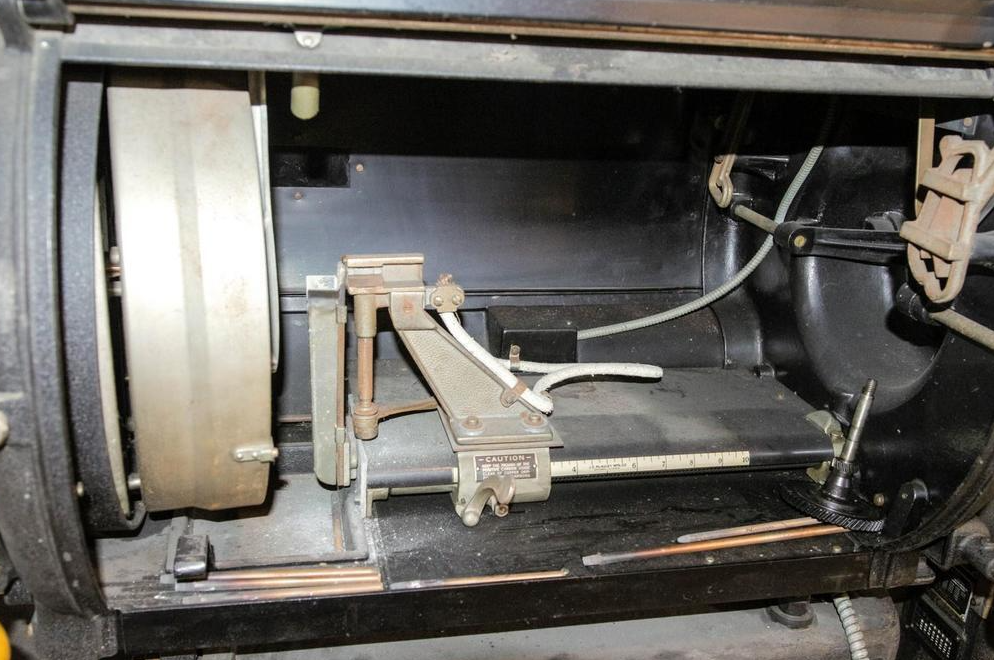
Inside view of the Simplex 35 carbon arc lamphouse.
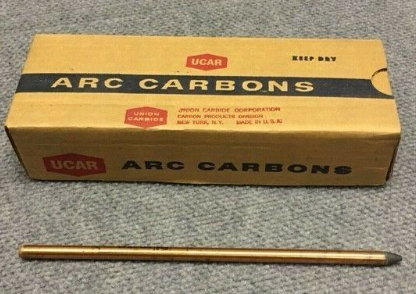
The component in the center (above) of the housing held two copper-clad carbon rods which were slowly fed towards one another with one rod penetrating the mirror. The position of the rods was continuously moved towards the focal point as the rods burned up in the arc. Good ventilation was required. The purpose of the motion was to keep the size and shape of the arc constant and in the focal point of the parabolic mirror. Once the arc moved away from the focal point, the brightness of the projected image would diminish. If the gap between the rods became too long, the arc would wander around and become unstable causing flickering to appear on the movie screen. The arc lamp for our indoor theater used 70 to 80 amps DC. The high DC power was supplied by a vacuum tube rectifier. The projectors for our drive-in theater used 120 to 140 amps DC. Longer throw and larger screen.
Copper clad carbon rods for arc lighting in a movie projector.
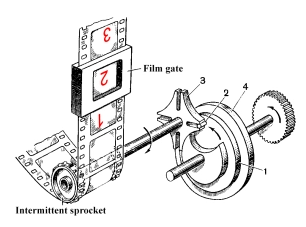
The gate mechanism was interesting. At its heart was a Maltese cross intermittent movement. It would twist a sprocket enough to pull the film down by one frame and then leave it there for a short time. While stationary, the shutter blades would alternate letting light pass through and blocking it. The frame rate was 24 frames per second, but to prevent flickering, each frame is shown twice. While the shutter blocks the light, the gate mechanism pulls down the next frame.
The intermittent movement pulled the film through the “ gate” for steady projection.
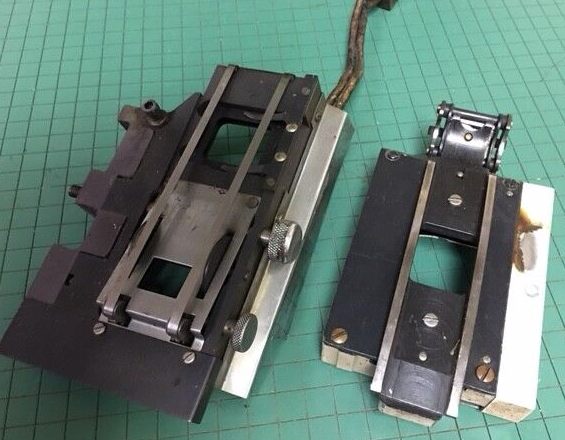
The intermittent movement pulled the film through the film gate and stopped momentarily in time with the shutter. The purpose of the gate was to clamp the film stationary in the focal plane for a moment while the light passes through. It was built to hold the film firmly in place but not adversely affect the movement of the film or damage it. Movie prints are expensive and not always replaceable, especially if they are older. One side of the gate had two smooth, polished steel sliding surfaces for the film sprocket-hole sides to slide on and the opposite side had two flexible steel bands sitting over the polished slides to apply light pressure to the film to prevent chattering.
The gate also holds the aperture which determines the shape of the light beam giving the image on the screen. It is just a thin black metal plate that has a precise rectangular hole in it. The idea is to put image on as much of the screen as possible. Apertures are defined by their aspect ratio, or the ratio of length to width. The most common aspect ratios are the normal 1.85 to 1 and the anamorphic wide screen ratio of 2.39 to 1. We used to refer to the anamorphic image as “Cinemascope.” The 1.85 ratio works well both in cinema and television. Movie theater screens were adjustable in width by black curtains called “masking.” There were two positions for the masking- fully open for wide screen Cinemascope and partially closed for the regular format. Theaters could have used fully exposed screens like they do today, but the aesthetics then was to cover unused screen at that time. The 2.39 to 1 Cinemascope format works well in the theater but adjustments have to be made for it on television screens. They will either lop off the left and right sides and convert it to 1.85 to 1, or they will broadcast the movie in letterbox form, preserving the entire image, but making it smaller vertically on the TV screen.
Some theaters use curved screens but most do not. If you think about it, the distance of the film plane to a flat screen is minimum from the film to the center of the screen. This distance, however, increases from the center to the edges of the screen. So, it isn’t possible to focus the center and the edges simultaneously. In practice, the center of the screen is put in focus. A concave screen overcomes this problem. The larger the screen the more obvious the improvement in focus will appear.
Projecting a large image onto a large screen has certain problems to contend with. A large image from a 35 mm frame will magnify any imperfections in the image like graininess and focus but also you will come up against limits on brightness of the image. The image on the film should be what the director intended- perfect and usually it’s quite good. Focus is mostly a theater problem. Focus degrades with image size inherently but also with how well the operator can use the focus knob on the projector.
When a complaint came in about the focus, I would check it right away. Usually, the image on the screen was already at the optimum focus. To show the audience we were attending to the issue, I would crank it way out of focus, then back through focus and to the other extreme. Then I would then bring the image back into focus carefully, demonstrating that the image on the screen was as good as it could get. At one theater we had a 960-seat auditorium with a large, curved screen. The large size of the screen image came from a 35 mm piece of film meaning the magnification was very large. Focus and graininess were always an issue.
The anamorphic lens will take a distorted image from the film and spread it out to give a proper wide screen image. On TV they refer to these movies as letterbox movies due to the wide image but narrow height on a TV screen.
So, what’s the deal with the noise? Projectors make a characteristic clattering noise that isn’t always very quiet. The film is fed to the upper end of the gate at a constant speed, but the film has to stop every 24th of a second so a stable image can be shown twice. The film motion into and out of the gate area goes from constant-feed to intermittent-movement to constant feed-out. To do this, a loop of film is placed a above and below the gate forming two bits of slack in the film. The slack is alternately fed in and out and pulled in by the intermittent mechanism. It’s a bit noisy, but the customers never hear it. There might be other noise from the motors and gearing mechanisms as well.
Platter projection systems eventually came along with better automation for easier use by people with a broader job description in the movie house.
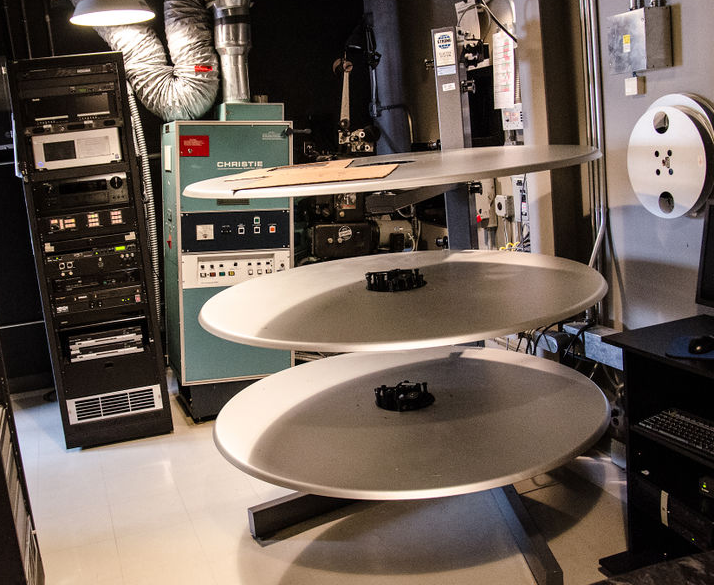
A single projector system with platters feeding and taking up film, No rewinding or changeovers. Source: Sprocket School.
The platter system came to our neck of the woods in the late 1970s. Our platters were air driven so they made a constant whining sound. The entire film was spliced together with heads in the middle and tales on the outside. One platter fed the film to the projector and a second one was the take-up platter. The film fed through a speed control mechanism in the center of the platter and then on to the projector. Out of the bottom of the projector, the film threaded through a speed controller and then rewound on the take-up platter. The third platter was a make-up platter for putting together the next movie. This system was not so good for the projectionist profession but did allow the theater to have a manager run the projectors and take care of everything in the lobby as well. I used to be a manager/projectionist at a duplex theater then later at a 4-plex theater while I was an undergraduate. If there was a power trip and the projectors dropped out, I would have 4 auditoriums of upset folks to content with. The house lights would automatically dim up so the crow could conveniently find their way out to complain. Lucky for me I was in one of the two projection booths getting the projectors running and away from the mob spilling out into the lobby. On the good side they usually bought concessions while pacing in the lobby.
When splicing film reels together it was convenient to mark the splice location along the edge so it could be seen wound onto the reel. We used white shoe polish to mark 2 ft of edge. When we were breaking down a print to ship out, unless there was a mark between reels, you could easily pass the splice as you were rewinding onto the shipping reels. We saved the head and tail leaders and spliced them back on for shipment. This was always done late Thursday night during and after the last show. Any previews had to be returned as well. Over time, movies came with previews attached.
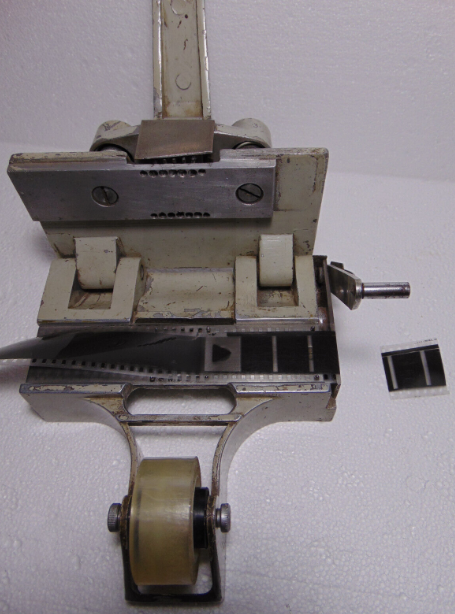
Tape splicer for 35 mm movie prints. There is a cutter on the right side for getting clean, square edges, and a roll of tape at the splice point. We would overlap the splices by 1 sprocket hole for strength. Butt splices were prone to failure after too many flexures but did not show during projection. Both sides of the print were taped. Note the holes on the top part. Punches would come out when in use to punch out the sprocket holes. Image from ebay.
The film lab where prints are made would do lab splices when a new roll of stock was needed in the middle of a reel. These splices were overlapped about 1/2 a sprocket length and were either thermally fused or glued. Normally you never noticed them.
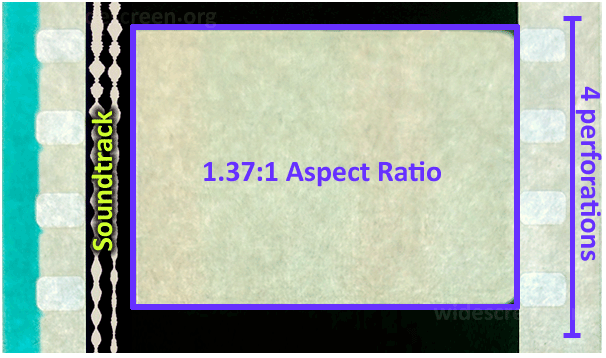
A “normal” movie print has one or two parallel optical soundtracks along one side that passes over the sound head. The sound head consisted of a lensed light source and a photodetector. The soundtrack(s) are black with variable transparent area that changes in proportion to the magnitude and frequency of the sound. Movies came with a single track early on and eventually changed to dual track stereo sound. In recent decades other schemes came along like Dolby sound and others. There are other sites where this is explained in more detail and with copy written graphics.
A 35mm movie print frame with dual soundtracks. The two soundtracks are different as you would expect stereo channels to be.
The Saturday Night fever Disaster.
On the opening Friday night ofSaturday Night Feverback in late 1977, I had just started the first showing. In the other theater, I started a sci-fi movie called Coma, written by Michael Crichton. Seeing that they were both running on our platter systems nicely, as manager/projectionist I had to attend to the lobby to check the ticket booth and grab some of the larger bills from the cash drawer and then the same at the concession stand. About 60 minutes later and into the third reel of Saturday Night Fever I went into the booth to check the projectors. Coma looked just fine. What I saw at the other projector floored me. I couldn’t believe it. Never had I dreamed that such a thing was possible.
What I saw was on the take-up platter of Saturday Night Fever. There was part of the film that was half gone across the film width. The film wound up smoothly as usual and the top surface looked smooth as it always did, except for maybe 80 % of a reel where the top half of the print was just gone! It looked like a gutter was gouged into the print. I looked everywhere in a panic for the missing film, many hundreds of feet of it, but it was not to be found anywhere. So I began to look closer at the print on the take-up platter. Where the next reel began (remember the shoe polish?), the layers of the film had a slightly different texture.
Feeling nauseated and incredulous all at once that I had destroyed a print of a blockbuster movie that people were dying to see during the very first showing, I stopped the projector, refunded 210 very hacked-off customers and halted sales for the next show. Turns out this was not really necessary but I did it in panic. Then I called the owner of the theater and explained what had happened. He was already pissed about something- taxes maybe- so my news just threw gasoline on the fire.
While he was on the way, I began to sort out what had happened. By the next day when I very laboriously removed the print, and instantly say what had happened. Early into reel 2 a lab splice had torn halfway across the width of the print, then down the middle for 80 % of the reel. It only stopped when it came to my tape splice between reels 2 and 3. So, this 80 % of reel two had piled onto the floor then at the beginning of reel 3 began to be pulled off the floor and onto the take-up platter where it neatly rolled up between layers of reel 3. Because it was from the top of reel 2 and layered along the top of reel 3, it wasn’t easily visible. Nobody had heard of such a failure before. Usually a print tore completely across and the projector automatically shut down.
The Simplex 35 platter projectors we had were equipped with a failsafe feature below the sound head. By this time, projectors had long had failsafe mechanisms, but they only detected tension in the film. This device did two things- it detected broken film and it detected a thin piece of conductive tape along the edge that would signal the automation to close the dowser and shut off the lamp to block the light, shut off the sound, dim up the background music (Neil Diamond, usually), signal the house lights to dim up, reset the masking curtains, and close the main curtains in front of the screen. The sensor consisted of two curved paddles that sat in the film path and across and against the film as it left the projector below the sound head. The stationary paddle picked up the shut-down metal tape that triggered the automation and the other spring-loaded paddle sensed the loss of film coming out of the projector. But it only sensed the presence of one side of the film. If the other side was somehow missing, there would be no film breakage detected. And that’s what happened.
The big problem was that we had an empty screen and needed a movie to throw on it. All 1400 of the Saturday Night Fever prints were in use across the world. There were no more, or so we were told. What we did to keep butts in seats was to show one print in 2 theaters simultaneously. Both projectors had Selsyn motors that would cause the two projectors run synchronously without creating or losing slack in the print between projectors. We called it “running in synch”. So, for 6 days we ran Coma on both screens. The cast included Geneviève Bujold, Michael Douglas, Elizabeth Ashley, Richard Widmark, and Rip Torn. Among the actors in smaller roles were Tom Selleck, Lois Chiles, and Ed Harris. It was pretty good.
The quote below gives the most interesting explanation I’ve seen of gun culture in the US.
“Guns are at the center of a worldview in which the ability to launch an armed rebellion must always be held in reserve. And so in the wake of mass shootings, when the public is most likely to clamor for gun regulations, Republicans regularly shore up gun access instead.”
No matter your position on firearms, there is no point in scolding the opposite side since few if any people are ever convinced to join your side. It is a waste of time and energy. The grownups of America need to find a way to de-normalize violence in general. Guns happen allow a person to commit violence from a safe distance, plainly a reason for their popularity. Obviously, self-defense is a delicate spot, but if committing violence is not nearly viewed as normal by the broader population, the need to for lethal self-defense just might diminish a bit.
American gun culture as I see it is comprised of a spectrum of individuals ranging from violent criminals to paranoid militiamen to peaceful hunters and sport shooting enthusiasts. Criticism of gun culture should not bunch them together under one umbrella. Carefully chosen vocabulary should be used so as not to antagonize the more peaceful side of the spectrum.
When the European frontier was settled by stone age people 40 or 50 thousand years ago, there were no firearms. There were weapons that could only be energized by their personal strength. Fighting was more intimate in the sense that clubbing and jabbing had to be done up close to your adversary. Stoning could be done from a few steps back. Killing wounds led to exsanguination and a rapid death while others led to sepsis and a longer, agonizing death.
The invention and spread of gunpowder starting in 9th century China led to the development of guns, cannons and, eventually, exploding projectiles. It was lost on no one that firearms enabled the projection of lethal force from a safer distance. The first really big war, World War I, in Europe was when advances like the Maxim recoil-operated machine gun and high explosives like picric acid were first put to large scale use. When the Maxim machine gun came out, many predicted that the mere appearance of the weapon would frighten the enemy into submission. Of course, it didn’t work and over the years the result was more and more efficient and mutual slaughter of opposing forces.
Male humans in particular have always been drawn to weapons and the martial arts. There are exceptions obviously, but men seem to take a shine to guns early in their lives. When asked why they like guns, they usually mention something about protection from intruders or perhaps just being a good guy with a gun in general. Often heard is the argument-terminating reminder of the 2nd Amendment and the vow that their guns could be confiscated only from their cold, dead hands.
Some Americans do live their lives in dangerous places. With some training, having a handgun in the nightstand may indeed be necessary for protection. Speaking for myself, I have never lived anywhere that was so burdened with crime that I felt it was necessary to pack a handgun. So, I can’t criticize those who are threatened by crime.
What I can criticize, though, is the broader culture that idolizes the Hollywood image of a good guy (or gal) who resolves conflict with a firearm. We have the screenwriters to thank for this. They dream up the story arc in the screenplay to include some fancy gun play. Death is always immediate and without the off-putting cries of pain and writhing that comes with a serious wound.
Gunplay in European TV programming is much less common. I’ve watched TV police drama series from the UK, Denmark, Norway, Iceland, Sweden, The Netherlands, Belgium, France, Italy and Germany. The only significant shooting I’ve seen is in a show from Germany called Luna & Sophie. Surprise, surprise. It turns out that a compelling police drama screenplay can be written without a lot of shooting and gratuitous violence. Or even with none at all. Perhaps it is because guns are not very abundant in the general population in Europe.
An effect of repeated and detailed depictions of gun violence on TV is that it suggests that shooting people is, well, normal. It normalizes the notion that the shooter can be the judge, jury and executioner. Killing someone with a gun also bypasses all of that due process stuff that wastes so much time. We all know that this is a dramatic depiction and that shooting people in real life will have very serious consequences. In my idea of civilization, people would be safe without a firearm. But, this is a fantasy I never expect to see unless I move to Iceland.
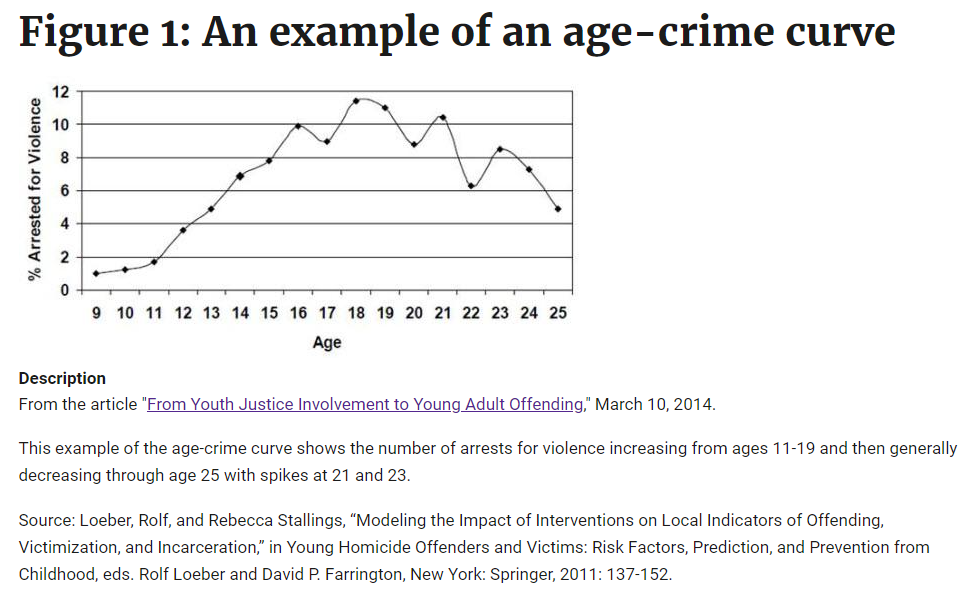
Maybe you could say that gunplay on US television mostly depicts good guys with guns defeating bad guys with guns. I’ll agree, that is a positive spin. The problem lies with population distribution within a large group. It often happens that a classroom or a large population will distribute itself unevenly when certain measurable attributes like personality or other performance metrics are considered. It is referred to as the bell curve. In the ideal mathematical sense, there is the standard distribution. Below is an example of a bell-shaped curve of % of members of a population versus age.
What is interesting to note is that as the population increases in size and barring any other influences, you would expect the population of each of the individual age groups to grow in number, though not necessarily in percentage. The point is that as the population grows, so does the subgroup of younger criminals.
So, as the general population increases we can expect the population of criminals to grow as well.
Reality
Clearly, America is in a pickle. Mass shootings have been increasing in number, unlike with most other comparable nations. But with every mass shooting the cries for gun control go unanswered no matter the number of bloody dead children strewn about the floors of American schools. What can be done?
Removing guns from citizens or blocking their ownership will not happen. This is completely unworkable and serious people know it. It will only lead to civil war.
More laws and tougher sentences for gun-related crimes. This has been done and hasn’t solved the problem.
Training teachers to shoot attackers. If you know many teachers, you know this is unworkable.
The congress will accomplish absolutely nothing but handwringing.
A president can do nothing without the support of the congress. Nothing will happen here.
The gun lobby and the National Rifle Association will continue to spew their cold dead hands rhetoric, shouting down voices in favor of even the faintest of gun control remedies, regardless of the bloody mayhem happening.
Citizens dedicated to maintaining the status quo with 2nd Amendment hysterics will continue to shout, wave their flags and demand freedom.
Republicans will continue to whip up hysteria by lying that gun rights are on the cusp of disappearing.
Militiamen will continue to gather in the woods hoping for civil war.
The US has planted itself into a sort of cul-de-sac of violence and extremism in regard to the possession of needlessly powerful weapons and there seems to be no way out. There is no viable political action on the horizon. Instead, let’s forget the damned guns and look elsewhere.
A simple suggestion
In the US we are bathed in violence as entertainment. There were 45,222 firearm-related deaths in the United States in 2020 according to the Centers for Disease Control. That is an average of 124 Americans dying per day from firearm-related injury. These aren’t misfires from gun cleaning.
While multiple factors lead to violent actions, a growing body of literature shows a strong association between the perpetration of violence and exposure to violence in media, digital media, and entertainment.
I’m not sure that viewers are actually asking for all of the entertainment violence that we see- it’s just that if it’s there we’ll eagerly watch it. It resembles click-bait. It is easy to write screenplays with of violence in it. Violence is genuinely exciting to most viewers. Violent content in programming helps to sell projects to those who finance and buy it. It definitely draws eyeballs which sells tickets, subscriptions and advertising. This is a reliable money machine.
What applies to movies also applies to video gaming. Many games are chock-full of violent content where the gamer does the simulated killing personally. I’ve played it myself. It triggers something that compels you to keep killing. But, does that condition you to committing actual violence? Maybe it is an effective release.
Producers and writers of violent content know full well what it takes to kick up the excitement factor. It is formulaic. While they operate under some sort of content guidelines, they are motivated to push it to the edge. The question is, do shoot ’em ups have to be every 4th scene? Are writers unloading their responsibility for compelling content to the stunt coordinators of gun fights and other violence?
What is needed is for screenwriters, producers and directors to back off on the violence a bit. All of the violence on TV comes from the imagination of the writers and producers. Surely it is within their power to throttle back a bit on the shooting, blood and guts. Desecration of human beings as entertainment should have tighter limits.
The goal is a safer and less violent civilization. The people who portray violence in vivid detail and orgasmic revenge produce a commercial product idealizes violence. They should be expected to self-govern better.
A Plea to Filmmakers
Your advertisers know that a certain fraction of viewers are persuaded to buy their products because of advertising within your TV programming. If they are persuaded to buy widgets they probably don’t need, don’t you think that your portrayals of violence might also be effective in negatively influencing impressionable young people? Will half the violence really reduce your profits by half? Does reducing violent content really infringe on your creative freedom? How limited are your creative abilities that you must accurately portray the destruction of human life?
>>> A smattering of thoughts each too small for a post. <<<
I’ve been thinking about quantum chemistry lately, or more to the point, my graduate-level single semester experience with it. First let me say that prior to taking the qualifying exams on arrival to the graduate chemistry program, I made sure to bone up on the particle in a one-dimensional box model. And sure enough, it was on the entry p-chem exam. Whew! Dodged that bullet. However, of all 5 exams we took, I didn’t pass the statistical mechanics exam. I would have to repeat the exam and pass it by the end of the year. Instead of taking the undergrad p-chem course I decided to risk it and study on my own and as luck would have it, I managed to pass it. Another monkey off my back.
Back to the quantum chemistry course. Initially I was hoping to gain a bit of qualitative insight into the subject. As it turned out, it was really just a high level math class where the prof spent the whole term deriving all of the key equations. I think this is pretty common for this subject. There were zero interesting applications mentioned. He was either unable or unwilling to render any of it into sentences for context. The guy was a rock star in his area of solid state nuclear magnetic resonance. Once I went in for help during office hours and he told me he was busy and to come back in 2 weeks (!). I was finally convinced that putting scientists on a pedestal was a serious error and that a**holes were truly everywhere. Anyway, I made it through the experience and moved on. Haven’t had to think about Hamiltonians since.
==========
I was chatting with a toxicologist colleague recently about the big derailment and fire disaster in East Palestine, OH. I had suggested that the decision of the responders to vent and burn the remaining vinyl chloride was probably a good idea. There was some fear that there may be a runaway polymerization of the vinyl chloride. This would likely lead to an explosive rupture of the tank car and a possible BLEVE. This is from the report–
“On February 5, responders mitigated the fire, but five derailed DOT-105 specification tank cars (railcars 28–31 and 55) carrying 115,580 gallons of vinyl chloride continued to concern authorities because the temperature inside one tank car was still rising. This increase in temperature suggested that the vinyl chloride was undergoing a polymerization reaction, which could pose an explosion hazard. Responders scheduled a controlled venting of the five vinyl chloride tank cars to release and burn the vinyl chloride, expanded the evacuation zone to a 1-mile by 2- mile area, and dug ditches to contain released vinyl chloride liquid while it vaporized and burned. The controlled venting began about 4:40 p.m. on February 6 and continued for several hours.”
My colleague said that a fire releases aerosols that are likely to be especially deleterious to the lungs. Burning organic chlorides leads to hydrochloric acid formation with all of the joy that it brings to the dance. The smoke plume, elevated by convection, and probably carrying some amount of unburned chemicals will spread with the aerosols far and wide. This would contaminate a larger patch of environment and expose a more distant population than a simple spill at the crash site would. He wondered to what extent the chemicals shouldn’t have been removed at the site, spill or not, and the land be designated as a Brownfield.
==========
Elon Musk has been running off at the mouth again, this time seeming to take sides with the Dilbert cartoonist Scott Adams who was recently given the death penalty of abandonment by his publishers. Adams used his cartoon to go off on the Black population saying that Whites “should get the hell away from Black people” referring to them as a racist hate group.
Set aside the merits/demerits and morality of Adams’ racial views for a minute. As an adult and businessman he should have known the boundaries of acceptable content in his cartoon strips in the current social environment. He published content that appeared to have alignment with white supremacist ideas. In publishing this content, he made himself radioactive and he was dropped by his publishers who happen to have better business sense. What a dunce. He was playing with a loaded gun and it went off in his face.
So, His Excellency, Elon Musk, has stepped into the fray and condemned the excommunication of Adams from the comic strip pages. Musk said that while Adams’ comments weren’t good, there was an element of truth in them. He accused the media of providing a “false narrative” by giving more attention to Black victims of police violence than to White victims of police violence. This is on top of his general loosening on hate speech on Twitter and the reinstatement of banned accounts such as with #45. Musk is broadcasting that hate speech is as valid as any other speech on his platform. Businesses like Twitter are free to edit content or not as they please. Musk believes in a rough-and-tumble environment where most anything goes. As an owner, he is certainly free to do that. But as owner, he is also responsible for content that drives away business.
Irrespective of your beliefs in this matter or the obvious morality issues, it should be apparent that neither Adams or Musk seem to care about the effect on business of draping yourself in the flag of racism, or even just of allowing the perception of it. Savvy is a kind of vector- it has magnitude and direction. Musk has strong vectors in the technology direction, but not so much in the public relations direction. He doesn’t seem to have full control of his mouth just yet.
It’s striking how the police in Uvalde were intimidated into inaction by a teen-aged shooter armed with a controversial weapon used in the manner for which it was designed- the projection of overwhelming power and violence. While children in the classroom pleaded for help on 911, armed and trained police and terrified parents stood outside and waited while children and teachers inside each died a bloody, violent death. Their last moments of consciousness were saturated with blood, gore and terror.
In the follow up, the Texas Republican political apparatus has struggled to respond to the slaughter while being careful not to alienate their macho gun totin’ Texas cowboy conservative voters. Meanwhile, in Houston at the NRA convention, and while musical acts were fleeing from the event, the show must go on. The convention was an opportunity gladly taken by #45 to pontificate at length to core voters and amplify all of the worries he himself planted.
School shooters tend to be young males so perhaps there is a tendency to blame “toxic masculinity”. We cannot blame men for displaying at least some amount of masculinity. However, when we show it by strutting around like a peacock in an ostentatious display of weaponry and decked out in militia costumes, we are beaming a stark message to those around us to beware. Its intent is always to intimidate. It is an asymmetry in power- a necessary condition for many.
Nothing new is to be said here about gun rights vs gun control. Weapons culture and politics will have to evolve for a few generations before that can be reasonably addressed. Many more mass murder scenes will come and go before shoot ’em up cowboy masculinity fades away, if ever. In the near term, however, we can do something about our exposure to violent entertainment.
We Americans entertain ourselves with movies, television and videogames that feature gunplay as a plot device and an easy form of conflict resolution. We love to see the good guys hand out 9mm justice with righteous gunplay. American movie makers know full well the attraction of audiences to gunplay in a storyline. What better way is there for screenwriters to keep the energy going in a screenplay than to throw in scenes with shootouts. And how do characters gain absolute power over someone? They point a gun. Is it any wonder that now and then a few kids obtain easily available firearms and try shooting as a way to vent their rage and frustration? How do we learn to be adults? We mimic.
The entertainment industry needs to account for their part in the poisoning of our civilization with highly detailed dramatic portrayals of violence. The excuse that viewers have free will and should be able to discriminate between reality and fantasy is only partly valid. There can be no denying studio influence over impressionable young people. It is human nature to learn from and mimic what we see, even from film. The entertainment industry has normalized gun violence in the minds of our population. Behind the glitzy facade of show business is a deadly serious capitalistic enterprise that banks on whatever it takes to sell ads and tickets. And, if violence sells, they’ll crank out more of it. We need to quit buying so much violent content.
Public outreach in science is a important element for the maintenance of our present technology-affected (or afflicted) civilization. Science and engineering (Sci & Eng) activity is continually expanding the scope of the known. The global business sector, without relent, puts new technologies to work and retires others as obsolete. It is as though civilization is in a constant state of catch-up with the tools and materials being made newly available. And the quality of news is quite variable.
When it comes to the electronic and print mass media’s government reporting, the emphasis seems to me to focus on the current budgeting process and political conflict therein. These two subjects are in the “eternal now” in the flow of events. The word “news” is just the plural form of “new” so it is natural that news media focus on present budgeting and in-fighting. Media directors and executives know that reporting must be as concrete as possible and what could be more so than large dollar values and pithy news of political hijinks? Both raise our ire because cost and anger are emotional triggers for people. And emotional triggers bring lingering eyeballs to media.
The public not affiliated with Sci & Eng are quite often unaware of what their tax dollars are actually producing, perhaps many years down the timeline. The eventual outcome of government spending on Sci & Eng may be quite specialized and seem only remotely related to non-Sci & Eng life.
It has been my observation that media equates boring content with failure and compelling content with broadcasting success. The word “compelling” is used to describe something that attracts lingering eyeballs. Modern news broadcasting is the process of jumping from one compelling piece to another. I suppose we cannot blame them for this emphasis on superficiality because apparently it is what “we” want. The big We that draws advertisers and thus cash flow to broadcasters. It keeps the lights on and families fed. Basic stuff that can’t be dismissed with a utopian wave of the hand.
If there is going to be any fundamental change in the tenor and quality of content in media, it will have to come from citizen viewers. This leads me to the thrust of this essay: Those knowledgeable in Sci & Eng must bring the value proposition of current efforts in technological civilization to the citizenry, because broadcast media certainly can’t. By “broadcast media” I mean to include everything right down to what appears on your smart phone. Unfortunately, tech content typically emphasizes consumer goods like automobiles, electronic widgets, space, or miraculous medicine.
Those knowledgeable in Sci & Eng must bring the value proposition of current efforts in technological civilization to the citizenry, because broadcast media certainly can’t in any depth. They’re in showbiz.
Arguments in favor of rational stewardship of our little world won’t influence elected politicians. But informed and persuasive citizens can influence those who are less so and if they apply some leadership. Carefully. Those who may be less educated and less up to date on the sciency subjects do not take kindly to speech that talks down to them. The hand that reaches from above is still above and off-putting. Learn to communicate on even ground.
What works for me in reaching out to all levels of education is to use humor and a bit of showmanship. Reaching out to the public in a way that keeps their attention is hard to do and not everyone is prepared to do it. Lest you think I am describing putting on a show, not entirely. I am saying that by the deft use of knowledge, public speaking skill, and the strength of personality, it is possible to persuade even the scientifically reluctant to perk up and follow your efforts at making a point. But the point must be accessible. Deep detail and meandering monologue will lose your group. Keep your outreach succinct and limit the breadth to a few pearls of wisdom. Get feedback on your presentation. With any luck, they’ll go home and jump on Google for more.
If you need help with public speaking, join Toastmasters to improve. Try acting lessons. Join a theatre group. Learn to relax, pace yourself, and enjoy speaking. The better you get at the mechanics of public speaking, the more effective you’ll become.
[Note: The crummy WordPress text editor used to write this post is just abysmal. Why it was changed to the current revision is a mystery to me. -Th’ Gaussling]
I sit in solitude in the lower dressing room, below the stage, at the Rialto Theatre in Loveland, CO, waiting for my cue to go on. The rest of the cast are upstairs in the new green room dressing and applying makeup. My preference is to get some self time before I go on. I have a bit part in our production of Father of the Bride.
The stage is set and the popcorn machines in the lobby are popping away, blowing a magical waft of diacetyl and hot corn into the dimmed auditorium. The curtain is closed and the blue low-wattage lights backstage are shining on the floor and black curtains in the wings. The stage crew are making last minute adjustments to the set dressings. Background music is playing and a few patrons are shuffling to their seats.
In a minute I’ll apply some makeup so my pasty white face topped with whitish hair will display a bit of facial expression in the bright stage lights. A bit of mascara to darken the eyebrows and some eyeliner to make the whites of the eyes pop out a bit: All to accentuate the emotional spin I will apply to the lines. This will emphasize vocal nuances contrived to convey the emotional intent of the playwright.
One of the key ideas in acting is listening. An actor must listen to the lines being said not only for the cues they may contain, but for pacing and to convey a realistic sense of the interplay. For many of us in life, conversation consists of waiting for others to be silent so we can talk. The best actors sound natural in part because they are also listening.
Opening night of our 2 week run went well. We need to fill the seats with backsides to fund the next production. Snow is predicted for tomorrow, Mother’s day. Hard to tell what effect that will have on attendance.
The current movie “The Lone Ranger” is a real stinker. The buffoons who produce pictures like this should not be encouraged with good attendance figures. You can’t build a movie solely on a sight gag consisting of Johnny Depp with a dead crow on his head. In fact, I’d rather not invest anymore heartbeats on the topic. <end>
There is a nice post at NeuroChambers on doing a PhD. It’s well worth the read for those who may be contemplating the form of self-abuse called “grad school”. Getting a PhD has more to do with adopting a 24/7 lifestyle than getting a diploma. The diploma is just your journyman’s card to get you to your mining claim where you have to set up your sluice all over again and begin sifting for nuggets.
Gold, silver, copper, and molybdenum discovered in Haiti. Majescor Resources report favorable initial findings. Yow! That’s good news for somebody.
Friday (tomorrow) night is opening night for our play. In it I play a farmer of root vegetables … for the second time no less. I farmed Beets, previously, and a giant potato this time. The story relates to an article in the September 28, 1895, issue of Scientific American, p 199, showing the potato and the farmer that I portray. The play is written in 19th century American English vernacular and has been a little vexing for the whole cast to adapt to. This will be the first performance of this play, so no one really knows what to expect by way of audience reaction. Our last play with this writer, Beets, was quite successful and well regarded.
In any case, final rehearsal is tonight. The set is complete, costumes fitted, special effects worked out, and light and sound cues set. We’re the first theatre crew to use the remodeled facility, so everyone is psyched. It’s a real trip to be in the blackened back stage and wings, dim blue lights illuminating the walkways, while waiting for your cue to walk onto a live stage with an audience in the seats.



 Lamentations on Chemistry
