Category Archives: Arts & Entertainment

Colloidal Porcine Lipids with Capsaicin-Lambda Max 550 nm

As a gastronaut, I have been in pursuit of the perfect chili verde for quite some time.  Fundamentally, chili verde is a type of gravy: a dispersion of lipid phase (preferably pork lipids), a dispersant (starches), an aqueous phase, phytochemicals (capsaicin, cumin extracts, etc), pork, and assorted plant tissues.  It is called green chili mostly because it is not red.  That is, it lacks red chili’s.  It is more or less green by default owing to the minor jalapeno or other chili components. 

Chili verde can be consumed as a soup with or without tortillas. It is also a wonderful sauce to drown a burrito or other variations of foods wrapped in tortillas.  When used as a sauce the rheology is quite inportant.  The chili verde must flow readily, but it must also coat the burrito or enchilada in a fashion so as to form a layer substantial enough to impart flavor and release enough heat to melt any cheese that might be applied. 

I’m an experimental gastronomer, not a theorist.  Much can be said about what constitutes authentic Mexican food.  I happen to prefer what tastes best, not what is stringently authentic.  When we use the word “authentic”, what do we really mean anyway?   Mexican food is now a kind of gastronomic diaspora- it has been dispersed in all directions (well, except for Europe) and is evolving.

Here is the latest revision– To a large stock pot is added 454 g of pork sausage or diced pork.  As the pork is browning, one half of a medium onion is diced and added to the browning meat.  Several cloves of minced garlic are added to the mix.  After the meat is browned, 6 cups of water is added and the mixture is heated to a gentle boil.  To the vessel is added 1 tsp of NaCl (or to taste), 1 finely diced jalapeno pepper, 1/3 cup diced Anaheim pepper, 1 tablespoon of cumin, 1 teaspoon of ground chili pepper, 1/4 cup corn meal, and one finely diced tomatillo.  The mixture is allowed to simmer for 30 minutes.  To a cup with 1/4 cup of warm water is added 2 tablespoons of corn or arrow root starch and the solids vigorously dispersed in the water (no lumps).  The starch slurry is added to the pot and the resulting mixture is simmered at low heat for 10 minutes to afford a mixture that should have the consistency of a gravy. Beware-  it is possible to overheat the composition and wreck the dispersion. 

Comment on the above lot:  Pretty good, I’d give it a 9 out of 10. Perhaps a bit more cumin.  Actually, a fresh salsa with cilantro & jalapeno would do the job on a burrito.

In a later post I will discuss fabrication techniques related to the burrito. For now, bon appetit!
An Authentic Life

So, if you live in a major metropolitan area like LA, how do you go about having adventure? Where are the untrodden corners that a person can explore? How does a person go about living an authentic life?  In such places, a person is absolutely surropunded by structure- streets, neighborhoods, commerical districts, underground infrastructure, zoning, civil law, criminal law, home owners associations, etc. You can’t dig a hole without doing a utility check. The airspace overhead is a codified layercake governed by the Federal Aviation Regulations.  Every aspect of life is structured. 

Even recreation is highly engineered in every way. I’m presently at DisneyLand. Every sound, texture, taste, smell, and view has been thoughtfully engineered for some specified effect. DisneyLand is a confederation of attractions held together by the glue of merchandising. In fact, virtually every form of recreation in SoCal (except the beach) has been contrived to give some kind of virtual experience. 

The effect of show business can be seen and heard in many ways here.  You can hear it in the way people speak, the cadences and the mannerisms are part of the Hollywood schtick.  It has permeated all of the surrounding space.  Show business remains what it was a hundred years ago, but with the raster scan of electronic immediacy.  It is still the rattling of a stick in a bucket of swill. The promise of titillating wonders and thrills. I’m hooked.

Clancy’s World of Spooks

It is like a disease. I find myself drawn to Tom Clancy novels.  I picked up Rainbow Six the other day. Other than his Op-Center series, I think I’ve read most of his books.  Clancy is one of the most successful writers in this genre.  Airport bookshops have been good for him.  When I was in the travelling phase of my career, his books were great for passing the time in airports.  Millions of us have read his books.

And millions of us have read Clancy’s idealized interpretation of how the clandestine world operates.  I won’t indulge in a superficial crtitque of the genre or his writing. But I would like to suggest that a population of readers who have followed the characters and themes of his immensely popular books might have developed certain impressions or even, shall we say, expectations, of the those who practice this tradecraft.

After reading his highly detailed and richly woven stories, one might develop the idea- subconsciously, mind you- that the clandestine services were capable of doing anything they set out to do.  Could it be that decades of Clancy’s stories have adjusted the expectations of countless readers in tems of what was possible in the world of the black arts? Could it be that such fiction has inadvertantly prepared our minds in such a way as to accept the assertions of government leaders when they tell us that hostile states have certain threatening capabilities? Surely, with all of the assets and talent at our disposal, when our elected leadership says that a threat exists, can’t we be certain that the conclusion was based on well placed human assets and has been through a series of tests and filters to verify the accuracy and magnitude of the threat? 

For those in power, the notion of “expertise” is not only useful, it may even be critical.  We all want to know that our safety is in the hands of experts. It is a comfort thing. Leaders need to be able to assure the population that experts are on the job and all will be well. 

I would suggest that there is no such thing as “expertise” as an intellectual destination.  There is only a continuum of confusion.  And some of us are more confused than others.

30 Years of Star Wars

It has been 30 years since the release of the movie Star Wars. Back then I had just started a job at the local movie house as a projectionist. We had two Phillips-Norelco 35 mm projectors with Xenon arc lamphouses and 6000 ft reels. We’d splice 3 x 2000′ shipping reels onto one reel so that there would be fewer changeovers. 

The theater owner put down a $10,000 non-refundable deposit on the print and paid 90 % of the ticket sales to the distribution company for the first 6 weeks. So for the first month and a half, we made our money on popcorn, cokes, and Junior Mints.

In 1977 Star Wars was THE blockbuster of all time. We had sell-out crowds every show for the first 2 weeks. The concession girls could barely keep up with the popcorn demand. Other theaters were popping corn for us in an attempt to keep up. We blew through 5 gallon syrup cylinders like spent cannon shells on a battleship in Guadalcanal.

I ended up running Star Wars 186 times. But it was far from routine.  The projector chewed up a bit of the end of reel three, the famous dumpster scene. Unfortunately, I was operating the night the print failed. The projector shredded about 20 feet of film (18 inches/sec) in several places and the resulting film break  caused the automation to switch on the houselights, close the curtain, and start a Neil Diamond 8-track tape playing for the audience. After 3 seconds of bewilderment, the crowd turned ugly and started shouting and storming to the lobby to complain. The film stopped at a very exciting point and the customers were none too happy.  I didn’t venture downstairs.

I was a casualty of Star Wars and actually had to be taken to the hospital during the run.  In trying to investigate the source of some troublesome image chatter, I got my finger caught on a sprocket and ran it between the teeth and the guard post.  Ended up with a meaty gash that required stitches.  Of course, I never told George Lucas…

The print grew progressively worse over time. The dumpster scene would chatter through the film gate in defiance of our best adjustments.  But despite this, few complained when they walked out of the theater. It remains a great movie.  Eventually, as a college student I moved up to a 4-plex theater with platters and automated Simplex 35’s.  This night job paid for much of my BA in chemistry. I read much of Solomons Organic Chemistry in the projection booth.

The Murder Room

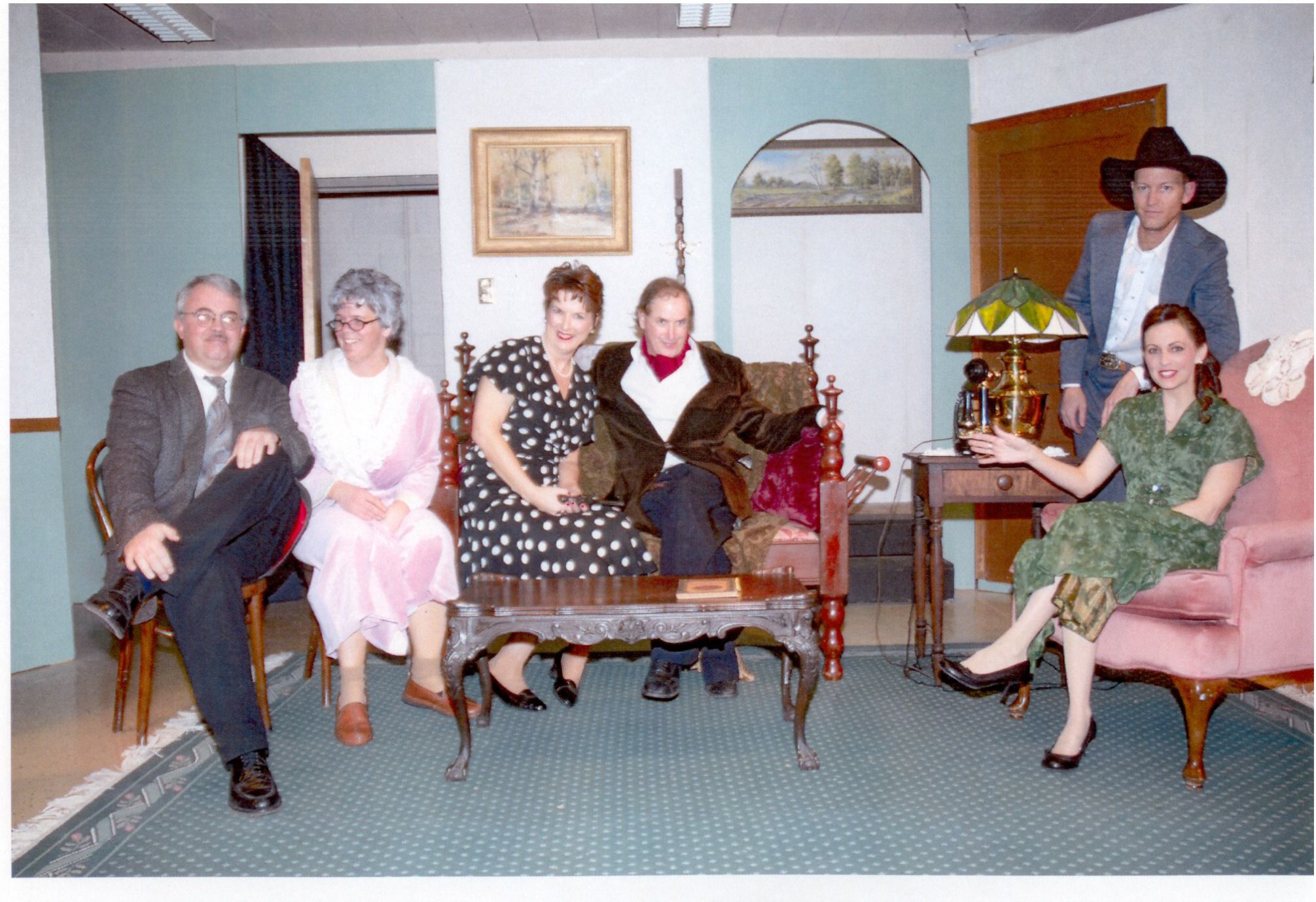
I have attached a cast picture of our recent production of The Murder Room.

murder-room-cast.jpg

It turns out that there is a small number of people walking around who do several plays per year.  They have no real designs on Hollywood or Broadway.  They do dinner theatre or community theatre just for the pure joy of it.  Despite the fact that the work is gratis, local, and not run by Spielberg or some other big name, it is nontheless a sizeable ordeal to prepare for. 

I am grateful that not a single bit of rotten vegetation was thrown my way and that at least some of my lines drew a smattering of laughter.  I did it with a British accent somewhere between Terry Thomas and Rex Harrison. 

The sensation of this kind of performance was what I would imagine ballroom dancing might be like. A fluid and coordinated dance of repartee, movement, and subtext. To have performed with experienced actors was great experience and I am eager to do it again.

In low gear

Th’ Gaussling is in low gear this week due to extra-curricular activities. I’ve been in rehearsal since October for a play that opened last night- The Murder Room by Jack Sharkey. It’s community theatre, which is the only way a hack like myself would have had a chance. This is my first time on stage and it has been quite an experience. Acting is a lot like flying an airplane- it is exhilirating and terrifying all at the same time.  And like flying, you can fall from such a height that it takes a long time to smack into the ground.

Acting requires a type of learning that is rather different from learning chemistry. First, there is rote memorization. There is no escape from knowing your lines. With experience the actor can develop the character around the structure of the dialog. 

It is nowhere near as easy as it looks, and it does require a large investment in time and effort. But in the end, performing with other actors and pulling off a complicated show is quite satisying.