Category Archives: Astronomy and Aerospace

Wherein I faintly Mock a Harvard Professor

Ok, so there is this Harvard professor named Avi Loeb who attracts media attention with his suggestions that a new comet or asteroid may be an alien spaceship, especially if we’re sure that it is from outside our solar system. Any given new object arriving from “way out there” has the possibility of being made and operated by extraterrestrials. Yes, it is a remote possibility, but still non-zero.

What gets my attention is how his pronouncements of possible alien spaceships are leapt upon by media who publish and promote with breathless and fanciful headlines. Ok, media are in a 24 hour or less news cycle and feel the need obligation to publish a story with breathtaking headlines. Or at least the writer of the story intends it will attract the reader’s engagement,

Is the professor just looney or is there method to his madness? Perhaps his personal threshold for signal to noise ratios is set just a bit too low. I just don’t know.

With this, however, the ET credibility gap is bridged by the fact that a professor at Harvard University is making the statement. This affords instant credibility because, as we all know, God himself spends Thursday afternoons at Harvard and what is more sanctified than a tenured Harvard faculty member? In fairness, it must be said that God spends Thursday mornings across town at MIT, though half-assed claims of ETs are a bit rarer from there.

As Carl Sagan or someone else once said, incredible claims require incredible evidence. In this example, where was the incredible evidence? Extremely distant, small and faint objects detectable only in the visible part of the spectrum with very sensitive equipment tend to reveal only faint evidence. Even if some kind of signal can be discriminated, would aliens want to broadcast their appearance to the whole flippin’ solar system straight away?

For myself, if there were aliens strapped inside this object, the more interesting problem is how did they manage to cross interstellar space in a way consistent with sufficient fuel for their propulsion system and critical supplies?

My faint mockery of the Harvard professor is now complete. Time to move on.

Perhaps aliens have picked up our radio transmissions, remembering that TV transmission is also a kind of radio transmission. Amplitude modulated transmissions, AM, would be easiest to investigate since it is only a narrow carrier frequency that is modulated by wave amplitude.
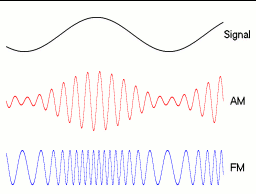
A radio signal modulated in two ways- AM and FM. Source: Wikipedia.

Black and white television used AM for video and FM for sound. AM is the easiest to understand, but the FM signals are quite different. Frequency modulation, FM, takes a fixed carrier frequency and combines it with signal that is near the carrier frequency, but the frequency is modulated in a way that the sum of the carrier and sound frequencies combine in such a way that the combined carrier and sound signals produce peaks and valleys resulting from combining two signals of somewhat different frequencies. The peaks of the carrier frequency end up adding or subtracting with the other signal.

AM receiving equipment has difficulty discriminating between signal by variable amplitude noise. Lightning or other sources of radio frequency energy easily interfere with the clarity of the signal. If you have listened to an AM radio station in stormy weather, you know how interfering lightning can be.

FM, on the other hand, is from the addition of a set carrier frequency plus a variable frequency sound signal. Electrical mechanisms that produce RF noise generally do not produce an FM signal, thus the quiet sound of FM reception.

Interlacing raster scan lines on a TV screen. Alien receivers of TV signals would have to assemble images from an interlacing raster scan signal with a proper sweep frequency across the screen. Image: Wikipedia.

This is a superficial explanation of television. Television images of the Lucy show, or the Three Stooges received by aliens has been speculated on to our great amusement, but we should understand that a transmitted TV signal is generated taking into account of specifically how it will be read. On a monochrome TV receiver screen, the picture is produced by interlacing two half vertical images alternating every 60th of a second so a whole image is received by our retinas every 30th of a second exploiting our persistence of vision to prevent flickering images. Below 30 frames per second, the images begin to flicker. Aiding in this is the fact that the phosphors in the picture tube glow momentarily after the beam has passed. In order to produce images from a radio frequency signal, this method would first have to be recognized then a receiver built by the aliens to “decode” the signal. Also, the aliens would have to recognize that the analog information is visual in nature and presented as an interlaced raster scan on some kind of display. Misinterpretation of our signals as hostile in nature would be avoided, hopefully.

Ok, movie projection just for fun

The passage of movie film through a movie projector is at 24 frames per second but flickering is avoided by projecting each frame twice to give a frame rate of 48. The classic sound of a movie projector results from the advancing of each frame past the shutter, stopping the film momentarily while the shutter rotates in the light beam and shines light through the frame twice. Slack is built into the continuous flow of film through the projector using loops of film above and below the aperture and shutter to allow continuous movement of the film but also stopping for 1/24th of a second so that a steady image is projected twice per frame. The source of the flickering sound is in large part from the upper and lower loops jumping up and down every 1/24th of a second.

If only we’d ship reels of movie film to the aliens, they could better understand us. For starters, I’d suggest a recent Godzilla movie.
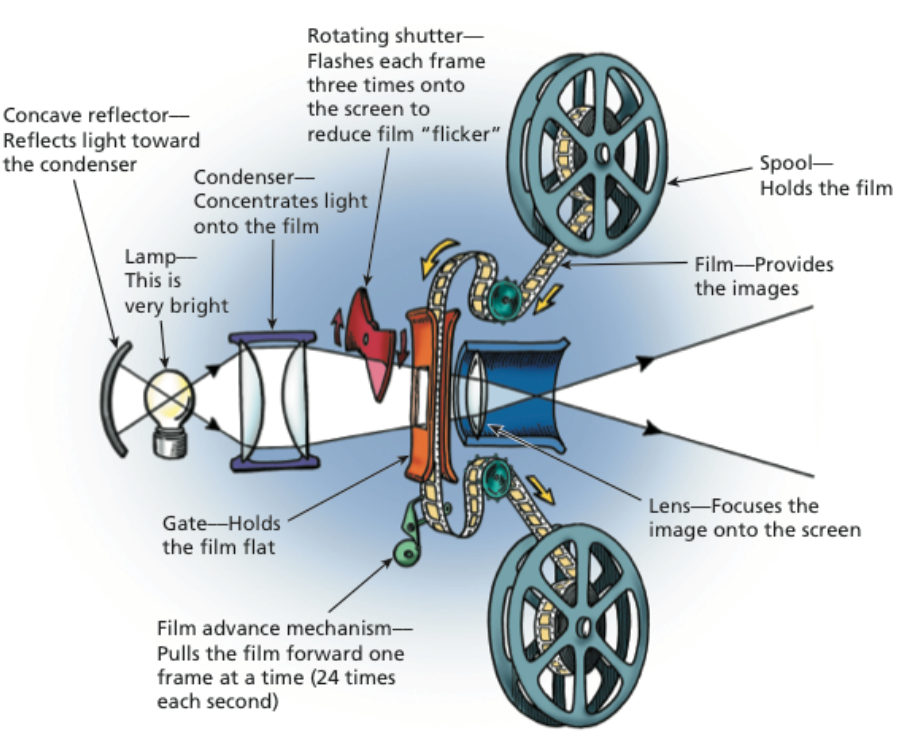
The essential parts of a movie projector. Note the loops above and below the shutter. Source: Smithsonian.

Visit to the Karl G. Jansky Very Large Array in New Mexico

We had the opportunity to visit the Karl G. Jansky Very Large Array, VLA, near Magdalena, NM, last week. They hosted an open house for visitors on the 11th of October, 2025. After we visited the two famous big holes in Arizona, Barringer Meteor Crater and the Grand Canyon, we turned east to the VLA. Recently we toured the summit of Mauna Kea in Hawai’i and saw the optical observatories and NRAO radio astronomy dishes up there.

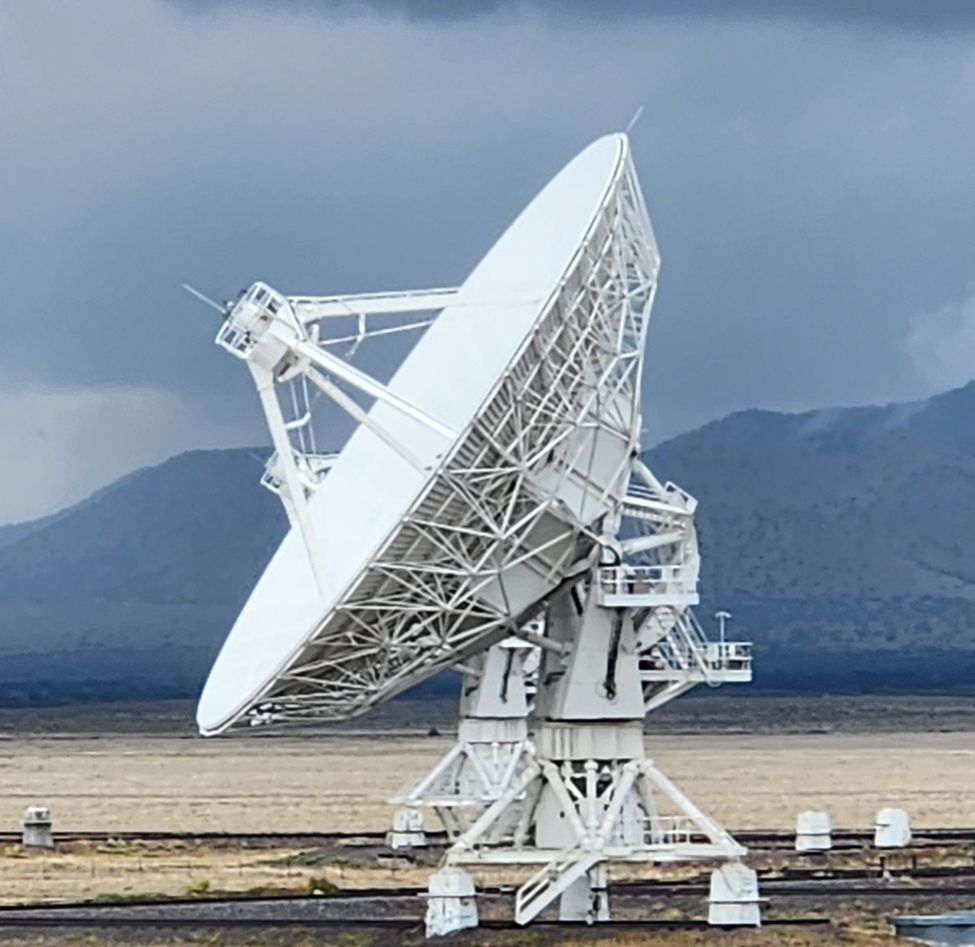
One of 26 radio telescope in operation dishes at VLA. Photo by Arnold Ziffel

Each dish has 8 antenna receiving elements clustered around the center of the dish, each detecting a different frequency. The continuous receiving range is 1 – 50 GHz. The dish antennas have 4 receiving configurations that they cycle through approximately every 16 months. Looking the secondary reflecting element of the dish in the upper left of the image, you’ll notice that there is a curved reflector. This reflector has a rounded surface that is designed to rotate, steering the focal point to the desired detector.

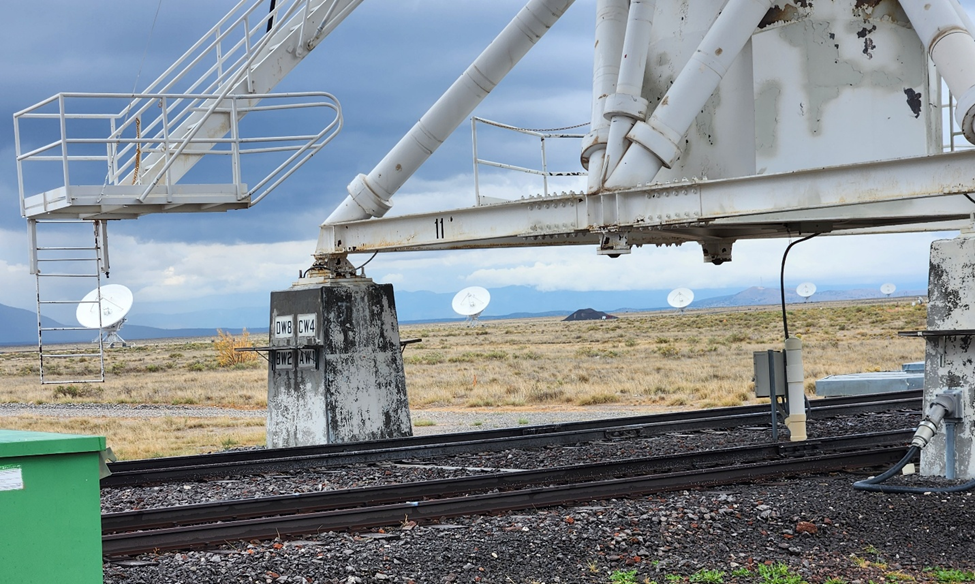
Looking at dishes in the distance from under another dish. Note the concrete pylons upon which the telescope rests. Photo by Race Bannon.

The rails on which the dishes move are of a “high speed rail” quality. The machine that moves the dishes is shown below. We were told by our astronomer tour guide that it takes 2 weeks to re-adjust the entire array of dishes. The “crawler” carrying a dish moves at 2 miles per hour.

The “Crawler” that carries the dishes into position. Photo by Quentin Quest.

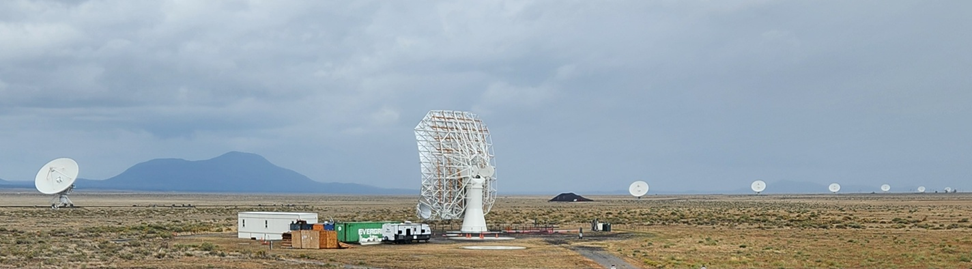
Below is a shot of the proposed next generation of radio telescopes.

In the center of the photo is a prototype radio telescope successor to the dish design of the VLA. Photo by some jabbering old guy.

NRAO has an image gallery at this link. The Astronomer’s link at the VLA website has a wealth of information available. A link to the next generation VLA is found here.

Why isn’t Jupiter’s atmosphere all mixed up?

Jupiter is quite old like the rest of the solar system. But even this far down the timeline, it is still a banded, multicolored gas giant. The same goes for Saturn. How is it that these planets are not some shade of brown or grey? The planet has an active atmosphere with complex circulation patterns. After a few billion years of atmospheric mixing, how is it that Jupiter still has a banded and bespotted atmosphere?

Ever wonder what substances are responsible for the colored features on Jupiter? Molecular hydrogen and helium make up the vast majority of atmospheric components but these gases are not colored in the visible spectrum. Other gases found in the atmosphere include the noble gases argon, krypton, and xenon; ammonia (NH3); methane (CH4); hydrogen sulfide (H2S); water (H2O); phosphine (PH3) are all colorless as well. Ammonium sulfide ((NH4)2S, CAS# 12135-76-1) and ammonium hydrosulfide (NH4SH, CAS# 12124-99-1) are thought to exist there. These last two could arise from a simple acid/base reaction between hydrogen sulfide and ammonia. A more comprehensive view can be had here. From the looks of it, Jupiter is a very stinky place.

The gaseous substances above are certainly colorless when free of suspended particles. Their respective pure condensates while colorless would be expected to produce whitish vapors or liquid/solid condensates. According to one source, ammonium hydrosulfide is a yellow fuming liquid with a boiling point of 51.6 oC at one atmosphere and forms white rhombic crystals under anhydrous conditions. Ammonium hydrosulfide is at equilibrium with its components ammonia and hydrogen sulfide.

Ammonium sulfide is a yellow crystalline solid that decomposes at ambient temperature (and presumably at 1 atmosphere on earth).

Organic compounds like methane, ethane, acetylene, and diacetylene found in trace amounts in the Jovian atmosphere could be activated by UV sunlight in the upper atmosphere into higher molecular weight unsaturated substances that could have visible chromophores present. This would be an ongoing process as circulation moves the substances around so there should be accumulation.

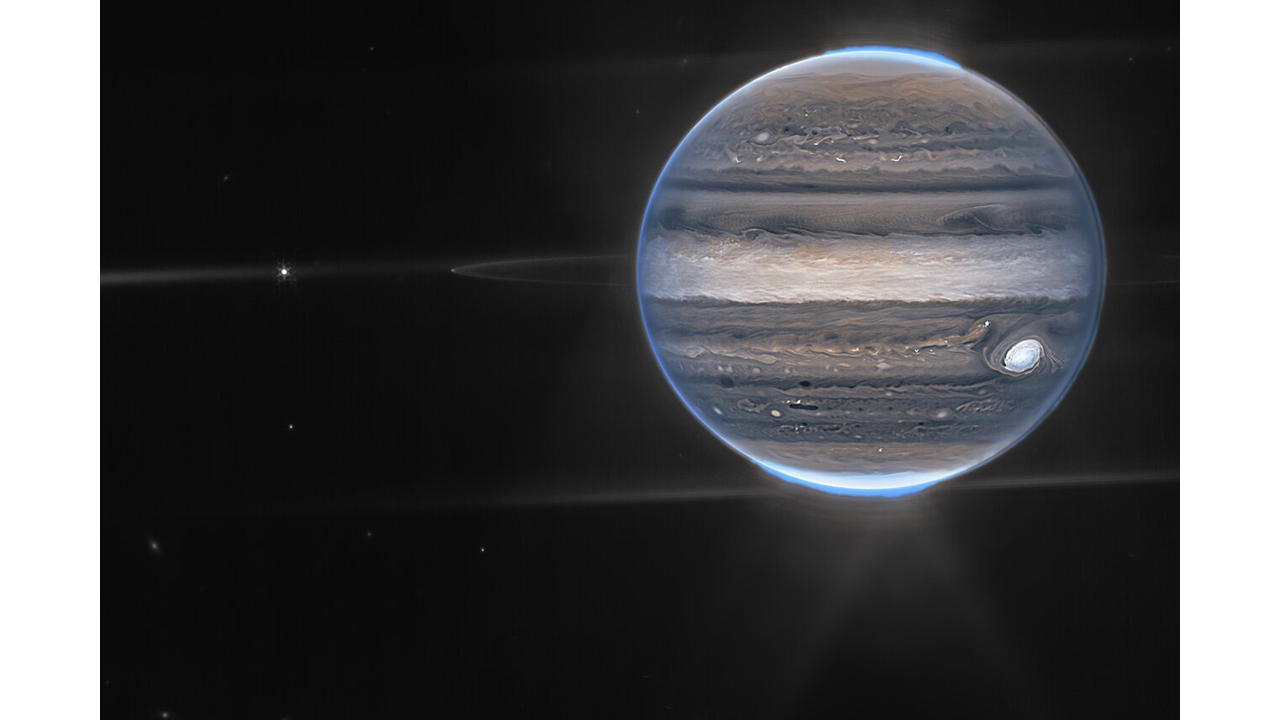
Credit: Webb Space Telescope; https://webbtelescope.org/contents/media/images/4182-Image

Given the optical opacity of the visible clouds on Jupiter, whatever colors are there must be due to suspended liquid aerosols and solid particulates. The colorful photo below, glorious though it may be, is an enhanced image in the optical wavelengths and possibly suggests there may be a higher concentration of colored substances than really exist.

In fairness, with all imagery, be it chemical photography or digital photography, decisions have to be made about color balance, saturation and contrast. In both cases, be it dyes or silver halide or semiconductor chips, these photosensitive materials won’t be sensitive across the color spectrum in the same way that our eyes are. It is hard to say by just looking at the photos how much image enhancement has been done to them. In particular, how is the color balance established? Well, NASA has made the Juno raw images available to the public so a lot of image enhancement by various people has been done based on aesthetics without regard to visual accuracy.

NASA has a piece of software used for color correction at the link here.

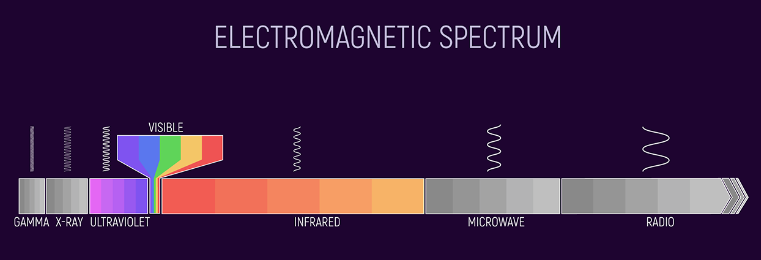
Even more fundamental than the limitations of the sensor chip on board Juno is the matter of “what is color anyway?” In this universe, the color of the spectrum as humans perceive it exists only in the convoluted neural pathways of our brains. In reality, the visible color spectrum is comprised of a band of wavelengths of electromagnetic radiation (EMR) ranging from 380 to 700 nanometers. Every other range of EMR like gamma rays, x-rays, ultraviolet, infrared, microwave and longwave “radio” light could be thought of as having their own “color” spectrum, albeit invisible to our eyes.

A Bit O’Chemistry

Color is a sensation that comes to our consciousness as a result of (bio)chemical mechanisms. Chemistry is generally about what can happen with the outer valence level electrons that buzz around atoms and molecules. We Earthlings are composed of chemicals and because EMR (photons) can interact with substances in ways that depend on the wavelength of the EMR. Our light perception begins with the ability of our chemical building blocks to absorb a certain band of wavelengths. Light can do two things in an encounter with matter- it can undergo absorption/emission or scattering with matter.

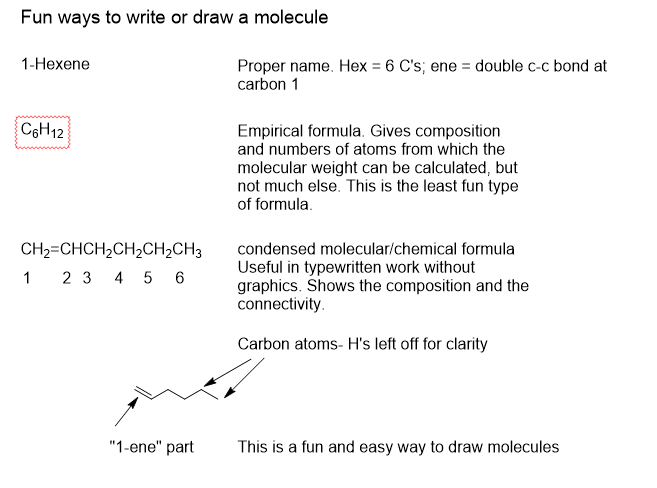
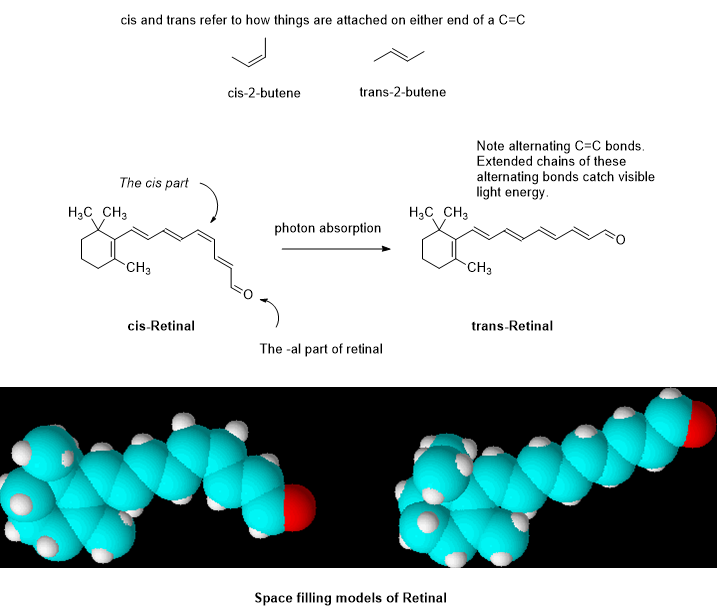
Graphics courtesy of me.

Absorption of a photon of visible or ultraviolet light by an organic molecule happens because there is something that can be acted upon to absorb the energy. Absorption of a photon of visible light by a molecule is limited to its valence electrons. In particular, a valence electron can be stimulated to jump to a higher energy level orbital around the organic molecule. This can result in a chemical change in the receiving molecule.

Absorption of infrared light causes vibration in the structure of the molecule. X-rays can cause ejection of inner electrons. Gamma rays can be absorbed or scatter off the nucleus. Microwave photons induce rotational motion or torsion in a polar molecule. Cosmic radiation is often so energetic that molecules are indiscriminately broken at the chemical bond level into neutral or charged pieces, leaving an ion channel along the path of the particle. However, new molecules may form when the reactive fragments recombine. Cosmic ray collisions with atomic nuclei form narrow sprays or showers of nuclear particles as is what happens in earth’s atmosphere. This is called secondary cosmic radiation and is comprised of x-rays, protons, alpha particles, pions, muons, neutrons, neutrinos and electrons.

Note the carbon bonds above with two lines between carbon atoms. They are called “double bonds” and they can absorb visible and ultraviolet EMR. When several of them are alternating as in Retinal, they are capable of visible light absorption. Roughly speaking, the longer the chain the longer the wavelength that can be absorbed, not unlike an antenna. Absorption of a photon can cause one of the two bonds to break and allow the remaining carbon chain to rotate about the remaining single bond. In this case the cis form rotates into the trans form which is a bit more stable due to reduced strain energy. The double bond can reestablish in the trans form and lock into place.

In changing from cis to trans, the elemental composition has not changed but the shape and certain chemical and physical properties have. When the shape of a molecule is changed, the manner in which the molecule interacts by contact with other molecules changes, particularly with proteins. This triggers the chain of biochemical events that follow, leading to light perception in our consciousness.

In living systems, some biomolecules have features that lend them the ability to absorb photons, sometimes to a useful end and sometimes to a destructive end (i.e., as with UV light and x-rays). Here, a chemical change would be the rearrangement of an electron around the molecule or a change in molecular shape or both. Receptor molecules in the retina are a particularly good example of a useful result of light absorption.

The result of this change from cis to trans is ultimately communicated from the retina to the brain via depolarization waves moving along nerve fibers and releasing neurotransmitters across synaptic gaps. Importantly, the change that caused the polarization wave is not permanent.

The visible spectrum of light waves, a bit under 1 octave wide, just so happens to be the band of light that can interact with valence electrons absent the destructive excitation that UV and x-rays cause. Infrared light causes vibration of chemical bonds and microwaves cause rotation of polar molecules. Longer radio waves pass right through us.

Rather than go into the biochemistry of this I will invite the reader to surf the interwebs for more. When you examine the chemical mechanism of light perception, think about what it took to figure this out.

Back to Jupiter.

Well, something opaque and colored is swirling around Jupiter persistently- just what the heck is it? The above example of Retinal was of a carbon-based, organic substance. The way carbon-based molecules interact with light is somewhat different than inorganic complexes. Whereas organic molecules can have double bonds and lone electron pairs that can interact with EMR, inorganic substances are largely absent this bonding feature. Instead, absorption and excitation of valence electrons and the net charge of a metal ion are involved. Inorganic substances as a group have a very broad range of colors.

What is of interest here is why the atmosphere hasn’t mixed into a single color over cosmic time. By visual inspection of the Juno images, Jupiter’s atmosphere is covered with abundant turbulent flows in the atmosphere.

The answer must relate to the unseen vertical flows. A colorless gas that condenses into clouds transitions from colorless to opaque as it rises, cools and condenses just like on Earth. Jupiter is famous for its colored stripes and the persistent Great Red Spot. These stripes render visual certain flows around the planetary axis. Due to the spherical shape of the rotating planet and heating from the sun, there will be a temperature gradient with altitude, a gradient pole to equator and Coriolis effect. All of this with varying amounts of vertical mixing as well.

There must be the possibility of non-gaseous material being lofted into the atmosphere from some liquid or solid surface below into a stable but complex system of circulation patterns. The process would self-select the finer particulates that are small enough to remain suspended in the atmosphere. But this in itself does not explain the presence of the colored bands or swirls.

Perhaps the colored bands and swirls infer a solid or liquid surface below that is inhomogeneous, that is, there are localized enriched “deposits” of particular substances. These surface deposits may or may not be “locked” into the latitude by the prevailing winds according to the physical properties of the material.

The apparent longevity of the multicolored atmosphere could be because the striped, large-scale circulation features are of sufficient strength that their inertia carries them around the planetary axis and directs them away from latitudinal flow. This would not prevent vortex formation at the interface or even within the band.

Enough. This is where I get off the hamster wheel of wild scientific speculation.

A few details on the JunoCam can be found here.

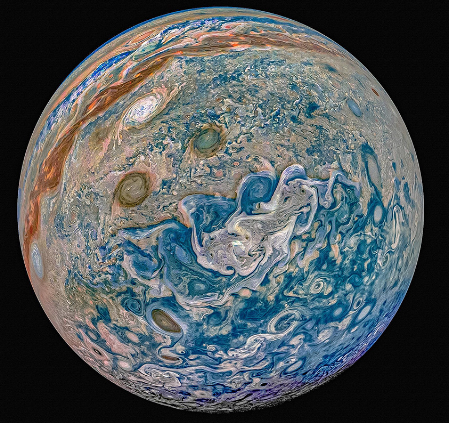
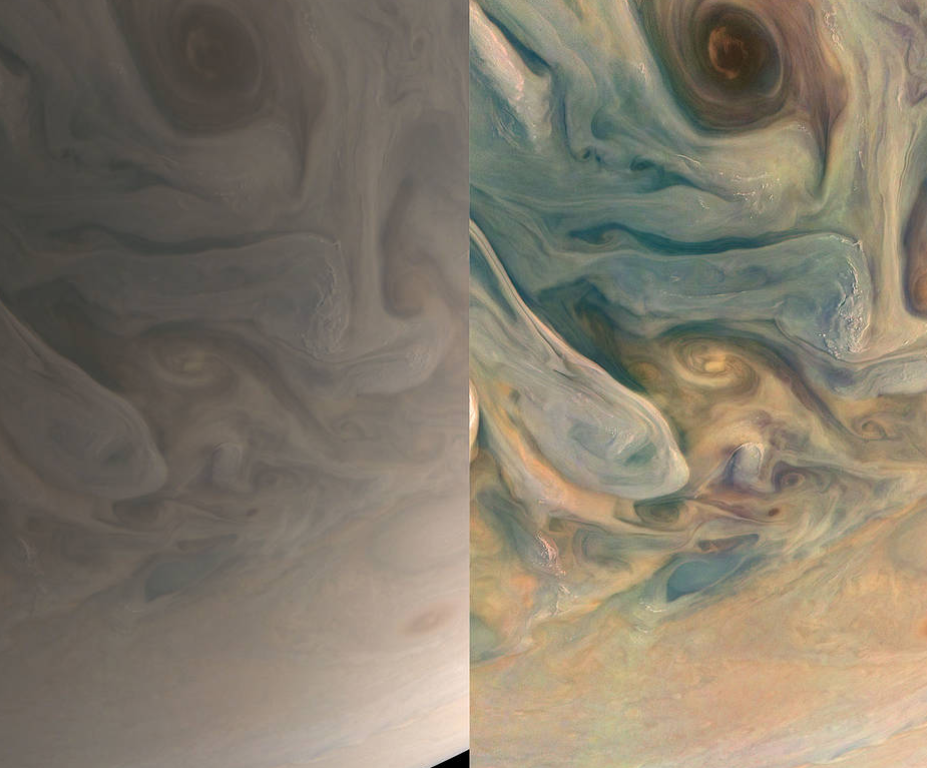
The above image is spectacular but is not what the human eye would perceive. Below is a comparison of a simulated human eye view vs a processed image with increased color saturation and contrast.

Human eye view of Jupiter vs image enhanced view. Image processing enhances color saturation and contrast. Photo credit: https://www.nasa.gov/image-feature/jpl/nasa-s-juno-mission-reveals-jupiter-s-complex-colors/
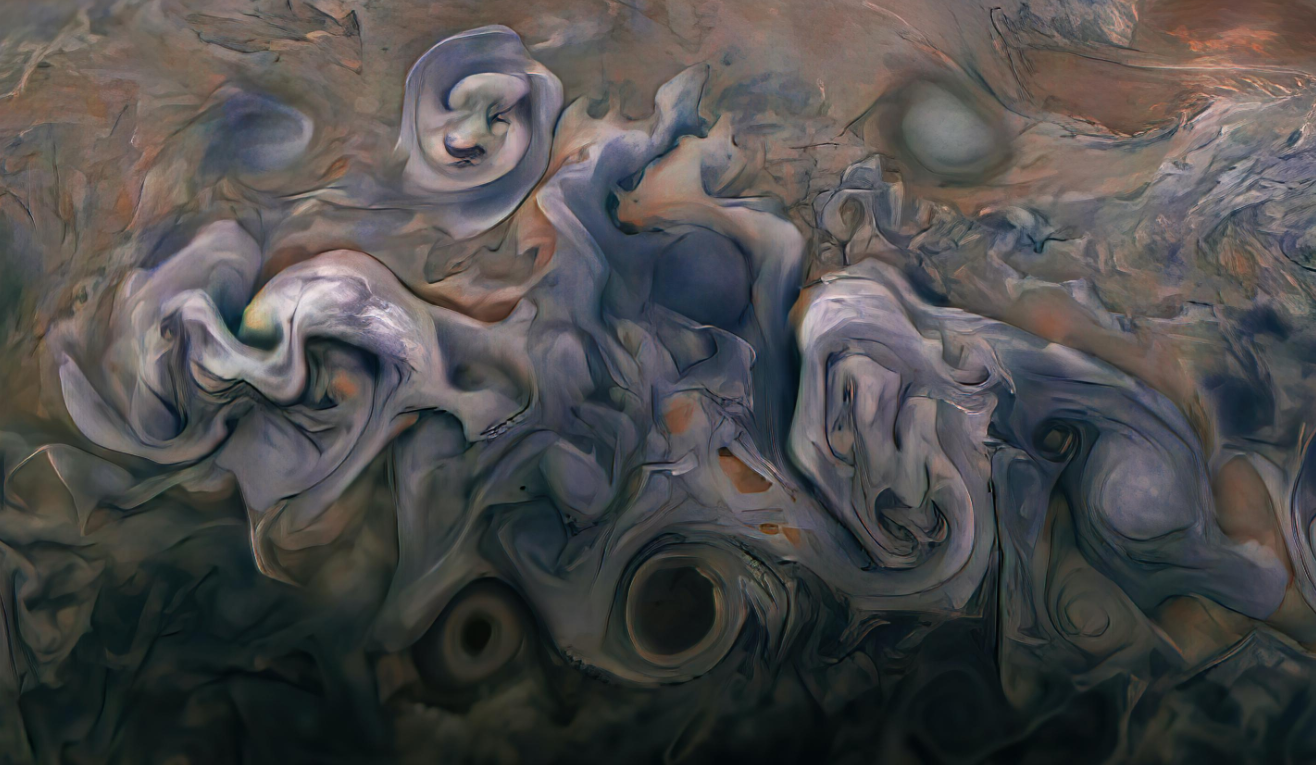
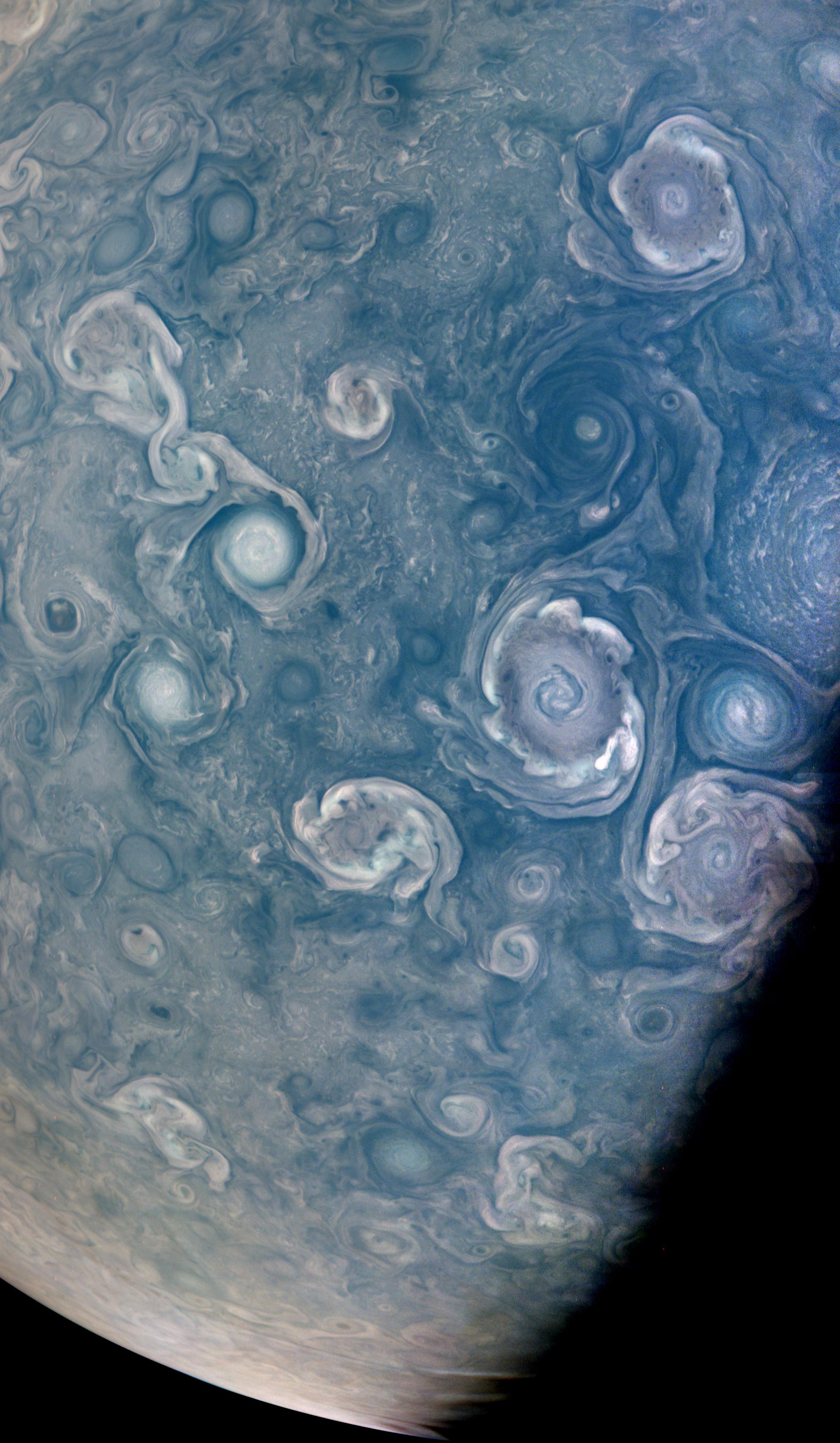
Credit: NASA JPL, https://photojournal.jpl.nasa.gov/jpeg/PIA25017.jpg

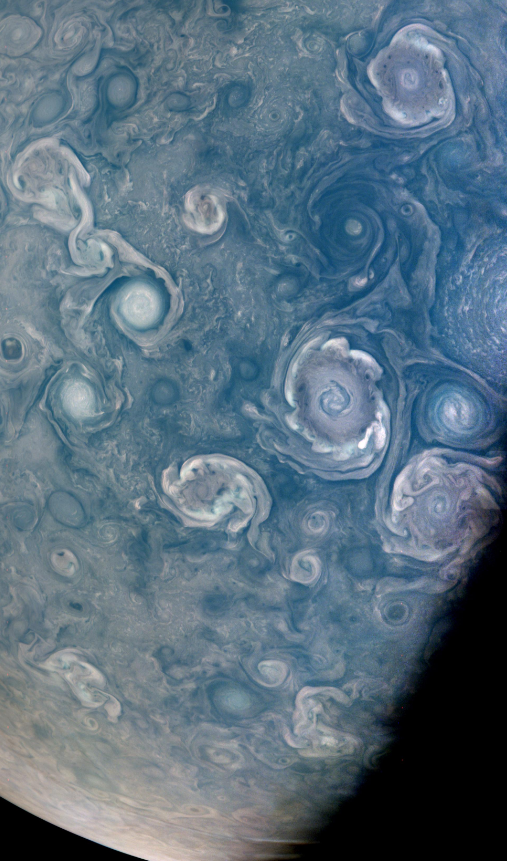
Included just because it is pretty. Credit: NASA

JWST Jupiter Image in False Color

A spectacular image of Jupiter, its rings and several moons from the James Webb Space Telescope (JWST) was recently released.

When looking at JWST images it is useful to remember that the camera is sensitive in the range of 0.6 (orange) to 5 (mid-infrared) microns. The human eye is sensitive to the range of 0.38 (violet) to 0.75 microns (red)- remember ROYGBIV? Image colors with a wavelength shorter than orange, 0.6 micron, green, blue and violet, are therefore a false color representation. In fact, all of the colors and intensities are chosen with both Hubble and JWST images. NASA is up front about this and an explanation can be found here.

A pet peeve of mine with the recent first radio image of a black hole (Sgr A*) has been that the colors represented are necessarily false, but left unexplained. This is well known to astronomers and other pointy-headed space weenies but not to the flat-headed public. The object may well be orangish from some nearer distance, but the reconstructed radio image we see is processed by software and intentionally given a visual color chosen by some person. This is fine, but a sentence or two about colored radio images is a lost opportunity for greater insight into instrumentation and the properties of light.

Alright, I’m sorry- I exaggerate. The public isn’t flat-headed. Okay? Is that better?

Black Hole Imagery

An image of Sagittarius A*, the black hole in the center of the Milky Way galaxy, has just been published. This is only the second such feat. The first image was of the central black hole of the galaxy M87. The images were captured through the collaboration of 8 synchronized radio telescopes around the world called The Event Horizon Telescope. It is an impressive technical problem to solve. Seeing something the apparent size of the M87 black hole as viewed from earth is said to be like trying to see a bagel on the surface of the moon. And they did it with sub-millimeter radio waves.

The color of the objects is interesting. I wonder how many folks out there think that radio telescopes can record the visual color of an object?

Pragmatics of effective science outreach

Public outreach in science is a important element for the maintenance of our present technology-affected (or afflicted) civilization. Science and engineering (Sci & Eng) activity is continually expanding the scope of the known. The global business sector, without relent, puts new technologies to work and retires others as obsolete. It is as though civilization is in a constant state of catch-up with the tools and materials being made newly available. And the quality of news is quite variable.

When it comes to the electronic and print mass media’s government reporting, the emphasis seems to me to focus on the current budgeting process and political conflict therein. These two subjects are in the “eternal now” in the flow of events. The word “news” is just the plural form of “new” so it is natural that news media focus on present budgeting and in-fighting. Media directors and executives know that reporting must be as concrete as possible and what could be more so than large dollar values and pithy news of political hijinks? Both raise our ire because cost and anger are emotional triggers for people. And emotional triggers bring lingering eyeballs to media.

The public not affiliated with Sci & Eng are quite often unaware of what their tax dollars are actually producing, perhaps many years down the timeline. The eventual outcome of government spending on Sci & Eng may be quite specialized and seem only remotely related to non-Sci & Eng life.

It has been my observation that media equates boring content with failure and compelling content with broadcasting success. The word “compelling” is used to describe something that attracts lingering eyeballs. Modern news broadcasting is the process of jumping from one compelling piece to another. I suppose we cannot blame them for this emphasis on superficiality because apparently it is what “we” want. The big We that draws advertisers and thus cash flow to broadcasters. It keeps the lights on and families fed. Basic stuff that can’t be dismissed with a utopian wave of the hand.

If there is going to be any fundamental change in the tenor and quality of content in media, it will have to come from citizen viewers. This leads me to the thrust of this essay: Those knowledgeable in Sci & Eng must bring the value proposition of current efforts in technological civilization to the citizenry, because broadcast media certainly can’t. By “broadcast media” I mean to include everything right down to what appears on your smart phone. Unfortunately, tech content typically emphasizes consumer goods like automobiles, electronic widgets, space, or miraculous medicine.

Those knowledgeable in Sci & Eng must bring the value proposition of current efforts in technological civilization to the citizenry, because broadcast media certainly can’t in any depth. They’re in showbiz. 

Arguments in favor of rational stewardship of our little world won’t influence elected politicians. But informed and persuasive citizens can influence those who are less so and if they apply some leadership. Carefully. Those who may be less educated and less up to date on the sciency subjects do not take kindly to speech that talks down to them. The hand that reaches from above is still above and off-putting. Learn to communicate on even ground.

What works for me in reaching out to all levels of education is to use humor and a bit of showmanship. Reaching out to the public in a way that keeps their attention is hard to do and not everyone is prepared to do it. Lest you think I am describing putting on a show, not entirely. I am saying that by the deft use of knowledge, public speaking skill, and the strength of personality, it is possible to persuade even the scientifically reluctant to perk up and follow your efforts at making a point. But the point must be accessible. Deep detail and meandering monologue will lose your group. Keep your outreach succinct and limit the breadth to a few pearls of wisdom. Get feedback on your presentation.  With any luck, they’ll go home and jump on Google for more.

If you need help with public speaking, join Toastmasters to improve. Try acting lessons. Join a theatre group. Learn to relax, pace yourself, and enjoy speaking. The better you get at the mechanics of public speaking, the more effective you’ll become.

[Note: The crummy WordPress text editor used to write this post is just abysmal. Why it was changed to the current revision is a mystery to me.  -Th’ Gaussling]

Ionospheric Bow Waves Caused by August, 2017, Eclipse

A recent paper (free) in Geophysical Research Letters reports the discovery of long anticipated ionospheric disturbances caused by the passing of the moon’s shadow over the earth during an eclipse. The paper, submitted by the MIT’s Haystack Observatory, reports the occurrence of ionospheric bow waves associated with the shadow ground-track of the August, 2017, North American eclipse.  The online source, MIT News, summarized the discovery.


Eclipsing Casper, Wyoming

I found myself up north in Casper, Wyoming, with friends for the 8/21/17 solar eclipse. We were modestly equipped for the spectacle. A member of our small group brought a Celestron 8″ Cassegrain telescope with solar filter and clock drive. We set up in an uncrowded neighborhood and began the wait.

Knowing that Casper would be crowded I had arrived 2 days early to explore some of the local geology. Jeez- I guess that makes me a geotourist. This activity gives a person a mission to complete. Pick some locations to visit and go do it within your time constraints. There is a beginning, a middle, and an end. Success consists of finding the location of interest, getting samples and photographs of unique rocks, stata and general landforms.

I’ve had good luck with the Roadside Geology series of books by Mountain Press Publishing. In the case of the eclipse trip, I secured a copy of the Roadside Geology of Wyoming ahead of time at a local Barnes and Noble. These books are quite well written and illustrated, especially important if you’re not packing a degree in geology.

The unique value of the Roadside Geology books is that the content is divided into state regions then subdivided into stretches of highway that you can drive along. Commonly along the highway can be seen many large-scale features described in the book. Even better, photographs and diagrams of road cuts are frequently highlighted. In hilly or mountainous regions there are many road cuts that allow you to view underground features.

Lately I’ve taken to wearing a yellow reflective vest along the roadside while taking a close look at the exposed formation. People don’t expect to see some yay-hoo walking along the road with a hammer and a notebook as they careen around the curves on a mountain road. Best not to surprise drivers.

Teapot Rock north of Casper, Wyoming.

There is a bit of interesting US history attached to the geology of the Casper area. The Teapot Dome scandal erupted during President Warren G. Harding’s administration in 1922. Harding’s Secretary of the Interior, Albert Bacon Fall, was caught taking bribes in exchange for awarding oil rights to a subsidiary of the Sinclair Oil Company.  The oil field was within the Navy Petroleum Reserve north of Casper.

“Teapot” Dome takes its name from Teapot Rock– a formation that, at the time, had a feature that resembled a spout. This feature is no longer there. “Dome” comes from an anticline fold in the oil bearing strata below. It is part of the larger Salt Creek Oil Field.

The seeing in Casper was good right up to the back third of the eclipse. The Celestron was rigged to throw an image onto a white screen. A chain of sunspots were visible early in the eclipse. As I was equipped with only my Samsung 6 for photography, I did not manage to get great pictures, nor was it really my intent. Sometimes you have to put the camera down and look. Just before totality we saw Baily’s Beads and the diamond ring. The autofocus of the Samsung was unable to produce a sharp image of the beads on the projection owing to the low light level.

Close-up of sunspots early in the eclipse.

When totality arrives you can look at it directly with the naked eye. It’s best to view it without the distraction of equipment. During totality it became noticeably cooler. The eclipsed sun had a wispy corona around it, reaching into space. Around the horizon back on the ground was a beautiful 360 degree sunset. People in the neighborhood were cheering. What a thing to see.


Pinhole projection using aluminum foil and a cereal box.

Here you can see some knucklehead trying to get a view through a pinhole projector cleverly disguised as a box of corn flakes. He commented that the image was only slightly better than nothing. In fact, the image projecting through a colander onto the pavement was superior (below).

Multiple images of eclipse as projected through a colander.


Fulminating Belief and the Drake Equation

It seems to me that the character(s) who produced the YouTube video that has caused so much religious fulmination in the sandy parts of the world ought to be parachuted into Cairo to answer for their actions. Surely they can give the best explanation of what their movie represents.

Another thing has occured to me. Perhaps we should make a minor adjustment to the Drake Equation which describes the number of civilizations in our galaxy with which communication might be possible. The equation can be found at this link.  The L factor defines the length of time a civilization releases detectable [radio] signals into space. Given the self destructive behaviours of beings capable of generating radio signals on at least one planet, maybe it is time to define L*.

L* = L(1 – P*/P) where P = average number of intelligent inhabitants of a planet and P* = average number of intelligent inhabitants willing to die/kill for their magical or political beliefs.

Perhaps the reader has a better modification.  Here is the Drake equation copied straight from Wikipedia:

N = R^{\ast} \cdot f_p \cdot n_e \cdot f_{\ell} \cdot f_i \cdot f_c \cdot L

where:

N = the number of civilizations in our galaxy with which communication might be possible;

and

R* = the average rate of star formation per year in our galaxy
fp = the fraction of those stars that have planets
ne = the average number of planets that can potentially support life per star that has planets
fâ„“ = the fraction of the above that actually go on to develop life at some point
fi = the fraction of the above that actually go on to develop intelligent life
fc = the fraction of civilizations that develop a technology that releases detectable signs of their existence into space
L = the length of time for which such civilizations release detectable signals into space

Curiosity on Mars

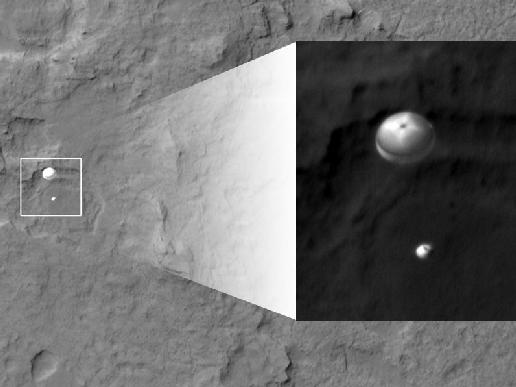
Photo of Curiosity during descent phase, taken from orbit. This shot is amazing all by itself.

Curiosity in descent phase. Photo taken by NASA’s Mars Reconnaissance Orbiter. Credit: NASA/JPL-Caltech/Univ. of Arizona.

Curiosity is powered by a Pu-238 oxide thermoelectric generator. The Multi-Mission Radiosiotope Thermoelectric Generator, MMRTG, has an output of 2000 watts thermal and 100-120 watts electric. The MMRTG unit sits in the aft end of the rover enclosed by a finned heat exchanger.