Category Archives: Astronomy and Aerospace

Outbreak of good news

There has been a stunning outbreak of sensibility in the past few days. KFC has decided to move away from partially hydrogenated vegetable oils and the unhealthy stereochemistry situated therein.  This is a good thing.  I’ve always been partial to cis-fats anyway … Now we can picnic with a clear conscience. One day, funnel cakes and corn dogs will be safe to eat.

The second hopeful news item is the decision by NASA to do another mission to refurbish Hubble.  This is one of the worlds great observatories and the notion of letting it expire while we have the capability to service it was just absurd.  Observations from this telescope have changed our understanding of the cosmos.  Good choice, NASA!

Why Teach Science?

Here is the text of a comment I made over at the Volokh Conspiracy. I have pasted it here so I don’t forget it.  OK, so there is a little bit of vanity here. But I do want to build on this theme. The context of this comment pertained to the teaching of science and the influence of proponents of Intelligent Design.

In the end, we who teach want students to be able to use their brains. We want them to be able to construct or use a theory to make predictions about the observable universe and then devise experiments to test their hypotheses. We want them to design positive experiments rather than negative experiments. We want them to use language and math to express what they are thinking. We want students to be comfortable using a working hypothesis while they are working on a problem, just as long as they remember that it is just that- a working model.

We want students to learn to follow the evidence and draw a conclusion rather that start with a conclusion and cherry-pick the data to be consistent with preconceptions. The glory in science is to be able to tip over the established order in favor of new insights and understanding based on data. In the end, scientific methodology is about intellectual honesty and accountability.

All measurement involves error which causes a certain amount of uncertainty in a result. You don’t have to invoke Heisenberg to consider uncertainty. A result is only as good as your worst data. This leads to my final point.

A sign of good training or instinct in science is the ability to be sceptical or at least a bit hesitant about your conclusions. Hesitant in the sense that your conclusion is to be considered within a set boundary conditions.

A scientific outlook has served me well in general. At least so far. The world would be much more complex if I had to invoke a miracle every time something odd happened.

As is common at this site, a cluster of blood-sucking fuss budgets are haggling over minutae.  I’ll bet not a damned one of them ever had to make sense out of a mass spectrum or isolate a new substance and prove it.

Fly the Friendly Skies

I’m just back from the ACS Meeting in San Francisco. More on that later. Of immediate interest to me is how air travel has changed and how we are blithely accepting the loss of a sort of egalitarianism that has only become apparent as it is lost.

In this age of security theatre, we are being required by Homeland Security to adopt a passive posture as users of airline services. But despite all of the visible security measures, turns out that good old-fashioned police work may be the best approach to terrorism. The Brits defeated IRA terrorism that way.

This afternoon while boarding at Gate 86 at SFO, ticket holders were required to queue up behind two distinct openings that were literally side-by-side and distinguished only by the presence of a short piece of red matting on the floor of one of the two entryways. The strident young male gate attendant (United) was adamant that only First Class passengers and certain other flying gentry were to walk across the red mat. All others were to trod upon the common carpet adjacent to the red mat. He did not come out and vocalize it, but he did demonstrate his intent through the use of crowd control cordons commonly found in airports. It strikes me as tragic yet exquisitely comical that this enthusiastic fellow is forced to perform such an absurd dance at every departure. You pay an extra kilobuck and you get to walk across the red mat.

I pointed this out to other Zone 4 coach passengers and was met with the usual “my-gawd-why-is-this-guy-talking-to-me-why-doesn’t-he-shut-his-cake-hole” look. They looked at their watch or cell phone and found a reason not to talk further. It’s amusing. Most of us are only too happy to adopt a passive stance and tough through it. Humans can adapt to fantastic incursions into their civil liberties and not utter even the most plaintive bleet of protest. Stalin knew this. So did Pol Pot, Hitler, Mao, and others.

Another observation is the recent attention to the seat-belt sign by the flight crew. Flight crews on airlines that I have flown lately, United and Frontier, have been real sticklers for obeying the seat-belt sign and keeping passengers in their ticketed toilets. It doesn’t matter that your bladder is about to discharge a dilute urea solution on their expensive seats. At the slightest indication of turbulence, the pilot switches on the sign and that’s it- gotta sit down pursuant to FAA law.

The facile conclusion is that they are practicing loss avoidance by keeping passengers from being plastered to the ceiling during extreme turbulence. But such events are really scarce. I might suggest that this is a subtle means of keeping passengers in their seats and away from the cockpit or the galley. After all, we need to keep a clear line of fire for the air marshall on board.

<End rant>

Bigger Glass

One of my other interests involves an astronomical observatory. I and many others volunteer at a completely volunteer-based operation. We recently obtained a telescope via Telescopes in Education. The deal is that we have to put the scope to use educating the public, especially K-12 kids. Sounds easy enough. That is what we do with the 18″ Cassegrain we already have. But the catch is that we have bigger plans for this scope than just serving the locals. The idea is to put the scope to use over the internet. Why not make it available to any teacher over the internet who wants to have an astronomy lab session? That is the plan. Fortunately, we have a telescope guidance engineer, an astronomer, an aerospace engineer, as well as several other resourceful folks on the board of directors. I think it’ll work.

Mt. Wilson 100 Inch Telescope24

Gil and Meinte

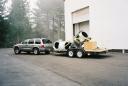
We drove to Mt. Wilson Observatory in July of 2006 to retrieve the Cole 24″ telescope, which was taken out of service in 2004 due to loss of funding. We estimated it weighed about one ton. We bolted it down to the trailer and drove it back to the front range of Colorado. We estimate that it’ll be up and running in 12-18 months. We’ll install an upgraded drive system and attach a weather station input to allow for automated weather sensing for the dome controls. The ideal configuration is to have a system that can be operated remotely without having a staff member in the dome. 

Putting together a Telescopes in Education equipment installation requires the overlap of some unusual characters. Gil Clark, the founder of TIE, and Meinte Veldhuis, President of the Little Thompson Observatory (see photo) are exactly the sort of people who are able to pull off such a thing. Gil’s (left) background is in computer science and he spent much of his career at JPL in Pasadena. Meinte (right) is a Dutch-born mechanical engineer and develops satellite payloads for an aerospace company. They are both one-in-a-million sort of guys and have the means and the vision to bring this scientific capability to a younger crowd. I tip my hat to them and the dozens of others who quietly go about this business.