
Category Archives: Astronomy and Aerospace

Jupiter Launch Vehicle Proposal. Safer, Simpler, Sooner.

The Space Shuttle Program is scheduled for shutdown sometime in 2010. At that time the reusable, tiled spaceplane concept (STS) will be put to rest in favor of the capsule-on-a-rocket design.  According to plans, there will be a 5 year interlude between the retirement of the shuttle and the implementation of a new man-certified lifter. Many have suggested that this idle period with no manned launch activity could lead to a brain drain in the ranks of skilled aerospace workers.

The successor to STS is the Ares Launch system consisting of a man lifter (Ares I) and a cargo lifter (Ares V).  Ares I is a two-stage system that will take a crew of 4 to 6 into low earth orbit. This vehicle will carry  55,000 lbs of provisions and astronauts to the ISS.  Additionally, it will be used to lift a lunar exploration team into orbit for docking with the lander module placed into orbit by the Ares V lifter. 

Ares V is a heavy lifter and is expected to be able to place 414,000 lbs into low earth orbit or send 157,000 pounds of payload to the moon.  Ares V uses two solid rocket boosters derived from STS and a central H2/O2 liquid fueled rocket using a cluster of 6 engines derived from the Delta IV system.
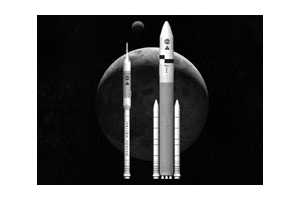
Ares I & V. Photo Credit- NASA

NASA has awarded contracts for this program and work is underway.

What has recently transpired is an alternative system proposed by a group of engineers. This system is called DIRECT, and involves the use of a single lifter called Jupiter.  The Jupiter lifter is derived directly from the STS lifter which consists of two solid rocket motors and a central H2/O2 tank which feeds the shuttle engines.  The DIRECT system would take advantage of existing technology, but with the addition of an O2 tank extension, a cargo section, and a cluster of engines to the existing liquid fuel tank. The proponents of this system claim that their system could get the next phase of manned space flight going sooner, simpler, and safer.

It is an interesting proposal. I hope it gets some serious consideration by the Congress.

Virgin Galactic’s 200 k$ Shuttlecock Ride

Pack your bags, boys and girls. Virgin Galactic is going to display their SpaceShipTwo at the upcoming AirVenture show in Oshkosh.  For 200 k$ you can strap a reusable rocket plane to your backside and take a suborbital flight. The AirVenture website has an animated video of a flight that is worth seeing. (The animators left out the floating vomitus that is sure to be a part of the experience.)

The designer and builder is none other than Burt Rutan’s Scaled Composites. This second generation suborbital vehicle uses the same reentry stabilization scheme that the first vehicle used. The lifting craft has 4 engines- two outboard of each of the twin fuselage sections. It has 4 engines instead of two to protect against the undesirable situation of loss of thrust from one side of the plane. With the engines so far from the centerline, the asymmmetric thrust that would result would make the plane difficult to fly.

The space vehicle is carried to a suitably high altitude (ca 50,000 ft) for release followed by an 80 second boost from the rocket motor. The boost phase sends the craft into a suborbital arc carrying the craft to a projected 361,000 ft peak altitude.  The passengers are treated to a period of weightlessness between the moment the rocket motor quits and when the reentry phase begins to encounter significant atmospheric drag.

At some point after the boost is complete, the tail booms pitch into an elevated position quite far from the centerline of the craft. The craft has reaction motors that stabilize the flight attitude during the phase in which the aerodynamic control surfaces are ineffective.

The reentry attitude is one in which the underbody of the craft faces in the direction of motion so as to provide maximum drag. The elevated, or “feathered” tail elements serve to stabilize the motion of the craft as it accelerates belly first into the ever thickening atmosphere.  The stabilization that the feathered empannage provides is much like the stabilization afforded a shuttlecock.

The feathering configuration helps the crew manage the kinetic energy developed during reentry to the atmosphere. The scheme includes a deadstick landing, so energy management is quite important.  Eventually, the tail booms retract to the in-line position and the craft transitions to a gliding condition with conventional flight control surfaces.

My dinner with a meteorite

Last night I found myself sitting at a restaurant with astronomers for the occasion of viewing a meteorite. Customarily, a few observatory folk have dinner with the speaker and then we go to the observatory for a public star night. While waiting for our entrees we passed the object carefully amongst ourselves, cherishing a few moments of close contact with this rare object.

Astronomers seem to be prone to public displays of humility. I would estimate that the humility quotient was near 0.8 (8 out of 10 Sagans- the Sagan is the international unit of humility). It is generally agreed that the Buddha achieved a Sagan quotient of unity. Okay, I’m kidding.

The curious 936 gram achondrite is from the recent Berthoud, Colorado, fall.  Meteor enthusiasts refer to the arrival of a meteorite as a “fall”.  This is one of only 5 witnessed falls in Colorado. A section of the meteor has been cut off and has been the subject of investigation at the University of Arizona.

Based on the composition of the object (olivine, plagioclase, ilmenite, chromite) and based on the reflectance spectra of various asteroids, the Berthoud meteorite is thought to be a fragment of the asteroid Vesta. Imagery of Vesta suggests that a portion of this object may have been shattered by an impact in the past.

The family whose property the stone landed on are somewhat bewildered by the event. They have been the subject of much unwanted attention, so the object is kept secure at an unknown location. In October of 2004, in the early afternoon several family members were standing outside their home when they heard a whistling sound and thump. Following the direction of the sound, they found the impact site less than 100 feet from where they were standing and in a spot where one member had just walked through. Only a small part of the object protruded upward through the disturbed topsoil.

Reportedly, it was cool to the touch immediately after arrival. This is counter-intuitive given the fiery appearance of most meteors. However, the object was quite cold prior to entry into the atmosphere and the rapid transit through the air didn’t allow for heat saturation. And, ablation carries away much of the friction energy.

The low iron object has a dark fusion crust over a grey, mottled composition. Other than the crust, it is not that unusual in its appearance. 


Chemistry on Mars

As I live and breath. The space community has gotten serious again about chemical analysis of Martian soil. NASA is very much driven by physicists and engineers, so it is nice to see chemistry get some flight time.  Why don’t more chemists elbow these physicists out of the way to put packages on rockets? I guess we are insufferable ground pounders.

The Phoenix Lander which, to NASA‘s great credit, has successfully landed in the North polar region of Mars, is equipped with an array of analytical instruments and wet chemical apparatus for on-the-spot analysis of soil samples. Among the devices on board is a Swiss-made Atomic Force Microscope. This device will provide direct microscopic imaging of Martian soil samples. In true Swiss fastidiousness, it has multiple cantilevers for redundancy. I’m sure it keeps good time as well. 

The Canadian Space Agency has contributed a meterological station on the lander.

The lander was constructed by contractor Lockheed Martin.

Given that the lander contains hazardous chemcials for the analyses, somebody is going to have to dispose of the hazardous waste after 90 days. I hope it is properly placarded.  \;-)


Vatican Astronomer Approves Belief in Aliens

Vatican Astronomer, Rev. Jose Gabriel Funes, stated in an interview that, essentially, belief in aliens was not incompatible with Catholic Doctrine.

“How can we rule out that life may have developed elsewhere?” Funes said. “Just as we consider earthly creatures as ‘a brother,’ and ‘sister,’ why should we not talk about an ‘extraterrestrial brother’? It would still be part of creation.”

In the interview by the Vatican newspaper L’Osservatore Romano, Funes said that such a notion “doesn’t contradict our faith” because aliens would still be God’s creatures. Ruling out the existence of aliens would be like “putting limits” on God’s creative freedom, he said.

This is quite a thing to hear from the Vatican. Rev. Funes stated that he felt that the big bang theory seemed quite reasonable to him, provided that the universe was an act of creation rather than chance. The Vatican has come a long way from the trial of Galileo, resulting in what John Paul II called a “tragic mutual incomprehension.”

In honor of Pope John Paul II passing awayI still see you too man I just think its funny to refer to the pope as a celebrity. peek-a-boo, pope

Photo pilfered from Collegehumor.com. 

Aviation Deathmatch- Boeing vs Airbus vs PR of China

China has announced that it will enter into the passenger jet manufacturing business.  China Commercial Aircraft is expected to produce 150-passenger aircraft by 2020. 

This is a big deal.  And a big time challenge to the primacy of the US aviation industry. China’s aim is to achieve self-sufficiency in all high tech sectors. If it were just that, it would be less threatening. But what it really means is global market domination, not just self-sufficiency.  This is just competition, but how it plays out for the US will depend on how US industry acts to hold on to its marketshare beginning right now.

The USA retains talent and ability in the entertainment and aviation industries. I believe that US influence of the petrochemical industry is in decline, due in part to the rise of nationalized oil companies in much of the oil producing world. It looks as if our aviation industry will feel competition by a nationalized aircraft manufacturer as well.

The rise of Chinese competition in the marketplace in inevitable. What the west must come to grips with is the inherent leverage that China has with its low wage labor force and the ability to channel resources into projects of national pride such as this.

China will also have the benefit of a century of jet engine and aeronautical research paid for by other nations. I imagine that more than a few of its engineers will have western universities listed on their resumes. Can’t do much about this either. But we in the west can use this example to strengthen our resolve to not go the way of tired and anemic empires.

A Fly in the Ointment. A Chemist Among the Astronomers.

This is a re-post of a 2008 seminar I attended by speaker Dr. Carolyn Porco.

28 April, 2008. University of Colorado at BoulderDr. Carolyn Porco of the Space Science Institute gave a public lecture at CU Boulder on the highlights of the Cassini Mission to Saturn. Porco gives a lively presentation and- dare I say it- is mildly charismatic. The website of the imaging group, ciclops.org, is quite well done and even includes downloads of many of the papers from the team. The paper on Enceladus is particularly interesting.

As a chemist sitting anonymously in a crowd of space science enthusiasts and professionals, I cannot help but compare the tenor of the experience to my own field of chemistry.

Space science people are funded in proportion to the general public enthusiasm for space.  The universe is big. Really, really big. And it is full of breathtaking scenery and wondrous objects. Space science almost always causes people to experience a deeply emotional sense of awe and wonder. This has not been lost on the space science community. The display of majestic photos with a bit of space music in the background goes a long way to rally public support.

Chemistry on the other hand, rarely induces this kind of raw response from the limbic system.  Whereas chemistry induces shock, astronomy induces awe.

The most common exhortation made on exposure to the chemical sciences is “How in the hell am I going to pass this course?”

Students take intro to astronomy classes as an enjoyable way to get their science credits. Students take chemistry because they have to. We all know this. Science aversion is even more extreme for the poor sots in physics.

The SI unit for humility is the “sagan”.  Public astronomy talks usually have a high sagan factor. I would estimate last nights talk was 8.5 out of 10 sagans.

Of particular interest to Porco was the Saturnian moon Enceladus. This moon has substantial water on it with evidence of “tectonic” activity on the uncratered surface. On closer inspection, it is apparent that this body is spewing water into space with fair vigor. Indeed, a vapor torus of water tracing the orbit can be seen on some of the images. The suggestion is that there may be liquid water under a water ice crust. IR images show hot spots that coincide with surface fissures on Enceladus.  This moon would be a good place to land some drilling equipment.

Porco spoke of the hope of eventually finding life on Enceladus or on Jupiter’s Europa. She suggested that this would finally “break the spell” and allow the assumption that life may be relatively common on worlds with liquid water.

What this kind of planetary exploration affords are insights into the evolution of planets and ultimately, what circumstances are likely and necessary for the ignition of life.  But the circumstances that promote life formation are chemical in nature. The origin of life is not an astronomical problem. It is a chemical network problem and for that we need the involvement of chemists.

Porco talk on Cassini

I’m off to Boulder-town tonight to hear Carolyn Porco lecture on the Saturn Cassini mission in the fabulous Glenn Miller Ballroom on the CU campus. The last time I was in that room I saw Carl Sagan talk about the Viking mission (ca 1978?). It’s been a while. I think I have some blurry Tri-X negatives somewhere of Sagan lecturing.

I’ll follow this post with a commentary afterwards.  Ciao.

Rocket Racing League

It has finally happened. The Aerospace crowd has formed a NASCAR-like racing league to promote an amped-up form of air racing. It is called the Rocket Racing League.  Velocity Aircraft, now a subsidiary of Rocket Racing Composites Corporation, will supply the airframes. The rocket motors are simple, one piece, throttled, stainless steel motors down-rated from 5000 lbs to 1500-2000 lbs of thrust. The motors will burn LOX and ethanol.

The first exhibition race will occur at the upcoming EAA Oshkosh AirVenture show in Wisconsin this summer.

One important result of this is that, if it is successful, it will demonstrate that entities smaller than governments can safely and profitably do rocketry.  If this field is to go anywhere, it must show that rocket propulsion can be conducted with less-than-NASA resources.