[Note: This is an updated post from the original posted one year ago.]
March 22, 2022. Swiss drugmaker Novartis has released Pluvicto, “the first FDA-approved targeted radioligand therapy (RLT) for eligible patients with mCRPC that combines a targeting compound (ligand) with a therapeutic radioisotope (a radioactive particle). Pluvicto is expected to be available to physicians and patients within weeks.“
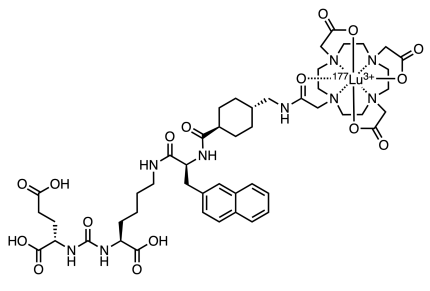
Pluvicto features a chelated 177Lutetium ion (half-life 6.7 days) which is the source of the molecule’s radioactivity. Lutetium is the heaviest of the lanthanide elements and the name comes from the Latin Lutetia Parisiorum which was the predecessor to the city of Paris, France.
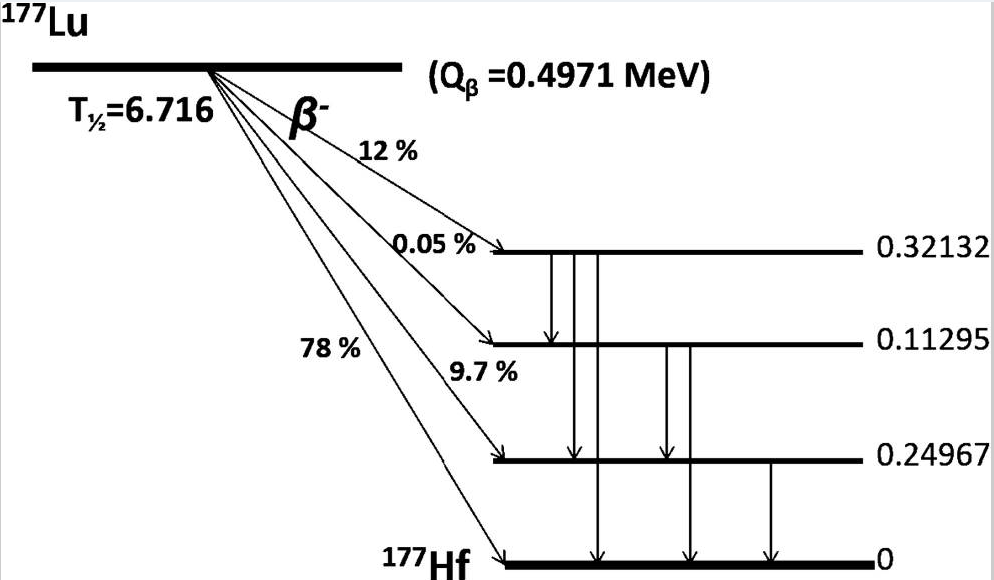
Pluvicto has been approved in the US for the treatment of metastatic prostate cancer. Several things are notable about the Pluvicto molecule. The molecule contains a PSMA-specific peptidomimetic feature with an attached therapeutic radionuclide, where PSMA stands for Prostate Specific Membrane Antigen. Peptidomimetic refers to a small chain that resembles a stretch of protein forming amino acids. This peptidomimetic fragment, which interestingly contains a urea linker, is designed as the tumor targeting piece of the drug. Connected to it is a chelated radioactive 177Lutetium cation (below, upper right). The tumor targeting fragment binds to the cancer cell. While bound to the cell, the short-lived radioisotope undergoes two modes of decay. The 177Lu has two decay modes. One emits a medium energy beta particle (Eβmax = 0.497 MeV) which is limited to a maximum of 0.670 millimeters of travel. This is the kill shot that will damage the attached and nearby target cells. The short path length of the beta ray in vivo limits the extent of surrounding damage by any given decay. Once the 177Lu emits a beta particle it becomes 177Hafnium.
Source: Ashutosh, et al. 177Lu decays to ground state 177hafnium 78 % of the time. In the three other beta decays to three hafnium excited states, each collapses to ground state by 6 possible gamma emissions.
The other mode of 177Lu decay is gamma emission by 177mLu, a nuclear isomer or metastable form of 177Lu. Gamma radiation is much more penetrating than beta radiation. The gammas can be detected from the outside of the patient allowing monitoring of dose and location of the drug. Even though gamma rays are more penetrating than beta rays, they produce many fewer ion pairs per centimeter as they traverse the tissue making them less effective per photon in tissue destruction compared to alpha and beta particles. For instance, alpha particles from therapeutic radionuclides like 223Radium used to treat prostate cancer are much more destructive because they produce many ion pairs per centimeter.
A Small Side-Track into Radon Decay
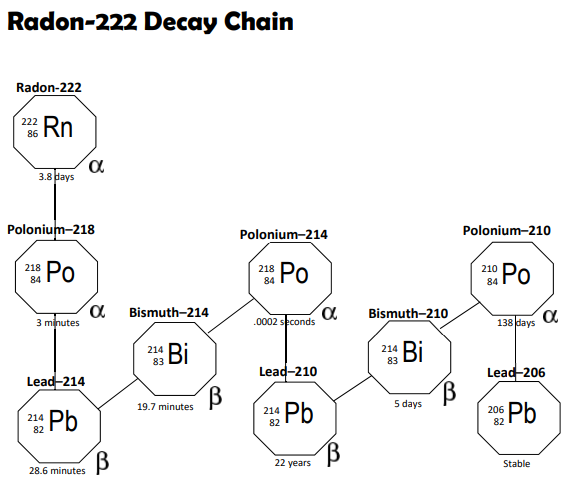
Not all radioactive isotopes are alike. Some, like 177Lu, offer only a single decay event while others are part of a domino series of decays. The decay of naturally occurring 222Radon begins a series of decay events (Radon’s daughters), with some decays being quite rapid, multiplying the radiological effect per initiating atom. Inhaling an alpha emitter like 222Radon is a gamble. Until the 222Rn decays, it is just an inert noble gas. But when it alpha decays in your lungs, it is converted to the 218Polonium which alpha decays to 214Lead which beta decays to 214Bismuth which beta decays to 214 Polonium which alpha decays to 210Lead which beta decays to 210Bismuth which beta decays to 210Polonium which alpha decays to stable 206Lead where the chain stops. Each of the daughter products is a reactive, nonvolatile metal.
Each 222Radon atom gives rise to 8 successive radiation emissions, 4 of which are alpha emissions. These new radioactive elements are called “Radon’s daughters”. This makes radon especially insidious. Note the half-lives in the graphic. Source: EPA.
Neutron Activation of 176Lutetium
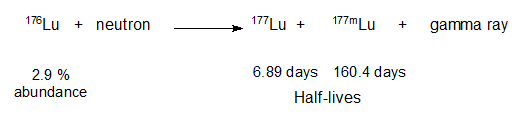
How does one obtain 177Lu? There are two pathways of nuclear chemistry that can be used, each with plus and minus attributes. The easiest pathway to execute would be the absorption of a thermal neutron by the lighter lutetium isotope 176Lu followed by a gamma emission from the new 177Lu. Gamma emissions result from metastable coproduct 177mLu that is in an excited state. It can de-excite by losing the excited state energy by the release of a gamma photon.
Where does one get thermal neutrons and what is “thermal” about them? Thermal neutrons are produced in a water-cooled nuclear reactor. It turns out that nature has bestowed a wonderful gift on 176Lu. It has a very large neutron capture cross section of 2090 barns for producing 177Lu. The metastable 177mLu isomer has a cross section of only 2.8 barns.
The unit “barn” is the unit of the effective target area of a nucleus and is equivalent to 10-28 m2, or 100 square femtometers. The capture cross section of a nucleus is dependent on the energy (or temperature) of a neutron and is proportional to the probability of a collision. Here is a brief reference on nuclear cross sections. The colorful etymology of the term “barn” is recalled here.
For comparison, the capture cross section of 239Plutonium is on the order of 750 barns with 0.025 electron volt neutrons. We can see that the capture cross section of the 176Lu is much larger than that of 239Pu. The word “thermal” comes from the kinetic energy corresponding to the most probable speed of a free neutron at a temperature of 290 K (17 °C or 62 °F).
The transmutation [176Lu + 0n —> 177Lu + 177mLu] is clean and direct with no other chemical elements to interfere. With its large capture cross section,176Lu is well suited to absorb a neutron. The down side is that the isotopic abundance of 176Lu is only 2.8 %. The other 97.2 % of Lu can also undergo neutron activation leading to chemical and radiological contamination of the desired 177Lu. Isotopic separation of 176Lu from the other Lu isotopes is difficult and not very scalable. By the way, the lutetium is neutron activated as the refractory oxide, Lu2O3. These lanthanide oxides are simple to prepare and can be dissolved in acid afterwards to produce Lu3+ cation for further chemistry.
Neutron Activation of 176Ytterbium
The other major channel to 177Lutetium is from neutron activation of 176Ytterbium, 176Yb. Generally speaking, the heavy lanthanides like Yb and Lu are less abundant than the light lanthanides on the left side of the series. All of the lanthanides have a 3+ oxidation state and similar ionic radii making them difficult to chemically separate, where “difficult” means that numerous steps are needed in purification often resulting in low yields. A few of the lanthanides have oxidation states other than +3. It turns out that Yb3+ can be selectively reduced by chemistry to Yb2+ in the presence of Lu3+ using sodium amalgam as the reductant. This happy fact allows for plausible chemical separation of Lu from Yb. Furthermore, Yb will amalgamate while Lu does not.
A Google search of Pluvicto or 177Lutetium will produce many good links of a technical and non-technical nature.
Pluvicto, PSMA-targeted radiotherapy (lutetium 177Lu vipivotide tetraxetan) for PSMA-positive prostate cancer 7.4 GBq (200 mCi) IV Q6W up to 6 doses
Due to a recent hospital stay with pneumonia, I found myself staggeringly bored. To stave off some of this I began to look into an antibiotic I was given that I had never heard of- Levofloxacin. The structure of this antibiotic was different from antibiotics I was previously familiar with. Natural I suppose, considering that I’ve been immersed in organo-transition metal chemistry for most of my industrial career. Metal-carbon bonds are quite useful in some sectors but not as drugs.
Levofloxacin is a good place to go deep diving into some of the murkier depths of chemical nomenclature. The complicated-looking chemical naming system exists to unambiguously represent the composition and shape of molecules. Certain features and properties of a molecule confer important attributes that need categorizing, thus requiring descriptive names rather than just a number. Every different chemical substance is, well, different and their chemical names must reveal a unique identity. Two or more substances with the same name leads to nothing but trouble.
Chemical substances can be grouped into categories to associate them with related aspects. We have noble gases, transition metals, hydrocarbons, pnictogens, polymers, acids, and bases etc. But the categories allow for variation when particular attributes are under discussion.
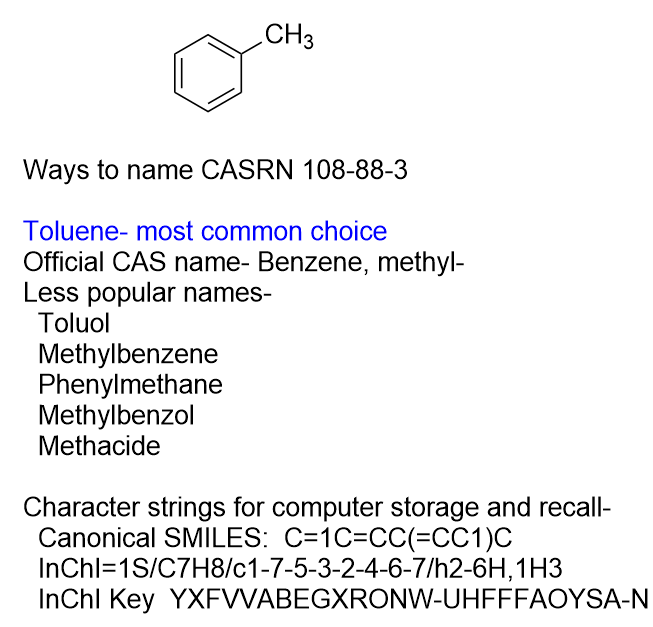
The names of chemical substances can be very off-putting to non-chemists and often does lead them to abandon their search for information. A few have even suggested that if you cannot pronounce the name it must be bad. Even worse than the polysyllabic and numbered character strings are the various synonyms. Consider simple toluene which is actually not so bad-
Directly from Chemical Abstract’s SciFinder.
In chemical nomenclature there is just a bit of flexibility in how numbers, syllables and name fragments can be assembled as the toluene example above shows, if you don’t read the rules too closely. The plethora of names come from historical trade names or long-time industrial use or may just predate systematic nomenclature now in use. There is also the German Beilstein and Gmelin organic and inorganic nomenclature as well, but these seem to be outdated.
As always, a proper chemical name describes the composition and 3-dimensional connectivity of the chemical structure of a molecule. These names are commonly listed in one of the two dominant styles of chemical nomenclature in the world- International Union of Pure and Applied Chemists (IUPAC) and Chemical Abstracts Service (CAS). IUPAC tends to be taught in undergraduate chemistry because it always has been and is maybe a trifle easier.
The CAS databases contain more than 200 million organic and inorganic chemical substances and about 70 million protein and nucleic acid sequences. There are two search platforms available in CAS- SciFinder and STN. STN is much more cryptic and harder to learn than SciFinder. Some say there are weaknesses in patent searching in SciFinder alone. For IP work I use SciFinder, Google Patents and the USPTO in combination. All three offer different kinds of searching capability.
Levofloxacin is a biocidal antibiotic effective against both gram-positive and gram-negative bacteria. It is an inhibitor of both DNA gyrase and topoisomerase IV enzymes which are involved in shaping the geometry of bacterial plasmids, or rings of bacterial DNA. Plasmids have to fit inside the bacterial cell wall and those that are not made compact enough are too long to allow successful formation of daughter cells in reproduction resulting in cell death. Other kinds of antibiotics are bacteriostatic and often work better in one or the other of Gram-Negative or Gram-Positive bacteria. Gram stains are effective with certain types of bacterial cell walls and not with others. The ability of a dye to stain a colony of bacteria a particular way is used to help identify bacteria.
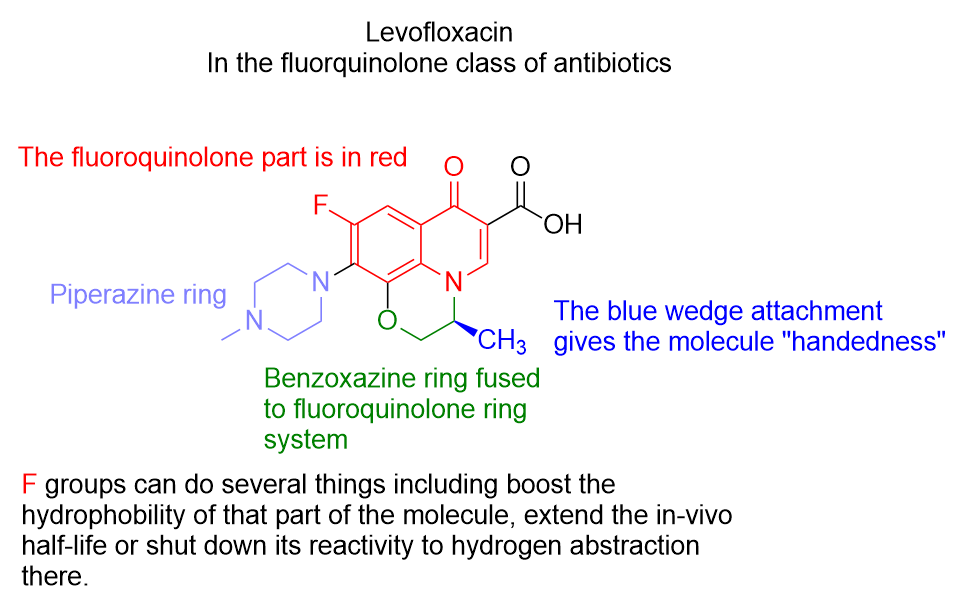
Consider the name of Levofloxacin from IUPAC: (-)-(S)-9-fluoro-2,3-dihydro-3-methyl-10-(4-methyl-1-piperazinyl)-7-oxo-7H-pyrido[1,2,3-de]-1,4-benzoxazine-6-carboxylic acid hemihydrate. The name is a string of characters with numbers indicating attachment points. The core of the structure is a 1,4-benzoxazine ring system which is festooned with a carboxylic acid and a few other groups. The core structure was identified and numbered previously by someone according to rules. The IUPAC name also specifies that it is a hemihydrate, meaning that there is one molecule of water associated with every two (hemi) molecules of Levofloxacin. For some reason the CAS name does not include the hemihydrate in the name, probably because it was not mentioned in the composition when registered with CAS. How it is in the IUPAC name is not known to me.
More pain. The IUPAC name above indicates “(-)-(S)-“. Molecules with “handedness” are said to be chiral and are not superimposable with their mirror images, similar to a right-hand being shape-incompatible with a left glove. These molecules can be prepared as individuals of single handedness or all of the way to a 50:50 mixture of left and right-handed. A 50:50 mixture of left and right-handed is called a “racemate” (RASS eh mate). Each handedness version is a type of isomer called an “enantiomer“. A substance consisting of a pure enantiomer is said to be “enantiomerically pure.”
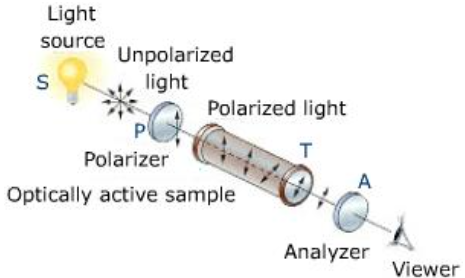
Isolated enantiomers have the ability to rotate plane polarized light as measured by a polarimeter. Plane polarized light is a light beam where the electric field vectors of the electromagnetic radiation are all vibrating in a single plane. Obviously the magnetic vectors are polarized as well, but it is the electric field that is usually mentioned. The angle of the oscillating ray’s electric fields along the axis can be tilted one way or the other depending on the interaction with matter. Reflected light and skyglow are polarized as well. Molecules with handedness rotate the vibrational plane and by an angle dependent on the light frequency and the amount of chiral mass traveled through. Light that is rotated counterclockwise, or levorotary, has a (-) sign and signified with an “l” and light that is rotated clockwise is dextrorotary and has a (+) sign and signified with a “d.” If a molecule rotates plane polarized light, the substance is said to be “optically active.” The amount of rotation is dependent on the light frequency, frequently the sodium D line (actually a close doublet) which is often used as the standard source for this. Mercury lines, e.g., 354 nm, can be used if the D line results in a low measured rotation. Substances that do not rotate plane polarized light are often designated “dl” as an abbreviation for racemic.
D-Glucose, or dextrose, solutions rotate plane polarized light in the clockwise, dextrorotary direction, thus the “D” in the name.
Commercial L-lactic acid derived from fermentation is “L” for levorotary. This enantiomerically enriched lactic acid is used to make the lactide monomer for poly(lactic acid), PLA. Only the lactide dimer from L-lactic acid gives the desired PLA isomer. The racemic form of lactic acid is not useful for PLA due to undesirable physical properties in the polymer.
A ratio can be taken from an experimental sample that may range from 50:50 racemate to 100 % of a single enantiomer to give the optical purity of the chiral material, representing the proportion of pure enantiomer. Often the measure % ee, or percent enantiomeric excess is used to describe enantiomeric purity. A 95:5 mixture of enantiomers would have a 90 % excess enantiomeric of one enantiomer. Chemical synthesis of 99 % ee can be quite difficult.
A racemate does not have a net rotation of plane polarized light. The (-) sign represents the “levo” part of the levofloxacin, referring to counterclockwise rotation of plane polarized light. Prior to the appearance of reliable analytical methods for the determination of enantiomeric purity, polarimetry and optical rotation were the method of choice. Today, Gas Chromatography (GC) and High Performance Liquid Chromatography (HPLC) columns and chiral shift reagents for 1H-NMR that can provide baseline separation of enantiomers.
The (S) character in the name indicates the handedness of a molecule as determined by standard selection rules defined by an organization for assigning absolute configuration. “S” stands for the Latin word “sinister” meaning left-handed. There is no simple calculation to go between absolute configuration and sign. The (-) sign can indicate which particular enantiomer is under consideration with an easy measurement if it has been previously correlated. (-)-(R) and (+)-(S) enantiomers can and do occur. The “(S)” defines only the precise configuration of atoms about an asymmetrically situated atom in a molecule based on a few simple rules. The mirror image of (-)-(S)- would be (+)-(R)-, “R” for rectus meaning right-handed in Latin.
The first task in assigning a name to a molecule is to determine the “core” structure. This is the basis of the name. Your molecule will be a variety of “the core structure.” This is not so easy because IUPAC or CAS will have already done this and your choice may or may not match. Referring to the CAS name below, you can see that some structural fragments end in “-yl,” “-ic” or “-o”. These signal that the fragments are not the core structure, they are attachments. The core structure onto which everything else is attached is the “1,4-benzoxazine”. It is a standalone chemical name which may be modified. This is a very obscure fact that most won’t know, but the “-ine” suffix indicates that the core structure is an amine, full stop. Other nitrogen indicators like azo, aza, amino, ammonium, nitro, azido, etc, suggest a nitrogen group attachment to something else.
Does it help to have a college degree in chemistry to know this stuff? Sorry but yes. In the set of all worldly knowledge, this is pretty obscure.
The CAS name for levofloxacin is 7H-Pyrido[1,2,3-de]-1,4-benzoxazine-6-carboxylic acid, 9-fluoro-2,3-dihydro-3-methyl-10-(4-methyl-1-piperazinyl)-7-oxo-, (3S)-. The core structure seems to be the 1,4-benzoxazine. CAS has a ring-system handbook that defines and numbers all of the known ring systems. The significance of CAS is that they assign and maintains the official CAS registry number, CASRN, which is depended upon world-wide for the exact composition and connectivity and geometry of substances. There is a very extensive rule book that rigidly defines a chemical name with rooms of CAS experts sitting in a building in Columbus, OH, to assign these names. For levofloxacin the CASRN is 100986-85-4. Today, CASRNs are usually directly searchable on Google. The final digit “4” is a check digit for error entry detection.
General comments about chemical features on Levofloxacin.
Yet more pain. The more formal official CAS name, however, does not indicate the direction of rotation of plane polarized light. I suppose this is considered experimental data not needed in the name. The CAS nomenclature only shows “(3S)-” in the name, indicating the absolute “S” configuration at position 3 of the molecule. The business of handedness or shape in 3-space of a molecule is called “stereochemistry” and arises in several ways. The rules for assigning the absolute configurations of R or S enantiomers may depend on the features of the molecule.
This business of molecular handedness is mostly an issue for biochemistry and pharmaceuticals. A great many- most?- biomolecules have handedness themselves and are therefore subject to interactions with other biomolecules or drugs that depend on the precise shapes for their interactions. This is very important for the interaction between molecules like an enzyme and substrate or ligand.
In the absence of other chiral molecules, two enantiomers will have the same chemical properties when individually pure. However, a racemate consists of a pair of enantiomers. The interactions between R and R or S and S enantiomers, will be different than the interactions between a racemic mixture of R and S or S and R enantiomers. If there is more than one chiral feature in a molecule- say two- then the molecule could be R, R or R, S, or S, S, or S, R. This gives two pairs of enantiomers, each called a “diastereomer.” For instance, one substance with R, S and another with R,R will be substances chemically and physically different called diastereomers. The presence of a diastereomer in an enantiomeric drug product would likely be deemed a contaminant and removed.
A druggable disease-state is one that can be positively influenced by a drug molecule. This commonly involves the drug molecule docking with an enzyme to activate it or deactivate it. These enzymes are very large diastereomers having many chiral atoms giving them complex shapes that can result if the formation of a pocket in the protein structure called the “active site.” This active site has very particular shape and charge features provided by the chiral amino acid chain of the protein. An active site will have a shape that is compatible with the close fitting of a drug or other molecule similar to a hand in a glove. Many of these active sites bind the shape and charge of one enantiomer of a drug molecule more effectively than the other for a better fit. The drug, or substrate, may just sit there and block the action of an enzyme, shutting it down or activate it continuously. Other active sites may bind a drug and change the shape of the enzyme causing the enzyme to speed up or slow down for a throttling or accelerating effect elsewhere on the enzyme. This is called the allosteric effect.
So, you may be asking- big deal, what does it matter? In the world of pharmaceuticals, many drug substances can exist as single enantiomers, racemates or diastereomers. Racemates may be easiest to manufacture, but very often one of the enantiomers is more biologically active than the other. In fact, one enantiomer may be disastrously harmful. The classic example is Thalidomide. The S form caused birth defects and the R form did not. Pure R enantiomer was safe from teratogenicity but a racemic mixture of R and S was not.
Conclusion. A superficial look at a chemical name opens up insights into the chemical nature of a substance. What makes each chemical substance unique is their distribution of charge in 3-dimensions. The distribution is affected by the types of the atoms present, geometric features of the 3-dimensional shape and the ability of the system to allow charge to accumulate in particular places of the molecule. These attributes mentioned also set up the type and vigor of reactivity the molecule will display.
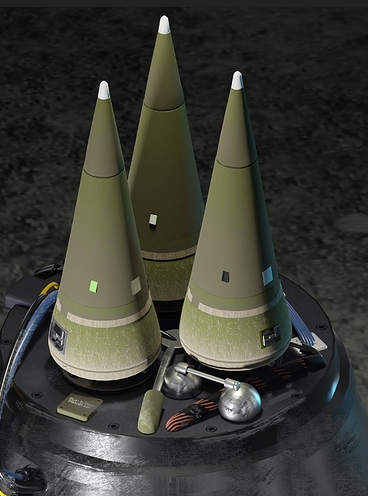
Some vocabulary from bad old days of the Cold War has come back to haunt us. Russia has announced that it has deployed its RS-28 Sarmat intercontinental ballistic missile (ICBM) in Belarus. The 112 ft long, 211 ton missile is said to carry 15 Multiple Independent Reentry Vehicles (MIRVs). As new and scary as this sounds, the US first conceived of the MIRV in the early 1960’s and deployed its first MIRV’d ICBM (Minuteman III) in 1970 and the first MIRV’d SLBM (Poseiden Sea Launched Ballistic Missile) in 1971. The USSR followed suit in 1975 and 1978, respectively.
In the early 1960’s it was believed in the US that it was behind the USSR in what was called the “Missile Gap”. It turns out this was incorrect and that, in fact, the US had a large advantage in the number of ICBM strategic delivery vehicles. For a long while we in NATO thought the Soviets were 10 feet tall and that turned out to be an exaggeration. From their performance in conventional battle, they have diminished in stature just a bit. However, their nuclear triad is to be respected.
The initial purpose of the MIRV concept was to compensate for inaccurate delivery. It has evolved to include decoys and multiple target delivery. There is a good deal of non-classified information on MIRV systems on the interwebs.
Putin’s threat of a new MIRV’d missile is just more nuclear bluster to frighten NATO citizens. For the present time his nuclear weapons are more valuable in storage as they have been all along with the Mutual Assured Destruction policy. That said, they have a policy of using nukes if the security of the state itself is under threat. I would guess that Putin sees himself as the state.
I wonder if it has dawned on the Russians that nobody in their right mind would actually make a preemptive attack on Russia or its former Soviet satellites. Who actually wants the place? What benefit is there in trying to subdue 140 million angry Russians and their huge frozen taiga? That’s nuts.
Russia sent a letter to the United Nations accusing Ukraine of preparing to use a ‘dirty bomb’ in their battle with Russia. Western countries have claimed that this is nothing but a transparent attempt by Russia to provide a pretext for their own use of a dirty bomb or some other offensive action.
This issue resembles the matter of Weapons of Mass Destruction (WMD) that the Bush administration in the US contrived as a pretext for taking down Saddam Hussein. A great many innocent people died and we damaged our moral authority in the world by that and other wars. It was an obvious lie to a great many Americans and allies yet the Bush administration went forward with the invasion. No WMDs were found.
According to Wikipedia, a dirty bomb is a conventional explosive packed with radioactive material that, on detonation, disperses the dangerous material in the target area. Such a thing could be made portable or assembled on site. It is not to be confused with a nuclear bomb. A dirty bomb blast would be a radiological calamity wherever it is set off as well as downwind of the explosion. Being non-nuclear, dispersion by a conventional explosive would be extremely limited in range in terms of blast effects, but intensely radioactive. As with any sudden generation of dust and smoke, there would be a plume of radioactive material (RAM) extending downwind from the release. Water soluble radioactive materials would pollute the watershed and possibly groundwater. Contaminated soil would exclude the area from farming for many decades if not longer. Great harm would befall the biosphere.
Construction of a dirty bomb could be quite problematic for its builders. Assuming the builders of the bomb are not suicidal, collecting RAM, assembling and delivering the bomb could be tricky. On one end of the scale, spent nuclear fuel could be used as the source of RAM. Assembly could be as simple as packing explosives around a container of RAM. To prevent serious exposure to the workers, there would have to be some kind of shielding present during the handling of the RAM. On the lower end, a small RAM source from a medical device could be used. Whatever the case, the containment must be fragile enough to rupture in the explosion but dense enough to provide some level of shielding for the handlers.
The harmful effects of a dirty bomb would be both radiological and psychological. On the psychological end, it is sure to cause dread fear in the general population and sway public sentiment toward one side or the other. Importantly, its use would be releasing the nuclear weapons genie from its bottle. It would lower the threshold and allow war planners everywhere to reconsider their own use of nuclear strategy and tactics because a precedent has been set. Once the genie is out, there is no putting it back, or so the saying goes.
In all of the war gaming and planning NATO has done over the decades, I wonder how much attention has been given to responding to nuclear conflict between non-NATO states? What should the NATO countries do if other actors engage in nuclear conflict? As always, it depends on the circumstances.
==========================
I have chosen to avoid using the term “explosive device” because I feel it has a certain sanitizing effect. A thing that is meant to cause death and destruction by the explosive release of energy is just a f*cking bomb with all of the meaning and negative connotation associated with the word. Even grudging admiration for someone’s cleverness should not be awarded for putting together a “device.”
An article by Bloomberg and reposted by MSN reports the launch of Russia’s new Sarmat intercontinental ballistic missile (ICBM) from the Plesetsk cosmodrome in the northern Arkhangelsk Oblast. Putin is quoted in the Bloomberg piece as saying-
“this unique weapon will strengthen the military potential of our armed forces, will reliably guarantee Russia’s security against outside threats and force those, who in the heat of frenzied aggressive rhetoric try to threaten our country, to think again.”
Can we take it that the stated uniqueness of this weapon is related to it’s ability to evade whatever antiballistic missile capability the west may have? Or perhaps Sarmat may have greater range or more numerous and more accurate MIRVs? Whatever the case may be, Putin is ratcheting up the tension and uncertainty with regard to his dedication to the doctrine of Mutual Assured Destruction (MAD), making us wonder about his unleashing a pre-emptive nuclear strike.
There has been much speculation on what could trigger Putin’s use of tactical nuclear weapons. Informed opinion can be found in The Congressional Research Office document, updated in March of 2022, titled “Russia’s Nuclear Weapons: Doctrine, Forces, and Modernization.”
This document states that in a 2018 speech to the Federal Assembly, Putin said-
“I should note that our military doctrine says Russia reserves the right to use nuclear weapons solely in response to a nuclear attack, or an attack with other weapons of mass destruction against the country or its allies, or an act of aggression against us with the use of conventional weapons that threaten the very existence of the state. This all is very clear and specific. As such, I see it is my duty to announce the following. Any use of nuclear weapons against Russia or its allies, weapons of short, medium or any range at all, will be considered as a nuclear attack on this country. Retaliation will be immediate, with all the attendant consequences. There should be no doubt about this whatsoever.”
“There is no provision for a preventive strike in our nuclear weapons doctrine. Our concept is based on a retaliatory reciprocal counter strike. This means that we are prepared and will use nuclear weapons only when we know for certain that some potential aggressor is attacking Russia, our territory [with nuclear weapons]…. Only when we know for certain—and this takes a few seconds to understand—that Russia is being attacked will we deliver a counterstrike…. Of course, this amounts to a global catastrophe, but I would like to repeat that we cannot be the initiators of such a catastrophe because we have no provision for a preventive strike.”
While Putin says that Russia cannot be the initiators of a catastrophe, which could be taken as a nuclear exchange, Russia does reserve the right to a nuclear response to the use of conventional weapons that threaten the existence of the state. This suggests that a first use of nuclear weapons is possible by Russia. So, what circumstance would Russia have to be presented with to view a threat as existential? The death of Putin or the collapse of his government? A NATO invasion rolling onto Russian soil? Moscow surrounded by NATO tanks? Or just a moment of panic by Putin? One thing seems certain- Putin will be the judge of what is existential.
Elsewhere in the report it is stated that “… several [US] analysts have argued that Russia has adopted an “escalate to de-escalate” nuclear doctrine. They contend that when faced with the likelihood of defeat in a military conflict with NATO, Russia might threaten to use nuclear weapons in an effort to coerce NATO members to withdraw from the battlefield.”
This escalate to de-escalate idea from 2018 looks familiar. Maybe this is what Putin is doing now.
I have been an advocate of thorium based nuclear power for a long time. There are certain advantages that thorium based nuclear technology has over uranium and plutonium systems that make it appealing, as long as the nuclear genie is out of the bottle anyway. Others have written about this and there is no point in my wasting bandwidth on it here. Fort St. Vrain Generating Station, one of the very few HTGR Thorium plants ever operated in the US sat a half hour from here from 1979 to 1989. As prototypical operations go, the plant had a history of upsets and unforeseen complications and was decommissioned after a decade of sub-commercial output. Eventually the plant was converted to a natural gas turbine plant and runs to this day in that capacity.
So it was of interest to learn that the venerable European company Solvay has teamed up with AREVA to develop thorium technology. Uranium and rare earth processing, as well as other minerals produce side streams enriched in thorium. According to the link, both players have been accumulating inventories of thorium. Hmmm. What could they be up to…?
It is a crying shame that we (the rest of the world) did not think to encourage Iran and other states to develop thorium-based nuclear power many years ago. The thorium fuel cycle provides nuclear-powered steam generation, but is largely absent the use of fissile isotopes in the cycle which may be used for nuclear proliferation. Thorium-232 is more abundant that uranium-(235 + 238) isotopes and does not require isotopic separation as uranium does.
The great exploration boom in progress with rare earth elements would facilitate thorium supply. Thorium and uranium are commonly found in rare earth ores and, to the dismay of extractive metallurgists since the Manhattan Project, these elements tend follow along in rare earth extraction process. The isolation of thorium was developed long ago. Point is, since so many rare earth element extraction process streams are either in operation or are pending, now is the time to accumulate thorium.
At present however, thorium is a troublesome and undesired radioactive metal whose isolation and disposal can be quite problematic. The best process schemes partition thorium away from the value stream as early in the process as possible and channel it into the raffinate stream for treatment and disposal in the evaporation pond.
The specific activity of natural thorium is 2.2 x 10^-7 curies per gram (an alpha emitter). The specific activity of natural uranium is 7.1 x 10^-7 curies per gram. Alpha emitters pose special hazards in their handling. Dusts are a serious problem and workers must be protected especially from inhalation or ingestion. While alpha’s are not difficult to shield from, their low penetration through ordinary materials or even air makes them a bit more challenging to detect and quantitate relative to beta’s and gamma’s. In spite of the mild radioactivity of thorium, managing the occupational health of workers is known technology in practice in the nuclear industry.
Regrettably, most of the world’s nuclear power infrastructure is geared to uranium and plutonium streams. Thorium, the red-headed stepchild of the actinides, is thoughtlessly discharged to the evaporation ponds or to the rad waste repository- wherever that is- to accumulate fruitlessly. If we’re digging the stuff up anyway, why not put it to use? It is a shame and a waste to squander it.
There is a saying that opportunity doesn’t beat the door down, it only knocks quietly. So it seems to be with uranium. The American uranium extraction business took a big hit when the Three Mile Island accident happened in the late 1970’s. Nuclear power growth was tabled and only recently has it shown signs of recovery.
With few exceptions, the rebound of the North American nuclear fuel business is largely invisible, apparent only if you go digging for signs. One exception is happening in north central Colorado, near the town of Nunn. A Canadian company, Powertech Uranium Corp., has acquired mineral rights to a sizeable parcel of land northeast of Ft Collins along the eastern side of I-25. It is called the Centennial Project and circumscribes an ore body estimated to hold 5.1 to 9.6 million pounds of U3O8, according to a technical report posted in the public domain at the Powertech website. The extent of U3O8 recovery would depend on the percent cutoff level of acceptable ore. The ore body is a discontinuous series of subsurface deposits with the top of the uranium mineralization at ca 82 feet below the surface.
According to the report by Gorski and Voss, the average grade of the ore is 0.094 % and the average thickness of the vein is 8.8 ft (Table 1, latest estimate). Powertech has mentioned the possibility of in-situ extraction with bicarbonate leach as the means of removal of the mineral value rather than underground mining.
Naturally, the locals have not warmed up to the news that there might be a uranium mining operation in the area. A local group, Coloradoans Agains Resource Destruction (CARD), has put up a website (NunnGlow) and are vigorously lobbying against the development. In particular, the matter of leaching has brought a large negative sentiment to the forefront and Rep. Marilyn Musgrave (R-CO) has intervened with the NRC to allow a more lengthy public comment period in the permitting process. Locals are rightfully concerned about their aquifer and are entitled to some straight talk about the matter.
While I am generally in favor of uranium mining, I have to agree with NunnGlow in regard to contamination of the aquifer by this in-situ leaching process. Powertech needs to offer some compelling evidence that the aquifer won’t be harmed by their leaching operations.
We’re approaching full circle from cold war to Perestrioka and collapse of the Soviet Union to re-ignition of cold war fires. News sources are reporting bluster of the most serious kind issuing from Vlad Putin in response to plans by the US to place ballistic missile interceptors in eastern Europe.
What motivates the Bush II administration to place anti-ballistic missiles and radar near the eastern frontier of Russia is a perceived ballistic missile threat from so-called rogue states. The reality of ballistic flight is that missiles launched from the region of Iran will fly over southwestern states of the former Soviet Union (FSU). In order to best detect and intercept such missiles heading for the EU, equipment would optimally be set up along the trajectory. Within the logic of strategic planning, the site placement seems consistent with the goal.
What is less than clear is the excuse for our ham fisted diplomacy with Russia. Yes, obviously Putin is escalating the bluster and the tensions in a manner that is less than rational. But the decision makers in the Bush administration appear to have been asleep during the cold war. Evidently the Bush administration didn’t consult with Russia in the run-up to missile site selection. It was felt that as members of the EU, Poland and the Czech Republic were no longer part of the eastern bloc and therefore Russia’s input was irrelevent. This was a whopper of a blunder.
The predictable result is that Russia is behaving like Russia, and, outwardly at least, the Bush people seemed slow to pick up on this. Finally, Bush Jr. is getting some on-the-job-training in eastern bloc politics.
The confrontation with Putin and Russia has begun to spin into something that will force Russia to vigorously protect and promote its interests. Putin is a lame duck and has to make some kind of stand to satisfy the quiet power brokers behind him. They can’t accept the placement of ABM systems in Poland anymore than we could allow it in Cuba or Alberta. Doesn’t matter if the initial placement consists of “smart rocks”. Any missile site can be quietly modified quickly.
There has been a disturbing lack of cultural and economic engagement between the United States and the FSU following the dissolution of the CCCP and the communist party. This is unfortunate. Western states should have made a more concerted effort to engage the FSU economically and socially.
For its part, the US has been curiously lacking in interaction with or even simple curiosity in regard to the progress of the FSU states in their difficult period of reconstruction. But I think that Russia has been characteristically distrustful of western intentions as well. Historians will ponder this transition period in world political history and wonder how it could be that even though a society got to push the reset button, the best it could come up with was Putin and the best that the other states could muster was benign neglect.
Iranian progress towards nuclear fuel processing seems to have everyone twittered. Recently on NPR a guest raised the question as to whether or not Iran has enough reactor capacity to consume the potential output of their nascent uranium enrichment program. Good question.
The refinement of fissile materials offers hazards that are poorly understood outside the actinide community. One of them is the “criticality” hazard. In the US nuclear program, there have been a few criticality events leading to heavy radiation dosages and even death in a few cases, i.e., Louis Slotin. Slotin’s case is unusual in that he was manipulating a subcritical bomb assembly rather than a uranium solution. A recent example is the criticality event at Tokai-mura. According to the literature, numerous elements (in addition to beryllium) absorb alpha’s and then emit neutrons.
One wonders if the Iranians have the infrastructure to safely perform this activity. A nuclear state needs a health physics community, sensitive and accurate radiation detection systems, and the ability to handle hazardous radioactive materials that are chemical hazards as well. Then there is the matter of what to do with high level rad waste. The US is still struggling with its rad waste inventory generations after the Manhattan project began. Who knows, maybe NIMBY isn’t an issue in modern Persia.
Nuclear weapons seem so secular for hyperorthodox nations. But these things do capture the fancy of many people- even followers of the worlds major Iron Age religions. Among scientists, the explosive runaway potential was considered not long after it was discovered that nuclear fission released two neutrons per fission. The human brain seems constructed to find extrema.
I wonder how the Iranians will validate their weapon’s design? I assume their program is not an ab initio project. No doubt they have culled design information from somewhere (Pakistan?). Eventually they have to assemble their weapon and tighten the wingnuts on the casing. But how will they know if it has enough thump? Will they be able to resist performing a test shot? Israel, to its credit, has not performed a test of theirs, though I have no doubt that considerable super computer time has been dedicated to validating their design.
How will these sons of Xerxes construct the chain of command for the release of nuclear weapons? What kind of fail-safe mechanisms will they put into place to safeguard against inadvertant or unauthorized arming and detonation? Even martyrs have to be careful.
Nuclear weapons have their military uses, but they are primarily a political amplifier used by states to project their voice on the world stage. But what happens when a religion gets hold of nuclear weapons? Clearly, the Islamic Republic of Iran is interested in more than mere self defense. They seem compelled to promulgate standards and doctrines given to them in the form of revealed truth. A nuclear weapon is as much about prestige and credibility as firepower.
The Iranians are very pragmatic people. They know that the US can easily rain nuclear destruction on them and then bounce the rubble a few times for good measure. They’ll use the bulk of the uranium for electrical power generation. But they’ll be sure to use a part of it for politcal power generation.

 Lamentations on Chemistry