In two-dimensional Euclidian geometry the shortest path between two points in a plane is a straight line. In a right triangle, one of the three internal angles, has an angle of 90o. The longest side is the hypotenuse connecting the ends of the other two legs. The square of the hypotenuse is equal to the sum of the squares of the other two sides. It’s the Pythagorean Theorem.
We know from high school geometry that the hypotenuse is the shortest distance between two points in a plane. This is exploited all the time on college campuses in a practical way. That would be walking across the grass in a direct line to class or lunch. The grounds keepers aren’t happy about it, but this was accepted long ago as an inevitability.
Stretching this axiom to the multidimensional realm of consciousness, the gap from the beginning of a thought to a conclusion could also be a kind of straight-line hypotenuse. But like walking on a hypotenuse across the grass, there are occasional fact and thought-obstacles that require a detour. Obstacles can be in the realm of physical reality or cultural norms and legality. Our consciousness must estimate the relative risk of one or more pathways. Align this with concessions to social norms and the law, we have the beginnings of a hairball.
My primate brain immediately searches for a conceptual hypotenuse when presented with a dilemma. What is the shortest and most efficient path to the best solution? First, one must define the current state and the desired end state. This is just old-fashioned gap analysis. What’s different is that thought processes are often clouded by mental illness and thoughts including conditioned response, preconceived notions, false or inaccurate information and personal animosity.
Any brainstorming session is really a hunt for a hypotenuse.
Ok, so there is this Harvard professor named Avi Loeb who attracts media attention with his suggestions that a new comet or asteroid may be an alien spaceship, especially if we’re sure that it is from outside our solar system. Any given new object arriving from “way out there” has the possibility of being made and operated by extraterrestrials. Yes, it is a remote possibility, but still non-zero.
What gets my attention is how his pronouncements of possible alien spaceships are leapt upon by media who publish and promote with breathless and fanciful headlines. Ok, media are in a 24 hour or less news cycle and feel the need obligation to publish a story with breathtaking headlines. Or at least the writer of the story intends it will attract the reader’s engagement,
Is the professor just looney or is there method to his madness? Perhaps his personal threshold for signal to noise ratios is set just a bit too low. I just don’t know.
With this, however, the ET credibility gap is bridged by the fact that a professor at Harvard University is making the statement. This affords instant credibility because, as we all know, God himself spends Thursday afternoons at Harvard and what is more sanctified than a tenured Harvard faculty member? In fairness, it must be said that God spends Thursday mornings across town at MIT, though half-assed claims of ETs are a bit rarer from there.
As Carl Sagan or someone else once said, incredible claims require incredible evidence. In this example, where was the incredible evidence? Extremely distant, small and faint objects detectable only in the visible part of the spectrum with very sensitive equipment tend to reveal only faint evidence. Even if some kind of signal can be discriminated, would aliens want to broadcast their appearance to the whole flippin’ solar system straight away?
For myself, if there were aliens strapped inside this object, the more interesting problem is how did they manage to cross interstellar space in a way consistent with sufficient fuel for their propulsion system and critical supplies?
My faint mockery of the Harvard professor is now complete. Time to move on.
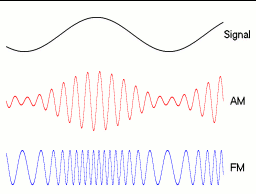
Perhaps aliens have picked up our radio transmissions, remembering that TV transmission is also a kind of radio transmission. Amplitude modulated transmissions, AM, would be easiest to investigate since it is only a narrow carrier frequency that is modulated by wave amplitude.
A radio signal modulated in two ways- AM and FM. Source: Wikipedia.
Black and white television used AM for video and FM for sound. AM is the easiest to understand, but the FM signals are quite different. Frequency modulation, FM, takes a fixed carrier frequency and combines it with signal that is near the carrier frequency, but the frequency is modulated in a way that the sum of the carrier and sound frequencies combine in such a way that the combined carrier and sound signals produce peaks and valleys resulting from combining two signals of somewhat different frequencies. The peaks of the carrier frequency end up adding or subtracting with the other signal.
AM receiving equipment has difficulty discriminating between signal by variable amplitude noise. Lightning or other sources of radio frequency energy easily interfere with the clarity of the signal. If you have listened to an AM radio station in stormy weather, you know how interfering lightning can be.
FM, on the other hand, is from the addition of a set carrier frequency plus a variable frequency sound signal. Electrical mechanisms that produce RF noise generally do not produce an FM signal, thus the quiet sound of FM reception.
Interlacing raster scan lines on a TV screen. Alien receivers of TV signals would have to assemble images from an interlacing raster scan signal with a proper sweep frequency across the screen. Image: Wikipedia.
This is a superficial explanationof television. Television images of the Lucy show, or the Three Stooges received by aliens has been speculated on to our great amusement, but we should understand that a transmitted TV signal is generated taking into account of specifically how it will be read. On a monochrome TV receiver screen, the picture is produced by interlacing two half vertical images alternating every 60th of a second so a whole image is received by our retinas every 30th of a second exploiting our persistence of vision to prevent flickering images. Below 30 frames per second, the images begin to flicker. Aiding in this is the fact that the phosphors in the picture tube glow momentarily after the beam has passed. In order to produce images from a radio frequency signal, this method would first have to be recognized then a receiver built by the aliens to “decode” the signal. Also, the aliens would have to recognize that the analog information is visual in nature and presented as an interlaced raster scan on some kind of display. Misinterpretation of our signals as hostile in nature would be avoided, hopefully.
Ok, movie projection just for fun
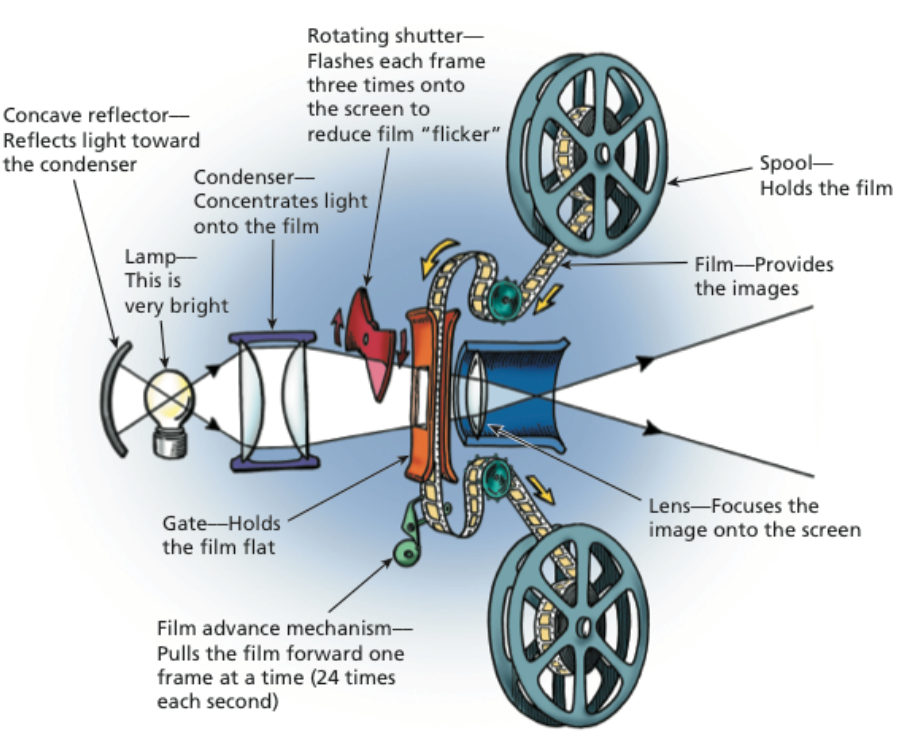
The passage of movie film through a movie projector is at 24 frames per second but flickering is avoided by projecting each frame twice to give a frame rate of 48. The classic sound of a movie projector results from the advancing of each frame past the shutter, stopping the film momentarily while the shutter rotates in the light beam and shines light through the frame twice. Slack is built into the continuous flow of film through the projector using loops of film above and below the aperture and shutter to allow continuous movement of the film but also stopping for 1/24th of a second so that a steady image is projected twice per frame. The source of the flickering sound is in large part from the upper and lower loops jumping up and down every 1/24th of a second.
If only we’d ship reels of movie film to the aliens, they could better understand us. For starters, I’d suggest a recent Godzilla movie.
The essential parts of a movie projector. Note the loops above and below the shutter. Source: Smithsonian.
Here we are 25 years into the 21st century already. One might have supposed that by four hundred years beyond the start of the Enlightenment, someone might have devised a coffee pot that does not dribble. Some pots approach this asymptote, however, but not ours. For myself the bigger problem shows up when I pour water into the reservoir of the coffee maker.
After considerable experimentation I have observed that dribbling will happen when the flow rate is either too slow or too fast. The problem for the coffee pot user is that while a dribble-free flow is occurring, the liquid level and flow rate drop and the water begins to dribble again. The angle of the pot can be raised to increase the water flow rate, but it is very easy overcompensate and slip onto the dribbling flow regime once more. So, filling the coffee maker can turn into a series of back and forth corrections trying to keep the water flow in the “sweet spot.”
As the flow rate rises the liquid flow begins to crawl up along the sides where there is no spout, thus adding to the dribbling. Too slow (lacking momentum) and capillarity pulls the stream around the curve of the spout causing it to run down the sides of the pot.
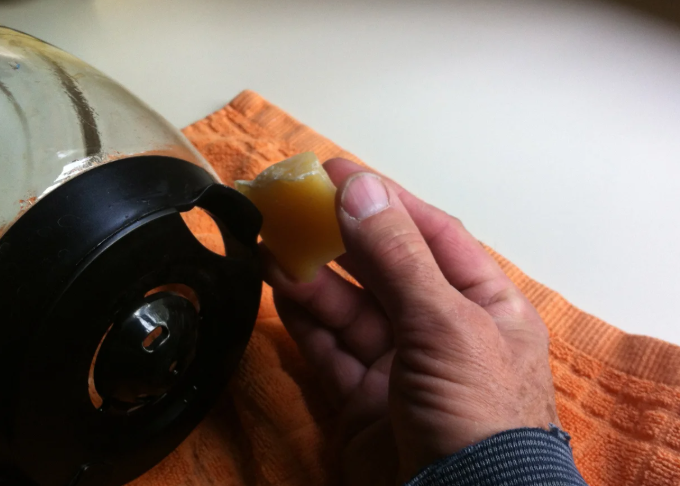
Applying beeswax to the spout of a dribbly coffee pot. Source: Instructables.
A cure for this can be found on the Instructables website. The author of this article found 2 possible causes- a mold seam in the plastic spout and capillary action of water. The author reports that after carefully filing down the ridge of the plastic molding seam and coating the spout with a light layer of beeswax, the problem has disappeared.
Every time I make coffee at work, I check my pockets only to find that I left my beeswax at home. I have a hoard of beeswax for use in the event of the apocalypse. After all of the “goody-two-shoes” have been raptured, those of us ground-pounding leftovers on earth will need candle wax.
It turns out that this pouring issue has been fixed at the commercial level for some time. I have seen plastic lips around the opening of syrup bottles that are actually dribble-free. In the laboratory I found plastic rings that fit on the opening of numerous chemical jugs. Off-hand I have seen this on 4 L jugs of concentrated nitric, sulfuric, chlorosulfonic and triflic acids. Dribbles of these acids are especially problematic. The purpose was obvious on inspection- make the spout hydrophobic to suppress capillary action attracting the liquid to follow the surface. Evidently, I failed to remember this trick.
The spout on our Cuisinart coffee maker is plastic, as is the spout in the Instructables article, so you’d think that in itself would prevent the dribbling due to its hydrophobicity. But apparently it is appreciably wetted by water. The dielectric constant of the beeswax then must be lower than the plastic, making the beeswax surface energy lower, thus the attractive forces lower.
The present situation is one whereby a large swath of the population, including K-12 students, are being exposed to an increased risk of bloody, violent death sustained by those who fetishize firearms. Whatever you may think of the 2nd Amendment to the US Constitution, the fact is that we are prioritizing an originalist interpretation over the lives of school children. We are allowing children to be sacrificed on the alter of the 2nd Amendment in order to satisfy people who idolize the idea of boundless access to metal tubes that discharge high energy bits of metal. We are not officially at war defending our borders in the US nor are we on the verge of a civil war. By far, most guns are not used to hunt. Most Americans lead peaceful lives in their neighborhoods without the need to shoot at people.
The very notion that the US government is going to wrench guns away from citizens in one of the most heavily armed democratic countries in the world is the fever dream of a fool. Any full-scale attempt to do this would lead to armed rebellion and the collapse of the USA as a democratic republic. Widespread gun confiscation is not politically feasible today or in the foreseeable future.
We must tone down and be less tolerant of the image of inflated machismo that guns confer to their users. Both in real life and in entertainment, gunplay is used to resolve conflict. By far, most gun owners do not commit violent acts with their guns. While they should not be penalized for the crimes committed by others, accepted mechanisms like driver’s and pilot’s licenses are a form of limitation and standardization that could be applied to access to firearms. But this reliably produces hysteria among the armed public. Like everything else in society, a few people have to ruin it for the rest of us.
The basic utility of a gun is to deliver crippling or fatal kinetic energy, or the threat of it, from a safe distance. The need for guns for peacekeeping use will last as long as there is dangerous criminality. What the US is presently suffering from is the use of rapid-fire, high-energy projectiles from guns designed to hit as many targets as possible in the shortest time. Man killers.
Sidebar
I took the hunter’s safety course sponsored by the NRA at the age of 9. The truth is that firing a gun is both fun and stimulating. I recall stealthily walking along a muddy creek in the Iowa countryside with a bolt action 0.22 caliber rifle desperately looking for some reason the fire the gun. I spotted fish, turtles and birds but something held me back from shooting at them except for once a few years later. With a BB gun I shot a sparrow perched on a small twig of an elm tree. The bird rotated backwards, still gripping the twig, and hung upside down for a minute or two. Then it released and dropped into an irrigation ditch with a small splash.
I was immediately gripped with regret and sorrow for what I had just done. I had just killed a random sparrow for utterly no reason than to see what happens. Even as a teenager I could see that this was a senseless action. I am sorry for killing the sparrow to this very day and, except for a few mice and bugs, I have never killed wildlife since.
Back to the essay
The point of the story above is that, for me, being in possession of a firearm could sometimes produce a strong urge to fire it. I’m confident that there are others who have felt the same way. The healthy release is to do target practice. Some people enjoy hunting. I do not indulge in this because I prefer the flavor of beef, pork and fish which, conveniently, are already butchered.
Male characteristics can have both good and bad attributes. A measure of focused male aggressiveness, ambition and territoriality can be beneficial for the wellbeing of loved ones and the community. Brute strength can be quite useful in providing for a family. Male rage, however, can be very destructive wherever it is directed, as we all know. A firearm or other weapon is a force multiplier for a raging male. Recent mass killings prove the point. Firearms provide the ability to kill or wound from a safe distance and the value of this is lost on no one.
It is hard to imagine that some restraint in the use of firearms without addressing the cultural and natural phenomenon of male aggression can be successful. We are saturated with violence in entertainment, on the streets and in the news. As long as we seek entertainment violence, show business will anxiously provide it.
I’m neither a Quaker nor a pacifist but I do admire their sincere dedication to non-violence. We need many early adopters of non-violence with considerable social standing and a non-violence vibe across the whole country. Destructive male behavior can be tamed to a great extent, but it has to start early and be immersed in non-violent surroundings. Where is the sign that Americans can summon the discipline to do it. I’m not seeing it.
Note: First, let me make clear that I am not a computer scientist and while I’ve learned FORTRAN, BASIC and PASCAL in the early 1980’s followed by coursework in quantum chemistry in grad school- and somehow passed– the question of how quantum computation actually computes with qubits remains a mystery to me. Honestly, I’m weary of hearing about it. That said, I do continue to worry about the ever-increasing pressure on the liquid helium tit which quantum computing will definitely lock on to.
An interesting article came out in the current issue of Quantum Magazine giving some straight talk about how quantum computers might actually be used. All of us have been bombarded by breathless predictions of a wondrous future where we can find prime factors of stupidly large numbers and crack very secure cryptography.
Quantum chemistry is about orbiting electrons confined to particular regions of oddly shaped space around a positively charged nucleus, depending on their energy. That is a lifetime of study right there for me. I think I’ll stick to atoms and molecules.
Oh yes, in the early 80’s we used an IBM 360 and submitted our batch jobs as a stack of punch cards. Eventually we were allowed to use the DEC writer for BASIC programming. One sunshiny day an Apple 2 appeared in the chemistry department office. It had 16 K of memory, a green monitor and an external floppy disk drive. There were whispers that 32 and maybe even 64 K were on the horizon. Heady stuff.
Vocabulary gained while watching British crime shows. I will only show the meaning from the context in which they were heard.
Putrescible, noun or adjective: liable to decay; subject to putrefaction, “putrescible domestic waste”
Summat, pronoun: a British dialect form of the word ‘something.’
Kip, noun: sleep, a nap: ‘I might have a little kip’
Egg sucking, phrase: used as an expression of anger or scorn, ‘go suck an egg if you don’t like it’
Gaffer, noun: a person in charge of others; a boss.
Scarpered, intransitive verb, to flee or run away.
Minging, adjective: very bad or unpleasant.
Parkour, noun: the activity or sport of moving rapidly through an area.
Gutted, adjective: Very disappointed or upset.
Bloke, noun: a man, guy or dude.
Knackered, adjective: Worn out or tired.
Bollocks, : nonsense or rubbish.
Ta, : Thank you.
To leg it, phrase: To run away.
Daft, : A bit stupid.
Gob, noun: Mouth.
Cuppa, noun: Shorted version of ‘cup of tea.’
To Crack on, : To get started or to finish something.
Innit, : Short for ‘isn’t it?’
I like and would adopt most of these here in the US if others knew what they meant. My favorites are the words in orange.
Editorial
Let me say a few things about British television in general. We subscribe to both BritBox and Acorn TV found on Prime streaming service. First, in American TV entertainment, most of the actors tend to be very pretty and young- even the men. It’s a bit too saccharine. British TV has young and pretty people too, but with a large dose of people who ordinarily wouldn’t fit that description. Perhaps the talent pool there is small. My point is that the Brits use older folks to a larger extent than in the US. Another noticeable difference is the use of gun play in the cop shows. British TV uses far less shooting or even just the pointing of guns in their screen plays. There is some, granted, but far less than in the US. I like that. The Brits have a tradition of parlor murder mysteries where the killer is identified by deduction. On Brit TV, conflicts or apprehensions of suspects is frequently handled without excessive violence.
Another refreshing aspect of BritBox and Acorn TV is the availability of continental European programming. I’ve never been bothered by reading subtitles, so the authenticity of language and the drama is unfettered. Truthfully, the use of subtitles for English, Scottish and Irish programming is necessary when accents are too thick to understand, which is not infrequent.
One thing I have noticed is the adoption of American English vocabulary abroad. It is a bit sobering to see the extent of influence abroad by the US movie and television industry.
Prologue: I want to give my bona fides on appreciation of the “US space program.” For as long as I can remember I have been a space enthusiast. I followed projects Mercury, Gemini, Apollo, Skylab, X-15, Space Shuttle, ISS, Voyager’s 1 & 2, Cassini and others in real time. Even though space publicists mention scientific research, they never go into more than the very least they can get away with for fear of MEGO- My Eyes Glaze Over. To its credit NASA posts annual lists of research papers with links disclosing research results from R&D conducted in the orbital environment. Here is such a list. Much of the research might seem arcane but it is important to realize that the practical value is likely to come later as others incorporate it into their subsequent research and product development. This is how R&D works.
A few words about Elon Musk’s plans on moving mankind to Mars. As everyone knows, Musk is actively engaged in developing space craft large enough, numerous enough and powerful enough to take a great many people to Mars. His stated dream for humanity is to transport a large number of people to the red planet to establish a permanent settlement- a sort of Earth 2.0 for humans. There is even fanciful talk of terraforming Mars for more convenient and safer occupation. This is a colossal job, even for a small world like Mars.
All energy produced and consumed on Mars will be electrical via nuclear energy, solar, or maybe wind (??) generation. Combustion as we know it is out due to the absence of combustible materials and abundant oxygen. Solar power generation will be limited by reduced solar energy shining on Mars and by the practical problem of dust accumulation. Thermoelectric generation from a Radioisotope Thermoelectric Generator (RTG) has been the solution used on many Mars landers and deep space probes.
The best radioisotopes for RTG are alpha emitters. Alpha particles are +2 charged helium nuclei which cause a large amount of ionization over a short distance as it crams its way through matter, stopping in a short distance. Because they lose energy over short distances even in air, alphas require very little shielding, unlike beta and especially gamma radiation.
Betas themselves are easily shielded, but as they decelerate in matter, they can generate radiation called braking radiation, or bremsstrahlung x-rays, which are more penetrating. This is how x-rays are generated in an x-ray tube. Electrons impacting a target like copper generates x-rays. The effect is more pronounced in higher atomic number (high Z) elements like copper, but in low Z materials like plexiglass x-ray generation is much reduced. Consequently, beta emitters are commonly shielded with plexiglass.
The main downside to RTG is the low efficiency in converting thermal energy to electrical energy via the Seebeck effect– about 3-5 % currently according to most sources. So, for every 100 watts of thermal energy production, only 3-5 watts of electrical energy are available. This puts pressure on the supply of scarce radioisotopes.
On the good side of RTGs, they are stable, reliable and long lasting. Waste heat can be used to provide warmth for proper operating temperature in the craft or facility. The Mars lander Curiosity uses 4.8 kg of 238PuO2 to produce 100 watts of electrical power.
The deal with the devil you have to make with RTG power generation is that the best heat generating isotopes in terms of power density (watts/g) also have the shortest half-lives. For instance, 210-Po has a high power density of 140 watts/g but a half-life of only 0.38 years. It undergoes a 5.6 MeV alpha decay directly to stable 206-Pb, emitting a gamma only once in 100,000 alpha decays. Gamma emission poses shielding weight penalties and radiation hazards both in manufacture and operation in space. Even with no humans around, there is still the matter of electronic components that are sensitive to radiation. The more commonly used alpha emitter 238-Pu has a lower power density of 0.54 watts/g but a reasonably lengthy half-life of 87.7 years and minimal shielding requirements.
The background radiation environment in space by itself demands that shielding and radiation hardened electronics be used. Any added radiation from an on-board RTG only compounds the problem. The amount of shielding any given material provides is measured in half-thickness, not “full thickness” and is dependent on the type and energy of the particle. This value is the thickness of a specific material required to reduce the intensity to half of the incident radiation, not the total radiation emerging from the shielding material. This is because scattering can occur within the shielding material contributing to or minimizing the total flux. The point of this is that shielding only attenuates radiation to acceptable levels and not to zero.
238-Pu is a synthetic isotope that must be isolated from other Pu isotopes as well as a dog’s lunch of other elements in spent nuclear fuel or be selectively synthesized by nuclear chemistry. Isotopic separation of 238-Pu from other plutonium isotopes is difficult, slow and not the preferred method of producing it at scale. Nuclear chemistry that provides exclusively 238-Pu from a single transformation as with like 237-Np, offers a more productive route. This allows good old regular, valence-electron chemistry to effect the separation needed.
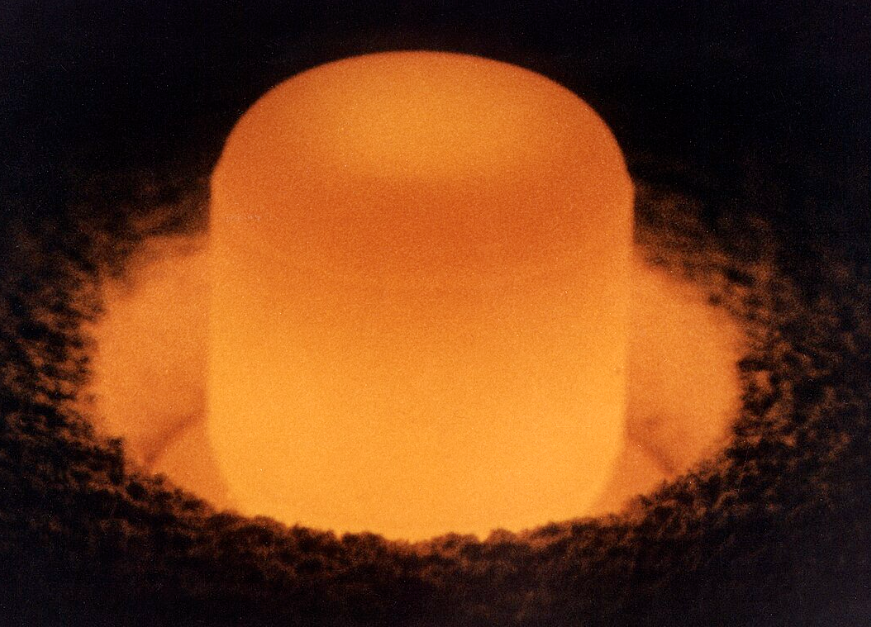
Source: Wikipedia. A pellet of 238PuO2 glowing from decay heat.
238-Pu is produced by neutron irradiation of 237-Np producing transient 238-Np with its 2-day half-life and subsequent beta decay to the 238-Pu. Chemical separation of the plutonium from residual neptunium is straightforward but, like all chemistry with radioisotopes, burdened by the need for radiation shielding for safety.
238-Pu is presently in short supply in the US. The Savannah River Site was producing “bulk” 238-Pu but was shut down in 1988. After closing of Savannah, the US purchased 238-Pu from Russia but the word is that Russia is short on it as well. In recent years other sites have been scaling up production where “scaling up” means producing in the several hundred grams to a few kilograms in a campaign.
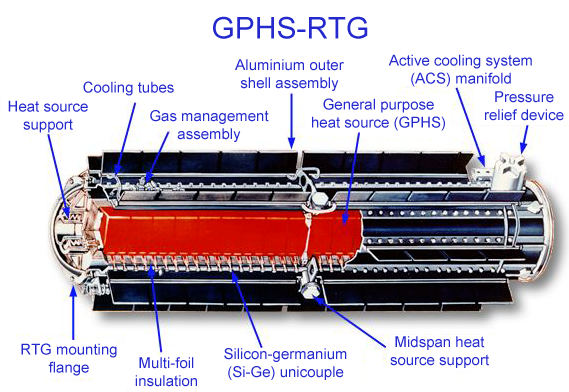
Source: Wikipedia. Just an example of an existing RTG generator.
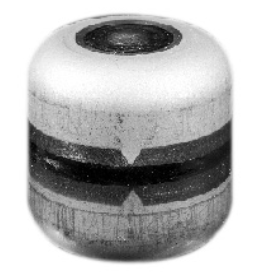
In the RTG, plutonium is not used in the metallic state but as the oxide which is a ceramic or refractory** material like most heavy metal oxides. The plutonium is oxidized to 238PuO2, pelletized and clad in corrosion resistant iridium. According to NASA, this refractory form of plutonium is resistant to an accidental release in a variety of accident scenarios including Earth reentry and rocket propellant fires.
Source: NASA. 238-Pu clad in iridium for use in RTGs.
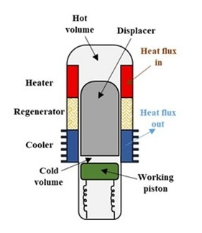
The Seebeck effect is not the only means of producing electrical energy from radioactive decay heat. The free piston Stirling Radioisotope Generator can use decay heat to drive a piston in a Stirling engine using helium gas as the working fluid. Waste heat is dumped at the cooled end of the engine and the linear reciprocating motion of the free piston is used to generate electrical power in the adjacent alternator.
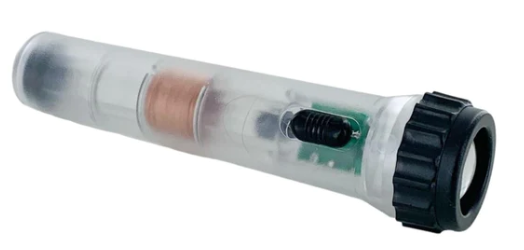
The electric alternator is similar to the electromagnetic flashlight on the market. It works on the ordinary induction principle buy moving a magnet through a coil. You shake the flashlight to recharge it, causing the internal magnet to move back and forth through a coil. Shake it for 1 minute to get 4 minutes of light. The Stirling radioisotope free piston linear alternator operating in this manner can produce 4 times the electrical power of an RGT.
Source: Free-Piston Stirling Engine Technologies and Models: A Review, Carmela Perozziello; Lavinia Grosu; Bianca Maria Vaglieco, Energies2021, 14(21), 7009; https://doi.org/10.3390/en14217009
In 2020 workers Wong and Wilson at the NASA Glenn Research Center reported that they were able to operate a Stirling radioisotope power convertor for 14 years maintenance-free.
Off we go!
Some thought will be needed on screening potential migrants to Mars for age, various physical ailments, dental health, genetic predispositions, sociability and underlying psychological issues. A manic crew member could drive fellow crew members to a murderous rage over time. Such screening has been done with astronauts for a long time. I wonder if choosing to migrate to Mars isn’t a sign of some precarious psychological condition in itself, after all the likelihood of a return to Earth may be slim. It would resemble going to jail in some ways.
Over time, the masses of new Martians living in Muskville will have to decide on what to do with themselves beyond exploratory geology, meteorology and engineering studies of Martian accommodations. Mars is a big, arid and frigid desert with no breathable air. But it may offer a few choices for recreation such as spacesuit hiking and shuffleboard. The outdoor choices will be limited by the Muskvillager’s battery, heating and oxygen supplies as well as ability to get around.
Eventually, all manner of psychological, social and physical maladies will manifest in Muskville and will have to be dealt with. People will spontaneously form cliques eventually giving us-vs-them issues requiring mediation. Unless the New Martian settlers are sterilized, pregnancy is a near certainty. An entire book could be written on complications this would bring. The alternative is to limit the inhabitants to a single gender or to gay individuals- most likely a non-starter.
Death on Mars means that your remains will need to rest somewhere outside the facility. A fresh body will freeze stiff in the Martian cold and remain that way indefinitely. Digging a grave will require energy expenditure and digging tools. Cremation will consume considerable power and may be out of reach.
Something like a hospital with medical supplies and trained staff will have to be present. The few physicians who might be present will be required to be generalists with exceptional diagnostic and surgical skills. A full medicine cabinet to cover a range of maladies will be needed to support this.
As Muskvillagers age out, the range of health problems will widen and require care. Diabetes, cancer, dementia etc. will fade in and people will age and die. This will leave job openings and duties behind which will have to be filled.
In general, the conveniences of modern living will be seriously cut short for the New Martians for a long time. A supply line with Earth that can withstand politics, business failure and war must be maintained.
If I were planning a migration to Mars, I’d worry about maintenance and spare parts for everything. Mechanical things will break. Perhaps an orange-colored Home Depot module will hitched to the back of the lander and sent along with a load of duct tape, assorted bolts and screws, sealant, O-rings, hand tools and cleaning supplies. Don’t forget a few bags of peanut M&Ms.
Wherein I jump to conclusions.
The human capacity for folly knows no bound. Woven in with folly are variable education, emotional inputs and diverse belief systems. The migrants will carry religious and political predispositions that they may or may not reveal in screening for candidates. Friends and relatives on Earth will sicken, age and eventually die but access to a return trip to earth may be severely restricted or effectively impossible.
On reflection, establishing even a modest Mars base will involve large energy inputs. Getting to the surface of Mars with enough reserve propellant for the return trip, the establishment of shelter, oxygen and water supplies are the priorities. Beyond just surviving day-to-day, there is interest in the possibility of putting Martian minerals to use as building materials or even water and oxygen production.
There are indications of frozen water on the surface of Mars in certain limited locations. Where there is water there is the possibility of using electric power to produce oxygen. The hydrogen produced may have utility somewhere but its use for combustion seems unlikely due to the corresponding amount of oxygen needed.
Anywhere you have silicates, aluminates and metal oxides, you have oxygen. Silicon and aluminum both have a strong affinity for oxygen and as such represent a thermodynamic well requiring steep energy inputs for oxygen extraction from minerals. Even worse, many silicates and aluminates are oligomers, chain polymers or network polymers that render them insoluble solids with high melting points. Silicates, aluminates and metal oxides are all comprised of a central atom- silicon, aluminum, or a metal -that are electron deficient by virtue of being connected to oxygen anions. In order to liberate oxide from oxidized silicon, aluminum or a metal, something negatively charged needs to come in and displace the oxide species. Metal oxides like the iron oxides are very often refractory requiring high temperatures to react. Then there is a long list of oxyanions like sulfate, phosphate, hydroxide, chromate, ferrates, molybdates, titanates, tungstates, manganates, etc., each with metal cations. After these there are the polyoxyanions …
The point is that there are a wide variety of oxide species to be found in rock and soil with differing properties. In the end, a negatively charged oxide anion must be oxidized to produce molecular oxygen.
A thermodynamic well resides in a substance where atoms come together to form strong chemical bonds and release a great deal of heat into the surroundings. The same amount of energy that was released is minimally what would be needed to drive the reaction in the reverse direction. This bond forming heat energy is dispersed amongst the large number of surrounding molecules. The heat evolved in forming the original bond produces a high temperature locally, but as it spreads out each succeeding layer of neighboring molecules gets a smaller and smaller share of the original energy. As the bond forming energy release is spread over more and more molecules, the resulting temperature rise of the succeeding layers get smaller and smaller.
Newton’s Law of Cooling says that rate of heat flow is directly proportional to the temperature difference between contacting objects. The greater the temperature difference, the more useful work (heat and work are both energy) that can be done. Large temperature differences transfer large quantities of energy. Low temperature differences result in less energy transferred. As the heat spreads to the surroundings it produces decreasing temperatures as the heat conducts away and the ability to do work diminishes. This constrains the recovery of waste heat.
The diffusion of energy in this manner is what entropy is about- the irreversible loss of energy to the surroundings. If you are tempted to talk about entropy, consider that it has to be consistent with its unit of measure: Entropy, S, equals energy per degree Kelvin or Joules/Kelvin (J/K).
In order to get molecular oxygen from minerals it will require a great deal of energy expenditure per kilogram of oxygen. Not only that but specialized equipment and chemicals. Any oxygen produced will have to purified and compressed into cylinders.
MOXIE
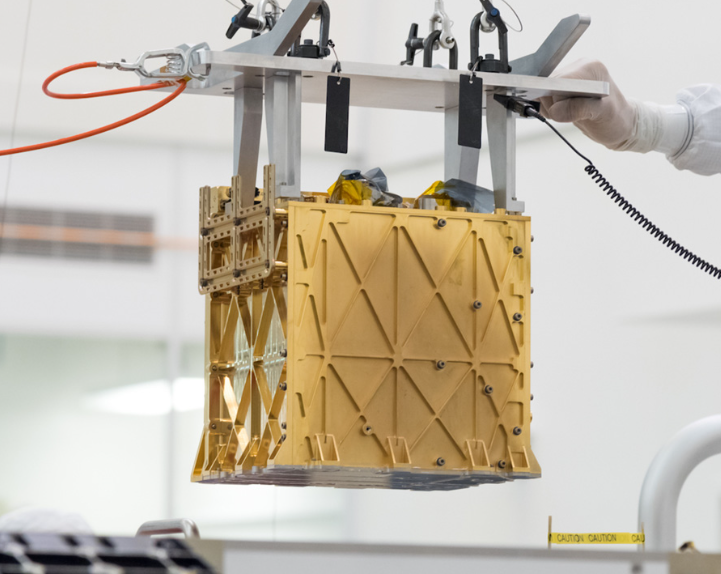
The extraction of molecular oxygen from the abundant carbon dioxide atmosphere seems desirable and has actually been put to the test on Mars. A prototype molecular oxygen generator called MOXIE went to Mars on the Perseverance rover and successfully produced oxygen from carbon dioxide beginning in 2021.
Source: NASA. The MOXIE package installed on the Perseverance rover.
The MOXIE oxygen generator is a solid oxide electrolysis device that operates at 800 oC and uses a stack of scandia stabilized zirconia ceramic electrolyte. An excellent source of information on MOXIE can be found at this Science site.
About 10 % yttria (Y2O3) or scandia (Sc2O3) will prevent the zirconia (Zr2O4) electrolyte from undergoing a phase change that causes the ceramic to fail at high temperature. From personal experience I know that scandia is chosen as a better diluent for zirconia because it allows lower temperature operation than yttria by perhaps 200 oC. The lower operating temperature with scandia allows for better sealing of the cell. High temperature seals are very problematic at these operating temperatures.
The MOXIE electrolysis cell uses a nickel coated cathode for reduction of the CO2, a ceramic zirconia/scandia electrolyte that allows oxygen anions to selectively pass through, and an anode where the anions are oxidized and combine to form O2 where it is captured. MOXIE produced O2 at a rate of 6-8 g/hr while on Mars. The process vents carbon monoxide waste as well as unreacted CO2 at the cathode where it is vented.
A limiting factor in operating MOXIE is the operating voltage across the cathode and anode. Two kinds of chemistry can occur within MOXIE. Carbon dioxide can be reduced to form oxide or carbon, depending on the flow rate of CO2 and the operating voltage. The Nernst voltage, VN, is the minimum voltage necessary to do the chemistry. At about 1.1 volts the cell will reduce CO waste biproduct to carbon on the cathode. This is called “coking”. Carbon formation on the cathode impedes the function of the cathode and reduces the output of the cell. The voltage for coking varies very little with flow rate.
The VN for the desired reduction of CO2 to oxide (O–) and CO at a low flow rate is around 1.0 volts and at high flow rates drops to about 0.95 volts or just a bit lower. So, the “normal” operating voltage range then would be between 1.0 and 1.1 volts to prevent fouling the cathode with coke. The operating voltage window seems a bit narrow. It was found that while a stable operating voltage could be supplied, the resistance of the cell was very sensitive to temperature making stable operation a bit delicate.
Pyrochemistry
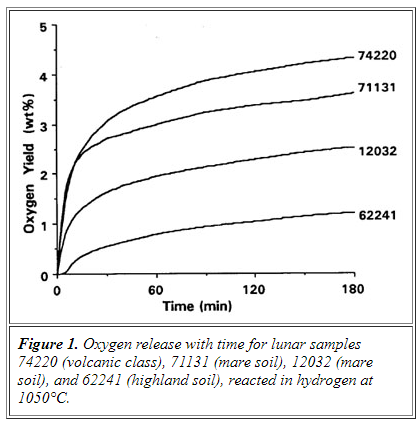
Extraction of oxygen from lunar mineral samples has been done previously (below). All of the mineral samples were iron rich and gave yields of 2 to 5 % in the form of water. The samples were from Apollo 17 and consisted of ilmenite (FeTiO3), basalt, soil and volcanic glass. The process uses hydrogen at a reaction temperature of 1050 oC producing H2O. Presumably the water vapor is mixed with hydrogen during and after the reaction. The water can be isolated by simple condensation in the presence of the hydrogen.
Reduction of Ilmenite: FeTiO3 + H2 — > Fe + TiO2 + H2O
To use the process described above, high temperature is required for the hydrogen reduction in a refractory vessel. This requires considerable electrical energy input to heat the thermal mass of the vessel and the regolith. Spent material will have to be removed and discarded. Perhaps the heat can be recovered for general facility heating. Oh yes, the recovered water will need to be electrolyzed to produce molecular oxygen and hydrogen. This process will use plenty of electric power as well as for the compressors to store the O2 in pressure bottles. In principle the hydrogen can be recovered for reuse in the hydrogenation vessel.
The above process applied to ilmenite produces metallic iron and titanium dioxide, a white pigment. FYI, ilmenite is a common raw material for high purity titanium dioxide production. It is high purity because the titanium dioxide is prepared from titanium tetrachloride which is isolated by distillation from the ore matrix after fluidized bed chlorination.
The first Martian settlers will have to bring every single thing necessary to live on the planet. That includes launching it and landing it on the surface intact. Landing on Mars is tricky because the atmosphere is too thin to provide much aerobraking. The Martian surface pressure is the same as the Earth’s at 80,000 ft altitude and the temperatures are frigid.
Let’s say we successfully land a crew and set up housekeeping. What are they going to do with their time? These missions are supposed to last about 2 years including a lengthy transit time. They can collect various kinds of data on Martian geology and weather and send it back to earth. Somebody will get publications out of it. Eventually, somebody will decide that there must be other things to do besides geology and meteorology. Naturally there will be much ongoing R&D on the pragmatics of living on a remote Martian outpost in a crowded pressure can.
Eventually, the question of what non-research living will look like. Shelter will need construction from some kind of materials. Every new section of shelter will need to be airtight and equipped with environmental controls, sanitation and power. Bulkheads between sections will need to be in place to isolate calamities.
Support staff will be needed one day to provide critical services and perform facilities maintenance. This would also include medical staff, emergency care, food & sanitary support, electronics and IT support and administrative staff for the inevitable paperwork. The lander will need rocket engineers for upkeep and repairs to assure launch reliability for the return trip. Do rockets exist that can sit for a year fueled and then reliably launch and insert into a trajectory back to Earth? There are many, many problems to be resolved in many areas.
After some period of time, a crime will happen on Mars. It could be petty theft, assault or even murder. Someone will have to be appointed to look after law and order. An astronaut-sheriff, sergeant at arms or just the po-leese. What kind of due process will be available to a suspect in a Martian colony? Guns will be too risky to have in the settlement given that a bullet could pass right through a bad guy and rip through the structure creating a leak.
On earth, doing independent research requires getting academic credentials, finding a position, grading exams for goddammed freshman chemistry, executing an R&D program, and then going home every day to refresh and have a social life. Imbedded in all of this we have courtships, marriage, mortgages, babies and divorce. We manage the ten thousand details of modern life and interact with our families and social networks. We mourn those we lose and celebrate our achievements. We enjoy good health and suffer injury and sickness and eventual death.
On Mars, the equation will be a bit different. Many of the above life elements will apply, but from a great distance. Instead, we will be confined to a small space with an unchanging group of fellow crew members. The distance to Earth from Mars is constantly changing and there will be a period absent any communication when the earth is behind the sun.
Eventually, research on living in space or on Mars will wind down to minutae if it hasn’t already and people will have to find other things to do. The funding for living off-world will have to switch from R&D to … what, a lifestyle?
I wonder if there will ever be room for commerce and jobs on Mars. I can see running a canteen or restaurant for profit but stocking them with earth supplies will be prohibitively expensive and infrequent.
What joy can there be living in a pressure can on a hostile planet? What few hermit-astronauts there may be might find it acceptable if they never need a dentist. Perhaps dentures or implants should be routinely fitted to all visitors to Mars.
The second stage of Mars exploration will have to ramp up progress on sustainability. Using Martian soil as raw materials for construction and for crops. As the Martian population rises beyond the first few rotating crews, what will the immigrants do with their time in can-living on a hostile world? Would going to Mars to lead an utterly confined life with nothing to do be an attractive draw?
Epilog
I think that settling on Mars is not such a great idea overall and specifically would be wasteful of resources that should be applied to the rehabilitation of the biosphere on our home world. It would somewhat resemble living on the Amundson-Scott Station on the south pole but without the benefits of breathable air or supplies regularly shipped in. Further, the lack of radiation shielding on the surface of Mars will offer 40-50 times the background radiation as on Earth, not counting the occasional storm of angry solar protons the sun flings out now and then.
** NASA does not use the terms “ceramic or refractory” in its description of the 238-Pu heat source. This is my choice of words.
As I approach retirement in a year or so, I’m overcome with intrusive thoughts as I inventory my accomplishments and failures. Questions like “what have I done with my life?” or “why the hell did I do that?” are dangling in my consciousness more than usual. It’s normal sentient-being stuff I suppose. I never had the impression that farm animals agonized over such things. One lucky benefit of being a bovine.
I find myself disappointed over not having chosen a career path that might have led to a more impactful life. The closest I got was as a chemistry prof helping students get through organic chemistry. It was very satisfying and I managed to meet many wonderful students and faculty. Chemical science has provided a comfortable and intellectually stimulating lifestyle. One negative I suppose is that a chemist isn’t much good without an institution from which to practice chemistry within. Outside of an organization with no lab and no free access to Chemical Abstracts, how is a person to remain connected to chemistry? I guess you just don’t. Some say that a I could be an adjunct prof somewhere. But that is just being a hired hand in a school too cheap to pay much. I wouldn’t be surprised if they picked up adjuncts at Home Depot early in the morning for day labor. The poor sods would load up in the back of an old Ford pickup and trundle off with their sack lunches.
One of my faults as a person is a deficiency in recreation and doing vacations. The fact is that I’m perfectly happy at home reading or watching YouTube videos on geology, writing this silly blog, war reporting on Ukraine or following Itchy Boots. The problem is that guys who don’t stay active during retirement tend to die soon thereafter. I’m not ready to croak just yet so I decided to stay on for another year.
My memory begins in the early 1960’s. One of my earliest memories is watching the funeral of JFK on black and white television. Up until age 14 most of my time was spent on a hog, corn and soybean farm in Iowa. I grew up very aware of the US space program on television and was captivated by it. My father was a private pilot/farmer so airplanes were in our lives. I recall him in his friend Daryl’s Stearman buzzing our farm. They would drop a roll of toilet paper producing a long streamer of paper sailing to the ground and then fly back to the airport. We would go to flight breakfasts at the local airport where we would feast on pancakes, sausage and scrambled eggs inside someone’s hanger. Afterwards they gave kids airplane rides for a penny a pound.
Source: Corn picker mounted on a tractor. Public Domain.
My family still used machines like the corn picker above when I was a kid. For a kid interested in space, these machines made fantastic spaceships of the imagination when sitting in the machine shed. Why didn’t I try to be an astronaut? I did, sort of. I got a pilots license then entered Air Force ROTC in college in 1980. Between nearsightedness and a superabundance of qualified candidates with perfect vision from the Air Force Academy down in the Springs, the odds looked poor. My civilian pilots license was sneered at and valued as less than nothing, but I could train to be the GIB- Guy In Back, handling weapons systems and electronic countermeasures. While blowing things up could be exciting, what do you do when you get out? Naah.
Instead they tried to funnel most of us off into some missile squadron up at F.E. Warren AFB in Cheyenne, WY. It is an honorable slot for many good Americans, just not me. I lived an hour from there and had no interest in southeastern Wyoming or the Dakotas. There would be long stretches underground with someone authorized to shoot you if they doubt your sanity. The whole point of missileer training was to get the launch orders confirmed and the bird launched before the silo got cratered when Soviet MIRVs came sailing in from over the north pole. You can drive by missile silos in northeastern Colorado. Just don’t linger at the fence or a USAF vehicle with armed military police will pull up with considerable urgency and ask just exactly WTF you are doing.
A civilian commercial airline flying career in the 1970’s was complicated by the number of retired Viet Nam pilots who dominated the flying slots at the airlines, or so I was told. They had turbine engine time in complex, very fast aircraft and I had time with a 100 hp Lycoming horizontally opposed 4-cylinder engine poking holes in the sky at 95 knots. I was overly concerned about this I think.
Anyway, organic chemistry captured my fancy and I went for it. This was a constructive career whereas blowing things up was destructive. I chose the former.
Back in graduate school we had a postdoc in the group who was a chemistry professor on a 1-year sabbatical from the Beijing Normal School in China. He was a great guy, but like most professors, a bit rusty in the lab. One day a few of us were exchanging our respective backgrounds. When my turn came around I mentioned that as a child I grew up on an Iowa farm where we raised the usual spectrum of crops and livestock- Corn, soybeans, hogs, cattle, sheep, a couple of horses and 5 kids. He looked at me for a moment and then said with a grin “Ah, peasant!”
I was startled for a moment because I had never considered this description before. I had always thought of peasant as mildly derisive, but as I thought about it, he was exactly right. Our income was low and we subsisted on what we could grow and sell. We always had home grown beef and pork in the meat locker in town and apples, walnuts and canned veggies in the cellar. Summer evenings we would go to the lake, eat fresh watermelon while swatting the mosquitos and do a bit of fishing for bullheads. It was ordinary rural life like millions of others had. I was a young peasant boy.
Well, so what? As I watch Trump’s festering MAGA movement infect its way across the US and begin to spread and flex its muscles, I’ve been looking for the right words to describe it. For me, finding the right words for something has always been at the entrance to the path of understanding. Last night I finally found the right description- Peasant Uprising.
The electronic media tends to focus on MAGA people wearing their uber-patriotic apparel. My inner snark keeps whispering that they may not be on the higher end of the bell curve as far as smarts go. Many are attracted to QAnon and its bulging pantry of wacky conspiracy theories. It is easy to be lazy and make sweeping generalizations about idiocy, ignorance or stupidity. To be sure, there are highly educated people who are also aligned with Trump’s MAGA handwaving. Some may actually believe the conspiracy theories but others are just surfing the populist wave.
Throughout European history there are instances of peasant folk, serfs and artisans rallying together to put an end to the rigid control of landlords and upper echelons of society that keep them in poverty. Violence would often erupt and the rebellion would be put down or some compromise would arise. It didn’t always end well for the peasant class.
1573 Peasant Revolt reenactment in Croatia. A contemporary revolt in the US wouldn’t be as squalid and it will be televised unlike those of centuries past. Hacking and stabbing wounds will be replaced with gunshot wounds. January 6 was a prelude.
I’m not suggesting that what has evolved in the US since WWII is the same. But what has happened in the US is that the opportunity to accumulate wealth today remains out of reach for a large fraction of citizens. Tens of millions of citizens are living paycheck to paycheck with debt piled high, assuming they could get the credit to get that way. Inflation has pushed up prices across the board irrespective of whether or not business expenses actually rose in proportion to the inflation rate. An inflationary period is a great opportunity to raise prices because customers will go along with it. Prices are always what the customer is willing to pay.
What I am suggesting is that there is a large fraction of the population in the US who have been passed by as ever advancing technology is improving our way of life. This has created previously unheard-of job opportunities but only for those with the right education. Organizations have required 4-year degrees or 2-5 years of experience in the field. A degree may or may not have educated the applicant in the particular field, but it does provide a credible credential that an applicant can start a challenging task and complete it over set timespan. I would say that this credential is nearly as important as the knowledge gained in college in judging the fortitude and character of an applicant. Obviously there are exceptions.
Many people find themselves stranded in modernity without sufficiently strong credentials to advance with the times. Anyone over 25 might face the prospect of enrolling in college to get the right credentials for a new profession or just to advance. This is difficult for most people to pull off. Children and debt can totally shut down this option for them. My guess is that a great many of Trump’s MAGA followers fit this description. Thus the comparison with a peasant uprising.
The MAGA movement may remain mostly bloodless or not. They represent a large group of angry and dissatisfied people who have an extremely varied level of understanding of civics. Many hold unfounded beliefs that are nothing more than boat anchors holding them back.
Libertarian utopianism suggests that everyone has the option of starting their own business. Some can do this, but most will find themselves under-capitalized and with no properly zoned facility in which to work. Yes, some people do get by making burritos and cupcakes in their kitchens or doing handyman work. But the market is limited for these services. The reality of rent/mortgages and health insurance make the cash flow requirements difficult to meet.
As a former peasant boy, this is what I’m observing.
This is an updated re-release of an old post from Dec 10, 2010. I have applied a bit of polish and a spit shine, but not much. Since I wrote this, political correctness has morphed into wokeness.
==========
I keep hearing comments by conservative people who are obsessed by what they call political correctness. In these commentaries, some kind of sarcastic parody is made regarding an alleged trend to ban the use of the phrase “Merry Christmas”. Neoconservatives latch onto this like barnacles on the bottom of a tramp steamer. Inside their heads they imagine that a cabal of liberals are scheming to take their guns and their religion from them.
At the most recent liberal cabal meeting, we decided to let the gun owners keep their damned guns. There was a vote, however, where a proposal was made to require gun owners to take turns cleaning up the blood and guts after a shooting and to pick up the funeral costs.
Ok, that was a joke. Actually, we voted on something else.
If other liberals are like me, then not only do we not want to deprive them of their damned firearms and religion, minimally we would simply like to be out of shooting range.
Christmas has a secular component and practice that even a bitter, crusty, non-religious liberal like myself can feel comfortable with. But as far as possible insensitivity to Christians, they’ll just have to get over it.
In my limited sphere I don’t know of a single liberal who is trying to replace “Merry Christmas” with “Happy Holidays”. The only time I hear of it is when a conservative repeats it sarcastically as a token of disapproval. Only conservatives carp about this. It’s a red herring promulgated by that famous dead yapping cur himself, Rush whatshisname, in the name of ratings.
——————
I’m moved to comment on what makes some people liberal. A recent article in Slate was written by a conservative, Daniel Sarewitz, who seems to be genuinely perplexed at the apparent trend of scientists, or at least academics in general, to be liberal. It is though he is talking about a smallpox epidemic. While I have no idea as to the conservative/liberal ratio of scientists and academics, I can say that from my perch on a small and obscure branch of the tree of science, scientists tend to be overall a bit left leaning. However, make no mistake, there are plenty of conservatives in the group as well.
Indeed, many of the industrial chemists I am in contact with are libertarians, religious conservatives or just plain-vanilla orthodox conservatives. So, from my limited data set, Sarewitz’s complaint appears a little specious to me.
He probably refers to the life and eco-sciences, earth science, astronomy, big-time-physics, etc. I suspect that the balance is different in these fields.
But why would scientists trend towards a liberal viewpoint? I have some ideas. First, the scientific approach to the world relies on study, measurement and analysis. Scientists tend to study analytically or, to use another term, critically. Critical study of the physical world requires a willing suspension of belief. A formal education in science takes the student through many, many opportunities to see how scientific knowledge was acquired by successive approximations and sometimes led into fruitless cul-de-sacs. A scientist must keep a loose grip on theoretical viewpoints because experimental results frequently contradict fundamental assumptions. Fame and glory in science goes to those who tip over the apple cart of concepts and theories. All scientists are excited at the prospect of looking at something in a new way or bringing a puzzle into sharper focus.
“But, it’s just a theory …” I hear this ignorant comment frequently. A theory is just a model of a particular aspect of reality that is then strengthened or weakened by experiment. It is not uncommon for theories to be tossed aside in the junk pile when data or a better theory comes along. Science advances by successive approximation. One does not “believe in” a theory. It is not a “devotional” thing. You agree with it to some extent or you dispute its accuracy. It’s an “analytical” thing. A theory does not have to be completely accurate to be useful. Even a faulty theory may provide certain perspectives that are useful.
Many conservatives whom I know also appreciate study and measurement. Numbers people are greatly influenced by numerical data regardless of their political stripe. But in the religious realm there is often a trend towards devotional study rather than critical study. Devotional study is about finding a greater understanding of doctrine or greater fidelity with a catechism of beliefs.
Religionists upset with the notion of the separation of church and state often assert their right to be heard and to express their religiosity in public spaces. Some might take this as a simple matter of freedom of speech. And if that is all the religionists want, that would be fine. But if you look closely, they don’t want just speech, often times they want government endorsement of their doctrine. They want equal time in the public schools. They want to bring the civil sphere into alignment with their beliefs. “Go ahead and teach Darwinian evolution, but Creationism should get equal time.” Creationism is just a Christian conservative flavor of denialism. It is the denial of evidence in favor of a magical world of spirits and things that cannot be physically evaluated.
Religious services are about the veneration of the sacred. The word “sacred” means that which is beyond question or understanding. In a real sense, holding something sacred is to set apart a concept or doctrine from critical analysis. Religionists are not interested in a public critical analysis of their precepts. They are interested in broader devotional coverage, i.e., the fruits of evangelism.
It isn’t unusual for a liberal person to be compelled to do critical analysis of their basic beliefs over a lifetime. The very notion of spiritual sacredness is antithetical to one who seeks analytical truth. The policy that some belief systems are beyond analysis is simply a form of thought control and is more suited to the iron age than the present. Being a nontheist I hold human life sacred. I’m very partial to kindness too. But this does not require that I believe in a supernatural universe.
For a great many people, college is a time and a place for intellectual experimentation and exploration. It is a place where you can have chance or purposeful encounters with new ideas, people and careers that were beyond your previous horizon. The university is an institution where critical analysis of the great world systems takes place. The active examination and betterment of our world is the realm enjoyed by the progressive. Progressives push the boundaries of knowledge and thought. Sometimes focused analysis reflects well on our human or national institutions and sometimes it does not. But knowledge hidden is knowledge abused. That universities are loaded with liberals is a natural outcome of the youthful intellectual adventure the students are taking. It is a journey of discovery of the self and one’s place in it. It can be both joyous and a bit disappointing. New lands and new boundaries are there to be found.
The current efforts by American conservative Christian nationalists to scour out all traces of liberalism in education is worrisome and frankly, a little stupid. The assault on New College by the governor of Florida is a dark example of state government taking a giant step backwards by imposing one-sided political controls on a public resource. This in itself shows that American education has failed a great many people. America has generally failed in citizen’s knowledge and practice of civics and the long, troubled path of history to the present.
Just take a long look at the MAGA movement. Make America Great Again. When was this actually? If you look below the surface in any period of US history, you’ll find political problems and upheavals galore. There have always been social struggles in our history. Formerly venerated American Heros like Buffalo Bill Cody and the near extinction of the buffalo. General Custer and what he was really doing at the little Bighorn. Or the revered westward expansion with the Gold Rush and migration of the pioneers which were part of our celebrated manifest destiny. These were national enthusiasms that have been endlessly celebrated and woven into textbooks for generations of school kids.
The ugly truth to much of the actions of our ancestors is that a great many innocent people died as settlers began to occupy North America. Land was stolen, European diseases were spread, native Americans were murdered and robbed of their land and resources and their children were reprogrammed in government schools. Survivors were herded into reservations with little in the way of amenities or natural resources that we take for granted. Treaties were made and broken. This is also part of our history.
There is no benefit in self-flagellating ourselves over the sins of the past. However, what we need to do is to take note of the mistakes of the past and steer a better path to the future.
Do I believe that American conservative thinking and liberal thinking are equally right? Not at all. I’ll take progressive liberalism any day.






 Lamentations on Chemistry