Category Archives: Bohemian

Wireless Wierdness

I just can’t get over the absolute wierdness of being in a crowd, say at the airport, where a large fraction of people are jabbering into a phone plastered to their ear or they are standing, walking, sitting, or pacing with heads bowed down, pecking and stroking their mobile communication device. It is a kind of enchantment. A portal to other coordinates in the continuum. It allows us to receive or deliver stress all the damned time. Nobody is safe from the possibility of belligerent assholes reaching out for you while waiting at a stoplight or well-meaning associates braindumping all over your eardrum as you search aisle 5 at the supermarket for a can of chickpeas.

Driving yesterday, I took defensive measures as a dipshit in a red Ford Expedition overshot a turn while closing in on me. The distracted driver chose to complete a task on the handheld device before putting the oversized killing machine back between her yellow and white lines. I know this because the driver plastered the phone to her ear as she looked up when I passed by.

It has been 2 months now since I powered down my Facebook account. Facebook is a colossal time suck. It is a kind of gravitational well that can pull wandering bodies into orbit and lock them into some perverse synchrony for purposes unknown. Facebook is a kind of electronic teat that nurses us and keeps us from having to face our dark thoughts in quiet moments.  It is also a perfect venue for those who just have to broadcast their thoughts in every waking moment.

As a Facebooker, I was pretty boring. I don’t have photos of grandchildren or garden flowers to post. I’m a serial science nerd and nobody wants to hear about that. Okay, that’s fine. I soon realized that Facebook was only providing delayed and fragmented social awkwardness that I could be having face to face in real time and without having to pay for electricity. So I pulled the plug.

Plasma

Today I found myself peering at the lovely lavender glow of opaque argon plasma through the viewing screen of a gleaming new instrument. The light-emitting 8000 K plasma sits apparently still alongside the conical metal skimmer. Somewhere a Dewar was quietly releasing a stream of argon into a steel tube that was bent in crisp military angles into and through walls and across the busy spaces above the suspended ceiling. Another cylinder quietly blows a faint draught of helium into the collision cell. A chiller courses cooled water through the zones heated by the quiet but savage plasma. Inside a turbo pump labors to rush the sparse gases out of the mass analyzer and into the inlet of the rough pump and up the exhaust stack.

Up on the roof, the heavy and invisible argon spills along the cobbles of roofing stones until it rolls off the roof onto the ground where the rabbits scamper and prairie dogs yap. The helium atoms begin their random walk into space. The argon shuffles anonymously into the breeze and becomes part of the weather.

All of the delicate arrangements; all of the contrivances and computer controls in place to tune and play this 21st century marvel. And a wonderment it is. The ICPMS obliterates solutes into a plasma state and then taps a miniscule stream of the heavy incandescent argon breath that trickles into the vacuous electronic salsa dance hall of the quadrapole.  All the heat and rhythm for the sake of screening and counting atomic ions. What a exotic artifact of anthropology it is. And it all began in a rift zone in Africa millions of years ago.

Dearly Departed

Our next play, Dearly Departed, is in production. I play a character named Royce. This part has some pretty good lines. I’ve always played some fairly minor characters. The trick is to always do your best no matter what the part. A play is an ethereal being that lives for about 2 hours and then folds into a mere memory.

The job world is sort of like that too. You might find yourself in what appears to be a minor part in a large production. You get upstaged and your lines are walked over by the main characters.  But the main characters are carrying larger risk. If they flub their cues or mangle their lines, the effect is commensurately larger. On some projects you definitely don’t want to be the leading character. What is critically important is that you play your part the best way you can, show up for all of the rehearsals, and most importantly, pay close attention to what the other actors are saying and doing now.  The best actors are always in the moment.

Is this as good as it gets?

I’ve had this notion (a conceit, really) that as someone from industry, I should reach out to my colleagues in academia in order to bring some awareness of how chemistry is conducted out in the world.  After many, many conversations, an accumulating pile of work in ACS activities, and a few visits to schools, what I’ve found is not what I expected. I expected a bit more curiosity about how commerce works and perhaps what life is like in a chemical plant. I really thought that my academic associates might be intrigued by the wonders of the global chemical manufacturing complex and product process development.

What I’m finding is more along the lines of polite disinterest. I’ve sensed this all along, but I’d been trying to sustain the hope that if only I could use the right words, I might elicit some interest in how manufacturing works; that I could strike some kind of spark.  But what I’ve found is just how insular the magisterium of academia really is. The walls of the fortress are very thick. We have our curricula firmly in place on the three pillars of chemstry- theory, synthesis, and analysis. In truth, textbooks often set the structure of courses.  A four year ACS certified curriculum cannot spare any room for alternative models like applied science. I certainly cannot begrudge folks for structuring around that reality.

It could easily be argued that the other magisteria of industry and government are the same way.  Well, except for one niggling detail. Academia supplies educated people to the other great domains comprising society.  We seem to be left with the standard academic image of what a chemical scientist should look like going deeply into the next 50 years. Professors are scholars and they produce what they best understand- more scholars in their own image.  This is only natural. I’ve done a bit of it myself.

Here is my sweeping claim (imagine the air overhead roiled with waving hands)-  on a numbers basis, most chemists aren’t that interested in synthesis as they come out of a BA/BS program. That is my conclusion based on interviewing fresh graduates. I’ve interviewed BA/BS chemists who have had undergraduate research experience in nanomaterials and AFM, but could not draw a reaction showing the formation of ethyl acetate.  As a former organic prof, I find that particularly alarming. This is one of the main keepsakes from a year of sophomore organic chemistry.  The good news is that the errant graduate can usually be coached into remembering the chemistry.

To a large extent, industry is concerned with making stuff.  So perhaps it is only natural that most academic chemists (in my sample set) aren’t that keen on anything greater than a superficial view of the manufacturing world. I understand this and acknowledge reality. But it is a shame that institutional inertia is so large in magnitude in this and all endeavors.  Chemical industry really needs young innovators who are willing to start up manufacturing in North America. We could screen such folks and steer them to MIT, but that is lame. Why let MIT have all the fun and the royalties?  We need startups with cutting edge technology, but we also need companies who are able to make fine chemical items of commerce. Have you tried to find a brominator in the USA lately?

The gap between academia and industry is mainly cultural. But it is a big gap, it may not be surmountable, and I’m not sure that the parties want to mix. I’ll keep trying.

The View

I don’t know where others sit in the chemical industry, but the view from my chair seems encouraging. The market is abuzz with activity. The chemical industry and the people who run it are, well, rather stodgy.  So to see lots of rfq’s flying around the ether is encouraging.

Every day I wake up and thank whomever will listen that I did not go into pharmaceuticals. There is a vibrant world outside of pharma and I’m glad to be in it. Those of you in pharma, I’m honestly happy for you. I’m relieved that so many bright people dig that brutal business.  But for me, I’m glad I let that bus go right on by.  The public corporation GMP life is not for me.

I have a PhD and a post doc in asymmetric organic synthesis. It was interesting at the time and admittedly hard to let go of, but I have few regrets today. If I’d have stayed in academics, I be teaching my 18th year of 2nd semester organic or (*gulp*) general chemistry and doing battle over meager and diminishing departmental budgets. That is, if I had survived student evaluations. What dipshit thought of student evaluations as a tenure and promotion metric?  The little punks should be grateful to be sitting in the classroom. Well, ok. That was a bit harsh.

I think the best part of having a background in synthesis is that you become very mechanistically oriented. Latent and blatant functional groups bristle and are pregnant with possibility. The ability to make a good stab at what happens when two molecules interact is a very powerful thing and I’m grateful for what little I can do.  And if you think that is false modesty, just try to go back and make sense again out of ligand field theory or lanthanide chemistry. Chemistry is a big field and much of it remains unfamiliar.

On the mysteries of show business. Th’ Gausslings 14th Epistle to the Bohemians.

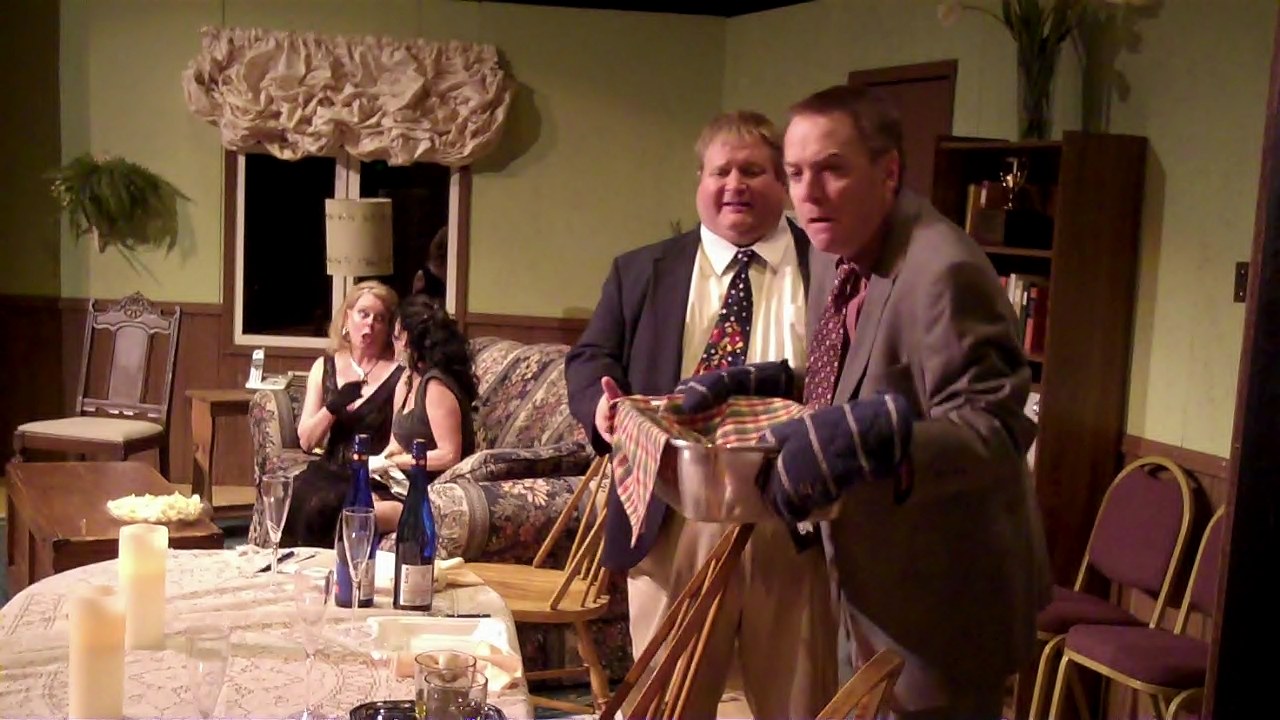
Last night, our production of The ODD COUPLE had its biggest audience to date. The audience enjoyed the show. They laughed at our delivery of Neil Simon‘s lines and were engaged in the story.  The suspension of disbelief actually happens.

The ODD COUPLE, Felix with burned London broil (1/21/11, Moon Theatre Company)


What is clear to one who is involved in this sort of thing is that once you have the show cast and directed properly, the play takes on a life of its own.  But not all aspects jump to life and run around.

Show business has two sides- the art side and the business side.  As I said above, the art aspect is taken care of by the director.  The business side, the haunting space of the producer, is perhaps more difficult in my experience.

The business side comprises the nuts and bolts of funding cast & crew, props, the venue, set design and construction, etc.  This is very concrete and relatively easy to understand and manage.  What is less than easy to understand is the publicity function. 

Publicity today must be done in the schizophrenic world of print and internet media.  The center of the community theatre-going demographic are the retired people and those over, say, 60 years of age. Go to most any production and you’ll see the Q-tips and Blue Hairs in the seats.

In order to put butts in seats, this group must receive the message and thence be wrenched from the recliner in front of the DirecTV and compelled to go out into the evening traffic, find a parking spot, and buy a ticket. 

After rehearsal the other night, a few of my fellows and I repaired to the local establishment for some beverages. This public house featured an open mike performance by local musicians who were actually quite good. The tables were filled with an entirely different demographic group than we had set our sights upon and the air was full of expectant optimism.

After the waitress delivered my cold glass of liquid bread I put  to her a sincere query.  I asked her what it is that would compel her and her fellows to attend community theatre?  This fine specimen of a 20-something stood there flummoxed. She was accustomed to fending off the unwanted advancements of inebriated customers, but this sort of question was completely unexpected. She left to tend another table, promising an answer on her next visit. 

On her next visit, the waitress, a former theatre major, said that she would be attracted to a production that was … edgy.  That was it.  I acknowledged her comment and asked her if she ever goes to live theatre performances. She said “no”. I asked her how would such a message find its way to her and her compatriots. She thought about it and replied that she didn’t know. There was no single information outlet that percolated up.

I suspect that this interchange represents the situation in miniature. We have so many channels with densely packed data streams pouring into our consciousness that we are overwhelmed with it. Information is cheap and abundant. The value of any given notice of a public event is diluted to an infinitesmal level by the sheer volume of similar such notifications across the multidimensional space of media.

We do suspect that the Blue Hair demographic still reads newspapers and in the future we’ll throw a handful of money at print advertising. But like everyone else, we’ll be uneasy with the expenditure.  It is very difficult to predict the effect of low intensity advertising in any given medium.

High intensity advertising, on the other hand, is a good way to get the message out. But high intensity advertising is high intensity spending and that isn’t an option yet.

Back to reality.

The holidays are over. The christmas lights are now obsolete. The first big snow storm of the season has come and gone. The cryosphere is unceasing in its wicked attempt to thermally equilibrate my house to a ΔT = 0 across the walls. Only high thermal inertia and a near constant stream of methane into the burners will hold it off.

That jolly elf brought Th’ Gaussling a 1 terabyte external hard drive. Years of pdf downloads and treasured jpeg’s streamed silently onto the drive via the fabulous USB port.  Papers on mining & metallurgy, LiBeB cosmochemistry (on the Lithium dip, one of my fascinations), and thousands of photos.

While picking at the guitar the other day it dawned on me why some people choose to play the base guitar.  Four strings are mechanically easier to play than six. Maybe there are other and better reasons, but this seems like a good one. Then, as you advance, there is playing notes from the fifth fret and above.  My brain plasticity turns vitreous at this level. It comes down to repetition of the basics.

Remember the basics: Task at a time- correction in the right direction;  attitude, altitude, cross check;  and, runway behind you is useless!  Dave Benton, Th’ Gausslings flight instructor, ca 1978.

For me and my day job, 2011 will be very much about thermokinetic issues in process safety. We’re going to install a reaction calorimeter and much time and effort will be needed not only in operating the device, but in folding its use into the development cycle. It is one thing to collect thermochemical data. It is quite another to use it to make decisions concerning engineering and process safety.  Considerable effort in my industrial career has been spent in building structure for information archival rather than just bench chemistry.  I didn’t anticipate that.

Our upcoming production of The ODD COUPLE opens in 2 weeks. I’m still rough with my lines, so there is no shortage of stress there. The thought of opening night and sitting on stage in the lights in front of a darkened audience wonderfully concentrates the mind. Neil Simon wrote some great lines in this play.

Benchtop ESR Spectrometer, Rare Earths, and Global Politics

A company called Active Spectrum is marketing a benchtop ESR unit called the Micro-ESR that performs electron spin resonance measurements. The site says that the system operates at 3.4 and 9.6 GHz and has sub-micromolar sensitivity.  It’s pretty amazing, really.

I don’t know for a fact but the easy guess is that this ESR instrument and the picoSpin NMR spectrometer are based on some kind of rare earth magnet technology. Both instruments use very small cross section sample space, presumably to accomodate a design scheme to bring magnetic field lines together as closely as possible in the probe giving a useful field strength without a big electromagnet.

A quick patent search fails to turn up patents based on some obvious key words. I’ll have to spend some time looking more intently.

Now that I’ve got you hanging on to the rotating frame, lets tip you over with this.  China’s new policy of restricting rare earth element (REE) export as well as the recent announcement that it would be inposing fairly stiff tariffs means that wonders like these two magnet-based technologies are going to feel a pinch in raw material supply and competition real soon. The aggregate demand picture for REE’s will exceed supply by 2014 or so.  Market purists will nod knowingly and chant their homily on the rational allocation of goods by the market. 

But to what extent is China part of a rational market? China, Inc., really consists of a highly nationalized array of business fronts that are backed to the hilt by the Chinese government by internally favorable regulations on ownership and local sourcing. Don’t forget that Chinese currency is shielded from valuation excursions. 

To a large extent, China is leveraging technology developed in Japan and the west with metal resources highly concentrated within its borders to apply a pincer attack on the market place. China has industrial policy that it is steadfastly acting to strengthen its manufacturing base while the USA has an emphasis on aligning its citizens to be more receptive to consumption.

Wouldn’t it be nice to live in a country that tried harder to make its manufacturing industry more robust rather than the present fascination with finance and the well being of financiers?  Wouldn’t it be nice if westerners transferred a bit less of our magic to countries who will turn it into a stick to beat us over the head with? 

It is going to take a lot more than glib talk about the free market to deal with China and the growing influence of nationalized companies around the world.

Patent holiday

It’s been days since I’ve shaved. I’ve spent 3 solid days over the Thanksgiving holiday hunkered down in my office studying patents and following threads through the IP swamps of Mordor.  A friend has engaged me to do some consulting and needs an IP map of a particular realm of industrial chemistry. I have no confidentiality overlap with this area of technology so I agreed. It sounded so easy when I said yes and estimated my fee. Now that I have blown well past anything I could ever hope to recover in terms of billable hours, I’m still blasting and hand shoveling muck from the pit of my own making.

His company is currently putting a plant in the ground to produce a well known commodity and the question foremost in their minds is- what added value beyond [—] does the product have?

I’m reasonably good at diving down the rabbit hole in the patent world and finding what I need to know. But the current project has forced me to press into use more USPTO resources since I don’t have a personal SciFinder account for this work. Especially useful has been the classification system.  Patent lawyers will scoff at my swoon over this and flash their Esquire stinkeye since they are all too familiar with it. But chances are they don’t use SciFinder like chemists do.

SciFinder’s ability to find patent families from a structure or CASRN input is phenomenal. Even from within Markush claims.   I’ve had one search with combined SciFinder/USPTO resources compared with legal specialists using their own search tools. My search was just as exhaustive as theirs. Yes, SciFinder has flaws. And not finding claims is like a negative experiment.  But it is a very good tool for combing the ground.

Part of my approach stems from my natural inclination to browse. I drive people nuts when I go to a store with them because I will thoroughly examine the contents of the store for interesting items.  I drive the merchants nuts because my browsing rarely results in a sale.  (Notice that the theme is that I drive people nuts.)

Once you find a lead patent it is important to search the classification as well as cited patents. It is a simple matter to do a search by classification and dredge up hits. Once the fish are on board, it is about sorting the results and casting the trash fish back in the water. 

Google Patents is an excellent resource and I heartily recommend it. It retrieves pdf’s of the entire patent document as well as providing links to patents cited and those patents citing the patent of interest. It also links to the the classification site at the USPTO. A simple click of the mouse in the USPTO site pulls up a search of all of the patents under that classification.

On occasion, Google patents will not retrieve a particular patent or application. This seems to happen with very newly issued patents and applications in general. For this circumstance I use pat2pdf.org.  You might have to monkey with the formatting of the application number string, but it almost always returns the document eventually.

OK. It’s fine to be able to retrieve a bunch of patent numbers and pdf’s. But soon one becomes overwhelmed by the large amount of highly dense data that has been recovered.  In my surveys, I use a form meant to collect key information, but sized in a manner so as to limit the amount of detail I can write down. Feel free to use this form or modify it as you please.

Patent Summary Blank Form

At some point it becomes useful to use Excel to develop a matrix of patent information. In particular, one can retrieve a list of patents from the PTO and cut and paste them into Excel. They’ll paste as hotlinks, so all you have to do is to right click on the cell and select the unlink option. Tedious but effective.

I have developed an Access database to store patent information and other IP office actions and produce reports for due diligence studies. This is very handy, but eventually you become enslaved by upkeep as is true with all database tools.

Am I suggesting that one does his own lawyering? Not at all.  But if you’re in high tech manufacturing, one must be very careful to avoid infringement. It it crucial that a few technical people in the organization be familiar with the patent picture.  It is far better to avoid infringement in the first place than to have to find a way out of it.

The best way to use a patent attorney is to be informed in all interactions with them.  While they can often noodle through a problem presented to them by napkin scribblings and hand waving, it is best for the client to be knowledgeable about the patent landscape and to help the attorney to focus on the key legal issues. Good lawyering happens when the attorney clearly understands the nuances of the problem and can act accordingly. Having a list of prior art or other IP facts will save you billable hours in the form of research and needless office actions.

Your attorney is an officer of the court and has a legal obligation to honesty and fidelity to the system.  Being well informed in advance and working cooperatively with a patent attorney will go a long way to staying out of litigation.

The other good reason for closely studying the patent literature is to find what some call the “white space”.  This is the negative space around the claimed art that is not claimed and is likely to be free to practice or fertile enough to file a application on. If you Google “patent white space” you’ll find that this is a cottage industry.  A study of white space may provide insight into maneuvering room around a patent.

NatGeo King Tut Exhibit- Ho Humtep of the Ballyhoo Dynasty

Th’ Gaussling went on a minor field trip recently to the local art museum in Denvertown to see the marvels of King Tut. And what a marvel it was … of marketing. It is hard to say that the exhibit met expectations. To be sure, there are some fine artifacts on display.  And it is a splendid example of museum-craft. Notable is the exquisite goldsmithing and scuplture on display. There are decorative articles that resemble a form of gold filigree that are quite impressive for the era. My northern European ancestors were sleeping in hollow logs and howeling at the moon when the Egyptians were doing the work on display.

But at the end of the day, the exhibit is yet another recasting of history in a theatrical form suitable for the attention deficit masses. Case in point:  a video short subject portrays DNA work on a mummy where the scientist assures us that such research is a part of the larger effort to cure disease.  Golly, sounds urgent.

Well, maybe there will be useful findings that contribute to the betterment of human health. But if it doesn’t , is the knowledge useless? I think not. This is the same sort of lame apologia used for jusifying space exploration or studying the frogs of Amazonia. If you are not looking around, you are not going to find new things.

Scientists should stand firm with the conviction that exploration is a net benefit for mankind. We should be more careful that claims of a breakthrough are tempered bya realistic warning about the speed of progress.  We should stop leading people along with false expectations about the fabulous things just around the corner. All progress is the result of prolonged hard work by many people.