
Category Archives: Business

The Nanny State. Gaussling’s 5th Epistle to the Bohemians.

“We live in an age of miracle and wonder” is the refrain from Paul Simon’s album Graceland. All around us and through us are engineered materials devised for their specific physical and chemical properties. Time-released magic bullet drugs that inhibit specific enzymes. Flavorants, colorants, rheology modifiers, and manufactured food substances are engineered and marketed to satisfy our lizard brain’s willingness to shell out cash-for-calories and stimulate our limbic system’s emotive triggers. 

It is nearly impossible to avoid contact with manufactured goods that aren’t modified by chemistry. A century and a half of tinkering with substances at the nanometer scale has given us the ability to optimise the composition and performance of products that make our lives easier and safer.  Microprocessors and Lycra, Hastelloy and Lipitor. The chemical industry has evolved to produce the raw materials and finished goods needed for the performance we have come to expect.

However, history provides a record of the problems associated with the exuberant but uncritical acceptance of this flood of manufactured goods.  From radium poisoning of watch dial painters to chromium VI to asbestos, there is a long list of negligence and environmental insult. The trail blazing of chemical industry leaves behind it a chronicle of tragedy as well as benefits.

The result of the checkered past of industry is a growing (some would say “metastisizing”) intertwined web of state, federal, and international regulatory oversight and requirements. And with it- perhaps as a result of it- has come institutional risk aversion

In general way, risk aversion is a type of survival trait and is probably hardwired into our brains. It is hard to blame people for being wary or fearful of risks, especially those they do not understand. But on the other hand, risk aversion is also a type of inertia. It is a fulcrum from which metaphysical rather than physical justifications are leveraged.  

At what point does concern for safety become excessive and how does one go about commenting on it? In a sense, it is similar to being critical of a religion. Similar to interpreting religion, we interpret that safety is important, but we do not often have a clear path mapped out for us through the maze of details and choices.

It is possible for organizations to be dominated by confident voices that are risk averse. Meeting facilitators will piously intone that “safety first” is our policy.  Detailed SOP’s will issue, dragging out the most elementary actions into numerous steps.  There is great merit to SOP’s, but enlightened and proactive management of hazardous operations personel is more important.

Organizations can find themselves spiraling into micromanagement of even the smallest details for fear that a regulatory or liability hammer will fall at any moment. Indeed, if one studies the regulations in detail, it is easy to fall into this habit. Risk aversion isn’t just a personality issue, it is statutory.

Statutory risk aversion is the domain of the Nanny State. The name “Nanny State” refers to the sum total of regulated actions and conditions in our lives as well as the set of penalties.  Though perhaps well intended, the Nanny State seeks to zero out risk, even for the less risk averse.

The Nanny State makes the startup of new chemical technology companies prohibitively expensive.  Nobody advocates the idea that we should be free to pollute and risk the lives of workers and communities.  But even for the most skillful and well intended, there are too many regulatory landmines to dodge: air, water, and waste permits; local zoning; OSHA; EPA (TSCA); fire codes; insurance inspections; MSDS’s in multiple languages; ITAR; and DEA. All have reporting requirements, statutes, and paper trails to maintain.

The plant is the domain of the chemical disaster. The inner offices are the domain of the administrative disaster.  Executives fear being out of regulatory compliance almost as much as an exploding 1000 gallon Pfaudler reactor (alright, I exaggerated … slightly).

In my view, the USA is becoming ossified in Nanny State paralysis in much the same way the EU has.  The combination of technological risk aversion along with the popular sport of outsourcing by our nations corps of MBA wizards only serves to accelerate the de-industrialization of the USA and the EU.
Excess Quality. High Purity vs Nominal Purity

So, the bane of my life right now is water.  You see, the planetary atmosphere that presses down upon us is dilute, wet, oxygen. Given that the planet is generally damp, providing a customer with an anhydrous product requires some care.  For solids, it resolves to the removal of lattice water and/or coordinated water originating from the process and then keeping the dried material from humidity.

Lattice water is the easiest to remove. Azeotropic methods or good old-fashioned vacuum goes a long way to remove this troublesome aqua. Coordinated water is a different issue, however.

Inorganic materials form aqua complexes that are often quite stable. Removal of this ligand opens a coordination site which begs to be refilled with a donor.  Removal of coordinated water may change the stuctural nature of the material and affect its application. Rare earth materials, for instance, often have coordination numbers of 7 to 9, so there are lots of extra coordination sites for water to park. OK, so what?

As a chemical merchant, one has to decide on the specifications of a product either in response to a query or as part of a collection. In the matter of dehydration, the issue that is front and center is how far to go with that dehydration.  How much water can you keep and still have a saleable product? It is quite possible to work way too hard to provide product purity that no one asked for.  Excess quality, call it.

Excess quality is excess expense. This seems contrary to the prevailing work ethic taught by our parents. But, for a given application, there will be a threshold material purity above which further purification affords little or no increase in benefit. Resources spent to obtain or use this excess quality is a type of loss.

Generally speaking, a chemical company will offer what it can make with reasonable effort to meet the needs of the market. If a customer comes along who wants a higher grade, then the manufacturer has to communicate with the customer to determine if the higher grade is really necessary and if so, make a decision as to the merits of kicking up the grade a bit. 

Many times a customer will develop a process based upon material obtained from Aldrich, Strem, Alfa Aesar, etc. These catalog houses provide R&D materials and are often quite pure.  Part of the reason for the purity is that many of the compounds are prepared in 5 or 12 liter flasks and are subject to benchtop processing that is difficult to duplicate in large metal reactors. In particular, tight fractional distillations or the handling of intractable solids, emulsions, or oils, is easier on the benchtop than in a plant. So, sub-kilogram quantities can be easier to prepare in a purer state, generally. Obviously, well engineered bulk manufacturing produces high quality goods as well. But remember, a large fraction of what you see in a catalog has not been scaled up.

It is often a shock for a customer to find that a material will have a different or exaggerated contaminant profile at scale because of their work with commercial R&D materials.  If you need to obtain a material at scale, it is best to work with a manufacturer as early as possible in the commercialization timeline to qualify samples of the needed compound. The assumption that process development with Aldrich samples is good enough could be a trap.  In reality, a user will have to consider to what extent they can live with residual process solvents, suspended solids, water, color, and side products.  Higher purity generally means lower manufactured yields and as a result, fewer kgs of product to dilute the costs. Somewhere the needs curve crosses the wants curve and you’re in business.

Take Control of Hydrocarbon Consumption

The US petrochemical industry has had many challenges post WW-II.  The restructuring of Europe and Japan as well as the US after the war lead to an unprecendented network of markets.  Add to the economic map a whole new spread of advanced technologies resulting from the war effort itself.  Advances in piston and jet engines, rocket propulsion, aeronautical engineering, RADAR, and nuclear energy were a direct result of the war or were highly accelerated therein. 

Postwar, the aforementioned technologies were exploited in the private sector and contributed to an unprecedented economic engine driving the growth of cultures and nations. Generous US spending on cold war military hardware added somewhat to the creation of jobs and spending.  The overall explosion of goods and services not only met the demands of consumers, but raised the expectation that technology would provide an endless parade of new things. 

For the present, the range of frontier for paradigm expansion is dramatically different compared to 50 years ago.  In the context of economics, to a large extent we now live in an age of refinement rather than an age of discovery. Most of what we regard as “new” is actually derivative of more fundamental tools. Transistors, penicillin, and fission can only be introduced to the market once as new technology platforms.  Subsequent innovations are derivative. Excited speculation of the future as a place of flying cars and a cure for cancer gives way to the pragmatic adoption of cars that parallel park themselves  and treatment of cancer as a chronic condition.

Today, hucksters promote ethanol or hydrogen as fuels of the future without a syllables worth of consideration for conservation.  The search for the replacement of fossil fuels is really the search for convenient, high energy density combustible fluids that can be mass produced and shipped in the present distribution system for low unit cost. Instead of finding a new fuel stream, why not try to figure out how to get 2x performance (or 1/2 consumption) out of the hydrocarbons we are already using?

One objection might be that we have already squeezed maximum fuel performance out of the internal combustion engine. Further technological improvements to the Otto Cycle engine going forward are going to be hard to capture.

Another objection is that higher material efficiences are always being sought by the marketplace. A 2x jump in efficiency probably is generally not possible across the board, though isolated exceptions do exist.

But the easy fix, the one that no one mentions is to simply burn less hydrocarbons/ethanol by driving fewer miles. The answer is in the hand that holds the car keys. Consolidate trips. Avoid hopping in your Hummer and driving to 7-11 for cigarettes. Car pool. Demand less cheap-plastic-crap from Big Box Mart.

The main stumbling block is this:  how does a market embrace reduced consumption? I think the answer is that it cannot. But it seems clear that our US consumption trajectory cannot continue indefinitely.

The insatiable demand for hydrocarbons has brought out the worst in us. Our oilman White House has lead us into a thicket of foreign entanglements that may well get much worse before there is any relief.

Petroleum Market Mechanics

Krung Thep, Thailand. The center of mass of the petrochemical industry is slowly on the move.  Middle eastern petroleum states are in the process of building increased capacity in the Middle East (ME). A reported 2.3 million barrels per day (MMBpd) of ME petroleum refinery capacity is due to come on stream in 2011.  A total of 10 MMBpd increase in world capacity is expected by this time.

US refiners have limited their recent upgrades largely to desulfurization and sour grade processing rather than distillation capacity. A relatively minor 500,000 barrels per day of new US capacity over several sites will be available by 2009.

Approximately 3/4 of the total petroleum reserves are controlled by NOC‘s- National Oil Companies. This is a crucial distinction. Only 1/4 of the known reserves are controlled by international corporate entities (the Majors).  The major oil consuming states are increasingly dependent on foreign, nationalized petroleum suppliers.

NOC’s are used for more than just oil production and distribution. They are used as a cash reserve for patronage, political leverage, and even mischief.  These entities are intermeshed in the global market and provide varieties of risk that are hard for the marketplace to understand.

In particular, ethylene cracking capacity is expected to shift significantly towards the ME, providing advantages for regional production and distribution of polyolefins. Despite advantageous feedstock costs, overall manufacturing costs may not be as low as anticipated. The dramatically increasing cost of refinery construction and logistic issues unique to the location appear to provide a leveling effect on cost structure. It is thought that the EU will see the biggest effect of the ME buildup in capacity.

It is unclear how this refinery capacity uptick will effect liquid non-fuel commodity prices (i.e., chemical feedstocks).

A Week in Krung Thep

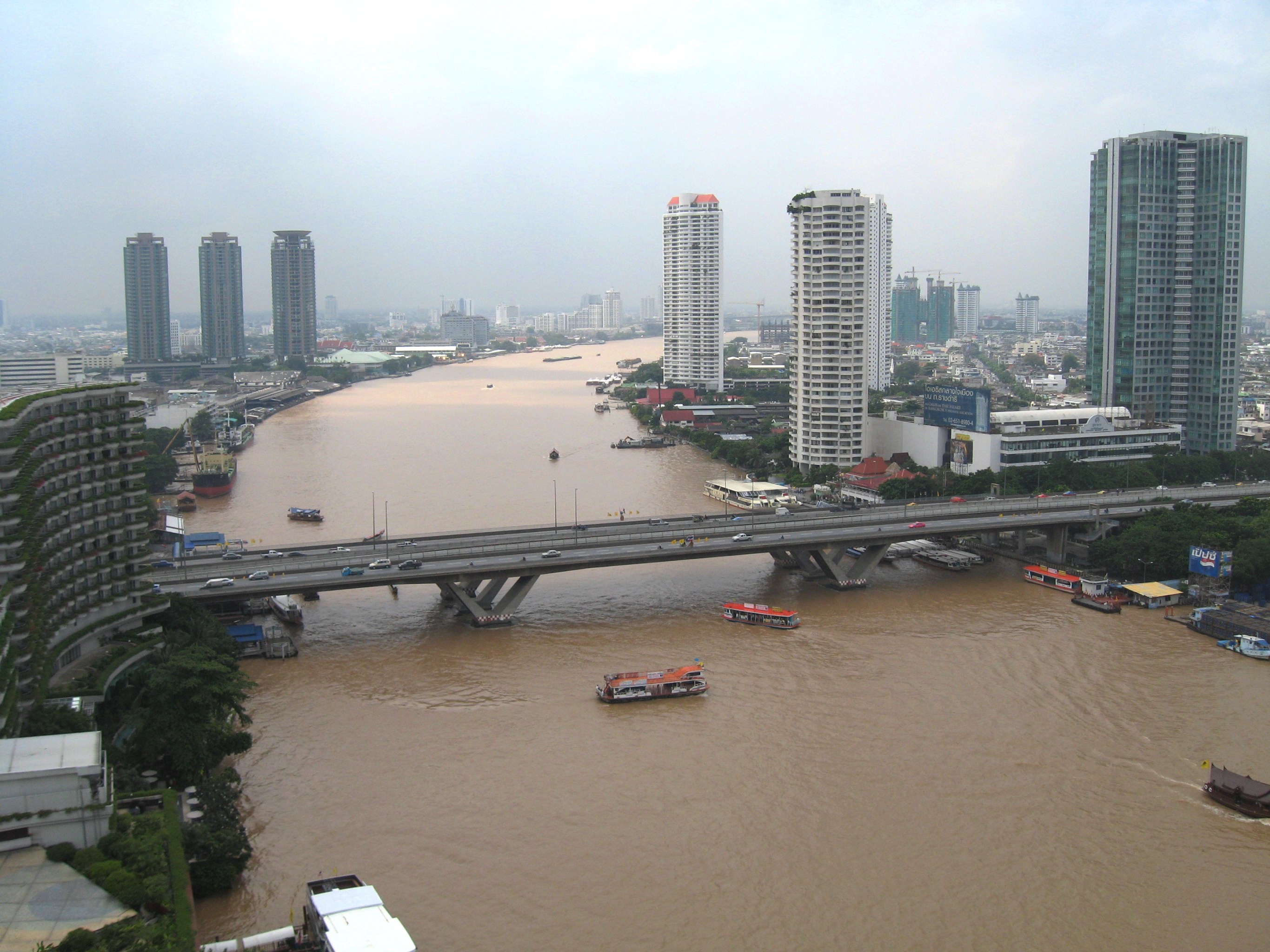
I startled to wakefulness by the sharp crack of nearby lightning. I had resolved to synch into the local time by remaining awake until evening, but failed shamefully. I stumbled to my feet and walked to the rain spattered window of my 21st floor room.  From this vantage I could study the cityscape of Krung Thep (Bangkok) and marvel at the activity on the muddy Chao Phraya river below. 

BKK

The television blares out that reassuring theme music of the BBC- the one with the swirling red pattern against the beeping time signal in the background. Despite all of my travel, it still boggles my mind how comfortable it is to go to distant places. You sit in an aluminum tube for a while, get out, and hop into a taxi.

The conference is in a 5-star luxury hotel, filled to the brim, it seems, with nattering western 60-somethings on holiday. Prosperous Europeans and North Americans out for a taste of exotic Siam. Nothing too strong mind you, just a taste.  The air-conditioned, hospital-clean hotel offers the one thing that you can’t get otherwise in Krung Thep- solitude.

A step into the streets of the city is, for this North American, a step into the heart of metropolitan Asia. It is monsoon season, so the air envelops you like a hot, wet sweater smelling of diesel and oily 2-stroke motor exhaust. Everyone is busy. Some are just moving from point A to B. Others are eyeing you from their narrow kiosks and calling out for your business.  Like the stationary bivalve that eats only when it can suck in some bystander, the kiosk proprietor has but 15 seconds to get catch your fancy before you leave the field of view. As a westerner, you resemble a big block of cheese and everyone wants a slice.

All of the motion, the incessant bartering and angling for prices is always a shock to Americans who are used to the economic firmament of price tags and the taboo of public bickering over prices.  Americans pride themselves on capitalism, but are reluctant to let it equilibrate to the microscopic level of one-on-one haggling with shopkeepers. Too untidy and confrontational. Americans would rather go to another store than attempt to haggle for a better price.  But this reluctance only serves to dilute the power of the consumer. This is a lesson we can take from Asia.

Far Side of the World

In chemistry, nothing is easy. Everything has failure modes. It’s possible to screw up when putting water in drums. My ham-fisted attempts at a new reaction pathway for a thorny, expensive process have thus far lead to naught. Nature has hidden some subtle requirements that are yet unknown to me. Application of known processes to new substrates may suffer failures that seem obvious afterwards, but are opaque going in.

I used to joke that if one in ten reactions lead to a good result I was doing well.  It’s not always that bad, but you can have stretches where the most reasonable transformations fail in one way or other. Unfortunate side products, poor yields, wrong selectivity, yada, yada, yada. Try doing the last experiment first, they say.

Th’ Gaussling is off to the far side of the world next week for a conference. A week in Bangkok will offer some needed punctuated disequilibrium.  The down side- 20 hours of confinement in an aluminum tube with wheezing strangers. I would prefer to be sedated and put in a box for transport than sit in an airline seat for that long.

Chemical Business in Russia- One Experience

Hearing of the passing of Boris Yeltsin, I can’t help but remember my trip to his northern empire in 2000.  We boarded a Lufthansa flight in Frankfurt, seemingly filled to the scuppers with jabbering Russian tourists anxious to return from their trip abroad. We left rainy Germany for the port city of St. Petersburg, near the mouth of the Neva River. Most of the terrain was obscured beneath heavy clouds so there was nothing to see until our descent at 10:30 pm. The sun sets late at 60 degrees north in the spring.  As we were coming down from cruise altitude, the lush green landscape became visible through breaks in the clouds.  We were going to land in Russia.

While the purpose of the trip was business, I was determined to soak in as much of the experience as possible. I had a total of one paltry year of Russian language in college so I could at least sound out the words and recall a tiny bit of vocabulary. 

In the late 1990’s doing business in Russia- that is, buying Russian goods- could be complicated. This was late in Yeltsin’s term and a kind of cynical take on the free market was beginning to set in.  Earlier, the eastern bloc had imploded and the communist hold on Russia was in deconstruction. Under Yeltsin a select few had managed to amass wealth- the so-called Oligarchs.  But as a few like Khodorkovsky were to eventually learn, wealth does not automatically confer political power in Russia.

Doing business in Russia was a highly manual activity. In 2000, the start of the Putin years, Russia lacked much of the business infrastructure that we in the west take for granted. When I say “business infrastructure”, I refer to the whole picture- commercial credit; internationally compatible contract and tort law; credible mechanisms for the flow of currency; GAAP; a multimodal transportation network; a comprehensible market exchange for commodities; and a market place with suppliers and specialists for the many instruments of finance and insurance. 

In the Yeltsin years, many formerly state-owned factories came under control of people who conducted business in facilities through quiet arrangements behind the curtain.  Factories would operate at low intensity or would even be shut down until orders came in.  Workers were furlowed and operated taxi’s or did other odd jobs until an order arrived.  Maybe this still happens today.  I don’t know.

We needed product that was made by a very few specialists in the world and one of those vendors was in central Russia.  Russian manufacturers are as skilled as we are of course, but there are differences in business culture that may be hard to anticipate.  Western standards concerning documentation was a particular problem.  I recall that our vendor was quite carefree about lot traceability and packaging.   They also had the maddening habit of reusing old lot numbers.

Then there was the problem of shipping.  Russia did not then, and still may not, have anything remotely similar to Aldrich.  Now, you probably think of Aldrich as the “chemical supply house” and you’d be right. But I’m thinking of Aldrich as the “master of logistics”.  Logistics in Russia was a problem.  Ground transportation was unreliable. Our solution was to hire a local to bird-dog the whole process.  It was worth every penny.

One of the differences I found was in the attitude of the few manufacturers I was in contact with.  They were usually aware of western prices for their goods and were never afraid to demand Aldrich-type pricing.   In the west, the customer is king.  That is just taken for granted.  Uppity suppliers are soon former suppliers. 

What I ran into in Russia was something that I hadn’t seen anywhere else, including China or Taiwan.  Our Russian supplier wanted to dictate terms and was unwilling to budge- I think they call it “Vlast”.  We absolutely needed better prices for the raw material.  I’m sure that there were urgent arrangements behind the curtains that were part of the need to stand fast. But in the end, it was their absolute inflexibility that caused them to lose the business. 

While in Russia I did try to source other raw materials and “vendors” who could supply spot buys of particular compounds.  At the time, many chemical factories were partially shuttered, so custom chemical processing capacity was very much hit and miss.  Processing equipment sat in dark and idled buildings waiting for a purchase order and prepayment. 

We met with principals in an empty flat to talk about the manufacture of custom compounds. But the same problem always arose. They wanted cash up front, preferably deposited in a European bank.  I was very clear that this was not the transaction model that we were accustomed to and in fact, this requirement was a showstopper. My Russian contacts were mystified that an American would come all this way only to refuse to pony up the cash to get the ball rolling. And that is where my attempts at trying to do business with Russia ended. 

The operators of the factories I was in contact with had the pots and pans, skilled staff, and expertise in the technology- these guys were first rate technocrats. At first glance, what they lacked was the benefit of investment capital to plow into their operations to find and service customers.  But, digging deeper, it wan’t just the hard cash they lacked. There was a system-wide lack of free market history and culture that, elsewhere, would have provided the institutions and mechanisms to exploit opportunity. 

I admire Russia and I believe that they will eventually get their system working well.  But they do need to get away from the fascination with the strongman model of governance. From my travels I have concluded that countries with cultures that date far back are simultaneously blessed and cursed by it.  They are blessed by the warm embrace of cultural richness. But they are also cursed by it because it can be a sort of ball and chain that complicates the adoption of change.

Note: This was written a few months prior to posting.

Copyright 2007

Verbal Beatings by “Professionals”

One of my pet peeves is the use of the word “Professional”.  It is the ultimate lever. Or, at least the ultimate big stick. Any given cube-kibbitzer can say “Well, that just doesn’t look professional” and their flatulent comment will somehow be imbued with a kind of transcendent credibility. Other cube-sitters will piously nod their heads in agreement- “We’re concerned that the chair just doesn’t look professional”.

Management or HR can proclaim that your attitude, presentation, or apparel isn’t “professional”. The word professional is a kind of wild card, a Joker in a stack of social cards that can mean anything you want it to mean.  It is a kind of peer pressure of the sort that the cool students in high school used to decide who was cool and who wasn’t.  It is an upgraded “ugly stick”.

What is amazing is the extent to which it works. It is like a phaser set to stun. It stops people in their tracks. This is why I keep saying that business is part of anthropology.

Creeping Featurism: Too much Software

My big problem in life, other than being age 50 on a runaway train with the Grim Reaper, is a plurality of software.  It crept up on me while I was standing there, slack-jawed and admiring of all of the pretty colors and pull-down menu’s that were a mouse click away. What a wonderous stack of riches, says I.

In any given week, I can find myself at the console of a Bruker 300 MHz NMR, an HP GCMS, an older HP GC with stand alone integrator, a TA Instruments TGA, a Cecil UV/Vis, A Perkin Elmer FTIR, two GOD**MNED cell phones, an office voicemail system, the business MRP accounting system (&$^#!#!@!), office laptop with many applications in Word, Excel, Access, Contact, GoldMine, ChemDraw, SciFinder, a telescope driven by The Sky, numerous platforms on the internet, two home computers, two cars, and, oh yes, a family. And don’t forget my cruel mistress- Chemistry.

It all adds up to a bit too much. I use perhaps the top 5-10 % at most of nearly every software on the list.  The standardization imposed by Microsoft Windows does help with basic navigation, but the data workup and all of the particulars put me into an eternal state of “technological Alzheimers”. I keep asking “Now, how did that work again”?

Then there is the password issue.  All of the computers I work on have some level of security, and so passwords are required to get in. Blessedly, being a networked system, my network password usually works. But passwords expire and it is a constant battle to remember all of them. But if you log onto the Aldrich catalog, or any number of other on-line systems, entry requires a password.

Each of these computerized marvels is layered like an onion with hierarchies and taxonomies unique to the miserable cluster of sods who wrote the code. These sadistic canker blossoms … whoa! I’m getting carried away here. Easy does it, skippy.

Then there are the rules- business SOP’s, IATA, DOT regs, Customs issues, TSCA, policies, lab safety, Hazmat storage, respirator training, new Homeland Security regs, flash points, HMIS numbers, Haz Waste issues. 

This week I did bench chemistry, wrote an MSDS, issued and received inventory in the accounting system, defined SKU‘s, ran a few TGA‘s and FTIR’s, defined some product specifications, did competitive intelligence and worked out some costing and pricing, sent out some quotes, sat in mind-numbing meetings, took two long days to write a report, noodled through some patents, sent some products out the door that I made with my own hands, and received a few new orders.

It was a productive week in fabulous industry. They don’t call it industry for nuthin’.

Thorium and Methanol

As we track down the back side of the petroleum curve, we will see a transition from the alkane/alcohol fueled Otto engine to a greater reliance on electric conveyance. Here is some wishful thinking-  Ethanol as a direct petroleum replacement will collapse under the weight of scrutiny as better cost data becomes available. Eventually, ethanol will be prized foremost as an oxygenate additive replacement for MTBE. 

Methanol and Fischer-Tropsch hydrocarbons from coal and biomass will provide high energy density fuels for the carbon-neutral future as petroleum scarcity drives other technologies into play. The Fischer-Tropsch liquified fuels technology from 20th century pariah states (Nazi Germany and South Africa) will assume a greater role in the post-petroleum age.

Fermentation of starch-derived glucose to ethanol and CO2 is too wasteful in the end to be attactive.  Fermentation of cellulosic material to acetate is more mass efficient. Esterification and reduction of ethyl acetate affords ethanol. One company, ZeaChem, (former coworkers, actually) is already working to bring this technology on stream. It remains to be seen how it will go over. I wish them well.

Electric power for the future will come from many sources. Distant, centralized power plants will channel energy across the grid to home-charged automobiles. Electrons travel fast and quietly over the lonely wire. They do not require fleets of ponderous 18-wheelers to move them around in limited quantities.

I see a future heavily reliant on electrons supplied from nuclear plants. Uranium-235 infrastructure will continue to supply fuel to nuclear plants for a long time. But the low abundance of U-235 (o.7 %) and the ever present proliferation potential of Pu-239 from this fuel cycle raises questions as to the wisdom of building U-235 nuke plants in the third or fourth tier states.

A more obscure nuclear fuel that is more abundant than uranium will see a phase-in as demand on the present nuclear fuel infrastructure exceeds supply.  That fuel is Th-232. Thorium-232 is  generally more abundant that uranium and has the additional benefit that it’s major isotope, Th-232 , is the nuclide of interest. Th-232 is not a fissile nuclide, but is a “fertile” isotope instead. Th-232 absorbs a neutron in a reactor seeded with U-235 or Pu-239 to provide an initial neutron flux to become Th-233, which beta decays to Pa-233 which further beta decays to U-233.  It is U-233 which is the fissile nuclide.  U-233 then participates in the fission chain reaction that generates the heat.

You can’t make a nuclear weapon out of Th-232, though in principle you could make one from U-233. The downside of a U-233 bomb is the high specific activity of this isotope.  U-233 is intensely radioactive and poses extra problems in handling.

The economics of thorium energy is advantageous in many ways to that provided by uranium/plutonium infrastructure. Thorium is abundant in monazite formations- reportedly up to 16 % thorium oxide.  The present problem with the thorium cycle is handling the intensely radioactive U-233 that remains in the spent fuel elements. Separate processing infrastructure will have to be put in place to supply reactors that burn thorium before this fuel can go forward.

An HTGR  Brayton cycle reactor with a helium turbine could provide up to 50 % thermodynamic efficiency.  Combine this reactor design with the potential cost savings of the more abundant Th-232, and you have a technology that is well set to provide power to keep the lights, cable TV, and the internet going into the post-petroleum age.

Check out the blog dedicated to Energy from Thorium. I’m writing about thorium because I think it is an important fuel and it needs to find its way to mainstream thinking.