
Category Archives: Business

Water Breaks in Tejas

Local laws mandating that 10 minute water breaks be given to construction workers every 4 hours have been eliminated by Tejas Governor Greg Abbott and the legislature under HB2127 titled “Texas Regulatory Consistency Act.” The bill was put forward by Rep. Dustin Burrows, R-Lubbock. The bill is seen as an effort to push back on progressive local laws by cities like liberal-leaning Austin and Dallas where ordinances have been put into place to protect construction workers against the oppressive heat of Texas. Abbott said the bill will “provide a new hope to Texas businesses struggling under burdensome local regulations.”

Hyperbole,  /haɪˈpɝː.bəl.i/, noun; a way of speaking or writing that makes someone or something sound bigger, better, more, etc. than they are

In Section 2 of the bill, it says the legislature finds that:  “(1) the state has historically been the exclusive regulator of many aspects of commerce and trade in this state; (2)  in recent years, several local jurisdictions have sought to establish their own regulations of commerce that are different than the state’s regulations; and (3)  the local regulations have led to a patchwork of regulations that apply inconsistently across this state.

The State claims to be the exclusive regulator of commerce and trade in the state pursuant to Section 5, Article XI, Texas Constitution. HB2127 was written to more closely define what kinds of codes local governments are free to do.

Given the state’s interest in commerce and trade, Section 6 removes any ambiguity in that regard. Labor regulations come under the heading of commerce and trade, so the state is the only lawgiver here.

HB 2127, SECTION 6.

Subchapter A, Chapter 1, Business & Commerce Code, is amended by adding Section 1.109 to read as follows:

Sec. 1.109. PREEMPTION. Unless expressly authorized by another statute, a municipality or county may not adopt, enforce, or maintain an ordinance, order, or rule regulating conduct in a field of regulation that is occupied by a provision of this code. An ordinance, order, or rule that violates this section is void, unenforceable, and inconsistent with this code.

Backers of the bill say that under OSHA, employers already have a duty to provide a safe workplace work place. A spokesman for the Associated Builders and Contractors of Texas said that “local rules impose a rigid scheme that, unlike OSHA guidelines, does not allow the flexibility needed to tailor breaks to individual job site conditions.”

However, according to David Michaels who led OSHA from 2009 to 2017, “Under OSHA law, it is employers who are responsible to make sure workers are safe,” said Michaels, now a professor at the George Washington University School of Public Health. “And we have compelling evidence that they are doing a very poor job because many workers are injured on the job, especially in Texas.”

Michaels also said that OSHA can issue a citation for a heat-related injury or death, but only after it has taken place. He also points out that OSHA has no national standard for heat related injury.

However, OSHA does have the General Duty Clause for situations where there are no specific standards applicable.

29 U.S.C. § 654, 5(a)1: Each employer shall furnish to each of his employees employment and a place of employment which are free from recognized hazards that are causing or are likely to cause death or serious physical harm to his employees.”

29 U.S.C. § 654, 5(a)2: Each employer shall comply with occupational safety and health standards promulgated under this act.

29 U.S.C. § 654, 5(b): Each employee shall comply with occupational safety and health standards and all rules, regulations, and orders issued pursuant to this Act which are applicable to his own actions and conduct.

The legislation to remove local laws regarding construction labor hazards was apparently motivated by the desire of the GOP to slap down islands of liberalism in Texas.
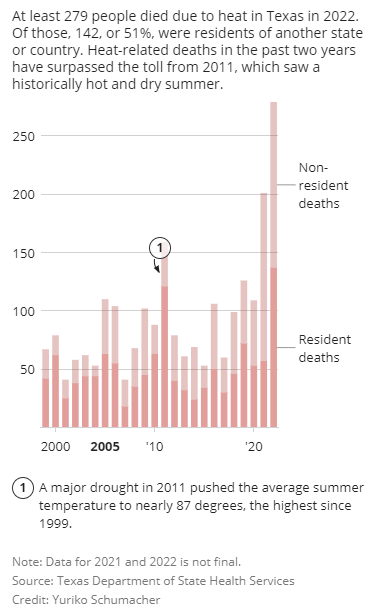
This graphic was produced by the Texas Tribune using data from Texas Department of State Health Services. Source: https://www.texastribune.org/2023/06/16/texas-heat-wave-water-break-construction-workers/

The chart above shows that known heat-related deaths in Tejas are up sharply in the last 2 years. Migrants and the homeless are hit particularly hard by hyperthermia.

I can understand the desire to smooth out the spotty nature of regulatory sovereignty across any state. It is really a matter of state vs local control and there shouldn’t be any confusing overlap of authority. Texas has chosen primacy over commerce and trade, of which labor is a part of. Somewhere in the process of this, someone noticed that regulations on water breaks mandated by municipal statute will be invalidated.

News stories came out with the shocking news that people working outdoors will not be guaranteed water breaks. The absence of statutory regulation on water breaks does not mean that workers will be denied water. Any employer who wants to retain employees will not deny water to employees. What has been invalidated are mandatory 10-minute water breaks every 4 hours. A workday is usually broken down into a break midmorning and midafternoon with lunch at around noon. These are 3 opportunities to grab a drink of water. A mandatory break after 4 hours past arrival places the break around lunch and quitting time anyway for an 8-hour day, so it is hard to imagine what advantage it gives for an 8-hour day. For longer days it would be beneficial. Employers who would deny water to employees should be punished.

Construction site managers object to rules that would interfere with things like concrete deliveries and crane work. Both are time sensitive activities. Even in the rough and tumble construction field, most companies will do the right thing and allow access to water at all times.

Texas HB2127 itself is silent on the matter of water breaks for workers. It simply reasserts authority already provided in the state constitution, namely as the, ” … exclusive regulator of many aspects of commerce and trade … ” and supersedes local statutes that overlap with what the state sees as its sovereignty. It seems a little sly, but not fundamentally corrupt.

So, the question becomes, will the State of Texas legislate mandatory water breaks for workers in hot environs? Given the rabid pro-business leanings of the state, it seems doubtful.

Am I taking the side of the Republicans on this? Goddammit, I hate to say it, but I suppose I am.

“… radical-left Democrats, Marxist, communists and fascists …”

I’m running out of words to describe the deplorable ex-president #45. Just when you think he can’t add to his steaming heap of manure called a legacy, he shovels on more. It seems like there is no limit to the falsehoods he is willing to declare in public and no limit to what his supporters are willing to accept.

In regard to his indictments, he was recorded as saying something to the effect of “They’re not after me, they’re after you … I’m just standing in their way!” He is turning his indictments into the image of him sacrificing himself on the cross for the millions of Americans. A blood sacrifice for his beloved followers. If you supposed that this vaudevillian stunt was transparently phony to everyone, you’d be wrong.

#45 has been referring to “… radical-left Democrats, Marxist, communists and fascists …” in his gimmie-all-yer-lovin’ rallies. How absurd. Leftists aren’t fascists- they are antifascists. And by the way, what is wrong with being against fascism? #45 is using his usual mirror tactic of taking accusations against him and aiming it back at his critics. He knows very well that he isn’t being held accountable for truthfulness by the people he counts on. He tells big lies and repeats them over and over. It works for him. The very boldness of his lies somehow validates them in the minds of his followers.

Marxism and socialism have been in the scrapyard of history for a decades. The Soviet experiment with using socialism to get to communism was an abject failure. Stalin’s USSR was a brutal, murderous dictatorship tarted up to appear as a people’s paradise for those outside the iron curtain.

China today is a single party communist dictatorship that practices centralized control and nationalistic state capitalism. Previously, however, under the command of Chairman Mao Zedong, it is estimated that 40 to 80 million people died as a result of starvation, persecution, prison labor and execution in order to achieve his personal dream of a communist paradise.

It is difficult to find a communist state where people have the liberties that we in the US take for granted. It seems that to compel people to hand over their belongings to the state, a good bit of muscle is needed. Stalin found this out when he tried to collectivize Ukraine in the early 1930s. He ended up causing mass starvation and sending people to the gulags. The notion that the US is under threat from communist influence is without credibility. The odd communist may pop up now and then but they are little more than a curiosity not worthy of concern.

It is hard to know what Republicans regard as radical about Democrat ideals. Could it be that anyone who disagrees with today’s GOP is a “leftist radical”? If there are actual living, breathing Marxists among liberals in the US, they are likely to be lonely. There is Richard D Wolff at UMass, Amherst. Wolff is against capitalism and makes some fair points, but the momentum of history won’t be going his way any time soon. People still remember the Soviet experiment with Marxism-Leninism which was a disaster.

So·cial·ism: noun; a political and economic theory of social organization which advocates that the means of production, distribution, and exchange should be owned or regulated by the community as a whole.

Source: Google

Will citizens of the US ever acquiesce to turning over private property to a socialist government? Clearly, there is not a chance. The accusation that US liberals harbor socialistic desires is a Republican fever dream. The same with communism. The current population of US citizens would never embrace communism. Too many past instances of communist or socialist dictatorships in the world, and besides, Americans love their private property and would defend it with the umpteen hundred million guns under their pillows.

It is a Republican fantasy that only they are the true patriots in the US. This gives them license to posture as the only “real” Americans worthy of the title. This froze out as axiomatic for them many years ago, especially since the years of Mr. “trickle-down economics” Reagan.

Having social services is not the same as having socialism. A capitalist economy that provides a social safety net through taxation is not socialism. The capitalists still own their means of production, distribution and exchange.

Ordinary citizens in the US pay taxes to support the Army, Air Force, Space Force, Marines, Navy and Coast Guard. We also pay taxes and fees for upkeep on state and national infrastructure like roads, bridges, air traffic control and many other things. All of this goes to support our capitalist means of production, distribution and exchange.

Citizens pay exorbitant tuition to educate themselves to a level where they can contribute to operating our capitalistic enterprises. Payment for the common good isn’t borne exclusively by business. Both citizens and our capitalist enterprises benefit from this arrangement.

The business side should recall that citizens contribute to their corporate existence by funding their government contracts and by purchasing products that they off-shored to China to the detriment of US workers and security.

Gaussling’s Epistle to the Bohemians 2/28/23

>>> A smattering of thoughts each too small for a post. <<<

I’ve been thinking about quantum chemistry lately, or more to the point, my graduate-level single semester experience with it. First let me say that prior to taking the qualifying exams on arrival to the graduate chemistry program, I made sure to bone up on the particle in a one-dimensional box model. And sure enough, it was on the entry p-chem exam. Whew! Dodged that bullet. However, of all 5 exams we took, I didn’t pass the statistical mechanics exam. I would have to repeat the exam and pass it by the end of the year. Instead of taking the undergrad p-chem course I decided to risk it and study on my own and as luck would have it, I managed to pass it. Another monkey off my back.

Back to the quantum chemistry course. Initially I was hoping to gain a bit of qualitative insight into the subject. As it turned out, it was really just a high level math class where the prof spent the whole term deriving all of the key equations. I think this is pretty common for this subject. There were zero interesting applications mentioned. He was either unable or unwilling to render any of it into sentences for context. The guy was a rock star in his area of solid state nuclear magnetic resonance. Once I went in for help during office hours and he told me he was busy and to come back in 2 weeks (!). I was finally convinced that putting scientists on a pedestal was a serious error and that a**holes were truly everywhere. Anyway, I made it through the experience and moved on. Haven’t had to think about Hamiltonians since.

==========

I was chatting with a toxicologist colleague recently about the big derailment and fire disaster in East Palestine, OH. I had suggested that the decision of the responders to vent and burn the remaining vinyl chloride was probably a good idea. There was some fear that there may be a runaway polymerization of the vinyl chloride. This would likely lead to an explosive rupture of the tank car and a possible BLEVE. This is from the report

On February 5, responders mitigated the fire, but five derailed DOT-105 specification tank cars (railcars 28–31 and 55) carrying 115,580 gallons of vinyl chloride continued to concern authorities because the temperature inside one tank car was still rising. This increase in temperature suggested that the vinyl chloride was undergoing a polymerization reaction, which could pose an explosion hazard. Responders scheduled a controlled venting of the five vinyl chloride tank cars to release and burn the vinyl chloride, expanded the evacuation zone to a 1-mile by 2- mile area, and dug ditches to contain released vinyl chloride liquid while it vaporized and burned. The controlled venting began about 4:40 p.m. on February 6 and continued for several hours.”

My colleague said that a fire releases aerosols that are likely to be especially deleterious to the lungs. Burning organic chlorides leads to hydrochloric acid formation with all of the joy that it brings to the dance. The smoke plume, elevated by convection, and probably carrying some amount of unburned chemicals will spread with the aerosols far and wide. This would contaminate a larger patch of environment and expose a more distant population than a simple spill at the crash site would. He wondered to what extent the chemicals shouldn’t have been removed at the site, spill or not, and the land be designated as a Brownfield.

==========

Elon Musk has been running off at the mouth again, this time seeming to take sides with the Dilbert cartoonist Scott Adams who was recently given the death penalty of abandonment by his publishers. Adams used his cartoon to go off on the Black population saying that Whites “should get the hell away from Black people” referring to them as a racist hate group.

Set aside the merits/demerits and morality of Adams’ racial views for a minute. As an adult and businessman he should have known the boundaries of acceptable content in his cartoon strips in the current social environment. He published content that appeared to have alignment with white supremacist ideas. In publishing this content, he made himself radioactive and he was dropped by his publishers who happen to have better business sense. What a dunce. He was playing with a loaded gun and it went off in his face.

So, His Excellency, Elon Musk, has stepped into the fray and condemned the excommunication of Adams from the comic strip pages. Musk said that while Adams’ comments weren’t good, there was an element of truth in them. He accused the media of providing a “false narrative” by giving more attention to Black victims of police violence than to White victims of police violence. This is on top of his general loosening on hate speech on Twitter and the reinstatement of banned accounts such as with #45. Musk is broadcasting that hate speech is as valid as any other speech on his platform. Businesses like Twitter are free to edit content or not as they please. Musk believes in a rough-and-tumble environment where most anything goes. As an owner, he is certainly free to do that. But as owner, he is also responsible for content that drives away business.

Irrespective of your beliefs in this matter or the obvious morality issues, it should be apparent that neither Adams or Musk seem to care about the effect on business of draping yourself in the flag of racism, or even just of allowing the perception of it. Savvy is a kind of vector- it has magnitude and direction. Musk has strong vectors in the technology direction, but not so much in the public relations direction. He doesn’t seem to have full control of his mouth just yet.

==========

Filthy Lucre, Again

Yet another reprint of posts from the past, this time from April 11, 2008.

As usual, Th’ Gaussling’s most interesting observations of the ACS meeting are of a proprietary nature and will have to go with me to the grave. Our student and academician friends can expound openly on what lights their fires. The lusty satisfaction of compelling oratory in the darkened halls of convention centers is part of the reward for the cardinals of the academy.  Members of the merchant class have to be satisfied with better dining.

People who are involved in personnel issues often speak of an employees “deliverables” as their work product. For those lucky enough to be in the academy, the work product includes teaching young minds, conducting research, and participating in the dissemination of the results in the form of papers and conferences.

For we chemists who did the deal with the devil in exchange for filthy lucre, our performance is rated somewhat differently.  Like academics, our performance metric only starts with some understanding of science. Once it is possible to begin understanding a thing, the task of transforming a process or material property into an item of commerce begins. In the chemical industry we do the most important reaction of all- the transformation of chemicals into money.

The part of the brain that sees a stick on the forest floor that resembles a tool is the same part of the brain that scans a molecule and sees latent functionality or value. The extraction of value from a composition or a process is a complex anthropological activity. Product development is anthropological because it involves the use of tools and organizational structure to provide products or services that are exchanged between groups.  

An industrial science group has to isolate value in some material property and contrive to bring some product or service into being.  But to get it to market, the science tribe has to cooperate with those with other skills. Organizations often resemble a confederation of tribes who cooperate with complex rituals and methods of exchange.

US LNG output to double by 2027

According to BloombergNEF, the United States is on course to double its natural gas liquefaction (LNG) capacity by 2027. US export capacity is expected to rise to 169 million metric tons per year with the opening of 3 new projects slated for funding approval this year. They are- Venture Global’s Plaquemines LNG, Sempra’s Port Arthur LNG, and NextDecade’s Rio Grande LNG. This new capacity will place the US well ahead of Qatar in annual production.

Appendix

LNG should not be confused with LPG, Liquified Petroleum Gas. LPG is a mixture of the somewhat heavier hydrocarbons propane, propylene, butylene, isobutane and n-butane. LPG is a fuel gas and can be used as an aerosol propellant and refrigerant.

LNG is composed mainly of methane (CH4) with a smaller amount of ethane (C2H6). Lesser amounts of propane and butane are isolated and sent to a separate stream. Natural gas is “sweetened” prior to cooling to remove corrosive hydrogen sulfide (H2S), carbon dioxide (CO2) gases as well as helium, mud, water, oil and mercury. Once the impurities are removed, the remaining methane/ethane mixture is cooled to −162 °C for bulk transport. On arrival at its destination, it must undergo a regasification process. In some locations seawater can be used to vaporize the LNG for injection into pipelines.

As an alternative to sea water heat transfer for regasification, LNG can be utilized for its “cold energy” potential. One application uses low temperature LNG as a refrigeration coolant for producing liquid oxygen and liquid nitrogen. Another use of the cold energy is to cool the exhaust of a gas turbine in a closed joule cycle with argon as the fluid.

Since we are talking about gaseous hydrocarbons, there is also a category of liquid hydrocarbons called condensates that accompany the production of natural gas and must be channeled into a separate processing stream because, well, they are liquid. Raw natural gas straight out of the ground may have varying amounts of condensates-

  • Crude oil wells can produce natural gas called associated gas and condensates may be entrained in the gas flow.
  • Dry gas wells produce gas that have no associated liquids.
  • Condensate wells produce natural gas with associate natural gas liquid.

Wikipedia explains the condensate situation in greater detail.

Euphemisms This Morning

A collection of euphemisms from a single 30 minute meeting.

Cold eyes review– outside review

Get engaged– bring into the group

Out of pocket– gone

Dot eyes and cross Ts– tidy up details

Just to jump in– I’m interrupting

The old pot makes the best stew– try an old method

Reach out– contact someone

Get on the radar– pay attention to

Just a bit of corporate-speak here. Nothing out of the ordinary.

I have a collection of salty and scatological euphemisms from my days on the farm and while working in construction, but I keep them close to my chest. I think others are grateful for that.

Lithium as a Chemical

Today we hear about lithium batteries ad nauseum. Everyone is anxious to achieve a bright battery-powered electric future for happy motoring. Mineral exploration has revealed a few new sources of lithium and mines are increasing production. Battery factories are ramping up and R&D keeps turning out tweaks in battery technology. Many are betting on or prophesying the eventual phase-out of hydrocarbon fueled motor vehicles.

Lithium is quite scarce and is the 25th most abundant element on earth with about the same crustal abundance as chlorine although this may vary with the source. For the most part, lithium is fairly widely dispersed in the earth’s crust but it is subject to concentration by hydrothermal transport, forming evaporite deposits or briny ground water. Lithium is also a component of the mineral spodumene which can be found in pegmatites within some host formation. An uncommonly rich site was at the Foote Company Mine in the Kings Mountain Mining District of North Carolina. This operation produced lithium carbonate, Li2CO3. This is a common finished product because it can be removed from a solution of lithium chloride by treatment with sodium carbonate to precipitate the poorly soluble lithium carbonate.

This light metal has many chemical uses apart from batteries. For instance, organolithium reagents are a vital part of the chemical industry clocking in at about $1 billion per year in sales. Organolithium reagents are an indispensable part of organic synthesis. Switching to a reagent with a different metal usually does not work well, giving poor results or the wrong reactivity.

Today we’re seeing organolithium prices rise dramatically with little expectation that it will ever come back and no clue of how it plays out in the future. If a few select lithium reagents, e.g., LiAlH4 or n-butyllithium, go off the market, it will be a bad day for the organic synthetic industry as well as for chemical R&D in general. It is an unexpected consequence of the switch to reduced carbon EVs.

LNG Ships and Shipping

An interesting bundle of factoids arrived in my daily newsletter from the American Petroleum Institute, API. The cost of shipping LNG is disclosed. I’ll just cut and paste it for convenience. The source is Freightwaves.

From API- “Liquefied natural gas charter rates were estimated to average $313,000 per day for the most efficient LNG carriers and $276,700 per day for tri-fuel, diesel engine carriers as of Monday, according to Clarkson’s Securities, some analysts predict rates could climb as high as $500,000 per day or even $1 million in the fourth quarter amid tight ship availability on the spot market. “According to brokers, owners can now achieve three-way economics, which means they are compensated not just for a regular round voyage but also for positioning voyages,” said Clarksons Securities analyst Frode Morkedal.”

Ok, I like big boats and I cannot lie. When you look into the shipping vessels themselves you can find a wondrous horde of information on LNG carrier details, such as tri-fuel, diesel engine (TFDE) powered ships. These are ship propulsion systems that drive the propellers with electric motors that in turn are energized by generators driven by engines that can burn diesel oil or LNG.

There are many advantages to the TDFE propulsion systems. Due to the low boiling point of LNG (-161.5 C), loss of LNG to evaporation is unavoidable. Fortunately, the boil-off vapor from the LNG tanks can be piped down to the engine room and used for propulsion. This LNG boil-off can be used to generate steam or can be used directly by powering two-stroke engines. The newer TFDE system, or the DFDE (Di-Fuel Diesel Electric) engines require less space than conventional diesel engines with all of their ancillary features. This leaves more room for payload.

The Bright Hub Engineering site says that a typical TFDE electric generator system produces 8 to 12 megawatts of power from each of its 4 generators at 6600 to 11000 volts at 60 Hz. The electric propulsion motors are coupled together with a reduction gear to turn the props.

As alluded to above there are duel fuel 2-stroke marine engines in use. The duel fuel engines combine Heavy Fuel Oil (HFO), also called bunker fuel, or Marine Diesel Oil (MDO) with LNG in the Diesel cycle with a load range of 10 to 100 %. The mixture of HDO or MDO with LNG is injected directly as opposed to being premixed with air. Because the autoignition temperature of LNG is high, a small amount of pilot oil is injected as well to ensure ignition. The actual mixture used can be adjusted to best match the price and availability of the fuel oil.

The di- and tri-fuel systems have the advantage of producing considerably less pollution that conventional bunker fuels. This is especially important in port where emission controls can be very strict.

Oil & Gas Companies and Their Gaping Holes

According to E&E News, the government is releasing $560 million of a total of $4.7 billion to fund the cleanup of orphan oil and gas wells in 24 states. It is part of the Infrastructure, Investment and Jobs Act.

From the E&E article-

“Historic oil and gas activity in regions like Appalachia and the West goes back more than a century, with many old wells lost. Additionally, oil and gas price busts have left more wells abandoned, their original drillers out of business or difficult to trace. When left unchecked, those wells can release greenhouse gases like methane and pose combustion risks.

All told, states have flagged more than 10,000 high priority wells for cleanup, the first in line of a nearly 130,000 backlog of unreclaimed known well sites, Interior reported today. That number is expected to rise as federal funds bolster state efforts to identify hidden or lost orphans.”

According to a June 16, 2020, article in Reuters, drillers are required to pay a bond up-front to pay for remediation in case they go bankrupt. In reality, the system is a patchwork of state and federal regulations that are underfunded. The article goes on to say-

The U.S. figures are sobering: More than 3.2 million abandoned oil and gas wells together emitted 281 kilotons of methane in 2018, according to the data, which was included in the U.S. Environmental Protection Agency’s most recent report on April 14 to the United Nations Framework Convention on Climate Change. That’s the climate-damage equivalent of consuming about 16 million barrels of crude oil, according to an EPA calculation, or about as much as the United States, the world’s biggest oil consumer, uses in a typical day. (For a graphic on the rise in abandoned oil wells, click tmsnrt.rs/2MsWInw )

The whole thing is a century-long train wreck- we could have easily followed along as it happened. The extractive industries have a long history of leaving a hazardous and unsightly mess in their wake so there is nothing new here. Industry has socialized the cleanup cost and kept the profits.

It is pathetic that someone would even have to remind them to at least seal the damned well when they were done with it. Walking away from a well that is or could be venting natural gas and hydrogen sulfide is obviously unethical. Transfer of ownership or bankruptcy should be no excuse by statute.

States like North Dakota, for example, have statutes relating to wells having “abandoned well” status.

For various reasons, wells stop producing.  State law requires that the site be reclaimed and directs the Industrial Commission to oversee that process.

The upstream exploration and production (E&P) side of the oil & gas industry should collectively pay for this. However, like most businesses, they will only respond to the threat of added costs. But, we’re not asking them to split the atom. This issue could be solved at a single board of directors meeting at any E&P company.

Naturally, the oil & gas lobby will howl like banshees at the very notion of holding the industry responsible. Refiners and distributors of distillates, I think rightfully, will say that they are not at fault. So it has to be upstream.

But what about the owner of the mineral rights? Should they be free from liability? Not being a legal scholar, I can only surmise that this is old turf.

A modest excise tax on every barrel of oil or every million cubic feet of gas would accumulate into a sizeable fund over time. But would E&P companies just leave every abandoned well uncapped thinking that they have already paid for it? Hard to say. There would be legions of corporate cost accountants and executives working on it though.

American voters have yet to elect a congress or legislature that will write law to hold E&P oil & gas or somebody responsible for the blight that oil & gas brings. The industry lobby knows that all they have to do is float out the twin dementors of lost jobs and economic despair to frighten the public into submission. Works every time.

When Colorado tried to pass a ballot initiative recently to ban oil & gas well operations within some expanded distance from residential neighborhoods, the industry had employees on the streets protesting even in my own small bedroom community. They seemed convinced that their livelihoods were in imminent danger. The initiative was voted down. Basically, it would have barred most drilling within cities. Would this have cost jobs? Well, I think that the frosting on the cake would have been ever so slightly thinner.

Literacy in the Permian Basin Oil Field

There was an interesting article cited from the Houston Chronicle in today’s news letter from the American Petroleum Institute. Here is the link. Unfortunately there is a pay wall.

From the API news letter- “Low levels of adult literacy and limited access to higher education in the Permian Basin are compounding the skilled labor shortage already facing oil and natural gas companies as the industry’s digital transformation creates a growing need for workers with specialized skills. Ray Perryman, founder of consulting firm The Perryman Group, estimates that Permian Basin residents could lose almost $425 million in potential earnings and $292 million in economic output unless literacy skills improve, a challenge that’s being addressed by initiatives such as the Permian Strategic Partnership.”

Even in the rough and tumble world of the oil patch, folks need to be a little more educated to keep it going forward.

I could crack wise about education in the Republican Evangelical Republic of Tejas, but I’ll leave it alone this time. This problem speaks for itself.