Category Archives: Chemical Industry

Helium

With uptick of natural gas exploration and “recovery” happening, you have to wonder if anyone is bothering to look for helium in it? And I’m referring to the Marcellus shale formation in particular.  Wouldn’t it be nice for some forethought here and try to recover some of the helium that may be lost.  Helium is a non-renewable resource and is critical to many industrial sectors, including superconductor applications.

The US has held helium in reserve since 1925. Helium extraction has been most fruitful from gas wells in the western states. The Helium Privatization Act of 1996 has resulted in the release of the helium reserve to the private sector at a federally mandated price. The FY2011 price is$75.00 per thousand cubic feet.  

According to the BLM, the agency that manages the strategic reserve, their enrichment facility in Amarillo, TX, can produce 6 million cu ft per day of crude helium at ca 80 % purity. The Amarillo plant provides crude He to refiners who polish it to the necessary level of purity for the end user.

A Homily on Extractive Metallurgy

In the last 6 months I have learned a bit of what extractive metallurgy is about. One of my projects involves isolating an element from an ore where the desired element is one of many minor constitutents. What is important here is the term “minor constituents”.  When the desired element is a minor constituent, then one necessarily faces the prospect of processing large quantities of mass.

Processing large quantities of mass requires that the material and energy inputs used in the process must be very inexpensive. Except for gold, you have to start thinking of heat as a kind of reagent that can be applied to make things happen. The lucky circumstance with gold is its affinity for cyanide in an oxygenated aqueous environment.

It is a very interesting and worthy challenge to start with rock and contrive to remove purified products from it. Half of the fun is working with the engineers and metallurgists. They have a very different perspective of industry than a stiff like me who has always relied on Aldrich for “raw materials”. I have had to recalibrate a bit. You don’t meet people like this at ACS meetings.

I have spent more than a little time digging into extractive metallurgy from the 19th century.  A good deal of fairly sophisticated technology was worked out long ago for many metals on the periodic table.  Mostly, what has changed between the metallurgy of yesteryear and today is that we now consider fairly low grade ore as economically viable. 

The tailings of yesterday will become the ore of tomorrow. It just depends on the value.  When you drive around the gold and silver mining districts in the Colorado Mineral Belt, the tailings that you see from the road have most likely been worked over at least once.

XRF Up Close

Had the chance to visit a lab today with an XRF and a GDMS. It was very interesting. Even though I’m an organikker by training, I have to say that I really dig haunting other parts of the periodic table. Organic chemists are spoiled by the splendid richness of multinuclear, multidimensional NMR.  But when you stray from C,H,N, & O, composition and structure can become much more problematic.

The XRF samples were prepared as a lithium borate fusion in a Pt mold in the muffle furnace. The vitreous buttons were then placed in the instrument sample station. One of the problems with XRF, like any other kind of spectroscopy, is the occasional interfering peak.  But, like the famous British philosopher M. Jagger once said, you can’t always get what you want.

The GDMS was a sight. This instrument is sensitive to sub ppm levels all over the periodic table. At this level, just about everything shows up to some extent. The concept of purity becomes muddied a bit, at least for mining samples. For most things there aren’t good standards at this level. You have to trust in the linearity of the instrument and be happy with 30 % error.

XRF Magic

We’ve been looking at hand held XRF spectrometers.  If you have not been introduced to this, you may be in for a real treat. A variety of companies make them- Bruker, Thermo, and Innov-X to name a few. These things are in the low-end Lexus price category, but are they ever amazing.  It’s straight out of Star Trek.

Clarke’s Third Law states that any sufficiently advanced technology is indistinguishable with magic. I gotta tell ya that these hand held XRF’s are just amazing.  You point at a sample and it gives a tally of the elements present, or most of them at least.  Some even have a built-in GPS you can punch to take a waypoint of the location of the sample you just analyzed out in the field.  It is a great tool for mineral prospecting.  

What is embarrassing is that this is the first I’ve heard of it. Our geologist friends have been using these things for a while now. 

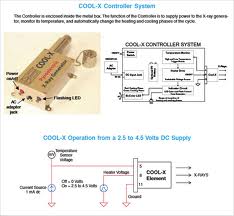
The whole thing depends on a miniature X-ray source.  I’ve been looking into this.  For the curious folks out there, lithium niobate- LiNbO3- is a very interesting material.  Crystals of LiNbO3 have the property of pyroelectric potential. A pyroelectric crystal is one that is able to generate a polarization across the crystal faces in proportion to the temperature.  A pyroelectric xtal placed on a heating/cooling block in a vacuum is able to generate a stream of electrons energetic enough that, when stopped by a copper electrode, will generate x-rays. 

One manufacturer, AmpTek, produces a miniature x-ray unit called the Cool-X that has a photon output equivalent to two milliCuries, with 75 % of the flux less than 10 KeV.  Elsewhere in the product literature, the output is described as 5 milliSieverts per hour.  So, the user has to be a little careful with this thing. But rad safety issues aside, this is quite an amazing source. The product literature doesn’t come out and say what kind of crystals are used, but they may be a tantalate salt.

AmpTek Cool-X

The unit does not operate continuously. It can only generate x-rays durig a thermal cycling period, The xtal starts out cool and as it’s heated, generates the electron flux that is de-accelerated by impacting the copper to produce the x-rays. The lit gives a cycling interval of 2-5 minutes.  It is referred to as a Kharkov X-ray generator.

It’s magic.

Extractive Metallurgy as Inorganic Chemistry

I am involved in an extractive metallurgy project 1 day per week give or take.  So I have been trying to take apart undesirable minerals in an ore to concentrate the desired metal. It’s called beneficiation- a word introduced by Agricola in his book De Re Metallica published in 1556.  I can’t disclose what the desired metal is.  Suffice it to say that it is rather scarce though not a coinage metal. 

What really amazes me is the disconnect between what many of us think of as the field of inorganic chemistry and the field of extractive metallurgy.  In my training as an organikker, I had never been exposed to extractive metallurgy, nor did I even know what it was.  Turns out that it is a field of applied inorganic chemistry. In this field, a metallurgist is the person who figures out how to extract desired metals from ore.  Nobody seems to call them a chemist, at least to their face. They’re the metallurgist.  No doubt there are exceptions.

Well, that clears things up quite a bit. I feel better getting that off my chest.  I’m sure any wayward metallurgist who happens upon this site has already begun to laugh. Extractive metallurgists do synthetic inorganic chemistry. It’s just that they prefer to keep company with a gangue of engineers and geologists rather than those who don’t work with minerals.  I can relate.

Chemistry jobs

Last fall I was invited to speak to some chemistry students at a local university. Being an industry guy, I was perceived as having some “special” insights into getting a job after college.  While I might have been a successful job hunter when I was less than 40, the odds got much longer after that transition to middle age. More on that in another post.

While I cannot outline the exact path to employment- you really can’t do that- I was able to talk about some of the lesser known jobs that  a chemistry degree will enable.  They are not sexy R&D jobs nor are they upper level executive jobs either. I’m not a pharma guy, thankfully, so my comments do not pertain to that bizarre and brutal world of pharmaceuticals.

The jobs I pointed out are critical to the conduct of manufacturing. They are jobs that one might not necessarily get at the entry level either.

So here are some of the jobs I mentioned.  Environmental health and safety- EH&S. Industry needs people who understand the regulatory situation relating to worker safety and to the environment.  EH&S is also concerned with hazardous waste management.  Expertise in this area is critical to the daily operation of any chemical plant.  This is a good place for an entry level and an experienced chemist to enter because the position typically requires a BS degree and greater than high school knowledge of chemicals and hazards.

Purchasing is an area where a chemist can play an important role in the operation of a plant.  Somebody has to source and buy the chemical raw materials. In general, there is spot buying and contract buying. Spot purchasing offers freedom on the upside but possible instability and higher pricing on the down side.  Purchasing under contract offers a better footing for negotiation and long term stability, but may lock the buyer into minimum volume and a firm price schedule. If demand for your product wavers, being locked into a supply agreement can be a problem if you have agreed to take a set volume.

There are various levels of purchasing positions.  At one end is the purchasing of non-chemical products.  Don’t need a chemist to do this.

On the other end is what is called the supply chain (or procurement) manager. Here is where you need to have a chemist.  This person is charged with assuring that there is an uninterrupted supply of feedstocks to the production facility. They are also tasked with assuring that the vendors meet some basic level of QA/QC and are able to document the whole spectrum of quality assurance. That is, does the vendor have the mechanisms in their business structure to assure not only the flow of product out the door, but also that the process is stable and produces material of the proper quality? Here,  management of change is is very important. A supply chain manager also makes site visits and conducts quality audits of vendors.

Business development and sales is an arena that makes good use of chemists and engineers. The most highly prized type of sales and business development person is the fabled “rainmaker”.  Business development is an activity where a manufacturer makes a connection with a customer who needs some particular material manufactured.  The goal in business development is, not uncommonly, to bring a new product into being.

In the chemical world (outside of pharma) there are commodity chemcials and there are custom and fine chemicals.  Commodity chemicals are those for which there are more than one manufacturer and the difference is mostly in the pricing and availability.  A chemical that is commoditized is one in which the volumes are often high and the margins are thin. Think ethylene, sulfuric acid, BTX, etc.

Commodity chemical producers need sales people too, but their job description is more related to account management and sales. If you dig being a sales rep, go for it.

A business development manager is someone who tries to match technological capability to the needs of the customer for more specialized products. This is teh person who looks at the chemistry and SWAGs a price based on paper chemistry and a spreadsheet.  This is often high pressure work. A bad quote may spell trouble for you. Too high and the customer balks. Too low and you may be faced with the wrong expectations by the customer.  Above all, a good business development person manages expectations.

Quality control/assurance is another position for a chemist. This is for someone who is highly organized and is fond of recordkeeping. This is the world of specifications and certificates of analysis, or certs. The QC person is responsible for making sure the company does what it says it will do in regard to product quality. It is a gatekeeper position and it can be a real hot seat. QA/QC can hold up a shipment or it can prevent the plant from using a raw material. It is a powerful post and those who hold it are not universally loved.

Process safety- what I presently do- is a job description wherein chemists are charged with determining whether or not a process is safe to execute. It is a hybrid job- part synthesis, analysis,and P-chem. It requires quite a bit of imagination in that you have to try to imagine possible failure modes and often obscure ways of testing materials for the potential to release hazardous energy.

Inventory management is central to the operation of any manufacturing unit. It is critical to receive raw materials both physically and in the accounting system. Materials have to be stored in designated locations and have to be staged for use according to a master schedule. While is is less common to find chemists here, I suppose it is possible. Often this position is filled by someone who is familiar with the manufacturing environment.

Related to inventory management is shipping and receiving. In order to load hazardous material onto a truck for transport, one must have training in the regulations pertaining to the transport of hazardous goods. In addition to the regs, there is training in operating in a hazardous environment and emergency response. Again, not a lot of chemists will end up here, but it is a job description in the chemical industry.

Finally, there is the possibility of working as a plant operator. You can find a large variety of people operating in a chemical plant. I know ex-firefighters, ex-military, biologists, farm boys, heavy equipment operators, construction contractors, and people who have worked in chemical plants all their adult lives. It is hard work. You have to work on the plant floor wearing PPE that is often uncomfortable, or perhaps sit at a terminal in a control room monitoring a process train.  But if you like working with your hands on machines and electronics in manufacturing, it may be job for you.

If your desire is to be a captain of industry- a CEO or President, then you should forget lab work and go into business development or sales, or even accounting. Anything related to the accumulation of sales dollars, customer service, plant startup, and deep finance is crucial to someone handing you the keys to the corporation.

Yes, I know that there are a few scientists who have ascended to the top, but they are the exception. You must be fluent with the ways of money and show a record of rainmaking.

The other possibility for a chemist is to join a startup venture. But this is hard to find since most startups are begun with a core group of people who know each other. At some point, however, they will begin to recruit skilled people to fit particular slots. I have no real advice to offer here except that startups are very risky. At some point you may be asked to invest more than just time.

Sanding the Mass Spec

January 19, 2010.  We unpacked our new Agilent GCMS today. It comes with a container of fine alumina abrasive. I’ve never had to maintain one before so this has been an education. It has a triple MSD (mass selective detector) on it for what amounts to a noise cancellation feature. This increases the signal to noise ratio of the output substantially. I never realized that the MSD was off-axis relative to the quadrapole electrodes. The ion beam is steered 90 degrees into the MSD by a 10 kV post that also accelerates the beam.

Oh yes, the abrasive is for polishing the metal surface that sits against the high vacuum seal of the mass analyzer chamber. It struck me as amusing that a mass spec comes with a supply of abrasives. Now it makes sense.

BS, MS, or PhD in Applied Chemical Science

Perhaps one solution to the problem of excess chemistry PhD production by our institutions is to take a step away from the path of pure scholarship into the applied sciences. That is, a chemistry program wherein chemical science is integrated with economics and business.  The goal is to support the industrial part of our civilization with scientifically educated people who desire to apply their knowledge to the industrial arts, i.e., manufacturing, sales, management, and distribution. 

I’m suggesting that chemical education could be split into two streams- scholarship and applied science- because that is where the grads go anyway.  Presently, the scholarly route supplies the entire supply of chemistry graduates.  I think there are several reasons for this. Faculty produce graduates along the manner in which they were schooled. Another reason  for this singular path is the effect of the ACS standardized curriculum.  Most chemistry departments struggle to maintain their ACS certification as a validation stamp for their program .  It also serves as a foil for deans who want to gut the chemistry budget because it is typically very costly.  The ACS program has basic requirements and that is that.

An applied science program would require a modification to the usual faculty profile. Instead of having a faculty of stellar Harvard , MIT, and Stanford graduates, the faculty would have a few from Dow, DuPont, Air Products, etc.

An applied chemical science program could include coursework on the manufacturing processes of petroleum feedstocks from crude oil to BTX, polyolefins, and maybe into some fine chemicals or extractive metallurgy.  It would cover the regulatory environment and give students familiarity with EPA and OSHA regulations as well as those regs governing transportation of hazardous goods. 

At some point there should be coursework in basic accounting, marketing, law, and finance. A business minor would be very useful.  A student should know how to calculate the manufacturing cost of a product based labor & overhead as well as the cost of raw materials.  There are many possibilities here to use real life examples. Y ou never know what will happen to a student once they understand how to get a product to market. The just might want to go do it themselves.

It is not inconceivable that a program along these outlines and with the right faculty could produce graduates who are inclined to do a startup. Once you know something about what is required to get a product out the door, it is natural to begin to dream about doing it yourself. 

American chemistry lacks a culture of strong entrepreneurship among chemists. This is not quite as true for chemical engineers, though. Chemists are afraid to start a company because they have not been exposed to much of the business environment because they are partitioned in the lab. They do not know what the issues are or how to attract resources to get the thing started.

I was on the phone with a professor the other day who has $$ in his eyes. He has a customer who wants x kg of his compound and he thinks that he is going to staff a small production campaign with students in a rental space. He admitted he had no idea of what is required once you have employees doing hazardous activities. He had no idea of what workmans compensation insurance was. 

 His business model was simply a larger version of his research lab. The university would pay his students a stipend and he would have them laboring off campus making some stuff that is too nasty for use on campus.  It is much like gold fever.  Otherwise rational people become greedy and foolish when they think there is a pot of gold at the end of the rainbow.

The over arching goal of an applied science degree program is to produce graduates who have a better understanding of our industrial culture and are prepared to strengthen it by a lifetime of effort in making better things for better living.  The future holds the inevitable confrontation with scarcity. We need a layer of educated industrialists who can help fashion a good life in the US with smarter manufacturing that can accomodate reduced energy and materials consumption.

Words from the Great Gondini

I used to work with a sales consultant who would say smart things now and then. As sales manager, consultants were usually the bane of my existance. Not because they were no good- often they were quite competent- but because they were problematic. Management brought them in because, with its all seeing eye, it believed that we foot soldiers were unable to make certain changes.

So when a consultant arrived we had to bring them up to speed and then watch them slowly fail to make the changes. They nearly always failed. Management was looking for change in the lower eschelons but never considered that change at the top was necessary. Ever. One day we’d hear that so-and-so had moved on to other things.

Working for a corporation is very one-sided unless you are at the very top. Employees are expected to be loyal and hard working no matter how outrageous the working environment and no matter how incompetent the management. Fail to impress management and you’ll face the prospect of job hunting without good references.

But I’ve gotten off track. The Great Gondini (I’ve scrambled the letters in his name) used to say this-

Never work for a company as a chemist if chemistry is not their main activity.

He spent much of his career with IBM and later, Lexmark, involved in magnetic coatings for disk drives, charge transfer agents and other xerography chemicals, and toners. IBM and Lexmark are not chemical companies.

The point my friend was trying to make was that professional isolation within a company has consequences. One consequence is that promotion to upper management is difficult owing to the lack of participation in the management of core projects.  It is understood that there are exceptions.

There are benefits to isolation. You get to be the company wizard. Often management is loath to mess with you because, while they know that you do something important, they aren’t really sure what it is. I experienced this phenomenon when I was a chemist in a dairy lab. It can be quite amusing.

The isolation issue exists even for chemists in chemical companies. Your ascendency to upper level positions is stunted if you have not been involved in the major company projects in a significant way. If you’re running an small lab somewhere in the organization, especially if you’re in a service role, it is hard for management to promote you to VP of Chemistry over that project manager whose successful project went to market on time and on budget.

If you’re not interested in this kind of advancement, then it is a moot point.

Some chemist friends have mentioned to me that I make sweeping generalizations and this is surely true. There are exceptions to all but the most specific statements, eg., x = 3 (wait a minute, doesn’t x = 4 as well !!??).  Generalizing is a rhetorical technique. The view from 50,000 feet is meant to show the overall topography.

Chemists love details and, like a pig in shit, we love to roll around in the data. And for some, no detail is too small to bring the show to a complete halt while they wrestle with details. I’ve seen this many times. This makes it difficult for some chemists to make the transition to other job descriptions. It is a simple fact that we sometimes have to move forward with an incomplete picture.

Who is best served by the chemistry degree pipeline??

Having interviewed numerous bachelors degree job candidates recently, I’m beginning to question some fundamental assumptions about the value of a BA/BS chemistry degree to industry.  Let me say from the outset that I wasn’t interested in hiring an analyst. There are plenty of analysts out there in the market, especially in the temp agencies. I’d been looking for someone to do synthesis. Both organic and inorganic.

Just to be clear, the slot has been filled, so don’t send your resume to me. Sorry.

I had the experience of interviewing a fresh BS chemist from a good- dare I say “elite”- school this week.  He had fulfilled the requirements for graduation and was sitting there at the table beaming at me with great confidence.  This fellow fared poorly on our application chemistry test, but was undeterred.

When asked as to the length and breadth of his organic synthetic experience in school, he admitted that it was limited to that obtained in sophomore organic chemistry.  He did have a trifle of inorganic synthesis experience- he made ferrocene once.  That being said, his interpretation of the NMR spectrum on the test was wrong, his understanding of carbocation stability trends was wrong, and he couldn’t calculate his way out of a paper bag.

This is not so unsual.

So here is what I have observed in the past 6 or 7 years interviewing BS chemists. Precious few of them had any demonstrable interest in organic chemistry or synthesis. It is not because they were lacking ability- they had not had the opportunity to practice the art. They might have been involved in some kind of research in their senior year, but very often it is involved in some highly specialized work with a very narrow scope. OK. That is the nature of research. It’s specialized.  I believe the college chemistry curriculum and the shifting interests of faculty to ultra specialized research are failing students.

I’m glad to hear that students at the local university have experience in operating a tunneling microscope or picosecond  laser equipment. But what about experience in basic synthetic transformations in actual glassware? How about a reduction of an ester or an amide with LAH? What about a catalytic hydrogenation or running a reaction with a Grignard reagent?  Are students limited to the microscale experience? Do chem majors get to handle greater than 100 mg of reagents? Do they learn to handle hazardous materials in a smart way, other than just learning tofear them?

This graduate that I interviewed had experience in some kind of nanoscience, but couldn’t say much at all about basic synthesis. When asked about Grignard reagents, he could not recall having heard of it.  What the hell good did the professor do for this kid?? The kid burned up his senior year doing deep-niche chemistry with skills of questionable transferability. He should have been doing distillations and crystallizations until he could coax pure subtsances out of a mixture that he/she made. That is what an undergrad should be doing.  An undergrad should be refining basic manipulation skills and accumulation experience in running diverse reactions.  Experience is proportional to the number of experiments run.

I have no reason to believe other than undergraduate chemistry education is failing to prepare bachelors students for the practice of the synthetic arts.  It has been my experience- perhaps yours is different- that students with an interest in synthesis go to grad school.  The problem with that is that it immediately doubles the cost of doing synthetic chemistry per unit chemist in society at large.

So, who is best served today in undergraduate education? The students or the institutions? Chemistry departments are faced with rising costs and diminishing funding, especially in public institutions. Faculty do what they know how to do. They promulgate scholarship. That is the comfort zone. And they develop strong opinions about who should join their ranks- people of like mind for the most part.

The pressure to minimize waste streams in undergraduate labs enabled the transition to microscale lab equipment. The development of computer technology has enabled the accumulation and treatment of data by semi-automated data collection tools and spreadsheets. Some of this is good- drudgery for its own sake is dumb. But we are removing students from contact with the very materials they study.  This is not how to accumulate expertise. This is expertise in automation and not automatically in chemistry. 

These graduates move into important roles in industry. Industry, contrary to a popular academic sentiment, isn’t merely a big sack of tedious details. It is a colossal part of our culture. We’re tool users and chemistry is one of the things that tool-using citizens do to improve our lot in life.  The synthetic arts in the USA are somewhat in decline as industry continues to outsource manufacturing and R&D (!!?) to India and China. The USA needs affordable labor to do synthetic chemistry. Continuing to stamp out PhD’s is not the answer. PhD’s are very expensive to have around, and while perhaps they do most of the critical discovery work, the costs are prohibitive. Just look around.

The USA needs a new cultural paradigm. We need a chemistry labor pool that consists of workers of high and medium skill to bring affordable and competitive products to market. Unless we figure this out we are headed for that realm of self-satisfied mediocrity that some of our neighbors across the Atlantic find themselves in. There are many examples of fallen empire around the world and the US is slouching in that direction.