Category Archives: Chemical Industry

Visit to the Argo Mill

After years of driving by the Argo mill in Idaho Springs, Colorado, we decided to turn off of I-70 and take the tour.  Admittedly my interest in the mining history of the west had something to do with it.  

This is a very unusual historical site and is worth a stop for those with an interest in history and mining. The facility consists of a red mill building built along the slope of the mountainside and, separately, access to the entrance of the Argo tunnel.  Adult tickets cost $15 and in exchange for the fee, you get a movie and a talk on the history of the mill by a staffer, and a pack of sand for your gold panning lesson.  The sample of sand is salted with gold flakes so that everyone has a decent chance of recovering some flakes.

Staff member demonstrating the use of a gold pan.

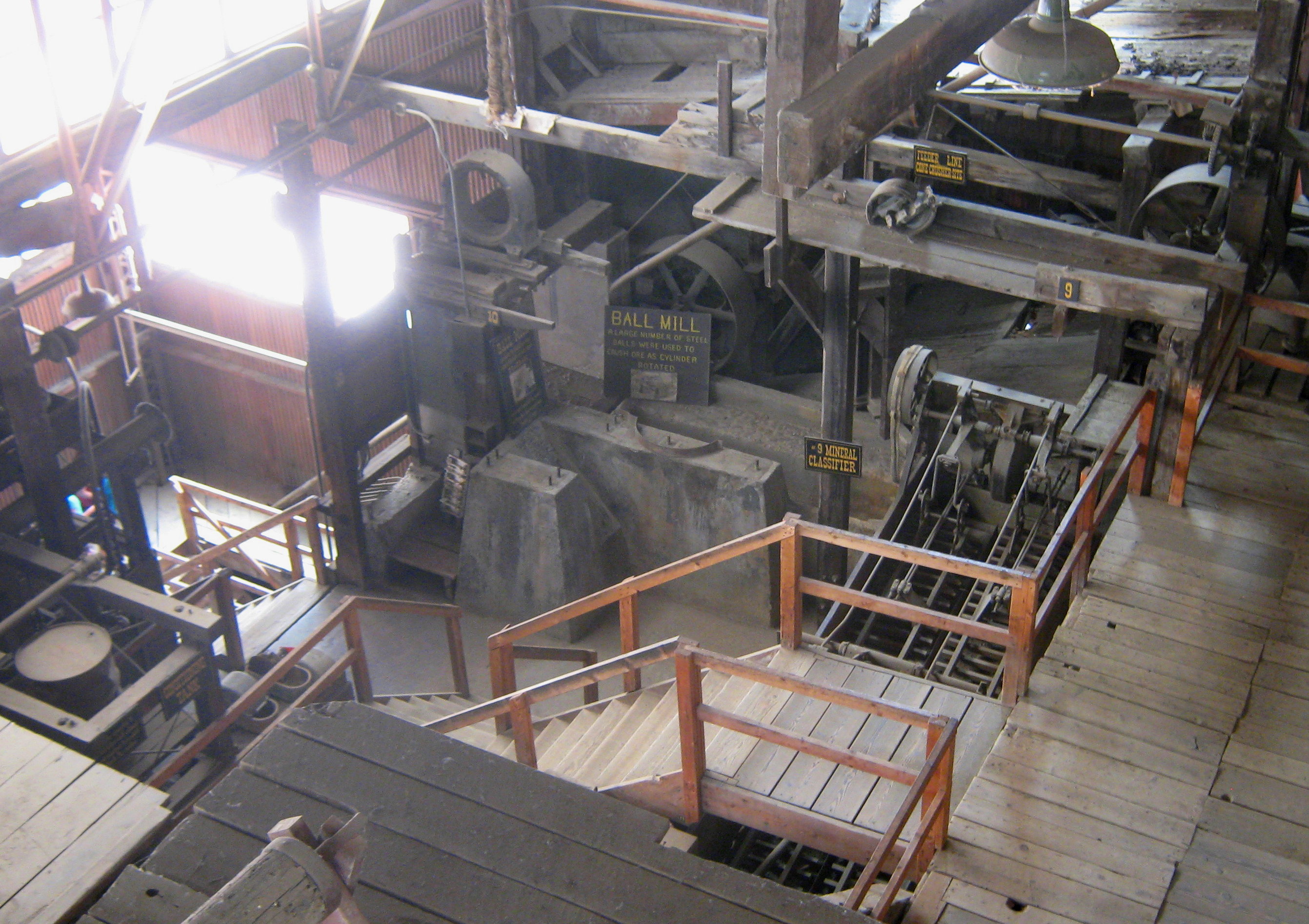
What makes the Argo mill unusual?  Several things. Most obviously, it is a gold mill that is quite well preserved. Most gold-rush era mill sites were in various stages of ruin in the early 2oth century. That this mill has been so well preserved alone makes it worth a visit. Add to that the machinery that is on display and you will get a fairly good idea of what it must have been like to work in such a place.

Interior Spaces of Argo Mill. (Copyright 2011 Th' Gaussling)

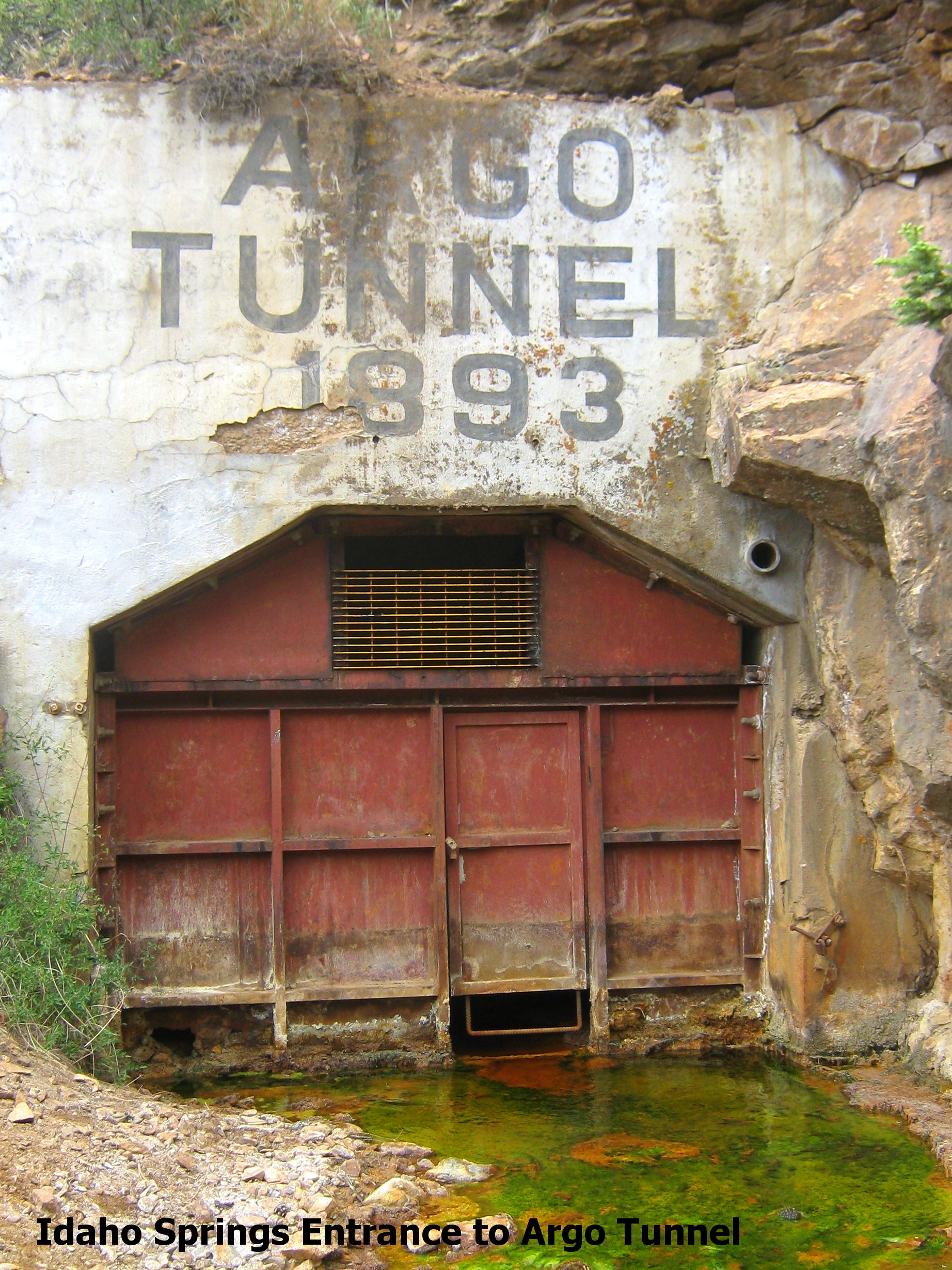
The other major reason for the unique quality of the Argo is it’s association and proximity to the Argo Tunnel.  The 4.16 mile long tunnel was begun in 1893 and completed in 1910. The idea behind the tunnel was both simple and ambitious. In order to provide milling services to the mining districts to the north, a tunnel was constructed below the mines to provide both drainage and easy transportation to a mill.

Entrance to the Argo Tunnel (Copyright 2011 Th' Gaussling)

Idaho Springs sits about 2000 ft below nearby Central City and is well situated for such a tunnel. The Central City gold district was a natural phenomenon at it’s peak. This section of the Colorado mineral belt was fabulously rich in gold and beginning with the 1859 discovery of gold, quickly became densely covered with mining claims from Idaho Springs northward to Central city and beyond. Hauling ore from the north to Idaho Springs was problematic owing to the topography.  A major road was the Virginia Canyon road, also called the Oh-My-God road, and was unsuitable for hauling ore. Ideally, a mill should be below the entrance to the mine in order to make maximum use of gravity in the milling operations.

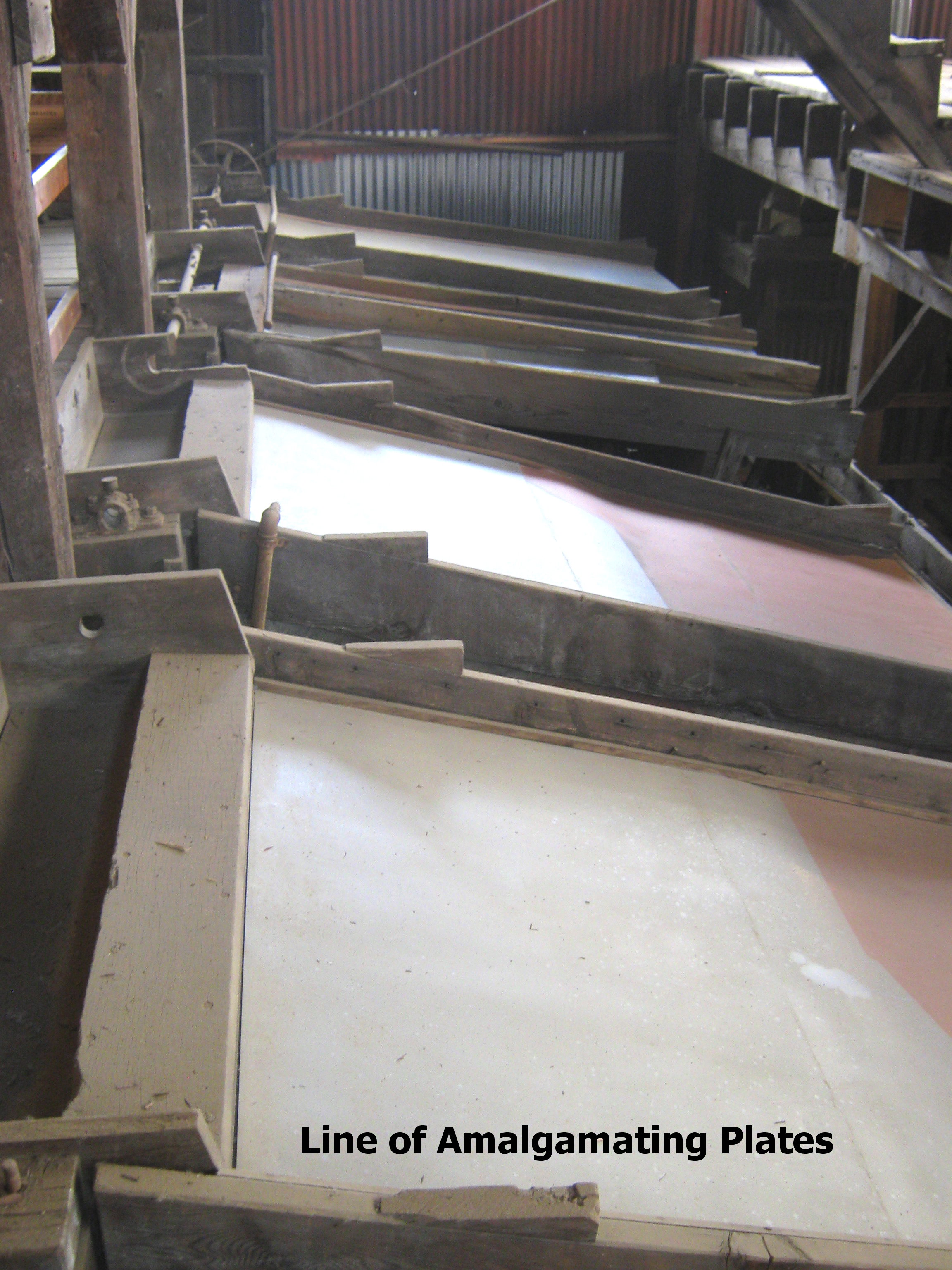
Amalgamation plates. (Copyright 2011 Th' Gaussling)

When completed, ore was moved through the tunnel by ore cart from mines to the north and received at the mill in the tipple house.  The ore delivery was recorded and assayed for gold content.  The business model of the mill was this- ore was purchased from the mines on the basis of assay and extractable gold was recovered.  This model of operation was common. Mills and smelters were customers for the mine operators. Ore was produced at the mine and sold on the basis of assay.

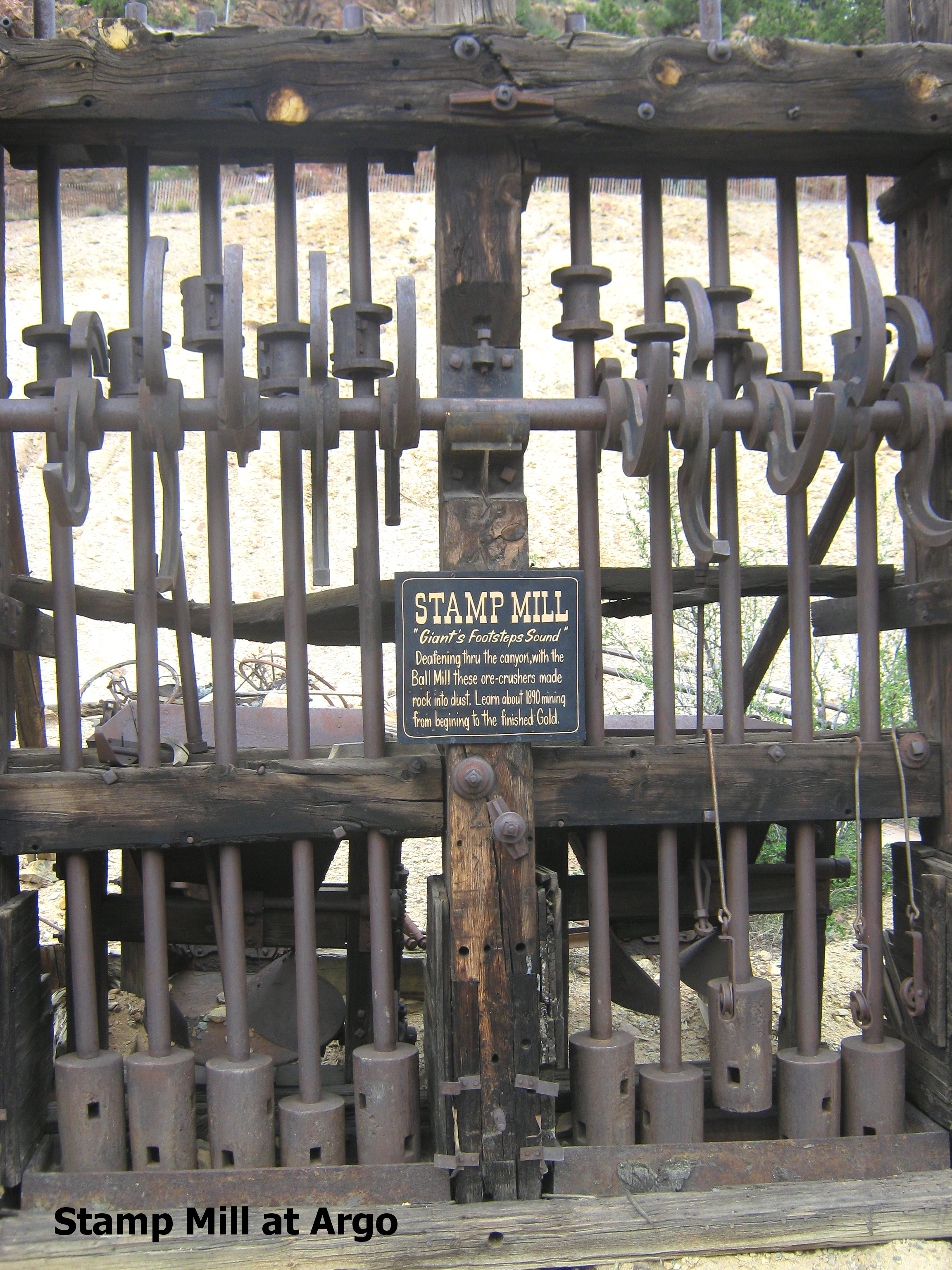
Stamp Mill on display at the Argo. (Copyright 2011 Th' Gaussling)

According to the guide at the mill, amalgamation operations were halted in the 1930’s, allegedly due to health and safety concerns.  The ore was comminuted with a ball mill and subjected to separation of the gold by shaker tables. Maybe the reason cited for ceasing Hg operations is accurate, but I’ll need to see independent verification of that.

Cyanadation was practiced at the mill as well. Not much was disclosed about this process. The guide disclosed that the mill tailings were contaminated with cyanide and mercury. As it happens, cinnabar occurs naturally in the Central City mining district, according to the guide, and can be found in spoils piles. Today this contributes to total package of contaminated leachates which may find their way into the watershed.

All in all, the Argo mill is worth a visit. Like all tourist attractions, however, you have to expect that there will be some dumbing down of the scientific and engineering details. Commonly, the emphasis in a visit to a tourist mine is on the craven details of gold mania and this tour is no different.  However, I am a purist. My interest relates more to the natural history of the chemical elements than the details of blasting and mucking.  So, if you can turn a blind eye to lackluster docent work, such tours are interesting and useful.

US Chemical Business Innovation. Policy or Culture?

The May 23rd, 2011, issue of C&EN, pp 30-31, printed an article titled “Innovation Policy Urged for U.S.”.  The article addresses more than a few considerations regarding the matter of innovation aspirations in the US. You can read the article for yourself. It details some silliness about government programs meant to stimulate startup’s. 

Startups are always in need of money. Like the salmon’s struggle to swim past the grizzlies to the upstream breeding waters, the struggle for resources is part of the Darwinistic screening process.  The struggle for operating funds is a way of screening out weak management. The trouble is, entrepreneurs are often awful managers so good products and services may die for the wrong reason.  Investor money is always loaded with conditions, as any startup operator knows.

The article quotes Richard Bendis, president and CEO of the consulting firm Innovation America. To quote Bendis, “Major research universities are the primary drivers of the future economy and job growth, mostly through science and technology. Global economic competitiveness requires the confluence of scientific discovery and the enabling resources of government and industry.” 

Well, Ok. It’s hard to take him to task here. But the last sentence is gobbledygook. What government cannot provide is the motivation or gumption on the part of chemists to start a company. Chemists need to be exposed to entrepreneuralism well before the day they set out to hatch a startup.  The current course of study in the bachelors program at virtually any US college or university is proctored by faculty who almost without exception come from a purely academic background. They know nothing about “industry” other than the salaries are probably better.

As Bendis rightly states, “Major research universities are the primary drivers of the future economy and job growth, mostly through science and technology.”  But major research universities, with a few exceptions, are poorly equipped to find and train chemists to be the future captains of of industry. It is a culture problem. The structure of the university chemistry department is not constructed to groom anything but scholarship. The American Chemical Society certification is part of the problem. The ACS recognizes and endorses a particular kind of curriculum. Most all chemistry departments have secured this endorsement long ago.  While the curriculum defines the minimum standards for a degree in chemistry, it also has the effect of freezing out much real innovation or adaptability in the field.

Faculty with business or industrial backgrounds are largely deselected from joining the club, if for no other reason than publication rates. Industrial chemists rarely have the opportunity to publish their work in the normal spread of journals owing to IP restrictions.  I’ve been a part of  a few search committees and I know how it can go.

The main exception to my generalization is MIT. Whatever it is that MIT is doing to stimulate startups, it’s does it very well. They are practically a force of nature by themselves. I would argue that the Mojo that MIT plainly possesses has more to do with culture than policy.

And it’s not just chemistry faculty that have to adapt to a new endgame in the program. The matter of turning a program to applied science must necessarily involve deans and university presidents.  They will all want to have their say. In the end, to most presidents, getting in the top 25 of whatever group of schools they aspire to be in is what matters. And that involves keeping the enrollment numbers and the endowment figures up. That is how they are measured and that is what they will look after.

Putting out applied science oriented majors will involve considerable cultural change in the academy. I’ve seen nothing to indicate that the academy is ready to embrace a real step towards the kind of entrepreneurial spirit in the aspirations expressed in the article in C&EN.  It is very difficult to be heard over the clucking in the academic henhouse.

Albemarle enters lithium market

Here is one I didn’t see coming.  Albemarle has announced that it will be entering the lithium carbonate market.  In case you didn’t know, Albemarle has been a leader in bromine and brominated flame retardants for some time.  Economically speaking, if you want to be a bromine specialist or brominator at the commodity scale you should probably be basic in bromine. That is, you get your bromine feedstocks from underground or the Dead Sea.

Everybody likes the benefits of flame retardants but nobody likes to pay much for it, so manufacturing has to be large scale to keep the retardant prices down. The way you do that is to pull bromide from the ground, often as a brine, and oxidize the bromide to bromine and isolate it from your process stream. Albemarle has recent US patent applications for the nth iteration of their technology: see US 2010/0047155 A1.

A quick perusal of Albemarle patents failed to turn up any US patents or published applications indicating that they had been working on this. This press release must have been given special consideration in view of anticipated demand for their lithium. 

Since Albemarle is already tooled up for brine work it is not such a stretch to see that they are piloting lithium extraction from their process streams. According to Specialty Chemicals, a chemical trade publication, the Albemarle brines contain 100-300 ppm of Li and sources say that they are using an exchange resin for the isolation. While the brines at it’s Magnolia, Arkansas, facility are a little on the lean side in lithium, the fact is that they are already set up for brine processing. A large chunk of capital costs for recovery have already been put in place for the bromine operation. So, it’s a matter of setting up a Li extraction train to intercept the brine stream somewhere in the Br process.

Setting up ancillary process trains like this to recover other values is not at all uncommon. According to the Specialty Chemicals article, Albemarle expects to be producing lithium carbonate in 2013.

The USGS publishes annual reviews on the global stockpile situation with economically important minerals, lithium included.  A prominent source of lithium in the US is the Tin-Spodumene belt at King’s Mountain District, NC. Spodumene, LiAlSi2O6, is the principal mineral variety at Kings MountainChemetall Foote, a subsidiary of Rockwood Holdings, now operates at Kings Mountain, NC, in Nevada, and  Salar de Atacama in Chile.

According to Virginia Heffernan at the website Mining Markets, the cost of spodumene processing to afford lithium carbonate is quite high, $5500 per tonne of Li2CO3. Acid roasting is used to process the ore to liberate the lithium.

According to the article at Mining Markets the three major players in global lithium are Chile’s Sociedad Quimica y Minera de Chile (30 %), Chemetall (28 %), and FMC (19%).

Memo to Aldrich, or ahem, SAFC

[Note: The rest of you can go about your business. This memo is to whomever at SAFC will listen. If you’re not SAFC, click here or here.]

Dear Aldrich, or shall I say SAFC?

I have a bone to pick wth you. I’ve noticed that the bottles of reagents I have received from you in the last year have been labeled with a newly formatted design. The Aldrich bottles do indeed stand out on the shelf in resplendent red and white as designed. Well done. The bottles function in the manner in which they are intended. Again, well done. All of that is as expected.

What I’m unhappy with is the fact that the labels all seem to lack the molecular weight of the contents. Having grown accustomed to finding the MW on the bottle, I now have to set the bottle down in the lab and reach for the calculator to do it myself.  After decades of using Aldrich products with the MW printed on the bottle, my addled brain now has to unlearn this and do the calculation myself.

So, what caused this? It was not an accident, was it? Were there complaints about printing errors that twittered your legal people?  Were there a series of meetings in which serious senior managers furrowed their brows and intervened over the possibility of liability? Nothing like the mention of liability to get a VP agitated.  Perhaps ink has gotten expensive.  I just don’t understand.

Was it one of us who complained? Was it some white-coated laboratory fussbudget? Did some crabby pisswink from “out there” write a letter and frighten someone in St Louis or Milwaukee? That would be sad.

One more thing. Why does the font size have to be so small on large labels? 

Th’ Gaussling

Helium

With uptick of natural gas exploration and “recovery” happening, you have to wonder if anyone is bothering to look for helium in it? And I’m referring to the Marcellus shale formation in particular.  Wouldn’t it be nice for some forethought here and try to recover some of the helium that may be lost.  Helium is a non-renewable resource and is critical to many industrial sectors, including superconductor applications.

The US has held helium in reserve since 1925. Helium extraction has been most fruitful from gas wells in the western states. The Helium Privatization Act of 1996 has resulted in the release of the helium reserve to the private sector at a federally mandated price. The FY2011 price is$75.00 per thousand cubic feet.  

According to the BLM, the agency that manages the strategic reserve, their enrichment facility in Amarillo, TX, can produce 6 million cu ft per day of crude helium at ca 80 % purity. The Amarillo plant provides crude He to refiners who polish it to the necessary level of purity for the end user.

A Homily on Extractive Metallurgy

In the last 6 months I have learned a bit of what extractive metallurgy is about. One of my projects involves isolating an element from an ore where the desired element is one of many minor constitutents. What is important here is the term “minor constituents”.  When the desired element is a minor constituent, then one necessarily faces the prospect of processing large quantities of mass.

Processing large quantities of mass requires that the material and energy inputs used in the process must be very inexpensive. Except for gold, you have to start thinking of heat as a kind of reagent that can be applied to make things happen. The lucky circumstance with gold is its affinity for cyanide in an oxygenated aqueous environment.

It is a very interesting and worthy challenge to start with rock and contrive to remove purified products from it. Half of the fun is working with the engineers and metallurgists. They have a very different perspective of industry than a stiff like me who has always relied on Aldrich for “raw materials”. I have had to recalibrate a bit. You don’t meet people like this at ACS meetings.

I have spent more than a little time digging into extractive metallurgy from the 19th century.  A good deal of fairly sophisticated technology was worked out long ago for many metals on the periodic table.  Mostly, what has changed between the metallurgy of yesteryear and today is that we now consider fairly low grade ore as economically viable. 

The tailings of yesterday will become the ore of tomorrow. It just depends on the value.  When you drive around the gold and silver mining districts in the Colorado Mineral Belt, the tailings that you see from the road have most likely been worked over at least once.

XRF Up Close

Had the chance to visit a lab today with an XRF and a GDMS. It was very interesting. Even though I’m an organikker by training, I have to say that I really dig haunting other parts of the periodic table. Organic chemists are spoiled by the splendid richness of multinuclear, multidimensional NMR.  But when you stray from C,H,N, & O, composition and structure can become much more problematic.

The XRF samples were prepared as a lithium borate fusion in a Pt mold in the muffle furnace. The vitreous buttons were then placed in the instrument sample station. One of the problems with XRF, like any other kind of spectroscopy, is the occasional interfering peak.  But, like the famous British philosopher M. Jagger once said, you can’t always get what you want.

The GDMS was a sight. This instrument is sensitive to sub ppm levels all over the periodic table. At this level, just about everything shows up to some extent. The concept of purity becomes muddied a bit, at least for mining samples. For most things there aren’t good standards at this level. You have to trust in the linearity of the instrument and be happy with 30 % error.

XRF Magic

We’ve been looking at hand held XRF spectrometers.  If you have not been introduced to this, you may be in for a real treat. A variety of companies make them- Bruker, Thermo, and Innov-X to name a few. These things are in the low-end Lexus price category, but are they ever amazing.  It’s straight out of Star Trek.

Clarke’s Third Law states that any sufficiently advanced technology is indistinguishable with magic. I gotta tell ya that these hand held XRF’s are just amazing.  You point at a sample and it gives a tally of the elements present, or most of them at least.  Some even have a built-in GPS you can punch to take a waypoint of the location of the sample you just analyzed out in the field.  It is a great tool for mineral prospecting.  

What is embarrassing is that this is the first I’ve heard of it. Our geologist friends have been using these things for a while now. 

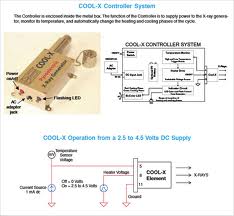
The whole thing depends on a miniature X-ray source.  I’ve been looking into this.  For the curious folks out there, lithium niobate- LiNbO3- is a very interesting material.  Crystals of LiNbO3 have the property of pyroelectric potential. A pyroelectric crystal is one that is able to generate a polarization across the crystal faces in proportion to the temperature.  A pyroelectric xtal placed on a heating/cooling block in a vacuum is able to generate a stream of electrons energetic enough that, when stopped by a copper electrode, will generate x-rays. 

One manufacturer, AmpTek, produces a miniature x-ray unit called the Cool-X that has a photon output equivalent to two milliCuries, with 75 % of the flux less than 10 KeV.  Elsewhere in the product literature, the output is described as 5 milliSieverts per hour.  So, the user has to be a little careful with this thing. But rad safety issues aside, this is quite an amazing source. The product literature doesn’t come out and say what kind of crystals are used, but they may be a tantalate salt.

AmpTek Cool-X

The unit does not operate continuously. It can only generate x-rays durig a thermal cycling period, The xtal starts out cool and as it’s heated, generates the electron flux that is de-accelerated by impacting the copper to produce the x-rays. The lit gives a cycling interval of 2-5 minutes.  It is referred to as a Kharkov X-ray generator.

It’s magic.

Extractive Metallurgy as Inorganic Chemistry

I am involved in an extractive metallurgy project 1 day per week give or take.  So I have been trying to take apart undesirable minerals in an ore to concentrate the desired metal. It’s called beneficiation- a word introduced by Agricola in his book De Re Metallica published in 1556.  I can’t disclose what the desired metal is.  Suffice it to say that it is rather scarce though not a coinage metal. 

What really amazes me is the disconnect between what many of us think of as the field of inorganic chemistry and the field of extractive metallurgy.  In my training as an organikker, I had never been exposed to extractive metallurgy, nor did I even know what it was.  Turns out that it is a field of applied inorganic chemistry. In this field, a metallurgist is the person who figures out how to extract desired metals from ore.  Nobody seems to call them a chemist, at least to their face. They’re the metallurgist.  No doubt there are exceptions.

Well, that clears things up quite a bit. I feel better getting that off my chest.  I’m sure any wayward metallurgist who happens upon this site has already begun to laugh. Extractive metallurgists do synthetic inorganic chemistry. It’s just that they prefer to keep company with a gangue of engineers and geologists rather than those who don’t work with minerals.  I can relate.

Chemistry jobs

Last fall I was invited to speak to some chemistry students at a local university. Being an industry guy, I was perceived as having some “special” insights into getting a job after college.  While I might have been a successful job hunter when I was less than 40, the odds got much longer after that transition to middle age. More on that in another post.

While I cannot outline the exact path to employment- you really can’t do that- I was able to talk about some of the lesser known jobs that  a chemistry degree will enable.  They are not sexy R&D jobs nor are they upper level executive jobs either. I’m not a pharma guy, thankfully, so my comments do not pertain to that bizarre and brutal world of pharmaceuticals.

The jobs I pointed out are critical to the conduct of manufacturing. They are jobs that one might not necessarily get at the entry level either.

So here are some of the jobs I mentioned.  Environmental health and safety- EH&S. Industry needs people who understand the regulatory situation relating to worker safety and to the environment.  EH&S is also concerned with hazardous waste management.  Expertise in this area is critical to the daily operation of any chemical plant.  This is a good place for an entry level and an experienced chemist to enter because the position typically requires a BS degree and greater than high school knowledge of chemicals and hazards.

Purchasing is an area where a chemist can play an important role in the operation of a plant.  Somebody has to source and buy the chemical raw materials. In general, there is spot buying and contract buying. Spot purchasing offers freedom on the upside but possible instability and higher pricing on the down side.  Purchasing under contract offers a better footing for negotiation and long term stability, but may lock the buyer into minimum volume and a firm price schedule. If demand for your product wavers, being locked into a supply agreement can be a problem if you have agreed to take a set volume.

There are various levels of purchasing positions.  At one end is the purchasing of non-chemical products.  Don’t need a chemist to do this.

On the other end is what is called the supply chain (or procurement) manager. Here is where you need to have a chemist.  This person is charged with assuring that there is an uninterrupted supply of feedstocks to the production facility. They are also tasked with assuring that the vendors meet some basic level of QA/QC and are able to document the whole spectrum of quality assurance. That is, does the vendor have the mechanisms in their business structure to assure not only the flow of product out the door, but also that the process is stable and produces material of the proper quality? Here,  management of change is is very important. A supply chain manager also makes site visits and conducts quality audits of vendors.

Business development and sales is an arena that makes good use of chemists and engineers. The most highly prized type of sales and business development person is the fabled “rainmaker”.  Business development is an activity where a manufacturer makes a connection with a customer who needs some particular material manufactured.  The goal in business development is, not uncommonly, to bring a new product into being.

In the chemical world (outside of pharma) there are commodity chemcials and there are custom and fine chemicals.  Commodity chemicals are those for which there are more than one manufacturer and the difference is mostly in the pricing and availability.  A chemical that is commoditized is one in which the volumes are often high and the margins are thin. Think ethylene, sulfuric acid, BTX, etc.

Commodity chemical producers need sales people too, but their job description is more related to account management and sales. If you dig being a sales rep, go for it.

A business development manager is someone who tries to match technological capability to the needs of the customer for more specialized products. This is teh person who looks at the chemistry and SWAGs a price based on paper chemistry and a spreadsheet.  This is often high pressure work. A bad quote may spell trouble for you. Too high and the customer balks. Too low and you may be faced with the wrong expectations by the customer.  Above all, a good business development person manages expectations.

Quality control/assurance is another position for a chemist. This is for someone who is highly organized and is fond of recordkeeping. This is the world of specifications and certificates of analysis, or certs. The QC person is responsible for making sure the company does what it says it will do in regard to product quality. It is a gatekeeper position and it can be a real hot seat. QA/QC can hold up a shipment or it can prevent the plant from using a raw material. It is a powerful post and those who hold it are not universally loved.

Process safety- what I presently do- is a job description wherein chemists are charged with determining whether or not a process is safe to execute. It is a hybrid job- part synthesis, analysis,and P-chem. It requires quite a bit of imagination in that you have to try to imagine possible failure modes and often obscure ways of testing materials for the potential to release hazardous energy.

Inventory management is central to the operation of any manufacturing unit. It is critical to receive raw materials both physically and in the accounting system. Materials have to be stored in designated locations and have to be staged for use according to a master schedule. While is is less common to find chemists here, I suppose it is possible. Often this position is filled by someone who is familiar with the manufacturing environment.

Related to inventory management is shipping and receiving. In order to load hazardous material onto a truck for transport, one must have training in the regulations pertaining to the transport of hazardous goods. In addition to the regs, there is training in operating in a hazardous environment and emergency response. Again, not a lot of chemists will end up here, but it is a job description in the chemical industry.

Finally, there is the possibility of working as a plant operator. You can find a large variety of people operating in a chemical plant. I know ex-firefighters, ex-military, biologists, farm boys, heavy equipment operators, construction contractors, and people who have worked in chemical plants all their adult lives. It is hard work. You have to work on the plant floor wearing PPE that is often uncomfortable, or perhaps sit at a terminal in a control room monitoring a process train.  But if you like working with your hands on machines and electronics in manufacturing, it may be job for you.

If your desire is to be a captain of industry- a CEO or President, then you should forget lab work and go into business development or sales, or even accounting. Anything related to the accumulation of sales dollars, customer service, plant startup, and deep finance is crucial to someone handing you the keys to the corporation.

Yes, I know that there are a few scientists who have ascended to the top, but they are the exception. You must be fluent with the ways of money and show a record of rainmaking.

The other possibility for a chemist is to join a startup venture. But this is hard to find since most startups are begun with a core group of people who know each other. At some point, however, they will begin to recruit skilled people to fit particular slots. I have no real advice to offer here except that startups are very risky. At some point you may be asked to invest more than just time.