Category Archives: Chemical Industry

Whither Diethyl Ether?

Diethyl ether seems to be in short supply in North America these days. Suppliers have customers under allocation constraints.  Yes Virginia, people still use Et2O in certain kinds of chemical processing. Sometimes Et2O is prized for its solvent effects and sometimes for its volatility. Sometimes the only way to solubilize some  inorganic compounds is as the metal etherate.  Solvent residues in fine chemicals are often a problem and volatile process solvents can be a big help in ameliorating that issue.  You can purchase 5,000 gallon tanker loads of Et2O if the supplier has qualified you. Another reason not to swerve in front of trucks on the highway. 

Part of the problem with Et2O availability is the considerable reduced demand for it these days.  Many companies have banned the use of Et2O on their site for any purpose. It is easy to understand why. The insane vapor pressure and low autodecomposition temperature are problematic for plant safety. The low boiling point of Et2O means that plant utilities can heat a vessel of ethereal soln rapidly and blow a rupture disk at reasonably low pot temps.  Naturally, the safetly department gets surly about this kind of thing.

Tetrahydrofuran is not always a suitable process stand-in for Et2O. Reactivity behaviors may be quite different from Et2O solns.  THF’s sensitivity to butyllithium, for instance, forces one to keep the processing conditions at low temp with a chiller. Lower pot temperatures increase the thermal margin of safety, but may have a deleterious effect on activation of a transformation once BuLi has done its job. 

I have studied the decomposition of methyl tetrahydrofuran with BuLi and have determined that it decomposes in the low 30’s °C range, somewhat higher than THF. MeTHF is not an exact stand-in for THF or Et2O either.  But it is definitely worth having in the stockroom for development work. It will surprise you in regard to how different it can be from THF.

While MeTHF is touted for its ability to phase separate with water, it will hold appreciable amounts of water.

Does Corexit really correct it?

According to news sources, BP is allegedly using a dispersant called Corexit EC9527A.  According to the EPA this formulation contains water, propylene glycol, and 2-butoxyethanol, as well as an unspecified confidential additive.

I guess the question is, what purpose does this treatment serve? By dispersing the petroleum, I assume that the effect is to spread a given mass of petroleum into a larger volume of sea water by virtue of producing dispersed globules of oil-phase material. Does the increased surface area result in off-gassing of volatiles and subsequent submergence of the now denser oil phase? Or, will the dispersed petroleum simply drift into larger patches of oily water? If it enables an increased dispersion so that the currents can chaotically distribute the petroleum to a greater range of shorelines, is this treatment of any real benefit? Perhaps it is better in the long run to have a heavier coating on fewer beaches? Less acreage to scrape.

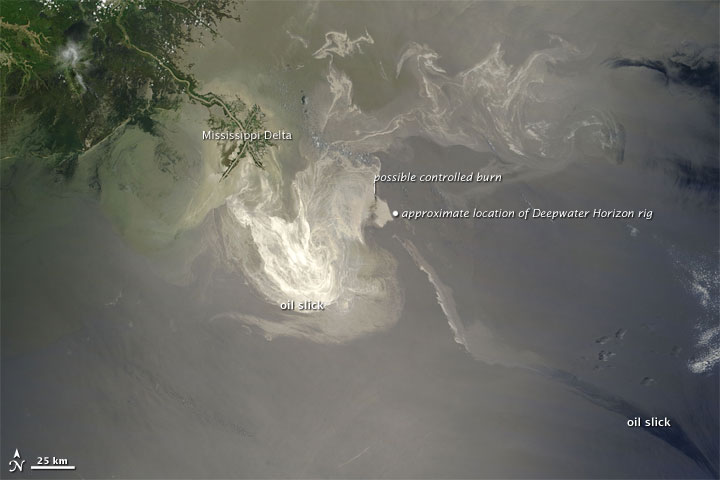
EPA is making noise about BP’s choice of Corexit. Seems to me that butyl cellosolve has been in the market for quite some time. There should be some information on its fate in the watershed. Judging from the map, the oil spill is near the dead zone around the mouth of the Mississippi River. So, until somebody gets some survey data, it’ll be hard to estimate the magnitude of the environmental insult of this event to the open ocean.

I do not understand what government officials were trying to do by saying that they might take over control of this spill. What is the government going to do to a petroleum discharge a mile below the surface? Call the Navy? Or Boots & Coots? As good as these guys may be, they’re land lubbers. 

Let the folks at BP finish the job.

NASA Earth Observatory Photo, May 24, 2010.

Force Majeure

If you are in the business of buying or selling chemicals under contract, you probably understand the merit of a force majeure clause in the contract. Literally meaning “greater force”, force majeure is essentially a declaration that a term, usually delivery, is not going to be met in an agreement owing to an “act of god” or other influence that is well beyond control or prediction. It’s not unheard of for a force majeure clause to be omitted in a supply contract. Both buyer and seller can benefit from this escape hatch when the sky falls.

Companies declaring force majeure in 2010 include Chevron Phillips on US olefins (ethylene cracker outage), Ineos on certain polyolefins (outage due to agglomeration in the reactor), Shell Chemicals on is Moerdijk styrene (ethylene supply problems), AkzoNobel on its Perkadox 14 line in Belgium (explosion & fire), Dow on phenol in the Americas (broken heat exchanger), Domo on its nylon 6 (feedstock supply shortage), Sasol on chemicals out of its Germiston, SA, plant (fire), Olin Corp. on its McIntosh, Alabama, Chlor-Alkalai plant (equipment failure), Cristal Global on its Stallingborough, UK, TiO2 operations (unspecified malfunction), BASF on acrilonitrile-butadiene-styrene (ABS) at its Tamaulipas, Mexico, site (butadiene shortage). Diethyl ether is also in short supply, but I am aware of no specific reason.

A few of these force majeure interruptions have been lifted already. Point is, it is always good to have multiple suppliers on line to provide supply of feedstocks. In regard to the olefin/polyolefin force majeure declarations, I wouldn’t be surprised if there wasn’t a bit of foot dragging that lead to a shortfall in capacity. Why keep all of your crackers in operation during the Great Recession?

Depth of knowledge

It’s funny how you can deceive yourself into thinking that you understand a reaction. Then you do that last experiment and get a result that shows unexpected sensitivity to one thing or other.  Depth of knowledge comes from doing a lot of experiments, not hand waving. It is important to try to learn something from every experiment. If the rxn went south, what happened?  Can you do a mass balance?  What happens to the mass that doesn’t convert to product?  Consider every “poor” result as an opportunity to extend your understanding of the reaction.

If you want to claim true expertise in a process, you have to know what the reaction system is broadly sensitive to and what it may be insensitive to. In short, you need to know what affects the velocity of the reaction or what steers it to side product formation. Exactly what are the boundaries of “normal”? 

Running the same reaction a hundred times successfully by carefully following the directions confers proficiency, not expertise.  It is fine for most workers to have proficiency. But someone should take the trouble to acquire broad expertise for the inevitable off-normal event somewhere down the timeline.

An upset condition can stem from an off-normal engineering input or from some reactivity issue. How many watts per liter will your reaction generate?  How will your reaction mass behave if there is a solvent boil-off? Does the solvent boiling point fall below the maximum temperature of the reaction in an off-normal condition? In other words, can the reaction mass self-heat in a manner leading to a runaway condition?  If so, what layers of protection are in place to prevent this kind of event?

The ability to push electrons in a mechanism or facility with named reactions is not enough skill for process scale-up. A chemist has to walk over the entire acreage to thoroughly map out the hills and valleys of the process. The people who operate the big pots and pans, and their families, are depending on your thorough knowledge to keep them safe.

Acquiring expertise is going to annoy people. It necessarily slows things down. It will make you a colossal boor at parties. But never confuse motion for progress or data for knowledge. Over time, people will come to you for advice on things. Be patient.

A story of continuous processing

Most of my industrial life has been spent in what can be called a semi-batch processing world where products tend to be high value, low volume. Fine chemical products sold at the scale of 1 ton/yr or less can be produced in a campaign of less than a dozen runs in 200 gal to 1000 gallon reactors in a batch or semi-batch mode. Depending on the space yield, of course.

In my polylactic acid (PLA) days many years ago, we found ourselves necessarily in the monomer business. If you hope to introduce a new polymer to the market- a very difficult proposition by the way- you must be firmly in control of monomer supply and costs. Especially if the new polymer uses new monomers. New to the market in bulk, that is.

Our task in the scale up of polylactic acid was to come up with a dirt cheap supply of lactide, the cyclodimer of lactic acid. The monomer world is one of high volume, low unit cost.  By the time I had my tour of duty with PLA, a short tour in fact, much of the lactide art was tied up in patents. Luckily, my company had purchased a technology package that allowed us to practice.

Our method for producing lactide was a continuous process called continuous reactive distillation. Basically, a stream of lactic acid and strong acid catalyst was injected onto a middle plate of a 25 plate distillation column which stood outdoors. The column was atop a small bottoms reservoir containing heated xylenes.

The solvent xylene was heated in a reboiler which was located 20 ft away from the column assembly. Hot solvent was circulated in a loop between the bottoms reservoir and the reboiler. After startup the solvent built up an equilibrium concentration of lactide and a dogs lunch of oligomers.

At the injection point in the column, 85 % lactic acid and catalyst entered the middle of a multiple plate column that was charged with refluxing xylene vapor and condensate. While in the column the lactic acid esterified first as L2, the open chain dimer, then some fraction of it cyclodimerized to lactide.

 The water that was extruded by the esterification process was vaporized by the hot xylene and equilibrated up the column to the overhead stream and out of the column to a condenser.  When condensed it phase separated in a receiver called a “boot” that had a cylindrical bottom protuberance that collected the water. The  upper xylene phase was returned to the process.

Meanwhile, the xylene loop accumulated lactide and oligomers. The loop had a draw-off point where some predetermined percentage of the bottoms loop was tapped for continuous lactide isolation. This is where the fun began.

When cooled even just a little, the xylene phase emulsified. Badly. So, the trick was to induce a phase separation by forcing the emulsion through a ceramic filter. Here, the water phase and most of the oligomeric species were partitioned into a separate mass flow while the xylene phase was sent to a sieve bed for drying.

After passing through the sieve bed, the xylene phase was sent to the continuous crystallizer where it was chilled a bit to precipitate the lactide. A slurry of lactide solids called magma was then sent to a continuous centrifuge where the solids were isolated and the supernatant was returned to the bottoms loop.

The Achilles heel of the process was residual acid. Since the monomer and the oligomers are all acidic species, and the catalyst is nearly as strong as sulfuric acid, pulling the neutral lactide cleanly and cheaply from this acidic hell broth was a problem. So big in fact, that it eventually was the straw that broke the camels back. This shut our fledgling company down.

Residual acid in the monomer has a disastrous effect on the quality of PLA. It gives low MW product that is amber in color. The winning technology was the back-biting process for lactide production. It was applied by our competitors who won the battle and they (Dow-Cargill) went to market.

Moving forward with the chemical process

The scale-up of a chemical process is an excercise in many subdisciplines. The bench chemist has to do his/her magic in finding a suitable reaction and purification scheme. Process R&D managers must exercise managerial art in shepherding people through a timely execution of the project. Purchasing managers must arrange for just-in-time arrival of raw materials and inventory managers must see to it that they are properly staged.

Technical writers must have a batch record written and signed off. Process hazards and EH&S folks must have procedures to evaluate for safety and regulatory compliance. Regulatory affairs people must have submitted forms for TSCA compliance. PSM processes must have all of the requirements in line for OSHA compliance. Air and water permits must be in place as well as provisions for capturing VOC’s and shipping of waste. Procedures for handling  liquid waste streams and filter cakes must be in place. Successful kilo lab and pilot plant validation of the process must be signed and passed along. The analytical department must have procedures for raw material validation, in-process checks, and final analysis for certification.

In order to go forward, a sales person must have already worked out acceptable price and shipping terms. The customer must issue a purchase order and the terms must be accepted by the manufacturer. Production management must then schedule a production run once the scale-up effort is complete. The QA/QC  folks must have acceptable specifications by which to issue a document certifying conformance to the specifications.

Once the PO has arrived, it’s show time.

Chemistry jobs, part (x + 1)

I received an email from a good friend and colleague who made some fine points relating to my comments on business experience for chemists.  Since he is shy about posting the comment to the blog, I’ll put it here. I’m sure he’ll forgive me.

The younger folks never heard that this has all happened before. My orgo prof talked about chemists driving trucks during the 70’s. During the Carter years things weren’t too pretty either.

Most of my colleagues seem to feel that you have to recruit to the field – since we already are a small fraction of the pre-med group and the success rate for chemists is low – but I am unsure of what an honest appraisal is. I don’t recruit, but I also don’t want to scare them away.

I agree that a few business courses are essential. But, I have a colleague who got an MBA after he started teaching here – I think that was not very useful. Unless he opens a business….

As I mentioned to my friend, I think that if a chemist wants to experience the business side of chemistry, then he/she must go to the business side with 100 % commitment. If you want to be on the business side of chemistry, then you must commit to competition with all of the cats & dogs on the other side of the science fence.  If you want to be a business person, then you have to BE A BUSINESS PERSON.  You cannot keep one foot in the lab and the other rubbing the customers ankle under the table. Ya gotta be all in or forget it.

A pure business person does not care if he is selling “As Seen on TV” widgets or pallets of triphenylphosphine. Someone with a chemistry background will almost certainly want to be in a familiar space, and so will gravitate to chemicals. But to get into chemical sales, you have to penetrate the veil of obscurity that covers most of this field. You have to find out who is manufacturing bulk chemicals and locate the name of the sales VP or manager. Entry through the scientific end is tighter than a fishes asshole and is the wrong approach.

To be a successful business person in chemistry (or anything) you must have a total commitment to better living through cash flow. Cash is both King and Life.  And cash comes from Selling!!!!!!  A successful business person wakes up thinking about sales and falls asleep that night thinking about sales for the next day.  Like with chemistry, it is a form of mania.

Frankly, if a person with a lengthy history of chemcial R&D approaches a VP of sales for a job, they’re likely to think there is something wrong with them. What the …? This is where the strength of your personality comes into play. You’re very first “deal” will be with the sales or business development manager who would hire you. And you better make it good. I would dial in 90 % substance and 10 % bullshit for full schmooze configuration.  Remember, you’re trying to impress professional schmoozers.  It is not uncommon for a schmoozer to be quite susceptable to it themselves.

Yes, I am aware that Dante Aligheri witnessed the ring of hell set aside for flatterers, but you’ll have to make amends later.

There is a key item to put on the table. It is called the value proposition and it is a crucial part of any sales pitch. You have to convince a potential employer that you bring things to the table that will benefit or increase sales. Before one can seriously go out and find a job in sales, ones personal value in the proposition must be sorted out and rehearsed for automatic release during conversation.

My friends colleague with the MBA will probably retire with an unused business degree if he does not get out there and mix it up.  But maybe sales is not his thing.

Perhaps he is more interested in procurement. This is the true dark side of business. Procurement managers are some of the most powerful people (mad dogs, actually) in business and everyone fears them. Procurement managers are the people who select vendors and authorize the release of vast streams of cash through an instrument called a purchase order (PO). A PO is a highly sought after item and represents the culmination of a courtship of sorts.

Chemists can be extremely useful in the procurement of chemicals.  A procurement manager with a chemistry degree is basically a necessity in much of the chemical industry.  Chemists speak the language and are able to keep an eye on specifications and make sure that the right R&D people or engineers connect with the vendor if there is a quality or timing upset.

There are jobs in the chemical industry that may be available to chemists who are willing to step away from research. But it does require putting on a different cap and assembling a different resume package.

Drill baby dr … what was the question?

I keep seeing video footage of citizens who have been asked to comment on the recent plan to open up offshore oil exploration. President Obama and his crew have read the tea leaves and have concluded that, in addition to advancing alternative fuel technologies and markets, it would be useful to open up offshore drilling, at least a bit. Invariably the people who appear on air seem to concur that we need to find and tap the petroleum resources under the sea floor.

Rarely one hears an interviewee who will openly say that we should reduce petroleum consumption, or at the very least, its growth rate.

Here is my question. Why are we so anxious to tap all of our resources as soon as possible?  Isn’t oil in the ground a little like money in the bank? Oh, I forgot. We are not a savings culture.

Obviously, the new exploration emphasis is to support a decent growth rate in consumption. A high throughput of fossil carbon and energy is needed to sustain the profitability of certain large public corporations.

As I see it, the problem with public corporations is that they are run on behalf of what are essentially absentee landlords. The stockholders demand a good return on their investment or they’ll bail. Can’t blame someone for that. So, management runs the corporation in a way that affords maximum profit rather than maximum sustainability. As a result, in the same manner as absentee landlords, management drifts into the mindset that they can justifiably milk the resource to depletion for fast cash. If cash is king, fast cash is divine.

The market is very much like a stomach. It cannot plan. It only knows that its hungry or not hungry. It seems to me that an organ with a bit more wiring should be in charge of energy resources.

Chemistry: The volatile profession.

One of my department manager duties is to review resumes sent to colleagues in other departments. HR gets them and records them and distributes them for review. Earlier in the 1st quarter we had to review a large stack of resumes from well qualified people. Perhaps 4/5 of them were from people in industry who had been let go. For the most part the applicants were chemists from the pharma field. Most had quite impressive backgrounds with lots of publications, patents, and responsibilities. More than a few could have been my boss. It was a sobering experience to see so many good professionals on the street.

I have been in such a position in the past. It is disorienting and deeply distressing to be let go. It is not unlike a death in the family. When you are a highly educated specialist, your ego is unavoidably tied into your career. Your career is who you are. No professional job, no value. No worth.  Even more maddening, it is difficult to stay connected with the profession when you are unemployed. You are off the train and standing there looking at it while it rolls into the distance. And chemistry is not a field of endeavor for the unaffiliated.

I still think of my lowest point between chemistry jobs.  I was working in construction and had spent the day in a  dirt crawl space pulling wire for a remodel job. It was up high in the mountains in the winter and it was very cold.  At the end of the day I drove down the canyon into Boulder and stopped at a pharmacy to pick up some cold medicine for my kid. I had to ask the pharmacist a question, so I stood there in dirty coveralls and muddy boots and asked about the dosing of the cold med for a 2 year old.

The pharmacist seemed exasperated for a moment, but then composed herself and spoke to me slowly while enunciating her words clearly. Her, the supermarket pharmacist, standing there on the raised platform in her white smock. Speaking slowly, so I’d understand. Simple words so I wouldn’t be confused. Me, standing there in Osh-Kosh coveralls and a filthy insulated work shirt draped over my aching body after a long day of labor in the dirt. I was a 40 year old apprentice electrician with a chemistry PhD who had hit the bottom of the ego pit. Or, so I thought.

I accepted her advice politely. I paid for the med and walked out to my pickup truck. What resonated so deeply was the realization of how it is that we judge people by their appearance. My grubby appearance had caused someone to presume that I was slow witted and in need of being patronized.

I had supposed that after this dose of humility there was no where else to go but up.  But I guessed wrong. There was much more to come.  When your ego has been roughed up, it can become inflamed and hypersensitive. Your sense of proportion can be lost.

Being discharged from your place of employment is one of lifes big shit sandwiches. While most people will learn and improve from it, it will always remain a sensitive spot in your psyche. You never forget the circumstances. Being called to a conference room only to find HR there with a table full of handouts and forms to sign. The metallic tang in your mouth as it dawns on you what is happening. The grim warning that your termination “package” is valid only if you agree not to sue or publically criticize your ex-employer.  But you sit there with tunnel vision and listening impairment. You’re nervous system is electrically charged with panic and the instant, crushing worry about how you’re going to keep your family fed and in shelter. As you take the last drive home you’re mind is numb.

Behind most every resume I read is a story of long term success and a recent setback. For those freshly out of work, the contrast between the emotional high and low is staggering.  I understand somewhat of the plight and angst they are feeling. But, like someone once said, the only way out is through. You have to be willing to start over down the pecking order to recover your career. Sometimes further down than you want. The cherished notion of seniority is one that will have to be reconsidered.

I am starting to believe that this chemical unemployment wave is different. I think that we are seeing a phase change in how the chemical industry does business. The acceptability of outsourcing R&D is the reason for my pessimistic view. It has become axiomatic in many organizations now that R&D must be outsourced to countries where the overhead rate is substantially lower. And the outsourcing of R&D can only be bad for US chemists.

Agilentus, Angry God of the Quadrupole

I’m going home now.  Just spent a few hours trying to make a parameter change its state on the GC side of  my spiffy new Agilent GC/MS.  Modern instruments are a confederation of subsystems that must give a thumbs up before a software magistrate will allow the instrument to initiate a run. If it is a hyphenated instrument, then all the more so.  All of the flow rates and temperatures and dozens of software settings must be in the proper state before the method can be executed. 

One of the first things you learn after acquiring a complex piece of apparatus is that the help menu is limited in scope.  The mere definition of a mode or a key or a parameter is hardly enough when an annunciator declares that the boat won’t move because the flippin’ gas saver mode is on. The gas saver feature is meant to reduce helium losses from the splitter when the instrument is idle.  What is especially irksome is when an obscure  feature declares that it suddenly can’t  play ball on the (N+1)th run.

My assistant is a truly gifted chromatographer.  She learned analytical lab management in pharmaceutical cGMP and EPA lab settings. What she can do with GC or HPLC is a thing of beauty.  I, on the other hand, have become a grumpy instrument Luddite. It’s not that I don’t like chromatography. In fact I really dig it.  What I get grumpy and dispeptic about is having to claw up the learning curve of yet another software package and then use it enough to retain some kind of fluency.

So, in order to save face with my staff, I have to figure this thing out myself.  Modern chromatographic instrumentation is now configured around the needs of documentation requirements. Creeping featurism. Long gone are the days of sauntering up to the instrument and jamming a sample in it without having to answer a lot of irksome questions about method names and directory gymnastics. Software packages are designed to provide a robust paper trail on the results of all samples injected. It’s all gotten very “Old Testament”.

What is needed is a simplified mode of operation for boneheads like myself. For my process development work I just want resolved peaks, a peak report, and – please god- mass spectra of the components. I do not need a fancy schmancy report. I just need some numbers to scribble in my notebook and report in order to understand what happened in the reactor.

So there it is. A lamentation on chemistry.