Category Archives: Chemical Industry

Reuters Receives Raw Materials for Fentanyl

The news service Reuters recently published an article on the ease with which the raw materials for the production of the opioid Fentanyl. From their $3600 expenditure on raw materials they estimate they could have produced $3 million worth of Fentanyl.

For an estimated 74,702 Americans in 2023, Fentanyl provided them with a narcotic experience prior to death. The lethal dose is reported to be 2 milligrams for an adult. It is 20 to 40 times more potent than heroin.

Outside of medical use Fentanyl should be described as a highly (neuro)toxic substance rather than just an opioid. Yes, it is an illegal narcotic, but it is also a potent deadly poison. Hidden with other illegal drugs in pill form, it is just a highly toxic contaminant.

On January 5, 2024, I posted a piece titled “A Bit of Fentanyl Chemistry” which is reproduced below. It turns out that the Janssen synthetic chemistry I wrote about then is quite close to what the investigators at Reuters had in mind for their story. In the world of chemical commerce, a process using easily available raw materials is highly favored.

My take-home message from the Reuters story is that unless China seriously clamps down on those who export the raw materials, all that is left to do is to suppress demand. The import of Fentanyl raw materials is aided by deceptive packaging and small quantities needed. Worse, Fentanyl raw materials have other uses in pharmaceutical chemistry and are too useful to completely shut down. The death and incarceration that Fentanyl can bring in the US does not appear to be sufficiently convincing to the at-risk American population. Nothing new here.

=========================

A recent raid on a clandestine drug lab in the Hatzic Valley east of Vancouver, BC, netted 25 kg of “pure” fentanyl and 3 kg which had already been cut for street use. Precursor chemicals used to manufacture the fentanyl were also seized. Along with the drug, the raid also seized 2,000 liters of chemicals and 6,000 liters (about 30 drums) of hazardous chemical waste, according to an RCMP news release 2 November, 2023.

The police said that the seizure represented 2,500,000 street doses.

In August of 2023 the police in Hamilton, Ontario, announced the results of Project Odeon. This was a large-scale sweep of illicit drug production in the Hamilton and Toronto area. From January 1, to July 30, 2023 there were 606 incidents related to suspected opioid overdoses and 89 suspected drug related deaths in the Hamilton area. Twelve people were charged for a total of 48 criminal charges. The police disclosed the following items that they seized-

  • An operational fentanyl drug lab at 6800 Sixteen Road, Smithville.
  • A dismantled fentanyl drug lab at 4057 Bethesda Road, Stouffville.
  • Approximately 3.5 tons of chemical byproduct from fentanyl production.
  • 800 gallons of chemicals commonly used in the production of fentanyl
  • Lab equipment commonly used in the production of fentanyl
  • 64.1 kg of illicit drugs, including 25.6 kg of fentanyl, 18 kg methamphetamine, 6 kg of ketamine
  • A loaded, Glock firearm and ammunition and four extended magazines
  • Over $350,000 of seized proceeds, including cars, jewelry, furniture and cash

Fentanyl is a synthetic drug first prepared in 1959 in Belgium by Paul Janssen (1926-2003). Janssen was the founder of Janssen Pharmaceuticals, now a subsidiary of Johnson & Johnson. In addition to fentanyl, the Jenssen team developed haloperidol, the ultrapotent carfentanil, and other piperidine based congeners. Piperidine itself is a DEA List 1 substance in the US.
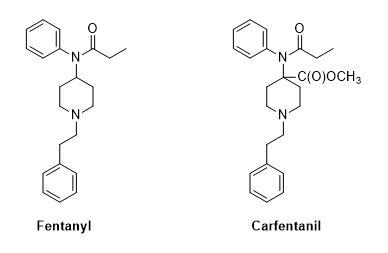
Carfentanil is just modified fentanyl. Graphics: Will O. de Wisp

The elephant in the room with fentanyl is its extraordinary potency as an opioid. In pharmacology, potency is a quantitative measure of the amount of dose needed to elicit a specific effect on an animal or human in terms of dose weight per kilogram of body mass. Potency is subject to variability across a population and rises to an asymptote which can be difficult to pin down. For these reasons potency is reported at 50 %. For highly potent drugs like fentanyl, the measure is expressed as milligrams or micrograms of dose per kilogram body weight (mg/kg or mcg/kg body weight). One milligram per kilogram is one part per million (ppm).

When matters of toxicity arise, it is important to remember the maxim that “the dose makes the poison”. This observation traces back to Paracelsus in the mid-sixteenth century.

Fentanyl acts much like morphine in regard to its affinity for one particular opioid receptor. Morphine is commonly the “standard” with which other opioids are compared. For instance, fentanyl is said to be 50-100 times more potent than morphine. Only 2 mg of fentanyl is equivalent to 10 mg of morphine. Carfentanil is more potent still at 10,000 times the potency of morphine.

Morphine is an agonist which activates the μ-opioid receptor. Activation of this receptor with morphine produces analgesia, sedation, euphoria, decreased respiration and decreased bowel motility leading to the earthly delights of constipation. Fentanyl is thought to interact with this receptor as well.
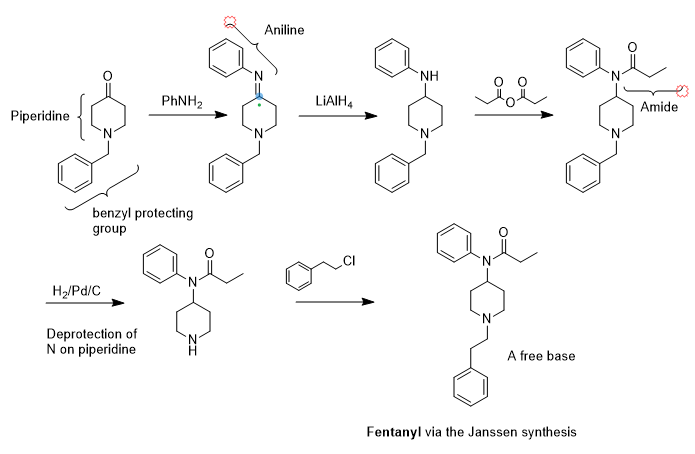
Original fentanyl synthesis by Janssen. Graphics: Will O. de Wisp

So, how is fentanyl synthesized? See the synthetic scheme above. I’ll just comment on the Janssen synthesis and some issues. I have no idea of how it is made out in there by the Mexican cartels and in ramshackle American trailer parks. The synthesis above has some steps that may be undesirable for backwoods or jungle operations like hydrogenation. In the first step, aniline will be needed to make the phenyl imine. It’s pretty toxic and stinks to high heaven. Next, lithium aluminum hydride is needed to reduce the imine double bond to an amine. This innocent looking grey powder is very hazardous and should only be used by an experienced chemist. It is also available as a solution in tetrahydrofuran. The next step is the formation of the amide with propionic anhydride. While the reaction entails a simple reflux, you still have to isolate the product. Once you have recovered the amide, the benzyl protecting group on the piperidine nitrogen must be removed. It allowed amide formation exclusively on the upper aniline nitrogen and has served its purpose. Finally, the piperidine nitrogen must be festooned with a phenylethyl group and phenylethyl chloride was used to afford the fentanyl product. 

An excellent review of the pharmacology and drug design of this family of opioids, see Future Med Chem. 2014 Mar; 6(4): 385–412.

In chemical synthesis generally, substances are prepared in a stepwise manner and with as few steps as possible to give high isolated yields. To begin, one must devise a synthesis beginning with commercially available raw materials as close to the target as possible. If the product has many fragments hanging off the core structure, it’s best to solve that problem early. Synthetic chemistry is almost always performed in a non-interfering solvent that will dissolve the reactants and allow the necessary reaction to occur. A low boiling point is preferable for ease of distillation. An important side benefit from a solvent is that it will absorb much of the heat of reaction which can be considerable. Left on its own, a reaction might take its solvent to the boiling point by self-heating, generating pressure and vapor. The benefit from evaporation or reflux boiling is that as a solvent transitions from liquid to vapor there is a strong cooling effect which helps to control the temperature. An overhead condenser will return cooled solvent to prevent solvent loss.

You can do any chemical synthesis in one step with the right starting materials. Unfortunately, this option is rarely available. The next best option is to take commercially available starting materials through a known synthetic scheme. People who run illicit drug labs are never interested in R&D. They want (and need) simple chemistry that can be done by non-chemists in buckets or coke bottles at remote locations. Chemical glassware can be purchased but sometimes the authorities will be notified of a suspicious order. This is especially true with 12 liter round bottom flasks.

The most difficult and risky trick to illicit drug synthesis is obtaining starting materials like piperidine compounds in the case of fentanyl and its congeners. In the case of heroin, acetic anhydride shipments have been investigated for a long time because it is used to convert morphine to heroin- an unusually simple one-step conversion. Solvent diethyl ether is similarly difficult to get outside of established companies or universities. Many other common drug starting materials are difficult to obtain legally in the US or EU by the criminal element. However, China is thought to be a major supplier of starting materials outside the US and EU. Countries with remote coastlines, loose borders, lackadaisical or corrupt law enforcement reduce the barriers for entry of drug precursors.

China in particular has a large number of chemical plants that make diverse precursors for legitimate drugs. Unfortunately, some of these precursors can also be used for illicit drugs or existing technology adapted for this use. Precursors can be sold to resellers who can do as they please with them. Agents may represent many manufacturers and can mask the manufacturer’s identity and take charge of the distribution abroad. Shady transactions become difficult for authorities to detect and trace. The identity of illicit precursor chemicals are easily altered in the paperwork to grease the skids through customs. Resellers can repackage chemicals to suitable scale, change the paperwork and jack up the price for export. It has been my experience that many if not most Chinese or Japanese chemical manufacturers conduct business through independent export agents. However, behind the curtains there often a byzantine web of connections between companies and agents, so you may never know who will manufacture your chemical. As an aside, this complicates getting technical information from the manufacturer since the agent will not disclose a contact at that manufacturer.

Highly potent drugs like fentanyl must be taken in very small dosages which means that kilo-scale batch quantities of drug result in many individual sales per kilo. Small quantities of highly potent drugs are more easily smuggled than bulky drugs like weed with its strong odor.

There is a down-side to the illicit manufacture of drugs like fentanyl. It is quite toxic at very low dosages and must be handled with the greatest of care lest the “cook” and other handlers get inadvertently and mortally poisoned. Good housekeeping helps, but I have yet to see a photo of a tidy drug lab.

Fentanyl can be sold as a single drug but perhaps is cut with a solid diluent that some random yayhoo decided was Ok to use. Other drugs of abuse like heroin may be surreptitiously spiked with fentanyl to kick up the potency. In either case, a given dosage may or may not be safe even for a single use. There is no way for a user to know. Also, the concentration or homogeneity of mixed solids may be subject to wide variation. For more than a few people, their first fentanyl dose will be their last.
Chemicals on My Yard: Prodiamine and Dicamba

In the US, it’s common to enhance one’s home with greenery, notably a grass lawn. However, a lawn requires ongoing attention. I have a lawn care service fertilize and treat our lawn with herbicides throughout the growing season. Recently, I’ve scrutinized the herbicides they use. They used prodiamine and dicamba.

Hold on a minute. Wasn’t the 2020 registration of dicamba nullified recently in federal court? Yes, it was. Why has it been sprayed on my lawn? The ruling applies to the use of dicamba on soybean and cotton crops that have been genetically modified to be resistant to it. The high volatility of dicamba has been quite deleterious to crops in adjacent farmland and to plants that are pollinated by bees because of drift resulting in crop losses and sharp decrease in honey production. Dicamba is a broadleaf herbicide, though not effective against grasses.

A Brief Meteorological Interlude

Nature continually directs hostility towards our lawns and gardens, both from above and the sides. Living in a semi-arid climate with only 14 inches of annual moisture, the lack of precipitation is immediately detrimental. The desiccating rays from the sun, located only 8 light minutes away, evaporate vital moisture from plants and soil. Compounding the problem, dehydrating winds whisk away the moisture cooking off the soil. Since moist air is more buoyant than dry air, it rises and is carried away by convection into the prevailing winds.

At higher elevations, the combination of increased moisture and decreased temperature can lead to cloud formation. Moisture ascending from the ground combines with the air above. The lower temperatures at these heights cause the moisture to transition from a gaseous to a liquid state, resulting in clouds. This change, although it appears innocent, has thermal consequences. For humidity to condense into liquid, the surrounding air temperature, which reveals “sensible” heat, must be low enough to absorb the “insensible” or latent heat released during condensation without causing a significant rise in temperature. If not, an increase in temperature would hasten the shift from condensation back to evaporation. There is a delicate equilibrium in this phase transition.

As latent heat is released, the air’s density decreases, enhancing its buoyancy and causing it to rise further. The ascending misty air cools, allowing more moisture to condense, which adds to the cloud’s mass. But wait, there’s more—

A rising air parcel causes the surrounding air to be drawn inward from below towards the ascending convective column. Consequently, a significant volume of air may be uplifted, enhancing the moisture levels above the ground contributing to the formation of a convective cumulus cloud. Latent heat supplies part of the energy needed for the vertical ascent of air. This cycle persists until a net downward movement of rain occurs, pulling down cooler air from higher altitudes. The cessation of upward momentum in cloud formation leads to a rapid downward surge of air with the rain, which, upon reaching the ground, spreads out horizontally, occasionally at high speeds. This explains why cool gusts of wind often signal the approach of a rainstorm.

Prodiamine

On to Prodiamine and Dicamba. These two herbicides provide broad coverage by virtue of different biochemical mechanisms. Dicamba is a selective postemergent broadleaf systemic herbicide.

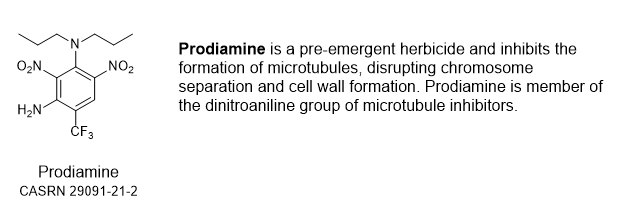
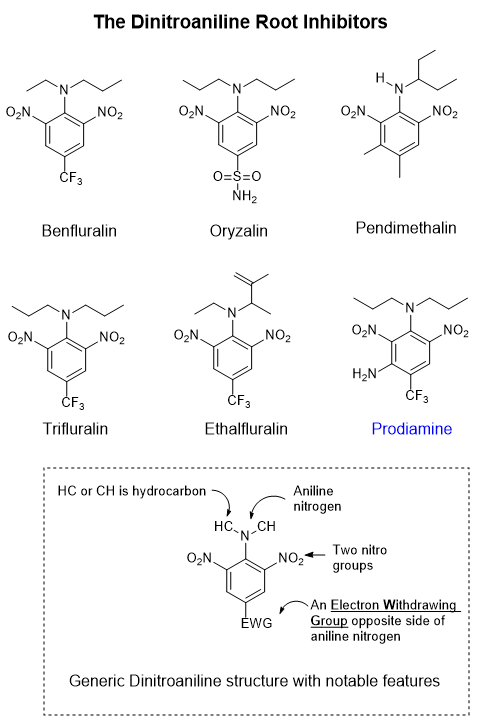
Prodiamine is a pre-emergent herbicide effective on crabgrass and annual blue grass, goosegrass, spurge, chickweed. A pre-emergent herbicide like prodiamine is injected into the soil where it binds to soil particles. A close analog called Trifluralin, prodiamine without the NH2 group, has been shown to have sufficient volatility that sufficient vapor can penetrate root tissue where it expresses its activity.

Source: Jinyi Chen, Qin Yu, Eric Patterson, Chad Sayer, Stephen Powles,” Dinitroaniline Herbicide Resistance and Mechanisms in Weeds”, Front. Plant Sci., Sec. Crop and Product Physiology, 24 March 2021 Volume 12 – 2021 | https://doi.org/10.3389/fpls.2021.634018.
Graphic: By Sam Scratch. A series of Dinitroaniline root inhibitors.

Comments on Patenting of Chemicals

When a biologically active substance is discovered, usually is the case that particular features and the shape of the molecule are crucial to the activity. Not just attachments but also the spatial relationship between them. The subject molecule is likely to be active in interacting with a pocket on an enzyme. That pocket has a particular 3-D shape that the molecule has to fit. Not only that, but the enzyme pocket is likely to have protein amino acid groups that have an affinity for charged or water insoluble features on the incoming molecule.

Looking at the prodiamine structure and analogs above, we can see that all of the analogs share certain features: two Nitro groups, -NO2; 1 Aniline nitrogen group with one or two hydrocarbons attached, -N(hydrocarbon)2 groups; a single 6-member hexagon ring (a benzene ring) from which to hang all of the appendages. Opposite to the top aniline nitrogen is an attachment present which 4 of the 6 analogs have: a -CF3 (trifluoromethyl) group attached. This doesn’t happen by accident- someone decided that it should be there because something useful happens with it there. A -CF3 group acts to pull electrons in the ring to lean in that direction, affecting how the electron charge is distributed on the whole molecule. Another analog has a -S(=O)2-NH2 group. This thing, called a sulfonamide group, also pulls ring electrons towards it. Why -CF3 versus -S(=O)2-NH2? Perhaps one is more potent or selective than the other or possibly because one was claimed in a patent and at the time the other was not. Either one could be a me-too herbicide. Analogs of a basic motif arise frequently in a competitive marketplace.

Often times, when a new and successful motif of pharmaceutical or agrochemical comes along, the race begins for competitors to develop close analogs, though being careful not to infringe on any patents. With chemical patents the composition of matter can be claimed, the method for making the substance as well as the method of use. Composition of matter, method of manufacture and use claims are often split into separate patents for IP safety in case one patent gets knocked down. What’s more, a composition of matter patent can be written so as to claim a vast number of analogs to broaden the IP real estate. This is called a Markush claim where a variable letter substitutes for a large or small set of chemical groups. A single structural framework can have many Markush groups giving rise to an astronomically large set of claimed combinations. Some companies, hide the composition of the best analogs in the Markush claims so as to minimize competitive intelligence losses to competitors.

Dicamba

A weed is a valueless plant growing wild that is in competition with a desired crop. The three major morphological categories are: grasses, sedges, and broadleaf weeds. A weed represents lost soil fertility.

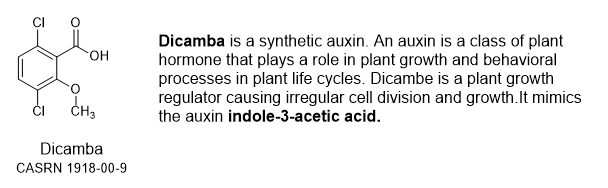
Dicamba is a member of the benzoic acid subgroup of the aromatic carboxylic acid group of herbicides. This group of compounds are synthetic auxins, or plant hormones, that interfere with plant growth.

Source: Robin Mesnage, Michael Antoniou, “6 – Mammalian toxicity of herbicides used in intensive GM crop farming”, Herbicides: Chemistry, Efficacy, Toxicology, and Environmental Impacts, Emerging Issues in Analytical Chemistry, 2021, Pages 143-180. https://doi.org/10.1016/B978-0-12-823674-1.00007-9.

Other popular herbicides

Other carboxylic acid herbicides besides dicamba are the 2,4-D analogs.

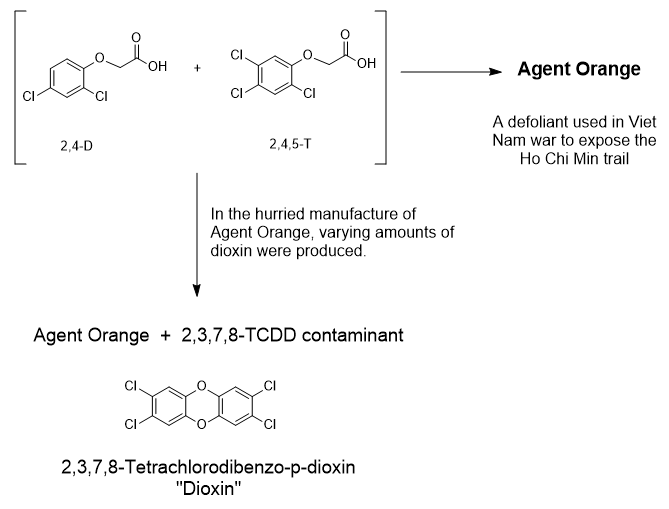
Graphics: Sam Scratch. The much-dreaded toxicant dioxin (TCDD) was a side product in the manufacture of the herbicide 2,4,5-T. When 2,4,5-T was blended with 2,4-D to make agent orange, the dioxin came along.

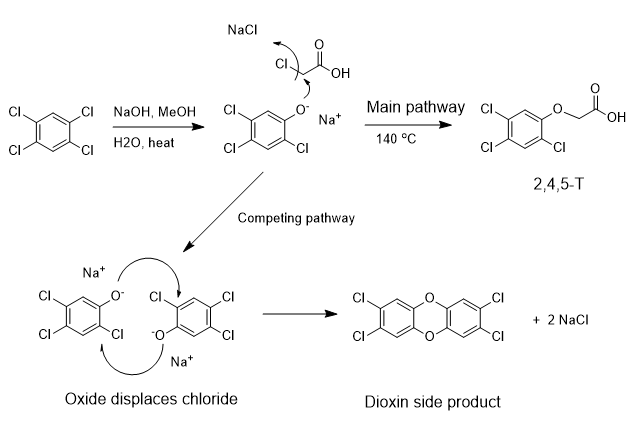
Of the numerous forms of the dioxins, the species that is often discussed is the 2,3,7,8-TCDD version. The positions and number of chlorine atoms varies. The mechanism above shows the dioxin analog coming from 2,4,5-T. The 3-ring structure of TCDD is the dioxin core structure.

Graphics: Sam Scratch. How dioxin was formed in the 2,4,5-T process. The chemical mechanism begins with the displacement of 1 chlorine atom of the 1,2,4,5-tetrachlorobenzene by a hydroxide anion turning the tetrachoro ring into 2,4,5-trichlorophenol. In the presence of NaOH, the phenol turns into a phenolate which attacks the chloroacetic acid to form 2,4,5-T. However, a competing reaction involving the trichlorophenolate attacking another molecule of itself over a few steps can lead to the cyclization of the trichlorophenolate to the 2,3,7,8-TCDD. The displacement of a ring chlorine is somewhat slower than the displacement of a chlorine from acetic acid, so dioxin formation would be a minor side product.

2,4-D is a synthetic auxin, similar to dicamba in mechanism, that causes uncontrolled and unsustainable cell growth. The herbicide is absorbed through the leaves and is moved to the meristem where uncontrolled cell growth follows.

Shell CEO Tips his Hat to the Biden Administration

Here is a link to an article reporting on comments made by Wael Sawan, CEO of oil major Shell plc. He stated that Biden’s bipartisan infrastructure law and Inflation Reduction Act “seem to be working in terms of attracting a significant amount of capital in different states, whether it’s a red or blue state,” at a meeting of the centrist Center for Strategic and International Studies.

It wasn’t all sweetness and light. He was critical of the Biden administration for its decision to pause new LNG export permits pending a thorough review of climate impacts. Sawan explained his view-

I have to agree with his comment. Given the colossal size of the global oil & gas (O&G) industry and the extensive reach of our reliance on petroleum fuels and chemical products like plastics, there must be a transition shallow enough to evolve into renewables without crashing the global economy and the political upset that will come from that. The path to renewables has to start sometime, but maybe there should be some negotiation on the LNG export permits, if there already hasn’t been any. Sawan’s comments on this were valuable.

The matter of climate change is pressing and the motivation to change rapidly is irresistible to many. But it took many decades to get into this mess and it looks like it will take some time to ameliorate it. In the meantime, we the public can alter our consumption and driving habits en masse and make real change faster than government policy.

Risk and Regulations: An Epistle to the Bohemians, Redux.

Attached is an updated reprint of an essay I posted 10/28/07. Since then I have shifted into EPA regulatory compliance within the chemical industry. My views have changed a little, it turns out.

==========

“We live in an age of miracle and wonder” is the refrain from Paul Simon’s album Graceland. All around us and through us are engineered materials devised for their specific physical and chemical properties. Time-released magic bullet drugs that inhibit specific enzymes. Flavors & fragrances, colorants, rheology modifiers, UV absorbers, emollients, preservatives, food irradiation and manufactured food additives are engineered and marketed to satisfy our lizard brain’s willingness to shell out cash-for-fun and stimulate our limbic system’s emotive triggers. 

It is hard to avoid contact with manufactured goods that aren’t affected by chemistry. A century and a half of tinkering with substances at the molecular scale has given us the ability to optimize the composition and performance of products that make our lives easier and safer.  Microprocessors and Lycra, Hastelloy and Lipitor- the chemical industry has evolved to produce the raw materials and finished goods needed for the performance we have come to expect.

Industry has a Spotty Record of Safety

Along with the considerable list of positive contributions, history provides a detailed record of the problems associated with the exuberant but uncritical acceptance of the flood of manufactured goods.  From radium poisoning of watch dial painters to chromium VI to asbestos, there is a long list of accidents, ignorance, negligence and environmental insult. The trail blazing of our chemical industry leaves behind it a chronicle of tragedy as well as benefits.

The result of the checkered past of industry is a growing (some would say “metastasizing”) and intertwined web of state, federal, and international regulatory oversight and requirements. And with it- arguably as a result of it- has come greater institutional risk aversion

Risk Aversion

In a general way, risk aversion is a type of survival trait and is likely hardwired into our ape brains. It is hard to blame people for being wary or fearful of risks, especially those they do not understand. Over time risk aversion is useful survival trait. But on the other hand, risk aversion is also a type of inertia. Or, it can be a fulcrum from which policy and imaginary justifications are leveraged.  The fear of risk may be firmly grounded on experience or it might be imagined or a mixture of the two. The hard part of risk management is identifying real hazards and the probability and magnitude of a bad outcome for managing safety day-to-day. Basically, the hard part is the whole part.

Corporate officers have a fiduciary responsibility to the stockholders. They’re purpose is to maximize profits without undue risk to the organization. Most respond to the regulatory environment by perhaps heaving a sigh and relenting to the requirements. Regulatory compliance can have costs associated with it like animal testing of chemical products and intermediates, or engineering upgrades and these costs need to be built into annual budgetary calculations.

How Granular Does Safety Have to Be?

Can safety practices be excessive? I would say that if some specific activity is based on imaginary risks, risks identified by the untrained or massively overestimated risks, the cold eyes of an industry consultant may be needed. Who knows, you may have actually underestimated a risk.

Safety has a large psychological component to it. How do you compel people to behave consistently in a way that keeps everyone safe? Not just immediately, but in the twentieth or five hundredth time they perform a task with associated hazards? Complacency is a normal human weakness where a misstep can lead to casualties.

The amount and type of safety measures in chemical processing required greatly depends on the chemical substance. Some company’s batch records give very detailed instructions to maintain constant safety. Others are less so on the assumption that the operations staff know what they are doing. Too much detail can lead to operator impatience and freelancing.

It is possible for organizations to be dominated by confident voices that are quite risk averse but not very knowledgeable about the technology. Leaders will state that “safety-first is our policy”.  A paper storm of SOPs will issue, dragging out the most elementary actions into numerous steps and check boxes. There is great merit to SOPs, but enlightened and proactive interpersonal management of hazardous operations is just as important. Management by walking around works.

Organizations can find themselves spiraling into micromanagement of even the smallest details for fear that the regulatory and liability hammer could fall at any moment. Indeed, if one studies many regulations in detail, it is easy to fall into habit of overreacting. Risk aversion isn’t just a personality issue, it is statutory under numerous regulatory umbrellas.

Being a baby boomer, the chemical safety practices I have been exposed to and have practiced is rather out of date. My education occurred during a time when running chemical reactions on an unventilated bench top was normal. We used Tirrill burners to flame dry our glassware on the sophomore organic lab benchtop and set the hot glass on a Transite square, an asbestos product from Johns Manville. I still would have no problem using Transite. In fact, I have done many things since summer of 1980 that would be frowned upon today. My grad school and post doc time went way into the weeds on using hazardous materials with minimal oversight.

Today I am a senior chemist involved in chemical safety in industry. Until recently, I was involved in finding the thermal safety boundaries of chemical reactions through calorimetry. But with the past experience that I have, I know a bit more about the boundary conditions of handling chemicals than the younger chemists may get to acquire. In order to know how to work with hazardous chemicals you must have worked previously with hazardous chemicals and perhaps seen for yourself what can happen with sloppy technique.

This is nothing reckless like poking alligators with a stick in Florida or free climbing El Capitan. I mean things like seeing what actually happens when you pour concentrated H2SO4 into water fast enough right up to the boiling point taking care not to have a splash. Maybe you can see the heat of dilution boiling the water at the H2SO4/water interface.

The Regulatory Environment

Statutory risk aversion is the domain of the state. The name “Nanny State” is a sarcastic descriptor referring to a perceived excess of regulated requirements and conditions in our lives as well as the set of penalties.  Though perhaps well intended, the Nanny State seeks to zero out risk. Even if a situation arises for which there is no explicit regulation, OSHA has the General Duty Clause where employers are required to provide:

This provision exists to address any gaps in OSHA regulations that may not account for unforeseen circumstances. The plethora of regulations is partly due to the vast array of situations in which industrial employees might be injured or killed. Additionally, lawyers have identified and exploited loopholes in the regulations, which are subsequently closed by regulatory agencies. Ambiguities are often resolved through statutory amendments or the application of established case law.

EPA TSCA has the job of generating and enforcing regulations regarding the manufacture and use of a range of industrial chemicals in a limited sector of manufacturing. The central doctrine is from:

TSCA does not include Food, Drugs, Petroleum, Pesticides and a few other areas.

The key words above are unreasonable risk. With every New Chemical Substance filing sent to the TSCA folks at EPA, an assessment must be made by various subgroups for unreasonable risk by the human health group, the engineering group and the environmental group. Thresholds for “unreasonable” have been quantified in order to exclude subjectivity. EPA has many computer models of exposure thresholds, migration in the soil and toxicity to many creatures including humans.

The regulatory environment can make the production of a new chemical substance more expensive or even unfeasible. Nobody advocates the idea that we should be free to pollute and risk the lives of workers and communities.  But even for the most skillful and well-intended, there are many regulatory landmines to dodge: air, water, and waste permits; local zoning; OSHA; EPA (TSCA); fire codes; insurance inspections; MSDS’s in multiple languages; ITAR; and DEA. All have reporting requirements, statutes, and paper trails to maintain.

Pragmatics

There are two kinds of disaster that can bring down a chemical plant. One is obviously a fire or explosion in the plant made even worse by casualties. The other is an administrative or legal disaster. This could be a tax problem or worse like having been determined to be out of EPA regulatory compliance for a chemical release into the environment or worker exposure over time. EPA fines are levied per day per violation.

In my view, the USA began ossifying many years ago in regulatory paralysis in much the same way the EU or Japan has.  The combination of business risk aversion along with the popular sport of outsourcing our means of production only serves to accelerate the de-industrialization of the USA and the EU. At present there is some effort by the semiconductor manufacturers and others to repatriate manufacturing back to the US out of fear of foreign governments using strategic trade regulation as a competitive cudgel.

What can one reasonably do? Consider even if regulations could be softened, this could take a long time. Until such time as there is a change in regulation, it is best to knuckle under willingly. First on the list is to just be compliant with regulations. Even an excellent argument against an “unjust” regulation enforced by an agency will get you nowhere because regulators are legally required to enforce the regulations and fine violators. If you are facing a regulatory judgement, it is well worth having a lawyer who specializes in that area of the law.

Accepting a harsh judgement on your record can possibly hurt you in the future by having a history of serious earlier infractions. A lawyer can search the case law and possibly find a lesser judgement or better interpretation of the regulations. Avoid at all costs the possibility of being found a repeat violator in some future court action. There could be extenuating circumstances that should be taken into account, but this is the lawyer’s domain and is no place for amateurs.

Fiat Lux

In the chemical industry we have regulatory specialists and EH&S departments who keep on top of the regulations and are responsible for maintaining timely compliance. They help keep the doors open and should be appreciated. That said, executives lurking in the C-Suite should be at least conversant in labor and environmental regulation to the point where they know to get advice before issuing directions relating to this.

Gasoline and Diesel Prices are Creeping Upwards

First, the word is out. According to the EIA, the US was the world’s leading oil producer for the 6th straight year in 2023 producing 12.6 million barrels per day.

It is common for people to blame rising US gasoline and diesel prices only on restrictions in crude oil production and alleged government regulatory overreach. Indeed, pressure on the gas and oil supply side or even just the threat of it can lea to unstable retail gasoline and diesel prices. What is less appreciated is the role of petroleum refineries on prices. To be sure, there is always price speculation on both the wholesale and retail sides of gas and diesel pricing to consider no matter the throughput. Like everywhere else, sellers in the petroleum value chain seek to charge as much as they possibly can 24/7/365. Everyone is itching to charge more but are hindered by competition and risk.

Refineries are only one of several bottlenecks in the gasoline and diesel supply chain that can influence retail prices. In principle, more gas and oil can always be produced at the wellhead by increased exploration or increased imports. Even so, there are constraints on transporting crude to refineries. Pipelines have flow rate limitations and storage tank farms and ocean tanker fleets all have finite capacity. Another bottleneck today is access to both the Suez and Panama canals. Suez Canal traffic is threatened by Houthi missile strikes on commercial shipping in the Red Sea and the Panama Canal seems to be drying up. The result is increased shipping costs and delays for international transport which the consumer will have to bear.

What do refineries do?

Refineries are very special places. Within the refinery there is 24/7 continuous flow of large volumes of highly flammable liquids and gases that are subjected to extreme temperatures and pressures for distillation, cracking, alkylates, hydrogenations and reformates. The whole refinery is designed, built and operated to produce the fastest and highest output of the most valuable group of products- fuels. This group would include gasoline, diesel, aviation fuel, and heating oil.

Petrochemicals account for approximately 17 % or refinery output. These petrochemical streams account for pharmaceutical raw materials, polymer products, coatings and films, synthetic fibers, personal hygiene products, synthetic rubber, lubricating grease and oils, paint, cleaning products and more. Regardless of what we may think of plastics and other synthetic materials, the 17 % produced by refineries feeds a very large fraction of the global economy. If plastic bags went away overnight, the whole world would begin to search immediately for alternatives like wood, metal or cotton/wool/flax/hemp.

Occasionally technological challenges confront refineries. An early challenge was the production of high octane anti-knock gasoline. This was investigated thoroughly as early as the 1920’s as the demand for more powerful automotive and aircraft engines was rising. Luckily for the USA, UK, and Germany, the anti-knock problem was solved just prior to WWII. This breakthrough led to aircraft engines with substantially increased power per pound of engine weight.

Leaded Gas

The petroleum that goes into gasoline is naturally rich in a broad range of straight chain hydrocarbon molecules. Straight chain hydrocarbons were used in the early days of happy motoring, but the engine power remained low. While these straight chain hydrocarbons have valuable heat content for combustion, the problem with these molecules is that in a piston engine, they cannot withstand the pressures in the compression stroke that would give greater power. To get maximum power from a gasoline engine, it is desirable to have the piston move up and down as far as possible for maximum power delivery to the crankshaft. However, a long stroke length means greater compression and higher pressure near the top of the compression stroke. Straight chain hydrocarbons could not withstand the higher pressures coming from the compression stroke and would detonate prior to reaching top of the cycle. This effect results in knocking or destructive pre-detonation with power loss.

Tetraethyllead was invented in 1921 by Thomas Midgley, Jr, working at General Motors. After some deadly and dissatisfying work by DuPont, General Motors and Standard Oil Company of New Jersey started the Ethyl Gasoline Corporation in 1924, later called Ethyl Corporation, and began to produce and market tetraethyllead. Within months of startup, the new company was faced with cases of lead poisoning, hallucinations, insanity and fatalities.

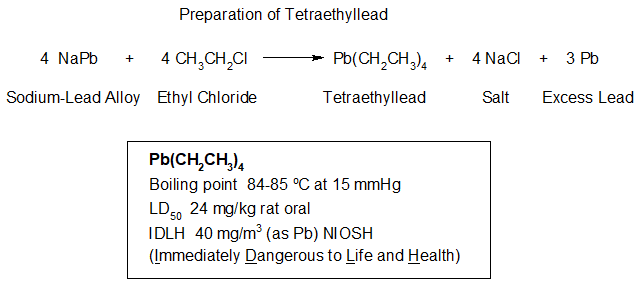
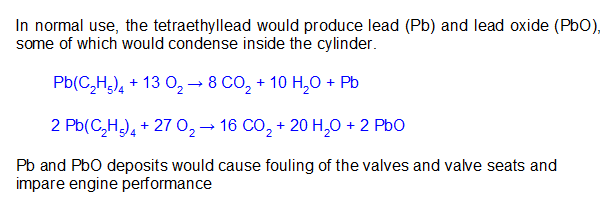
The first commercially successful fuel treatment to prevent this pre-detonation was tetraethyllead, (C2H5)4Pb, produced by Ethyl. This is the lead in “leaded” gasoline. The use of (C2H5)4Pb began before WWII and just in time to allow high compression aircraft engines to be built for the war. It allowed for higher powered aircraft engines and higher speeds for the allies which were applied successfully to aerial warfare. The downside of (C2H5)4Pb was the lead pollution it caused. Tetraethyllead is comprised of two chemical features- lead and 4 tetrahedrally arranged ethyl hydrocarbon groups. The purpose of the 4 ethyl groups (C2H5) on (C2H5)4Pb was their ability to give hydrocarbon solubility to a lead atom. It was the lead that was the active feature of (C2H5)4Pb that brought the octane boosting property. At relatively low temperature the ethyl groups would cleave from the lead leaving behind a lead radical, Pb., which would quench the combustion process just enough to allow the compression cycle to complete and the spark plug to ignite the mixture as desired.

Data from Wikipedia.

While tetraethyllead was especially toxic to children, it was also quite hazardous to (C2H5)4Pb production workers. Its replacement was only a matter of time.

Data from Wikipedia.

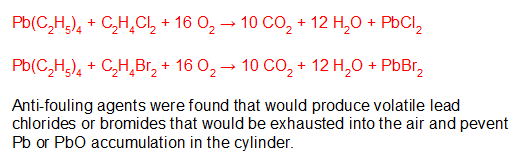
Fuel additives were found that would reduce engine fouling by scavenging the lead as PbCl2 or PbBr2 which would follow the exhaust out of the cylinder. While this was an engineering success, it released volatile lead products into the atmosphere.

Data from Wikipedia.

Eventually it was found that branched hydrocarbons could effectively inhibit engine knock or pre-detonation and could replace (C2H5)4Pb … which it did. While lead additives have been banned for some time from automotive use, general aviation has been allowed to continue with leaded aviation gas (avgas) in light piston engine aircraft like 100 octane low lead (100LL). Only recently has leaded avgas become a matter of public concern.

A refinery not only engineers the production of fuel components, it must also formulate blends for their customers, the gas stations, to sell. The formulations will vary with the season and the location. Some gasolines have ethanol, other oxygenates like MTBE, octane boosters, detergents and more. One parameter is the volatility of the fuel. When injected into the cylinder, it must evaporate at some optimum rate for best fuel efficiency. This will depend on the vapor pressures of the components.

Back to Refineries

The production volumes of the individual fuel products will not match the contents of the crude oil input. Gasoline is the most valuable product, but more gasoline leaves the refinery than arrives in the crude. Any given grade of gasoline has many, many components and the bulk of them have somewhere around 8 carbon atoms in the hydrocarbon chain. Wouldn’t it be nice if longer hydrocarbon chains could be broken into smaller chains to be added into the gasoline mix? And guess what, that is done by a process called “cracking”. A piece of equipment called a “cat cracker” uses a solid ceramic catalyst through which hot hydrocarbon gases pass and get cut into smaller fragments.

But what about straight chain hydrocarbon molecules? Wouldn’t it be nice to “reform” them into better and higher octane automotive fuels? There is a process that uses a “reformer” to rearrange hydrocarbon fuels to give better performance. The products from this process are called reformates.

Reforming is a process that produces branched, higher-octane hydrocarbons for inclusion in gasoline product. Happily, it turns out that gasoline with branched hydrocarbons are able to resist pre-detonation and have come to replace tetraethyllead in automotive fuels entirely. Today we still refer to this lead free gasoline product as “unleaded”.

Octane and Cetane Ratings

Octane rating is a measure of resistance to pre-detonation and is determined quantitatively by a single-cylinder variable compression ratio test engine. Several octane rating systems are in use. RON, the Research Octane Number, is based on the comparison of a test fuel with a blend of standard hydrocarbons. The MON system, Motor Octane Number, covers a broader range of conditions than the RON method. It uses preheated fuel, variable ignition timing and higher engine rpm than RON.

Some gasoline is rated in the (R + M)/2 method which is the just average of the RON and MON values.

In both the RON and MON systems, the straight chain hydrocarbon standards are n-heptane which is given an octane rating of 0 and the branched hydrocarbon 2,2,4-trimethylpentane, or isooctane, which is given an octane rating of 100.

Tetraethyllead and branched hydrocarbons are octane boosters. Methyl tert-Butyl Ether (MTBE), ethyl tert-butyl ether, and aromatics like toluene are also used to boost octane values. Internal combustion engines are built to use a gasoline with a minimum octane rating for efficient operation. A rating of 85 or 87 are often the octane ratings of common “unleaded” gasoline. Higher compression ratio engines require higher octane fuel- premium grade -to avoid knocking.

For comparison, diesel has a RON rating of 15-25 octane so it is entirely unsuitable for gasoline engines. Diesel has its own system called the Cetane rating. The Cetane Number is an indicator of the combustion speed of the diesel and the compression needed for ignition. Diesel engines use compression for ignition unlike gasoline engines which use a spark. Cetane is n-hexadecane which is a 16-carbon straight chain with no branching. Cetane is given a Cetane Number (CN) of 100. Similar to the Octane rating, the branched 16-carbon hydrocarbon heptamethylnonane, or isocetane, is given a CN of 15. Included in the Cetane number.

Refineries must keep close tabs on seasonal demand for their various cetane and octane-rated products as well as the composition of the crude oil inputs which can vary. Each gasoline product stream has performance specifications for each grade. While gasoline is a refined product free from water, most sulfur and solid contaminants, it is not chemically pure. It is a product that contains a large variety of individual hydrocarbon components varying by chain length, branching, linear vs cyclic, saturated vs unsaturated members that together afford the desired properties.

Specific Energy Content

Absent ethanol, the combustion energy values of the various hydrocarbon grades are so similar as to be negligeable. The energy content of pure ethanol is about 33 % lower than gasoline. Any energy differences would be due to subtle differences in blending to achieve the desired octane rating or proprietary additives like detergents. A vehicle designed to run on 85 octane will not receive a significant boost in power with 95 octane unless it is designed to operate on higher octane fuel.

Source: Wikipedia

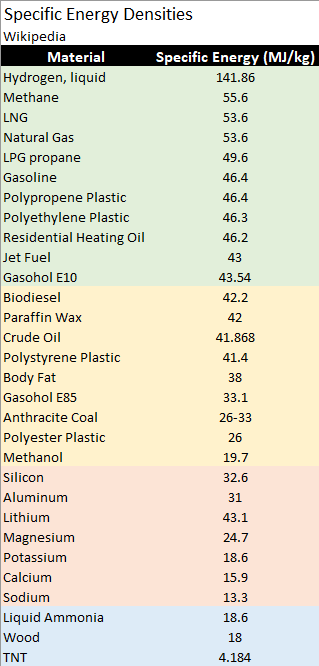
From the Table above and looking at the polypropylene (PP) and polyethylene (PE) entries then comparing to gasoline, we see that the specific energies are the same. The two polymers and gasoline are saturated, hydrocarbons so it is no wonder they have the same specific energies. Polystyrene is a bit lower in specific energy because the hydrogen content is lower, reducing the amount of exothermic H2O formation as it burns. The point is that by throwing away millions of tons of PP or PE every year, we are throwing away a whopping amount of potential fuel for combustion and electrical energy generation.

Petroleum based liquid fuels burn readily because of their high vapor pressure and low flash points. Polyolefins like PP and PE by contrast have virtually no vapor pressure at room temperature and consequently are difficult to ignite. In order to burn, polyolefins need to be thermally cracked to small volatile fragments in order to provide enough combustible vapor for sustained combustion. Plastic fires tend to have an awful smell and dark smoke because the flame does a poor job of energizing further decomposition to vapor.

Going from E10 to E85, the specific energy density drops considerably from 43.54 to 33.1 MegaJoules per kilogram (MJ/kg). Replacing a significant quantity of gasoline with the already partially oxidized ethanol lowers the potential energy. In the tan colored section, we can see the elements silicon to sodium. These elements are either very oxophilic or electropositive and release considerable heat when oxidizing. Some metals amount to a very compact source of readily oxidizable electrons.

Refinery Troubles

According to the US Energy Information Agency (EIA) US refinery output in the first quarter of 2024 has dropped overall by 11 % and has fallen as low as 81 % utilization. Decreasing inventories are causing rising retail prices. Still, average gasoline and diesel prices are currently below the same time period in 2023.

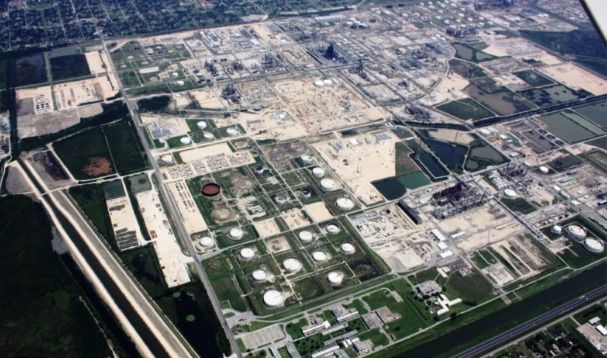
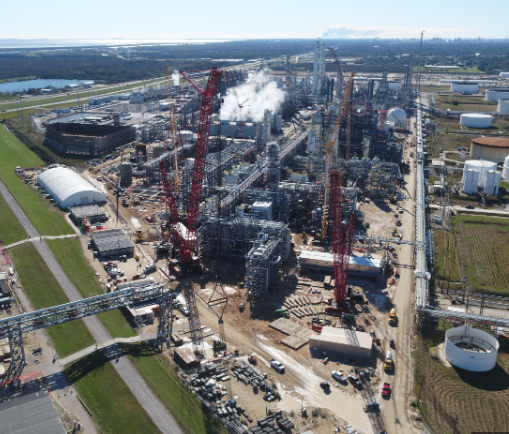
According to EIA, the US Gulf Coast has seen the largest 4-week average drop in refinery utilization at 14 % since January, 2024. This is attributed in part to the early start of maintenance shutdowns of Motiva Port Arthur and Marathon Galveston Bay refineries which account for 7 % of US capacity.

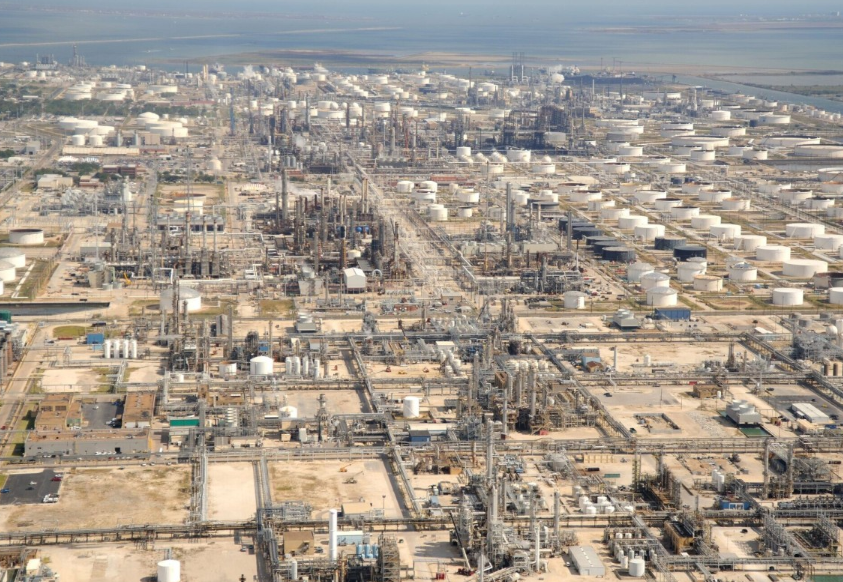
Galveston Marathon Refinery. Source: Google Images.
Motiva, Port Arthur, TX. Source: Google images.

Weather has factored-in this year as refinery production was halted in several locations in the US. A severe winter storm shut down the TotalEnergies’ 238,000 barrel-per-day refinery in Port Arthur, Texas.

TotalEnergies, Port Arthur, TX.

Oil production in North Dakota fell to half. Oil production was estimated to have fallen between 600,000 and 650,000 barrels per day.

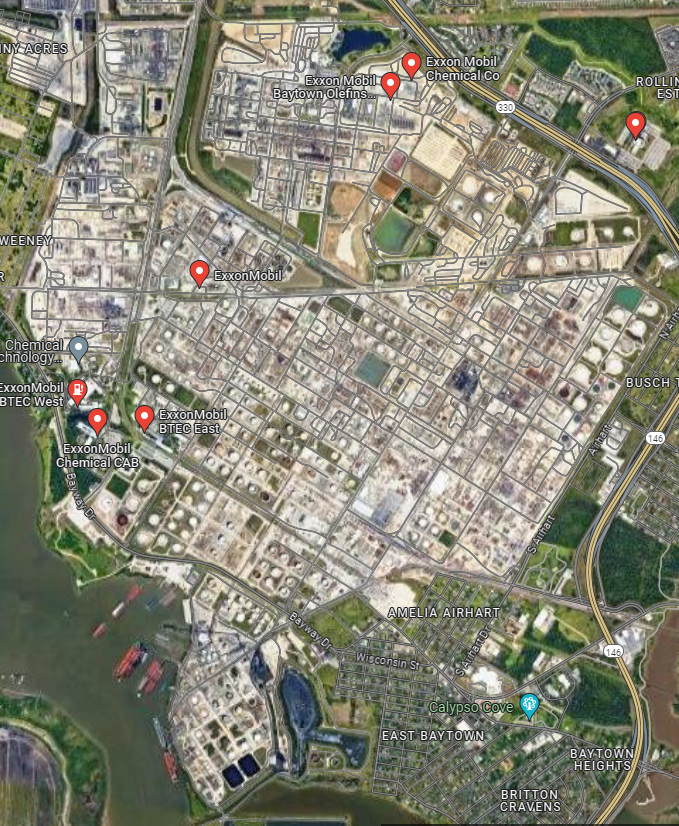
Exxon Mobil Corp returned a fluidic catalytic cracker and a coker to normal operation at its 564,440 barrel per day refinery in Baytown, Texas.

ExxonMobil Corp, Baytown, TX. Source: Google Maps.

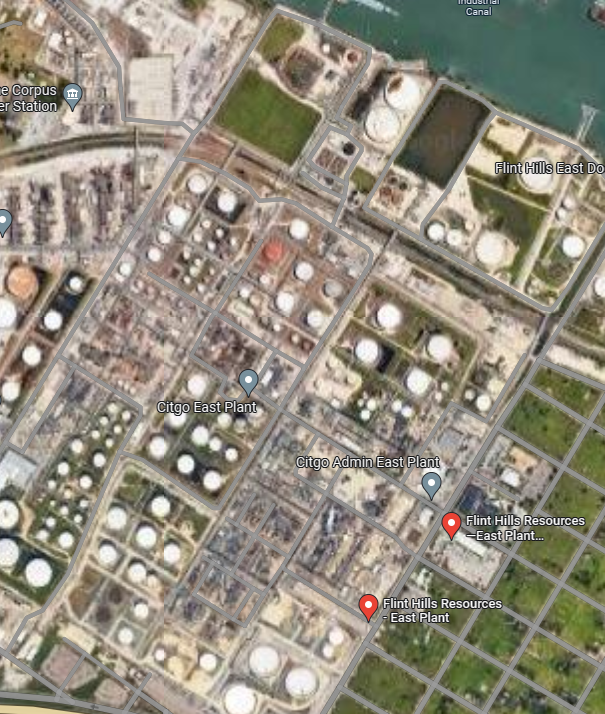
A Flint Hills Resources 343,000 barrel per day refinery in Corpus Christi, Texas, was significantly impacted by unseasonably cold weather including freezing rain.

Flint Hills Resources, Corpus Christi, TX. Source: Google Maps.
Flint Hills Resources East Plant, Corpus Christi, TX. Source: Google Maps.

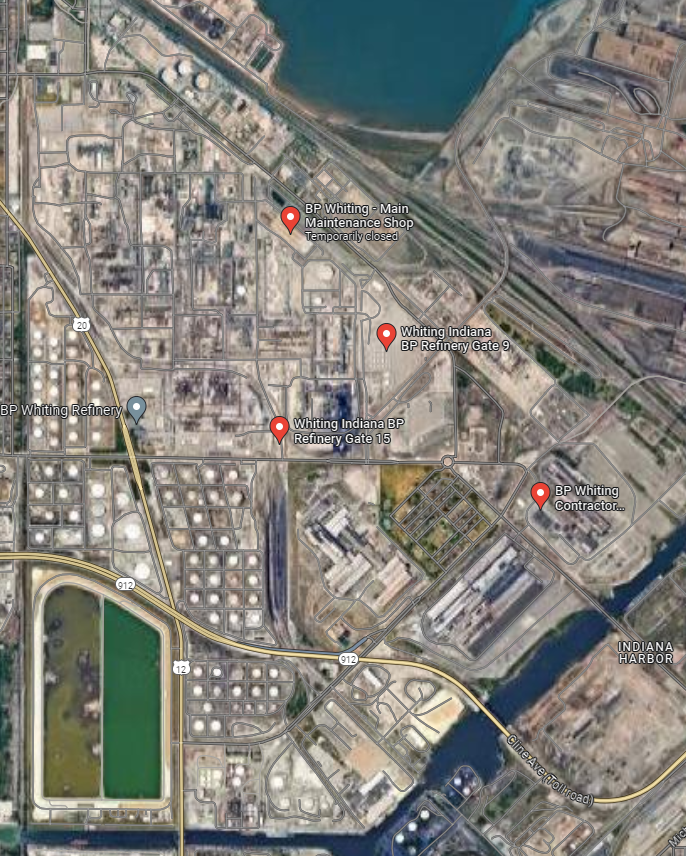
The largest refinery in the Midwest, BP’s 435,000 barrel per day refinery in Whiting, Indiana, was taken off-line by a power outage and forced a 10 % drop in refinery utilization in the Midwest the first week in January. Normally the Midwest region produces as much gasoline and diesel as it consumes. This rich local supply leads to somewhat lower prices in the region.

BP’s Whiting, IN, refinery along the southern shore of Lake Michigan, between Gary and South Chicago.

Zombie Oil & Gas Wells in Texas

Much has been written about the gas & oil industry in the US. My aim only is to highlight the leaking, not actively producing, oil & gas wells.

Many states have a problem with orphaned and zombie wells. Big ole Texas has a problem with orphaned and “zombie” oil wells also. Over time, oil and gas companies have been abandoning uncapped oil and gas wells in their eternal haste to produce “Black Gold, Texas Tea.” Inactive or non-compliant wells with delinquent organizational reports (Form P-5) for more than 12 months are called “orphan” wells in Texas. The state of Texas does have procedures for the disposition of orphan wells. Wells may be abandoned because of low output or the owners going bankrupt. It is possible to take over an orphaned well, though why would someone takeover a depleted orphan well or a low output well?

What’s worse, even the capped wells have begun to leak because of the corrosion and decay of well casings and plug material. The leak may be far down the hole or near the surface. These abandoned wells that are now leaking are called “zombie” wells. The zombie wells push up brackish water along with hydrocarbon liquids and vapors into the atmosphere and the surface soil as well as underground into the water table. Some underground flows are large enough that sinkholes form and fill up with polluted water.

The Oil & Gas division of the Texas Railroad Commission is responsible for “Regulating the exploration, production, & transportation of oil and natural gas in Texas.”

In a September 14, 2022, article in the Houston Chronicle, James Osborne writes

Source: Houston Chronicle

Following up, Amanda Drane writes in her July 17, 2023, article in the Houston Chronicle

Source: Houston Chronicle

The Texas Oil & Gas Association has stated-

Source: The Houston Chronicle.

As can be seen, the Texas Oil & Gas Association seems to feel that it has done its job with orphaned wells. The Teflon-coated Texas Oil & Gas trade association did what trade groups are supposed to do- shield their members from public blame and immense liability.

One component of crude oil & gas is hydrogen sulfide (H2S) which resides in both the liquid and vapor phases. This component is capable of both oxidation in the air to form a series of variously oxidized sulfur products as well as elemental sulfur itself. Hydrogen sulfide is extremely toxic and prone to cause olfactory fatigue in humans. The odor threshold is extremely low which could lead one to safely vacate the area, but the “nose numbing” effect on the sense of smell can lead to a false sense of security and continued exposure. Most cases of intoxication occur in confined spaces, however.

In a way, drilling for and striking oil & gas is like opening Pandora’s box. The well can produce valuable oil & gas, but along with it comes produced water with undesired dissolved minerals, petroleum and drilling residues. It seems clear that the State has a compelling interest in the final disposition of the well. The driller or party who owns the drilling rights to the well should be financially responsible for its clean shutdown. Bankruptcy should not absolve a company from responsibility for trouble the well brings.

This post is limited to the issue in Texas but it can exist anywhere oil & gas drilling has occurred. Obviously, the oil & gas industry represents a massive amount of economic activity and consequently it has enjoyed a privileged position in American industry in terms of regulations. It is doubtful this will change but that doesn’t mean that the beady eye of scrutiny should blink.

Even if hydrocarbon vapors and other gaseous substances blowing out of wells were not greenhouse gases, can’t a case be made for capping-off wells just to prevent pollution? There is a mentality out there that holds that if some pollution action is not mandatory, then it is not necessary. Their response to a problem is often that they “met regulatory standards.” That is, they would have done less if they could have.

Passage Slowdown Through the Panama Canal and Some Rerouting at the Suez Canal

The year 2023 has been a bad year to be a canal user. Between a drought aggravated by El Nino and a shooting war by Houthi terrorists, transit costs and risks have risen steeply.

The two major canals for transoceanic shipping in the world are seeing events affecting their operation which are beyond their control. The Panama Canal is suffering a slowdown in transits due to a drought reducing the water level of Gatun Lake which feeds the canal lock system. The Suez Canal is being affected by hostile Iranian-backed Houthis in Yemen threatening shipping in and out of Israel moving through the Red Sea. They claim to be after ships to and from Israel, but it doesn’t appear that their target identification is very good.

The Suez Canal does not use locks so it can pass more ships per day. While the Panama Canal suffers from drought limiting its throughput, the Suez Canal has no new physical impediments. It is affected by ship operators who elect to bypass the Houthi threat by going around the Cape of Good Hope. Since 17 November, 2023, 55 ships have rerouted around the Cape of Good Hope and 2,128 ships have passed through the Suez Canal according to Reuters.

The Panama Canal auctions-off transit slots on a daily basis. During normal conditions before the drought, there were 36 transits per day. At the start of December, 2023, that rate was at 22 transits per day and the cost of a transit has risen accordingly. As of 15 December, 2023, the transit rate was increased to 24 transits per day through both the Panamax and Neopanamax locks.

The US produces more gasoline than it consumes and most of the excess is exported from the Gulf Coast. For buyers along the Atlantic basin, the US produces the cheapest gasoline. The Gulf Coast also supplies refinery products to the Pacific rim via the Panama Canal.

Within the US, gasoline prices have been low owing to excess inventories. Because of the Panama Canal slowdown, some refineries may have to reduce production to prevent further inventory buildup, potentially resulting in increased prices generally and heating oil in particular.

Panama Canal “slots are prioritized according to highest bid in auction processes, full containers, market and customer rankings,” according to Reuters.

The Illuminating History of Producing Brighter Flames

This is a reprint of an October 25, 2010, piece that I wrote about illumination with flames. I did tweak the title a bit for the sake of accuracy. -Th’ Gaussling

Until the invention of the electric lamp, the illumination of living and working space was very much the result of sunlight or of combustion.  Since the development of fire making skills in prehistoric times, the combustion of plant matter, fossil fuels, or animal fat was the only source of lighting available to those who wanted to illuminate the dark spaces in their lives.

From ancient times people had to rely on flames to throw heat and an agreeable yellowish light over reasonable distances. A good deal of technology evolved here and there to optimally capture the heat of combustion to do useful work (stoves, furnaces, and boilers) from readily available fuels. 

Lighting technology also evolved to maximally produce illumination from flame.  High energy density fuels that offered a measure of convenience for lamp users evolved as well. Liquid fuels like vegetable oils, various nut oils, whale oil and kerosene could flow to the site of combustion and were in some measure controllable for variable output. The simple wick is just such a  “conveyance and metering device” for the control of a lamp flame. Liquid fuels flow along the length of a wick by capillary action to a combustion zone whose size was variable by simple manipulation of the exposed wick surface area.

The first reported claim of the destructive distillation of coal was in 1726 by Dr Stephen Hales in England. Hales records that a substantial quantity of “air” was obtained from the distillation of Newcastle coal. It is possible that condensable components were generated, but Hales did not make arrangements to collect them.  Sixty years earlier an account of a coal mine fire from flammable coal gases (firedamp) highlighted the dangerous association of coal with volatiles. So, flammable “air’ was associated with coal for some time.

By 1826 a few chemists and engineers were examining the use of combustable gases for illumination. The historical record reveals two types of flammable gas that were derived from coal- coal gas and water-gas. Both gases came from the heating of coal, but under different conditions. Coal gas was the result of high temperature treatment of coal in reducing conditions. It is a form of destructive distillation where available volatiles are released.  Depending on the temperature, there was the possibility of pyrolytic cracking of heavies to lights as well. 

Water-gas was the result of the contact of steam with red hot coal or coke. The water dissociates into H2 and CO. Water gas is a mixture of hydrogen and carbon monoxide, both of which are combustible. The formation of water-gas is reported to have been discovered by Felice Fontana in 1780. 

One of the properties of burning coal gas or water-gas was the notably meager output of light from the flame. Workers like Michael Faraday and others noted that these new coal derived gases provided feeble illumination, but if other carbonaceous materials could be entrained, then a brighter flame could result. It was during the course of investigations on illumination with carburized water-gas that Faraday discovered bicarburet of hydrogen, or benzene.

About this time, an engineer named Donovan also noted that if other carbonaceous materials were to be entrained into water-gas, then the light output was enhanced. So, in 1830, engineer Donovan installed a “carburetted” water-gas lighting system for a short run in Dublin.

Coal gas was first exploited for lighting by the Scottish engineer William Murdoch.  Murdoch began his experiments in 1792 while working for Watt and Boulton in England. By the late 1790’s, Murdoch was commercially producing coal gas lighting systems. His home was the first to be lit with coal gas.

The carburization of water gas eventually became an established industry in America in the second half of the 19th century. The treatment of gases, especially with the discovery of natural gas in Ohio, increased the commercial viability of lighting with gas. Carburization of water gas was aided by the discovery of hydrocarbon cracking to afford light components that could be used for this purpose.

Thorium is frequently found in the ores of rare earth elements (REE) and the connection of REE’s to the issue of illumination begins in the laboratories of Berzelius in about 1825. Berzelius had observed that when thoria and zirconia were heated in non-luminous flames, the metal oxides glowed intensely.  But this was not a new phenomenon. Substances like lime, magnesia, alumina, and zinc oxide were known to produce a similar effect. Goldsworthy Gurney had developed the mechanism of the Limelight a few years before. In the limelight, a hydrogen-oxygen flame played on a piece of lime (calcium oxide) to produce a brilliant white glow.  This effect was soon developed by Drummond to produce a working lamp for surveying.

The work of Berzelius was an important step in the development of enhanced flame illumination. He had extended the range of known incandescent oxides to include those that would eventually form the basis of the incandescent mantle industry.  Thoria (mp 3300 C) and zirconia (mp 2715 C) are refractory metal oxides that retain mechanical integrity at very high temperature. This is a key attribute for commercial feasibility.

Numerous forms of incandescent illumination enhancements were tried in the middle 19th century. Platinum wire had the property of glowing intensely in non-luminous flames. But platinum was not robust enough for extended use and was quite rare and consequently very expensive. By 1885, a PhD chemist named Carl Auer von Welsbach patented an incandescent mantle which was to take the gas light industry to a new level of performance. Welsbach studied under professor Robert Bunsen at the University of Heidelberg. 

Welsbach fashioned the incandescent mantle into the form that is familiar to anyone today who has used a Coleman lantern. The original mantle was comprised of a small cellulose nitrate bag that had been impregnated with magnesium oxide, lanthanum oxide, and yttrium oxide in the ratio of 60:20:20.  The mantle gave off a greenish light and was not very popular.

By 1890, Welsbach produced an improved incandescent mantle containing thoria and ceria in a ratio of 99:1. This mantle emitted a much whiter light and was very successful. Many combinations of zirconia, thoria, and REE metal oxides were tried owing to their refractory nature, but the combination of thoria-ceria at the ratio of 99:1 was enduring.

Welsbach made another contribution to the commercialization of REEs. Welsbach had experimented with mischmetal and was interested in its pyrophoric nature. He had determined that a mixture of mischmetal and iron, called ferrocerium, when struck or pulled across a rough surface, afforded sparks. In 1903 Welsbach patented what we now call the flint.  In 1907 he founded Treibacher Chemische Werke GesmbH. Today Treibacher is one of the leading REE suppliers in the world.

See the earlier post on REE’s.

REE’s in Greenland.

REE Bubble?

REE’s in Defense.

REE’s at Duke.

Low Water Slows Traffic Through the Panama Canal

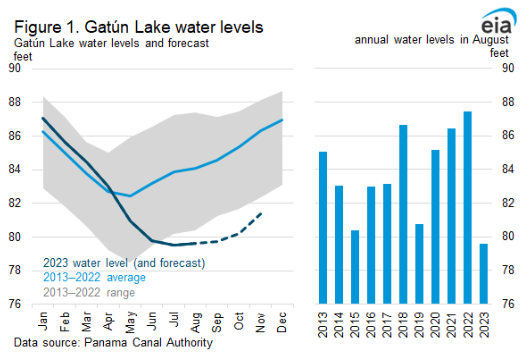
The US Energy Information Agency, EIA, released a notice about low water levels from a historic drought in the Panama Canal region is slowing the passage of large ships. In particular, the Very Large Gas Carrier (VLGC) vessels are restricted which affects the transport and price of Liquified Petroleum Gas (LPG). According to the Panama Canal Authority (APC), water levels in the canal are at their lowest levels since 1995 and are expected to stay low if the drought is prolonged.

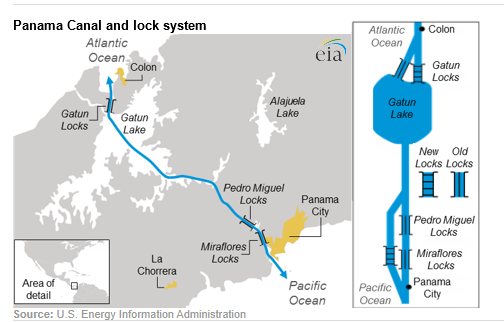
The core of the problem is low water levels at Gatun Lake. This lake is a key part of the system. It is an artificial reservoir that sits between the Atlantic and Pacific oceans providing water and power for the lock system. Due to a prolonged dry season and below normal precipitation, the APC has enacted water saving regulations.

Source: Charts from EIA

The largest fraction of US-provided hydrocarbons carried through the canal by VLGC vessels is propane which is used for petrochemical applications and highly seasonal heating demand. Increased demand for US propane in East Asia has put pressure on the canal due to increased vessel demand.

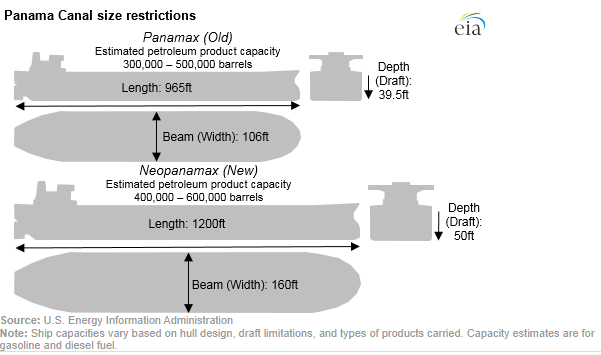
The canal has two types of locks- Panamax and Neopanamax. Ships are rated according to their size and draft as seen in the EIA graphic below.

Source: Graphic from EIA.

The base cost of transit for Panamax VLGC vessels is $300,000. A smaller gas or chemical carrier using the Panamax locks has a base cost of $60.000. The low water problem has restricted the flow of traffic through the canal to just 32 transits per day- 10 for the Neopanamax and 22 for the Panamax. Other routes to Asia are around the Cape of Good Hope or through the Suez Canal.

Source: Graphic from EIA.

Due to low water, restrictions have led to a waiting time of 13 to 17 days to transit the canal during August. According to Reuters 8/22/23, 125 booked and non-booked vessels were waiting to pass. As of this date, restrictions allow vessels with a maximum 44 foot draft. According to EIA a 6 foot decrease in draft can lead to a 40 % reduction in cargo.

EIA Releases New Btu to kWh Energy Conversion Factor

The US Energy Information Agency, EIA, has just released a new energy conversion relationship for the British thermal unit (Btu) and the kilowatt-hour (kWh). It is 3412 Btu/kWh.

EIA Monthly Energy Review

I post this kind of petroleum-related information with the hope that more people will pay attention to large-scale energy in general and oil & gas in particular. It is fashionable to pooh-pooh the petroleum sector for several reasons but, like it or not, it is one of the pillars of civilization. If we are going to be steering it in some particular direction, we should know a bit more about it.

There is a great deal of fascinating technology in oil & gas extraction and refining. The funny thing is that when you learn more about a subject, the more level your viewpoint on it will become, to the plus or minus side.