Category Archives: Chemical Industry

The Passing of Irwin “Ike” Klundt

I just received the sad news that my friend, boss, and mentor, Dr. Irwin “Ike” Klundt died in Tucson, AZ, of cancer. Ike retired in the early 1990’s as VP of Sigma-Aldrich. He was an organic chemist from eastern Washington state. He joined Alfred Bader in the 1960’s (?) and helped build Aldrich into what is is today. He started the Aldrichimica Acta and appeared in it many times in the capacity of awarding a prize to honor prominent chemists. Ike also managed the publication of the catalog and invented the Aldrich “Coffeepot” Kugelrohr.

I first met Ike when I taught for a year at Ft Lewis College in Durango, CO. He was an adjunct prof and I was a visiting prof. Ike was loved by all and was a useful hand to have around for the department.

Ike was a good hearted soul who enjoyed the company of others and actively worked to help younger chemists develop their careers. He loved the science and business of chemistry and the people who worked in this field of ours. Ike was forced out of Aldrich soon after Bader was given the boot as the once entrepreneurial company began to behave like a normal publicly traded company- you know, the ones that eat their young.

The chemical field is poorer for the loss of Ike Klundt. He was one of the human beings of the trade and he will be missed.

The joy of logistics

It is amazing how complicated and labor intensive logistics can be for manufacturers. Customers often have strict requirements on how materials are to arrive at their facilities. Some customers have preferred shipping companies and will require that you use them. Others don’t care. Some want you to pre-pay and add the freight to the invoice. Some will accept FOB shipping point terms and pay the shipper themselves. 

International shipments are even more complex. Multimodal freight forwarding companies will take charge of the shipment and get it on a boat or plane. Once across the pond, they’ll get the shipment through customs and plugged into the local ground transport.

If you’re shipping internationally, unless the customer is a known quantity, you’d better get prepayment or a letter of credit from their bank.  Cash is king.

It becomes complex if you allow yourself to be a custom shipper. Some companies simplify things by offering a one size fits all shipping policy. This is best if you can get away with it, but more often than not, custom service means custom shipping.

There is much more to chemical business than just the chemical part. Chemistry students planning to enter the fabulous world of chemical industry should be advised that if they are going to step out of the lab, then the full spectrum of business related problems and challenges will be available to them. It is a great opportunity for some and a gigantic nuisance for others.

Lowest Common Denominator

What is happening in the chemical world is that the safety people are taking control. Everything is dumbing down to the point where the safety of a facility is being judged on the basis of what the least qualified deem as safe. 

I just received an MSDS for the Buchner funnel (!$#%!!) I recently purchased from Aldrich.  The MSDS lists zero’s for Health, Flammability, and Reactivity both for HMIS and NFPA ratings. Thank heavens for that. It does recommend “suitable storage” and that it be kept “tightly closed”.  It is silent, though, on the matter of repeatedly jabbing the pointy end into your eye.

I gotta get out of the chemical business if this is where it is going. Administrative controls on common laboratory activity requires management by a dedicated staff member in order to maintain a favorable paper trail and stay in compliance with the ever growing web of regulation. OSHA, EPA, Homeland Security, as well as state and local agencies who want to inspect this or that or place tax stamps on your balances.

How did civilization get this far along without the legions of officious ninnies who want to exert control over everything you do? Chemical labs have inherent hazards, depending on the work that is being done in them. The cost of achieving de minimus risk for the lowest common denominator is quite high. Risk ends up being transferred to countries who reside on the other side of the curve- those who have little care for people.

Retrocurricular Translocation of Post-Modern Emphasis in Chemical Pedagogy

I couldn’t resist a sarcastic allusion to post-modernism, whatever the hell that is. What could possibly be under such a bullshit heading? Well, all of my tramping around chemical plants from Europe, Russia, North America, and Asia as well as local mines and mills keeps leading me to an interesting question. Exactly who is being served in the current course of chemistry education? Is it reasonable that everyone coming out of a ACS certified degree program in chemistry is on a scholar track by default? Since I have been in both worlds, this issue of chemistry as a lifetime adventure is never far from my mind.

What are we doing to serve areas outside of the glamor fields of biochemistry and pharmaceuticals? There are thriving industries out there that are not biochemically or pharmaceutically oriented. There is a large and global polymer industry as well as CVD, fuels, silanes, catalysts, diverse additives industries, food chemistry, flavors & fragrances, rubber, paints & pigments, and specialty chemicals. There are highly locallized programs that serve localized demand. But what if you live away from an area with polymer plants? How do you get polymer training? How do you even know if polymer chemistry is what you have been looking for?

Colleges and universities can’t offer everything. They attract faculty who are specialists in areas of topical interest at the time of hire. They try to set up shop and gather a research group in their specialty if funding comes through. Otherwise, they teach X contact hours in one of the 4 pillars of chemistry- Physical, inorganic, organic, and analytical chemistry- and offer the odd upper level class in an area of interest.

Chances are that you’ll find more opportunities to learn polymer chemistry as an undergraduate in Akron, OH, than in Idaho or New Mexico.  Local strengths may be reflected in local chemistry departments. But chances are that in most schools you’ll find faculty who joined after a post-doc or from another teaching appointment. This is how the academy gets inbred. The hiring of pure scholars is inevitable and traditional. But what happens is that the academy gets isolated from the external world and focused on enthusiasms that may serve civilization in distant ways if at all. The question of accountability is dismissed with a sniff and a wave of the hand of academic freedom. Engineering departments avoid this because they are in constant need of real problems to solve. Most importantly, though, engineers understand the concept of scarcity in economics. Chemists will dismiss it as a non-observable.

One often finds that disconnects are bridged by other disciplines because chemistry is so narrowly focused academically. It would be a good thing for industry if more degreed chemists found their way into production environments. I visited a pharmaceutical plant in Taiwan whose production operators were all chemical engineers. Management decided that they required this level of education. But, why didn’t they choose chemists?  Could it be that they assumed that engineers were more mechanically oriented and economically savvy?

Gold mines will hire an analyst to do assays, but metallurgists to develop extraction and processing. Are there many inorganic chemistry programs with a mining orientation? Can inorganikkers step into raw material extraction from a BA/BS program or is that left to mining engineers?

In my exploration I am beginning to see a few patterns that stand out. One is the virtual abdication of  US mining operations to foreign companies. If you look at uranium or gold, there are substantial US mining claims held by organizations from Australia, South Africa, and Canada.

So, what if? What if a few college chemistry departments offered a course wherein students learned to extract useful materials from the earth? What if students were presented with a pile of rock and debris and told to pull out some iron or zinc or copper or borax or whatever value may happen to be in the mineral?

What if?? Well, that means that chemistry department faculty would have to be competent to offer such an experience. It also means that there must be a shop and some kilo-scale equipment to handle comminution, leaching, flotation, and calcining/roasting. It’s messy and noisy and the sort of thing that the princes of the academy (Deans) hate.

What could be had from such an experience? First, some hours spent swinging a hammer in the crushing process might be a good thing for students. It would give them a chance to consider the issues associated with the extraction of value from minerals. Secondly, it would inevitably lead to more talent funneling into areas that have suffered from a lack of chemical innovation. Third, it might have the effect of igniting a bit more interest in this necessary industry by American investors. The effect of our de-industrialization of the past few generations has been the wind-down of the American metals extraction industry (coal excluded).

If you doubt the effect on future technologies of our present state of partial de-industrialization, look into the supplies of critical elements like indium, neodymium, cobalt, rhodium, platinum, and lithium. Ask yourself why China has been dumping torrents of money into the mineral rich countries of Africa.

I can say from experience that some of the most useful individuals in a chemical company can be the people who are just as much at home in a shop as in a lab. People with mechanical aptitude and the ability to use shop tools are important players. Having a chemistry degree gives them the ability to work closely with engineers to keep unique process equipment up and running efficiently.

Whatever else we do, and despite protestations from the linear thinkers in the HR department, we need to encourage tinkerers and polymaths.

This kind of experience doesn’t have to be for everyone. God knows we don’t want to inconvenience Grandfather Merck’s or Auntie Lilly’s pill factories. Biochemistry students wouldn’t have to take time away from their lovely gels and analytical students could take a pass lest their slender digits become soiled. Some students are tender shoots who will never have intimate knowledge of how to bring a 1000 gallon reactor full of reactants to reflux, or how to deal with 20 kg of BuLi contaminated filter cake. But I hasten to point out that there are many students with such a future before them and their BA/BS degree in chemistry provides a weak background for industrial life.

A good bit of the world outside the classroom is concerned with making stuff.  I think we need to return to basics and examine the supply chain of elements and feedstocks that we have developed a dependence upon. American industry needs to reinvest in operations in this country and other countries, just like the Canadians, South Africans, and Australians have. And academia should rethink the mission of college chemistry in relation to the needs of the world, rather than clinging to the aesthetic of a familiar curriculum or to the groupthink promulgated by rockstar research groups. We need scholars. But we also need field chemists to solve problems in order to make things happen.

CSB Reports

Being a reactive hazards person, I try to keep up on the reports posted by the US Chemical Safety Board (CSB). In my view, the CSB does exemplary work in root cause analysis of what are often very complex events leading to disaster. I wholeheartedly recommend that people in the process side of chemistry peruse the many reports and videos posted on the CSB website.

The development of any technology in the real world involves what I refer to as

“the discovery of new failure modes”.

While it is possible to anticipate many kinds of failure modes, it often happens that plant operations will present the opportunity to line up the planets in a particular way that was left out of the failure analysis.

A recent account from the CSB is the report on the T2 Laboratories accident in late 2007 in Jacksonville, FL.  This accident killed 4 employees and injured 32 in many of the adjacent businesses. The explosive yield was estimated by the CSB investigators to be equivalent to 1450 lbs of TNT.

What is most instructive about this incident is the extent to which the thermokinetic behaviour was unknown to the owner/operators. This accident illustrates that thermal decomposition modes leading to runaway can happen despite a large number of successful runs.

I won’t go into too much detail since the report itself should be read by those interested in such things. But the upshot is that the reactor contents (MeCp dimer, Na, and diglyme) accelerated to a temperature that lead to the exothermic reaction of sodium metal and solvent diglyme. The reaction contents accelerated, raising the temperature and pressure to the rupture disk yield pressure of 400 psi. However, the acceleration was far too energetic for this safety device. The vessel exploded, hurling fire and fragments off the site. Just prior to the explosion, the owner/engineer directed the operators to leave the control room, saying prophetically, “there is going to be a fire”.

While the owners did perform some process development and did have the used vessel professionally inspected, what was left out was a study of the aptitude of the reaction to self-heat into a runaway condition. The company rightly anticipated the exothermicity of the sodium reaction with MeCp monomer and in fact, relied on the exotherm to raise the rxn temperature to a level where the economics would be more favorable. But what nobody at T2 anticipated was the runaway potential of the reaction of the sodium with the diglyme. No doubt they thought that the cooling jacket would prevent temperature excursions leading to a runaway.

The various glymes are often chosen as reaction solvents owing to their diether character as well as their high boiling points. Troublesome compounds or reactions requiring a polar solvent can be dissolved at high temperature and reacted in this high boiler. In certain cases, reactions can be run in a glyme and the product conveniently distilled out of the reaction mixture. Perhaps this is what they were doing in the MCMT process, I don’t know. This level of detail was not provided in the report.

Thoughts on hazardous substances. An epistle to the bohemians.

This post has been updated. Th’ Gaussling, 6/4/16.

If you work with chemicals at the level of chemist in a production environment, chances are at some time in your career you’ll be called upon to help decide when a material is too hazardous to use in manufacture. It can be in regard to raw materials or as the final product. Your organization may have protocols or institutional policies or memories relating to certain classes of substances. Some companies, for instance, will not use diethyl ether in its processes. Others may require hydrocarbon solvents *absolutely* free of BTX. Some companies are so fastidious about worker exposure that the faintest whiff of solvent constitutes a breach. One world class company I know requires R&D chemists to include a process hazard analysis, review, and an inspection for all R&D reactions performed in the hood.  Whatever the company, most have fashioned some kind of boundary as to what is permissible to have on site and what isn’t.

Large chemical companies tend to have large EH&S departments with well established SOP’s and protocols with regard to personal protective equipment (PPE) and the measurement of occupational exposure to substances. Larger companies may have an OSHA attorney on retainer and staff members specializing in regulatory compliance.

One might suppose that smaller chemical companies may not have the depth of hazardous material experience that the larger companies have for many reasons. Smaller companies may have smaller capital equipment and a smaller staff. But smaller companies may have a greater organizational freedom which can lead to a great variety of projects. A great variety of projects often means that a great variety of materials are used on site. As such, a smaller company might very well have considerable expertise in a wide variety of chemical substances and, consequently, a wide variety of hazards.

While a smaller chemical company may have considerable expertise in handling its hazardous materials, it may be lacking in infrastructure for administrative controls and regulatory compliance. A wise CEO watches this aspect as closely as the actual operations.

Whether large or small, eventually a company has to draw the line on what hazards it will bring on site. The chemist has some very sober responsibility in this regard. Through the normal ordeal of process development, the diligent synthesis chemist will find the optimum path from raw material to product. All synthesis consists of the exploitation and management of reactivity. But there is always the “deal with the devil”. In exchange for a useful transformation, properly reactive precursors must be prepared and combined. A mishap with a 1-5 liter reaction on the bench top is messy and possibly an immediate threat to the chemist. But that same reaction in a 50 gallon or 5000 gallon pot can turn into the wrath of God if it runs away. The chemists judgment is the first layer of protection in this regard. All process chemists have to develop judgment with respect to what reagents, solvents, and conditions are feasible. Economics and safety come into play.

A runaway reaction poses several kinds of threats to people, equipment, and the viability of the company. There is the immediate thermokinetic threat stemming from the PV=nRT, meaning that energy can be dumped into PV work leading to the high speed disassembly of your equipment. A prompt release of heat and molecules kicked into the gas phase may or may not be controllable. Especially if the runaway leads to non-condensable gases. A runaway has a mechanical component in addition to the chemical action.

An runaway may cause the reactor contents to be abruptly discharged. Several questions should be answered ahead of time. Where do you want the contents to go and what are you going to do with it once it is there? Catchpots and emergency relief systems are common and resources should be invested there.

A question that the wary chemist must ask is this: What if a cloud of my highly useful though reactive compound gets discharged into the air or onto the ground? Do the benefits of this reagent outweigh the downside costs? Even if a release is not the result of a thermokinetic disaster like a runaway, explosion, or fire, a simple release of some materials may be consequential enough to require the evacuation of a neighborhood. Once your materials have left the site in the form of a cloud or a liquid spill and you make the call to the fire department, you have lost control of the incident. Even if nobody gets hurt or exposed, the ensuing regulatory “administrative explosion” may knock you down.

A chemical process incident can have mechanical consequences, chemical release issues, and the matter of fire. Substances that are pyrophoric have automatic ignition problems that may be surprisingly easy to deal with, especially if they are liquid. Liquid transfer systems can be inerted easily and pyrophoric liquids can be transferred airlessly and safely. Pyrophoric solids are another matter. There  are few generalizations I can make about pyrophoric solids. Inert solids pose enough handling issues without having the added complication of air/water sensitivity. All I can say about pyrophoric solids- waste or finished product- is that you will need specialized equipment and a big tank of LN2. Production glove boxes and Aurora filters are particularly useful. Also required is a space on the plant site where you can open up a container and let the contents burn if needed. If air gets into a drum of pyrophoric solids, it”ll begin to get hot. That is when you need to have an open spot where it can take off and not bring the facility down. Industrial parks are a bad place for such material handling.

When designing a chemical handling space, it is important to think about what happens in a fire. Flammable liquids are under the constant influence of gravity and will run to the low point on a floor. The question you have to ask is this: Where do I want the burning liquid to go? There are good choices and poor choices. Burning pools of organic liquids radiate considerable energy per sq ft per sec. The temperature of nearby objects will rise rapidly to the flash point and the ceiling spaces will accumulate smoke and hot gas. Drums and cylinders filled with flammable liquids or gases will eventually overpressure and release their contents adding to the mayhem. The release can be in the form of a BLEVE or a flood of flammable liquid leading to a widespread pool fire.

Such flammable liquid scenarios can begin many ways.  Forklift and maintenance operations are particularly rich in opportunity for a fire. The physical location of flammable liquid storage must be well thought out. Ideally a warehouse fire should not be allowed to spread to capital equipment locations. This helps to keep workers out of harms way and contains the magnitude of the financial disaster as well.  Since most chemical plants seem to grow organically over time, unfortunate choices are usually made in regard to incident propagation.

There are resoures available to quantitate the risks of such releases. The American Institute of Chemical Engineers (AIChE) is well organized and provides much literature on the topic of chemical plant safety. In particular I am thinking of Dow’s Chemical Exposure Index Guide, 1994, 1st Edition, AIChE, ISBN 0-8169-0647-5.  This handbook takes the reader through calculations aimed at estimating the risk and likelihood of chemical releases.

Also available is Dow’s Fire & Explosion Index and Hazard Classification Guide, 1994, Seventh Edition, AIChE, ISBN 978-0-8169-0623-9.  This handbook supports the use of a quantitative risk analysis chart for the use of a risk and hazard index for generating numbers associated with process activities for cost/benefit analysis. It is well worth the addition to your library.

When is a substance just too hazardous? Well, there are nitroglycerine plants in operation as well as phosgene factories. Most risks can be abated by properly thought-out processing and packaging. It really comes down to personal choice. Is that ammonium perchlorate plant that just offered me a job operated safely? Nitroglycerine, phosgene, and ammonium perchlorate all have properties that lead to demand for their use. Somebody is going to supply that demand. We chemists have to look inward and then act with our eyes wide open and our heads on a swivel. Myself? I wouldn’t work in a nitroglycerine factory, but I’m glad that someone does.’

[Added 6/4/16 by Th’ Gaussling] I happened to go back to this post and in doing so read a comment by “Bob”, which you can see in the comment section below. Here is a copy

“I actually believe that as a society should keep the safety rules relaxed a bit in academia. Academia, for better or worse, is our national chemical research institution”

So underpaid grad students, postdocs and staff working at  a univeristy are less human, and less deserving of safety than their for profit brethren?

That’s diabolical Mr. Gaussling. Pure evil incarnate. For whose gain do you sacrifice their lives?

I want to address this now better than I did back then. To Bob I say this: Everyone has a right to a safe workplace. Academic institutions as well as industrial operations must use best practices in regard to worker safety. This is axiomatic. Plainly I did not articulate my contention as well as I could have. I will do so now.

We have to assume that junior chemists are likely grow to be senior chemists in an organization. The role of a senior chemist in industry for example, may be quite varied through her/his career. A senior chemist who has stayed in the technical environment will almost unavoidably have been confronted with a large variety of questions in regard to circumstances and outcomes relating to hazardous materials and tricky reactions. Moreover, a senior chemist is likely to have been promoted to a level that also involves supervision, the drafting of SOPs, work instructions, MSDS documents, emergency planning, laboratory design, etc.

In my view, a senior chemist as described above has an ethical and moral responsibility to coworkers, plant operators, material handlers, and customers to oversee chemical safety. A chemist at any level has a responsibility to make known to all involved what dangerous circumstance might arise with any given chemical operation. Either in relation to the hazardous properties of substances that may be released in mishandling, or in regard to hazardous processing conditions that can lead to danger.

I’ve used the word hazard(ous) and the word danger(ous). We need some clarity on this. If you Google the words and stop with the dictionary definitions you will be left with the shallow notion that they are synonyms. If you dig deeper, say at the website of the Canadian Centre for Occupational Health and Safety (OSH), you will find a definition of “hazard” that I find particularly useful. To wit:

A hazard is any source of potential damage, harm or adverse health effects on something or someone under certain conditions at work. [italics mine]

The same fuzziness in definition exists for the word danger(ous) as well. A definition I prefer is below:

A dangerous occurrence is an unplanned and undesired occurrence (incident) which has the potential to cause injury and which may or may not cause damage to property, equipment or the environment. [italics mine]

This definition is borrowed from the University College Cork, Ireland (UCC). I believe this is a good definition and it readily sits apart from the definition of hazard above.

The key difference is that a hazard is any source of potential of damage … under certain conditions.. whereas danger is a condition brought on by an unplanned or undesired occurrence. Next, lets consider these terms in the context of chemistry.

On the shelf in the fire cabinet is a glass bottle of phosphorus oxychloride, properly sealed and segregated. As the POCL3 sits on the shelf in the cabinet, I would argue that it is only hazardous. If, however, you pick up the bottle and in walking to the fume hood drop it causing it to break and spill the contents in the open, you’ve caused a dangerous situation. It’s an imminent threat to health and safety.

Conversely, let’s say that you carried the bottle to the hood, used it, then returned it to storage without incident. In the reaction the POCl3 is consumed and in the workup the residual acid chloride is quenched by water. Congratulations! You have taken a hazardous material, used it safely, passivated the actives during workup, and eliminated at least the acute hazard relating to POCl3.

In the first situation, a hazardous material was mishandled and became dangerous. In the second situation, the hazardous material was handled properly, consumed, and residuals passivated. In this case a hazardous material was used safely and to positive effect.

Seem trivial? Well, it’s not. This difference in meaning leads to a confusion that is especially acute among the non-chemist population. But my point lies takes us to the question of how students are taught to use hazardous materials.

I spoke of relaxing safety requirements in academia. An example of such a thing might be the use of diethyl ether. This useful solvent is banned outright in some chemical manufacturing operations across the country owing to the flammability. Even in their R&D labs. This is corporate policy handed down by those responsible for risk management, not scientists. In some industrial labs, woe is he who has an unexpected occurrence like a boil-over or a spill.

I believe that Et2O should remain in academic research labs for both the research value and for the development of valuable lab experience by students and postdocs.

You learn to handle hazardous materials by having the opportunity to handle hazardous materials.

Ether is only a simple example of what I’m trying to communicate. In order for chemists to graduate as experienced scientists with working familiarity in the properties of substances, they must have experience handling and using a large variety of substances, many of which may be substantially hazardous. And by hazardous I mean much more than just toxic. A substance may have a reactive hazard aspect that is a large part of it’s utility.  To safely handle substances that pose a reactive hazard, a chemist needs to have experience in using it. And killing it. The chemist must try to gauge the level of reactivity and modify the use of the substance to use it safely. If you’ve made or used a Grignard reagent you know what I mean. Expertise in laboratory chemistry only comes through direct experience.

Hazardous reactive materials do useful things under reasonable conditions. Non-hazardous, unreactive materials find great utility in road and bridge construction.

If we regulate out all of the risk by eliminating hazardous materials in academic chemistry, what kind of scientists and future captains of industry are we producing? What we can do is to put layers of administrative and engineering protection in the space where the hazardous transitions to the dangerous.  Academic laboratory safety is promoted by close supervision by experienced people. Limits on the amount of flammables in a lab space, proper syringe use, safe quenching of reactive residues, proper use of pressurized equipment, and a basic assessment of reactive hazards present in an experiment will go a long way to improving academic lab safety. Experienced people usually have a trail of mistakes and mishaps behind them. If we corporatize the academic research experience to a zero risk condition, we may kill the goose that lays the golden egg.

 

Some Thoughts on Hazardous Goods

When a customer orders a chemical from a chemical company, a series of events are triggered leading to the shipment. Every company has a unique business system for order fulfillment. Variable as the details may be though, certain aspects are shared by all companies.

There are special considerations for chemical goods that other manufactured items may not have. Chemicals must be packaged and shipped according to the nature of the material and to certain types of hazards that are present. The type of packaging is not just governed by good sense, but also by transport regulations.

Some substances are covered under regulations meant to control illicit drug manufacture or distribution. Diethyl ether, iodine, phosphorus, phenylmagnesium halide, phenylacetone, ephedrine, acetic anhydride, and many more seemingly ordinary chemical products are constantly under watch by authorities from behind the curtains.

Some substances may be used for explosives and munitions manufacture or use and prospective customers are screened accordingly. Other substances have been identified by the authorities as substances of interest. Phosphorus trichloride is one that comes to mind. Zirconium and titanium powders and components are subject to limitation also.

The kinds of regulatory constraints depend upon the compound of interest and whether or not it is an item for export or import. Import and export controls are in place for many reasons. The control of dangerous goods or illegal substances is an obvious goal. But the act of goods crossing the border is an opportunity for governments to temper the effects of international competition on behalf of homeland businesses through the imposition of duties.

International or domestic shipping of chemicals is rife with complications owing to the potential hazards of the cargo. Chemicals are classified according to their hazard and certain hazard classifications are barred from air transport or constrained to maximum package quantities. What is not transportable by air is usually fine for surface or ocean shipping, but these modes have their limitations as well. Fortunately, the regulations are internationally harmonized for the most part.

Woe is he whose container of hazardous goods is damaged or leaks at a foreign port of entry. Such an event may trigger remedies by the local authorities that will not only be very expensive, but will block the delivery of the material for a long time. This is why a smart manufacturer ships FOB -Free on Board. Once the order is on the truck and rolling off your mfg site, it is the responsibility of the customer thereafter.

For ocean shipments, the captain of the vessel has the final say as to what goes on the boat. Accordingly, your shipping container full of metal alkyls (Dangerous When Wet) will get loaded only at the pleasure of the skipper. It is not unheard of for the boat to sail without such cargos. More likely than not your container will get on the boat, but it will be placed at the top of a stack along side the railing. If there is a leak, over it goes.

A company that practices just-in-time inventory control with hazardous goods that come or go by boat must be prepared for delays and long transit times relative to air transport. It is always best to work with a logistics company that specializes in intermodal international shipments.

Significant New Molybdenum-Rhenium Find Announced

A significant new ore deposit of molybdenum and rhenium has been announced by Ivanhoe Australia. The Merlin Mo-Re deposit is located in western Queensland, Australia, south of Cloncurry. The deposit is said to be worth $6 billion Australian. The core sample shown on a download contains 2.25 % Mo and 29 g/t of Re, according to the company.  The principal ore is Molybdenite, or molybdenum sulfide.

Ivanhoe claims the advantages of the ore stem from the high grade and shallow depth. High grade ore requires a smaller refining facility. Ivanhoe says that its rhenium is not a byproduct.

Climax Molybdenum, a Freeport-McMoRan company, is also a producer of rhenium products. Climax Molybdenum operates the Climax mine on Freemont Pass near Leadville, Colorado, and the Henderson Mine near Empire, Colorado.

The geochemical association of Mo and Re is apparently not limited to a unique location. Molybdenum deposits at Ivanhoe, Climax, and Copaquire all have associated rhenium.  Rhenium products such as rhenium pellets and ammonium perrhenate are supplied by Climax Molybdenum in addition to a variety of metallic moly and moly chemicals.

International PBX operates the Copaquire Mo-Re-Cu porphyry project in northern Chile.  The company estimates that 47,000 to 60,000 lbs of indicated rhenium reside in their part of the district. According to PBX announcement, the indicated moly is between 203 and 253 million lbs and indicated copper lies between 364 and 563 millions lbs. The company is quick to point out that 25 % of the deposit is above ground in a mountain.

As of 2005 the three leading producers of rhenium were Chile, Kazakhstan, and the USA, with the USA having the largest known reserves. How the Australian find will alter this distribution is unclear at this time. The estimated rhenium trade in 2005 was $32 million.

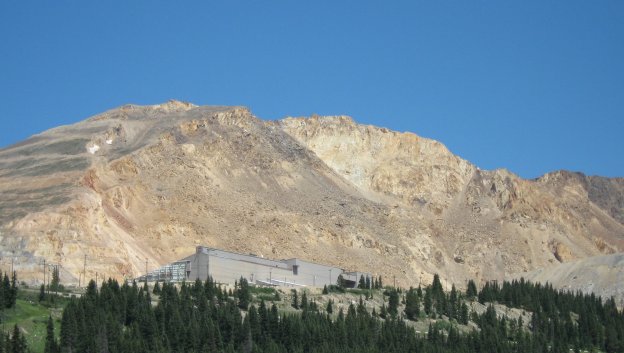
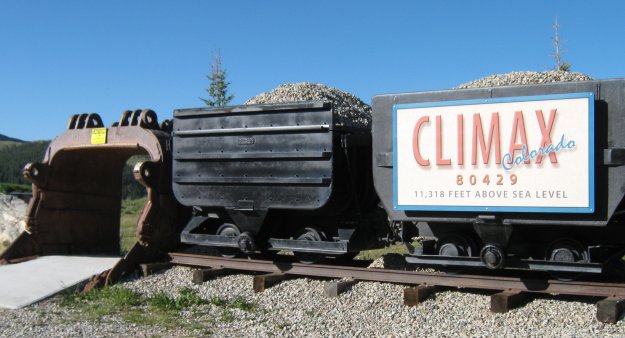
Rest Stop on Freemont Pass at Entrance to Climax Mine

Rest Stop on Freemont Pass at Entrance to the Climax Mine


View of Climax Mine (Copyright 2009 All rights reserved)

View of Climax Mine (Copyright 2009 All rights reserved)

The above photo of the Climax mine shows a processing building with what remains of Bartlett Mountain behind it. In fact there is a considerable lode of moly remaining in the mine.

The Gangues of Leadville

The mining history of Leadville, Colorado, is well documented and the details are left to the reader to pry out of the internet. As a process chemist, my interest in mining is more directed to the geochemistry and milling of the ore. How did they get the pay out of the paydirt?

How does it come about that we can get our hands on particular elements like molybdenum, gold, silver, uranium, tungsten, vanadium, etc? How do the elements manage to concentrate into ore bodies that are worth the effort and expense to refine?

When you take the various mine tours around the country, the spiel offered by the guide is usually geared toward the lowest common denominator- our fascination with fabulous wealth. The miners were certainly taken with the possibility of wealth. Gold and silver mines are an easy sell because everybody has greed and everybody yearns to pluck a fat nugget of gold from a pan of gravel.  Other types of mines are a tougher sell entertainment-wise and require a bit more explanation of the relevance of the obscure element that is being extracted.

Mining is an activity with good and bad effects. To sustain modern civilization, if you can’t grow what you need, you have to mine it. Mining is inherently extractive in nature and requires that large volumes of earth be disturbed. Open pit mining requires that overburden be removed and the mineral value be moved to a processing site. Material sidestreams are generated and must be dealt with. 

Underground mines also generate large volumes of material that must be piled somewhere. To ensure responsibility for reclamation costs mining companies are required to put up a surety bond to cover the costs of future reclamation under 43 CFR section 3809.

The inevitable trade-off that a society must make is one of environmental insult for material goods. The balance point is always hard to find, and in fact is usually a moving target on account of politics, employment, and environmentalism.

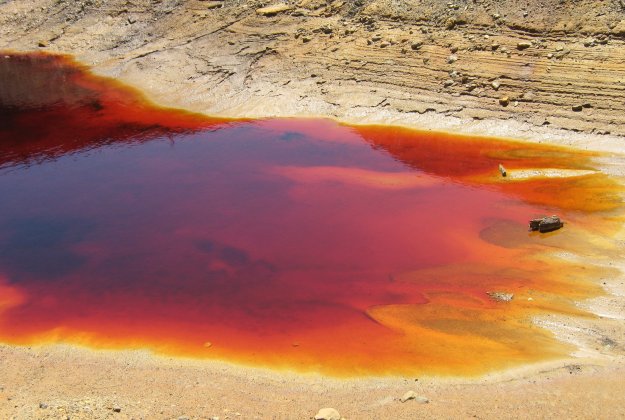
Mining can have substantial effects on the landscape, the watershed, real estate, and the future tax base. Land that is not available for habitation or sustainable commercial use is fundamentally limited in potential value. An area covered with mine tailings, mine shafts, the occasional blasting cap, and acidic runoff is an area that requires cash infusion on a long timescale.

But if we enjoy the benefits of lead batteries in our cars, or silver jewelry, tungsten elements in our light bulbs, zinc plated wire fences, or the ten thousand other metal products in our lives, we must come to grips with the consequences for having such material goods. At some stretch point, everybody becomes a Luddite. Question: How much technological triumphalism can we take? Answer: Whatever the market says we can take.  

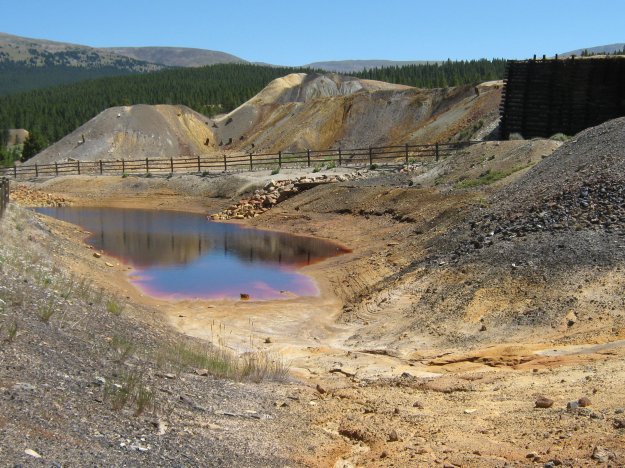
Runoff Collection Pond from Mine Tailings in Leadville Mining District.

Runoff Collection Pond from Mine Tailings in Leadville Mining District.

Our society has benefitted greatly from metallurgy. The compulsion to recover metals from the ground is one of the great economic forces in civilization. No amount of highminded pontification will stop it. Metals enable industry and war which are forever entangled in politics and greed. The goal is to be smart about how we mine elements from the ground so that maximum value of the surrounding land may be enjoyed. The enthusiasms of the time come and go. But metals are forever.

Mine Waste, Leadville Mining District August 2009

Mine Waste, Leadville Mining District August 2009

Gaussling’s 12th Epistle to the Bohemians. Elements Rock.

Some acquaintances have asked about my new interest in geology. What’s the deal with rocks and mining? 

What interests me is not so much the economic value and extravagant production of certain minerals and precious metals. What is of interest is the question of how it came about that there is such a thing as an ore body.  An ore body is a geological formation which is defined by a localized concentration of certain substances. How does it happen that chemical elements can become concentrated from a more distributed condition?

Celebrity astronomers are often seen on cable channels pedantically nattering on about “Star Stuff”.  OK, Dr. Skippy, what is star stuff and what does it do? What are the particulars about the local star stuff, ie., the earth? This is the realm of cosmochemistry and geochemistry- elective classes the TV glamour boys apparently skipped.

The nucleosynthesis of the heavy elements (C to U) and their subsequent ejection from exploding stars is an inherently dispersive process. Eventually, here and there, some heavy matter will aggregate to form a protoplanetary cloud which can then produce planetary bodies. Inevitably, some of the heavy matter is pulled into massive bodies dominated by the presence of thermonuclear fuels- that is, hydrogen and helium. Sufficiently large accumulations of these two highly abundant elements will compress and initiate a self-sustaining fusion reaction of hydrogen to form the (n+1)th generation of stars. All told, some heavy matter accumulates to form of planetary bodies while some of it siphons into the next generation of stars.

It is within the ability of gravity to concentrate matter into smaller volumes of space as a dense, bulk phase. The geometric shape that allows all of the mass to be as near the center of mass as possible is the sphere.  This is why we don’t see planets shaped like cubes, pyramids, or ponies. 

Once cooled well below incandescence, the matter in a sufficiently constituted and situated planet may begin to self-organize into chemical phases. Along the lines of the Three Bears allegory, Earth is parked in an orbit that is just right for the presence of liquid water. Irrespective of the needs of life, liquid water is critical for the eventual concentration of some elements into ore bodies.

Earth has a gas phase blanketing a liquid phase which wets much of the bulk rocky phase of the planet. A generous portion of water circulates in the maze of fractured recesses of the planetary crust. In the case of Earth, we know that our planet has a fluid core within a solid shell. This molten phase in the core energizes a kind of convective heat engine that will drive the shuffling motion of tectonic plates and episodic volcanic mass transfer on the surface. 

Matter has gravitationally self-organized at the planetary scale on the basis of density. But what is perhaps most interesting to a chemist is the phase composition of the planetary solid matter. On cooling, a body of magma will sequentially produce precipitates representing different chemical substances. Over geological time this igneous rock may experience modification by the hydrothermal action of hot water under high pressure. Depending on its circumstances, parts of the formation may be depleted of soluble constituents or it may receive a deposit of new mineral species.

On the scale of planets, the earth has self-organized into bulk phases of matter- Solid, liquid, and gas. But at a much smaller scale, the earth self-organizes into domains of chemical substances. This is evident by simple inspection of a piece of granite. A piece of pink granite shows macroscopic chemical domains of potassium feldspar, quartz, and mica. While these three mineral components of granite are compounds and not pure elements, they nonetheless represent self-organization of species based on chemical properties.

The forces that drive chemical differentiation in mineral formation are ultimately thermochemical in nature. Large differences in Ksp lead to partitioning and phase separation of distinct substances. Subsurface formations may be approximately adiabatic on a short time scale, but over deep time they can slowly cool and equilibrate to yield a sequence of fractional crystallizations of metal carbonates, oxides, silicates, and aluminates giving rise to a complex bulk composition.

Speaking only for myself, coming to an understanding of how mineral deposits form is a kind of hobby.  If I wanted immediate answers to specific questions, I suppose the most expedient thing would be to consult a geochemist. But where is the adventure in that? The answers are not the fun part. The real adventure is in the struggle to find the best questions. As it often happens, once you can frame the problem sufficiently, the answer falls out in front of you. Whoever dies with the greatest insight wins.