Category Archives: Chemical Industry

Preparation of Iodonium Tetrafluoroborates

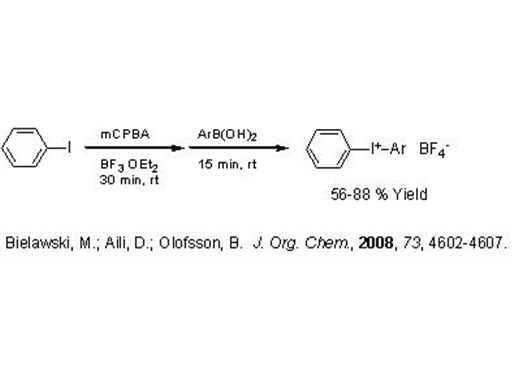
An interesting bit of chemistry was published by Berit Olofsson at Stockholm University in a recent JOC. The Olofsson lab has previously produced a method for the one-pot preparation of diaryliodonium triflates. This latest work provides diaryliodonium tetrafluoroborates (JOC, 2008, 73, 4602-4607). 

The preparation of I(III) compounds usually starts with an Ar-I compound undergoing oxidation followed by an electrophilic addition/substitution to another arene. Regioselectivity is obtained by choosing a donor with a leaving group such as a boronic acid, stannane, or silane.

What is clever about this process is the fact that a BF4 salt is directly produced. Two equivalents of boron trifluoride etherate are used in the reaction which evidently results in some kind of disproportionation producing the BF4 counter-anion. 

It is known that the reactivity of iodonium compounds is somewhat sensitive to the coordinating ability of the counter-anion, so BF4 is less undesirable than other choices (like chloride). Solubility is greatly influenced by the choice of counter-anion as well. This is particularly true in photo-initiator applications where the choice of carrier fluid may be limited.

Meat and Cheese Explosives

So, I’m blundering through the literature on a snipe hunt when I run into this ICI patent- US 5,456,729. In the description, they teach a method of preparing an explosive composition using “lactic casein”. Having been in the dairy business long ago, and specifically having worked in a cottage cheese plant, I recognized this component as … cheese. Well, mostly. Example 5 discloses a composition comprising 25 % ammonium nitrate and 3 % lactic casein.

Unless you have lactose intolerance, cheese is not ordinarily an explosive. In the patent, the lactic casein is one of many examples of a foam stabilizer. Other stabilizers include animal and fish proteins as well as collagens. A collection of other chemical additives rounds off the list.

If they had specified gluten, they could have claimed the use of a pastrami and cheese on rye sandwich as stabilizer feedstock for their explosive composition.

Structural diversity of organic chemistry

The recent issue of Journal of Organic Chemistry, (JOC, 2008, 73(12)) has a few articles that are particularly interesting.

The article by Lipkus, et al., entitled Structural Diversity of Organic Chemistry. A Scaffold Analysis of the CAS Registry, JOC, 2008,73, 4443-4451, is a particularly ambitious bit of work that only CAS could do. This article describes a scaffold survey of more than 24 million organic compounds in the CAS Registry.

The data set was limited to carbon-based structures containing the heteroatoms H, B, Si, N, P, As, O, S, Se, Te, and the halogens.  Moreover, the work was further limited to framework structures containing rings or linked rings. Acyclic compounds were not included owing to the inapplicability of the framework definition in the search algorithm. Multicomponent substances and polymers are ignored as well.

Lipkus and coworkers found that half of the graph frameworks analyzed are described by only 143 framework shapes.  The remaining half are described by 836,565 graphs.

One of the key conclusions is quoted here-

“It is not surprising that some frameworks occur much more frequently than others. However, the extreme unevenness in the way frameworks are distributed among organic compounds is somewhat surprising. This is particularly true at the graph level, where it is found that only 143 framework shapes can describe half of the compounds. The fact that both graph and hetero frameworks have very topheavy distributions tells us that the exploration of organic chemistry space has tended to concentrate on relatively small numbers of structural motifs.”

Lipkus concludes that cost minimization is one of the drivers of this “… shaping the known universe of organic chemistry.” He comes to this conclusion due to the presence of a power law which describes this distribution. The power law he refers to is a linear log-log relationship that is indicative of what they refer to as the “rich-get-richer process”.

If I understand this correctly, a relatively small number of easily made or commercially available early precursors are comprised of ring graphs that, by virtue of modification, propagate into more complex analogs that retain the original graph. This has the effect of multiplying the frequency of a given graph.

The cost minimization aspect comes from the benefits of familiar chemistry and the commercial availability of a fairly limited set of ring graphs. Adding more rings will usually mean adding more molecular weight and adding problematic synthesis and separation issues.

The authors conclude that the lopsided distribution of organic compounds toward only 143 graphs comprises a bottleneck in drug discovery. They further suggest that more exploration in other areas of chemistry space may be worthwhile.

Verbund Manufacturing

German manufacturing culture does many things very well, but a few things particularly stand out. One of these items pertains to the concept of verbund manufacturing. Verbund simply means “integrated” or “linked”. Verbund manufacturing sites are clusters of manufacturing units that take advantage of proximity. Clustering can offer certain logistic and energy advantages if done intelligently.

A cluster of manufacturing sites can operate and share a co-generation plant for the distribution of steam, waste heat, and electricity. Large capital items like steam plants can be shared so funds can be plowed into larger scale for better economy. Rail operations and other transportation resources can be shared as well. Clustering also provides for the possibility of vertically integrated manufacturing on site and a reduction in transportation costs.

Clustered manufacturing may also have the effect of concentrating the supply of skilled workers for the labor pool. A manufacturing nexus can attract community colleges and other vocational opportunities for the next generation of employees.

The USA has many manufacturing sites where similar industries congregate. Look at the Gulf coast with all of the refinery locations. But the extent to which there are synergistic interactions between companies is unclear.

In the US, corporations tend to behave as the Republic of Exxon or the Republic of the Union Pacific. This kind of a fragmented confederation of corporate states is becoming obsolete as we go up against nationalized business entities that control key resources and trade. The key to future vitality is greater efficiency with resources. Synergistic cooperation is one model that is available. But to do this requires trust and the desire to cooperate for mutual benefit. Competition begets gamesmanship and posturing which works against the verbund model for US businesses.

US corporations have much to learn from this business model.

“60 Minutes” and Dust Explosions

Sunday evening on 60 Minutes on CBS there was a segment on dust explosions. For the most part, it was an expose on the failings of OSHA. It is hard to avoid the conclusion that OSHA is lead by a bunch of dullards who are under the enchantment of an administration reluctant to impose new regulations on industry.

The thrust of the program was that OSHA is completely unable to recognize incipient dust hazards on their site inspections, partly due to a lack of training and partly due to a slack-jawed lack of direction.  It wasn’t pretty.

As a dramatic backdrop, numerous instances of major plant explosions were trotted out for all to see. The message is that plants keep blowing up from dust explosions, but OSHA isn’t holding companies to higher standards- because there aren’t any.  The Secretary cited OSHA’s housekeeping requirement as broad enough to cover the dust explosion scenario. It was less than convincing.

I couldn’t help but notice that the subtext was that there can only be safety if more regulations were written. I didn’t see any company officials grilled in the same manner that the Secretary was grilled.

In fairness to OSHA, someone needed to clarify just what that agency is free to do in regard to rule making and what must be done by the Congress.  I know there are smart people in OSHA, but being federal employees, there is little incentive to champion new regulations. Between institutional inertia, lobbyists, and an antagonistic executive branch, who wants to charge ahead of the parade on new rules?


Chemists and Engineers

What would happen to innovation in chemical technology if we had a more intimate comingling of chemistry and the engineering sciences?  What effect would there be on the stream of chemists graduating into the world if more schools had a chemical engineer on the chemistry faculty? Could a single engineer on the faculty actually make a difference in altering the direction of the boat a few degrees?

Why is such a change desirable? One way to change the trend of deindustrialization and economic repositioning of manufacturing out of North America is to stimulate innovation in the industrial sciences. To do this we can rely on business leaders individually to formulate strategic plans to upgrade plants and processes by way of step changes in technology. But for business leaders, the calculation for such a change must also take into account the alternative of moving production to another country. Many times it is easier and faster to move production to China rather than taking a gamble on the invention of better technology. A large amount of pharmaceutical manufacturing has been shifted to China, Mexico, and India for this very reason.

To rely on business leaders (top down) to ramp up innovation really means that one is relying on the market. While letting the marketplace drive the economics and distribution of manufacturing has a certain appeal to purists, the global marketplace is highly distorted by government and taxation. Letting “pure” market forces govern innovation as the sole driver is to bet all of your money on a horse that limps.  Why not find ways to stimulate innovation with an improved stream of chemical innovators and a renewed urgency?

Universities do this all of the time. But it is my sense that other disciplines perhaps do this better. It is all too easy for we chemists to invent a reaction or composition, publish it, and then move on to the next outcropping of opportunity. We do this thinking that surely somebody will pick up the ball and run it to the end zone of commerce.

But for any given paper published in SynLett or JOC or ______, the likelihood of commercialization is low. It is not automatically the role of academic science to drive its work towards commercialization. That has been the role of engineering. 

What has been lacking is more significant early overlap of the two disciplines. For a chemist to truly be a part of bringing a transformation to the manufacturing scale, the chemist has to begin thinking about how to prepare the chemistry for the big pots and pans. This is what the art of scale-up is about. And in scale-up, the practice of chemistry has to overlap with the practice of engineering.

Industry already provides for itself in this way by training chemists to do scale-up work. This kind of work has always been beyond the scope of academic training.  But what if there were a course of study wherein chemistry faculty and students could more thoroughly address the problems of chemical manufacture? What if engineering concepts would be allowed to creep into the training of chemists?

Chemistry faculty would begin writing grants for process oriented research. Schools without engineering departments might start hiring the odd engineer or two in an effort to “modernize” the chemistry department.  Gradually, a department might become known among recruiters and donors for producing a strain of BS, MS, and PhD chemists who are already adapted to process research.

It is important to stress that the goal is not to plop conventional engineering curriculum into the chemical course of study.  That will not work. But what is possible is to build a minor in industrial chemistry applications. This pill will be easier to swallow for the P-chemists because in short order it would be apparent that chemical engineering is heavily loaded with physical chemistry.

I have tried to make a case that one way to make a positive influence in chemical innovation in North America is to begin a grass-roots effort to stimulate the culture of chemistry. I believe that providing an avenue of study that includes early exposure to engineering and process economics will stimulate many more students and faculty to make significant contributions to entrepreneurism and industry.

The Chemistry Curriculum

It is time to have a frank talk about the fundamental merits of the college chemistry curriculum. This plan of study has remained substantially unchanged for decades (see comment by bchem). Certainly minor changes occur through nudges and bumps here and there pertaining to details. But in the last generation has there been a dialog or debate on the fundamental assumptions of the common curriculum? And I refer specifically to the ACS certified curriculum, which has been the gold standard across the country. Major changes that I have been witness to mainly accomodate an increased emphasis on biochemistry or new computerized instrumentation. 

The undergraduate chemistry curriculum is a very logical and thorough survey of the three pillars of chemistry- Theory, synthesis, and analysis. This covers the fields of inorganic, organic, physical, analytical, and biochemistry. Along the way we teach a few other areas of specialty by way of electives.

The current program of chemical pedagogy is certainly true to itself. There is genuine concern and care to avoid dilution of the content and over-inflation of grades, generally. The core domains of the subject are sorted out and given special consideration. Much work has been done to spark interest in the field and textbooks seem to be written quite well as a rule.  Resources like J. Chem. Ed. are a continuous stream of clever tools and tricks to make the subject more plain.

Our colleges and universities have been quite good at churning out chemical scholarship. And students are given scholarly exposure in their learning program. Not surprisingly, scholars are very good at producing more scholars.

But has the academy been keeping up with the role of chemistry in the world?  Just look around. How many CEO’s and upper executives in the top 100 chemical companies are chemists? I have not seen this statistic tabulated. But I am confident that relatively few chemists populate those ranks. Those that do often arise through marketing or finance channels.

But why should they? The field of chemistry attracts people interested in science, not business. Chemical educators have a responsibility to educate chemical scientists with a minimum proficiency in the field.  That requires a minimum number of semester hours of coursework within a 4 year period. There is only so much a department can do and so much a student can absorb.

Yet, the purpose of a college education is to prepare a student for a productive life. A learning program that is internally consistent but blind to the needs of the external world is a fantasy. Have we come to value programmatic tidiness more than practicality?

Chemistry is a highly practical field. It involves problem solving and production. Chemists make stuff. Chemists solve problems. Chemists are specialists in the transformation of matter. But chemists do not operate in a vacuum. They do their work for organizations, and there is the rub.

By training, chemists are woefully prepared to function outside the laboratory. And as a direct result, chemists are poorly prepared to leave the lab and function elsewhere in the organization.  Traditionally, education in the organizational arts has been considered on-the-job training. In a sense this is not unreasonable. How can educators anticipate the needs of a student 5 years into the future? 

What is under appreciated by educators and students alike are the many opportunities that will follow for a chemist in industry. Many if not most chemists will come to a fork in the road in their careers. Will they stay in the lab or will they go to the business side? Usually, the path to greater opportunity in a business organization is the business side. Technical sales, customer service, marketing, procurement, management, etc.

I am not proposing that chemistry faculty teach coursework that cover such material. I am trying to suggest, however, that chemistry departments take a closer look at what an industrial career really looks like and try to anticipate a few needs that will arise as a result of this career path. Advisors can talk to students about the possibility of a business minor. An accounting or marketing class could be very helpful for a student who is uncertain about his/her career path. These are painless actions that can be of great use to a graduate.

But there is more than the passive approach of suggesting alternatives to undergrads. There is a more active approach that would definitely serve the needs of students and society alike.

Elective coursework covering intellectual property and patents, business law, the regulatory world (TSCA, EPA, OSHA, CERCLA, REACH, etc.), industrial hygiene, and perhaps most importantly an introduction to chemical engineering. This last item I cannot overemphasize.  Chemical engineering includes the basics of unit operations, process economics, thermodynamics, and controls. I would offer that the whole package could be called Industrial Chemistry. 

There are junior college programs for chemical operators that do provide exposure to some engineering concepts. But this isn’t necessarily for management track graduates.

I would offer that the department with an industrial chemistry program would be very successful in job placement as well as attracting new majors.  Comments?

 

B.S., Ph.D., A.D.D.

For those newbies just coming out of school into the fabulous world of Big Time Chemistry, you have an interesting time ahead of you. You’ll soon learn that your crisp new diploma is really just a backstage pass down the rabbit hole of The World, Inc.  Your brain is now as sharp as it’ll ever be … well, after some well deserved R&R. Your capacity to spend long hours in the lab will never be greater.  And, your skin has thickened to the abuses from too many years in college. The cleat marks of rabid and unscrupulous profs posturing for tenure will scab over and vanish. Now is your chance to plant your cleats anywhere you please.

For those going into industrial slots, there is yet much to learn. Whereas in school your cohort is confined to a narrow age group, in the world you’ll land in a place filled with workers of all ages. The biggest surprise of all may be the slow realization that perhaps you’re not the only person of Ability in the room. Not all of the really bright people stay in academia or even went to college.

You’ll be able to examine people in various stages of career growth and in various capacities. There is a vast difference in corporate cultures and in time one adapts to the demands of the Machine. This Machine requires much of its people. All company Machines are constructed around a core. This core is the accounting system.  Many people are dedicated to the upkeep of this part of the Machine.  Scientists fresh out of school are often unaware of the critical importance of non-scientist staff pulling the handles and twiddling the knobs of the Machine so it can keep operating.

I happen to think that chemical plants are really fascinating places whose sophstication and importance is frequently misunderstood. Yes, they are often maligned as unattractive blights on the landscape. But from the technology pespective, chemical manufacturing is a rich part of our technological heritage and more of us need to make that point to our communities. 

There are many paths in a good and righteous career in chemistry. Some choose to stay in R&D. Others choose the dark side and enter business development or the even darker side of supply chain management (just kidding, mostly). Many will discover fascinating specialties they never new existed like scale-up, kilo-lab, pilot plant operations, or production support. Then there is quality control, analytical services, technical support, or environmental health and safety.

There are many industry segments that use chemists, so try not to get fixated on just one. It is quite possible to have a good life outside of pharmaceuticals. For students who are interested in grad school, there is polymer chemistry or a variety of material sciences. Polymer science and rheology is fascinating and there is a huge industry out there making polymers. But no matter what you pick, make certain it is something that you really dig. Then it is less of a job and more of a passion.

Poorer Living from Better Things

I’m not an apologist for the chemical industry. Chemical industry has a checkered past in many ways. The pesticide, petrochemicals, and mining industries have left a deep and abiding foul taste in the mouths of many communities. In a previous era, heavy industry has fouled rivers, lakes, air, and ground water. It has lead to illness, death, and loss of livelihood to many people.

But in the modern era much of this wanton issuance of hazardous industrial material into the air and waters has been halted or greatly diminished. At least for the US, Canada, and the EU. And it is not because industry suddenly found religion. The “regulatory environment” became so compelling a liability cost factor that industry set its mind to engineering plants into compliance. 

I would make the observation that today, the major chemical health issues before us are not quite as much about bulk environmental pollution by waste products. Rather, I would offer that the most important matter may have to do with the chronic exposure of consumers to various levels of manufactured products. High energy density foods, particularly, high fructose corn sweeteners; veterinary antibiotic residues, endocrine disrupters, smoking, highly potent pharmaceuticals, and volatiles from polymers and adhesives to name just a few.

Modern life has come to require the consumption of many things.  A modern nation must have a thriving chemical industry to sustain its need for manufactured materials. It is quite difficult and isolating to live a life free of paint and plastics or diesel and drugs. Choosing paper over plastic at the supermarket requires a difficult calculation of comparative environmental insults. Pulp manufacture vs polymer manufacture- which is the least evil? I don’t know.

Our lives have transitioned from convenience to wretched excess. Our industry has given us an irresistable selection of facile ways to accomplish excess consumption. Individualized portions meter out aliquots of tasty morsels that our cortisol-stressed brains cry out for. These same portions are conveniently dispensed in petroleum- or natural gas-derived packages within packages within packages. These resource depleting disposable nested packages are delivered to our local market in diesel burning behemoths because some pencil-necked cube monkey decided that rotund Americans needed yet one more permutation of high fructose corn syrup saturated, palm oil softened, sodium salt crusted, azo dye pigmented, extruded grain product on Wal-Mart shelves.

Enough already.

All Rights Reserved. Copyright 2008.