Category Archives: Chemical Industry

Literature Swim. The Guo-Liu Catalyst.

Guo & Liu Catalyst

The literature train station is overflowing with diverse catalysts for the large variety of coupling reactions out there, as is the patent literature. Parties scramble to get window seats on the IP Express, the high speed non-stop to that Golden City on the Hill. 

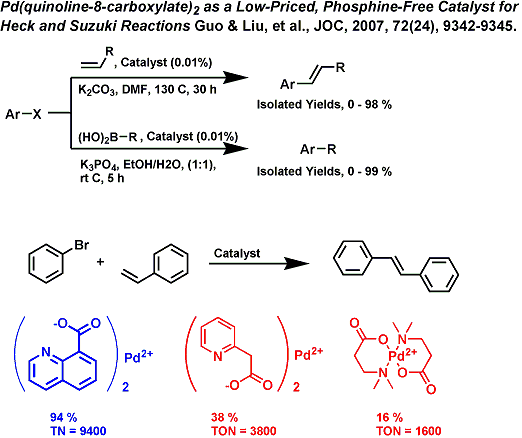
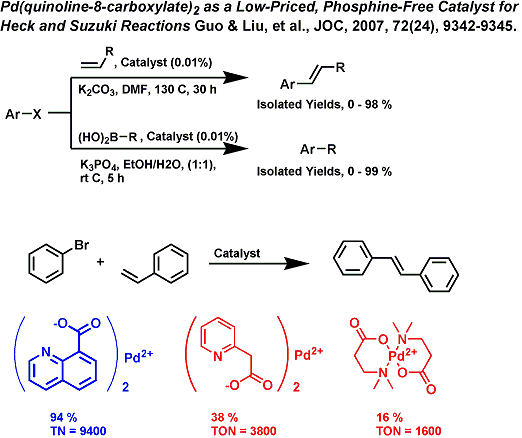
A recent JOC article disclosing an inexpensive catalyst system that struck me as interesting.  The article by Guo and Liu emphasizes economy and so discloses a phosphorus-free bidentate ligand system that affords Heck and Suzuki-type coupled products.  There are pluses and minuses to this system, as is the case for most catalysts.

On the plus side with the Heck and Suzuki reactions, both activated and deactivated aryls gave decent yields. On the minus side, the Heck coupling reaction is a bit slow. A fair amount of energy input was needed- 130 C in DMF over 30 hours. On the Suzuki side, most reported reactions resulted in good yields, except for the aryl chlorides. The relative inertness of chlorides is not particularly unusual, but it may cause this catalyst to be passed over in some applications where the less atom-efficient bromides and iodides have been targeted for replacement.

Finally, the apparent requirement of DMF is rarely happy news. Regardless, I have no doubt that this catalyst will find its way into the future literature and many clever applications will be revealed.  As of this writing, I was unable to find a US patent by inventors Guo and Liu claiming this technology. Since there is a 1 year limit on the filing of a patent application following disclosure, this technology could be in patent prosecution at present. Or not. Wouldn’t it be a happy thing for it to be in the public domain?

Economic Katrina

I’m reluctant to sound alarmed, but with the apparent shape of an impending economic Katrina moving over North America, it is getting harder to grant the benefit of the doubt. The dollar is sinking, exposing this import-heavy nation of ours to price increases in nearly every sector. The petroleum resources that energize global production and grease all economic skids is generating considerable doubt and turmoil in financial circles.

Oil production is flat in many key regions but the demand for consumer goods by the global middle class is expanding.  Our television-enchanted population, brains scrambled to numbness by chronic exposure to American Idol, are seeing only what the media powerbrokers want us to see. The eternal message that comes from TV is spend, spend, spend

The popular economic indicator is the stock market. The DJIA up- good. The DJIA down- bad. It is a sort of pallative. We’re lulled into a false comfort zone by the meta-stability of todays stockmarket.  Other dots are beginning to line up into a harmonic convergence, however.

Yesterday, as a humorous conversation starter, I asked a senior colleague well placed in the petroleum industry this question- “when will crude oil hit $150/bbl?”.  His reply surprised me. He estimated that it would happen this summer. Later, tempering his answer somewhat, he suggested that it would be more like $130/bbl, and mostly on the strength of nervousness in the market. He added that at present, crude oil stocks in the USA were in ample supply. 

The extended weakness in the dollar seems to favor American exporters and disfavors import consumers. Hmmm.  Does gov’t inaction on the weakness of the dollar amount to bias for corporate constituents and neglect of unincorporated citizens? Curious.

Advice- payoff as much debt as possible. Insulate your house. Get rid of that gas guzzler. Accumulate greater savings. A lot of the soon-to-be-unemployed are going to face higher higher gasoline prices for their commute to the new job at the auto salvage yard. And when they get back to their trailer at night, the thermostat will be set low due to higher heating costs. Beans and weenies, Mac-n-Cheese. Bon apetite!

Polyolefin Migration

The worlds burgeoning middle class has a voracious appetite for polymers and this has compelled other regions of the world to execute a refining and manufacturing buildup that will cause an upcoming oversupply situation. In particular, Middle Eastern and Asian PE and PP capacity will take a sharp upturn, shifting supply patterns and causing margins to fall. Demand for North American (NAm) polyolefin (PO) products will enter what is projected to be a permanent decline as capacity and market share shifts to other longitudes.

Fortunately for US interests, many PO producers have anticipated this and have diversified through significant structural changes increasing access to the far regions of the world. This fact alone should buffer the upcoming downturn in the industry. Projections I have seen suggest that the NAm PO market should be back up to present levels by 2012 as the new capacity operates as price taker rather than a price maker. Eventually for NAm and the EU, finished goods imports will overtake market growth and a period of decline will ensue.

The new world I am describing is projected to happen in 2009. We are about to feel the gravitational pull of the “New Gulf”. The Old Gulf- Gulf of Mexico- will take a back seat to the Gulf in the Middle East.

One weakness of the New Gulf seems to be ethylene. US capacity for the extraction of ethane from natural gas and its conversion to ethylene is an advantage that will buoy NAm PE business for a while. But once Middle East and Asian operators learn to run their plants efficiently, NAm facilities will face the somber truth of the marketplace. NAm will become a net importer of PO’s. 

Asian demand for PO’s is growing so rapidly that it may never become a net exporter of PP and PE.

One factor that I do not understand yet is the effect on petroleum supplies and the cost pressures therein. Increased capacity giving lower prices could increase petroleum and gas scarcity resulting in increased prices of petro-energy.

Changing Petrochemical Center of Mass

The Middle East (ME) is currently undergoing a dramatic change in petrochemical supply and refining capacity. Multiple projects in several countries are underway that will offer greater capacity of key hydrocarbon feedstocks as well as fuels. 

The current run up in crude oil prices has produced an abundance of cash for oil producing states in the ME.  Acutely aware of the transient nature of their oil reserves, the cash generated has been applied to infrastructure. Social infrastructure as well as industrial infrastructure has been expanded in the ME with facility no doubt eased by the nationalized nature of the petroleum companies. 

In the USA, a run up in crude oil prices has not resulted in a major uptick in refinery capacity, port expansion, or the birth of new universities. Instead, US oil companies have plowed investment into new discovery activity in an attempt to sustain the current rates of consumption. Profits are channeled into CEO salary packages and to shareholders, who, in turn, go to great lengths to shelter their funds from taxes that support US infrastructure.

Saudi crackers alone are expected to add 14m tonnes/year of extra ethylene capacity by 2015. ME market share of PE and PP is expected to double by 2011. So large will the demand for ethane be that there is considerable skepticism that the full potential of the buildup will be realized.

Since ethylene comes from the cracking of ethane, and presently a large share of ethane comes from natural gas, the question arises as to the effect on natural gas prices as ethane scarcity becomes apparent.  Naphtha crackers are part of the answer to the question of supply. The US has (had) abundant natural gas and a corresponding reliance on the extraction and cracking of ethane from this resource. Elsewhere in the world, a large fraction of ethylene comes from naphtha feedstocks.

And so it is that the Saudis are building crackers to bolster their feedstock supplies. The Dow/Siam Cement JV is also addressing their ethylene supply issue with a second naphtha cracker in Map Ta Phut (ICIS, 2007, December 3-16, p 6).

The largest petrochemical complex in the world is under construction at Ras Tanura in the eastern province of Saudi Arabia.  This US$20 Bn project is being developed jointly by Dow and Saudi Aramco and is expected to come onstream in 2012. The goal is to integrate the existing Ras Tanura and Yanbu refineries into a single operation offering petroleum refining and production of value added hydrocarbons like ethylene.  Clearly, the principals have downstream conversion in mind. The project will have the first naphtha cracker in the ME and will offer ethylene cracking and aromatics capacity as well.

According to the article in ICIS, Basell claims that the ME will be the only net PE and PP exporting region by 2011.  And so it was that the petroleum scare in the first decade of the 2000’s financed and expedited the migration of dominance in the polyolefin industry to the Middle East.

On Marketing Chemicals

If you are a marketing person in the chemical industry, the question of how-to and how-much is never far from your mind.  I’m not talking about selling pesticides or drain cleaner to consumers. I’m referring to B2B chemical sales.  Feedstocks, reagents, catalysts, additives, etc.

Management never likes to pay much for advertising and will always be skeptical of the value of ads. Yet, deep within that black heart most managers know that some advertising is necessary.

Sales to the public is demand that can be fairly easily measured. Sales in the public domain are open and lots of nifty and informative stats and trends can be compiled to help plot marketing strategy.

By contrast, sales of products that are not out in the open, or products that are part of a proprietary process leading to another kind of product are things that are somewhat problematic to understand.  Products that are uncommon or are unique to a few limited circumstances are not products that you necessarily want to promote in the mass media.

If a company makes a bracket that is used to hold a fuel flow sensor on a 1998 Buick, chances are that the product will be useless for just about every other application.  But many components on that same Buick are of a general nature and may be found on many kinds of cars.

In chemical marketing, many products are of a general nature and many are highly specific. The marketing approach for highly specialized products is necessarily more focused than that for chemicals of a more general utility. A specialized product requires that marketing people be like a Dachshund- these dogs were bred to go into burrow hole to pull out the critter that lives in there. Marketing specialty chemicals requires the same sort of proclivity.

Where do I find information about who uses what?  I search patents, SciFinder (to see who is publishing with what materials), Google, and I talk to people about what they are looking for. Purchasing people always have a list of troublesome products. Your company should have a decent customer list to draw upon.

Another approach is to do a patent search starting with a particular company AND a key word. While there is absolutely no assurance that the company is actually practicing the art that they patented, it is possible to collect a list of companies that have used your product at one time.

Finally, there is the Johnny Appleseed approach. You simple plant literature at every fertile site you can find, and you do it several times with multiple media. Brochures, emails, cold calls, websites, conferences, and technical literature.  “Technology Push” is hard work. Especially if the economy has taken a dive. It can take 3 months to 3 years for a potential customer to give you a call when they finally decide to make a query.

The marketing of obscure products is spotty business and hazardous to your wallet if you are on commission. The best circumstance is to have a portfolio of products, or a catalog. If your collection is good enough, something will always be in demand.

Droppin’ your pants for chemistry

In my career in the fabulous world of industrial chemistry, I have had to drop my pants exactly twice in the cause of business.  The first and best time was in Japan. We had just been to the science city of Tsukuba near Tokyo. After driving all day in Tokyo traffic and shuffling around at business meetings in comically small sandals, we finally ended up at what I thought was a restaurant. Glad to get out of the car, I followed my running host through the rain and into a stone building out in the countryside. But instead of walking into a dining area, we walked straight in to a locker room!

I was about to protest that I didn’t have a swim suit when it dawned on me that birthday suits were the standard dress wherever we were going. Hmmm. Lordy, I wonder if this is co-ed? Gaijin anatomy would be the featured attraction this evening.

We padded out, barefoot and naked, into a covered outdoor area and straight into the heated pool.  It was delightful. We soaked for 45 minutes and talked about business and life in Japan. All too soon, we got out, showered, dressed, and entered the dining area.

We took our positions on the cushions on the floor by the table and were treated to an incredible meal of exotic food and drink. It was highly civilized, relaxing, and memorable experience.

The next experience is the one time I had to go home without my pants. Some years ago I was making about a kg of some material in a 12 L flask. The reaction proceded normally and all was well until I tried to disassemble the apparatus in preparation for a filtration. The flask slipped from the clamp due to the considerable weight of the halide and dropped a few inches onto the benchtop. The flask broke, discharging the contents onto the hood benchtop.  I can’t say what was in the mixture, but I can say that the solvent and residual halogen were absolutely the least of my worries.

It didn’t take long for me to realize that this was beyond my ability to safely handle without a Hazmo suit and supplied air.  Somehow, in the course of this, I got a smudge of reaction mixture on my pants.  The safety manager looked at me and ordered me to remove the contaminated pants, which I did.

So there I was, standing in my boxer shorts- the ones with the orange and green watermelon print- while the safety manager was standing there shaking his head laughing. He threw a tyvek bunny suit at me and walked out.

We discontinued the reaction after that event. The hazards were just too edgy, even for me. 

On Running a Plant

Here is a collection of thoughts on running a chemical plant, listed in no particular order.

  • Always have some extra production capacity. Don’t be tempted to book every hour of plant time with processes.
  • It’s easier to get purchase orders than you think. Corollary: It is easier to overbook a plant than you think.
  • Hire the smartest, hardest working people you can afford. 
  • Never do R&D in the plant. Consider using laboratories for that.
  • You will eventually have an incident or an accident. Make sure the HAZWOPER people drill every now and then.
  • Beware the rag layer. It will confuse the operators.
  • Hot filter cakes can ruin your whole day.
  • Somebody sit and think about how failures might be expected to propagate during an incident.
  • Don’t be an asshole.
  • Watch out for reactions with initiation lag times. They’ll getcha.  Stored energy is scary.
  • Try to get the supplier to send dry, clean solvents. Purifying solvents is always a money losing operation.  The same is true for all starting materials.
  • To the greatest extent possible, try to move solutions around rather than solids. Solids handling is always more difficult.
  • Think about where that butyllithium solution is going to go if there is a spill.
  • Try to decide early on how you would like the next disaster to unfold. This is true for all hazardous operations- plant operations, highway driving, or marriage.

I’m sure there are many more good suggestions from Bloggerspace.

C6D6

Crap. I nearly had a heart attack the other day. Absentmindedly, I burned an NMR in CDCl3 instead of C6D6. The shifts were all cattywompus. The atropisomerism I was expecting from the amide was nearly non-existent in deuterochloroform and my aromatic peaks were all flibbertygibbet. Cripes! This was no good at all!

So, I went to a nearby diner and thought about it over a plate of hashbrowns with onions, jalapenos, and cheese. While gnawing on the breath-busting composition, the problem of solvents dawned on me like an ice cream headache. Doh!!

That Pesky Brazil Nut Effect

The Brazil Nut Effect is a type of equilibration process that granular systems with a distribution of particle sizes will undergo. It occurs with agitation and proceeds in such a manner as to result in a final state with the center of mass as low as possible. The equilibrated state results in the larger particles migrating towards the top and the smaller particles filling the void spaces down low. According to the above Wikipedia site, certain container shapes can suppress or enhance this effect.

In the merchant chemical business, suppliers strive to provide customers with the maximum quality that is feasible.  Some applications require high chemical purity and others require less purity. The trick is to pay for the purity that you need.  Excess purity is an unnecessary expense.

In many applications a chemical substance must be both chemically pure and of a certain specific physical form.  For applications where the solid must be blended to form a suspension, a slurry, or it must dissolve rapidly, a small particle size is often desirable. Particle size control and analysis is an art that many synthetic chemists can go through their entire careers and never encounter.

In the process of filtration, solids often compact along surfaces to afford flakes and angular chunks that may retain their shape until they reach the package. Lumps can arise from incomplete washing and drying and may be indicative of chemical inhomogeneity in the bulk material. 

Chemical products that are used in compounding for very exacting applications- catalysts, coatings, polymer compounding- may have specifications that require the absence of lumps in the bulk solid. Free flowing homogeneous powders can be prepared by milling or sieving or even spray drying. Compounds that are air, moisture, or light sensitive may not respond well to excessive handling. Before you accept business involving powdered products with bulk solid specs, you need to demonstrate that it is art that you can actually perform.

This is where a smart buyer is worth their weight in gold. Instead of having their own company take the burden of particle sizing, they make the vendor do it. And if the vendor fails, find another.

Where the Brazil Nut Effect seems to enter my life is when the product finally arrives at the customers facility.  If your nice powder had even a single hidden clump in it, you can bet that on arrival it has migrated to the surface to greet the frowning customer. I have received digital photographs of this from customers who wished to drive home the point. So, you just buck up and apologize as sweetly as you can manage and give them your FedEx number so they can send it back.

Send your Gluteal Scan to the FBI

It is hard to believe with all of the “good” news lately that the US gvernment is on our side. The Bush II Y2009 budget proposal comes in at a stunning $3.1 Trillion against an estimated $2.5 Trillion in receipts.

The FBI wants to collect biometric data on US citizens. It wasn’t clear to me as to whether they want to collect this data as law abiding citizens go about their business at airports with iris scans and electronic fingerprints, or if they will limit the effort to people taken into custody.  In any case, the notion of our government collecting ever more data on its citizens should bring chills to everyone.  It is all about control. Once taken, never returned.

I, for one, would be only too happy to fax a photocopy of my biometric gluteal cleft to the FBI to post wherever it suits them. It shines like a mackerel in the moonlight. In fact, there is a protest movement I could get on board with- The Million Man Moon on Washington.

The Customs and Border Patrol agency has proposed the new “10 + 2” rule which should be a real delite to deal with. We’re already scrambling to figure out what the hell this means for the purchasing people.  Lots of detailed info will have to be timed properly to keep things moving through customs.  It’s going to be a big mess and the only benefit will be that the government will collect more duties.