Category Archives: Chemical Industry

Propinquity

Process development and scale-up isn’t one of those things a young, freshly minted synthesis chemist generally aims for.  I recall the heady days in grad school when we thought “drug design” was the ultimate gig for a synthetic organic chemist.  Landing a slot in a first tier pharmaceutical discovery group was like landing a spot on the cast of a Broadway play.  And, in fact it is like that.  I have many friends and fellow students who have found fantastic careers doing just such a thing.

In the late 80’s and early 90’s, asymmetric synthesis was hitting its stride and anyone who could make heterocycles with chiral shrubbery attached somewhere was golden. Even better, if you had studied “Enzymatic Reaction Mechanisms” by Christopher Walsh and you could name all of the amino acids, you definitely had a future.  Most of us were lucky to be able to pronounce propinquity after consuming four pounds of Killians after a long day of research.

This time period that I refer to is before the introduction of high throughput experimentation (HTE), or CombiChem.  It was a kind of gilded age where reductionists prevailed.  If only we had enough data on the geometry of the active site, we could design a suicide substrate inhibitor to shut the enzyme down. We had CAChe(R) and SAR to help with the design of pharmacophores- it was a heady time.

It was an age when giants walked the laboratories- Corey, Evans, Nakanishi, Seebach, OppolzerMeyers, etc.  Some of these fellows still do.  But things would fundamentally change when a new experimental methodology rolled into town. The age of automation had arrived.

HTE would spawn new ways of thinking in discovery.  To methyl, ethyl, butyl, … futyl would be attached an exponent.  It would become possible to do and analyze a thousand reactions in a day.  Pharma companies invested heavily in this technology and, I understand, some of it is actually paying off.

But while the elite discovery krewes were spending down these giant R&D budgets that exceeded the GNP of a third world nation, a different group was quietly laboring with that most favored transformation of all.  Actually turning chemicals into money.  The most prized alchemy.

The activity to which I refer is, of course, process development and scale-up.  This field requires a slightly different mind-set.  It is not the domain of the show-horse. It is the world of the plow horse. And, by the prinicple of propinquity, I have developed a taste for it. 

More to follow.

On the Road

I often think back to my college days and wonder what coursework I might have taken that would have been beneficial for a more lucrative mid-career.  I am presently over the great plains in the suborbital arc of my career- somewhere between Memphis and Kansas City, westbound to that Golden State on the horizon.  At some point in a chemists career he must mix metaphors and make a choice at the great fork in the road.  To remain in the lab or to move on to the crystal city on the hill:  Sales & marketing.  I chose sales and marketing, well, because I had to.   

Chemical sales is a odd field. One is neither a full member of the R&D tribe or the business tribe.  You become a chimera- a half man, half beast of burden that lopes through the B2B high plains sniffing for the stray morsel or rotting carcass.  In principle you are a member of an elite strike force, one in possession of the sacred knowledge of molecule marketing. On business trips you can mingle in the company of professors or supply-chain managers with equal ease. Your tongue can bend words with both the old ones- the blessed faculty- and those keepers of the elusive coin. 

But in your sterile cubicle, you are just another salesman.  Many companies have computer software that can be rigged to specifically to watch your every keystroke, even how frequently you move the mouse. This malevolent utility will time your calls, refuse to budge unless you set a deadline for a task, and collate every infraction from your self-imposed calendar into a tidy report for review by the taskmaster. Back in the dreamtime, you crafted covalent bonds and imbued molecules with chirality.  Today you fuss about “making the numbers”. 

As a sales man you take short courses on telemarketing and you learn how to deftly worm your way into the calendars of decision makers.  You develop a script for making the dreaded cold-call.  Your daytimer brims over with business cards. Early on you learn how to get past cold hearted administrative assistants who screen your calls and stonewall your well honed charms. 

You have become a road warrier, conversant in the codespeak of frequent flyer miles, airport hotels, and rental car companies. You learn to navigate in strange cities and how to find your way through the squirrel warren industrial parks. Your heart hardens in some ways and softens in others.  Welcome to the fabulous life of the sales man.

Alas, poor ether, I knew it well …

I’m sorry to witness the slow demise of diethyl ether.  A wonderful solvent it is.  Or perhaps the past tense is more in order.  Righteous organizations are fleeing from this magnificent ethereal fluid.  It will dissolve a Grignard reagent, mighty LAH, or bovine lipids from hamburger.  It’s low melting point and low boiling point has helped to solve ten thousand problems.  Yet despite its advantages, ethers dark side is its undoing.

Ethers “spirited” volatility, that very property that allows for its facile removal, is largely to blame for its doom.  It’s celebrated aptitude for finding ignition sources far from its point of origin has sealed its fate.  Ethers broad explosability window, its distant lower and upper explosion limits, will cause strong men to tremble openly at its supersonic possibilities.  Space explosion, they’ll say in hushed voice.  Poor-mans nuke.  And in the hands of the clumsy, the uncaring, or the plain unlucky, they’re probably right. 

So if you need an extra tanker of ether soon, you may not get it.  It may be on allocation. Serious executives in corner offices with furrowed foreheads and great fuzzy caterpillar eyebrows will anxiously lean forward to explain that it’s really not their fault.  They’ll plead that market demand has shifted its attention to other commodity solvents and that they feel the radiant heat of potential liability for all of the ether product that is out there in plants and on the road. Yes, on the road.  Yet one more reason not to swerve in front of an 18-wheeler.

So, young turks of R&D, consider the multitude of splendid possibilities before you and be not attached to the ether diethyl. For it has gone the way of the buggy whip and cathode ray tube. And above all, take heed the advice of the blessed sage of Stanford, the Cardinal d’efficacité d’atome, Professor Trost and his divine doctrine of atom efficiency.  Verily, he hath cast his pearls before the swine. Blessed is he who substitutes nickel for platinum and chloride for iodide.  And blessed is he who raiseth his space yields, for his pot shall not runneth over.  And exalted is he who spares his rupture disc, for many shall be his days before the Pfaudler.

2-Methyltetrahydrofuran Idea Clearinghouse

I would like to invite readers to share their non-proprietary experiences with the solvent 2-methyltetrahydrofuran, 2-MeTHF.  This is an ethereal solvent that has been around for a while.  While my personal experience with it is admittedly scarce, I have been eyeing this solvent for product use and process chemistry for some time. The manufacturer is concerned that they have a great solvent that will solve some problems for the folks out there, but are a bit flummoxed as to how to spread the word.

Most all synthesis folks will agree that tetrahydrofuran (THF) is a very useful solvent and, no doubt, have their favorite applications for it. I for instance prefer THF in LAH reductions.  THF is a polar, non-protic solvent that offers great solvating capability and a not unreasonable boiling point.  Sterically, THF seems to have a solvating aptitude that is different from diethyl ether. This is seen in the case of Grignard reagents, just to name one example. 

But despite all of the advantages THF offers as a solvent, a non-trivial downside is its water miscibility.  The aqueous workup and extraction of a THF reaction mixture can be complicated by the difficulty in getting a phase separation.  Various tricks can be performed, such as salting out the water layer, adding an aliphatic solvent, or solvent exchange. But these things amount to a workaround to compensate for this unfortunate attribute of THF.

These workaround techniques are not so bad on the benchtop, but at plant scale, they amount to complications that add cost to the process.  Extra expenses in terms of raw mat costs, storage & handling, and waste disposal costs.  A solvent that behaved like THF but allowed for easier workup will definitely help keep the costs of processing down.

MeTHF seems to have some aptitude for solving the THF-water miscibility issue.  But, what do you think?  Have you tried it?  Need to find a supplier? Do you have an anecdote you can share?   Let’s hear what is going on out in the world.

Pissin’ and a moanin’, part deux

So, I get an email from some cheerleading functionary from SOCMA, Synthetic Organic Chemical Manufacturers Association.  In it, the sending party gushes that they are endorsing a program to assist public school chemistry teachers in cleaning out their collection of “dangerous chemicals” from school stockrooms.  I promptly replied that I thought it was a terrible idea.  There has been no reply.

Well, I said a bit more than “I think it’s a terrible idea”. 

But how could a rational person conclude it’s a terrible idea? Here it is.  If I thought that the proposed clean-out orgy was limited to ancient bottles of peroxidized ether, great steaming heaps of calomel, or dried out picric acid leftovers, the I agree, let’s get rid of it.  But I know safety people.  Safety people do not like chemicals. They would prefer that we limit our chemical handling to baking soda and vinegar, and even at that, we need full protective garb.

Safety people will clear any stockroom of all of the interesting and useful chemicals from the shelves if given the chance.  Safety people will dress up in bunny suits with respirators and tape off the area in order to do this clean out. I can just see it.  The chemistry lab barracaded with red cones and yellow tape behind which the “hazardous material team” carefully packing jars of copper sulfate and ferric chloride into blue plastic drums filled with vermiculite. The school principal, a former kinesiology major with an administrators certificate, just stands there shaking his head at the prospect of what horrific things could have happened. Another school saved from certain tragedy.

As I’ve said before, reactive chemicals are useful chemicals. If we banish reactive chemicals from our stockrooms, we’re left with petrolatum and NaCl.  It is all part of a tragic dumbing down in the name of safety.  Just because safety staff feel insecure about chemicals, do the rest of us need to have our hands tied? Handling a chemical is like handling a knife. A knifes very utility is manifested in its sharpness. Yeah, you can get cut. But we recognize that the usefulness outweighs the risk.

We should all be skeptical of this trend to replace authentic experiences with virtual experiences.  All students should witness how tiny bits of sodium or potassium react with water. Limiting such real experiences to video experiences is wrong. Students should get to see and do the real thing.

The 80/20 Rule

Having done my tour of duty in chemical sales and having travelled over a good bit of the northern hemisphere buying & selling, I’ve picked up a few insights into the B2B and “retail” chemical business.   Everyone has the major chemical catalogs on their desk. You know, the thick tomes from Aldrich, Spectrum, TCI, Matrix, Strem, GFS, Gelest, Fisher, etc.  There is considerable overlap in content, though some specialize in their chosen niches. While Aldrich makes no bones about total world domination, others are pleased just to dominate certain cul de sacs of chemistry. 

SAF is clearly the colossus of international catalog companies.  The Aldrich wing was started by Alfred Bader, now a retired art collector. To hear him tell it, Bader was frustrated by the limited availability of reagent chemicals and spotty service (by Eastman Chemical, if I am not mistaken).   Anyway, Bader was the right character at the right time.  He had a single-minded drive to give chemists what they needed and make a few bucks doing so. The slogan “Chemists Helping Chemists” was a the result of a sincere calling.  Bader visited university chemistry departments and asked professors what they needed.  Over time the Aldrich catalog collection grew and so did the company. Eventually, Bader was quietly forced out of the organization.  Founders can become “problematic” evidently.

Today SAF offers a vast collection of products and makes a sizeable fraction of what they offer.  Most professors don’t know it, but interesting materials from the lab might be saleable to a catalog company. If a prof has developed a new reagent or some useful fragment or pharmacophore, for instance, it might be worth contacting a catalog company to see if they want to stock it. You never know until you ask.

But we business types know that dealing with professors can be sticky, so Herr Doktor Professor, don’t get too high handed or greedy!  Academics are often missing the merchant gene and as a result badly price their wares.  The typical mistake is to over-estimate the demand and hike the price up to the astronomical numbers that you see in the catalogs. 

Here are the problems. Catalog companies do not pay the prices that you see in the catalogs. Buying material for inventory is equivalent to putting a stack of money on the shelf.  They have to pay lots of money up front before the first purchase order for your wonder product is faxed in. They have to pay for those damned fat catalogs, the inventory, salaries, the facility, regulatory compliance, certification, labeling, packaging, the time value of money, taxes, and they have to make a profit for the shareholders. So if the catalog price of something is $10 per gram, figure that they’re likely to keep their costs to $2 to $3 per gram for it, tops.  Obviously, this is subject to variation due the type of material or special negotiated deals.  But a 3x to 5x markup is not uncommon and is necessary to stay in business.

Then, after you ship the product to the catalog house and they put it into the collection, it might not sell.  It could be a dog.  The rule of thumb is that 20 % of your inventory will do 80 % of the business.  So, one of the ways to grow is to increase the number of products. Their interest in your product may be of a statistical nature rather than a firm belief in it’s viability.

I’ve heard many people go off about high catalog prices. I don’t like to pay the high prices either. But it is the cost of convenience.  If you need some obscure material, chances are that you can order it and have it in a few days. That is worth something and the catalog companies know it.  Hell, I’d do the same thing.

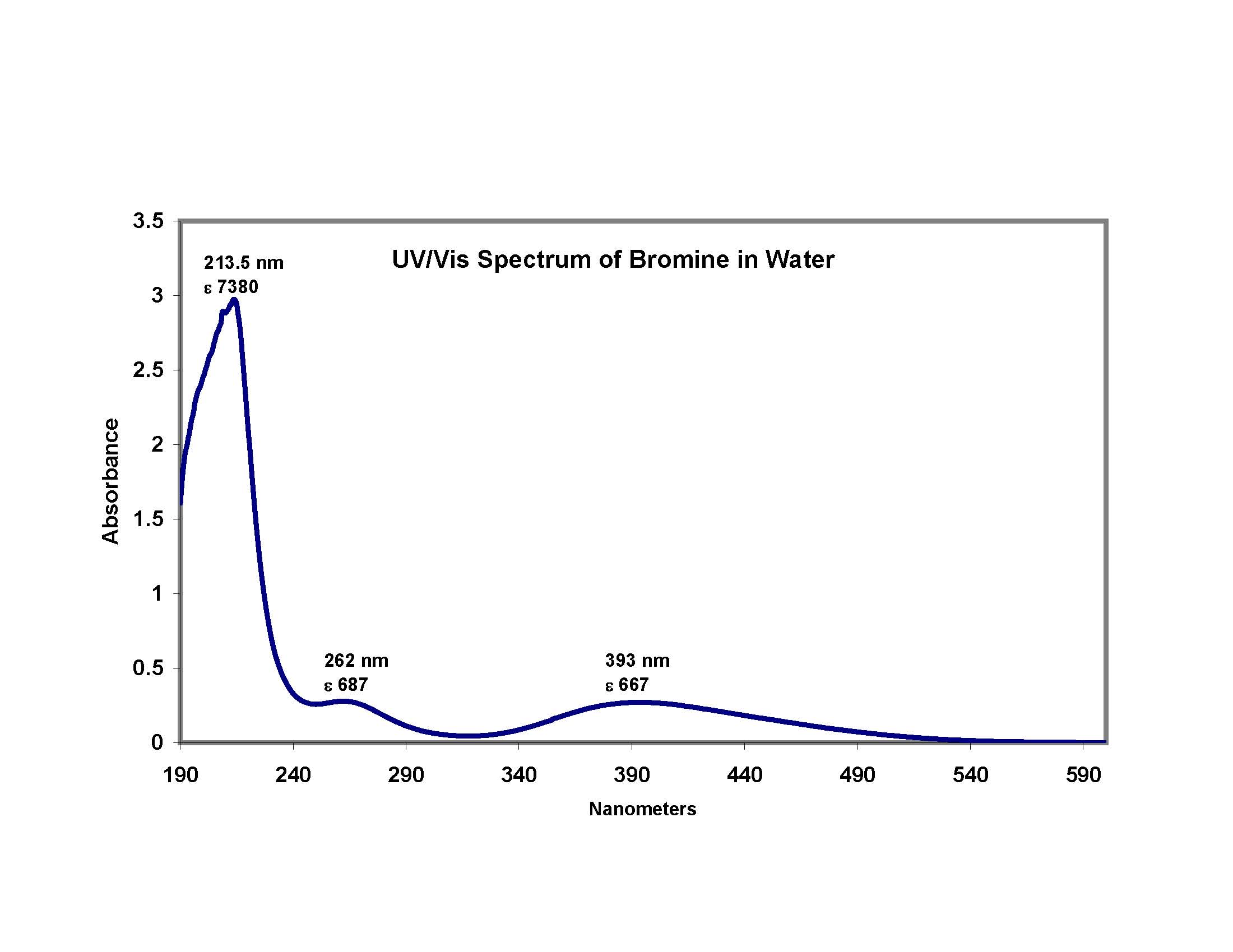
UV/Vis Spectrum of Bromine in Water

We have a Cecil CE 2041 UV/Vis spectrometer.  Data is collected by the DataStream CE2000 software package. The instrument has 4 nm of resolution, not the best, but still quite usable. To quote the famous British philosopher- “You can’t always get what you want!” (M. Jagger).

This posting is an experiment on how to upload data to the web. The graphic below is a jpeg conversion of a pdf conversion of an Excel chart. Seems like an awkward way to do this. Undoubtedly someone out there can offer a suggestion of how to upload an Excel graphic to the blogosphere.

 uv-vis-of-br2-in-water-rev-2.jpg

It looks like prior to an upload the graphic has to be beefed up a bit.   I’m gonna have to monkey with it some more. Maybe someone has a suggestion.

Fabulous 2-Methyltetrahydrofuran

Some predict a bright future for 2-methyltetrahydrofuran.  At least one company is patenting MeTHF products.  For process chemists, MeTHF offers at least one advantage over THF, i.e., MeTHF is immiscible with water.  Well, mostly.  Your water phase is going to have some MeTHF in it and some water in the MeTHF phase.  You don’t have to salt up your water to get a phase boundary or worse, do a solvent exchange for an extraction. An aqueous quench of a MeTHF reaction mixture should phase separate with the aqueous wash and allow aqueous extraction. This is certainly convenient for the chemist, but at a price. 

Last time I looked, MeTHF is about twice as expensive as THF. For small scale bench work, the cost differential isn’t too onerous. If you’re talking about filling a 5,000 liter reactor with it, the costs do add up.  So, a defensible process improvement/change would have to yield at least the differential solvent cost and probably another 10-25 % to justify the cost of process validation and change management. 

Some process changes will require customer approval and product validation on their side.  Then, they’ll want a price concession for all of the trouble you put them through. So a switch to MeTHF over, say, THF will have to yield some bottom-line value to the manufacturer and the customer. It is always better to fold in your innovations before you submit your process to the plant people.  

The other issue with MeTHF has to do with it’s chirality.  For instance, MeTHF-metal complexes will be solvated by either or both enantiomers. The presence of diastereomeric complexes will only complicate in-process NMR checks of such processes.  Though certainly not a show-stopper, it is a complication that the analytical crew will have to contend with.

Scathing Diatribe on RTIL’s

The 2006 ACS meeting in SF was interesting. In a much earlier post I lamented the recent trend of boring ORGN section meetings. That was definitely not the case this time around.  Of course, there was the usual assortment of faculty rockstars with their fawning groupies (OK, I’ve done that too). A lot of interesting insights into obscure stuff.  But I have to say that there was more buzz in the air in the ORGN talks.  My favorite profspiels included Toste, Doyle, Knochel, and Trost.

This time I noted a distinct lack of talks on room temperature ionic liquids (RTIL’s). After far too much breathless ballyhoo, the worker bees in this “area” seem to have hunkered down a bit.  Do I sound cynical? I have actually developed a manufacturing process for a commercial RTIL species. I can say that the economics of RTIL manufacture and certain kinds of applications of these expensive solvents can be awful.  At least awful in direct comparison to solvents like THF, toluene, ether, etc. If you’re using an RTIL, say, in a two-phase catalytic extraction process, then the comparison is faulty and the RTIL may be quite efficient to use.  However, if you need batch reactor volumes, i.e., 50 to 1000 gallons, then the batch process costs may require scientific notation.

Even pharma companies with deep pockets extending to the MOHO layer will worry about these economics.  In order to justify an $50-$250/kg solvent (!!), there has to be some whiz-bang process improvent to justify such costs.  In batch processing, RTIL’s are prone to the concentration of ionic species or water from the previous run. The practical consequence of this is that the RTIL may be a different material from one run to the next. It may or may not be an issue. But you’ll have to investigate and qualify it. You may have to polish the solvent (!!!) after each run to qualify the subsequent use of the RTIL. How green can that be?  

I cannot speak from the perspective of a pharma industry chemist. But I can speak as someone who makes specialty products for the pharma business. From bitter experience I can testify that the last thing you want to be is the supplier of the most expensive reagent in the customers process.  It is like a rock in their shoe. They’ll squirm and fitch around until they find a cheaper supplier or engineer a way around the offending reagent. Hell, I’d do the same thing in a heartbeat. Nothing wrong with that. But it is this sort of raw cost pressure that makes the commercial viability of RTIL’s difficult. 

The disposal of bulk RTIL’s may be expensive too.  Since as a group they are resistant to incineration, the natural question is- How do we safely and ethically dispose of bulk RTIL’s?  I’m sure that someone out there in the blogosphere has a comment on this.

<END RANT>
 

Risk, Terror and H.R. 5695

Reactive materials are often hazardous. But, reactive materials are useful. They do things. They “react”.  The very reactivity that might mark a compound as hazardous also gives it utility in industry. The chemical industry is to a large extent in the business of doing reactions. The central theme in chemical technology is obtaining the right kind of reactivity and then harnessing it to do a transformation.

So, when a piece of legislation like H.R. 5695 comes along that proposes to examine reactive materials and allow the Secretary of Homeland Security to define some or all of them as “substances of concern”, I become suspicious and concerned myself.

For the sake of readers who have no direct involvement in the chemical processing industry, allow me to just come out and say it- Safety is a big deal in the chemical processing world. Chemical plants spend large sums of money and time trying to minimize the occurrence and consequences of incidents and accidents. This attention is mandated by numerous government agencies, insurance carriers, company policies, and common sense. A chemical plant is a complex place that can have many layers of hazards- ice covered sidewalks, forklift activity, hazardous material releases, chemical exposure, fires, and explosions. The kinds of hazards present depend on the plant processes and the kinds of materials on site. 

The nature of chemical plant operation is usually a mystery to people outside of the industry. It is often complex, confidential, and of a highly specialized nature. Surrounding communities tend to tolerate chemical industry as long as things go smoothly. But when things go wrong, the publics perceived value of the industry comes into serious scrutiny. That’s fine. Any business should have to justify it’s existence when it risks exposure to workers and the community of unique hazards. But it is not inaccurate to say that the public is substantially lacking in knowledge when it comes to the chemical industry and it’s substantial part in our modern world.  Rightly or wrongly, a chemical plant accident can induce a special kind of fear in the public. This kind of fear elicited by members of the public can be called “dread fear”.

Dread fear is a kind of visceral response that is brought on by the prospect of consequences that appear horrible, irreversible, or incomprehensible. Dread consequences cannot be controlled, avoided, or even detected immediately. They include cancer, death, mutations, loss of home & property, etc. Chemical or nuclear accidents are often cited as dread circumstances that can affect large areas and are of such a nature that they render most people helpless in their response. Not only is it hard to understand and respond to a dread circumstance, but the state is likely to intervene and impose restrictions on civil liberties.

It is in the nature of terrorism that it is inexpensive and possessing of a disproportionate leverage. The shoe bomber in his clumsy attempt to set off an explosive in a passenger jet, spread dread fear primarily among security agencies and secondarily, I would judge, among the flying public. The result was a response that is arguably disproportionate to the event. It has been described by some as “security theatre”. Bruce Schneier has written an excellent and cogent essay on this theme. I’ll leave it to the reader to follow this thread.

I am leading to a point. The assembly of a proportionate response to a risk is a difficult thing to do because uncertain threat and risk are hard to quantify. When faced with a question of a risk to safety, some will take the approach that a full defensive response is the only choice. Others may want more data. Still others will be more laconic about it, preferring to deal with it when it happens.  Clearly, a wise decision maker must take security risks seriously, but at the same time understand that some risk is inherent to living.  

At any given moment we are aware of only a few of the risks that we are under from the totality of our activities in life. If we focused on all of these risks- driving, cancer, accident, disease, contagion, etc- we might freeze in our tracks. Some individuals are risk averse and others are not. To add to the complexity surrounding risk assessment, many decision makers may chose actions that minimize the threat to their careers. These kinds of choices in risk management always tend towards low risk taking.

All of this prelude takes me to H.R. 5695.  A decent summary of commentary by house committee members has been reported.  H.R. 5695 is sponsored by Rep Daniel E. Lungren (R-CA) and cosponsored by 10 others.

It must have been because of dread fear that Rep. Lungren and others conceived of H.R. 5695. This bill contains numerous zingers that are worthy of concern to industry. Beyond the obvious thick overlay of regulation and generous discretion bestowed upon the Secretary of Homeland Security are a few gems that are worthy of highlight. Consider 1802 (a)(1)(A) 

`(a) Substances of Concern-

 `(1) DESIGNATION BY THE SECRETARY- The Secretary may–

`(A) designate any chemical substance as a substance of concern;

Think of all of the abuse potential here.  Under the guise of homeland security, any substance could be designated as a substance of concern and submitted to regulation under the whim of whatever political wind is blowing at the time.

`(B) exempt any chemical substance from being designated as a substance of concern;

`(C) establish and revise, for purposes of making determinations under subsection (b), the threshold quantity for a chemical substance; or

`(D) require the submission of information with respect to the quantities of substances of concern that are used, stored, manufactured, processed, or distributed by any chemical facility.

`(2) MATTERS FOR CONSIDERATION-

`(A) IN GENERAL- In designating or exempting a chemical substance or establishing or adjusting the threshold quantity for a chemical substance under paragraph (1), the Secretary shall consider the potential extent of death, injury, or serious adverse effects to human health, the environment, critical infrastructure, national security, the national economy, or public welfare that would result from a terrorist release of the chemical substance.

`(B) ADOPTION OF CERTAIN THRESHOLD QUANTITIES- The Secretary may adopt the threshold quantity established under paragraph (5) of subsection (r) of section 112 of the Clean Air Act (42 U.S.C. 7412(r)(5)) for any substance of concern that is also listed under paragraph (3) of that subsection.

Imagine the effect of the uninformed designation of a useful but hazardous reagent. Pick one- say XXXXyl chloride. Yes, this material is noxious and could be used for mischief, but it’s very reactivity is the heart of it’s utility. What if a single person writes the Secretary and states, in a fit of paranoia, that it would be possible for a terrorist to get hold of this material from a catalog company and use it to poison people on a train. This reporting to the Secretary is provided for in the code.  Well, yes, it could happen. If past history is any indicator, it is unlikely to happen.

An individual could be walking down the street somewhere and be knifed, shot, or otherwise attacked. This does happen, but realistically it is infrequent almost everywhere. The same victim could be attacked by an assailant brandishing a bottle of reagent acid or caustic, or any of a hundred obscure corrosive substances.  This is even less likely to happen for several reasons. Most people are not aware of such materials, and even if they were aware of them, access is already difficult. Those few who do know of the hazards are no more likely to assault someone than the general population, so those with the means for a chemical attack are a small fraction of a small fraction of the population.

Any given useful reagent could become a ‘substance of concern’ by simple declaration. Suddenly, the sourcing, inventory, and use of such a material will be complicated by this law. Reporting requirements and layers of security will be associated with it’s very presence. More likely, the restrictions on reagent chemicals and specialty non-bulk materials will be more severe on the supply side rather than on the user side, though there is no mention of this in the bill.

The persons writing the bill (security consultants??) probably had large installations in mind. Refineries, fine chemical plants, polymer installations, etc.  Since terrorists do what they do for psychological effect, an attack on a large installation resulting in great tongues of orange flames licking the sky and cubic miles of black smoke is more likely to occur than most other scenarios. The bill provides for “red team” exercises for the high risk tier under 1803 (b)(4)-

`(4) RED TEAM EXERCISES- The Secretary shall conduct red team exercises at facilities selected by the Secretary that have been assigned to the high-risk tier under section 1802(c)(4). The exercises shall be conducted after informing the owner or operator of the facility selected and shall be designed to identify at each selected facility–

`(A) any vulnerabilities of the facility;

`(B) possible modes by which the facility could be attacked; and

`(C) any weaknesses in the security plan of the facility.

Imagine operating a chemical complex and in addition to just keeping all of the processes on line and getting products out the door, you now have to contrive war games with the Department of Homeland Security. Will companies be required to keep a standing security squad to satisfy DHS? Remember the old James Bond flick where Dr. No had an army of security goons to protect the hideout under the island volcano? C’mon.

Turning the USA into a security state is not the answer. Reasonable upgrades in perimeter security and fencing will go a long way toward making it harder to commit an act of terrorism on a plant by an outsider. Attaching complicated security restraints on individual materials will only serve to drag business down and hasten the current trent toward de-industrialization of US chemical production.