Category Archives: Chemistry Blogs

I’ve Been Scraped!

Last week, this blog saw an unusual spike in traffic—roughly 350 visits higher than normal. Each visit appeared to be for a single post, with no clear theme among them. My best guess? An AI platform was scraping my content for something specific.

Suddenly, I feel a renewed sense of accountability for what I’ve written. What if—gasp—a sentence was inaccurate, or a sarcastic remark too obscure for most readers? The responsibility could be enormous! Think of the children!

The content choices lie somewhere between the bookends of accurate and complete fabrication. I’d rather be accused of being boring than being found in an untruth.

How does this mesh with my anonymity? Well, a handful of people know my identity and their respect is important to me. Eventually I will reveal my identity and suddenly the truth and accuracy (and spelling) of my 1700 posts will be forever connected to my real name. Skin in the game.

Disclosure-

Very occasionally I will write some fictional content, and it should be apparent as fiction from both the content itself, and the key words attached to the post. The example would be my posts on the fictional Poltroon University in Guapo, Arizona. I do enjoy the occasional jab at the culture of higher education and the institution of science.

However, as a scientist in matters of physical reality, I am dedicated and eager to describe content as truthfully, accurately and mellifluously as possible. When I’m on one of my political jags, I’ll admit to some amount of enhanced emphasis where others have tread more carefully with the source material.

The reason I write and blog is to help me think ideas through. Somehow the act of scribbling down sentences followed by multiple passes in editing is helpful. At any given time I have 20 to 30 unfinished posts languishing in draft space. The open-air aspect of blogging is to assure that I have done my best lest public humiliation, scorn and derision should come my way. Not just in the present, but more so in the future. Writing is thinking. To put it bluntly, there is a fear of publishing something I would regret forever. Absolutely the worst thing I could do as a blogger and as a scientist would be to post indefensible or phony science. Posts with linked references are direct connections to what I view as credible content on the internet. The reader only has to click a link to verify a factual statement thing I made.

Academia and Industry, Industry and Academia. It’ll never work.

Today I have a slightly different demographic of readers of this blog than in the past, so I’ve been dredging up old posts into the light of day. This is a renamed post from September 3, 2011. I’ve changed some wording to be a bit more mellifluous if that’s even possible.

==========

I’ve had this notion (a conceit, really) that as someone from both academia and industry, I should reach out to my colleagues in academia in order to bring some awareness of how chemistry is conducted off-campus.  After many, many conversations, an accumulating pile of work in local ACS section activities, and visits to schools, what I’ve found is not what I expected. I expected a bit more academic curiosity about how large-scale chemical manufacturing and commerce works and perhaps what life is like at a chemical plant. I’d guessed that my academic associates might be intrigued by the marvels of the global chemical manufacturing complex and product process development. Many academics would rather not get all grubby with filthy lucre. Not surprisingly, though, they already have enough to stay on top of.

What I’ve found is more along the lines of polite disinterest. I’ve sensed this all along, but I’d been trying to sustain the hope that if only I could use the right words, I might elicit some interest in how manufacturing works- that I could strike some kind of spark.  But what I’ve found is just how insular the magisterium of academia really is. The walls of the fortress are very thick. I’m on a reductionist jsg right now so I’ll declare that chemistry curricula is firmly in place on the three pillars of chemistry- theory, synthesis, and analysis. In truth, textbooks often set the structure of courses.  A four-year ACS certified chemistry curriculum spares only a tiny bit of room for applied science. I certainly cannot begrudge departments for structuring around that format. Professors who can include much outside the usual range of academic chemistry seem scarce.

It could easily be argued that the other magisteria of industry and government are the same way.  Well, except for one niggling detail. Academia supplies educated people to the other great domains comprising society.  We seem to be left with the standard academic image of what a chemical scientist should look like going deeply into the next 50 years. Professors are scholars and they produce what they best understand- more scholars in their own image.  This is only natural. I’ve done a bit of it myself.

Here is my sweeping claim (imagine waving hands overhead)- on a number’s basis, chemists apparently aren’t that aware of industrial chemical synthesis as they come out of a BA/BS program. That is my conclusion based on interviewing many fresh chemistry graduates. I’ve interviewed BA/BS chemists who have had undergraduate research experience in nanomaterials and atomic force microscopy but could not draw a reaction scheme for the Fisher esterification to form ethyl acetate, much less identify the peaks on 1HNMR.  As a former organic assistant prof, I find it sobering and a little unexpected.

A mechanistic understanding of carbon chemistry is one of the keepsakes of a year of sophomore organic chemistry. It is a window into the Ångstrom-scale machinations of nature. The good news is that the forgetful job candidate usually can be coached into remembering the chemistry. After a year of sophomore Orgo, most students are just glad the ordeal is over and they still may not be out of the running for medical school.

I think the apparent lack of interest in industry is because few have even the slightest idea of what is done in a chemical plant and how chemists are woven into operations.

To a large extent, the chemical industry is concerned with making stuff.  So perhaps it is only natural that most academic chemists (in my limited sample set) aren’t that keen on anything greater than a superficial view of the manufacturing world. I understand this and acknowledge reality. But it is a shame that institutional inertia is so large in magnitude in this. Chemical industry needs chemists of all sorts who are willing to help rebuild and sustain manufacturing in North America. We need startups with cutting edge technology, but we also need companies who are able to produce the fine chemical items of commerce. Have you tried to find a company willing and able to do bromination in the USA lately? A great deal of small molecule manufacture has moved offshore.

Offshoring of chemical manufacturing was not led by chemists. It was conceived of by spreadsheeting MBAs, C-suite engineers and boards of directors. It has been a cost saving measure that mathematically made sense on spreadsheets and PowerPoint slide decks. The capital costs of expansion of capacity could be borne by others in exchange for supply contracts. There is nothing mathematically wrong with this idea. Afterall, corporate officers have a fiduciary responsibility to their shareholders. Allowing profit opportunities to pass by is not the way to climb the corporate ladder.

We have become dependent on foreign suppliers in key areas who have control over our raw material supply. Part of control is having manufacturing capacity and closer access to basic feedstocks.

The gap between academia and industry is mainly cultural. But it is a big gap that may not be surmountable, and I’m not sure that the parties want to mix. But, I’ll keep trying.

Stereochemical Descriptors for Cyclophanes and Metallocenes

Assigning the stereochemical configuration of a cyclophane or a metallocene is a rare task out there for most chemists. Two classes of molecules, cyclophanes and metallocenes, have flat features that can be tough to assign priority numbers to.

I ran into an organic chemistry resource on LinkedIn that was worth zooming in on. It is a blog called MakingMolecules and it features graphics that give instruction and illustrate most aspects of sophomore organic chemistry. Having taught organic chemistry I know that nomenclature is a favorite topic among students (wink wink, nod nod), especially where stereochemical configurations are concerned. Ah …, if only the world had only chiral acyclic hydrocarbons to name. As we know, there is much, much more than that.

Finding a chiral carbon atom on most simple molecules isn’t that hard. Find a carbon atom with 4 different groups attached and then check for symmetry around it from every direction while you rotate the parts.

If it has rotational symmetry or a plane of symmetry including the atom of interest, then it may not be a chiral “center”. Molecules with a C2 symmetry axis but without a mirror plane can be chiral.

The more difficult molecules to characterize as chiral are those that have unusual rules necessary for an R or S configuration.

AI Scrapings

I have noticed that ChatGPT has been visiting this site more and more frequently. I can’t tell what posts they have been visiting. I do write the occasional humorous or lampoon style of post so I hope for the sake of mankind that ChatGPT can tell the difference.

We’ll see if my fictional Poltroon University gains wider recognition from AI.

A Second Edition Organic Chemistry Textbook

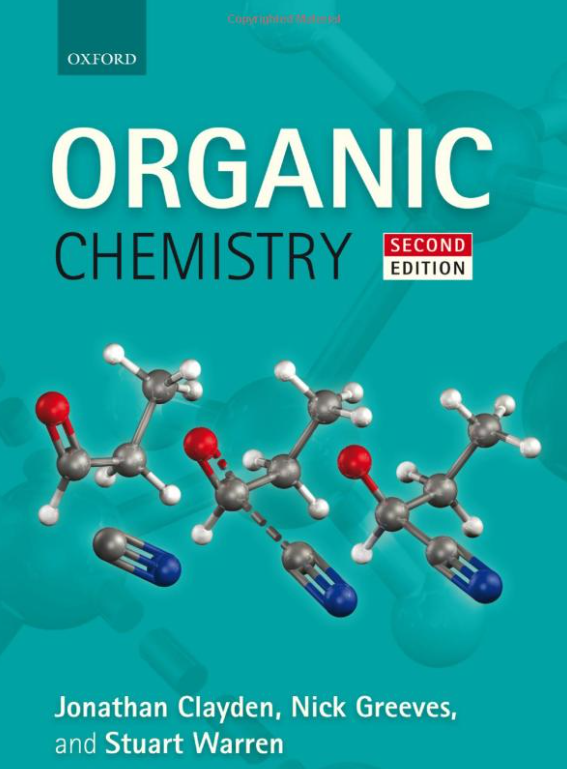
On occasion I step off the industrial hamster wheel for a few minutes to have a look around. In Linkedin this morning I saw a post for the 2nd edition of Organic Chemistry by Jonathan Clayden (Author), Nick Greeves (Author), Stuart Warren (Author), Oxford University Press, ISBN-13 ‏ : ‎ 978-0199270293. From inside the hole along the creek where I spend my free time, I was never aware that Warren had an O-chem textbook.

Amazon allows you to examine a bit of content on-line. If you teach O-chem, this text is worth a look in my estimation.

Many of us are familiar with Warren from his book Organic Synthesis: The Disconnection Approach, 1st edition 1982. A second edition was released in 2008. Retrosynthesis was spreading around to the far-flung corners of the chemistry polygon then. Warren’s book was quite useful in demonstrating that technique for devising an organic synthesis.

An interesting interview of Warren can be found at The Skeptical Chymist from 2009. Warren died in 2021 at age 81.

FOOF – Dioxygen Difluoride and ClF3 Chlorine Trifluoride

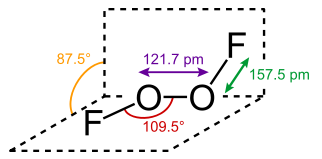
Just today, as the open door to my golden years stands gaping before me, I learned of a substance called dioxygen difluoride, FOOF. It’s also known as perfluoroperoxide at the NIST Chemistry WebBook site. Seems like I’m always the last one to the oxidizer party. This rather unhappy substance can be prepared as shown below. The word is that the orange-yellow solid is only stable below −160 °C.

O2 + F2 → O2F2 (electric discharge, 183 °C) Wikipedia.

2 O3F2 → O2 + 2 O2F2

Another synthesis can be found in a 1991 paper in the Journal of Fluorine Chemistry.


Image from Wikipedia. https://en.wikipedia.org/wiki/Dioxygen_difluoride. A mixture of fluorine and oxygen gas were heated to 700° C then, according to the abstract “rapidly cooled on the outer surface of stainless steel tubes. The tubes were refrigerated by a liquid oxygen bath pressurized to >7600 torr with helium. Six grams of O2F2 were produced in less than an hour.”

Derek Lowe mentioned in one post in his Blog In the Pipeline that FOOF was in the list of materials he won’t work with. Derek also mentioned chlorine trifluoride. A method of preparing this substance is shown below. This substance is a powerful fluorinating agent and reacts in hypergolic fashion with asbestos and sand according to chemist John Drury Clark. Clark wrote a book called Ignition! An Informal History of Liquid Rocket Propellants based on his experiences with rocket propellant research. Clark said that the great toxicity of ClF3 was the “least of its problems”. It’s ability to react in a hypergolic manner with nearly everything was a barrier to its use. It could be stored in metal containers that were first passivated with fluorine gas.

3 F2 + Cl2 → 2 ClF3

Uranium hexafluoride is produced with chloride trifluoride-

U + 3 ClF3 → UF6 + 3 ClF

According to Wikipedia, ClF3 is used to clean Chemical Vapor Deposition (CVD) chambers. Not surprisingly, prior to WWII the Nazis had experimented with ClF3 as a chemical warfare agent called N-Stoff. Production halted when the Red Army overran the facility in 1945. The substance was never used in war.

The degree symbol- Do we really need to keep using it?

I had an evil thought just now as I attempt to write 2 reports simultaneously. Why do we keep using that superscripted circle in front of C (i.e., ºC) that designates “degree”?

What the hell? We don’t use it for the Kelvin temperature scale. And, who knows if the engineers use it for Rankine? The thing is useless like an appendix or a titular chairman. Get rid of it!

What do you think?

Plasma

Today I found myself peering at the lovely lavender glow of opaque argon plasma through the viewing screen of a gleaming new instrument. The light-emitting 8000 K plasma sits apparently still alongside the conical metal skimmer. Somewhere a Dewar was quietly releasing a stream of argon into a steel tube that was bent in crisp military angles into and through walls and across the busy spaces above the suspended ceiling. Another cylinder quietly blows a faint draught of helium into the collision cell. A chiller courses cooled water through the zones heated by the quiet but savage plasma. Inside a turbo pump labors to rush the sparse gases out of the mass analyzer and into the inlet of the rough pump and up the exhaust stack.

Up on the roof, the heavy and invisible argon spills along the cobbles of roofing stones until it rolls off the roof onto the ground where the rabbits scamper and prairie dogs yap. The helium atoms begin their random walk into space. The argon shuffles anonymously into the breeze and becomes part of the weather.

All of the delicate arrangements; all of the contrivances and computer controls in place to tune and play this 21st century marvel. And a wonderment it is. The ICPMS obliterates solutes into a plasma state and then taps a miniscule stream of the heavy incandescent argon breath that trickles into the vacuous electronic salsa dance hall of the quadrapole.  All the heat and rhythm for the sake of screening and counting atomic ions. What a exotic artifact of anthropology it is. And it all began in a rift zone in Africa millions of years ago.

Bubble bubble, Windows trouble

The latest rev of Windows 7 and MS office is driving me freaking nuts. Used to be that I could do a graph in Excel and copy it cleanly into Word.  That convenience seems to be absent in the latest rev. What fails to copy are the arrows and text boxes that I add to the graph. Not only do some of them fail to transfer, but the graph reformats and they arrive all cattywompus.

What works is to save the Excel document as a pdf and then cut out the graph and paste it into Word.  Fancy that.

So, Microsoft, if I could make the dollars I pay for software change form inside your bank account, say, from dollars into Congolese francs, I’d do it this moment.

Amine Question of the Day

Here is an interesting question. What fraction of the organic nitrogen in your body is ultimately from the Haber-Bosch Process?  Any guesses?  This question arose during dinner discussion following a rousing seminar on frustrated Lewis pairs. There is no connection to frustrated Lewis pairs, but the speaker raised the question.

Oh, I don’t have an answer. This happens in science.  I’m guessing ~50 %, depending on the extent of protein containing corn products consumed. Any meat science people out there?