Following a great link from Mitch at Chemical Forums, there is a chemistry musical video called “Resistant to Base” that is just hilarious. Have a look. Mitch runs a really good blog.
Chemistry Music Video
2 Replies

Following a great link from Mitch at Chemical Forums, there is a chemistry musical video called “Resistant to Base” that is just hilarious. Have a look. Mitch runs a really good blog.
According to Chemical Blogspace, a website that collates blog posts and does a bit of linguistic analysis on the text, this blog has a Gunning Fog index of 13.6. Apparently, Al Gore’s writing generates the same Fog Index. Jeepers.
I’m glad they aren’t grading my sentence construction and punctuation. Or are they … ?
A few more blogs have been added to honored positions on the Illustrious Blogroll. Check them out. Lots of good bloggers (Bloggists?) with penetrating commentary on the current literature.
Blogging is a bit harder for industrial folk. Or should I say riskier? One of the unfortunate realities of working in Fabulous Industry is the matter of secrecy. You can’t discuss any of the fascinating stuff you work on with your buddies in academia. You know, chalk-talk stuff. The pay is good in industry (they fit you with golden handcuffs early) and the chemistry is fascinating, but the sad part is that it is nearly all confidential. When the conversation turns to sensitive material, people become noticeably uncomfortable. And they should.
Meetings with site visitors begin with the standard preamble- “You’ll recall that we are speaking under the conditions of our Non-Disclosure Agreement. We at MegaLithium Company are in the XYZ business and have no need for any information from you beyond what is required to evaluate the project. We really don’t want to know your secrets.” Usually a well manicured and coiffed senior honcho says this. If the sleeves of his white shirt are not rolled up and his head shines with a high gloss, he is probably one serious SOB. This would be the alpha male and his underlings will studiously follow his lead. Often, there is a tour following the meeting.
As you take the tour you’ll find that the guides are not appreciative of breaching the decorum of secrecy, so blatantly nosey questions can cause them to throttle back the gee-whiz stuff. It’s always best just to nod appreciatively, pay attention, and be grateful for what you get to see.
I’ve been on both buy and sell sides of the secrecy matter. I have hosted plant tours for visitors who were less than upfront with their intentions. You see, in the custom chemical Business to Business (B2B) world when someone requests a price and availability, there is some chance that they have no intent on buying anything. Their real intent may be to get scaled pricing and an estimate of the annual sales turnover for a product. It’s called competitive intelligence. And pricing intelligence is the most coveted of all. Typically, this is only true for customers who may be competitiors.
Here is some good advice. If you’re about to sign a secrecy agreement, look for a clause providing for the reduction to writing for all Information to be considered Confidential. These words are in bold because they are key words in a secrecy agreement. A good secrecy agreement will go to great pains to define what is meant by Information. If the other side is going to take you to task for a breach in confidentiality, then exact information that they consider sensitive had better be reduced to writing so you have a fair chance of avoiding a breach.
Having done my tour of duty in chemical sales and having travelled over a good bit of the northern hemisphere buying & selling, I’ve picked up a few insights into the B2B and “retail” chemical business. Everyone has the major chemical catalogs on their desk. You know, the thick tomes from Aldrich, Spectrum, TCI, Matrix, Strem, GFS, Gelest, Fisher, etc. There is considerable overlap in content, though some specialize in their chosen niches. While Aldrich makes no bones about total world domination, others are pleased just to dominate certain cul de sacs of chemistry.
SAF is clearly the colossus of international catalog companies. The Aldrich wing was started by Alfred Bader, now a retired art collector. To hear him tell it, Bader was frustrated by the limited availability of reagent chemicals and spotty service (by Eastman Chemical, if I am not mistaken). Anyway, Bader was the right character at the right time. He had a single-minded drive to give chemists what they needed and make a few bucks doing so. The slogan “Chemists Helping Chemists” was a the result of a sincere calling. Bader visited university chemistry departments and asked professors what they needed. Over time the Aldrich catalog collection grew and so did the company. Eventually, Bader was quietly forced out of the organization. Founders can become “problematic” evidently.
Today SAF offers a vast collection of products and makes a sizeable fraction of what they offer. Most professors don’t know it, but interesting materials from the lab might be saleable to a catalog company. If a prof has developed a new reagent or some useful fragment or pharmacophore, for instance, it might be worth contacting a catalog company to see if they want to stock it. You never know until you ask.
But we business types know that dealing with professors can be sticky, so Herr Doktor Professor, don’t get too high handed or greedy! Academics are often missing the merchant gene and as a result badly price their wares. The typical mistake is to over-estimate the demand and hike the price up to the astronomical numbers that you see in the catalogs.
Here are the problems. Catalog companies do not pay the prices that you see in the catalogs. Buying material for inventory is equivalent to putting a stack of money on the shelf. They have to pay lots of money up front before the first purchase order for your wonder product is faxed in. They have to pay for those damned fat catalogs, the inventory, salaries, the facility, regulatory compliance, certification, labeling, packaging, the time value of money, taxes, and they have to make a profit for the shareholders. So if the catalog price of something is $10 per gram, figure that they’re likely to keep their costs to $2 to $3 per gram for it, tops. Obviously, this is subject to variation due the type of material or special negotiated deals. But a 3x to 5x markup is not uncommon and is necessary to stay in business.
Then, after you ship the product to the catalog house and they put it into the collection, it might not sell. It could be a dog. The rule of thumb is that 20 % of your inventory will do 80 % of the business. So, one of the ways to grow is to increase the number of products. Their interest in your product may be of a statistical nature rather than a firm belief in it’s viability.
I’ve heard many people go off about high catalog prices. I don’t like to pay the high prices either. But it is the cost of convenience. If you need some obscure material, chances are that you can order it and have it in a few days. That is worth something and the catalog companies know it. Hell, I’d do the same thing.
We have a Cecil CE 2041 UV/Vis spectrometer. Data is collected by the DataStream CE2000 software package. The instrument has 4 nm of resolution, not the best, but still quite usable. To quote the famous British philosopher- “You can’t always get what you want!” (M. Jagger).
This posting is an experiment on how to upload data to the web. The graphic below is a jpeg conversion of a pdf conversion of an Excel chart. Seems like an awkward way to do this. Undoubtedly someone out there can offer a suggestion of how to upload an Excel graphic to the blogosphere.
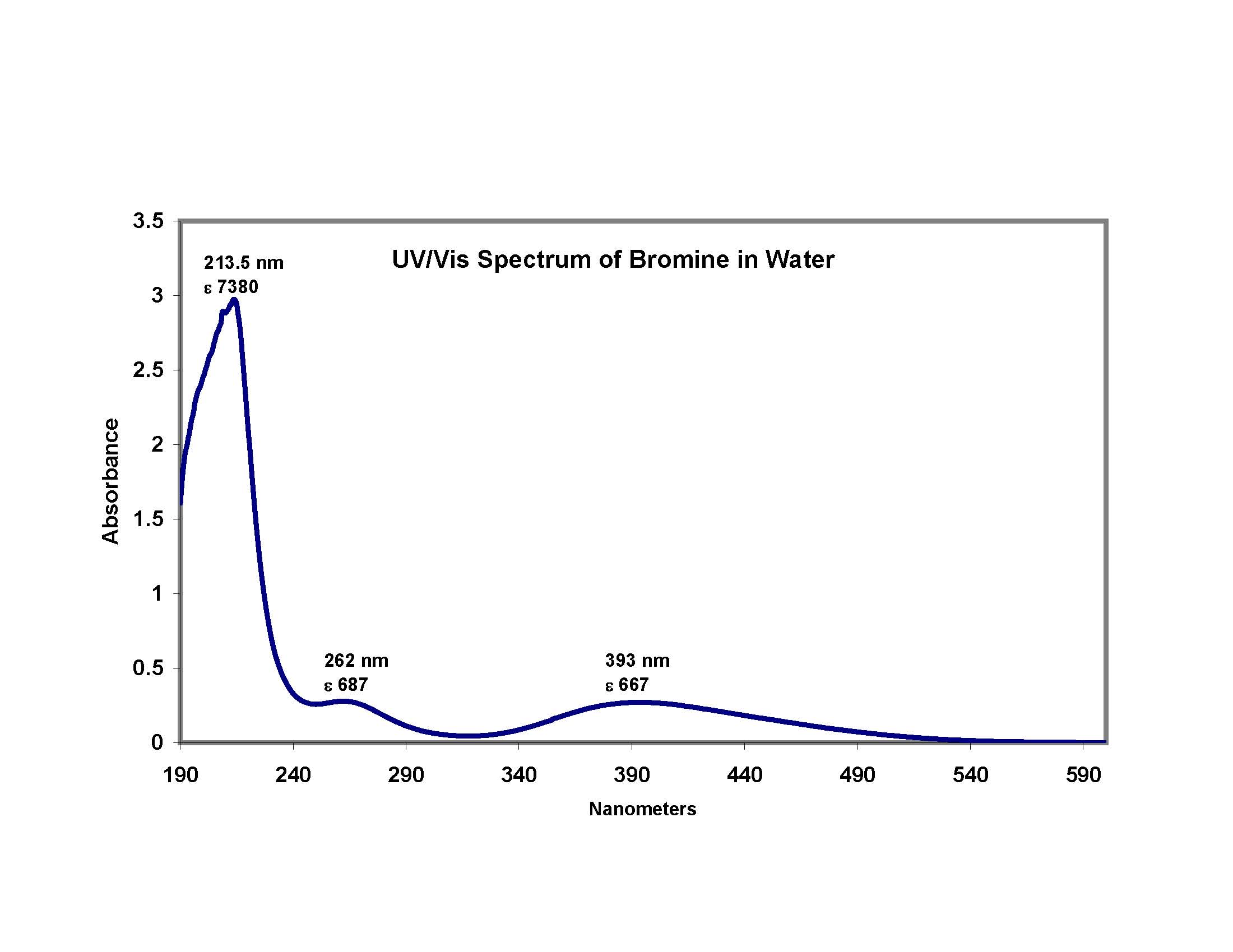
It looks like prior to an upload the graphic has to be beefed up a bit. I’m gonna have to monkey with it some more. Maybe someone has a suggestion.
Here is the text of a comment I made over at the Volokh Conspiracy. I have pasted it here so I don’t forget it. OK, so there is a little bit of vanity here. But I do want to build on this theme. The context of this comment pertained to the teaching of science and the influence of proponents of Intelligent Design.
In the end, we who teach want students to be able to use their brains. We want them to be able to construct or use a theory to make predictions about the observable universe and then devise experiments to test their hypotheses. We want them to design positive experiments rather than negative experiments. We want them to use language and math to express what they are thinking. We want students to be comfortable using a working hypothesis while they are working on a problem, just as long as they remember that it is just that- a working model.
We want students to learn to follow the evidence and draw a conclusion rather that start with a conclusion and cherry-pick the data to be consistent with preconceptions. The glory in science is to be able to tip over the established order in favor of new insights and understanding based on data. In the end, scientific methodology is about intellectual honesty and accountability.
All measurement involves error which causes a certain amount of uncertainty in a result. You don’t have to invoke Heisenberg to consider uncertainty. A result is only as good as your worst data. This leads to my final point.
A sign of good training or instinct in science is the ability to be sceptical or at least a bit hesitant about your conclusions. Hesitant in the sense that your conclusion is to be considered within a set boundary conditions.
A scientific outlook has served me well in general. At least so far. The world would be much more complex if I had to invoke a miracle every time something odd happened.
As is common at this site, a cluster of blood-sucking fuss budgets are haggling over minutae. I’ll bet not a damned one of them ever had to make sense out of a mass spectrum or isolate a new substance and prove it.
The 2006 ACS meeting in SF was interesting. In a much earlier post I lamented the recent trend of boring ORGN section meetings. That was definitely not the case this time around. Of course, there was the usual assortment of faculty rockstars with their fawning groupies (OK, I’ve done that too). A lot of interesting insights into obscure stuff. But I have to say that there was more buzz in the air in the ORGN talks. My favorite profspiels included Toste, Doyle, Knochel, and Trost.
This time I noted a distinct lack of talks on room temperature ionic liquids (RTIL’s). After far too much breathless ballyhoo, the worker bees in this “area” seem to have hunkered down a bit. Do I sound cynical? I have actually developed a manufacturing process for a commercial RTIL species. I can say that the economics of RTIL manufacture and certain kinds of applications of these expensive solvents can be awful. At least awful in direct comparison to solvents like THF, toluene, ether, etc. If you’re using an RTIL, say, in a two-phase catalytic extraction process, then the comparison is faulty and the RTIL may be quite efficient to use. However, if you need batch reactor volumes, i.e., 50 to 1000 gallons, then the batch process costs may require scientific notation.
Even pharma companies with deep pockets extending to the MOHO layer will worry about these economics. In order to justify an $50-$250/kg solvent (!!), there has to be some whiz-bang process improvent to justify such costs. In batch processing, RTIL’s are prone to the concentration of ionic species or water from the previous run. The practical consequence of this is that the RTIL may be a different material from one run to the next. It may or may not be an issue. But you’ll have to investigate and qualify it. You may have to polish the solvent (!!!) after each run to qualify the subsequent use of the RTIL. How green can that be?
I cannot speak from the perspective of a pharma industry chemist. But I can speak as someone who makes specialty products for the pharma business. From bitter experience I can testify that the last thing you want to be is the supplier of the most expensive reagent in the customers process. It is like a rock in their shoe. They’ll squirm and fitch around until they find a cheaper supplier or engineer a way around the offending reagent. Hell, I’d do the same thing in a heartbeat. Nothing wrong with that. But it is this sort of raw cost pressure that makes the commercial viability of RTIL’s difficult.
The disposal of bulk RTIL’s may be expensive too. Since as a group they are resistant to incineration, the natural question is- How do we safely and ethically dispose of bulk RTIL’s? I’m sure that someone out there in the blogosphere has a comment on this.
<END RANT>
What is becoming more apparent in the chemical industry is the rapid rise of R&D horsepower in countries that had only recently been known for low cost manufacturing. Previously, the universe of nations known for their R&D engines was limited to the familiar players- USA, Japan, EU, and to a lesser extent Russia (or FSU). These countries have extensive institutional and university infrastructure that can be applied one way or another to manufacturing output.
Today, India, China, Taiwan, and South Korea in particular have begun to apply considerable traction with their R&D engines. Really, anyone who reads C&EN, Chemical Week, or CMR knows this.
But reading about it is just an abstraction. It is quite another thing to witness it face to face. It is especially obvious at chemical trade shows like Informex, ChemSpec, or CPhI. Large tracts of the exhibition halls are literally crammed with small booths- perhaps 25 % or more filled with representatives of Asian firms bearing exotic names unfamiliar to attendees from the western hemisphere. Many exhibitors have product lists that seem strangely similar: generic API’s, heterocyclic intermediates, natural products, etc. It is all quite bewildering to Americans who still swagger with the attitude of Manifest Destiny.
As everyone knows, there has been a positive trend in outsourcing raw materials and intermediates from outside the USA. Having participated in this myself, I can say that foreign outsourcing allows much US manufacturing to remain competitive in world markets. However, it is one thing to outsource raw materials and quite another to outsource R&D.
While Americans must learn to adapt to the irreversible trend of positive growth in chemical discovery and manufacturing around the world, we should be a bit more circumspect about outsourcing R&D.
I’ve had the occasion to listen to more than a few American business leaders- smart upper level R&D management- crow about the cost savings they are seeing by outsourcing some of their R&D activity. In particular, we are seeing companies outsource custom synthesis of R&D materials or opening off-shore R&D centers. One US contract Pharma R&D firm specializing in API’s has been making hay about their outsurcing capabilities in discovery and process development to highlight their cost effectiveness.
These managers and executives give impressive talks at symposia and conferences. Their PowerPoint skills are impeccable, though no doubt aided by invisible in-house staff who gin up the cool graphics. These folks attend all of the trendy business method classes like Six Sigma and toss around quotes by Jack Welch. They read all of the right business books found at airport bookshops. The obligatory and right-thinking buzzwords roll off their MBA tongues like melted chocolate, all carefully crafted to reassure stockholders that spending is being contained.
The out-sourcing of R&D doesn’t always begin with the outright execution of contracts to foreign comnpanies. It may begin more modestly, with the outsourcing of R&D custom projects. As relationships build and as project managers cycle through projects, greater and greater comfort with the outsourcing arrangement is felt. Soon, scale-up happens and substantial subunits of molecules are manufactured off-shore. Eventually, US plants are shut down and the equipment shows up on Dovebid for auction.
Yet for all the apparent good economic sense that R&D outsourcing may provide, I find myself uncomfortable with the concept. At one extreme there is the corporate cosmology spoofed in Sidney Lumet’s movie “Network“, where the real nations of the world are the multinational conglomerates who wield major currencies like an occupying army and nationality is an archaic formalism. R&D is only the wagon that carries the troops for the greater glory and profit of the shareholders.
The other extreme would be the notion that R&D is part of our culture and is something to be guarded as national treasure. It is is an extension of who we are.
It’s obvious that R&D is part of the American economic driver and it should be expoited to bring prosperity to our nation. But that is not to say that US companies should provide companies in competing nations with a critical skill set in exchange for short term gain. Irrespective of non-compete agreements and secrecy arrangements, the fact is that once valuable technology is divulged you can depend on ambitious players to learn from it and accelerate their growth. While apparently sensible in the short term, exporting your magic is ultimately foolish.
This essay may be a bit parannoid and provincial, but the USA is rapidly de-industrializing itself under the enchantment of its own intoxicating doctrine of promulgating laissez-faire. Allowing the progress of de-industrialization to occur under the influence of quarterly profit reports is perhaps inevitable under our present political era.
I would argue that industry and commerce are not just a business math exercise. They are part of the fabric of our culture. Adopting abstract economic formalisms and dressing them up as social policy is to neglect why we start businesses at all. If the acquisition of money were the only goal, then we’d all go into finance. We start businesses in areas we prefer in order to make money and to have something constructive to do. It stimulates our brains and drives progress. It contributes to the common good. Work and industry are part of anthropology, not just economics.
 Lamentations on Chemistry