Category Archives: Chemistry

The Squamous Chronicles, part deux: Into the beam we go.

My adventure with Head and Neck Squamous Cell Carcinoma, HNSCC, soon enters a third phase.  A week from this writing I’ll don my custom prepared plastic mesh mask and they’ll strap me onto an x-ray machine. Oh yes, one other thing. There’ll be a weekly dose of cis-platin coincident with irradiation. Turns out that there is a synergistic effect with radiation and platinum poisoning cis-platin chemotherapy. No doubt it is related to the fact that platinum is a heavy atom with a lot of electron density ripe for scattering. Platinum ligated to DNA during irradiation is a bonus as well I suppose. Your own DNA as a ligand for platinum. A funny thought for someone in the catalyst business.

The first phase was the identification of a swollen lymph node and its subsequent removal from its cozy perch on my right carotid artery. Here I learned first hand why cancer is destructive. Mutant squamous cells from some molecular-genetic train wreck are washed away from their birthplace to lodge in distant locations. In my case, the aloof cells got hung up in a lymph node. There, they invaded the node and proliferated to the point where much of the lymphatic tissue became necrotic, likely from blood starvation. The node was not especially painful. Well, until the biopsy needle went in. Then it became very, very angry. But I digress.

The second phase, post surgery, was the adventure of finding suitable oncologists. This is a little bewildering. It is easy to get overwhelmed by information. I went for a second opinion and soon thereafter chose the Anschutz Cancer Center at the University of Colorado in Aurora. I’ve already had medical students and residents sitting in on consultations and exams.  The medical oncologist is a research professor specializing in head and neck cancer. He sees patients on Fridays too. The radiation oncologist sees a lot of HNSCC and seems knowledgeable and confident.

More to follow.

Suggestions for future customers

Being a grey haired chemist in the manufacturing field, allow me to make a few suggestions regarding the design of custom chemicals. If you as a customer would like to have a custom product that has minimal cost, maximum quality, and minimum variability, please consider the following attributes of an ideal custom synthetic chemical product.

Boundary conditions must be set on my comments:  custom or proprietary product; produced under batch or semi-batch conditions; non-pharma-food-neutriceutical related.

To the greatest extent possible the raw materials for your product are preferably-

  1. existing items of commerce unencumbered by composition of matter or process claims.
  2. available in a grade suitable for direct use.
  3. unencumbered by import restrictions, law enforcement watch lists, and relevant EPA restriction lists.
  4. TSCA and REACH listed already.
  5. those free of problematic isomers.
  6. those not requiring tight fractional distillation to purify.
  7. free of explosaphors like azide or nitro esters.

Your costs are best contained if your product-

  1. does not require enantiomeric purity or is not subject to facile isomerism affecting the specification.
  2. does not require more than one protection/deprotection scheme.
  3. does not require tight fractional distillation for final purity.
  4. does not require bulk high pressure chemistry (shops that can do this are limited).
  5. is air stable.
  6. is soluble enough in process solvents to maximize space yields (if it is, say, <10 wt %, batch costs will start to get high).
  7. does not require solvent changes in a process unit operation.
  8. is amenable to parallel synthetic strategy.
  9. does not require serious chilling of the reaction mixture (say, < -20 C).
  10. has been screened for real purity requirements rather than those based on the desire for tidiness.
  11. can be isolated by a simple Buchner filtration rather than, say, a centrifuge or other more elaborate solids isolation scheme.
  12. can be isolated by simple distillation.

It is important not to underestimate the cost of excess purity. A process may afford 96 % absolute purity on first isolation with say, 1 % solvent and 3.5 % side products or starting materials. The cost of taking this to >99.5 % is often very high in plant time and in product losses from added operations. Maybe you can get by with 98.5 % purity with some constraints on certain contaminants for your application.

Products and their intermediates may be designed in the early development stage to have properties that aid in low cost manufacturing without too much alteration of utility. For example, consider not using an n-octyl ester group in favor of 2-ethylhexyl ester. There are many structural motifs that derive from large scale items of commerce. Products that are strictly polyaromatic with or without hetreroatoms, are zwitterions or salts, or have a large heteroatom-to-carbon ratio, often have organic solubility problems. Will a bit of aliphatic shrubbery in a side group enhance processability? Maybe. If it allows your vendor to have better process economics, that helps everyone.

Does the process require nitromethane as a solvent? Does it require an exotic PGM catalyst that is patented? Do you have to use a patented transformation in the scheme that requires pencil-necks from the University IP office to audit annually? If so, try to find a better way.

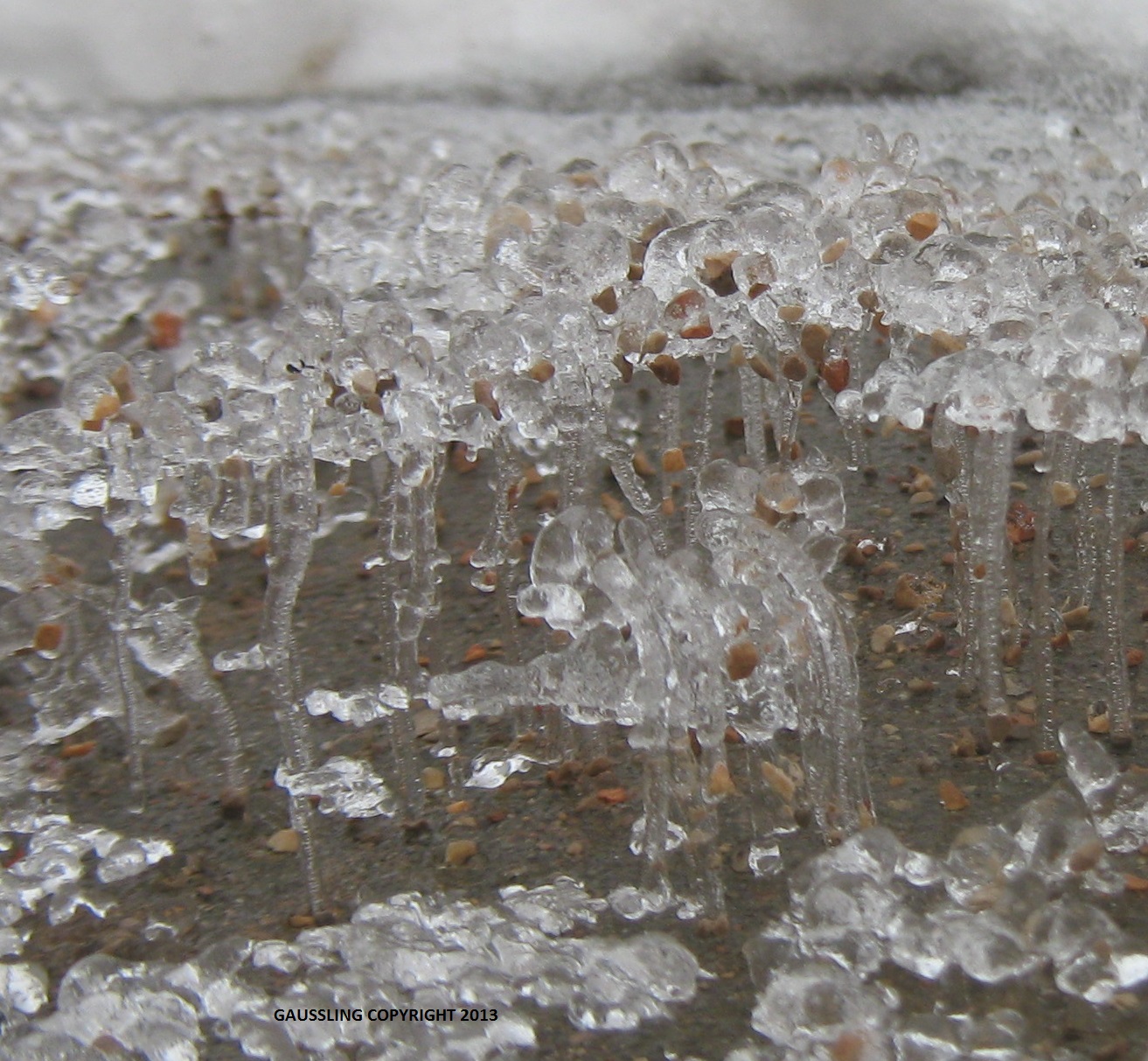
Ice stalks. A winter oddity.

Yesterday I placed clay sorbent granules on my steep, north facing driveway to add some friction so the car and visitors can negotiate the grade in the snow and ice. The clay granules are used for absorbing oil and are similar to cat litter. I used the granules because I did not have sand.

Curious ice formation. Copyright 2013 Th' Gaussling.

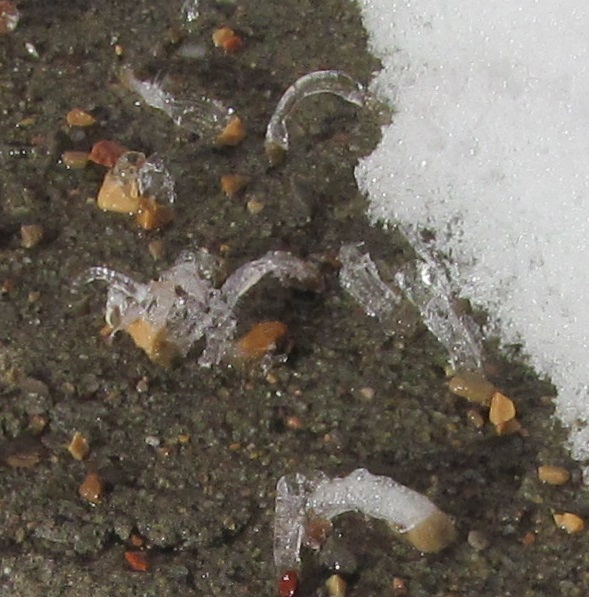
Ice stalk formation. Note that many of the clay granules have been lifted by the slender stalks of ice. Copyright 2013 Th’ Gaussling.

The granules were deposited on freshly shoveled concrete with just a thin layer of clear slush. I would estimate that, overnight, the temperature ranged between 25-32 F. In the morning, the 1-5 cm stalks of ice were observed only where the granules were deposited.

The slender stalks were capped with flat, irregular plates of ice.  Many of the stalks had lifted granules off the ground. Most appear to have arisen from the granules. Obviously, the process forming the stalks lifted some of the granules and ice vertically. Curved ice stalks appear to have extruded gradually from the granule and, under the influence of gradually shifting cover of snow or other ices, have extended produced a curved shaft of ice.

The granules are manufactured with absorbency in mind.  In this circumstance, I will hypothesize that capillary action pulling liquid water from the concrete surface is delivered to the upper surface of the granule where it freezes at the air/water interface by evaporative cooling. Why it doesn’t just stop is puzzling. Perhaps the action of freezing at the granule upper surface reduces the vapor pressure of water enough to induce a small pressure drop through the pores of the clay that draws liquid phase to the surface where is freezes continuously. The heat of fusion at the surface may be sufficient to prevent freezing of the water within the pores of the granule in the subfreezing range of the air and shutting the process down.

Ice Stalks 2

This is a very curious type of ice formation, one that I have observed on two separate occasions. This is another odd thing water can do.

Priestley Medal 2013

Congratulations to Professor Peter J. Stang on winning the 2013 Priestley Medal. The C&EN bio at this link reveals quite an interesting career.

Oh, by the way.  Am I the only one to notice some faint resemblance between the Medal winner and Ambassador Sarek from Star Trek? Face it. Being a JACS editor is about the same status as an ambassador.

Well, it depends …

Getting technical people to offer insight and advice can range from simple to vexing. Following a recent purchase of an unusual type of spectrometer we found ourselves in need of advice regarding consumables and sample preparation. Going into this installation I believed, naively, that our set up to operate the new instrument would be eased by patient advice from the seller.  I was mistaken.

I could whine on about deficiencies in this or that, but instead I’ll get to my point. Consider the following exchange-

Q:  What sort of electrode should we use to run this mineral sample?

A:  Well, that depends.

Q:  It depends upon what?

A:  Well, it depends on the type of matrix you have and the concentration of the desired metals.

Q:  How do we decide on what kind of electrode to use?

A:  We do not have experience with that element or that matrix. And there are many kinds of graphite widgets, many for specific uses. The widget company did not return your email because they are small and would prefer to talk to their customers.

Q:  So, how do we get started?

A:  You’ll have to prepare bracketing calibration standards that match your matrix as closely as possible.

Q:  What can you tell us about buying or the preparation of calibration standards? Are there any special materials we can use as diluents or any preferred methods?

A:  There are no manufacturers of these solid calibration standards anymore. We bought out the inventory of the last one.

Q:  So we can compound our own standards at concentrations close to the spec of the inventory you hoarded bought out?

A:  Well, yes, I suppose. It depends on your capabilities ….

And on it went.  Eventually we extracted the information we needed and are moving forward.

Here is my point. Everything “depends”.  A little louder.  EVERYTHING DEPENDS. For crying out loud!  This is one of the fundamental theorems of life. We technical people have to get past this barrier when a questioner asks for help.

A few sentences of advice-

On the assumption that everything depends, offer a hint to the questioner in the form of a range of possibilities. Open with insightful examples or a recitation of common practices. Do not sit there, Sphinx-like, while the questioner sputters and struggles with finding the best questions. Offer some guidance by way of general performance boundaries.

The technical service folks we spoke with were very much in the quandary of Buridan’s Ass. In this fable, a donkey was in between two identically appealing piles of hay. In the end he starved to death because there was no good reason to pick one over the other.

In the case of the tech service folks, one pile of hay was to offer zero advice and make no errors. The other pile of hay was to offer frank advice and satisfy the customer. Having been in this position, I know that offering advice has it’s appeal, but it may be fraught with liability. Telling people how to run their equipment can have negative consequences- thus the reluctance to speak. But sellers are there to service their customers. They should use words and pictures to help their customers get started.

A splendid iridescent grime

While sitting at a stop light this morning, facing south and bathed in the low morning sun, I happened to notice an interesting thing. The sun was a palm width above the horizon and admittedly a bit of a driving nuisance. As the radio droned on I absently squinted toward the east. Just then I became aware of a thin layer of mist-deposited road grime clinging to my driver’s side window. It was alive with thousand’s of faint but unmistakable points of diffracted sunlight. The thin gray layer had an overall iridescent aspect to it that I had never taken note of before.

As I pondered the spectral beauty of this I became aware of an alarming noise. The driver of the white Ford F-250 behind me was waving his hands and honking without the slightest consideration for the unlikely phenomenon I was enjoying. The enchantment vanished as quickly as it appeared as I motored into the intersection and the beginning of the day.

The Company Joules

We will soon have a new HEL Phi-TEC Adiabatic Reaction Calorimeter up and running. Hopefully this will help solve some nagging questions I have about the thermal stability of certain compounds. Time to maximum rate (TMR) is a useful parameter and ARC testing helps to find this value.

I have spent  a good deal of time with the Mettler-Toledo RC1 and have found it to be very useful in process development. There is a tendency for chemists to design exothermic reactions to start at low temperature and at perhaps some point raise the temperature to take the reaction to completion. The RC1 will indicate accumulation of energy in a vessel following a charge. By varying the temperature of the reaction mass and modulating the dosing rate it is possible to find a reaction temperature and feed rate that affords a steady state (or manageable, at least) output of power with minimal energy accumulation.

With the reactions I have been studying it has become apparent that sometimes a preference for low temperature (-30 C to 0 C) by the chemist may in fact be based on habit rather than need.

Naturally, the thermal picture is not the entirety of the problem. Product stability in the reaction mass and residence time at temperature play a role in how the process is configured. But a reaction calorimeter can help find threshold temperatures below which the reaction substantially shuts down.

The RC1 measures heat of reaction in Joules and power in Watts. After some time on the instrument one comes to view a reaction mass as a power generator or an absorber. Power is reported in Watts and is indicated by the magnitude of the deflection of the power curve from baseline.  Joules of energy are calculated from the area under the power curve.

The instrument has a calibration routine where it determines the Cp of the vessel contents. If you have the reaction mass, heat of reaction, and Cp, you can calculate the adiabatic temperature rise for a given dose of reactant. This is an extremely useful element in sketching out the safe operating parameter space of a reaction.

Safety is a political concept. Safety has no basis in physics. It is an artifact of anthropology. It is a fuzzy construct defined by a magnitude of “likelihood” and type of consequence individuals and organizations are willing to absorb to obtain a particular outcome.  But when you sit down in a meeting with thermokinetic data and solid interpretation, all of the stakeholders in a plant can brainstorm and home in on a fairly rational and agreed upon process profile. This is politics at its finest- data driven and substantially rational.

Flame and Ash

Fire is something that we are all familiar with. Everyone has experienced the simple fact that certain things can burn and in doing so are irrevocably changed. For mankind, fire has been an agent of change from the beginning of its use. A simple campfire can be thought of as a crucible where organic matter is destructively distilled and oxidized to carbon dioxide and water and where inorganic matter is consolidated to metal oxides, carbonates, and phosphates.

The flame of a campfire sits in place over the fuel source, appearing to be stationary. But in reality, a flame consists of hot flowing gas. It is the combustion process that is stationary.  A campfire is a kind of air pump pulling air in from the sides and lifting it upwards due to the buoyancy of hot combustion gases. As the gases rise, microscopic particles of glowing carbon are lifted above the wood giving the appearance of an envelope of glowing gas.  Properly mixed propane or natural gas give a flame that has a bluish appearance with much less luminosity. Reading is possible by the light of a campfire. It is not so good by the blue flame of a camp stove.

A wood campfire will consume the wood down to ash. But before the wood becomes ash it can be observed to change from a fibrous solid to a glowing ember of black carbon. The early phase of burning is characterized by the evolution of abundant volatiles that distill into and fuel the flame. Early gas lighting used the flammable gases destructively distilled from coal to provide flame lighting for streetlights and home lighting. The problem with coal gas was that it was free of particulates so the brightness of the flame was poor. The problem of poor gas flame luminosity lead to invention of the limelight and the lantern mantle.

The lantern mantle was developed to overcome the problem of poor gas flame luminosity. A fabric bag soaked in thorium nitrate solution (with 1 % cerium) was dried and then attached to a burner. The gas ignition process burned the fabric and caused the thorium to calcine in place, forming a gossamer webbing of thoria ceramic. The heat capacity (Cp) of thoria is relatively low and the melting point is exceptionally high. Low heat capacity materials require less energy to raise the temperature to a given point relative to high heat capacity materials. The result is that a flame of ordinary energy can raise the temperature of the low Cp thoria to produce high luminosity. The ceria in the mantle dampened the green tinge of glowing thoria to produce a relatively natural light.

Thoroughly burned wood produces an ash that is largely inorganic in nature and at one time was considered quite valuable for soap making and gunpowder. Wood ash was used to provide saltpeter for early gunpowder formulations.  In the early days of gunpowder, saltpeter was extracted from various sources and used with mixed results. The potassium nitrate or nitre form of saltpeter is found in wood ashes. Elsewhere, potassium nitre would appear in damp patches of organic-rich earth as a whitish solid clinging to twigs and plant matter on the ground looking much like hoar frost. Caverns have long been a rich source of sodium nitrate saltpeter. Mammoth Caves in Kentucky and Carlsbad Caverns in New Mexico were mined for their nitrate rich sediments long before tourists began tramping through them.

In 15th and 16th century England, saltpeter was systematically cultivated and extracted on saltpeter farms.  These farms had deep beds of manure and plant matter that underwent air oxidation and were covered to shield them from rain.  After an aging period, the beds were transferred to a large basin and leached with water. The leaching solution was then boiled to dryness to give crude saltpeter. This crude nitrate was carefully recrystallized from water to produce a purified white crystalline product.

Saltpeter is a nitrate salt comprised of a nitrate anion and a cation like potassium, sodium or calcium. In the early days of gunpowder, quality and reliability of the powder was highly variable. One of the variables was the extent to which gunpowder attracted moisture. Powder makers eventually learned by trial and error that gun powders made from wood ash saltpeter were much less likely to be passivated by humidity than those made from sodium saltpeter. It became common practice to combine wood ash with saltpeter extracts from another source to produce what we now know to be potassium nitrate.

As an interesting aside, an important development in gunpowder came along when it was prepared in a form that was much less powdery. A technique known as “corning” was applied to the composition that made it more granular in form. This gave much improved burning characteristics.

Saltpeter from the guano beds of Chile were rich in sodium nitrate while material from the great nitre deposits along the Ganges river in India were substantially potassium nitrate. Indian nitre was an important commodity of the East India Company and strategic material for the British Crown.  Until the invention of the Haber-Bosch process of synthetic nitrogen fixation in 1909 and subsequent oxidation of ammonia to nitrate, the world’s guano beds, wood ashes and cave soils were the major sources of nitrates.

The first World War has been called the chemist’s war in part because of the tremendous casualty counts due to the mass implementation of nitroaromatic explosives like trinitrotoluene and picric acid. Haber is notorious for his part in the development of war gases, but the subsequent production of nitrates from his process was of no less consequence.

The last 20 % of the reaction

It’s common for a kinetics study of a reaction to focus on the first 5 % to say, 20 %, of reaction completion. Usually the study is done at high dilution as well. There are good reasons for this. Ideal solutions are best approximated at high dilution and interferences are not nearly so pronounced. The basic science behind the interaction between reactants can be teased out from the early course of the reaction.

For those of us in the chemical synthesis business the imperative is somewhat different. Our concern relates to the extent to which the reactants go to completion.  In commercial synthesis the desired outcome is to maximize the space yield of a process in the available equipment.  That means that work goes into determining the maximum concentration of reactants and getting the highest yield in the shortest time. The material state in the reactor near the end of a commercial run is quite far away from the conditions one would choose for a kinetic study.

Getting to reaction completion is sometimes rather difficult and may involve whiling away plant hours for the reaction yield to get just a bit closer to the asymptote.  The problem is that the remaining 5, 10, or 15 % reaction completion may consume considerable plant time and bring opportunity costs. Near the end of the reaction the reactants all trend to infinite dilution, so of course the reaction slows down.

Often reaction completion is not simply about getting higher yield. Purification may be greatly complicated by a reaction mass that contains remaining reactant. If chromatography is not an option then one is left with the usual methods of bulk purification. As we all know, some materials crystallize poorly out of a messy solution. This is where the plant chemist has to cancel all appointments and grind through the workup scheme.

I would say that semi-batch reaction completion problems can be a serious matter for a process chemist or engineer.  This is especially true with new processes but older processes can surprise you. My advice is to throw resources at it early. There is a tendency to get the run behind you and move on.  It’s best to work out a detailed analytical profile of the reaction mixture and strive to understand what the components are and what causes their appearance or disappearance. Sometimes changing the stoichiometry helps. Getting to completion and finding a clean work up is where the plant chemist really earns his pay.