Category Archives: Chemistry

Vannoccio Biringuccio. Sixteenth Century Chronicler of Metallurgy.

By the early 16th century in Europe, metallurgy had become an established cottage industry in numerous locales. Artisans were sourcing copper, tin, zinc, antimony and iron ores for reduction, refinement and alloy production for cannon and bells among other products.  While there was no systematic science of chemistry in a form recognizable today, the necessity of constant proportions was understood and exploited to maximize the efficient use of scarce materials. Metallurgists of the 16th century would no doubt share the enthusiasm of developing technology with the same fervor as the technologists of today. 

Unfortunately for these 16th century technologists, the contribution of centuries of alchemy produced a confusing array of occult-based practices. These alchemical practices were based on Aristotelian notions of material “qualities” rather than a system of quantitative relationships of and between substances. It is thought that alchemy began with Grecian metalworker’s practical knowledge of metal preparation. Inevitably, this practical art was overprinted with a thick layer of theological mysticsm by the end of the first millenium. By the end of the alchemical age, any systematic theories of matter were blended into a Mulligan stew of early Roman Catholic mysticism,  incomprehensible nomenclature, and the false choices set forth by Aristotle in his theory of matter.

Fortunately for 16th century practitioners of the metallurgical arts, several encyclopedic works were published detailing the practical art of smelting and casting of metals and what we now know to be alloys.  A prominent early work published in 1540 was the Pirotechnia by Vannoccio Biringuccio (1480-1539). Born in Siena, Italy, over the course of his life Biringuccio traveled extensvely throughout Italy and Germany. His Pirotechnia is a series of books and chapters detailing foundry techniques that he witnessed first hand throughout his travels. He made every attempt to describe methods and techniques in enough detail to accurately capture the technique in question. Above all, he completely drops all the alchemical mysticism and bases his comments on process oriented details such as measured proportions and processing conditions.

Up to this point, what was missing from this very early form of chemistry was a systematic collection of facts and measurements and an accurate chemical model in which to give the facts meaning and predictive value.  Biringuccio, and later Agricola, would begin the disengagement of alchemical mysticism and provide a basis of metallurgical technology upon what might be called science. In a real sense, this helps to set into motion the western industrial revolution. Metallic goods would be produced by very pragmatic artisans who would continue to improve their art through the application of rudimentary measurement.  While it would be four centuries before atomic theory would be developed to make sense of the manner in which definite proportions operated, systematic methods of assay would begin to appear well before atomic theory. The ability to identify value in ores and quantitate it allowed the mass industrialzation of metals.

Thorium and Rare Earths. A Possible Market Synergy.

If one studies the economic geology of Rare Earth Elements (REE), it becomes clear that REE’s are frequently (usually?) found in deposits rich in other elements.  Deposits of zirconium, tantalum and niobium, for instance, are frequently co-located with REE’s.

The REE’s are found in ore bodies that are naturally enriched in either heavies (yttric or HREE’s) or lights, (ceric or LREE’s). The LREE’s seem to be the most common spread of the REE’s.  Molycorp’s Mountain Pass bastnasite deposit is a good example of this.

What is not so widely known is that thorium and/or uranium are nearly always found in these deposits.  This might be regarded as a good thing except that companies in the REE business seem to be less interested in actinides than lanthanides. The actinide business is fraught with complications related to the natural radioactivity of Th and U. If one is interested in rare metal production, the matter of radioactivity is unwelcome.

However, there is opportunity here if certain institutional thinking is allowed to expand. I refer to the global preference for uranium and plutonium in the nuclear fuel cycle. Nearly the entire world’s nuclear materials infrastructure was directed to the production of yellowcake and separation of U235 from U238 post WWII. While there has been some experimentation with thorium 232 in the US, and there are some limited initiatives in motion, it has been largely neglected in reactor design and the fuel cycle in favor of uranium and plutonium.

Rare earth element mining and processing naturally produces thorium and uranium. At present, those practicing REE extractive metallurgy have every incentive to avoid concentrating the actinide components owing to the radioactivity. However, if there were a coherent program for the development of an efficient thorium fuel program, this natural resource could be efficiently taken from the REE product streams now or in the future.

Our reliance on energy will trend substantially towards electricity. The greater absolute abundance of Th over U, as well as the ability to use 100 % of the predominant isotope makes thorium a good candidate for energy exploitation. The recent boom in REE exploration has uncovered new sources of thorium. The nuclear genie was let out of the bottle nearly 70 years ago. By now we should be a little smarter about how we use it.

Re-thinking start-up opportunities

It is interesting how ones perception of opportunities in the world depend on your context. I have academic colleagues who are in nanotechnology, for instance. When I have spoken of the apparent dearth of entrepreneurialism in chemistry, the sincere feedback I get is that there are nanotech-related startups out there. You know, I don’t doubt this.

What I was unable to articulate to my friends was that we need people willing to start companies for the manufacture of starting materials and intermediates for less cutting edge applications. I’m afraid that the word “start-up” has come to mean “bleeding edge technology”.

Have you ever tried to source specialty silanes or halogenated hydrocarbons for instance? The choices of manufacturers in North America are very slim. There are companies in the USA and Canada who manufacture pharma related materials. But believe it or not, not everyone needs costly cGMP manufactured feedstocks. You can find suppliers of thousands of varieties of boronic acids, esters, and difluorides. But what if you want an alkyl chloride?  In my experience there has been a mass extinction of North American halogenators in the last 10 years.

In the previous 5 decades US taxpayers have heavily subsidized US industry by the establishment of a university research complex residing at many dozens of public and private universities. Several generations of faculty at these institutions have written and been awarded a large number of grants over the decades that have produced the scientific talent. Some of the graduates have been the children of those whose combined support via taxed income paid for the complex. Others, in the form of foreign undergraduates, graduate students, and post-docs have been invited to come to the US and take advantage of this rich resource.

I, for one, am in support of sharing the scientific knowledge that has been so expensive in time and money. But what we find is that over the decades, the unstoppable advance of civilization has come to apply the inventions of technology to increase industrial efficiency by reducing the need for labor. Thus, as technology has advanced, the man-hours needed for any given item of commerce has generally declined.

When you combine this natural consequence of invention with a cultural inclination to export industrial production, what you get is a post-industrial civilization that becomes unable to support its previous level of comfort.

The US has been exporting its industrial magic faster than it can adapt to deindustrialization.  Whereas in previous times whole cities have grown around manufacturing plants, today we have whole cities substantially abandoned and blighted (like parts of Detroit). Public corporation shareholders who have taken full advantage of the rich infrastructure of the USA have pulled up stakes and moved to Mexico or Asia.  This article in Forbes is telling.

The combination of automation plus outsourcing overseas with the absentee landlord management of public corporations has triggered a basic instability in our culture. No one really knows how this will play out.

This is what leads me to urge my colleagues out there to consider starting out on your own. It will be hellishly difficult and will consume 5-15 years of your life. I have been a part of several failed startups myself. It is really hard to do. But let me say this: Avoid starting with a one-act pony, and find a way to have something to sell right away.  Not all start-ups have to bring single item, new technology on stream. Find a niche selling high value added, low volume products. Don’t be intimidated by environmental complications and zoning. You have to put your head down and plow through it.  Showing up and some hard-headed persistance counts for a lot.

Euphemisms and similes to avoid in 2012

I propose a 20 year ban on the following overused and often mangled euphemisms and similes-

Rocket scientist–  “it doesn’t take rocket scientist to …”.  This one is really tiresome. I propose that it be banned indefinitely and that repeat offenders be tatooed with some humiliating symbol on their noses.

Holy Grail–  “… It’s like the Holy Grail of …”.  This was overused centuries ago and abusers should be called down on the carpet forcefully and publically. A good swatting with a rolled newspaper may be called for.

American taxpayers–  “… The American taxpayers are tired of …”.  You mean, American citizens. To play to the taxpayer’s emotional conflicts over taxes is a ham fisted rhetorical manipulation that bypasses the greater good of citizenship and responsible stewardship over our civilization. I am a citizen who pays taxes and I insist on being addressed as a citizen.

Perhaps the dear readers have even better examples of rhetorical ditties that should be retired.


Mercury Processing at the New Idria Smelter

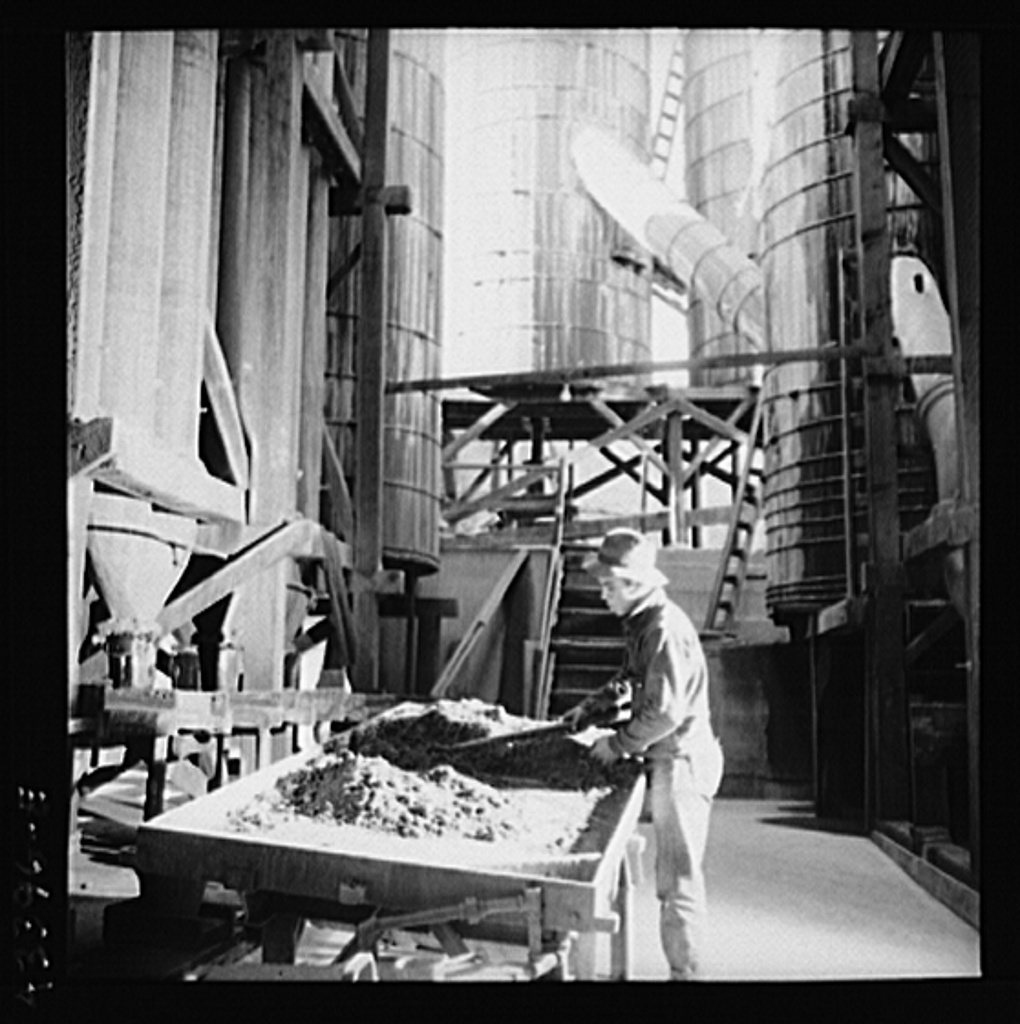
A few Andreas Feninger photos found at the Library of Congress are shown below.  The New Idria mine was a productive mine and smelting operation in central California. Note the fellow at the tilted sorting table, physically agitating the mercury from the solid soot and allowing it to run down the table for collection.  This is a gravity sorting process. Hard to know what kind of occupational exposure the poor fellow is into.

Worker collecting mercury from soot from smelter at New Idria mine, ca 1942. Library of Congress.

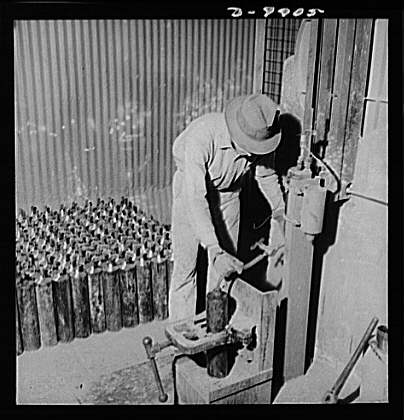
Since the early days of Spanish mercury trade, mercury has been packaged in iron flasks. According to my sources, the 76 lb sizing of the flask was based what laborers and pack animals could plausibly carry all day. In the picture below, a flask is being filled with mercury at the New Idria smelter.

Mercury Filling Station at New Idria Mercury Smelter, 1942. Photo by Andreas Feninger, Library of Congress.

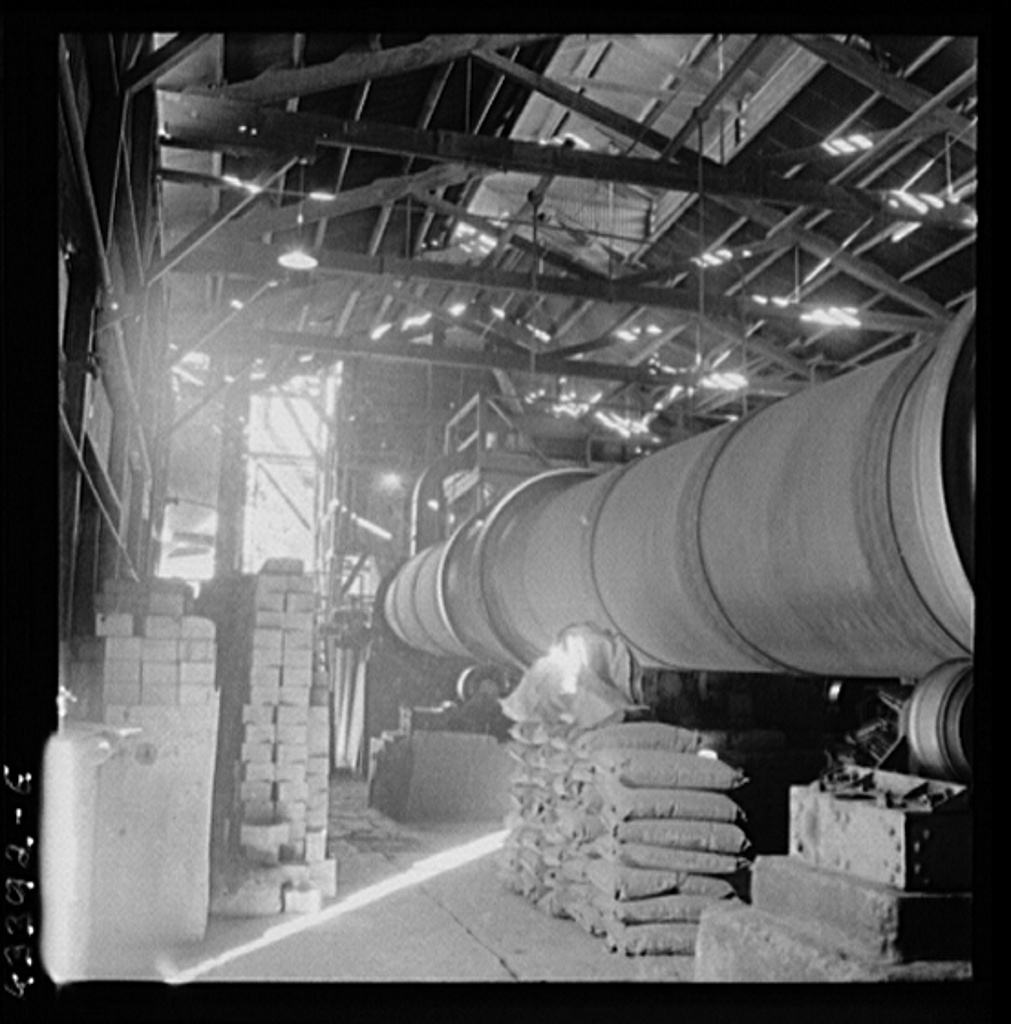
Cinnabar ore was crushed and then roasted in a rotary kiln. This process not only released the sulfur from the cinnabar (HgS), but also decomposed the oxide and volatized the mercury. The mercury vapor was knocked down from the exhaust gas in condensers.

Rotary Kiln at the New Idria Mine and Smelter, 1942. Photo by Andreas Feninger, Library of Congress.

Process development with calorimetry

I’ve turned my attention to reaction calorimetry recently. A reaction calorimeter (i.e.,  Mettler-Toledo RC1) is an apparatus so constructed as to allow the reaction of chemical substances with the benefit of measuring the heat flux evolved. Reaction masses may absorb heat energy from the surroundings (endothermic) or may evolve heat energy into the surroundings (exothermic).

Calorimetry has been around for a very long time. What is relatively recent is the development of instrumentation, sensor, and automation packages that are sufficiently user friendly that RC can be plausibly used by people like me: chemists who are assigned to implement a technique new to the organization.  What I mean by “user friendly” is not this: an instrument that requires the full time attention of a specialist to operate and maintain it.

A user friendly instrument is one engineered and automated to the extent that as many adjustments as possible are performed by the automation and that the resulting sysem is robust enough that operational errors and conflicting settings are flagged prior to commencing a run.  A dandy graphic user interface is nice too. Click and drag has become a normal expectation of users.

An instrument that can be operated on demand by existing staff is an instrument that nullifies the need for specialists. Not good for the employment of chemists, but normal in the eternal march of progress. My impression is that RC is largely performed by dedicated staff in safety departments. What the MT RC1 facilitates is the possibility for R&D groups to absorb this function and bring the chemists closer to the thermal reality of their processes. Administratively, it might make more sense for an outside group to do focus on process safety, however.

In industrial chemical manufacture the imperative is the same as for other capitalistic ventures- manufacture the goods with minimal cost inputs to provide acceptable quality. Reactions that are highly exothermic or are prone to initiation difficulties are reactions that may pose operational hazards stemming from the release of hazardous energy.  A highly exothermic reaction that initiates with difficulty- or at temperatures that shrink the margin of safe control- is a reaction that should be closely studied by RC, ARC, and DSC.

It is generally desirable for a reaction to initiate and propagate under positive administrative and engineeering controls. Obviously, it is desirable for a reaction to be halted by the application of such controls. Halting or slowing a reaction by adjustment of feed rate or temperature is a common approach.  For second order reactions, the careful metering of one reactant to the other (semi-batch) is the most common approach to control of heat evolution.

For first order reactions, control of heat evolution is had by control of the concentration of unreacted compound or by brute force management of heating and cooling.

Safe operation of chemical processing is about controlling the accumulated energy in the reactor. The accumulated energy is the result of accumulated unreacted compounds. Some reactions can be safely conducted in batch form, meaning that all of the reactants are charged to the reactor at once. At t=0, the accumulation of energy is 100 %. A reliable and properly designed heat exchange system is required for safe operation (see CSB report on T2). In light of T2, a backup cooling system or properly designed venting is advised.

The issue I take with the designers of the process performed at T2 is this: They chose to concentrate the accumulated energy by running the reaction as a batch process. This is a philosphical choice. The reaction could have been run as a semibatch process by feeding the MeCp to the Na with a condenser on the vessel. Control of the exotherm could have been had by control of the feed rate and clever use of the evaporative endotherm. A properly sized vent with rupture disc should always be used. These are three layers of protection. 

Instead, they chose on a batchwise process relying on a now obviously inadequate pressure relief system, and the proper functioning of water to the jacket.

No doubt the operators of the facility were under price and schedule pressure. The MeCp manganese carbonyl compound they were making is an anti-knock additive for automotive fuels and therefore a commodity product. I have no doubt at all that their margins may have been thin and that resources may not have been there to properly engineer the process. This process has “expedient” written all over it in my view.

Reactions that have a latent period prior to noticeable reaction are especially tricky. Often such reactions can be rendered more reliable by operation at higher temperatures. Running exothermic reactions at elevated temperatures is somewhat counter-intuitive, but the issue of accumulation may be solved.  

Disclaimer: The opinions expressed by Th’ Gaussling are his own and do not necessarily represent those of employers past or present (or future).

Conquistador’s preamble

The extraction of silver and mercury in Spanish new world was central to the expansion and upkeep of the empire. Silver provided wealth enabling the crown to project power and pay its debts. In the early years of the conquest the Spanish pilfered and exhausted Inca gold and silver available in stores and caches. Eventually, the Spanish found deposits of gold and silver and developed a form of forced mine labor (mita) wherein indian families were required to provide a worker for one year’s unpaid labor in the mines.

The Viceroyalty of New Spain and the Viceroyalty of Peru during the age of conquest developed many mines, yielding mostly silver. Many deposits, especially Cerro Rico in what is now Potosi, Bolivia, contained silver in the metallic form to some minor extent. The Incas had developed smelting before the Spanish occupation, but the process was inefficient and required fuel for smelting. Wind smelting was developed by the Incas, but was dependent on the winds to drive the fires. The discovery of amalgamation and recovery of silver and gold by retorting solved many problems in production.

After the discovery of the patio amalgamation process in 1554 in what is now Mexico, the importance of mercury was recognized as the key to efficient, large scale silver production. This discovery eventually enabled the large scale enslavement of aboriginal peoples to run the mercury mines and smelters of Huancavelica, Peru, and amalgamation operations in the many silver mines in the region.

The conquistador Mancio Serra de Leguisamo (b. 1512, d. 1589) lamented in a preamble of his will-

We found these kingdoms in such good order, and the said Incas governed them in such wise [manner] that throughout them there was not a thief, nor a vicious man, nor an adulteress, nor was a bad woman admitted among them, nor were there immoral people. The men had honest and useful occupations. The lands, forests, mines, pastures, houses and all kinds of products were regulated and distributed in such sort that each one knew his property without any other person seizing it or occupying it, nor were there law suits respecting it… the motive which obliges me to make this statement is the discharge of my conscience, as I find myself guilty. For we have destroyed by our evil example, the people who had such a government as was enjoyed by these natives. They were so free from the committal of crimes or excesses, as well men as women, that the Indian who had 100,000 pesos worth of gold or silver in his house, left it open merely placing a small stick against the door, as a sign that its master was out. With that, according to their custom, no one could enter or take anything that was there. When they saw that we put locks and keys on our doors, they supposed that it was from fear of them, that they might not kill us, but not because they believed that anyone would steal the property of another. So that when they found that we had thieves among us, and men who sought to make their daughters commit sin, they despised us.

Many Spaniards attempted to speak out for the Inca and other aboriginals. Few were effective. But by the time of the Fifth Viceroy of Peru, Francisco Alvarez de Toledo, it was recognized (by Toledo, at least) that reforms were needed to bring the Inca into Christianity and life in a world of laws. Perhaps it was unfortunate for 16th century Incas that King Phillip II was an especially enthusiastic proponent of the counter-reformation and the Inquisition.

Rare Earth Boom

There is a rare earth exploration boom in progress at the present time. This boom is in response to the policy shift of the Chinese government toward greatly reduced export of crude rare earth feedstocks. This political phenomenon is the result of the grand geological lottery that has deposited mineral wealth around the world.

Billions of years ago the geological processes in play were causing the partitioning of the elements into minerals that afforded local concentrations of groups of elements. Over geological time magma rose and cooled, sequentially crystallizing out minerals that by virtue of the principles of chemistry, laid down zones of enrichment. Recrystallization, extraction, ion metathesis, hydrolysis, melting point depression, attrition, processing of melts, degassing- all processes recognizable to the chemist. These processes are responsible for the formation of mineral species as well as their transport and alteration.

But the earth is never finished processing its mineral horde. Land masses are subject to upheaval and erosion, geochemical synthesis and decomposition.  Any given formation at any given time is an overprinting of frozen events separated in time.

Large zones of continent may be subject to forces that cause it to break in networks of fractures. The forces may be in the nature of shear where fracture faces slide past one another. Other forces may lead to an upthrust of rock on the continental scale leading to mountain building.  The shear and bending applies forces that exceed the tensile strength of the rock, leading to fracturing. Over time these fractures may serve as channels for hydrothermal flows.

Hot, pressurized water over long periods will dissolve susceptible minerals in the rock faces and transport solutes and suspended solids throughout the fracture network. Established mineral species yield to the solvent effects of water and slough off part or all of their constituents. In doing so, the minerals are taken apart into anions and cations that will eventually reassemble elsewhere into different mineral species. Over time these fracture networks will fill with solids and self-seal. They are called veins.

Water is not innocent in its behavior. Water’s ever eager oxygen atom binds to oxophilic metals and metalloids, taking them down to the energy bargain basement of oxide or oxyanion formation.  Water with dissolved acids can digest whole formations leading to cavernous voids in susceptible rock.

Over time, geological processes have left formations of elements in bodies of economically viable concentrations called ore bodies.  In the case of rare earth ore bodies, these elements are found concentrated in veins and breccias, pegmatites, or dispersed at more dilute levels in many other kinds of minerals.  It is a truism that the lanthanide set of the rare earths are all commonly found in the same formation, but emphasizing the lights (LREE) or heavies (HREE).  Scandium and yttrium are the Group III elements grouped with the 15 lanthanides to form the rare earths. While yttrium is often found with the lanthanides, scandium is often scarce in deposits otherwise rich in the other rare earths (REE’s). It is not uncommon for REE deposits to contain significant levels of zirconium, hafnium, tantalum, niobium, thorium, and uranium.

China does not seek to deprive the world of products using REE’s. It has taken the position that the REE exports will be in the form of finished consumer products. The policy of China is that it will manage the output of rare earth-based products in a highly value added good as a means to extract the most value from it.  China’s market has a central nervous system that has devised manufacturing policy. It is much like an octopus. In the US, the prevailing wisdom is that the market should seek it’s own equilibrium without government interference. Our system is a distributed in the manner of a coral reef.

Today, mining exploration firms principally from Canada, Australia, and South Africa are exploring Africa, Australia, and the Americas for deposits of REE’s- and finding them.  In my survey of the field, it would seem that the US is poorly represented in the roster of rare earth exploration firms.

My Favorite Reaction

C&EN recently published an article on the favorite reactions of several bloggers. It was the result of an open call for favorite reactions by the C&EN blog in celebration of IYC. Naturally, I missed this call for submissions.

I would’ve offered the biosynthesis of squalene oxide and cyclization to lanosterol as my favorite reaction. The domino assembly of phosphorylated terpenoid precursors and the penultimate cyclization with the hydride and methide migrations is a thing of beauty. To make a fused hydrocarbon ring system in aqueous media as complex as the steroid nucleus with all of the stereocenters landing in place as they do is a true wonder of nature!

Octopole and Quadrupole

Busy week learning to use the new ICPMS. Pretty flippin’ amazing instrument. Reaffirms my admiration for Bill and Dave. A lot of nuances and software to learn, but do-able.  Agricola and Biringuccio could’ve used one of these. Of course, they’d have needed 208 VAC single phase power …

Interesting approach to polyatomic ion interferences- run the beam through a He chamber to slow down the large cross section ions and use the octopole to steer the beam into the off-axis chamber exit and into the quadrupole mass filter. Clever monkeys.