Category Archives: Chemistry

Chemistry jobs

Last fall I was invited to speak to some chemistry students at a local university. Being an industry guy, I was perceived as having some “special” insights into getting a job after college.  While I might have been a successful job hunter when I was less than 40, the odds got much longer after that transition to middle age. More on that in another post.

While I cannot outline the exact path to employment- you really can’t do that- I was able to talk about some of the lesser known jobs that  a chemistry degree will enable.  They are not sexy R&D jobs nor are they upper level executive jobs either. I’m not a pharma guy, thankfully, so my comments do not pertain to that bizarre and brutal world of pharmaceuticals.

The jobs I pointed out are critical to the conduct of manufacturing. They are jobs that one might not necessarily get at the entry level either.

So here are some of the jobs I mentioned.  Environmental health and safety- EH&S. Industry needs people who understand the regulatory situation relating to worker safety and to the environment.  EH&S is also concerned with hazardous waste management.  Expertise in this area is critical to the daily operation of any chemical plant.  This is a good place for an entry level and an experienced chemist to enter because the position typically requires a BS degree and greater than high school knowledge of chemicals and hazards.

Purchasing is an area where a chemist can play an important role in the operation of a plant.  Somebody has to source and buy the chemical raw materials. In general, there is spot buying and contract buying. Spot purchasing offers freedom on the upside but possible instability and higher pricing on the down side.  Purchasing under contract offers a better footing for negotiation and long term stability, but may lock the buyer into minimum volume and a firm price schedule. If demand for your product wavers, being locked into a supply agreement can be a problem if you have agreed to take a set volume.

There are various levels of purchasing positions.  At one end is the purchasing of non-chemical products.  Don’t need a chemist to do this.

On the other end is what is called the supply chain (or procurement) manager. Here is where you need to have a chemist.  This person is charged with assuring that there is an uninterrupted supply of feedstocks to the production facility. They are also tasked with assuring that the vendors meet some basic level of QA/QC and are able to document the whole spectrum of quality assurance. That is, does the vendor have the mechanisms in their business structure to assure not only the flow of product out the door, but also that the process is stable and produces material of the proper quality? Here,  management of change is is very important. A supply chain manager also makes site visits and conducts quality audits of vendors.

Business development and sales is an arena that makes good use of chemists and engineers. The most highly prized type of sales and business development person is the fabled “rainmaker”.  Business development is an activity where a manufacturer makes a connection with a customer who needs some particular material manufactured.  The goal in business development is, not uncommonly, to bring a new product into being.

In the chemical world (outside of pharma) there are commodity chemcials and there are custom and fine chemicals.  Commodity chemicals are those for which there are more than one manufacturer and the difference is mostly in the pricing and availability.  A chemical that is commoditized is one in which the volumes are often high and the margins are thin. Think ethylene, sulfuric acid, BTX, etc.

Commodity chemical producers need sales people too, but their job description is more related to account management and sales. If you dig being a sales rep, go for it.

A business development manager is someone who tries to match technological capability to the needs of the customer for more specialized products. This is teh person who looks at the chemistry and SWAGs a price based on paper chemistry and a spreadsheet.  This is often high pressure work. A bad quote may spell trouble for you. Too high and the customer balks. Too low and you may be faced with the wrong expectations by the customer.  Above all, a good business development person manages expectations.

Quality control/assurance is another position for a chemist. This is for someone who is highly organized and is fond of recordkeeping. This is the world of specifications and certificates of analysis, or certs. The QC person is responsible for making sure the company does what it says it will do in regard to product quality. It is a gatekeeper position and it can be a real hot seat. QA/QC can hold up a shipment or it can prevent the plant from using a raw material. It is a powerful post and those who hold it are not universally loved.

Process safety- what I presently do- is a job description wherein chemists are charged with determining whether or not a process is safe to execute. It is a hybrid job- part synthesis, analysis,and P-chem. It requires quite a bit of imagination in that you have to try to imagine possible failure modes and often obscure ways of testing materials for the potential to release hazardous energy.

Inventory management is central to the operation of any manufacturing unit. It is critical to receive raw materials both physically and in the accounting system. Materials have to be stored in designated locations and have to be staged for use according to a master schedule. While is is less common to find chemists here, I suppose it is possible. Often this position is filled by someone who is familiar with the manufacturing environment.

Related to inventory management is shipping and receiving. In order to load hazardous material onto a truck for transport, one must have training in the regulations pertaining to the transport of hazardous goods. In addition to the regs, there is training in operating in a hazardous environment and emergency response. Again, not a lot of chemists will end up here, but it is a job description in the chemical industry.

Finally, there is the possibility of working as a plant operator. You can find a large variety of people operating in a chemical plant. I know ex-firefighters, ex-military, biologists, farm boys, heavy equipment operators, construction contractors, and people who have worked in chemical plants all their adult lives. It is hard work. You have to work on the plant floor wearing PPE that is often uncomfortable, or perhaps sit at a terminal in a control room monitoring a process train.  But if you like working with your hands on machines and electronics in manufacturing, it may be job for you.

If your desire is to be a captain of industry- a CEO or President, then you should forget lab work and go into business development or sales, or even accounting. Anything related to the accumulation of sales dollars, customer service, plant startup, and deep finance is crucial to someone handing you the keys to the corporation.

Yes, I know that there are a few scientists who have ascended to the top, but they are the exception. You must be fluent with the ways of money and show a record of rainmaking.

The other possibility for a chemist is to join a startup venture. But this is hard to find since most startups are begun with a core group of people who know each other. At some point, however, they will begin to recruit skilled people to fit particular slots. I have no real advice to offer here except that startups are very risky. At some point you may be asked to invest more than just time.

Inverse Midas Touch

I seem to have contracted a case of the inverse Midas touch. Everything I touch turns to crap. I mean everything. Chemistry, friendships, a pot of chili, volunteer work, you name it.  What gets me is that it seems statistically unlikely that I would uncover so many large magnitude failure modes (??) in such a tight temporal cluster.  A flock of black swans landed in my back yard.  A monkey sat at my typewriter and typed “screw you” 500 times.  A simple reaction making a simple product  is fraught with unforseen complications. Son of a …

Okay, the monkey thing didn’t happen.

One thing I’ll get out of this is to be more reticent to volunteer for projects that seem simple in concept. Nothing is simple. Every single thing has degrees of freedom you can’t see and local minima to sink into on the way to the prize. It’s a dangerous world out there and in ways you can’t imagine.

Geysers of Enceladus

My day job requires that I can practice the art of calorimetry with some reasonable extent of expertise, so in that vein I have been cracking open some of my dusty p-chem texts and revisiting basic thermo.

The other day while on an excursion to a bricks and mortar bookstore to pick up some of my favorite periodicals (Kitplanes and Vanity Fair), I happened upon a copy Elements of Chemical Thermodynamics by Leonard K. Nash (1970, Dover, $12.95). Feeling bad for Borders and their current run of poor luck, I bought the book as though it would make some difference.

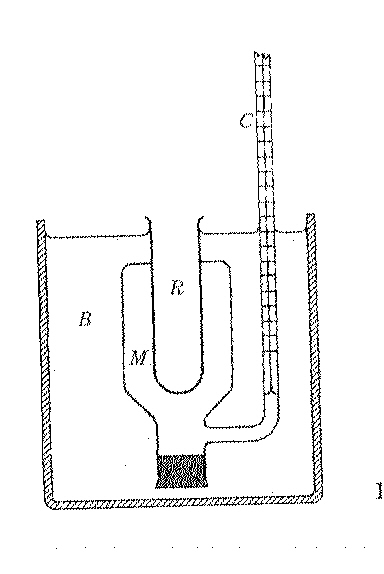
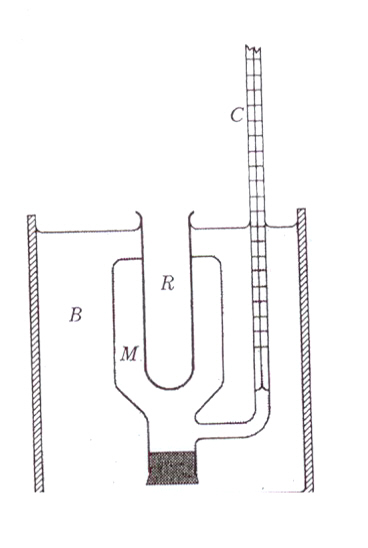
Figure 2 on p 5 (below) shows a schematic of a ice calorimeter.  An ice calorimeter uses a thermally isolated enclosed space M completely filled with liquid and solid water immersed in an insulated tank of ice and water B. The internal, thermally isolated, working volume of water has two important features- it has a small volume sample container R protruding into it and it has a calibrated small inside-diameter expansion capillary C. 

A sample in container R is in thermal contact with reservoir M.  Heat absorbed in M melts some ice and results in the loss of low density ice and the formation of higher density liquid water. The net volume of the contents then decreases and is registered as a column height change in capillary C.

Given the volume change and knowing the density and heat of fusion of water at 0 C, one can calculate the heat absorbed by the reservoir.

So, what about Saturn’s moon Enceladus? The moon is thought to be covered by water ice with liquid water underneath. It’s reasonable to assume that if some volume of water below the ice transitions to the solid phase then the collective volume for liquid water is decreased resulting in an uptick in pressure.

If this happens, it could provide a mechanism for the geyser phenomenon witnessed by the Cassini probe. The geyers could simply be a result of PV work energized by gravity and radiative cooling of the surface and subsequent thickening of the surface ice into the underlying liquid phase.

I’m sure the boys and girls at Cassini have thought of this, but since I’m not tied into the literature I have not heard anybody express it.

Sanding the Mass Spec

January 19, 2010.  We unpacked our new Agilent GCMS today. It comes with a container of fine alumina abrasive. I’ve never had to maintain one before so this has been an education. It has a triple MSD (mass selective detector) on it for what amounts to a noise cancellation feature. This increases the signal to noise ratio of the output substantially. I never realized that the MSD was off-axis relative to the quadrapole electrodes. The ion beam is steered 90 degrees into the MSD by a 10 kV post that also accelerates the beam.

Oh yes, the abrasive is for polishing the metal surface that sits against the high vacuum seal of the mass analyzer chamber. It struck me as amusing that a mass spec comes with a supply of abrasives. Now it makes sense.

BS, MS, or PhD in Applied Chemical Science

Perhaps one solution to the problem of excess chemistry PhD production by our institutions is to take a step away from the path of pure scholarship into the applied sciences. That is, a chemistry program wherein chemical science is integrated with economics and business.  The goal is to support the industrial part of our civilization with scientifically educated people who desire to apply their knowledge to the industrial arts, i.e., manufacturing, sales, management, and distribution. 

I’m suggesting that chemical education could be split into two streams- scholarship and applied science- because that is where the grads go anyway.  Presently, the scholarly route supplies the entire supply of chemistry graduates.  I think there are several reasons for this. Faculty produce graduates along the manner in which they were schooled. Another reason  for this singular path is the effect of the ACS standardized curriculum.  Most chemistry departments struggle to maintain their ACS certification as a validation stamp for their program .  It also serves as a foil for deans who want to gut the chemistry budget because it is typically very costly.  The ACS program has basic requirements and that is that.

An applied science program would require a modification to the usual faculty profile. Instead of having a faculty of stellar Harvard , MIT, and Stanford graduates, the faculty would have a few from Dow, DuPont, Air Products, etc.

An applied chemical science program could include coursework on the manufacturing processes of petroleum feedstocks from crude oil to BTX, polyolefins, and maybe into some fine chemicals or extractive metallurgy.  It would cover the regulatory environment and give students familiarity with EPA and OSHA regulations as well as those regs governing transportation of hazardous goods. 

At some point there should be coursework in basic accounting, marketing, law, and finance. A business minor would be very useful.  A student should know how to calculate the manufacturing cost of a product based labor & overhead as well as the cost of raw materials.  There are many possibilities here to use real life examples. Y ou never know what will happen to a student once they understand how to get a product to market. The just might want to go do it themselves.

It is not inconceivable that a program along these outlines and with the right faculty could produce graduates who are inclined to do a startup. Once you know something about what is required to get a product out the door, it is natural to begin to dream about doing it yourself. 

American chemistry lacks a culture of strong entrepreneurship among chemists. This is not quite as true for chemical engineers, though. Chemists are afraid to start a company because they have not been exposed to much of the business environment because they are partitioned in the lab. They do not know what the issues are or how to attract resources to get the thing started.

I was on the phone with a professor the other day who has $$ in his eyes. He has a customer who wants x kg of his compound and he thinks that he is going to staff a small production campaign with students in a rental space. He admitted he had no idea of what is required once you have employees doing hazardous activities. He had no idea of what workmans compensation insurance was. 

 His business model was simply a larger version of his research lab. The university would pay his students a stipend and he would have them laboring off campus making some stuff that is too nasty for use on campus.  It is much like gold fever.  Otherwise rational people become greedy and foolish when they think there is a pot of gold at the end of the rainbow.

The over arching goal of an applied science degree program is to produce graduates who have a better understanding of our industrial culture and are prepared to strengthen it by a lifetime of effort in making better things for better living.  The future holds the inevitable confrontation with scarcity. We need a layer of educated industrialists who can help fashion a good life in the US with smarter manufacturing that can accomodate reduced energy and materials consumption.

Top chemistry professors get the idea

A recent issue of C&EN (the Specialty Chemicals swimsuit issue, Vol 89, number 5) quotes several top research profs on the topic of the present glut of PhD’s.  Seems that these professors profess to actually grasp the job picture for recent and current grads.  Was there a flash of light or was there a visitor in the night who whispered the situation to them?  These folks have been benefitting from cheap, abundant, and enthusiastic labor to propel their research forward for decades and suddenly they claim to be paying attention to the job picture for their alums. Oh please!

In his column, Rudy Baum concludes that it isn’t so much that that we have too many PhD’s, but that we aren’t teaching them what they need to “succeed and benefit society.” 

OK. I can get on board with that. But it begs the question, who is going to teach them what they need to know, whatever that is? A bunch of academics who have spent their careers grooming students to be academics?  Are you kidding me? The status quo is not capable of adjusting curricula to make this change.  It isn’t in their bag of tricks. It is well beyond their experience.

Imagine trying to convince a group of faculty members of anything, much less that their past efforts are now obsolete?  Just imagine that happening. I can’t.

C&EN is the publicity organ of ACS. Imagine the handwringing and chafing that had to happen before these Polyanna’s came to publish such findings? The horror, the horror.

The university/research apparatus in the USA is the principal system within which basic R&D gets done in this country. Resources by way of tax revenues are plowed into the university system to maintain the research effort. Corporations hire the graduates of this system and benefit from their education by way of invention and innovation.

IBM, Dow, GE, GM, etc, didn’t grow wealthy and successful in a vacuum. Their hires, many of which came from the US university/research infrastructure, brought their eduction to bear on the problems of market penetration faced by these companies.

These companies took advantage of the entire spectrum of American infrastructure available to them. They did not have to build roads, monitor public health, run power distribution lines, build hydroelectric dams, or fight wars on foreign soil themselves. That infrastructure was provided to them. Yet, these and other corporations are unhappy with operations in the USA and, rather than inventing a domestic solution, are happy to export their operations and magic.

Over time, university departments and institutions grow based on state and federal funding. Now, the system finds itself possibly with excess capacity. But who is going to admit it? Who is going to go along with American industry and admit that R&D is too expensive to do in the USA?

Part of the problem with the present dearth of scientific jobs is with the structure and imperatives of the publically owned corporation. Publically owned corporations are owned by absentee landlords. The owners, i.e., we who have 401(k)’s, are only interested in quarterly growth. Absentee landlords don’t want to throw cash at a new roof and an upgraded sewer line. They (we) insist on rapid growth in shareholder value. That imperative isn’t necessarily compatible with the organic growth of a business or a market. So, if outsourcing of R&D offshore will save money, then the CEO better do it. I think we need a new business model that isn’t so anxious to export our magic.

My libertarian friends will say that this is the natural result of market forces, as though whatever the market wants is good by definition. 

The market is like a stomach. It has no brain. It only wants one thing- more.

Is that automatically the only acceptable consequence? I don’t think so. We have civilization to buffer us from the extremes of reality. Those who advocate adherence to pure market logic are missing the point of civilization.

Cuppa Noodles

Working late in the lab tonight. Listening to Music from the Hearts of Space on NPR. Couldn’t leave for supper so I had to break into my emergency cup-o-noodles for nourishment, such as it is.  Night is a good time to write reports and tumble deep into the dendritic recesses of the internet. Some companies won’t let you in the building after hours. I’m good as long as I don’t unchain the dragon and let her fly around.

Have to purify some inorganic stuff I made. It’s very problematic. The material has a large coefficient of expansion in the solid phase from room temp up to the mp. The solid mass tends to break the container if you’re not careful.  It’s a real pisser to make some moisture sensitive stuff only to have the jar or flask break on warming.  The earth’s atmosphere will have its way with my lovely anhydrous product and deliquesce it into a corrosive hellbroth.  Glovebags are useful, but not always the answer.  Deliquescent powders have a way of contaminating the interior surfaces of a glovebag, making it sticky like a empty bag of honey-baked ham.

I use glovebags from Aldrich and am less than happy with them. The ziplock fastener always fails after just a few uses no matter how gently I use it.  I’m pretty sure the check we send to SAF for the bags always clears the bank and the funds remain negotiable until they need it. 

And speaking of SAF, I have received many bottles of reagents lately that are absent the usual physical properties printed on the label. You know,  like MW, density, etc. And what print there might be is absolutely microscopic. C”mon guys.

Sharpless dihydroxylation technology now off patent

I noticed that a number of the Sharpless US patents for dihydroxylation processes would appear to be expired. For example, US 5126494, US 4965364, US 5227543, US 5260461, US 4871855, etc. 

I wonder how useful this chemistry is today? It was a minor sensation back when I was in grad school.  Of course, grad students and profs didn’t worry about patent coverage then.

Carbonate Fusions

I’ve been reading about extractive metallurgy in my spare time for the last 18 months. Finally I get to try it. The other day I rediscovered the solvent power of molten sodium carbonate. At 1000 C it dissolves porcelain crucibles. Luckily an hour at 1000 C wasn’t enough for a catastrophic failure, just some melt through on the bottom.

Somehow, seeing your reaction vessel glowing yellow-orange (on purpose) is deeply satisfying and awe inspiring.

At these temperatures, the notion of acidic and basic conditions needs to be recalibrated for low temperature chemists like me. Irrespective of the crucible, I did digest my sample and convert it into a yellowish meteorite shaped like a flattened cupcake.

Carbonate fusions are used to release metals from silicate matrices. Molten carbonate hydrolyzes the silicate matrix and renders the resulting mass amenable to attack and dissolution by mineral acids.  Platinum is the preferred crucible material of construction.  I have such a Pt crucible. It’s beautiful.

On the pitfalls of science outreach to the public

There was a time when I cared about spreading the gospel of the periodic table. I was a believer in the inherent good of knowledge and in chemistry in particular.  I knew in my heart that the examined life was a good life and that knowledge of chemical phenomena could enrich ones life greatly. And for me it has for the most part.

I flamed out a few years ago in the public outreach of science. I was involved in an organization that had some astronomy equipment that was available for public use.  I was enthusiastic about science and gave a lively talk that was often well received by members of the public. I had been an astronomy hobbiest since I was a boy.

But over time, I began to see that a sizeable fraction of people weren’t really too interested at all. Parents there with their kids usually just sat there waiting for it to be over.  The kids, usually boys, wanted to hear about black holes. In fact, we could have gone “All Black Holes All the Time” and could have kept the attendance up. All people wanted to hear about was black holes and aliens, it seemed. On occasion there would be some interest in eclipse phenomena. But how fascinating can a shadow be, anyway? It’s just a shadow people. Let’s move on.

Being bored with black hole talk (or my superficial understanding of them) I began to talk about matter and how it seems to have come about. I read about nucleosynthesis and stellar novae phenomena. I read about the insanely energetic Wolf-Rayet stars and tried to introduce the matter side of things.  People would politely sit and listen for a while, but eventually the squirming kids would blurt out a request to hear about black holes.  So,  I would relent and give the canned spiel.  Nobody was interested in hearing about matter. I was on a fools errand.

Space science people and astronomers would come by now and then and speak about star stuff to the community during an open-house. I became increasingly impatient with this and began to ask questions about the star stuff. What the hell is it? What do you mean when you use the word “ice”. 

I finally realized two things. That I’m not an amateur astronomer and I have no interest whatever in being one. And I was bone-weary of the public.  I was not indifferent to the public. Rather, I was annoyed by the public and had no business standing in front of them trying to sell science because, in the end, I just didn’t care if they got it.

Why was I annoyed? Because they didn’t want to work for their insights. They just wanted to pick through it like a box at the flea market. Screw ’em, I thought. The ones who go home and continue their search will eventually get the prize. That I could respect. The rest are out of luck.

I realized that as a PhD scientist I was a member of a small group of actual freaks who were set well apart from the rest of the bell curve in at least one regard. The willingness to dive into deep and prolonged study on really basic concepts and phenomena. I imagine a similar situation for a sculptor facing a block of marble. The answer is in there, but you have to work to bring it out.

All this being said, what about chemistry?  I have done some classic demonstrations for the public. People like watching flash-bang demo’s or other fairly superficial displays. But what everybody wants to see is razzmatazz. The underlying principles are where the deep and meaningful beauty is. But this is to be enjoyed by the few who are willing to hike deep into the bush for a glimpse of it.   I can’t say for the life of me if my talks and demos made a whit of difference to anyone beyond simple entertainment.

Fact is, society doesn’t need a lot of actual scientists at any given time.  It doesn’t even need too many to be even moderately educated in science.  But we do need to provide opportunity for some to learn and grow in scientific concepts. I’m inclined to think that those who show a natural interest in science are the ones we should take care to educate and cultivate. Most people can lead a perfectly happy life without knowing the work of Newton or Einstein, Seaborg or Woodward. For most of human history, this has been the case. Yet we got to the moon and developed the microprocessor.

The real motivation behind broad science education is in the matter of public funding. We need public funding to support the scientific culture. The public needs to feel that it is important to justify the expenditure. So, to keep up appearances, we beat the drum.