Category Archives: Chemistry

A story of continuous processing

Most of my industrial life has been spent in what can be called a semi-batch processing world where products tend to be high value, low volume. Fine chemical products sold at the scale of 1 ton/yr or less can be produced in a campaign of less than a dozen runs in 200 gal to 1000 gallon reactors in a batch or semi-batch mode. Depending on the space yield, of course.

In my polylactic acid (PLA) days many years ago, we found ourselves necessarily in the monomer business. If you hope to introduce a new polymer to the market- a very difficult proposition by the way- you must be firmly in control of monomer supply and costs. Especially if the new polymer uses new monomers. New to the market in bulk, that is.

Our task in the scale up of polylactic acid was to come up with a dirt cheap supply of lactide, the cyclodimer of lactic acid. The monomer world is one of high volume, low unit cost.  By the time I had my tour of duty with PLA, a short tour in fact, much of the lactide art was tied up in patents. Luckily, my company had purchased a technology package that allowed us to practice.

Our method for producing lactide was a continuous process called continuous reactive distillation. Basically, a stream of lactic acid and strong acid catalyst was injected onto a middle plate of a 25 plate distillation column which stood outdoors. The column was atop a small bottoms reservoir containing heated xylenes.

The solvent xylene was heated in a reboiler which was located 20 ft away from the column assembly. Hot solvent was circulated in a loop between the bottoms reservoir and the reboiler. After startup the solvent built up an equilibrium concentration of lactide and a dogs lunch of oligomers.

At the injection point in the column, 85 % lactic acid and catalyst entered the middle of a multiple plate column that was charged with refluxing xylene vapor and condensate. While in the column the lactic acid esterified first as L2, the open chain dimer, then some fraction of it cyclodimerized to lactide.

 The water that was extruded by the esterification process was vaporized by the hot xylene and equilibrated up the column to the overhead stream and out of the column to a condenser.  When condensed it phase separated in a receiver called a “boot” that had a cylindrical bottom protuberance that collected the water. The  upper xylene phase was returned to the process.

Meanwhile, the xylene loop accumulated lactide and oligomers. The loop had a draw-off point where some predetermined percentage of the bottoms loop was tapped for continuous lactide isolation. This is where the fun began.

When cooled even just a little, the xylene phase emulsified. Badly. So, the trick was to induce a phase separation by forcing the emulsion through a ceramic filter. Here, the water phase and most of the oligomeric species were partitioned into a separate mass flow while the xylene phase was sent to a sieve bed for drying.

After passing through the sieve bed, the xylene phase was sent to the continuous crystallizer where it was chilled a bit to precipitate the lactide. A slurry of lactide solids called magma was then sent to a continuous centrifuge where the solids were isolated and the supernatant was returned to the bottoms loop.

The Achilles heel of the process was residual acid. Since the monomer and the oligomers are all acidic species, and the catalyst is nearly as strong as sulfuric acid, pulling the neutral lactide cleanly and cheaply from this acidic hell broth was a problem. So big in fact, that it eventually was the straw that broke the camels back. This shut our fledgling company down.

Residual acid in the monomer has a disastrous effect on the quality of PLA. It gives low MW product that is amber in color. The winning technology was the back-biting process for lactide production. It was applied by our competitors who won the battle and they (Dow-Cargill) went to market.

It’s a hip hop hippity hop

I was standing in a light rain this afternoon watching a hip hop dancing exhibition. A lawyer friend standing next to me commented that it was so cold he had to keep his hands in his own pockets. I thought that was funny.

Since the kid has been studying hip hop dancing, I’ve been to one hip hop concert and a few dancing exhibitions. I have to say that I rather like it. 

I’ve noticed something over the years at school functions where parents gather to watch their kids. Strangely, the parents are almost universally uncomfortable around the parents of other kids. When they (we) walk into the school they automatically become shy. Their social skills seem to be left outside. Even the elementary quantum unit of civility, an introduction and a handshake, is offered only after awkward minutes elapse and it becomes apparent that anonymity cannot be maintained. The notion that the parents of your kids friends are also your friends is not an axiom.

In fact, this whole business of adult friendship is a puzzlement to me. I can’t tell you how many times a discussion with another adult escalates into “that’s bullshit, this is how ya do it …” or terminates as “well, we don’t do that…”.  Many adults I know are seemingly unable to enter into a discussion where ideas are tossed around and back and forth analysis ocurs with mutual curiosity and interest.

So many people I know will take any given comment as an invitation to render approval or disapproval. There is rarely any interest to build on a concept or flesh out possibilities. One coworker is unable to discuss any topic I bring up. The reply to my sentence is invariably to throw out onto the table the activity or thing they do in a superior way than implied by my comment. There is never any back and forth- their participation is just a series of reflections off a mirror back to themselves.  Some of these folks are very brittle emotionally and intellectually.

Then there are the people who only participate in a discussion when they can dominate it. If they cannot dominate the proceedings, they leave. I have taken to the bad habit of preempting them by leaving when they arrive to dominate the discussion. Who is the bigger fool? I am not sure.

Somebody (William James?) once said that for most people, thinking consists in the rearranging of their prejudices. There is a lot of truth in this.

Moving forward with the chemical process

The scale-up of a chemical process is an excercise in many subdisciplines. The bench chemist has to do his/her magic in finding a suitable reaction and purification scheme. Process R&D managers must exercise managerial art in shepherding people through a timely execution of the project. Purchasing managers must arrange for just-in-time arrival of raw materials and inventory managers must see to it that they are properly staged.

Technical writers must have a batch record written and signed off. Process hazards and EH&S folks must have procedures to evaluate for safety and regulatory compliance. Regulatory affairs people must have submitted forms for TSCA compliance. PSM processes must have all of the requirements in line for OSHA compliance. Air and water permits must be in place as well as provisions for capturing VOC’s and shipping of waste. Procedures for handling  liquid waste streams and filter cakes must be in place. Successful kilo lab and pilot plant validation of the process must be signed and passed along. The analytical department must have procedures for raw material validation, in-process checks, and final analysis for certification.

In order to go forward, a sales person must have already worked out acceptable price and shipping terms. The customer must issue a purchase order and the terms must be accepted by the manufacturer. Production management must then schedule a production run once the scale-up effort is complete. The QA/QC  folks must have acceptable specifications by which to issue a document certifying conformance to the specifications.

Once the PO has arrived, it’s show time.

Chemistry jobs, part (x + 1)

I received an email from a good friend and colleague who made some fine points relating to my comments on business experience for chemists.  Since he is shy about posting the comment to the blog, I’ll put it here. I’m sure he’ll forgive me.

The younger folks never heard that this has all happened before. My orgo prof talked about chemists driving trucks during the 70’s. During the Carter years things weren’t too pretty either.

Most of my colleagues seem to feel that you have to recruit to the field – since we already are a small fraction of the pre-med group and the success rate for chemists is low – but I am unsure of what an honest appraisal is. I don’t recruit, but I also don’t want to scare them away.

I agree that a few business courses are essential. But, I have a colleague who got an MBA after he started teaching here – I think that was not very useful. Unless he opens a business….

As I mentioned to my friend, I think that if a chemist wants to experience the business side of chemistry, then he/she must go to the business side with 100 % commitment. If you want to be on the business side of chemistry, then you must commit to competition with all of the cats & dogs on the other side of the science fence.  If you want to be a business person, then you have to BE A BUSINESS PERSON.  You cannot keep one foot in the lab and the other rubbing the customers ankle under the table. Ya gotta be all in or forget it.

A pure business person does not care if he is selling “As Seen on TV” widgets or pallets of triphenylphosphine. Someone with a chemistry background will almost certainly want to be in a familiar space, and so will gravitate to chemicals. But to get into chemical sales, you have to penetrate the veil of obscurity that covers most of this field. You have to find out who is manufacturing bulk chemicals and locate the name of the sales VP or manager. Entry through the scientific end is tighter than a fishes asshole and is the wrong approach.

To be a successful business person in chemistry (or anything) you must have a total commitment to better living through cash flow. Cash is both King and Life.  And cash comes from Selling!!!!!!  A successful business person wakes up thinking about sales and falls asleep that night thinking about sales for the next day.  Like with chemistry, it is a form of mania.

Frankly, if a person with a lengthy history of chemcial R&D approaches a VP of sales for a job, they’re likely to think there is something wrong with them. What the …? This is where the strength of your personality comes into play. You’re very first “deal” will be with the sales or business development manager who would hire you. And you better make it good. I would dial in 90 % substance and 10 % bullshit for full schmooze configuration.  Remember, you’re trying to impress professional schmoozers.  It is not uncommon for a schmoozer to be quite susceptable to it themselves.

Yes, I am aware that Dante Aligheri witnessed the ring of hell set aside for flatterers, but you’ll have to make amends later.

There is a key item to put on the table. It is called the value proposition and it is a crucial part of any sales pitch. You have to convince a potential employer that you bring things to the table that will benefit or increase sales. Before one can seriously go out and find a job in sales, ones personal value in the proposition must be sorted out and rehearsed for automatic release during conversation.

My friends colleague with the MBA will probably retire with an unused business degree if he does not get out there and mix it up.  But maybe sales is not his thing.

Perhaps he is more interested in procurement. This is the true dark side of business. Procurement managers are some of the most powerful people (mad dogs, actually) in business and everyone fears them. Procurement managers are the people who select vendors and authorize the release of vast streams of cash through an instrument called a purchase order (PO). A PO is a highly sought after item and represents the culmination of a courtship of sorts.

Chemists can be extremely useful in the procurement of chemicals.  A procurement manager with a chemistry degree is basically a necessity in much of the chemical industry.  Chemists speak the language and are able to keep an eye on specifications and make sure that the right R&D people or engineers connect with the vendor if there is a quality or timing upset.

There are jobs in the chemical industry that may be available to chemists who are willing to step away from research. But it does require putting on a different cap and assembling a different resume package.

Chemistry: The volatile profession.

One of my department manager duties is to review resumes sent to colleagues in other departments. HR gets them and records them and distributes them for review. Earlier in the 1st quarter we had to review a large stack of resumes from well qualified people. Perhaps 4/5 of them were from people in industry who had been let go. For the most part the applicants were chemists from the pharma field. Most had quite impressive backgrounds with lots of publications, patents, and responsibilities. More than a few could have been my boss. It was a sobering experience to see so many good professionals on the street.

I have been in such a position in the past. It is disorienting and deeply distressing to be let go. It is not unlike a death in the family. When you are a highly educated specialist, your ego is unavoidably tied into your career. Your career is who you are. No professional job, no value. No worth.  Even more maddening, it is difficult to stay connected with the profession when you are unemployed. You are off the train and standing there looking at it while it rolls into the distance. And chemistry is not a field of endeavor for the unaffiliated.

I still think of my lowest point between chemistry jobs.  I was working in construction and had spent the day in a  dirt crawl space pulling wire for a remodel job. It was up high in the mountains in the winter and it was very cold.  At the end of the day I drove down the canyon into Boulder and stopped at a pharmacy to pick up some cold medicine for my kid. I had to ask the pharmacist a question, so I stood there in dirty coveralls and muddy boots and asked about the dosing of the cold med for a 2 year old.

The pharmacist seemed exasperated for a moment, but then composed herself and spoke to me slowly while enunciating her words clearly. Her, the supermarket pharmacist, standing there on the raised platform in her white smock. Speaking slowly, so I’d understand. Simple words so I wouldn’t be confused. Me, standing there in Osh-Kosh coveralls and a filthy insulated work shirt draped over my aching body after a long day of labor in the dirt. I was a 40 year old apprentice electrician with a chemistry PhD who had hit the bottom of the ego pit. Or, so I thought.

I accepted her advice politely. I paid for the med and walked out to my pickup truck. What resonated so deeply was the realization of how it is that we judge people by their appearance. My grubby appearance had caused someone to presume that I was slow witted and in need of being patronized.

I had supposed that after this dose of humility there was no where else to go but up.  But I guessed wrong. There was much more to come.  When your ego has been roughed up, it can become inflamed and hypersensitive. Your sense of proportion can be lost.

Being discharged from your place of employment is one of lifes big shit sandwiches. While most people will learn and improve from it, it will always remain a sensitive spot in your psyche. You never forget the circumstances. Being called to a conference room only to find HR there with a table full of handouts and forms to sign. The metallic tang in your mouth as it dawns on you what is happening. The grim warning that your termination “package” is valid only if you agree not to sue or publically criticize your ex-employer.  But you sit there with tunnel vision and listening impairment. You’re nervous system is electrically charged with panic and the instant, crushing worry about how you’re going to keep your family fed and in shelter. As you take the last drive home you’re mind is numb.

Behind most every resume I read is a story of long term success and a recent setback. For those freshly out of work, the contrast between the emotional high and low is staggering.  I understand somewhat of the plight and angst they are feeling. But, like someone once said, the only way out is through. You have to be willing to start over down the pecking order to recover your career. Sometimes further down than you want. The cherished notion of seniority is one that will have to be reconsidered.

I am starting to believe that this chemical unemployment wave is different. I think that we are seeing a phase change in how the chemical industry does business. The acceptability of outsourcing R&D is the reason for my pessimistic view. It has become axiomatic in many organizations now that R&D must be outsourced to countries where the overhead rate is substantially lower. And the outsourcing of R&D can only be bad for US chemists.

Phosphate the Wonder Anion

I thought it would be good to start the week by highlighting a particularly praiseworthy anion. That anion is phosphate, sometimes called orthophosphate, (PO4)3-.

So, you ask, what is so bloody interesting about phosphate? Isn’t every atom, ion, and molecule special in some way?  Well, yes, but phosphate is uniquely constituted to provide services in the critical area of genetic information keeping and functional group transformation (without Pd and boronic acids).

Here is the curious thing: Biochemical systems use phosphorylation and hydrolysis as a means of executing molecular transformation. Remember oxidative phosphorylation?  So, how is it that a phosphate moiety that is so useful as a leaving group or activator is also able to hold together DNA with such high fidelity?

Phosphate Backbone on RNA and DNA

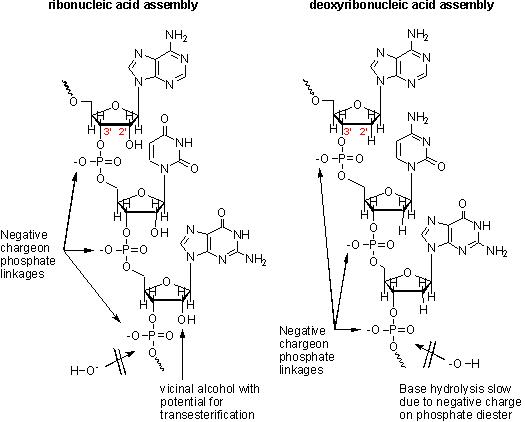
In his much-referenced 1987 paper entitled “Why Nature Chose Phosphates” (1), Frank Westheimer observed that phosphate diesters have a very useful property as a linking group for nucleic acids. The charged oxygen on (RO)2P(=O)O- serves several purposes.  The presence of a charged linker renders DNA and RNA compatible with the hydrophilic environment inside the cell. The charge prevents the nucleic acid polymers from migrating to more hydrophobic environments found inside of cell membranes. And equally important, the monobasic anion serves as a kinetic barrier protecting the millions of phosphate linkages in a DNA strand from cleavage under neutral or basic hydrolytic conditions over the lifetime of the organism.

The hydrolytic stability of phosphate diesters is not to be underestimated. Westheimer points out that dimethylphosphate anion has a half-life of 1 day at 110 C in 1 N base. He cites the rate constants at 35 C for the saponification of (CH3O)2PO2- is 2.0 E-9 (1/mol sec);  (CH3O)3P=O is 3.4 E-4 (1/mol sec); and for ethyl acetate 1.0 E-2 (1/mol sec).

However, the very simplicity and current prevalence of phosphate ion in the environment does not go far in explaining how phosphate might have found its way into metabolic and structural use.  In prebiotic times, the occurence of phosphate is in doubt (2).  But not just the occurrence of phosphate is in doubt. The relative abiotic inertness of phosphate towards esterification and the formation of other metabolically useful species raises the question of the original oxidation state of phosphorus during the onset of early life.

While phosphate is found in certain meteorites, Pasek suggests that a more ubiquitous meteoric phosphide mineral species such as schreibersite, (Fe, Ni)3P, found in iron meteorites may have provided the necessary reactive precursors for metabolic evolution (2). Pasek cites growing evidence of a late meteoric bombardment period at 3.8-3.9 GA.

Schreibersite hydrolyzes to a variety of oxidized species including phosphite. Phosphite has the advantage of being substantially more water soluble than phosphate, providing a larger molar concentration in seawater.  Schreibersite reacts with acetate to form acetylphosphonate. In fact, a variety of organophosphorus compounds may be formed on exposure of schreibersite and its hydrolysis products with organic materials.

Lowly phosphate isn’t sexy like the newer anions triflate and BArF. But its seemingly mundane properties are key to the function of metabolism and genetics.

(1)  F.H. Westheimer, Science, 1987, 235(4793), 1173-1178.  (2) Pasek, M.A. PNAS, January 22, 2008, vol 105, no. 3, 853-858.

Gravity Anomaly Along the Colorado Mineral Belt

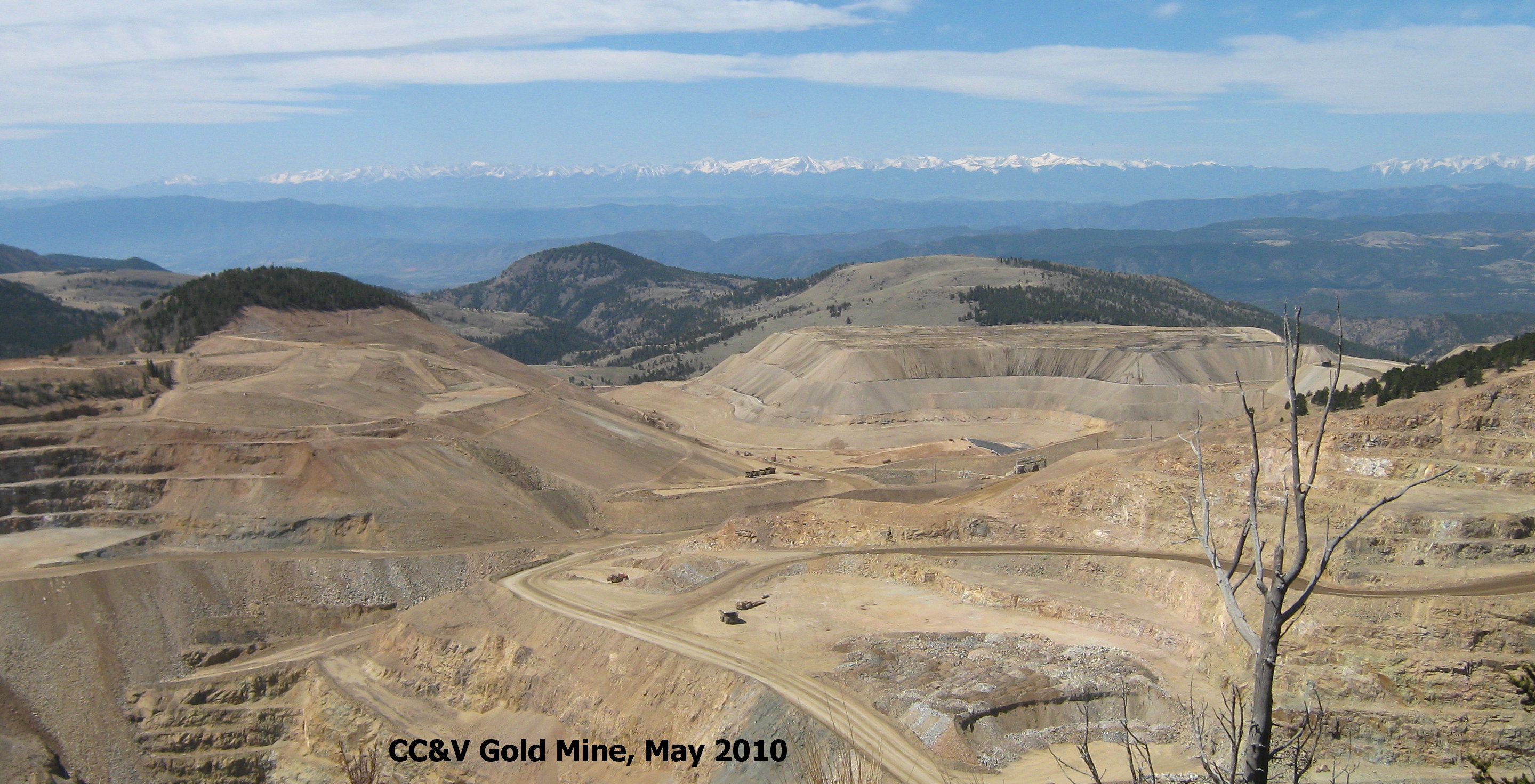
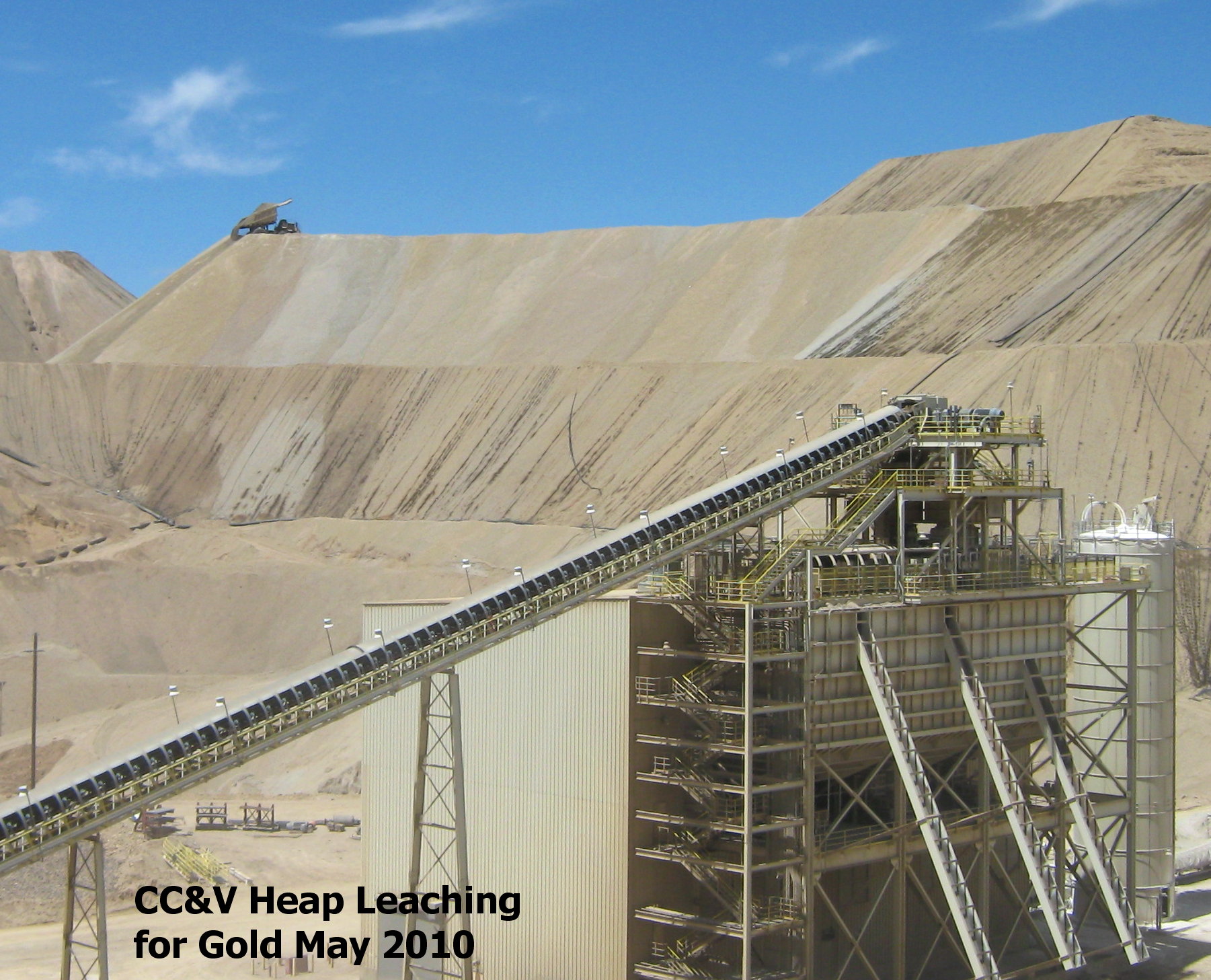
The Colorado mineral belt (CMB) is a swath of metalliferous mineral veins and faults spanning 15 to 30 miles in width and running ~250 miles in length between Dolores and Jamestown, Colorado. This NE trending zone encloses most, but not all, of the significant occurrences of gold and silver deposits found to date in Colorado.

Significant finds like the Cripple Creek district have been found outside the CMB, but these are exceptions to the trend. The large gold/silver/tellurium lode in the Cripple Creek diatreme is the result of a volcanic past that stands somewhat apart from the vein deposition processes that produced the CMB lodes.

What is especially intriguing about the CMB is that it is coincident with a significant gravity anomaly. It turns out that a particularly deep negative gravity anomaly exists in the Colorado Rocky Mountains. A few papers on this effect can be found on the web. In particular, a paper (ref 1) by Mousumi Roy at the University of New Mexico offers some details on the  extent of the gravity anomaly and some possible reasons for the effect.

At first blush it might seem odd that a negative gravity anomaly should coincide with a region known for heavy metal deposits. After all, dense matter has greater mass per unit volume, and if there is a lot of volume, then one might expect the acceleration of gravity to be a tiny bit greater than some reference value.

While this line of reasoning has merit, it turns out that despite the presence of thin metalliferous veins in the region, the overall density of rock below the CMB formation is somewhat low. A density contrast exists in the CMB formation and the surrounding rock. A large, low density formation in the crust and/or upper mantle would cause the local acceleration of gravity to be slightly below that of the reference geoid value.  The structure of the density contrast is the subject of some scrutiny and has been addressed by Roy and others.

A large low density mass below the surface is expected to have some buoyancy. A buoyant mass is one that would exert an upward distortion on the crust. The Colorado Rocky Mountains are part of a region characterized by numerous past episodes of mountain building. Whether mountain building was the result of large scale tectonic interactions or more localized effects of density contrasts, the fact remains that a gravity anomaly exists coincident with the CMB.

The mechanical effect of the upthrust of the lower members of the crust to form the Colorado Rocky Mountains has been that a series of faults and fractures have formed. These void spaces have provided networks for the flow of mineral rich hydrothermal fluids over geological time.

High pressure, high temperature aqueous fluids are prone to cooling and depressuriation as they work their way upwards into cooler and less constricted formations. At some point these fluids throw down their solutes and suspensions in the form of solids that occupy the void network. Eventually the flows become self-sealing and circulation halts leaving veins filled with chemical species that were selectively extracted and transported from other formations.

The earths hydrothermal fluid system is continuously extracting soluble components and transporting them to distant locations where solubility properties force their deposition. But this process does not always produce solid, compacted veins. Void spaces can be left behind at all scales, from microscopic size to large chambers. These spaces are called “vugs”. Rock with a large fraction of void spaces is referred to as “vuggy”. It is possible to walk up to a mine dump in the CMB and find hand samples of vuggy rock. It is not unusual to find crystals of pyrite or other minerals lining the internal spaces of the vugs.

1.  McCoy, A., Roy, M., L. Trevino and R. Keller, Gravity models of the Colorado Mineral Belt, in The Rocky Mountain Region – An Evolving Lithosphere: Tectonics, Geochemistry, and Geophysics: American Geophysical Union Geophysical Monograph 154 (eds. Karlstrom, K.E. and Keller, G.R.), 2005.

[Note to the reader: Th’ Gaussling is just a chemist, not a geophysicist. But like many others, I have the ability to read and learn. When I learn something new and interesting, I like to write about it. It reinforces the learning.]

SF ACS Meeting, Not

It has been 4 or 5 years since I have given a talk at a national ACS meeting. It was with great enthusiasm then that I registered and submitted my abstract last fall. There is not a lot we industrial guys can get up and talk about.  A few weeks ago I confidently decided to follow up on the disposition of my talk and was dismayed to learn that it was declined.

D’oh!!!

I am very disappointed. To my knowledge I followed all of the rules and chose a section that fit the topic.  While the ACS registration website does a good job of collecting your information, it is rather lacking in providing a means of feedback or status to speakers.

Since I have not yet been contacted by a human being, or an automated notification for that matter, I can only surmise that the theme of the section was a mismatch with my topic. Oh yes, I received a limp email “sorry” from somebody at the online help desk.

I wanted to talk about the unexpected energetic decomposition of a class of compounds and some DSC and TGA studies I have done.

Okay, I’m dismayed with certain organs of the Nat’l ACS and their inscrutable ways. But I am willing to admit that I missed some cue or other stagegate that kept me off the boat. But for cryin’ out loud! What was it?? Whose shoes do you have to shine to get an answer?

So, I’ll use the time to get more data and aim for the Boston meeting. A friend was helping with some Hartree-Fock calculations. I was able to correlate onset temperatures with certain periodic trends experimentally. Perhaps we’ll have a better theoretical understanding of the bonding issues by the next meeting.

Update.  Made contact with a person. The sections website is a bit lacking in detail, but with persistant surfing names and email addresses can be found elsewhere.

Antimatter Storage

We had an ACS local section meeting recently in the clubhouse of the Air Force Academy golf course.  The featured speaker, a DoD chemist, gave an interesting talk on his work on some of the basic issues relating to the storage of positrons or anti-electrons. In the interest of fairness, since I am writing under a pseudonym, I’ll not wave his name about.

The speakers background is P-Chem and in particular, spectroscopy of isolated species in cryogenic matrices. He pointed out that an atom or molecule or cluster in an inert cryogenic matrix is in a dissipative environment and thus isolated from solvent interactions that might otherwise mask other kinds of phenomena.  So it is possible to spectroscopically examine the solid phase environment of the cryo matrix. In other words, an imbedded subject  molecule might find itself in an isotropic or ansiotropic environment, depending on the matrix. Infrared spectroscopy could give clues as to the symmetry of the local environment.

It turns out that ortho-hydrogen is an interesting matrix in which to study an important aspect of antimatter storage technology.  In order to collect positrons, one has to first find a source of them. While they can be supplied by some kind of nucleosynthesis, an easier route experimentally is to find a radioisotope that emits positrons.

It does not take too long for the would-be keeper of antimatter to move to the problem of storage. If you’re going to have anti-matter, you must think carefully about where you’re going to store it.  But there is another issue.  The challenge in collecting positrons from nuclear decay begins with slowing them down. As they are emitted they are travelling at relativistic velocities. Positrons, like “regular” beta particles are emitted in a fairly broad band of energies, so slowing them down via some kind of electromagnetic trap would result in very high losses. Instead, a moderator is envisioned to bleed off speed.

Positrons do not automatically annhilate with the first electron cloud they encounter. In fact, positrons were observed early on by the tracks of ionization they left in bubble and cloud chambers. So positrons can move through matter some distance without annhilation.

Electrons and positrons can pair up to give a transient neutral form of matter called positronium. There are two forms of positronium- singlet and triplet- with the difference being the relative alignment of their spins in either a parallel (triplet) or an antiparallel (singlet) arrangement.  Singlet positronium has the shortest lifetime at 125 picoseconds and triplet at a relatively long lived 145 nanoseconds.

Back to ortho-hydrogen. Positrons can interact with lattice defects in a solid, resulting in early annhilation losses. It turns out that ortho-hydrogen at 2.3 K can be warmed to 5 K and be annealed to a single crystal structure, largely free of defects. Therefore it is possible to prepare a solid moderator free of positron quenching defects.

This is where the speakers research stands at present. The have uncovered a potential positron moderator that would be part of a collection and storage system.  The speaker freely admitted that practical antimatter storage in a container is 100 years in the future. But given the high energy densities available from antimatter, the Air Force is committing modest funds to exploring the issues.

There is work being done to study the positronium Bose-Einstein condensate. It is complicated by the short lifetime of positronium. But fortunately there are ways of storing positrons in storage rings. The annhilation of positronium as a BE condensate would afford coherent 511 keV gamma rays. This would be the basis of a gamma ray laser.

Agilentus, Angry God of the Quadrupole

I’m going home now.  Just spent a few hours trying to make a parameter change its state on the GC side of  my spiffy new Agilent GC/MS.  Modern instruments are a confederation of subsystems that must give a thumbs up before a software magistrate will allow the instrument to initiate a run. If it is a hyphenated instrument, then all the more so.  All of the flow rates and temperatures and dozens of software settings must be in the proper state before the method can be executed. 

One of the first things you learn after acquiring a complex piece of apparatus is that the help menu is limited in scope.  The mere definition of a mode or a key or a parameter is hardly enough when an annunciator declares that the boat won’t move because the flippin’ gas saver mode is on. The gas saver feature is meant to reduce helium losses from the splitter when the instrument is idle.  What is especially irksome is when an obscure  feature declares that it suddenly can’t  play ball on the (N+1)th run.

My assistant is a truly gifted chromatographer.  She learned analytical lab management in pharmaceutical cGMP and EPA lab settings. What she can do with GC or HPLC is a thing of beauty.  I, on the other hand, have become a grumpy instrument Luddite. It’s not that I don’t like chromatography. In fact I really dig it.  What I get grumpy and dispeptic about is having to claw up the learning curve of yet another software package and then use it enough to retain some kind of fluency.

So, in order to save face with my staff, I have to figure this thing out myself.  Modern chromatographic instrumentation is now configured around the needs of documentation requirements. Creeping featurism. Long gone are the days of sauntering up to the instrument and jamming a sample in it without having to answer a lot of irksome questions about method names and directory gymnastics. Software packages are designed to provide a robust paper trail on the results of all samples injected. It’s all gotten very “Old Testament”.

What is needed is a simplified mode of operation for boneheads like myself. For my process development work I just want resolved peaks, a peak report, and – please god- mass spectra of the components. I do not need a fancy schmancy report. I just need some numbers to scribble in my notebook and report in order to understand what happened in the reactor.

So there it is. A lamentation on chemistry.