Category Archives: Chemistry

Uranium roll fronts

As a kind of hobby Th’ Gaussling has been surveying the literature on uranium occurrences in North America. Uranium is found in many interesting locations and as a result of several distinct kinds of ore forming processes.

Prospector with Geiger Counter

From Ballard &Conklin, Uranium Prospectors Guide, 1955 Harper & Brothers

For the most part, uranium ore body formation is the result of aqueous transport and deposition.  Uranium is found as a lode in vein formations in precambrian  igneous/metamorphic structures as in the case of the Schwartzwalder mine near Denver. In fact, there are many lode occurrences that contain a variety of uranium minerals in the Colorado mineral belt.

What seemed counterintuitive to me was the extent to which uranium is found in sandstone. Evidently I had developed a bias for connecting heavy metal occurrences with igneous/metamorphic formations.

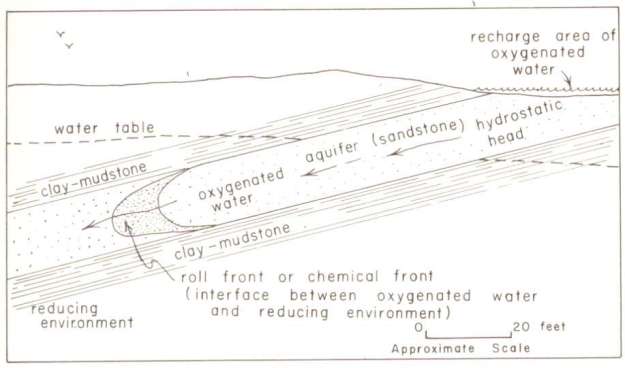
Uranium occurrences in sandstone take on certain characteristics as a result of ore forming processes. Uranium is often found in concentrated bodies called “roll fronts” or “ore rolls”. A roll front is a body of concentrated mineral with a lenticular cross section and is found in confined strata sandwiched between impermeable clays, shales, or mudstones.

Roll Front Cross Section

Adler & Sharp, Guidebook to the Geology of Utah, No. 21, Utah Geological Society, 1967, p. 59.

The action of oxygenated meteoric water (i.e., rain and surface water) migrating through a porous sandstone stratum will selectively mobilize mineral species that are soluble. In the case of uranium, the relatively insoluble U4+ compounds are oxidized to more soluble U6+ species which are then mobilized and flow in the formation.

Eventually, as the water flow encounters reducing conditions, U6+ gets reduced to U4+ and deposition occurs. Sandstone with organic material may be a net reducing environment and provide the necessary carbonaceous reductants to do the deed.

As the U6+ enriched aqueous flows encounter reducing conditions, deposition of U4+ insolubles occurs in a manner determined by fluid mechanical forces. The result is an elongated and tapered ore body confined to a narrow stratum.

Uranium roll fronts are common in many uranium districts. The Uravan uranium belt in the Colorado Plateau is a good example. Uranium is found concentrated in tuffaceous formations as well. An example of this is the uranium occurrence found in the 39 Mile Volcanic Field in the central Colorado mountains.

What is interesting to ponder is the geological effect of plant metabolic byproducts like oxygen. Oxygen directly contributes to a natural process that lead to the concentration of a scarce element like uranium. Plant life facilitating nuclear power. Hmmm.

The Passing of Irwin “Ike” Klundt

I just received the sad news that my friend, boss, and mentor, Dr. Irwin “Ike” Klundt died in Tucson, AZ, of cancer. Ike retired in the early 1990’s as VP of Sigma-Aldrich. He was an organic chemist from eastern Washington state. He joined Alfred Bader in the 1960’s (?) and helped build Aldrich into what is is today. He started the Aldrichimica Acta and appeared in it many times in the capacity of awarding a prize to honor prominent chemists. Ike also managed the publication of the catalog and invented the Aldrich “Coffeepot” Kugelrohr.

I first met Ike when I taught for a year at Ft Lewis College in Durango, CO. He was an adjunct prof and I was a visiting prof. Ike was loved by all and was a useful hand to have around for the department.

Ike was a good hearted soul who enjoyed the company of others and actively worked to help younger chemists develop their careers. He loved the science and business of chemistry and the people who worked in this field of ours. Ike was forced out of Aldrich soon after Bader was given the boot as the once entrepreneurial company began to behave like a normal publicly traded company- you know, the ones that eat their young.

The chemical field is poorer for the loss of Ike Klundt. He was one of the human beings of the trade and he will be missed.

The joy of logistics

It is amazing how complicated and labor intensive logistics can be for manufacturers. Customers often have strict requirements on how materials are to arrive at their facilities. Some customers have preferred shipping companies and will require that you use them. Others don’t care. Some want you to pre-pay and add the freight to the invoice. Some will accept FOB shipping point terms and pay the shipper themselves. 

International shipments are even more complex. Multimodal freight forwarding companies will take charge of the shipment and get it on a boat or plane. Once across the pond, they’ll get the shipment through customs and plugged into the local ground transport.

If you’re shipping internationally, unless the customer is a known quantity, you’d better get prepayment or a letter of credit from their bank.  Cash is king.

It becomes complex if you allow yourself to be a custom shipper. Some companies simplify things by offering a one size fits all shipping policy. This is best if you can get away with it, but more often than not, custom service means custom shipping.

There is much more to chemical business than just the chemical part. Chemistry students planning to enter the fabulous world of chemical industry should be advised that if they are going to step out of the lab, then the full spectrum of business related problems and challenges will be available to them. It is a great opportunity for some and a gigantic nuisance for others.

Mole Day Thoughts on Lab Life

I have come to the realization that, after a career of avoiding it, I really dig physical organic chemistry. While I do have the synthetikkers love for developing a synthesis, I really enjoy taking the rare opportunity to do a focused study on a single transformation or compound.  It is a stylized form of play that any developmental psychologist would recognize. Discovery is about learning, just like play, and many of the exploratory behaviors observed in play apply just as well to discovery (well, except for hitting and crying).

One way a scientist learns is by doing a search for boundary conditions. Where or how in parameter space does a thing change? What is the best solvent for the desired outcome? What effect does stoichiometry have? Does dry, inert atmosphere really make a difference? What are the best leaving groups? Yes, it’s just research. But there is more.

In order to claim that you have expertise with a substance or process, you must have an understanding of how a process or substance behaves under a variety of conditions. If faced with a product that is off spec and the prospect of having to rework or remake, it is very helpful to understand what conditions lead to the off-normal outcome. Either the chemist sleuths each upset for a cause, or the chemist goes in the lab and purposely exposes the process to off-normal parameters and analyzes the outcome, or both. After a while, patterns begin to arise and trends become apparent. This is play.

Seems bloody obvious. But in a production environment the opportunity to explore  parameter space is often not possible. Favor almost always finds the more practical, though short term, fixes. Production managers are not always chosen for their focus on the long term. They are short term oriented- a necessary predilection for timely delivery of product on a tight timeline.

Part of a good process development program is a study of how the process behaves in various upset conditions. This is important for understanding the thermal safety issues, but it also is a good time to take snapshots of how the composition of the process system behaves when it is out of whack.  A reaction profile under conditions of reagent mischarges or off-temperature can give many clues as to the operating window of the process. It can also tell you something about the best way to do an in-process check and define flags for particular types of upsets.

Many companies do this, but a good many find a way to gloss over such work.

Lowest Common Denominator

What is happening in the chemical world is that the safety people are taking control. Everything is dumbing down to the point where the safety of a facility is being judged on the basis of what the least qualified deem as safe. 

I just received an MSDS for the Buchner funnel (!$#%!!) I recently purchased from Aldrich.  The MSDS lists zero’s for Health, Flammability, and Reactivity both for HMIS and NFPA ratings. Thank heavens for that. It does recommend “suitable storage” and that it be kept “tightly closed”.  It is silent, though, on the matter of repeatedly jabbing the pointy end into your eye.

I gotta get out of the chemical business if this is where it is going. Administrative controls on common laboratory activity requires management by a dedicated staff member in order to maintain a favorable paper trail and stay in compliance with the ever growing web of regulation. OSHA, EPA, Homeland Security, as well as state and local agencies who want to inspect this or that or place tax stamps on your balances.

How did civilization get this far along without the legions of officious ninnies who want to exert control over everything you do? Chemical labs have inherent hazards, depending on the work that is being done in them. The cost of achieving de minimus risk for the lowest common denominator is quite high. Risk ends up being transferred to countries who reside on the other side of the curve- those who have little care for people.

2009 Nobel Prize in Chemistry

Congratulations to the international trio winning the 2009 Nobel Prize in Chemistry-  Venkatraman Ramakrishnan, Thomas A. Steitz, and Ada E. Yonath. The three chemists won the prize for their fundamental work in characterizing the structure and detailed function of the ribosome.

I sat in on a talk at the Organic Symposium this summer where the speaker showed a bit of the work of Yonath.  The ribosome work is simply stunning in its detail and experimental prowess. Hackers like myself can only watch from a distance and admire the work.

Retrocurricular Translocation of Post-Modern Emphasis in Chemical Pedagogy

I couldn’t resist a sarcastic allusion to post-modernism, whatever the hell that is. What could possibly be under such a bullshit heading? Well, all of my tramping around chemical plants from Europe, Russia, North America, and Asia as well as local mines and mills keeps leading me to an interesting question. Exactly who is being served in the current course of chemistry education? Is it reasonable that everyone coming out of a ACS certified degree program in chemistry is on a scholar track by default? Since I have been in both worlds, this issue of chemistry as a lifetime adventure is never far from my mind.

What are we doing to serve areas outside of the glamor fields of biochemistry and pharmaceuticals? There are thriving industries out there that are not biochemically or pharmaceutically oriented. There is a large and global polymer industry as well as CVD, fuels, silanes, catalysts, diverse additives industries, food chemistry, flavors & fragrances, rubber, paints & pigments, and specialty chemicals. There are highly locallized programs that serve localized demand. But what if you live away from an area with polymer plants? How do you get polymer training? How do you even know if polymer chemistry is what you have been looking for?

Colleges and universities can’t offer everything. They attract faculty who are specialists in areas of topical interest at the time of hire. They try to set up shop and gather a research group in their specialty if funding comes through. Otherwise, they teach X contact hours in one of the 4 pillars of chemistry- Physical, inorganic, organic, and analytical chemistry- and offer the odd upper level class in an area of interest.

Chances are that you’ll find more opportunities to learn polymer chemistry as an undergraduate in Akron, OH, than in Idaho or New Mexico.  Local strengths may be reflected in local chemistry departments. But chances are that in most schools you’ll find faculty who joined after a post-doc or from another teaching appointment. This is how the academy gets inbred. The hiring of pure scholars is inevitable and traditional. But what happens is that the academy gets isolated from the external world and focused on enthusiasms that may serve civilization in distant ways if at all. The question of accountability is dismissed with a sniff and a wave of the hand of academic freedom. Engineering departments avoid this because they are in constant need of real problems to solve. Most importantly, though, engineers understand the concept of scarcity in economics. Chemists will dismiss it as a non-observable.

One often finds that disconnects are bridged by other disciplines because chemistry is so narrowly focused academically. It would be a good thing for industry if more degreed chemists found their way into production environments. I visited a pharmaceutical plant in Taiwan whose production operators were all chemical engineers. Management decided that they required this level of education. But, why didn’t they choose chemists?  Could it be that they assumed that engineers were more mechanically oriented and economically savvy?

Gold mines will hire an analyst to do assays, but metallurgists to develop extraction and processing. Are there many inorganic chemistry programs with a mining orientation? Can inorganikkers step into raw material extraction from a BA/BS program or is that left to mining engineers?

In my exploration I am beginning to see a few patterns that stand out. One is the virtual abdication of  US mining operations to foreign companies. If you look at uranium or gold, there are substantial US mining claims held by organizations from Australia, South Africa, and Canada.

So, what if? What if a few college chemistry departments offered a course wherein students learned to extract useful materials from the earth? What if students were presented with a pile of rock and debris and told to pull out some iron or zinc or copper or borax or whatever value may happen to be in the mineral?

What if?? Well, that means that chemistry department faculty would have to be competent to offer such an experience. It also means that there must be a shop and some kilo-scale equipment to handle comminution, leaching, flotation, and calcining/roasting. It’s messy and noisy and the sort of thing that the princes of the academy (Deans) hate.

What could be had from such an experience? First, some hours spent swinging a hammer in the crushing process might be a good thing for students. It would give them a chance to consider the issues associated with the extraction of value from minerals. Secondly, it would inevitably lead to more talent funneling into areas that have suffered from a lack of chemical innovation. Third, it might have the effect of igniting a bit more interest in this necessary industry by American investors. The effect of our de-industrialization of the past few generations has been the wind-down of the American metals extraction industry (coal excluded).

If you doubt the effect on future technologies of our present state of partial de-industrialization, look into the supplies of critical elements like indium, neodymium, cobalt, rhodium, platinum, and lithium. Ask yourself why China has been dumping torrents of money into the mineral rich countries of Africa.

I can say from experience that some of the most useful individuals in a chemical company can be the people who are just as much at home in a shop as in a lab. People with mechanical aptitude and the ability to use shop tools are important players. Having a chemistry degree gives them the ability to work closely with engineers to keep unique process equipment up and running efficiently.

Whatever else we do, and despite protestations from the linear thinkers in the HR department, we need to encourage tinkerers and polymaths.

This kind of experience doesn’t have to be for everyone. God knows we don’t want to inconvenience Grandfather Merck’s or Auntie Lilly’s pill factories. Biochemistry students wouldn’t have to take time away from their lovely gels and analytical students could take a pass lest their slender digits become soiled. Some students are tender shoots who will never have intimate knowledge of how to bring a 1000 gallon reactor full of reactants to reflux, or how to deal with 20 kg of BuLi contaminated filter cake. But I hasten to point out that there are many students with such a future before them and their BA/BS degree in chemistry provides a weak background for industrial life.

A good bit of the world outside the classroom is concerned with making stuff.  I think we need to return to basics and examine the supply chain of elements and feedstocks that we have developed a dependence upon. American industry needs to reinvest in operations in this country and other countries, just like the Canadians, South Africans, and Australians have. And academia should rethink the mission of college chemistry in relation to the needs of the world, rather than clinging to the aesthetic of a familiar curriculum or to the groupthink promulgated by rockstar research groups. We need scholars. But we also need field chemists to solve problems in order to make things happen.

Linkenschmutz

Links found whilst thrashing about the internets on my computer machine.

RCS Rocket Motor Components supplies, well, rocket motor components for the serious “non-professional”. RCS offers propellants, casting resins (i.e., polybutadiene), bonding agents, tubes, and other pieces-parts for the rocket builder. Good stuff, Maynard.

It turns out that my fellow Iowegian and former US President Herbert Hoover published a translated and annotated version in 1912 of De Re Metallica by Georgius Agricola (1556). Hoover’s translation can be found on the web and a copy is on display at the National Mining Hall of Fame and Museum in Leadville, CO. This work by Agricola is nothing short of amazing. A series of images of the text in the original Latin can be found as well.

It is interesting to note that Agricola (1494-1555)  and Paracelsus (1493-1541) were contemporaries in central Europe. Agricola, a Saxon, spent much of his time in Joachimsthal and Chemnitz whereas Paracelsus,  Swiss, is famous for being a bit of a wanderer. While I have not encountered a reference indicating whether these two polymaths had any knowledge of one another, they very much exemplify the meaning of Renaissance.

This USB temperature logger is pretty cool. I can hear it calling for me.

Here is a collection of links to monographs on Radiochemistry from LANL.

Topspin

After a long absence I climbed onto the Bruker 300 NMR and locked in for some actual lab work. Expecting to just to shim up and hit “zg”, I was pleasantly surprised to find that the software had finally been updated. Topspin had been loaded and with it a new and improved graphic user interface. Wow. I feel like I have come out of a long walk in the forests of Mordor and into a garden party. I’m sure there are better systems out there, but this will do nicely for a while.

2009 Nobel Prize in Chemistry. The Winner is …

I don’t have a clue who is in serious contention for the 2009 Nobel prize in Chemistry. Yeah, there are a bunch of old guys out there who deserve it. But who are the contenders this year? I have all but stopped reading C&EN and JACS, so I am unaware of who this years darlings of chemistry really are.

I’d really like to see Harry Gray share it. I’d like to see Whitesides and Bergman get a trip to Sweden as well. But I’ll admit that I’m well out of the loop. Any thoughts out there? I’m sure that I’ve slept through the discovery, development, and implementation of  several new disciplines, each with it’s own journal and series of conferences. It’s inevitable.

10/4/09.   OK, I’ll guess Craig Venter for Chemistry and Stephen Hawking for Physics.

10/7/09.  Wrong Again!!!! See later post for update.