Category Archives: Chemistry

Organic Symposium at CU

The 41st National Organic Symposium starts 7 June, 2009, in Boulder at the CU campus. I’m trying to decide if I want to go bad enough to pay the admission price.  The registration is rather pricey- $400-425, depending on your membership status. The symposium features a lineup of some of organic chemistry’s top rock stars and illuminati.

The whole fandango begins with a homily by Bobby Grubbs on what else? Metathesis. Good lord. I don’t think I can bear to see it again. I wonder if he’ll disclose the patented art during his talk? (These guys never point out that the cool and useful stuff is tied up in claims!)

I popped into a few web sites of the various rock stars who will be presenting. I noticed that Dale Boger is selling his lecture notes on-line for US$120 for a CD.  Fancy that.

Apparently, he is still working on Vinca alkaloids. Buried in the Boger website is a graphic showing the various and complex compounds that his groups have prepared. It is pretty amazing, really. But it is as much an indication of what generous funding and hordes of rabid post-docs and grad students can provide as anything else. Boger is listed as an inventor on 25 US patents (with Scripps as assignee) by my count. Scripps owns a bunch of Boger technology. I wonder if any of it is commercialized? I don’t know the guy, so I don’t want to be too obnoxious here.

If an advisor is patenting the work that a student is doing for her/his dissertation, how do they manage the notebooks (i.e., disclosures) and the meetings with the students committee? If the student is helping to develop IP for someone else, are they decently paid for it? Does the student have multiple notebooks for confidential and “public domain” work? What kinds of liability does a student have in terms of proprietary information after they graduate? Lots of sticky issues for a fresh graduate.

“Don’t Even Taste Like Sewage”

I spent 4 1/2 hours saturday touring our town’s water system from both ends. It was quite a detailed tour and, since it involved chemicals, how could I not tag along?

We began with the sewer reclamation plant first. Lots of interesting details here. Turns out that one of the big problems to running a waste treatment plant has to do with keeping large debris out of the pumps- rags, underwear, shoes, plastic parts, etc.  Once you get past the shock of learning what your fellow citizens can and do flush down the toilet, it is plain to see that a bit of money spent on screening out the the big chunks is returned in the form of reduced down time and pump repair costs.

Our little hamlet of 6,000 souls sends 450,000 gallons of waste water to the reclamation plant on an average day. The flow peaks at about 8 am every day in the form of a sudden 5-6 x increase in flowrate. It takes about 90 minutes for an average volume (i.e., a flush) of wastewater to get to the plant. A lot of groggy citizens hop into the shower at around 6:30 am.

After the incoming stream passes through a grit removing station at the entrance, it is lifted to the first treatment operation for aeration and fermentation. This is the physical high point in the process, meaning that the stream is subsequently transferred by gravity for the remaining process steps.

I won’t go into further process details other than to say that the final step prior to discharge into the stream is a sanitizing step where the effluent is exposed to a large jolt of UV radiation. At this point in our tour, the plant manager dipped a sampler into the flow and withdrew one liter of clear, colorless liquid with a few strings of algae floaters. Only too eager demonstrate his faith that the water was sanitary, he dipped a finger into the effluent, put it into his mouth and exclaimed with a grin as wide as his mullet

“It don’t even taste like sewage!” 

As he passed the sample around so others could share in the experience, I wandered over to the control panel and feigned interest in the LCD display. The UV just renders the wee beasties non-viable. Their little microbial carcasses are still there. Pathogen free it may well be, I didn’t have the stomach to taste it. Yes, I know that microbes are everywhere and that our notions of what constitutes “clean” are merely a fantasy. But I just couldn’t do it.

A hot little number

hot-load-on-the-interstate1

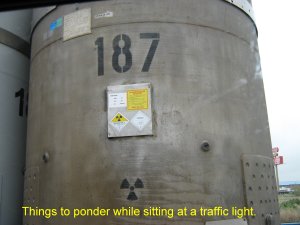
I see these shipping casks on the highway at least once a month.  This time I had a Canon with me (Powershot A470, you know, a camera). While sitting at the off-ramp stop light next to this container I began to wonder how much activity shines through the shielding. I began to daydream … if I could see in the gamma spectrum, would this thing be bright or dim?

Then, in the blink of an eye the spell was broken. The light turned green and I parted company with this hot little number.

Franz Ritter von Soxhlet and the Hungarian Siphon

Franz Ritter von Soxhlet is credited with inventing an extraction apparatus in 1879 that now bears his name. Soxhlet was a German agricultural chemist of Belgian “extraction” from Brünn (now Brno in the Czech Republic) working in the area of milk characterization at the Vienna Agricultural Institute.

Soxhlet spent most of his career in the analysis of milk and its constituents. In an attempt to isolate the fatty constituents from milk, he (and students) had been attempting to use an extraction apparatus developed by another Brno chemist, Professor Zulkowski. Soxhlet developed a technique whereby milk was absorbed into a quantity of calcium sulfate powder and then submitted to extraction by ether. The Zulkowski apparatus proved problematic, however. Solids were able to find their way over the extraction tube and into the solvent reservoir. Modifications of the design also suffered from inefficiencies that apparently required extended operation.

A student of Soxhlet, a Hungarian fellow by the name of Mr. Szombathy, contrived a solution to the problem. Szombathy is credited with coming up with the clever siphon feature that so distinguishes what we now call the Soxhlet extractor.

It has been lamented that the efficiencies gained by the siphon discharge design have been partially lost due to the entertainment effect. Generations of chemists have dropped what they are doing to stand and watch the collection thimble fill and subsequently discharge dramatically through the siphon. You have to take your fun where you can find it.

Well done, Szombathy!

Beryllium Mining

The aerial view above shows the location of the Brush Wellman beryllium mine near Spor Mountain, Utah. It is reportedly the only major beryllium mining operation in the USA and one of the very few economic beryllium ore locations in the world. The host materal is called “tuff”- a compacted and cemented volcanic ash composition. Coincident with this Be deposit is low grade uranium and fluorspar. Occurances of Cu, Au, and other base metals can be found in the area.

The concentration of Be in the ore body is thought to be due to the mineralization action of meteoric and hydrothermal fluids. The region is marked by the presence of 3 Oligocene-era calderas, with the Spor mountain Be mineralization found along the ring structure of the Thomas caldera.

The action of hot, saturated aqueous flows transporting solublized components from distant host bodies is one of the chief mechanisms for the appearance of “ore bodies” near the surface of the earth. Very often, such deposits are found in regions of faults and fractures of various kinds of rock formations. Mineral laden water follows the fracture system and, as it moves toward the surface, begins to cool and deposits the burden of now insoluble compounds. Deposition can occur due to simple solubility properties, redox from exposure to atmospheric oxygen, or via ion exchange with available chemical species to form high Ksp compositions.

This is nothing new to geologists who have been aware of these mechanisms for generations. But for a non-geochemical chemist like myself, the matter of how elements like beryllium come to be concentrated is less than familiar. Indeed, the question of how any element comes to be concentrated in rock formations is a question of increasing interest to Th’ Gaussling. I hope to spend a lot of time in the future exploring this matter.

Liptonian Symbolism

Never one to allow reason to interfere with sentimentality, my blackened heart is softened somewhat by the recent shipment of Lipton Tea bags delivered to Th’ Gaussling from an online admirer via the US Postal Service. 

The tea in this gift shall be symbolically applied to the local waterway, but not before being used to formulate some refreshing iced beverage via aqueous extraction.  A vessel filled with aqueous goodness (OPE-Our Pure Essence) will be charged with the anthocyanin and alkaloid laden forest litter for extended exposure to solar radiation. Brownian motion will be relied upon to disperse the colloidal value away from the biomass.

Once so processed, the fortifying beverage will be passed through a pair of kidneys as a symbol of my dark contempt for the IRS. This nephro-raffinate will be discharged into the municipal fluid collection system for a kind of Nicene rectification that will provide further philosophical processing of the symbolic gesture. Finally, after the Liptonian fluids have been subjected to Libertarian aeration and Calvinist filtration, the clarified symbol will be discharged into the river for its turbulent hero’s journey to the drinking water inlets of New Orleans and beyond.

The Cresson Vug

The history of the Territory and State of Colorado is inextricably tied to base metals and precious metals. Gold and silver strikes were a big draw for the migration of population to Colorado from the 1859 Pikes Peak Gold Rush onward.  A map of the ore geology of Colorado reveals a few key districts or zones of enhanced mineral abundance. The Colorado Mineral Belt (CMB) is a band of ore deposits that are positioned diagonally across the middle of the mountainous part of the state, SW to NE, roughly from Durango to Boulder.

Other districts containing economically viable ore bodies exist outside of the CMB, notably the Thirtynine Mile Volcanic Field west of Colorado Springs. While rich deposits of gold were found near Central City and many other locations in the CMB, the relatively rare  gold/tellurium ore found near Cripple Creek and Victor on the periphery of the Thirtynine Mile Volcanic Field have provided approximately half of all the gold mined in Colorado. Gold has an affinity for tellurium and may be found combined with it in the form of the mineral calaverite.

In particular, the Cresson mine near Cripple Creek has been an especially rich producer of gold. In November of 1914, a 4 m x 8 m x 13 m cavity or “vug” at the 1200 ‘ level was found to be lined with gold telluride and other minerals.  Depending on which source you believe, it is reported that from 20,000 to 60,000 ounces of gold were removed from this small space.

The Cripple Creek volcanic complex is a highly altered, highly brecciated formation that has been described in detail elsewhere. The link provides a more detailed description and a bibliography.

Links updated 7/2/19.

Energetic Materials Manufacture

Everyday in factories around the world, people manufacture energetic materials at the commercial scale. Yet we do not witness a continuous stream of reports describing industrial tragedies at these facilities. Plants for the manufacture of energetic compositions are often purpose built with many layers of protection (LOP) built-in. Such facilities may be constructed in remote locations and with assets separated by large distances.

What is telling about explosive chemical manufacturing is the extent to which the operators possess a deep level of knowledge of their materials and processes. The explosives industry has at its fingertips a wide variety of tests that assay certain manifestations of sensitivity.  There are many tests that assay for friction sensitivity and for shock sensitivity. Impact and electrostatic stimuli are also important dimensions not only for manufacture, but for use in the field.

For instance, a material with a high detonation velocity may have a large critical diameter, meaning that the packing density and bulk geometry must be sufficiently large for it to propagate a shock. Knowledge of impact sensitivity, shock sensitivity, or detonation velocity alone does not tell the whole story of the explosive.

There are several causes for this depth of knowledge. Easiest to see is the history of US explosives manufacture.  There have been many spectacular industrial accidents going as far back as the revolutionary war. Much has been learned about manufacture and handling at a very high cost to lives and property. The explosives industry has had to learn to develop safe manufacturing practices to prevent the loss of life and business interruption.

Another motivating influence for explosives safety is perhaps less than obvious to outside observers. Over time, the US military has been revising and modifying its munitions designs and specifications.  It is highly desirable that explosives and propellants provide maximum energy density for performance requirements, but at the same time be sufficiently insensitive to inadvertant stimulus so as to provide maximum safety for those handling the munitions.

The properties of military explosives- a major market driver- are highly specified by military procurement. The current library of explosive compositions have been highly refined through many years of evaluation and field testing. The effect has been that the compositions presently in the field are quite well understood in terms of their operational boundaries.

In addition to being driven by material specifications, manufacturing facilities and quality control systems are also driven by a selection process that is quite stringent.  We see fewer explosive plant disasters today not only because the explosives are safer, but also because plants are managed better.

The lesson in this for fine chemical operators is that depth of knowledge of materials and reaction mixtures can be highly desirable and potentially very useful. In particular, an intimate understanding of the behavior and sensitivity of materials under process conditions as well as off-normal conditions can lead to safer plant operations.

Seems like a “No-Brainer”. But the fact is that the activity leading to such knowledge can be difficult, time consuming, and expensive to obtain. The push to get product out the door can be irresistable and the urge to cut corners can happen quietly and without fanfare. It is very easy for institutional knowledge to be lost in the struggle to maintain output and profitability.

Fine chemical manufacturers can be hobbled in their understanding in other ways. On the producers side or on the users side of fine chemicals, it is not unusual for chemists to specify methods of analysis that are familiar to them. NMR or GCMS or a variety of wet chemical methods set up on the benchtop are commonly used to set specifications and to validate certificates of analysis. 

However, familiar methods of analysis tend to give profiles of familiar properties. Unfamiliar properties or contaminants may be invisible to any given method of analysis. A compound with a low threshold to decomposition or one that will exotherm vigorously and shed mass aggressively may reveal this attribute only through happenstance to an alert chemist.

What is especially interesting about explosives testing is the extent to which compositions are subjected to challenge tests. Rather than looking for a spectral signature, materials are subjected to a variety of stimuli in a manner that provides an unambiguous outcome. The card gap test for instance looks at the sensitivity of a composition to a standard stimulus that has been attenuated through a variable gap (set of spacers) of polymethylmethacrylate or air. Does it produce a hole in the witness plate or not?

There are people who go to work in nitroglycerin factories everyday knowing that they are working with a shock sensitive high explosive. Others may work in a lead styphnate factory filling primer cartridges by hand.

There are also people who go to work everyday in plants that have banned the use of diethyl ether or require peer review of even the simplest reaction they run in their fume hoods. The range of what is considered acceptable risk varies greatly.

Today, there is a mandate for IM- Insensitive Munitions. Here is the scenario- a TNT filled projectile is impacted by a large caliber projectile or shrapnel. There is a good chance the stimulus provided by the impacting body will initiate the TNT and cause the charge to explode, causing death or harm to those in the area.  It is desirable to have high explosives that detonate or deflagrate only when properly initiated.

A major push is being made at government and industrial labs to produce explosive compositions that are insensitive to inadvertant stimulus, yet energetic enough to perform the task.  One desired end of this activity is to phase out TNT in military explosives. The lack of US manufacturers of TNT is nearly as important a motivating factor as the sensitivity issues are. From the industrial hygiene side, some workers reportedly become sensitized to TNT, so the elimination of this toxicological dimension is desirable as well.

Green munitions are also part of a phase change in the munitions field. At first blush it seems silly to make explosive devices more environmentally friendly. However, explosive chemicals and their decomposition products can be widely dispersed in the environment as the result of warfare and training. The reduction of toxic residues can be considered a reduction in collateral damage.

Green Propellants

Notes from the Field-

There appears to be a movement in the gun and rocket propellant field away from perchlorates.  Propellants that are comprised of substances that pose minimal potential for the dispersal of adverse and environmentally persistant substances are referred to as “green propellants”.  Substances that qualify as adverse include arylamines, perchlorates, and certain rheology modifiers. Substances that are thought to be endocrine disrupters have been specially targeted for replacement.

While it may seem absurd to attempt to produce a weapon system having a reduced toxic signature, the  fact is that between practice projectiles and warshots, a good deal of hazardous residues are released in the use of these devices. Reducing the chemical environmental insult is a step in the direction of reduced collateral damage.

One expert in the area of perchlorates said that people with adequate iodine intake shouldn’t worry about perchlorate contamination of water. Hmmm. While that may be true, it sounds like a poor basis for policy.